I would like to explore the idea that there are two Americas, and have always been two Americas … more or less in conflict with each other. Indeed, that dualism actually goes all the way back (four centuries!) to America’s founding in the early 1600s. There were basically Two Americas that were founded back then: Virginia in the South and New England in the North. The two British colonies were each founded for quite purposeful, and quite different, reasons.
One was founded on the desire to find in America the wealth, like the Spanish had a century earlier, that would not only make the American settlers rich, but also improve greatly their social status. However, unlike the Spanish, they found no gold. But they soon found that the drug tobacco could be a similar source of wealth … such wealth as to qualify them as belonging to some version of the British aristocracy.
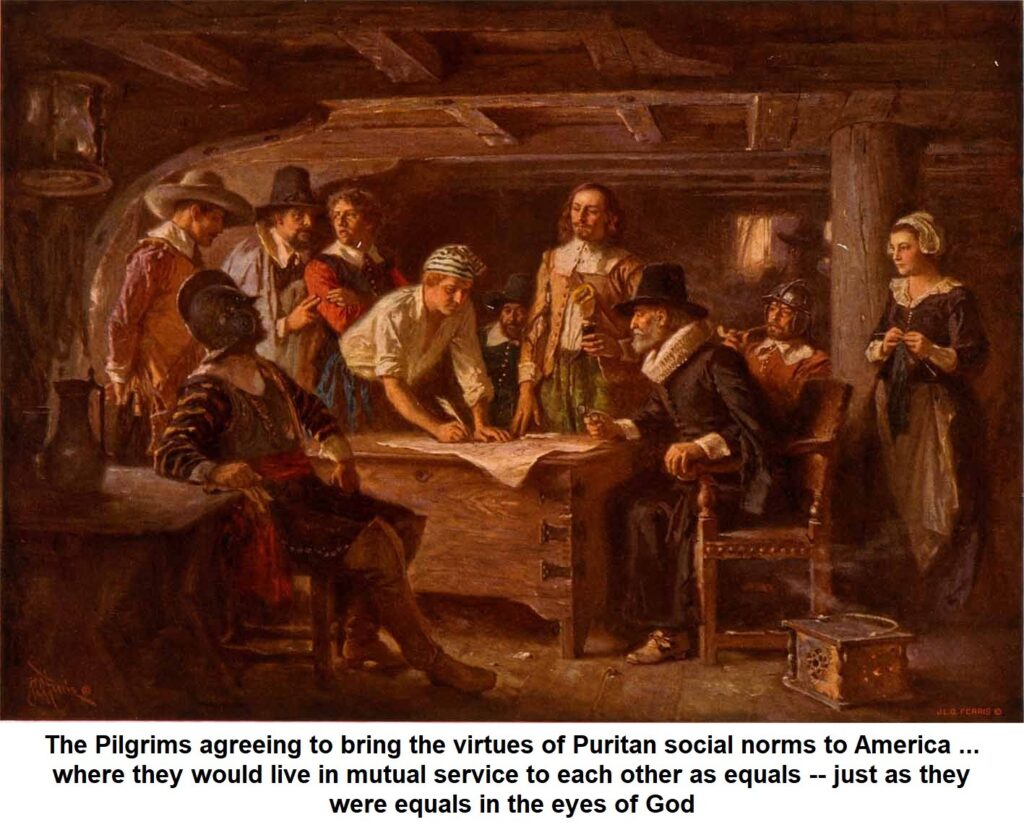
The other America was founded on the desire to set up a society in which the settlers would model in their social life a strong sense of Christian social principle, social principle that would help the broader world understand how God himself wanted all humankind to live.
In a sense, both colonies were following social trends in their homeland of England. Virginia was simply following the social model long in place in England (and across Europe), a social model we term feudalism … in which all social authority flowed from top down, from kings and aristocrats (with their own ranks of greater and lesser aristocrats) down to peasants and even serfs … with a small middle class somewhere in between. The goal of the feudal political game was somehow to raise oneself and one’s family higher in this social pyramid … even though there was little likelihood of someone with a peasant background (the vast majority of the English population) actually being able to make such a move. Basically, peasants played no role in the political game. But social advancement was possible for members of the middle class and the lower-ranking members of the aristocracy. And thus they came to Virginia to find the wealth that would enable them to present the visible appearance (most importantly, a fancy plantation home) of a living at a higher social rank than the one they were born to. No one born and raised within England’s feudal system thought that this was in any fashion an improper way to go at life.
But crashing into that feudal realm was a very strong religious movement, mockingly termed “Puritanism.” “Puritans” were deeply scorned because of the “purist” ways (strongly Biblical Christian) by which they readily opposed England’s long-standing feudal system.
Ultimately, finding the opposition to their “puritan” ways so strong in England, they made their move to America − to the territory north of Virginia recently identified as “New England.” And there in New England they very purposely set up towns and villages to live by their Puritan moral-spiritual standards … standards built importantly on the equality of all their members – and the sharing of their lives with each other on an equal basis. Even their leaders abandoned all pretense to aristocratic superiority. They did so because they were certain that this was precisely how God wanted them to live.
Not too surprisingly, these two Americas would at various points find themselves in contention, even bitter contention. The two Americas came to bloody contention in the late 1700s, when New England “Whigs” became resolved to throw off the ever-tightening British royalist grip on their lives. But not all Americans saw such feudal authority as illegal and even took sides as “Tories,” joining the British troops in trying to crush this spirit of independence. Not surprisingly, this Tory instinct was quite strong in the American South (Virginia and the Carolinas). But ultimately, “democratic America” won. “Feudal America” lost that round.
Then there was the Civil War … again a quite regional battle between the anti-slavery North and the pro-slavery South. It’s amazing to see how many Southern farm workers were willing to side with the Southern feudal instinct, despite the fact that Black slavery actually kept their own White farming world quite poor economically. But again, and most thankfully, democratic America won that battle and feudal America lost out.
Then sadly, this event was soon followed in the later 1800s by bitter battle between industrial owners and their workers. Industrial workers, now actually mostly in the North, were treated by very wealthy industrial owners no better than serfs or slaves. Workers’ unions were formed … but bitterly contested by corporate thugs. And thus the battles became quite bloody. Fortunately, Teddy Roosevelt’s and Howard Taft’s anti-trust legislation broke the power of these industrial feudal lords … and a more democratic mood once again took control in America.
Unfortunately, this dualism did not go away entirely, but found a way more recently to creep back into the American social system. This matter was a key part of the ugly racial wars in the 1950s and 1960s. And it appeared in the 1970s (and pretty much since then) over the matter of the role of the sexes.
Ultimately, this divide took the form of a bitter social debate over who exactly it was that was to resolve these matters: the people themselves … or professional governmental agents, taking a role similar to feudal lords, making those decisions for them. In the 1960s, Dr. Martin Luther King took the racial matter to the people to decide. That was very democratic. Likewise, Betty Friedan did the same with the sexual-role matter with her book, The Feminine Mystique. But other Americans looked to the political professionals to take control of matters. Thus federal courts and federal agencies became very busy dictating social policy on the basis of their own ideas on the subjects at hand. And they were soon joined in many cases by state governments doing the same.
The problem here is that when sovereignty is removed from the people − who “enlightened ones” typically feel are not to be trusted to make the right decisions – and placed in the hands of a political elite, the feudal instinct is planted and begins to grow in the American mindset.
Thus ultimately what comes to govern America is the worst of all social instincts: unlimited power in the hands of those ambitious enough to want to take the power that puts them in charge of the people they bring under their authority. And of course all of this – like feudalism of old – finds it easy to give well-reasoned moral justification for this shift in social power.
And this also becomes an economic matter as well as a political matter, for social power and personal wealth usually go hand in hand.
Thus it is that the feudal model is once again growing in America … even increasingly controlling social matters. But of course it’s a feudal system that is not working very well for most Americans. For instance, who today can afford a college degree, or even – as a young family – afford to own their own home? And indeed, why are major corporations allowed to buy up these homes … and then offer them back to Americans merely as rentals? Personal ownership of the American home is being stripped away. And why do costs for medical treatment (and insurance) turn out to be an increasingly unaffordable item for Americans?
Most sadly, Americans are increasingly being brought under the social and economic authority of the increasingly wealthy … some of them vastly so − like feudal aristocrats who lived economically, socially and politically way above the rest of society. Is this the model Americans should be following today?
So I ask: with a declining “puritan” attitude in America about living Christ’s Way, sharing rather than dominating life with others, what’s there to turn this trend towards feudalism around? What can get us back in place as a society originally set up to be a model for the world as to how God – not human ambition – should lead us?
Most clearly, we need another Great Spiritual Awakening … badly. Morally undisciplined and therefore quite greedy human instinct is not working well for us. So … may God help us! We cannot do this without his intervention.
Miles Hodges is a writer, historian and political analyst who explores the question of why societies behave as they do … especially in this matter of their rise and fall.