CONTENTS
 The rise and fall of societies
 The Parable of the Four Generations
 The Christian component in the dynamic
 The purpose and character of this study
The textual material on this webpage is drawn directly from my work, America’s Story – A Spiritual Journey © 2021, pages 1-11

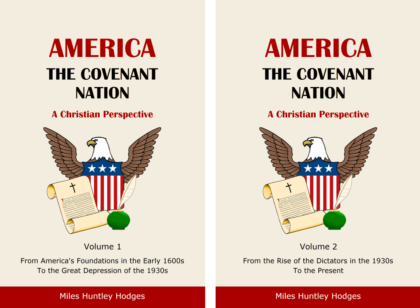
The larger, two-volume study, entitled America – the Covenant Nation,[1] has been brought together in these pages as a somewhat summarized version, not as detailed, but with all the major ideas and key points of the larger study presented here nonetheless. You may indeed consult the larger study if you are interested in going deeper into these matters.
This work is the result of years of personal study that began back in the early 1960s when I was a student at the University of Geneva in Switzerland. This was a period when America dominated so much of the world that it was natural for Americans to believe that everything about American politics and culture was the proper model for that larger world. But I found myself in Geneva not only in deep company with students from all around the world – an eye-opening experience in that alone – but also in closest friendship with a group of young Germans, friends going at life on the basis of a start on life amidst a rain of American and British bombs on their homes and neighborhoods, and then growing up watching their parents deal with a world that had for a brief time seen great glory and then the most humiliating of defeats. Listening to them I got a vivid picture of what it was as a people to go through the proverbial rise and fall of a society. It was a very condensed but very vivid example of how history itself works over the long run – and in the case of the Germans in the short run.

Hubert Robert, Imaginary View of la Grand Callerie in Ruins (1796)
Paris, Musée du Louvre
But in their coping power, my German friends also showed me a resiliency that made me realize that there was an amazing dynamic to life operating deeper than merely the one providing generous material blessings to Middle American life. I certainly continued to enjoy those blessings of Middle American life. But from that point on, I would continue on in my journey in life with a keen understanding that there were also other ways to go at that life, some of them quite awesome, but also some of them quite terrible. And getting an early taste of this strange dynamic, I wanted very much to dig deeper into the cause of that dynamic, the forces that made for social success – and for catastrophic failure.
After graduating from the University of Illinois in 1963 I moved on to Georgetown to do masters and doctoral studies. It was a great place to learn the lessons of a tough political “Realism” or Realpolitik,[2] both at the university and by working part-time in the Washington bureaucracy itself (Peace Corps Headquarters and the World Health Organization’s regional headquarters). And it being the 1960s – the age when the Kennedy dream died and Johnson attempted to replace that dream with massive bureaucratic action designed to bring into being the Great Society at home and a democratic Vietnam abroad – I got to see another example of the rise and fall of a grand social dynamic. [3]
Indeed, in August of 1968, I left behind me an angry, violent, and highly self-destructive America – which I got to experience up very, very close in the rioting, pillaging and burning going on around me in Washington – to head off overland in a VW “squareback” from Belgium to Nepal and back (via France, Italy, Greece, Turkey, Iran, Afghanistan, Pakistan and India) and then ultimately to find myself in much quieter surroundings in Belgium to do my doctoral research (that is, after working nine months for IBM as a programmer/ analyst in their Brussels office).
Here in Brussels I continued my search into the dynamics of a deeply divided society – Belgium struggling with the problem of being composed of two distinct and frequently mutually antagonistic cultural groups: the French-speaking South and the Flemish (Dutch) speaking North. But it was the end of 1960s and the beginning of the 1970s, and Belgium was finding a higher cause for its existence: serving as the political center of a rising United Europe, relocated to Belgium thanks to French President de Gaulle who tried to undercut the European-unity momentum when it first located itself in France! I saw clearly how a higher social cause, such as was developing in Belgium, has the amazing power to bring people together to greater social strength. A friend of mine, Newt Gingrich – who was also doing his doctoral research in Brussels at the same time – would spend lunches and much of the afternoons discussing with me what it would take to bring a deeply divided America back to a similar sense of unity.
Upon returning to the States, I got a job as an assistant professor in the political science department at the University of South Alabama, set up an international studies program at the university, and then proceeded to teach young people what I had already observed up close about social dynamics, both at home and abroad.
And naturally the one question that kept coming up from my students was what I thought about the status of America itself in this matter of the rise and fall of a society – especially as America at the time was finding itself going through another national trauma, as a Democratic Congress was doing its best to cripple and take down a Republican White House. This question dug especially deeply because I had made it a key point to emphasize the importance of the role that the national leader had in shaping the moral foundations of any society. And America at that time seemed to be caught up in a major battle over that very issue.
[1]America, The Covenant Nation – A Christian Perspective, 2021, in two volumes: (1) From America’s Foundations in the Early 1600s to the Great Depression of the 1930s (2) From the Rise of the Dictators in the 1930s to the Present.
[2]A German term referring to “Political Realism,” popularized by Prussian Chancellor Otto von Bismarck, who in the 1870s used all the political tricks in the book to finally bring together a single or united German nation, one drawn from the multitudes of smaller German states formerly making up a deeply divided German society.
[3]Also, in my first years at Georgetown I researched and assembled a 250-page master’s thesis on the social-political dynamics going on at the time in South Africa, noting that the actual dynamics of that country had little to do with the Black-White dynamics unfolding at the time within America itself, something that Americans looking at South Africa had seemingly little ability to understand. I predicted that South Africa was not going to go the way of the Euro retreat taking place at the time in the rest of Africa, but that the social situation would remain unchanged for at least this present generation At the time I was accused (by some … though not by my thesis supervisor who liked my work very much and encouraged me to stay on for doctoral studies) of being a “Fascist.” But I was simply analyzing the social-political dynamics, not offering ideological advice!
THE CHRISTIAN COMPONENT IN THE DYNAMIC
At the time (the 1970s and early 1980s) I was strictly a classic political Realist, rather cynical in my view of political policy-making, legal “reasoning” and intellectual Idealism. Such Realism did not necessarily make for a happy place.
And the economic mess that America fell into at the very end of the 1970s (and into the first years of the 1980s) did not help my mood any. I myself was trapped in a number of investments that, with Federal Reserve President Paul Volcker’s astonishingly high interest rate strategy, I knew of no escape. This proved to be too much Realism for me. And it all led me to find refuge from my many social responsibilities by abandoning them – and then even hiding myself away from that world … working in a friend’s back office as a simple clerk for a year, while attempting to figure out which direction in life was actually up – and not down!
And in the midst of all this, God showed up, actually in the way Christ was shown to me in the unexpected care Christian friends extended to me in all my confusion.
Actually, Christianity itself was not new to me. But this particular expression of that Christianity was! I had been raised a Christian, had gone off to college to prepare for the Presbyterian ministry, but had a Bible professor (who committed suicide that same year) completely cut away my young faith with his attempt to make the Bible itself more “Realistic.” It obviously had not worked for him. And it certainly did not work for me!
Now years later, in coming back to the Christian faith, I did not need to abandon my Realism – for my understanding of human nature itself did not change any, nor did it need to change. I did not need to escape into some kind of idealized Humanism (in which some intellectuals seem to find some degree of religious salvation). Social and political reality was not going to go away.
But I came to realize – as had so many Americans before me – that there was a force in life much higher than man himself in charge of outcomes in this universe. I knew that Albert Einstein, Erwin Schrödinger, Niels Bohr, John Polkinghorne and other famous scientists operated from this same assumption. And I soon found myself operating from that perspective as well. And thus off to Princeton Seminary I went to study the matter further.
My “Realism” continued to be operative for me even while I immersed myself in the world of Princetonian academics, by doing prison volunteer work and then starting up a street ministry of my own to the homeless of nearby Trenton. Here I got to experience first-hand the redemptive power of Christian truth, a truth that needed no clever intellectual argument to justify.[7] It was true simply because it worked – right there in real life. I continued that ministry for over four years, even after graduating from seminary and remaining in the area as a construction worker.
When I finally got a call as a Presbyterian pastor, I found myself mixing Biblical teachings with actual examples drawn from the social narrative of both America and the larger world, all of which I knew intimately. And while pastoring, I taught courses on the subject as well. And eventually a website (newgeneva.org) was assembled where all this material was laid out. Thus the foundations of this huge writing project (of which this volume is an abridged version) first began to be assembled.
I knew full well that God has long worked redemptively not just with individuals but with whole societies. And this has been true not just anciently – as with old Israel, whose narrative of divine social redemption constitutes the Christian Old Testament – but also on an ongoing basis. Yes, the same God is active among us as a people, as a society, even today.
And that understanding was certainly there in a strong way back in the early 1600s. That was what brought the Calvinist Separatists and Puritans to New England, to build in the New World a society that operated out of that same understanding. New England society was a covenant society, a people covenanted (contracted) to be a people of God – to serve him, and thus be served by him. And it worked. It worked fabulously. It made America (at least the northern and middle portions of the American colonies) a very unique society.

John Winthrop addressing some of the Puritans leaving for America (1630)
Finally, after a dozen years of pastoring, I was led back to classroom teaching, to a Christian high school this time – where, over the years, I got to teach all of my four children (and their friends) American history and social dynamics, on the basis of this very understanding: America’s grand covenant with God.
During these years these ideas got clarified, reformulated for a younger audience, and expanded considerably (the enormous pictorial portion is still to be found online at spiritualpilgrim.net). Then after eighteen years of such teaching, I finally “retired” to put this work into print – the three-volume series completed in the second half of 2019 and first months of 2020. And now the condensed or “abridged” version is finally available … as you are reading it right now!
[7]Reason, posing itself as absolute Truth, tends generally to be presented merely from the point of view of personal or social self-interest! This hardly qualifies as “Truth” in itself. Even at six years of age my granddaughter could offer the most sophisticated reasoning in rebuttal to her mom’s command “It’s time for bed.”
THE PURPOSE AND CHARACTER OF THIS STUDY
Recovering the Christian Covenant with God. So what we have here is the narrative of a people, the American people, going at life by way of a special covenant relationship with God. They do not always live up to that commitment – distracted by waves of “enlightenment” in which some Americans have supposed that they could control life their own way without God’s instructions. But they are a people revitalized by divine interventions (the “Great Awakenings”) when God remembers his covenant with America and restores its spiritual character, usually in anticipation of an enormous life-and-death challenge that the nation will soon be facing and will need enormous spiritual strength to take on successfully. And so, like Israel of old, it is the narrative of a “covenant people” living and serving God himself, as a “City on a Hill,” a “Light to the Nations”, showing the world how ordinary people can do extraordinary things when they work closely with the God who presides over the universe.
The power of the Christian narrative. One of the things I learned in seminary was the power of a society’s narrative itself, the way it shapes social identity and purpose. Indeed, Christianity is itself built on the power of such a narrative, found in our Bible. The Biblical narrative has long shaped Western society. And it certainly was critical to the birth of the American nation in the early 1600s, and key to its development over the next several centuries.
 I was deeply impressed by how Judaism built itself entirely on its own narrative … and how that Jewish experience also shaped the way Christianity would understand its character and role in life. While other civilizations conducted worship by having priests sacrifice animals (sometimes even people) at alters located at huge temples (the Jews at one point did that as well, just with animals, of course!), the Jews learned to approach God also – and more importantly – simply through prayer, reflection, and study, of God’s ways, and of the ways of those Jews and Israelites of earlier generations revealed through their well-recorded social experience (Scripture) which demonstrated by the example of those who went before them how best to work with God in daily life itself – not to mention in times of wars and enormous social crises. So the Jews developed Godly worship simply through devoting themselves to the task of learning from Scripture, gathering weekly to study and learn from such social narrative.
Indeed! Looking to such social narrative for guidance was a very unique way to go before God – one that worked very well for the Jews, certainly at least as well as having priests slaughter animals at the Temple.
And it was this habit that was picked up by Christianity in its formative years (also as an oppressed people), as Christians gathered locally (homes or underground “churches”) to worship and attend to the instructions or sermons of their elders or pastors. And it proved so powerful that eventually Christianity would take Roman society by storm! But we will have more to say about this in the pages that follow.
But anyway, that was real Christianity. And I understood very clearly its power and its vital importance in the founding and development of American society, unfortunately an understanding that is being lost as America turns away from such “superstitious” doings to follow the more “reasonable” path of Secular-Humanism, a religion established by the Liberal political Left, and the federal courts – quite in violation of a very Christian Constitution that is supposed to be protecting the people’s powers to shape and direct their own society … like the ancient Christians – and the Jews before them.

The American pulpil (early 1600s) as the actual constitutional foundation of American society
The moral role of leaders. I am also (as my four-generation parable illustrates clearly) a great believer in the enormous power and social role played by the very special people of society: their leaders. Usually leadership comes from a society’s governing officials. But it frequently comes also from others who step into the picture to give society critical guidance. The Reverend Dr. Martin Luther King, Jr., for instance, would qualify as the second type: not a government official, but one whose leadership had a huge impact in moving America off in a much grander direction.
Leaders set the moral-spiritual example before the people, helping them to understand the best way to go at life’s challenges. Modern social science sees them as planners and managers. I see them as inspirers, people who do not need to dictate to others, but simply show others the way through personal example.
Thus I tend to give America’s historical leaders very special coverage in this narrative, especially in the matter of what it was precisely that made them the leaders they happened to be. This is not only to give insightful information to those who want to know more about those who left such a major mark on American society, it is, as with all personal testimony, to inspire the reader to try to follow a similar path in life themselves. That is, after all, how true leaders (not dictators) lead: by inspiring others with their own personal example!
Taking up the narrative. And so we begin our journey, taking up the American narrative or story – learning not just the facts of history but, even more importantly, the ways of society itself: its social dynamics.
Indeed, let us now begin that journey into America’s great social narrative, its grand history … so as to know how to deal more effectively with the challenges before us today.