CONTENTS
 The earliest attempts at European settlement in America
 Establishing an English settlement in Virginia
 The English settlement of New England
 The founding of the English proprietary colonies
The textual material on this webpage is drawn directly from my work, America’s Story – A Spiritual Journey © 2021, pages 47-68
THE EARLIEST ATTEMPTS AT EUROPEAN SETTLEMENT IN AMERICA
The Spanish colonies. Meanwhile, across the seas in America, the ongoing plundering of American Indian wealth in gold and silver was beginning to slow up for the Spanish. However, as an alternative source of status improvement, extensive land ownership in America itself came to be considered as an acceptable substitute – since the acquiring of more land was always the main path to much higher social status within the dominant feudal system. Thus the feudal social pattern was naturally extended to the Spanish lands of the New World as large landed estates or haciendas – similar to the manorial estates back in Europe – were put in place around the Spanish colonies. These haciendas were naturally supported economically by the labors of local Indians bound, like European peasants back in Spain, in lifetime service to the noble Spanish families that took root there.
Also, alongside this feudal landholding system, the Spanish (Catholic) Church, with its religious hierarchy of priests and monks, was put in place in the Spanish colonies to give them a character as close as possible to the culture back in Spain. This was also intended to help the Spanish Habsburg kings keep a close watch over these royal colonies, which ultimately were the king’s personally to rule, exploit and protect. In a way also it was to put Catholic priests and Dominican and Franciscan monks on site in America to protect the king’s Indian subjects (they were his subjects as well) from the worst of the exploitation by the Spanish lords.
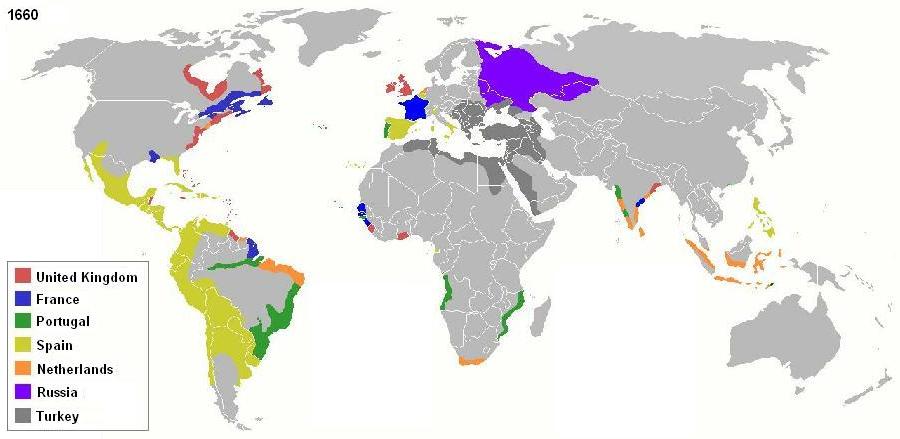
European Colonization – 1660
Wikipedia
Portuguese Brazil. Likewise the Portuguese established a foothold on the Eastern shores of South America in a region of what would come to be called Brazil – a convenient refueling station for ships heading onward with the trade winds across the Southern Atlantic to Angola in southwestern Africa, and then the tip of South Africa at the Cape, and from there up the African coast to Mozambique, and then to India … and eventually beyond that to the Spice Islands of Southeast Asia (the future Indonesia) – and finally onward as far as China (the port of Macau).
Like Spanish America, Portugal’s American colony of Brazil would also develop along feudal social-cultural lines similar to the mother country of Portugal – except that alongside the local Brazilian Indian population, slaves from Africa were brought in to Brazil (much as they were, however, also in the Spanish Caribbean Islands) to constitute the huge class of servant-workers supporting the whole system.
The French and Dutch in North America. The Spanish and Portuguese had shown little interest in North America, although they considered the Atlantic Ocean their private domain and thus blocked efforts of other European powers to explore the New World. But after the Spanish had suffered a number of defeats, the opportunity to explore and secure the riches of the New World (American furs were particularly popular) both the French and the Dutch got into the act.
But the French sent not only explorers (Cartier, 1530s; Champlain, early-1600s; Joliet mid-1600s) to what would eventually become New France (basically Quebec and the Maritime Provinces), they sent Jesuit priests (for instance, Father Marquette, mid-1600s) to claim Indian souls for the Church, not just along the St. Lawrence riverway but well beyond that into the Ohio region and then finally down the Mississippi River, establishing French outposts along the way.

The Dutch meanwhile hired the English explorer Henry Hudson to do some exploring for them along the middle reaches of the North American Atlantic coastal region, where, in 1609, he discovered a river (named after him) which he hoped would provide the greatly hoped-for passage through the Americas to the Pacific Ocean and thus also to the wealth of Asia across that great ocean. Although that plan did not work out, it enabled the Dutch in 1615 to place a trading post (for valuable Beaver pelts) up that river at Fort Nassau (Albany), soon to be joined by another Dutch settlement (1624) at the mouth of that river at Manhattan (New Amsterdam), and also claim the land between these two settlements, which became the basis of New Netherland. Then the Dutch attempted to expand that position further south into what today constitutes New Jersey and Delaware.

Amsterdam, Rijksmuseum
ESTABLISHING AN ENGLISH SETTLEMENT IN VIRGINIA
The “Lost Colony” at Roanoke. And of course the English had a similar interest in laying claim to territory in the New World. Thus an Elizabethan courtier Sir Walter Raleigh petitioned the Queen to authorize a settlement of English families at a point along what would eventually become North Carolina, in order to enter an English territorial claim to North America. A Roanoke colony of 116 men, women and children was thus settled at this point in 1587 – with promises of continuing support from England. But support did not come immediately – because of the English naval battle with the Spanish Armada the following year. But when a supply ship was able finally to return to the colony, the colony’s members were found to be missing. And there were no signs of what might have happened to them. This shock brought to a halt further English thoughts of colonizing America – until a generation later when the irresistible idea of gold lured forth new attempts at planting an English foothold in America.

(Roanoke is the small pink island in the middle of the map)
drawn by John White in 1585
The Virginia colony at Jamestown. Thus in 1607 another attempt to secure an English position along the North American coast took place, as a English party of three ships and their men (no women this time) – financed by a group of London “Adventurers” (investors) constituting the Virginia Company – arrived in America to begin the search for America’s fabled gold. They immediately built a wooden fort on a small island upriver along the banks of one of the wide rivers feeding into the Chesapeake Bay, honoring their English King James by naming the fort Jamestown and the river the James River.
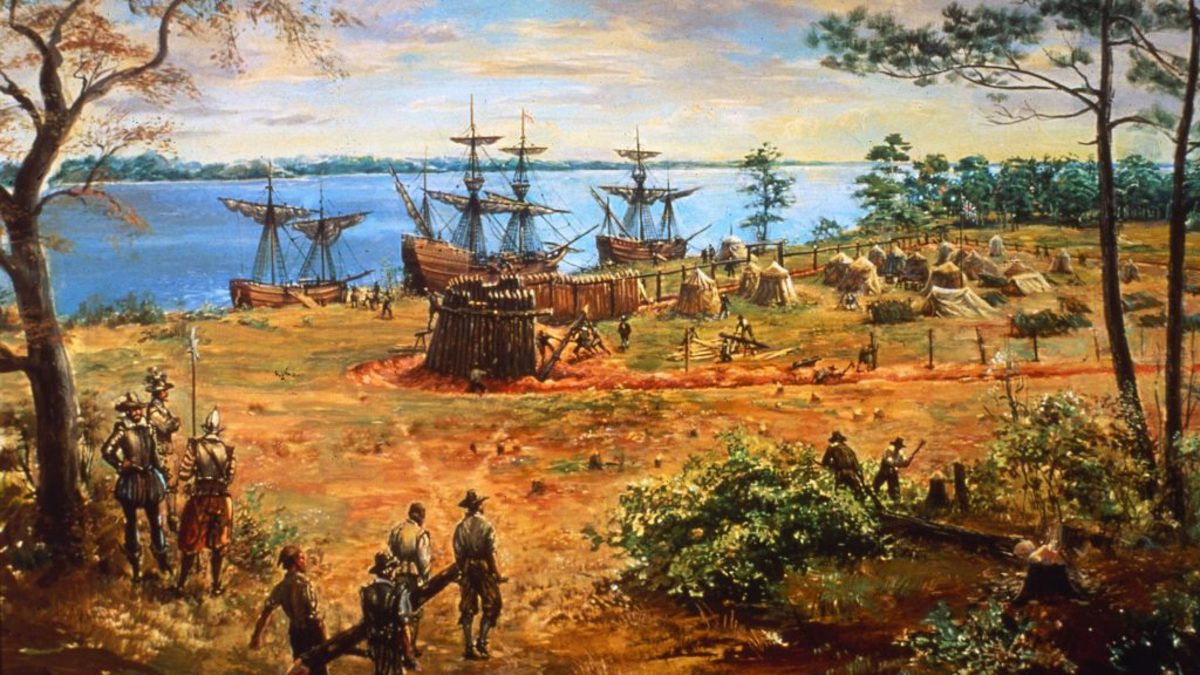

“Gentlemen just do not dirty their hands in common labor.” But they had made no plans to work together as a community beyond the building of the fort. Instead they headed out to look for the gold that would make them rich (and status-worthy). Thankfully they had enough food supplies brought with them (or stolen from the local Powhatan tribe) for them to survive the first winter’s rigors. But with the arrival of the next summer, no effort was made on their part to grow the food they would need to get through another winter – for, like the conquistadors of Mexico and Peru, they were busy looking for the wealth in gold that would allow them to purchase land rights, which in turn would bring them into the status as “gentlemen.” And besides, English gentlemen just simply did not debase themselves by dirtying their hands in common labor. So, no one bothered to grow the food the colony would need to survive.
 A big part of the problem was that the colony lacked true leadership, the kind that could get these Englishmen to work together. Captain John Smith led the Council briefly, though he preferred adventure (and gold-hunting) over administrative work, and anyway was wounded and had to return to England in 1609 – returning the colony to a leaderless existence.
 Consequently, by the third winter of 1609-1610, they nearly all starved to death (420 of the 480 colonists died). In fact the 60 survivors were in the process of abandoning the Jamestown project when they were intercepted in their departure by the arrival of a new shipment of 150 men and more supplies. The colony survived at that point – only by coming under the discipline of a new director, Lord De La Warr (Delaware).
Indenture. More men (and eventually women) were subsequently brought in – as indentured workers.
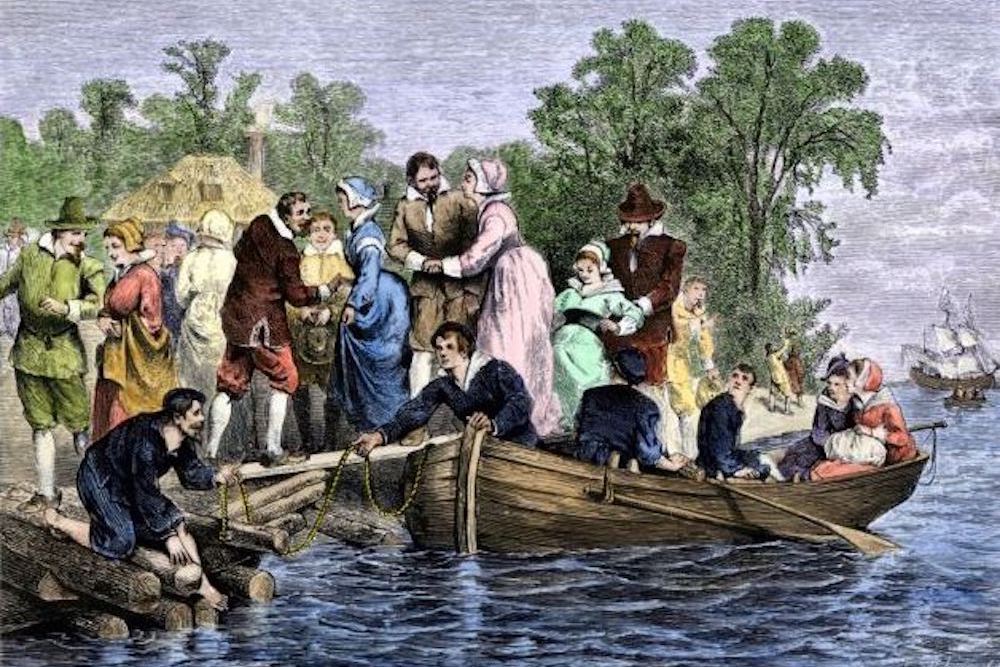
These were common laborers obliged for seven years to do the physical labor required to support community life, as payment for their passage to America and for the tools and a small allotment of land they would need to get their own lives started up in America when the term of indenture was completed. Finally, under this new dynamic, the Virginia colony began to grow.
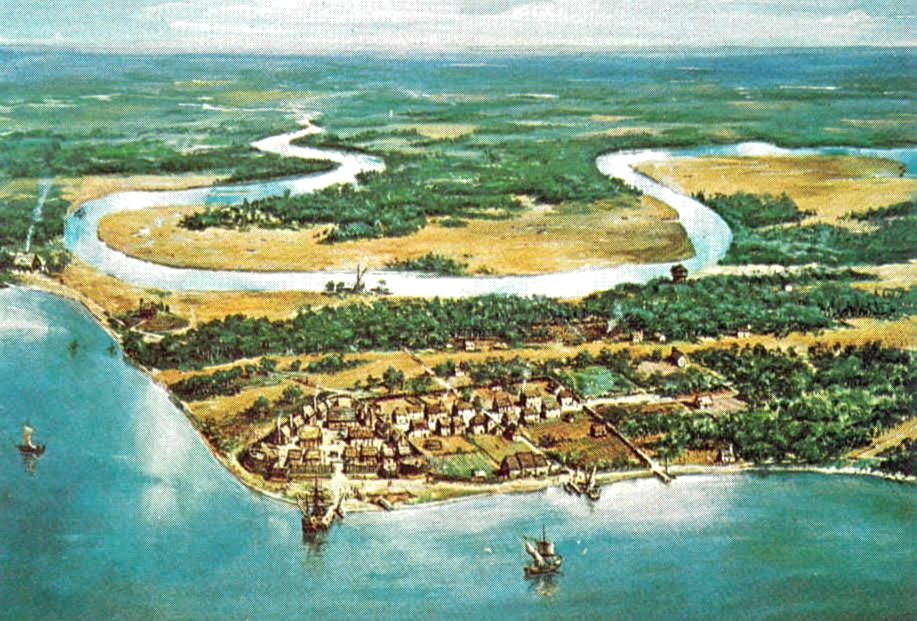
Tobacco. Also, it was soon discovered that although no serious amount of gold was to be found in the colony of Virginia, tobacco, brought to Virginia by the enterprising John Rolfe, proved to be a huge seller back in England.[1] Considerable wealth could be secured simply by growing and shipping back to England this valuable drug. Thus vast acres of land were cleared to make way for this single crop – one vital to the growing Virginia economy.
John Rolfe. Rolfe’s passage to America had not been easy. His ship was hit and destroyed by a hurricane, leaving Rolfe, his wife and baby stranded in Bermuda (where both wife and child died). It was here that Rolf discovered the tobacco seed that the Virginia economy would eventually be based on. Finally having a new ship constructed from the wreckage, he made his way to Virginia. Here he met and in 1614 married Chief Powhatan’s daughter Pocahontas, bringing some degree of peace between the English and the Powhatan Indians. But two years later in a special trip the two of them made to England to publicize the Virginia venture, Pocahontas died, and Rolfe had to return alone to Virginia. And Rolf would live on only for a half-dozen more years, possibly killed in the Indian uprising of 1622.

Tobacco farmer John Rolfe and Pocahontas marry (1614) … helping to settle relations (for a while anyway) between the English settlers and the Powhatan Indians
Some social-political reforms. Despite the economic boom that came to Virginia, complements of the tobacco trade, changes were needed to attract more settlers to the colony. In 1617 the Company ended its monopoly on land ownership, allowing private ownership.
By 1619 there were ten major plantations in Virginia, mostly along the wide James River. In that year Virginia received a new governor (Lord Delaware had died on another trip to America) and a new colonial legislative assembly. As part of the plan to encourage settlers to come to Virginia, this assembly was set up to give the settlers their own voice through two elected representatives sent to Jamestown from each of the ten plantations, plus Jamestown itself. Thus in Virginia the idea of representative democracy was first born in America.
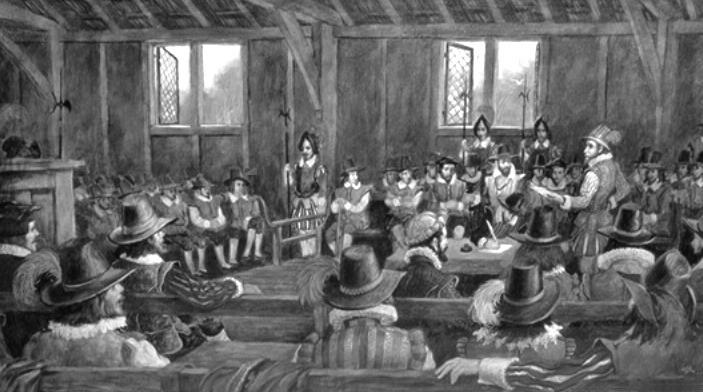
A meeting of the 22 burgesses or representatives to the Virginia General Assembly after its founding in 1619 (the forerunner to the House of Burgesses, formally established in 1642)
Troubles with the Indians. English settlement on what the Indians knew to be heir hunting lands had come to anger the Indians greatly. Finally in 1622, the new chief Opechancanough (younger brother of Chief Powhatan) struck the English settlements hard, killing 300 to 400 settlers in a single day[2], although Jamestown was spared destruction because of a warning issued by an Indian boy to the inhabitants of the town.
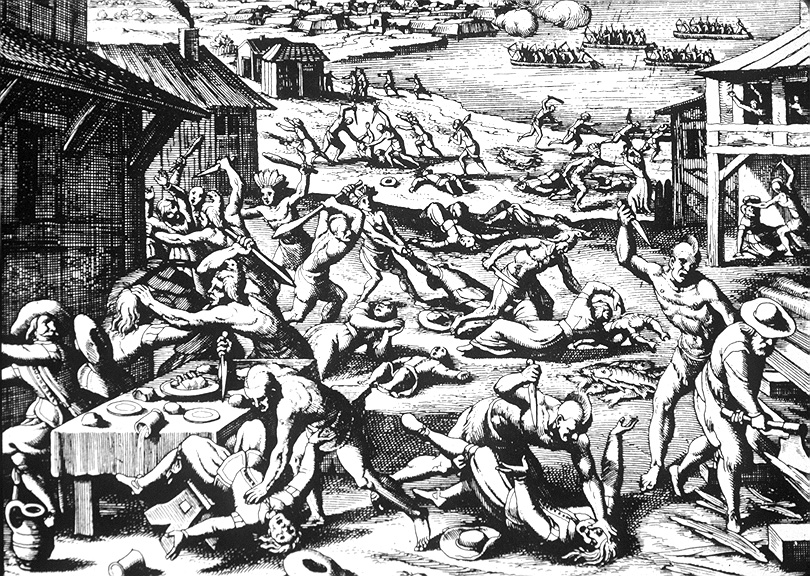
But after a year of constant struggle, both sides arrived at a peace agreement (never fully respected by either side however).
Even at the high death rate of the English settlers, the Indians succeeded in killing off only about a third of the English population. And although the Indian loss was numerically lower, that loss represented an even higher percentage of the smaller Indian population.
Then another Indian rebellion broke out in 1644 when Opechancanough struck again, killing another 500 English settlers this time. But Opechancanough was captured and killed, and the Indian rebellion collapsed. In fact the whole episode ended up breaking Indian power throughout the entire Tidewater region.
But the Indians located in the foothills of the Appalachian Mountains to the west were more determined than ever to stop the spread of the English into their lands.
Feudal Virginia. Despite the ongoing problems with the Indians over land ownership, enterprising Virginians began to purchase more land with their tobacco profits – until some of the widely scattered tobacco estates were proving to be quite immense, worked by multitudes of indentured[3] laborers, especially those family estates that lined the wide Rappahannock, York and James Rivers of the Virginia Tidewater region. For instance, the estate of William Byrd II reached 180,000 acres in size by the early 1700s! These plantations now began to look quite like the great manorial estates back in England. And thus a Virginia aristocracy was beginning to be formed – modeled closely on England’s feudal or class-based culture.

William Byrd II (1674-1744) – Virginia-born, but raised in the style of a British aristocrat … but returned to Virginia to manage a 180,000-acre plantation.
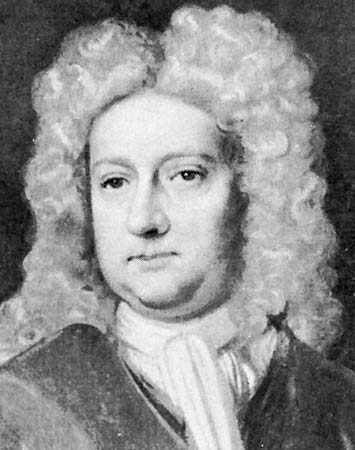 The governorship of Sir William Berkeley. Presiding over all this was Virginia governor Sir William Berkeley (first period of service, 1642-1652), the exception to the rule that royal-appointed governors were always anxious to move on to better assignments. Berkeley actually made himself at home in Virginia, developing a plantation there of his own (Green Springs), where he conducted experiments in raising new crops – in an attempt to move Virginia past its one-crop tobacco economy. He also encouraged the members of the Virginia Assembly to act more independently of the royal government in London. And his role in putting down the 1644 Indian uprising gave him strong support among the Virginians.
But with the overthrow of the Stuart Dynasty back in England, he was ultimately removed from service (1653), until the Restoration in 1660, when he was returned to his position as Virginia governor. But at that point the dynamic had changed, with Berkeley now overextended in his duties (he was also a co-proprietor of the new Carolina colony) and not able to deal with the growing problem with the Indians in a way that satisfied the Virginia frontiersmen located to the West where thick forest, rocky soil and, most of all, angry Indians made life extremely tough and unrewarding.
Rural Virginia. Virginia early on would develop essentially as a rural colony, with no real towns developing there – the sole exception being the colony’s political capital at Jamestown (later replaced by Williamsburg), where the royal governor had his residence – but which came alive only when a general meeting of the House of Burgesses was being held. Beyond that, there were no business centers or commercial towns needed for the Virginia colony, as each of the major plantations was quite able to conduct all of its shipping business with its customers back in England right there from the plantation’s docks along these wide and deep rivers. Urban life thus was not an important feature of southern society.
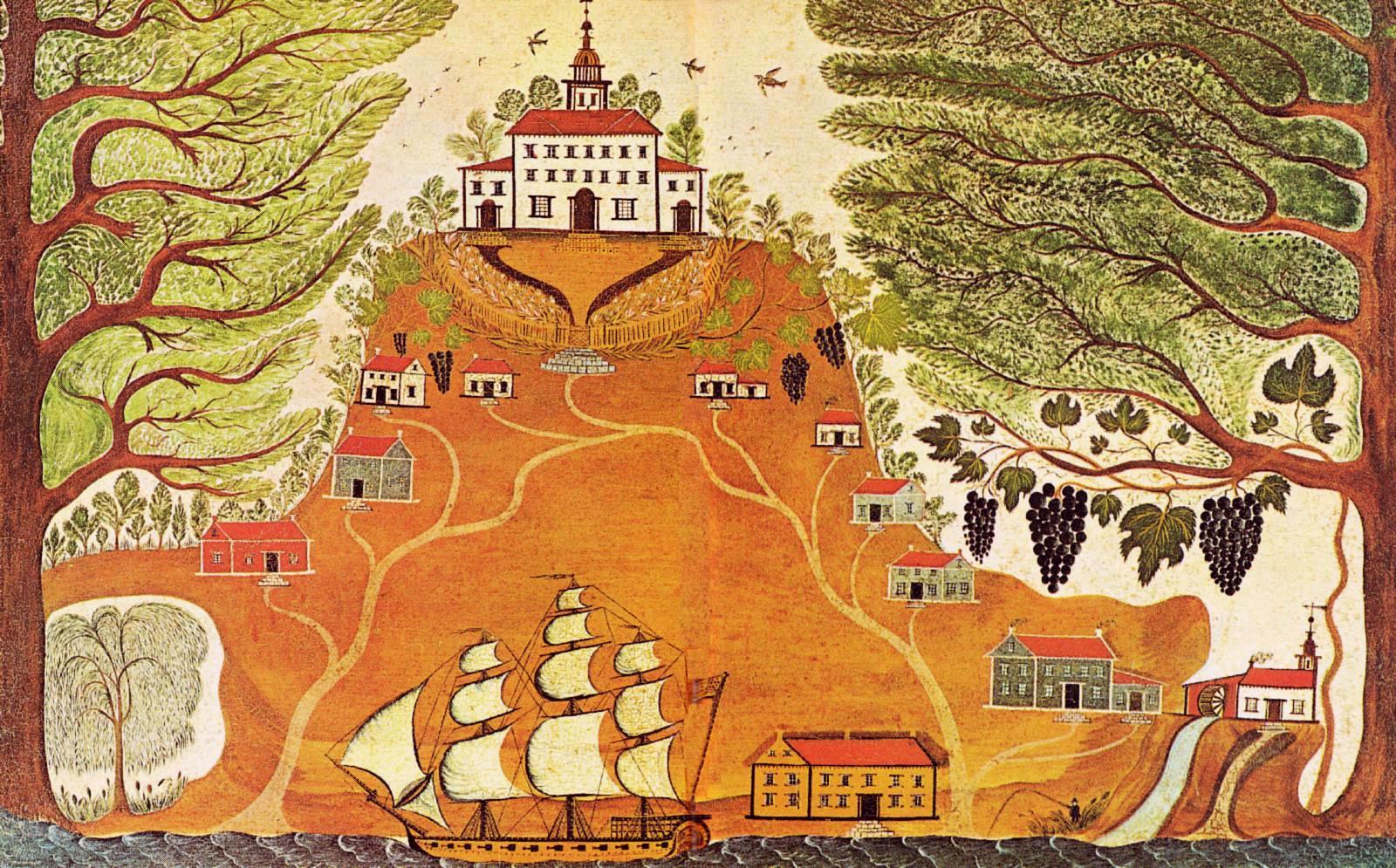
Christian Virginia. To be sure, there developed in Virginia a typical “Christian” character about the society – for that went right along with being English. Much like in the Catholic Spanish colonies, in Virginia the King’s own Church of England was expected to be established as part of the (feudal) political order there. Parishes were laid out as part of the natural ordering of Virginia and attendance at church service was the law of the land – although the law was not really enforced, in part because there were few Anglican (Episcopal) priests sent on assignment to Virginia and in part because the plantations were so widely scattered and sparsely settled that churches were hard to reach. Actually, relatively few were even put in place in Virginia. Anyway, Virginia was not really that much caught up in the religious issues that were keeping old England in constant crisis. Virginia had other things that concerned it more: tobacco – and the land and servants needed to work the tobacco fields, while the Virginia aristocrats conducted their necessary social rounds.
[1]Sugar was, at the time, an even vastly more valuable commodity, produced mostly in the Caribbean. But the Virginia climate was too cool for sugarcane to thrive there.
[2]One of the myths perpetrated today for various ideological reasons is that of the “gentle Indian.” The Indians were warriors, their men used to the rigors of battle over the scarce hunting lands that sustained their tribes. The American Indians could be very cruel, in that they had no use for defeated enemies – who would be just additional mouths to feed should they let them live on (even as slaves) after defeat in battle. Mostly, enemies were killed on the spot. Worse, many of the Indians took great delight in watching a captured foe be put through a torturous death. And women and children were not spared, because their battles were always over the matter of which tribe had the right to the land, an all-or-nothing (men, women, children) affair.
[3]Their indenture involved seven years of service to their masters – who had paid for their passage to America and were obliged to teach their servants a trade, usually tobacco farming. At the end of their tenure, the servants were then free to set up their own lives elsewhere, although in Virginia once the prime lands along the major Tidewater rivers were taken up by the huge plantations, there was little opportunity for doing well in the mountainous and Indian-defended land to the West.
THE ENGLISH SETTLEMENT OF NEW ENGLAND
Persecuted “Separatists.” Meanwhile another English settlement was in the making – but of a very different nature. It began in the Dutch Netherlands (at Leiden), to which in 1607-1608 a group of English Calvinists of the “Separatist” variety had fled in order to escape the persecution they were experiencing in England.
They were labelled “Separatist” because they had given up all hope that the Church of England would ever be reformed to Puritan standards and simply wanted to “separate” themselves from the English Church, something King James felt amounted to treason.
But it had not been an easy time in Leiden for these English “Pilgrims”, as only some of them possessed technical skills that could find work there, the rest being simply of a farming background and thus having to take menial jobs just to survive. Also these Pilgrims wanted to retain their English identity, which seemed to hold less importance among their youth, who were taking up the Dutch language and its more libertine ways. And Dutch politics was bringing them under pressure, as the English King James was leaning on the Dutch authorities to suppress the English Separatist communities taking refuge in their land … at a time that the Dutch needed English support in the face of ongoing Spanish efforts to defeat the Dutch and force them back into Catholicism.
Thus after ten years at Leiden, the Pilgrims knew they had to move on. But to where?
The Plymouth Plantation and the Pilgrims. Finally, the English refugees chose to make that move to North America, despite the horror stories concerning the “dying times” that accompanied all English attempts at settlement there. They had a social ideal as a “Reformed” Christian community to live up to, in America if need be. And they would meet this responsibility no matter what the cost might be. They were like soldiers going off to war, except their war was in service to God, not any king, not any bishop, not any such human authority.
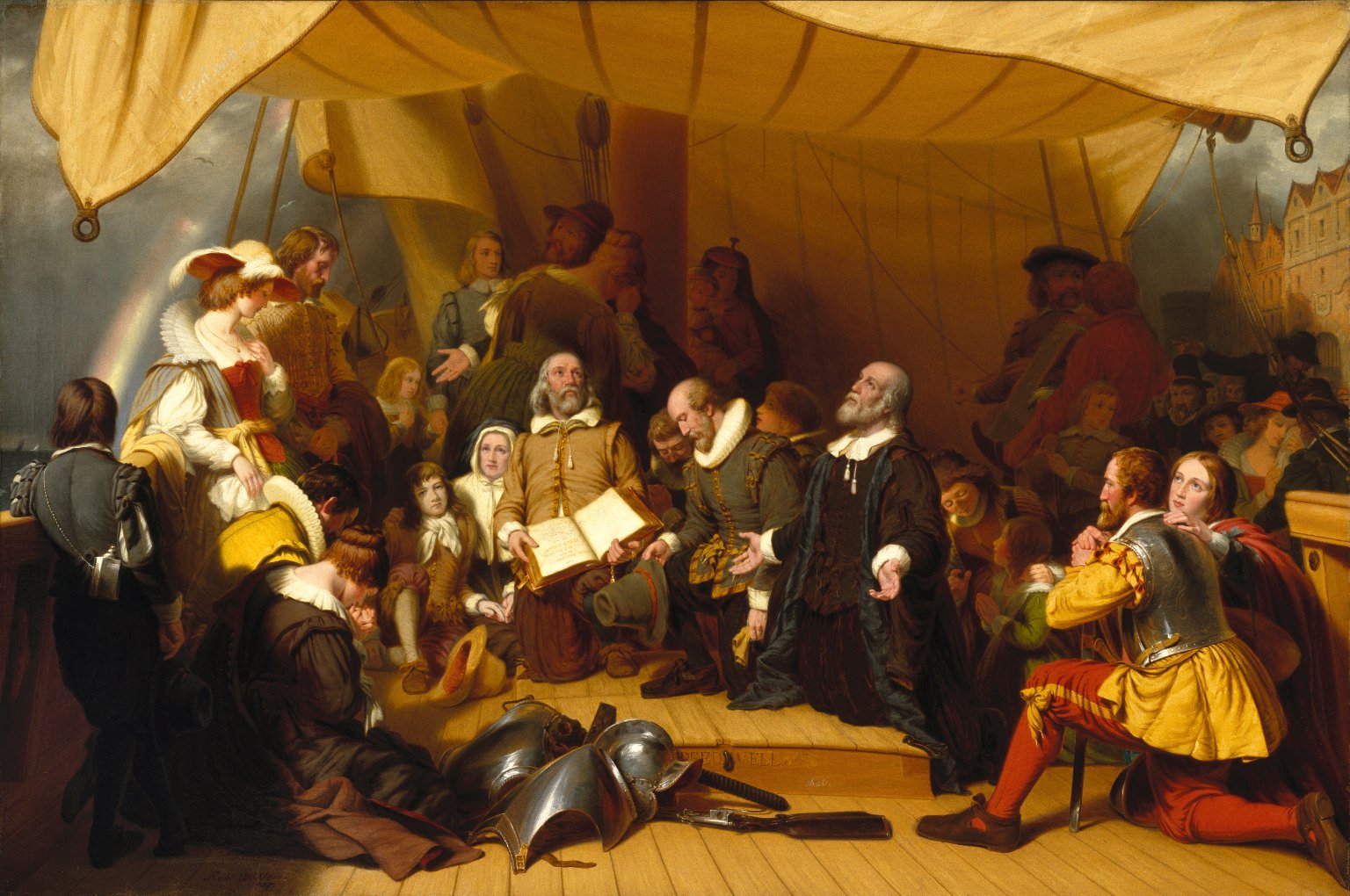
United States Capitol Art Collection – Architect of the Capitol
Tragically, these Pilgrims suffered a huge delay in their departure (a leaking ship forced them to return to port, then try again) and consequently they arrived late in the season (November) at a destination in America that proved to be well north above where they were assigned to settle. Also, the prevailing winds that had blown them north of their course prevented them from heading south along the American coast to that intended destination (the Hudson River area). Thus they were stuck there at Cape Cod – just as winter set in upon them.
But they were determined to make the most of this unexpected situation. Thus before they disembarked from their ship, they created a covenant (the Mayflower Compact) among themselves, covenanting to work together as a community.[4] And then they set out to do just that.
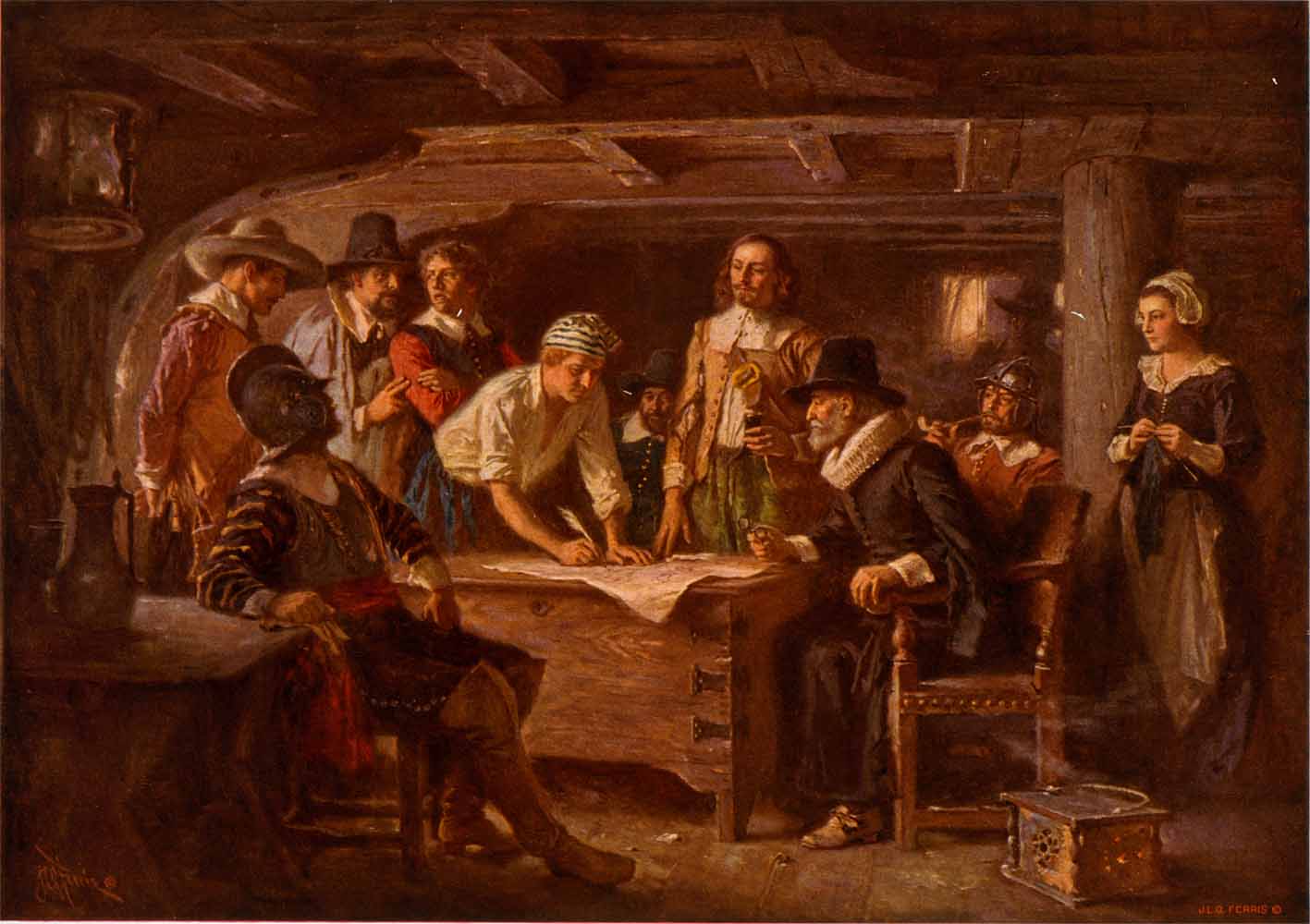
Library of Congress
Nonetheless these Pilgrims persisted – and finally that spring they were able to put into place a permanent settlement, a plantation they named “Plymouth.”
Friendly relations with the local Wampanoag Indians (including, miraculously, the English-speaking Squanto who showed them how to grow corn!) helped immensely. And thus at that first harvest time in New England they were able, with their Indian friends, to celebrate a great Thanksgiving to God for their success.
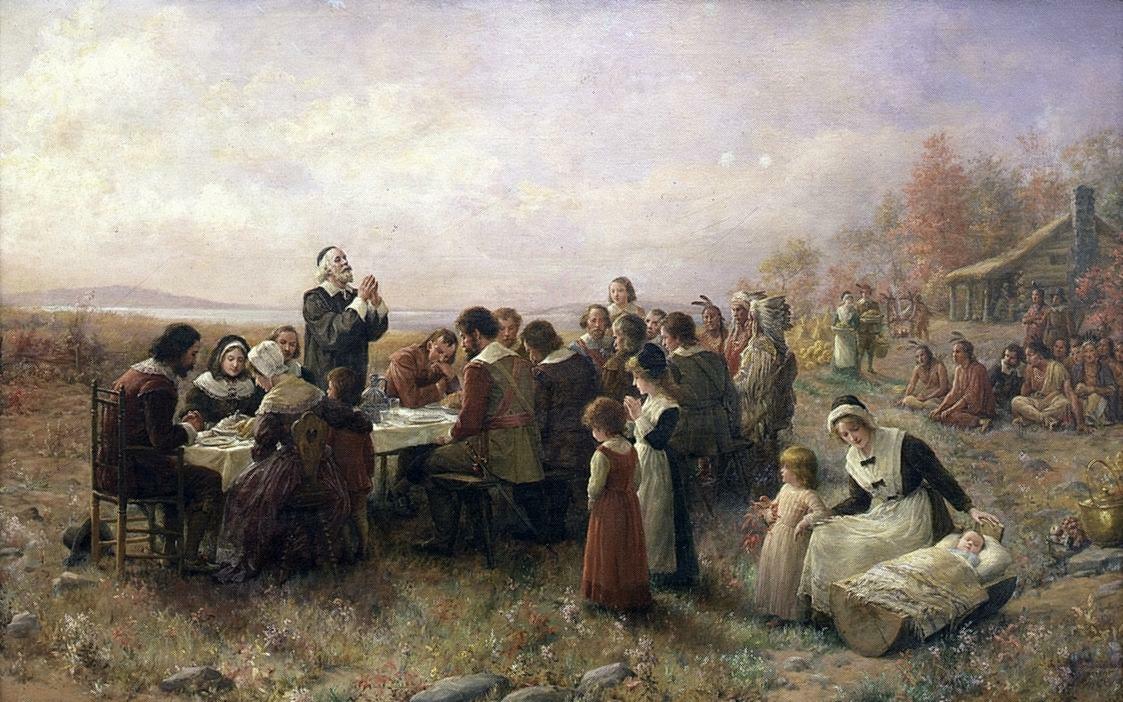
The First Thanksgiving at Plymouth – by Jennie A. Brownscombe (1914)
Stedelijk Museum De Lakenhal
Clearly, they had built a community of Christian faith where they now could freely worship God as they understood he was to be worshiped – without fear of the English authorities.[5] And they prospered, not elegantly like English (or Virginia) nobility, but like the hardworking Protestant commoners they indeed were.
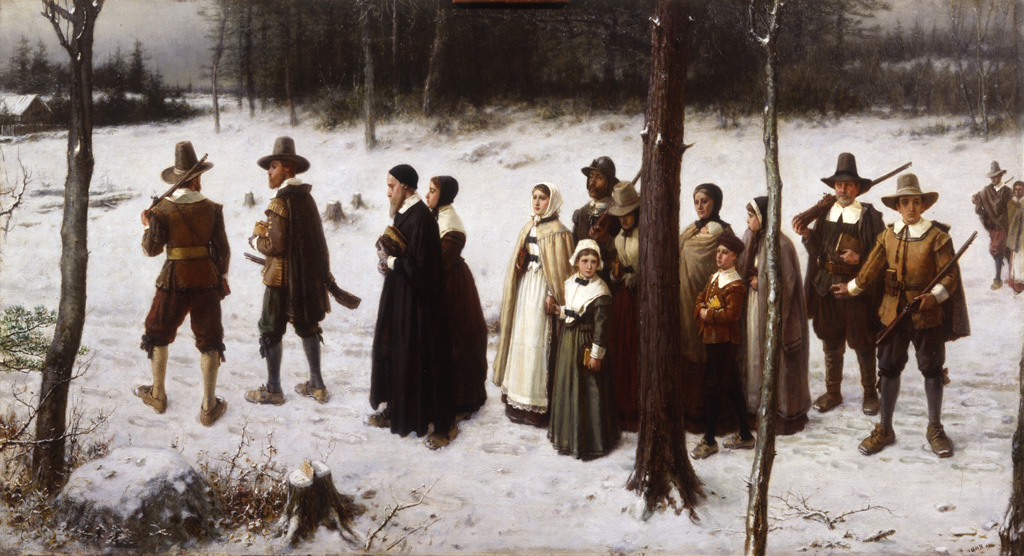
Pilgrims going to church – by George Henry Boughton
New York Historical Society
The Puritan Great Migration to Massachusetts (1630-1642). The Pilgrims were soon followed to New England by other settlers, including, importantly, a Puritan settlement well to the north of Plymouth at Salem. But poor organization and poor leadership almost scuttled the plantation there – and by 1630 most were returning to England, having given up on the venture.
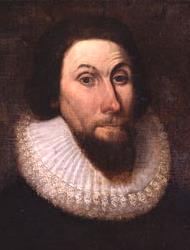 But another attempt was made that same year, one which would be amazingly successful – due to the excellent leadership of John Winthrop and the accompanying leadership team of equally talented and deeply dedicated Puritan pastors and elders. Winthrop himself personally helped finance the migration of the first group of eleven ships carrying some 1000 Puritans from England to the new Massachusetts Bay colony, located in the large harbor region (the future Boston) just south of the Salem site and north of the Plymouth plantation.

Winthrop and company arrive at Massachusetts

Some of the ships John Winthrop brought to New England,
anchored in Boston harbor – by William F. Halsall
In essence this group of Puritans were now also Separatists by the mere fact that as Puritans they were facing heavy opposition from the newly crowned and quite pro-Catholic King Charles who took the throne in 1625 when his father James died. Thus it was that numerous Puritans had finally concluded that it was time to leave England. They thus had applied for a charter to set up a colony of their own in America, King Charles believing that this was simply just another commercial venture like the Virginia Company. But it was not. Not only would the major financial backers be themselves part of this group leaving England for America (1630), but this group was the advance guard of some 20,000 Puritans who would over the next dozen years migrate to New England, in order to establish there the Reformed society that they had previously hoped would take root in England.
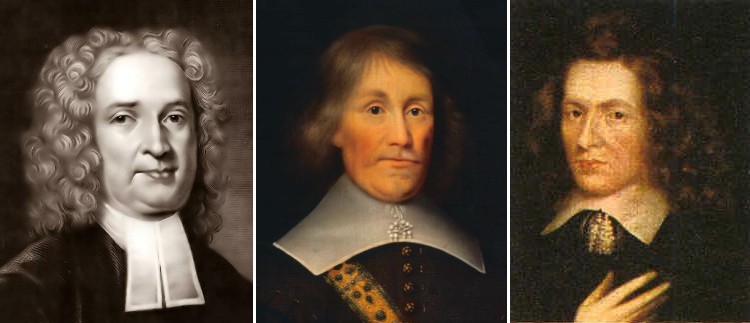
Some Puritan fathers: John Cotton (left), Richard Saltonstall (center), and Josiah Winslow (right)
The Puritan covenant. Just as this first wave of Massachusetts Bay settlers were about to leave on ships for their new life in America (March 1630), Winthrop delivered one of America’s most famous sermons, reminding these Puritans of the Covenant they were taking out with God, he to be their God and they to be his people.
In this Covenant, their settlement was to serve as a “City upon a Hill,” a “Light to the Nations,” demonstrating to the larger world how living under the authority of God in Christ – in close accordance with God’s Word in Holy Scripture – could bring human life to great success. He told them:
Thus stands the cause between God and us. We are entered into covenant with Him for this work. We have taken out a commission. The Lord hath given us leave to draw our own articles. We have professed to enterprise these and those accounts, upon these and those ends. We have hereupon besought Him of favor and blessing. Now if the Lord shall please to hear us, and bring us in peace to the place we desire, then hath He ratified this covenant and sealed our commission, and will expect a strict performance of the articles contained in it; but if we shall neglect the observation of these articles which are the ends we have propounded, and, dissembling with our God, shall fall to embrace this present world and prosecute our carnal intentions, seeking great things for ourselves and our posterity, the Lord will surely break out in wrath against us, and be revenged of such a people, and make us know the price of the breach of such a covenant.
Now the only way to avoid this shipwreck, and to provide for our posterity, is to follow the counsel of Micah, to do justly, to love mercy, to walk humbly with our God. For this end, we must be knit together, in this work, as one man. We must entertain each other in brotherly affection. We must be willing to abridge ourselves of our superfluities, for the supply of others’ necessities. We must uphold a familiar commerce together in all meekness, gentleness, patience and liberality. We must delight in each other; make others’ conditions our own; rejoice together, mourn together, labor and suffer together, always having before our eyes our commission and community in the work, as members of the same body. So shall we keep the unity of the spirit in the bond of peace. The Lord will be our God, and delight to dwell among us, as His own people, and will command a blessing upon us in all our ways, so that we shall see much more of His wisdom, power, goodness and truth, than formerly we have been acquainted with. We shall find that the God of Israel is among us, when ten of us shall be able to resist a thousand of our enemies; when He shall make us a praise and glory that men shall say of succeeding plantations, “may the Lord make it like that of New England.” For we must consider that we shall be as a city upon a hill. The eyes of all people are upon us. So that if we shall deal falsely with our God in this work we have undertaken, and so cause Him to withdraw His present help from us, we shall be made a story and a by word through the world.
In short, they were going to attempt to do in America what Calvin had achieved in Geneva.
John Winthrop – Puritan New England’s Founding Father. Indeed, Winthrop was the “Calvin” to New England, the one above all others who directed the course of Puritan Massachusetts to its success as a grand religious or social experiment, on quite new and untested principles. It was Winthrop’s sense of vision and his optimism that kept New England on course. It was Winthrop who helped steer the course of this development between the dangerous rocks of religious fanaticism on the one hand and heavy-handed religious legalism on the other. And as with all true leaders, he did so by setting the example himself of the kind of humble, self-critical behavior needed by all in order to produce the spirit of mutual cooperation that the new society needed in order to thrive. He inspired others to higher behavior – rather than use his social office to dominate and control the behavior of others. And although he sincerely loved those he was responsible for, he was not one in need of their constant approval. Ultimately, he was answerable only to God – as Winthrop reminded his followers that they too were. They were all to live by the counsel of God (prayer and Bible study), and that alone. Winthrop was to them merely an advisor, not their judge. And they loved him for it.

Winthrop and his assistant Dudley having a disagreement over Dudley’s unnecessary adornments to his house. Winthrop insisted on keeping things simple – and equal.
Winthrop was actually nobly born to a father who was a lawyer, landowner, and Cambridge University director, who opened similar doors to John in his development. After graduating from Cambridge, John became Lord of the Manor at Groton and then eventually a member of his father’s law firm in London.
John was also profoundly Puritan in his beliefs, relying on his Christian faith to get him through the death of two wives and then the growing problems as a Puritan with the reign of King Charles.
When as a Puritan he was removed from the Court in 1629, he was then free to take the lead in the development of the Massachusetts Bay Company, using his own finances to help assemble the fleet necessary to bring the first 1000 Puritans to America, be willing to face personally the well-known challenges of life in America by leading that voyage himself, and recruit other Puritan pastors to the same risky mission as leaders in the towns and villages that would constitute Puritan New England. And thus it was that America was blessed to have the New England colony come under such splendid leadership. Winthrop was a gift of God to America.
“Democratic” small-town Massachusetts. The Massachusetts Bay Colony would take on a character very, very different from Virginia. The New England soil was rocky and the forests thick – not suitable for huge plantations to develop. Besides, from the very beginning this was never intended to be an economic venture – nor the path to social status. Many of those coming to New England were in fact leaving behind quite respectable social status in order to start a new life in America. And they would be living at a social level fairly equal to everyone else making the trip. Upon arrival they would be assigned plots of land just large enough to support a hardworking family, these land allotments arranged in such a way as to form a small village, centered on a town square equipped with a meeting house which would serve the village as both church and town hall. And each village would have a seminary educated pastor[6] whose job was to help guide the village as it attempted to live out its new covenant life.
When the available plots of land for a village were fully distributed, then another village, normally to the west, would likewise be surveyed and subdivided into fairly equitable plots of land for distribution to Puritan newcomers. And so the Massachusetts colony slowly spread its way ever westward.
Thus it was that Christian religious refuge – not improved economic status – was the theme that not only brought those Puritans to New England but also became the moral-cultural underpinning of the entire venture. This had very little to do with what was going on way to the south in Virginia.
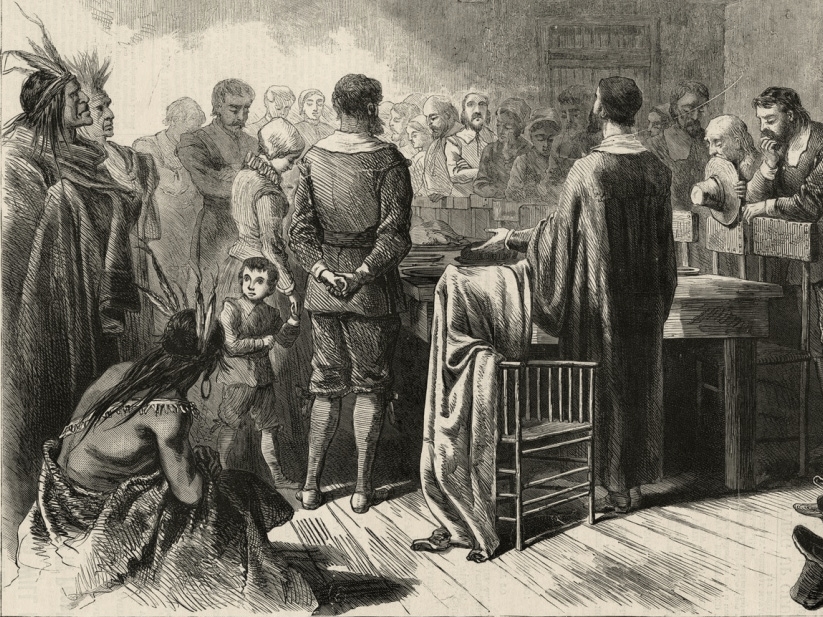
The Puritans also celebrate a day of Thanksgiving

Puritans did not celebrate Christmas … because of its non-Biblical or pagan Roman roots (Easter was their big holiday)

To the surprise of moderns, the Puritans enjoyed their beer (water was not reliably a healthy drink at the time)

Life in Boston – 1660s
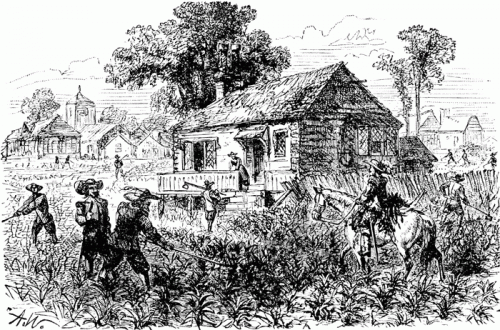
Life in the typical Puritan village
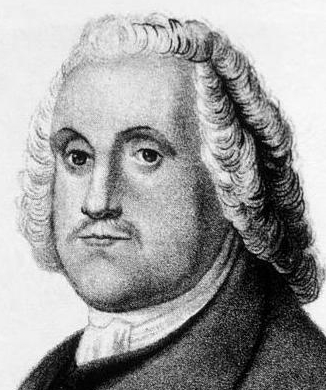 Rhode Island and Connecticut. The whole enterprise being essentially religious in character, it was natural that questions of religion and society would develop among the leaders of this enterprise themselves. At one point, Roger Williams was forced to leave the Massachusetts colony when he loudly and persistently complained about a number of ways the colony there did not meet his dramatically high idea of proper Puritan standards – first at the Boston church assigned to him, then the Plymouth church, and finally the Salem church. His constant fault-finding with the lack of proper religious purity in Massachusetts (for instance some of the Puritans had failed to repent of the sin of having taken communion in the Church of England back in the home country) threatened greatly the new-born and still very fragile foundations of the community. Tiring of his tirades, the colony’s leaders finally forced him to leave, to start up his own colony elsewhere (Providence, Rhode Island). There he could also put into service his understanding that religion and secular government ought to be treated as separate functions of the colony.
Also, Thomas Hooker requested and received leave to establish a colony of his own in the more fertile Connecticut River valley (already being settled by English immigrants) – and there build a community in which also religion and secular government were treated as separate entities.

Thomas Hooker and his followers move to Connecticut – 1636
Finally Williams came to understand the difficulties of leading a new social venture when he ran into his own troubles with the rowdies who moved to his colony to avoid the disciplines of the Massachusetts colony, rowdies who were glad to remind him of his own words spoken earlier about political freedom amidst religious discipline! It was frustrating meeting human expectations and demands. Thus it was that Williams would increasingly look to friendship and counsel with Winthrop over leadership matters. Indeed Winthrop, Williams and Hooker would find that the path of mutual friendship and counsel served each of them very well over the years, as they took their colonies through the various challenges involved in colony-planting and development.
Troubles with Anne Hutchinson. An event involving deep contention over the running of the Massachusetts Bay Colony has today been made by “progressive” or “revisionist” historians into their unique measure of the moral character of that colony – and of Puritanism in general. We are talking about the expulsion from the colony of Anne Hutchinson. What supposedly is highlighted by the revisionists in this event is the “male chauvinism” that directed horribly not just the colony but Puritanism in general.
What is overlooked by such historians was that she was constantly and most loudly undercutting the leadership of this new and fragile colonial venture (the mid-1630s) – although not for the reason that these historians would themselves sympathize with if they would be more honest about the matter. It is claimed that she was expelled simply because she was a woman who dared to organize her own study group (including males as well as females), and to speak her mind so openly.
Actually, women holding such study groups attended by both men and women – and giving strong opinions on various matters – was not the uncommon event these historians pretend it to be. Rather, she was expelled because she loudly and unrelentingly put forth a claim that, through a prophetic voice given her by God himself, she could see clearly that all the pastors of the colony – except her beloved pastor John Cotton – were in fact serving the “anti-Christ,” the Devil himself.
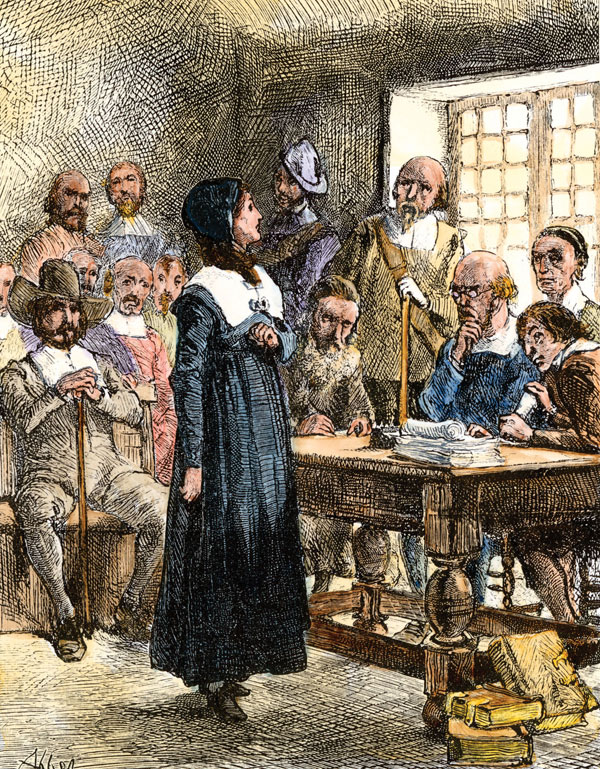
In serving as this highly negative prophetess, she had succeeded in gathering a circle of discontented souls (discontented for one reason or another), and thus threatened to split the still-fragile colony into antagonistic factions. Realizing that she was set on destroying the fragile social order holding this colony together, the authorities (including Winthrop) told her that she had to leave the colony. That punishment was mild in comparison to the damage she would have caused the colony if she had been allowed to continue her “prophetic” denunciations of the colony and its social order.
But ironically (and tragically) the curse she had pronounced on the Massachusetts colony at her departure ultimately fell on her and her family instead when, in the Dutch colony to which she eventually moved (she was even moved on from William’s Providence Colony in Rhode Island!), they were murdered in an Indian attack.
Relations with the Indians. The Indians that the English encountered were at first quite friendly, even anxious to work with the English settlers in the matter of trade (beaver pelts in exchange for English tools, for instance) and even in the hope of enlisting the English as allies in the on-going tribal conflicts among the Indian tribes themselves. And the English, in turn, were interested in bringing their precious Christian gospel to their Indian neighbors – eventually even creating communities of “Praying Indians” who joined the English in taking up for themselves the Christian faith.

John Eliot preaching to the Natick Indians
But ultimately tensions would grow between the Indians and the English over the matter of land rights, as English settlers pressed onward into the Indians’ hunting lands. The English did not understand that the woods that housed the animals the Indians hunted were not open land just waiting for human settlement and agricultural development. These were well-fought-over tribal properties vital to the survival of the Indian hunting societies. Conflict thus eventually developed.
At first these conflicts tended to be merely local, although still a matter of life and death for those involved. Such was the case of the conflict with the Pequot tribe (1636) which involved both the English and their Indian allies in a war against the Pequot, which step by step became increasingly bloody for both sides as battles raged back and forth. In the end the war basically destroyed the entire tribe – whose members fled, were killed, or were enslaved.
But the bloodiest battle ever fought between the English and the Indians – bloodiest in the long history of Anglo-Indian relations because of the highest percentages of deaths on both sides during this war – took place in 1675-1676 when the once-friendly Wampanoag came under the leadership of an individual known to the English as King Philip – who went on the warpath against the huge Anglo community which now reached deeply into Indian territory (all the way to Springfield in today’s Central Massachusetts).

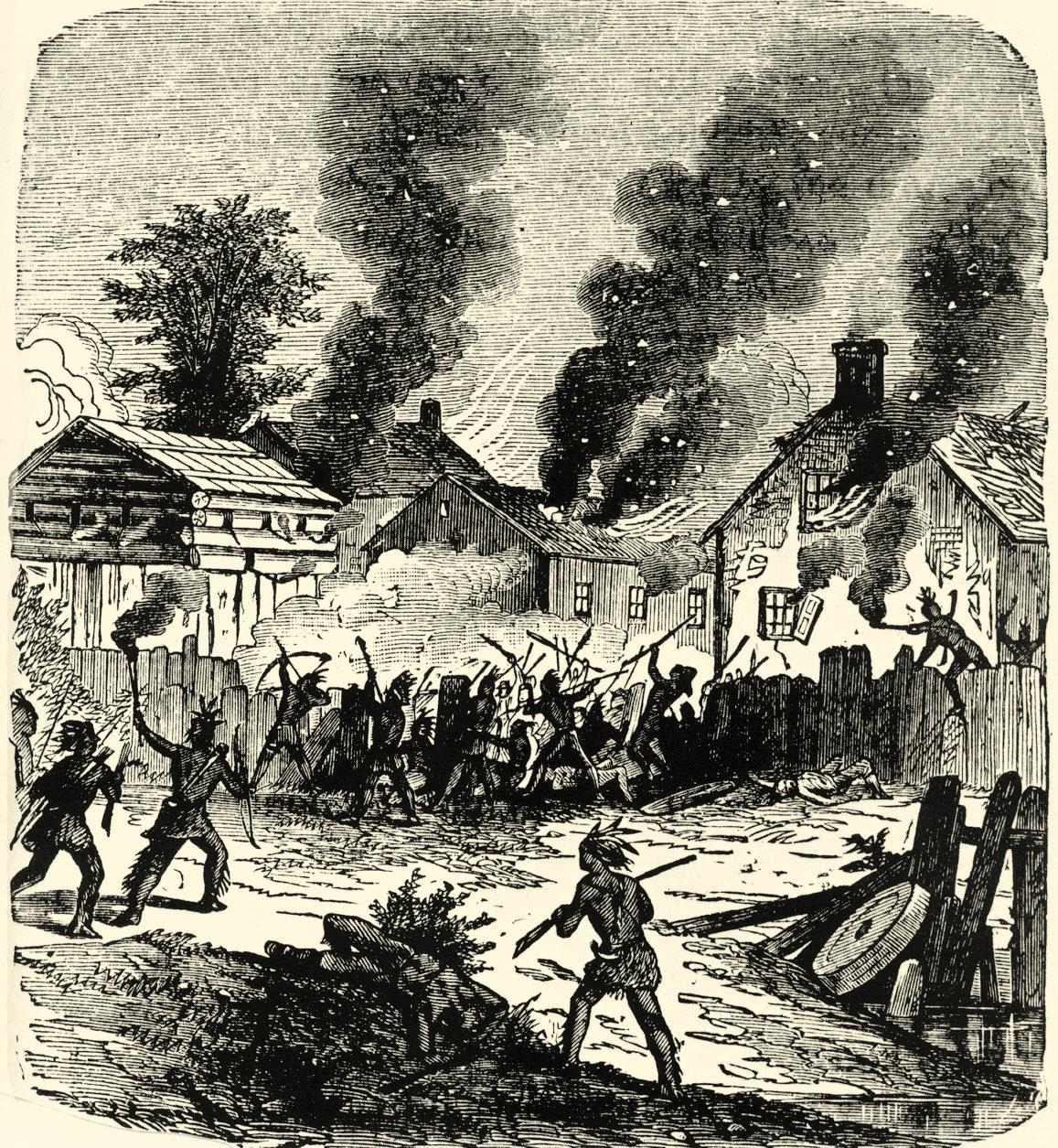
A coalition of Indian tribes at first were very successful in the conflict, burning and slaughtering English settlements everywhere – even reaching as far east as the Plymouth settlement at the Cape and the once-friendly Providence, Rhode Island (the latter which the Indians burned to the ground).
San Francisco, Sutro Library
But in the end the Indians began to receive the worst of the deal, having missed a growing season and facing a hard winter ahead of them. Indians began to surrender as amnesty was offered to those who did – starvation, disease or the possibility of enslavement or slaughter as the alternative. And little by little the war ground to a halt finally by the following August.
This was simply the early stages of a dynamic that was to continue all the way through the 1800s. The land would be fought over, as it had been since time immemorial. The Indians themselves were warriors, because it was vital to them to be able to defend the forests that they hunted for meat – against other Indian tribes seeking the same privilege.
The problem with the arrival of the European to their land was that socially and technologically, the Indians were now hugely outmatched by these new contenders for the privilege of land ownership. The Indians were a people still living at the level of early Neolithic life, whose economic mainstay of hunting and fishing was supplemented only by rudimentary levels of farming. Thus the land could support only very small, widely scattered Indian communities. The Europeans, on the other hand, were commercial farmers, capable of clearing sufficient land to produce farms able to support comparatively huge numbers of individuals. And thus it was that the European intruders into the Indians’ traditional hunting grounds would come to vastly outnumber the Indian population of the area.
Ten Europeans for every Indian killed in battle over the land would be required to keep the two different populations in some kind of balance or stalemate. And try as the Indians might, they simply were not capable of reaching such numbers in their wars waged against the intruding Europeans. Besides, the Europeans came well equipped militarily. Indian bows and arrows were serious weapons; but European muskets were just as deadly and more easily brought to skilled use by the European commoner who was less the warrior and more the farmer, but a dangerous foe to the Indian nonetheless. Also, the Indians had so long been adversaries among themselves, tribe against tribe, that it was difficult for them to find the unity necessary to offer joint resistance to the European. Indeed, at first some Indians tribes saw the Europeans as useful allies against their traditional tribal foes.
Thus it was that history was set against the Indian in this contest with the European for the land. It would be a cruel contest, cruel for both sides of the contest. But in the end, it was the destiny of the European to win this all-important battle for the land.

Indian Territories – and Indian and colonial settlements of significance during King Philip’s War – 1675-1676
Wikipedia – “Raid on Deerfield”
[4]The Mayflower Compact reads: In the name of God, Amen. We whose names are underwritten, the loyal subjects of our dread Sovereign Lord King James, by the Grace of God of Great Britain, France and Ireland, King, Defender of the Faith, etc.
Having undertaken, for the Glory of God and advancement of the Christian Faith and Honour of our King and Country, a Voyage to plant the First Colony in the Northern Parts of Virginia, do by these presents solemnly and mutually in the presence of God and one of another, Covenant and Combine ourselves together into a Civil Body Politic, for our better ordering and preservation and furtherance of the ends aforesaid; and by virtue hereof to enact, constitute and frame such just and equal Laws, Ordinances, Acts, Constitutions and Offices, from time to time, as shall be thought most meet and convenient for the general good of the Colony, unto which we promise all due submission and obedience. In witness whereof we have hereunder subscribed our names at Cape Cod, the 11th of November, in the year of the reign of our Sovereign Lord King James, of England, France and Ireland the eighteenth, and of Scotland the fifty fourth. Anno Domini 1620.
[5]Today’s Secular-Humanist historians mention only that the Pilgrims came to America to find freedom, as if this were some Hippie venture. They fail to mention that the Pilgrims came to find the freedom to worship God the way they knew God expected of them. Religious freedom is thus not mentioned, only freedom, as if that alone (with no greater purpose behind such freedom) would have led these Pilgrims to stake their lives on such a dangerous venture.
[6]This is why Harvard College was founded in 1636, only six years after their first arrival in America. They needed pastors faster than what Cambridge University back in England was able to provide them. Note that Virginia would not take similar action until 1693 when the College of William and Mary was established, in part finally to train Anglican priests.
THE FOUNDING OF THE ENGLISH PROPRIETARY COLONIES
Maryland. At about the time New England was being settled for religious reasons, so was Maryland – except for the opposite reason in the religion category: as a refuge for Catholics wanting to escape Protestant England.
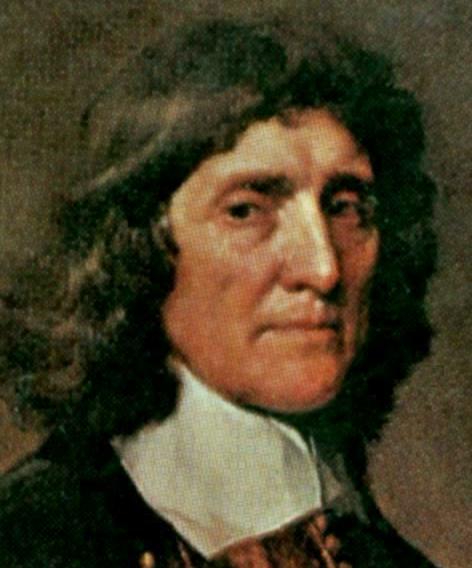 George Calvert (Lord Baltimore), a recent English convert to Catholicism, saw a double opportunity in securing land in America, both as a way to enrich his family fortunes and as a religious refuge for fellow Catholics. In 1629 he petitioned Charles I for a tract of land in which to establish a settlement along the Chesapeake Bay just north of Virginia [he had given up on a similar venture in Newfoundland because it was simply too cold there!] – but died before a land grant was awarded him by the king. His son Cecil then took over the project, receiving a royal charter in 1632 – despite the opposition of the Virginians who claimed the same land as part of their colony.
Calvert needed thousands of settlers to make the colony pay for itself, so he made settlement available also to English Protestants – at first mostly Church of England (non-Puritan) “Anglicans” – who would actually outnumber the Catholics, even from the very beginning. Thus Maryland was always officially a religiously tolerant colony, open to settlement by anyone, regardless of religious affiliation (Catholic, Anglican, ultimately Puritan, and eventually even Quaker).
The venture, beginning with only a couple of hundred English settlers in 1634, started off smoothly, with no starving time or trouble with the local Indians. In the area where the Marylanders first laid out a town (St. Mary’s) the local Indians befriended them because they themselves were in need of allies against their own Indian enemies. The Indians sold them the land they first settled and also corn to feed the colony. And soon the rich Maryland soil had the Marylanders producing enough food to easily feed the colony.

Maryland Historical Society
And Calvert was quick (1635) to grant his settlers a voice in colonial affairs with an assembly that operated much like the colonial assemblies of Virginia and New England.
Indeed, in most respects Maryland differed very little from its neighboring colony next door (Virginia). Tobacco was the main crop, at first worked by indentured laborers – and then over time by slaves. The colony was dominated by an aristocracy, set up from the outset by the Calverts, who gave large land grants to family members and fellow English gentry. This, as in Virginia, created in Maryland a distinct upper class that stood socially far above the common dirt farmers who then came to Maryland as indentured workers.
More proprietary colonies in America resulting from the Stuart Restoration. The Restoration of the Stuart monarchy in 1660 – after the failure of the Puritan political experiment in England itself in the mid-1600s – was accompanied by shows of great gratitude by Charles II son of Charles I (the former who had been beheaded by the English Puritan army in 1649) who simply paid his political debts, or just demonstrated the size of his gratitude, by awarding huge grants of land – full colonies actually – to various noblemen who had supported him during his exile and then his coming to the throne. Berkeley, for instance, who had been dismissed as Virginia governor during the period of the English Puritan Commonwealth, was restored as Virginia’s governor. But there were more, many more, acts of royal gratitude.
The Carolina colony – and Shaftesbury as its cultural-spiritual leader. In 1663, soon after his coming to the throne, Charles II granted a group of English noblemen (which included also Berkeley) a huge section of land to the south of Virginia – in theory reaching all the way to Spanish Florida. The land was termed “Carolina” in honor of Charles’s father, Charles I (from the old Latin name from which Charles derives, Carolus).
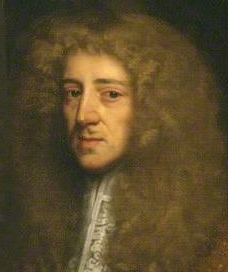 Taking the lead in this venture was another outstanding (and unusually virtuous – at a time when being virtuous could be politically very dangerous) Founding Father, Anthony Ashley Cooper, Earl of Shaftesbury. Although nobly born, he was orphaned at an early age, but raised by relatives through the normal noble path, graduating from Oxford and becoming a lawyer and even (at age 18) Member of Parliament. But he was of a cautious nature, rather realistic in his refusal to enter the intense ideological squabbles going on at the time. Originally, he was a supporter of Charles I, until one of Charles’s generals plundered a Puritan town that Cooper himself had negotiated peaceful surrender terms – shocking and grieving Cooper deeply – who at this point went into some kind of political retirement. But Cromwell called him back to service as a member of his new Commonwealth’s Council of State, where he trod cautiously the path between the contending sides, doing his best to keep the peace among the groups. With Cromwell’s death in 1568 Cooper was brought, now as “Lord Ashley,” into the small group negotiating the return to the throne of the Stuarts – which brought him huge favor with King Charles II, membership on the king’s Privy Council, eventually appointment as Chancellor of the Exchequer (Treasury, and second most important position on the king’s cabinet), and ultimately selection as one of the proprietors of the Carolina colony.
 As the individual taking the lead in developing the Carolina colony so as to best serve its settlers, he enlisted the help of the famous English social philosopher and personal friend (and personal in-residence physician), John Locke. He asked Locke to design a legal order for the colony, one that would make it a shining example of a society based on human reason rather than on just religious or political interests (the kinds that were tearing England apart at the time).
Remember, it was the second half of the 1600s and the time of the Enlightenment or “Age of Reason,” and “natural philosophers” supposed that they were coming into a full understanding of the precise mechanics of life. Thus supposedly, with some careful investigation into the matter, they could actually construct a social system of a high degree of human perfection, while sitting at their desks simply contemplating the matter! Thus it was that Locke mapped out a Carolina colony in which, among other things, individuals would receive a varying amount of property-rights on the basis of their social status – English philosophers such as Locke being certain that property ownership, as in feudal times, was the key to social stability and efficiency (which indeed, at least in part, it is!).
As it turned out, of course, Locke’s design had to be scrapped when reality struck: the varying lay of the land, the varying quality of the soil, and the problems of finding defense against highly resistant Indians, made for a reality which did not submit well to the beautiful plans of “enlightened” Idealism.
As for Ashley (soon to be named as the Earl of Shaftesbury), he continued to find himself in the middle of a very bumpy political world, especially after he played a leading role in creating the Whig Party,[7] infuriating the arch-royalists – the Tories – in the process. He would be arrested (1681), flee England (1682), and would die in Amsterdam early the following year, because this was one issue he simply could not find the path of political reconciliation to go down.
But as for the Carolina colony that he had given so much of himself to get started on solid ground, it did prosper. The harbor at the Charleston site proved economically advantageous in its service to the rural hinterland – and individuals of all sorts of cultural background flocked there – including a good number of French Protestants (Calvinist Huguenots) chased out of France when in 1685 King Louis XIV revoked the Edict of Nantes, the century-old promise of Protestant rights in France.
Thus Charleston became the South’s first true city.
New York. Another such proprietary colony awarded by Charles was New York – part of the former Dutch colony of New Netherland. While the English had earlier been settling the areas of Virginia and New England, the area between these two English regions had been explored and settled in the 1620s by a Dutch commercial company which sent settlers north up the Hudson river and east across the Long Island to trade with the Indians for their wealth in fur – and to develop the region as Dutch territory.

The centerpiece of Dutch New Netherland: “New Amsterdam” (today’s New York City )

A 1660 map of Dutch New Amsterdam showing Wall Street and the Bowery (“Farm”) to the right
British Museum, London
After the Stuart Restoration in 1660, the Dutch and English – though both Protestant – found themselves deeply engaged in commercial wars – and Charles II’s brother James, Duke of York, headed the naval command that seized New Netherland from the Dutch in 1664.
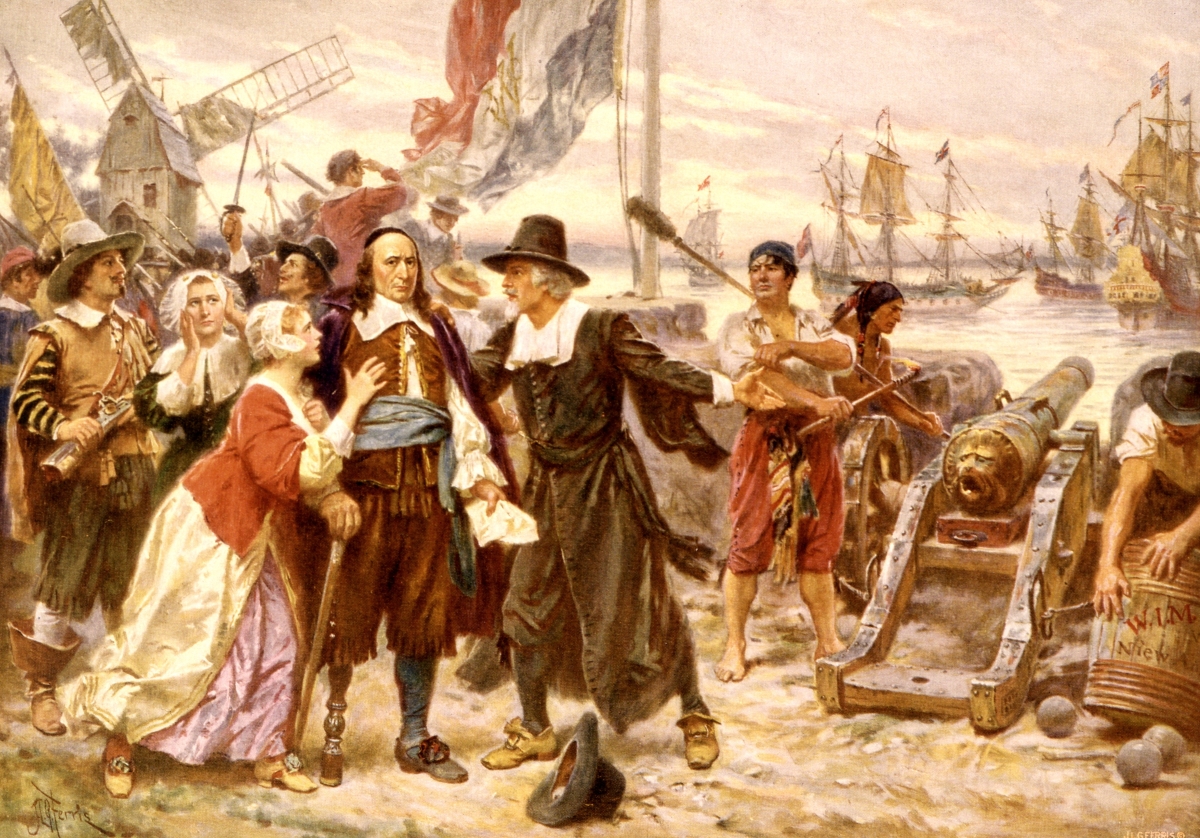
Dutch Governor Stuyvesant being urged to surrender
For his services, Charles granted James proprietary rights to the Dutch colony – as his “New York.” However, during subsequent Anglo-Dutch wars, the Dutch colony changed hands between the English and Dutch several times. Finally, in 1674, the colony came permanently into James’s hands.
James never visited his American colony, but governed it through a series of appointed governors – and eventually (1683) an elected Assembly. But by and large the New York colony, with strong Dutch Protestant roots and a variety of other ethnic and religious groups present in the colony, was quite diverse in its cultural makeup – giving the colony a very cosmopolitan character virtually from its founding.
New Jersey. What came to be called New Jersey was also part of the Dutch territory awarded to James in 1664. But he turned around and in 1665 awarded sections of this huge feudal estate to personal supporters of his own, George Carteret and Virginia Governor Berkeley’s brother John (the Carterets were also involved in the development of the Carolina colony at that same time).
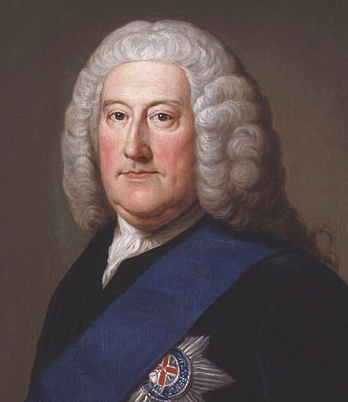
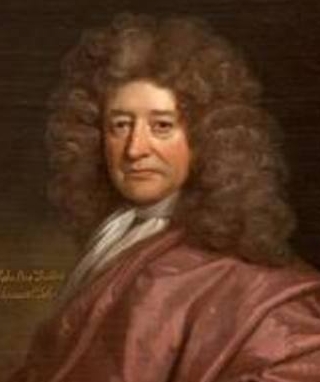
George Carteret John Berkeley
Ultimately William Penn also became part of the New Jersey project when Berkeley sold his shares to Penn, who was looking to provide a place of refuge for fellow Quakers (Penn was himself a recent convert to this new and quite unusual version of Christianity). Quakers had come under considerable attack for their peculiar ways (thus the name “Quakers” – for their behavior when they became overcome by the Holy Spirit) – and like the Puritans of New England and Catholics of Maryland, they needed a place of refuge.[8]
 Pennsylvania … and William Penn. The Penn family, besides having offered invaluable military support to Charles, had lent the Stuart kings a vast amount of money in getting the Stuart monarchy restored to power in 1660. An agreement between King Charles II to pay off that debt was finally struck in 1681 when the king’s brother James agreed to turn over to William Penn the vast lands west of New Jersey, a land the king himself named Pennsylvania (“Penn’s Woods”). Here Penn could expand his Quaker refuge – and build an ideal city, Philadelphia, the city of “Brotherly Love.”
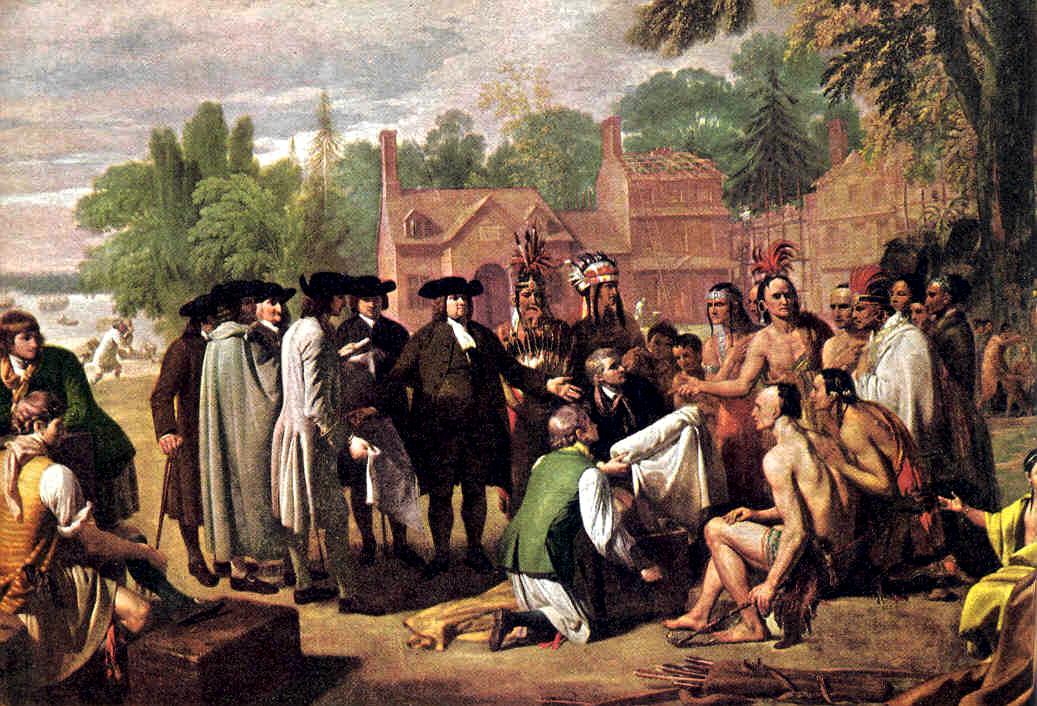
Pennsylvania Academy of the Fine Arts
However, Quakers were immediately outnumbered by other religious groups (Mennonites, Amish, Puritans, Presbyterians, Catholics, Jews, etc.). But thus it was that Pennsylvania grew as a land offering religious freedom and the opportunity for people to build their own communities as they so desired.
Behind this spiritually welcoming society was the personal sensitivity of the colony’s founder, William Penn. As a youth Penn had shown a rather strong philosophical bent, rather than an ambition to perform great military service, of which the family was highly respected (his father was a leading admiral in the royal navy, and also one of the key agents arranging for Charles’s return to the throne). But the young Penn had a heart for serving instead the poor, especially those devastated by the return of the Plague in 1665 and the Great Fire of the following year which destroyed most of London, increasing enormously the misery of the poor. This had led Penn to associate himself with the Quakers, who were offering help to exactly those devastated by these tragedies, bringing upon himself an eight-month prison sentence for his Quaker connections (the first of many such prison terms), despite his family’s own prominence.
But two things were to keep Penn’s spirits up, despite the considerable political opposition his work brought him. On his deathbed, Penn’s father acknowledged the remarkable integrity of his son, and told him never to betray what his conscience knew to be true. And secondly, at this point Penn came into enormous wealth, which Penn then put to use to promote the Quaker cause, and thus his involvement in Quaker settlement in the American colonies.
Penn would be one of the few colonial backers to actually come to his colonial holding in America to personally supervise its development, everything from the layout of his precious Philadelphia (built on a grid pattern at the junction of the Schuylkill and Delaware Rivers) to the political order (the Pennsylvania Frame of Government) which would guide the colony down its welcoming path. And he was generous in his offer of financial compensation to the Indians for the land, blessing his colony with peace with the Indians as a result.
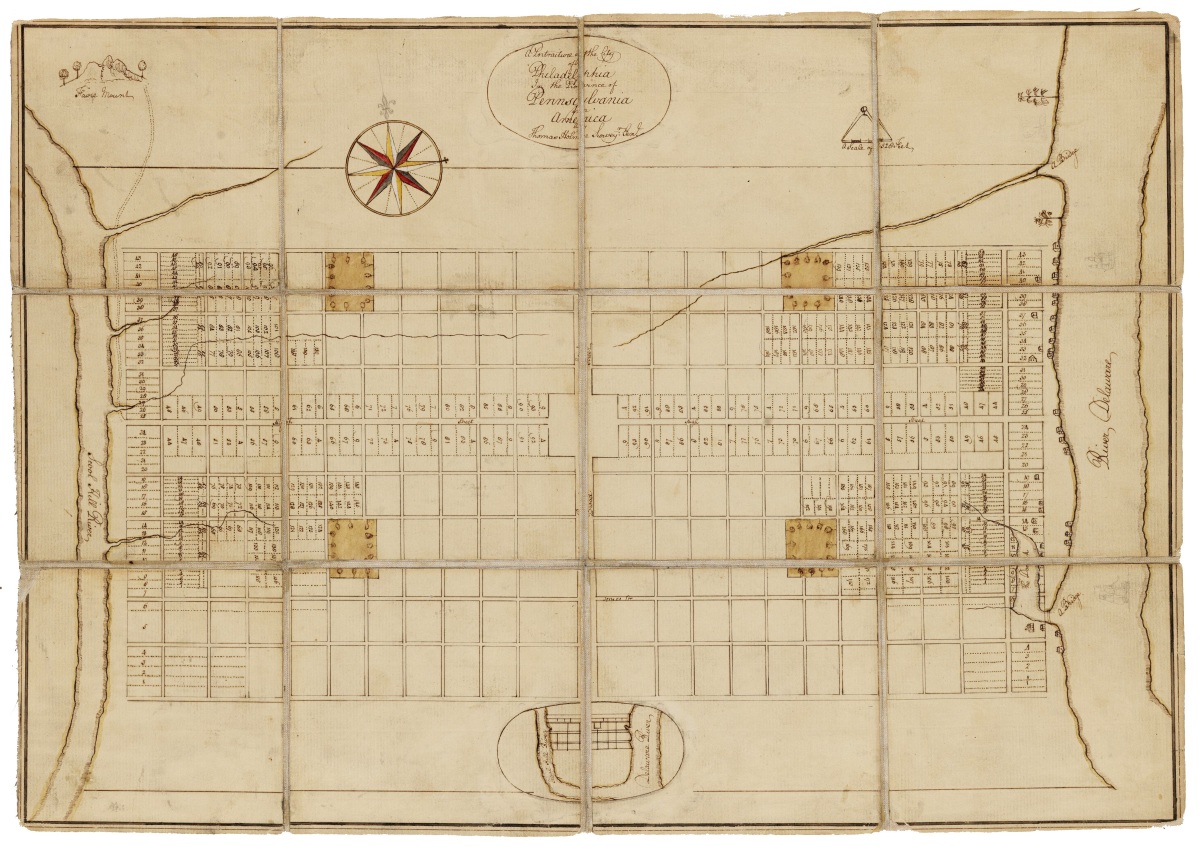
A 1683 “portrait” of Philadelphia by Thomas Holme
But sadly, the colony would not become exactly the utopia Penn had hoped for, as the Quakers could not agree among themselves as to what their religion constituted exactly, and their rivalries ultimately disrupted greatly the Quaker order Penn was trying to achieve. And tragically for the kindly and idealistic William Penn himself, his Pennsylvania proprietorship bankrupted rather than rewarded him financially – largely because he did not have the heart to collect the quitrent owed him by his Pennsylvania tenants, and because his unsuspicious nature blinded him to the fact that his business manager was stealing Penn’s earnings. This would cost him time in debtor’s prison on multiple occasions, and leave him penniless at his death in 1718 – Penn believing that his venture had been a huge failure.
Equally sadly, he would die not knowing how well his Philadelphia would serve as something of a national spiritual capital, uniting the various American colonies during the dark days (1770s and 1780s) of their struggle to maintain their independence from an overbearing English king. Nor would he know how America would quickly come to honor greatly the integrity in Penn that the country has long understood as the very groundwork of its own existence – and its larger purpose in the world.
Thus it was that Penn’s colonial venture contributed greatly to the growing notion that America was a land not of government restriction and social-cultural conformity, but of true opportunity for those willing to come and work hard to build their own world – in full cooperation with others of different political and religious ideals. So he too helped greatly to make America a “City on a Hill,” a “Light to the Nations.”
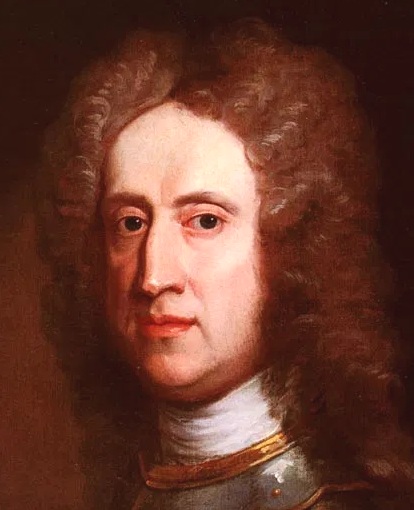 Georgia – the last of the major English colonies in America. Georgia, named after England’s King George II, was founded in 1732 as a proprietary colony assigned to a group of English philanthropists. Most important among them was General James Oglethorpe, who personally had taken an interest in England’s prisons and sought a colony in America that offered debtors a chance to leave prison in order to start a new life and come out of debt. It would also serve as a military colony buffering the Carolinas from Spanish Florida.
Actually very few debtors made their way to the colony – although others came there for numerous reasons, including religious reasons (Georgia too took a very non-restrictive view on this matter of a person’s religion).
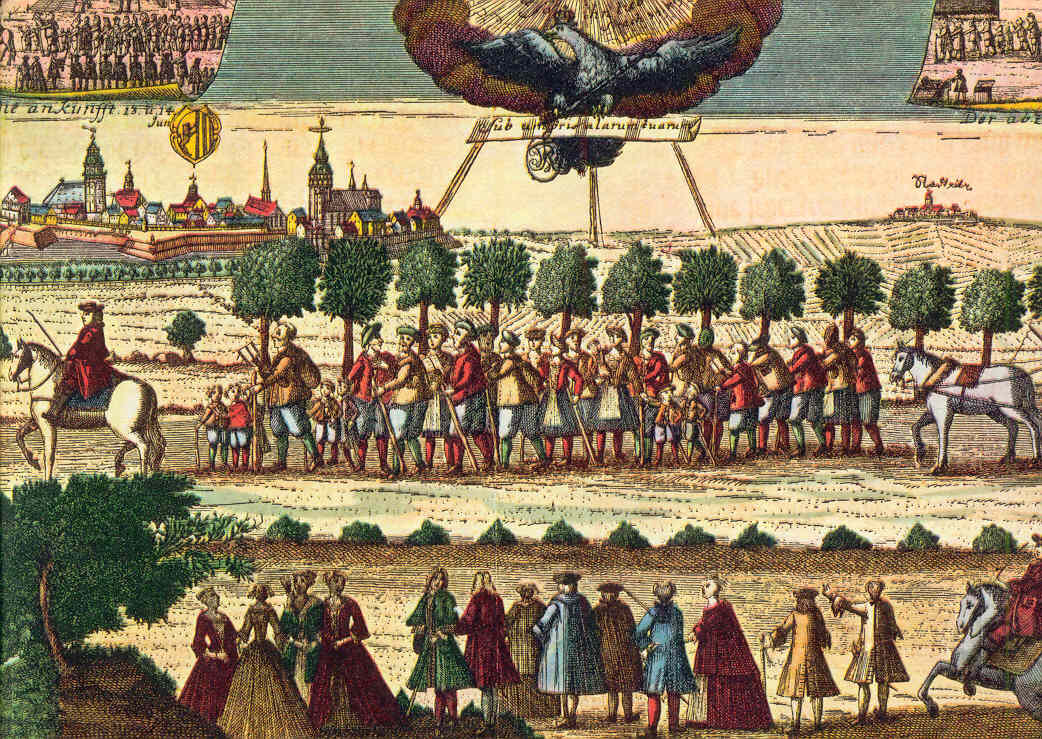
New York Public Library
However Georgia would also follow the Southern trend to build its society on the Virginia model – idealizing the lifestyle of huge rural plantations cultivating tobacco (and other farm products) by companies of African slaves, the whole thing presided over by a small, but highly privileged local aristocracy.
Yet the colony did provide the South its second city after Charleston, an Atlantic port named Savannah – located at the mouth of the Savannah River and well laid out on a beautiful grid pattern.
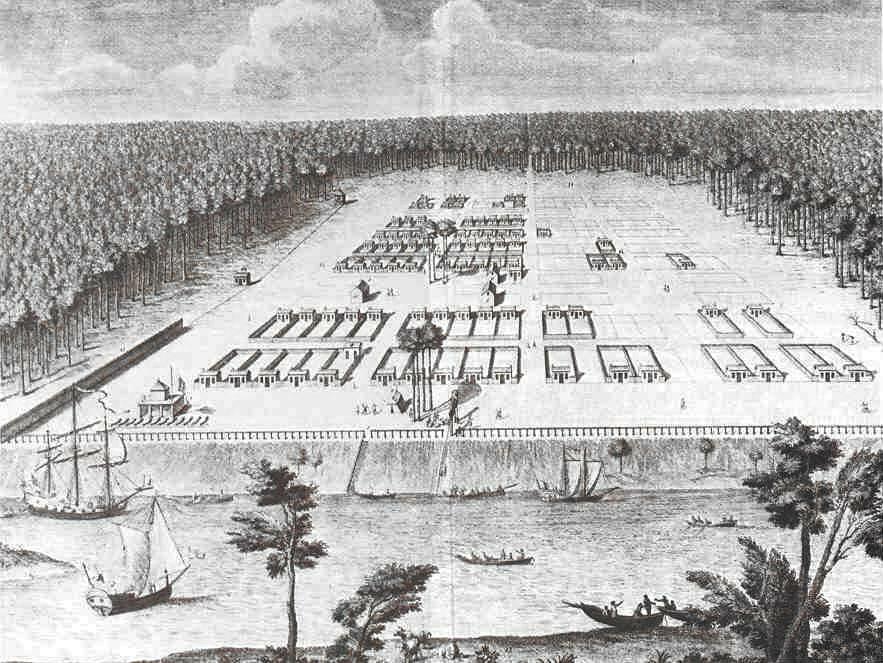
Savannah – 1734
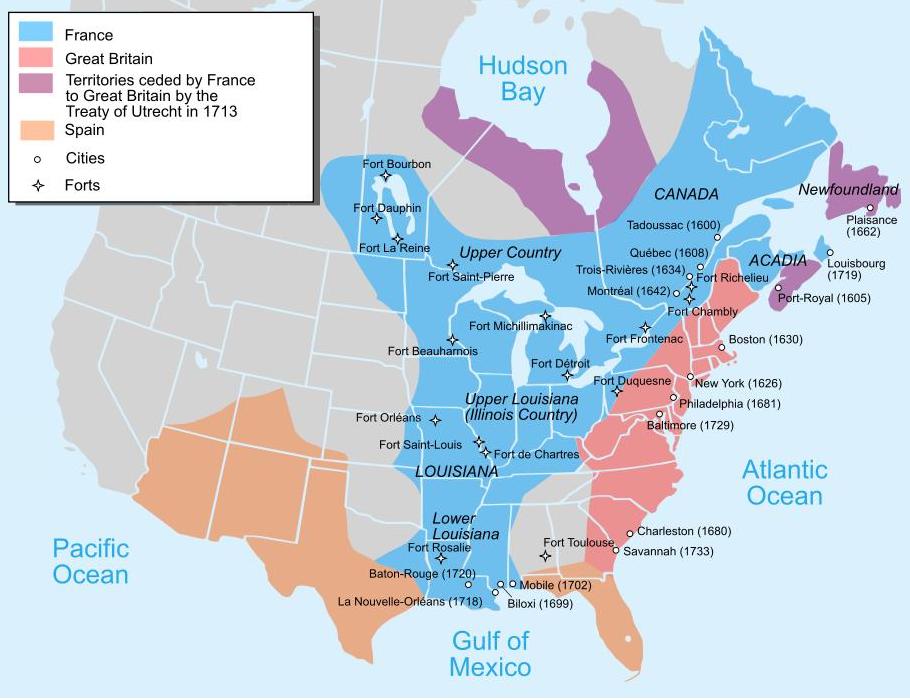
Colonial boundaries as of the 1713 Treaty of Utrecht
Wikipedia – “Colonial history of the United States”
[7]Shaftesbury and his fellow Whigs precipitated the Exclusion Crisis when in 1679 they introduced into Parliament the Exclusion Bill, in the attempt to block the pro-Catholic James’s future accession to the English throne. The Whigs were also demanding that royal authority be placed under the discipline of a written constitution, a shocking idea in the days of royal absolutism. Opposing the Whigs were the Tories, supporters of James and defenders of the doctrine of royal absolutism.
[8]The Quaker movement was started up in the mid-1600s by an English shoemaker and shepherd, George Fox, who did not believe in original sin (nor the need for the atoning death of Jesus on the cross), but instead emphasized the divine favor awaiting any person who simply sought the “inner light” that God had placed in each and every person, letting that inner spirit lead that person to righteousness. Clergy were unneeded in this process, only communal gatherings at which one or another person was moved to speak whenever led to do so by that inner spirit.
This approach to Christianity deeply upset many “normal” Christians, although interestingly Cromwell found himself sympathetic to and thus protective of the Quakers during the reign of his Commonwealth (the 1660s). This was when Penn joined the group. And in America, Providence colony leader Roger Williams accepted this group into his colony, where they soon came to make up half the population – the other half being mostly Baptists (Puritans opposed to the idea of infant baptism, because to the Baptists, baptism signified a quite adult decision to follow Christ).