CONTENTS
 The colonies mature, and wander spiritually
 The American “Great Awakening” of the mid-1700s
 The war to confirm American independence (1775-1783)
 The young American Republic
 The American and French “Revolutions” compared
The textual material on this webpage is drawn directly from my work, America’s Story – A Spiritual Journey © 2021, pages 69-100
THE COLONIES MATURE, AND WANDER SPIRITUALLY
Bacon’s Rebellion in Virginia (1676). Soon after the Stuart Restoration in 1660, Virginia fell under the spell of a young English aristocrat, Nathaniel Bacon, a recent arrival to Virginia – who was ambitious and had plans of his own to take charge of the Virginia colony. He cultivated the land hunger of landless Poor-White Anglos and the bitterness of Anglo frontiersmen who felt that Governor Berkeley was uninterested in the problems they faced from the fierce Indian wars on the frontier (Berkeley was known to try to keep the peace between the English and the Indians – rather than solve the matter by driving the Indians from their lands).
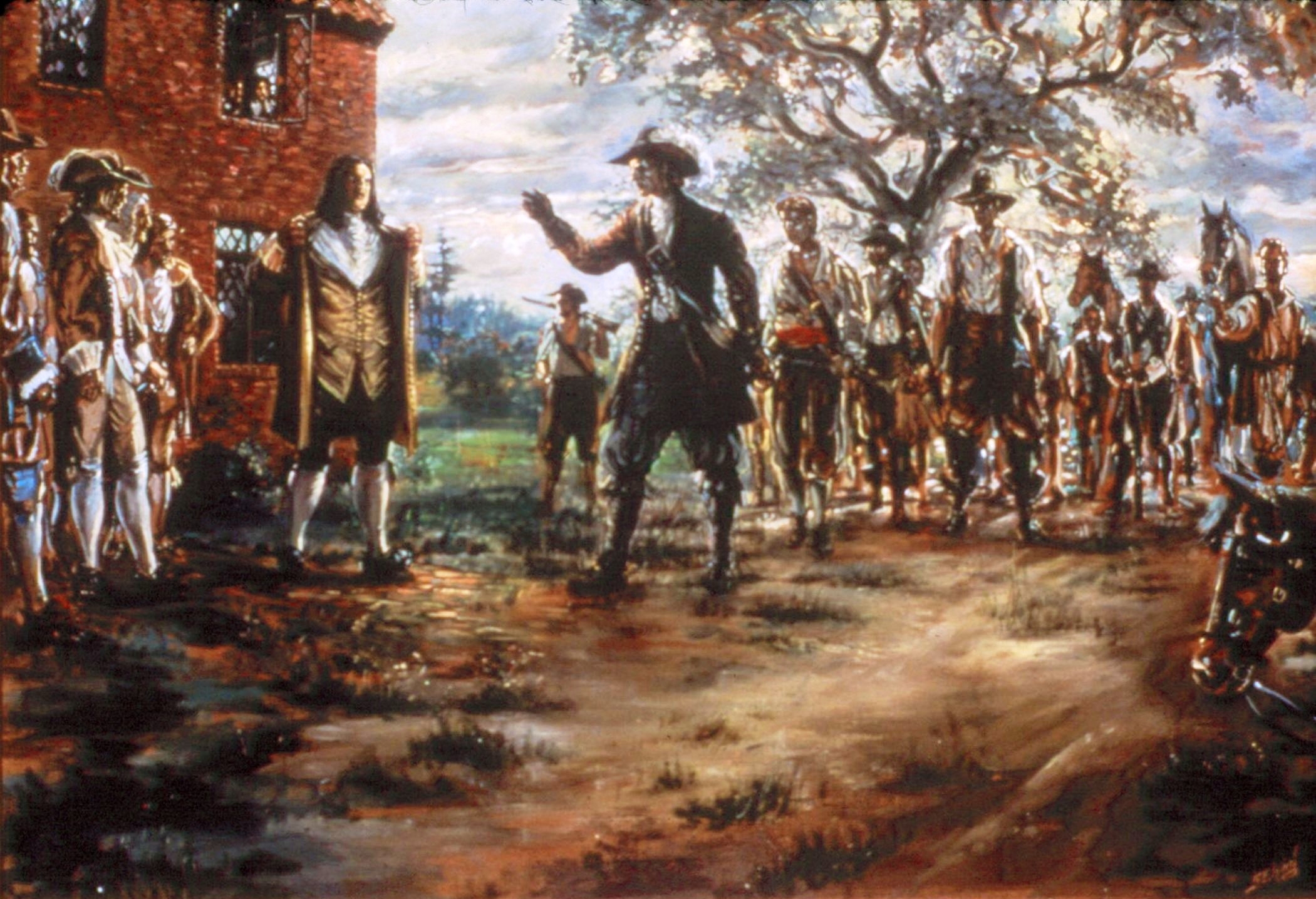
Then in 1676, in disobeying Berkeley directly by attacking friendly Indians whose land the Anglos wanted, Bacon was arrested and imprisoned, only to have Bacon’s supporters break him free – and start a rebellion. Bacon’s militia burned Jamestown to the ground.
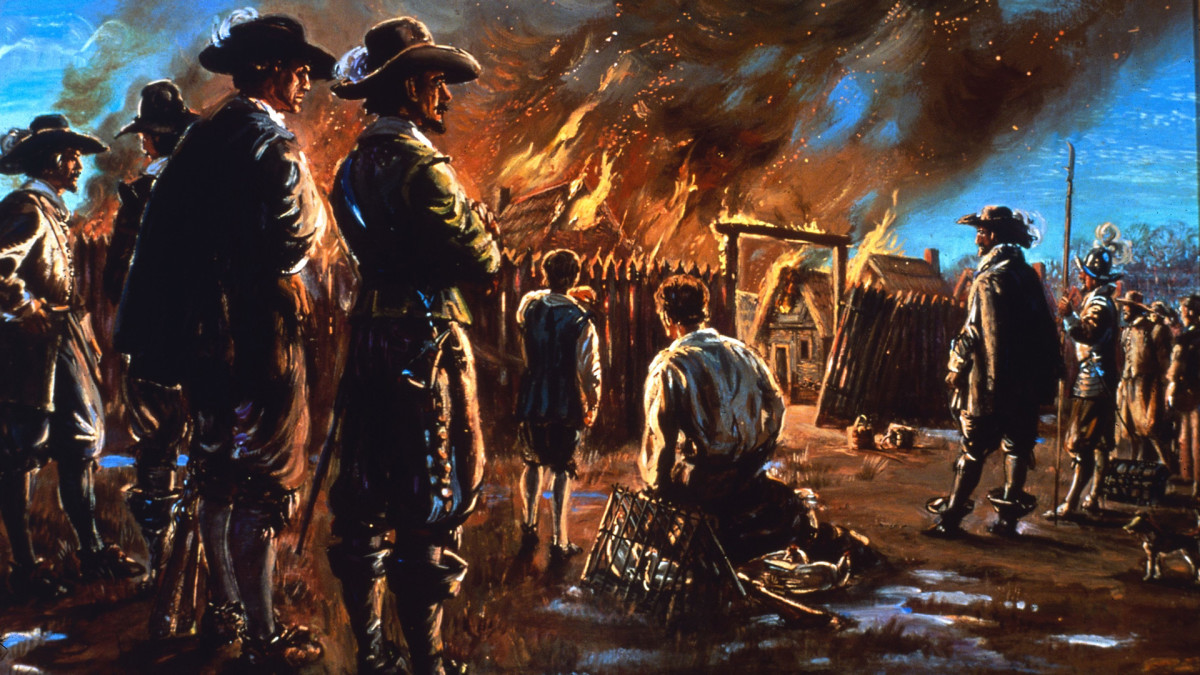
And then suddenly Bacon developed a fever and died, and the rebellion fell apart.
The move from indenture to slavery. The fallout from this incident was that the Virginia aristocrats were so unnerved by the anger of the rebels that they now lost interest in indenture – and moved to use fully slave labor instead – mostly African.
Up until that time Africans had been brought to Virginia largely as indentured workers (like the English, Scots, Germans and others). However, the much more passive Africans tended to stay on – and then their children after them – even generation after generation – because free life on the frontier seemed more dangerous than simply staying on with the masters of the plantations. Thus step by step, Africans and their offspring found themselves locked into a state of total dependency on their masters – which ultimately became outright slavery.
At the same time, the business of the purchase, shipping and sale of African slaves (brought down to the African ports for sale by tribal enemies) was becoming quite extensive, making slavery in America an option in lieu of indenture.
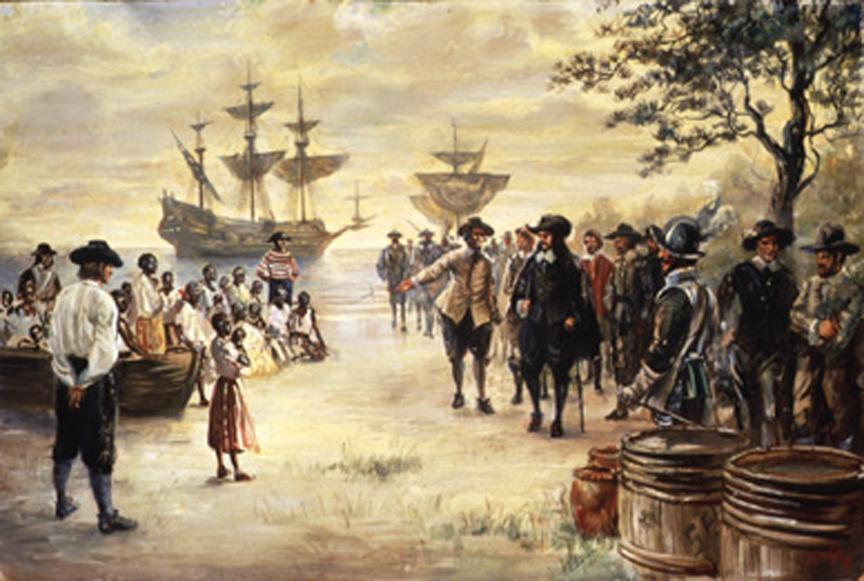
It should be noted that the sale of people as slaves was not a shocking practice at the time, reaching back to the dawn of history – and long practiced not only among Europeans (and Arabs) but also even among the Indian tribes – and as well as the tribes of Africa. Actually, in Virginia slavery as an institution had been recognized as a permissible institution only in 1654. In any case, after Bacon’s Rebellion in 1676, the move to slavery was more deliberate (fully defined in the Virginia Slave Code of 1705) on the part of the Virginia aristocracy, as slaves seemingly presented less danger of future rebellion – although not completely, for the fear of that too was always somewhere in the minds of the slave-owners.
The cooling and wandering of the Puritan spirit. Meanwhile, up in New England, Puritan society was following a pattern well described in the Bible as having occurred regularly with the ancient Israelites: a fervently religious generation that looked to God for support in a great struggle for survival, being followed eventually by future generations that fell away from this affection, feeling that they themselves were in full control of their world and no longer in need of the protection or even the counsel of God. This was proving to be exactly the case for Puritan New England as well.
Whereas Williams’s Providence Colony and Hooker’s Connecticut Colony had built their social orders on the idea that the realm of religion and the realm of politics were to be treated as separate items (mostly so as not to pollute the religious ideals with political corruption) the Massachusetts Colony had insisted that full religious standing as true believers was absolutely necessary to ensure that those who had political or civil responsibilities carried those out in a truly Christian fashion. Thus civil rights and responsibilities were based on a person’s ability to demonstrate to the community their full standing as Christians.
However younger generations of Puritans, who found life much less challenging, and thus the need for Puritan discipline not terribly necessary, just simply did not measure up to Puritan standards, both religious and civil, appearing even to be uninterested in achieving such a goal. The colony by the 1660s was thus in a quandary about how to answer this situation of mounting spiritual indifference. Thus the old Puritan leaders came out with the idea of a compromise of sorts, in which “partial” church membership could be offered to the rising generation, sort of an internship in which some civil responsibilities could be assigned to the individual pending the ability of that person to demonstrate sufficiently full Christian standing, sort of a “Halfway Covenant” with the community and with God.
But over time either the ability to give proof of such merit was just not forthcoming, or simply there was little interest in taking up the challenge coming from the members of the younger generation. In short, the Puritan spirit was cooling and dying. Massachusetts was, like Israel of old, going through a time of spiritual wandering. The younger generation just did not “walk with God” the way the older Puritans had.
Christian “enlightenment.” On top of that, towards the end of the 1600s and into the early 1700s, many of the leading intellectual voices in the “Christian” world itself (both back in England and there in the American colonies) were looking more to Human Enlightenment or Human Reason than to God to solve life’s problems. Also, Unitarianism, even Deism, was infecting the upper reaches of the English religious hierarchy.
Thus for instance, the very head of the English Church, the Archbishop of Canterbury, John Tillotson, portrayed Jesus not as the atoning sacrifice for sinners but instead as the great moral example that reasonable people would want to follow in order to achieve righteousness. And others, such as the popular author, Matthew Tindal, in his book Christianity as Old as Creation, advised Christians not to put much stock in the Bible’s stories of miracles and other non-scientific stories, and instead focus on developing the moral instincts that are to be found in all men, and ultimately in all religions.
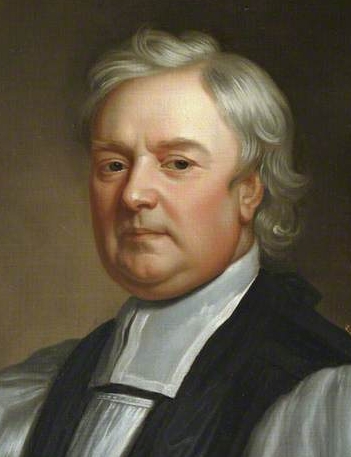
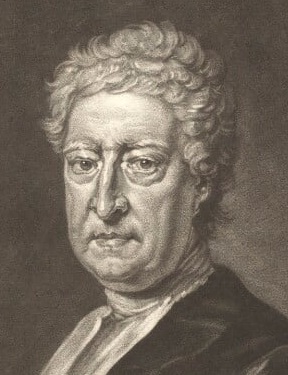
John Tillotson Matthew Tindal
The Salem witch-scare. This decline of the Puritan spirit did not mean that the colony had been delivered from all serious problems. It is just that as the Puritan spirit had grown legalistic and stale, many of the less intellectually inclined New Englanders tended to look to more primitive religious instincts for spiritual relief, such as a belief in witches and warlocks.
At this point the rocky soil of New England had been overworked by New England’s rapidly expanding population – and the deep and dark fear of another Indian attack had not yet left the hearts and minds of the New Englanders. Thus it was very easy for nervous New Englanders to look to the works of the devil and demons as the logical explanation for the recent round of crises hitting the colony.
Very famous today is the Salem witch-scare of 1692-1693 – told as a rebuke to Puritanism, in an effort to show how degrading such religious superstition as Puritanism can be. The only problem with this theory is that this tragic event resulted not from Puritanism – but from the very loss or lack of the original Puritan spirit.
It is indeed a very tragic mark on the social record of New England how the prank of a few schoolgirls turned the town hysterical in fear of witches everywhere – resulting in the execution or just death in prison of some twenty-four people breezily accused of this practice.
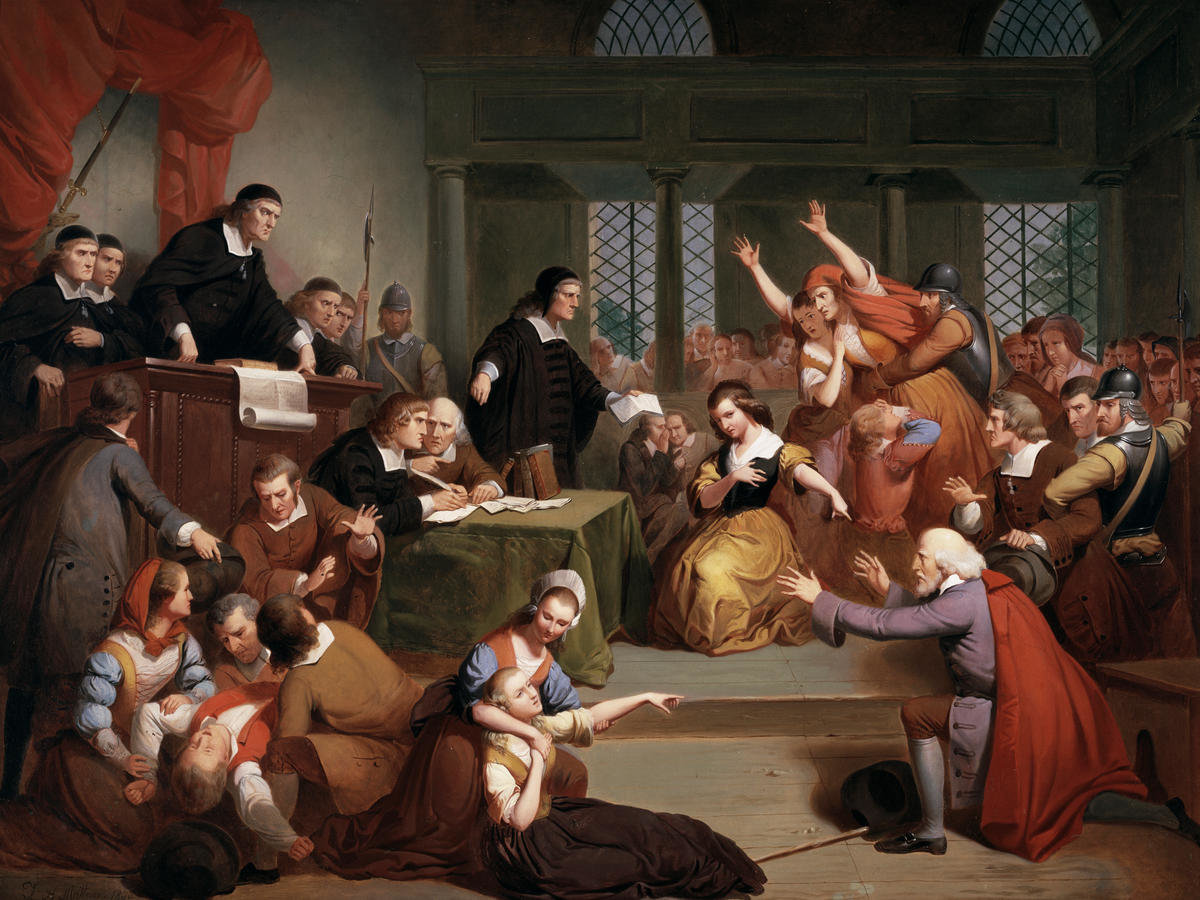
The event was finally brought to a halt when the Puritan authorities in Boston stepped in to stop the whole affair – an important detail usually left out of the modern anti-Puritan (or anti-Christian) narrative. Also the larger context of the times is not mentioned – because much of the West, including enlightened France and newly emergent Sweden (which were hardly Puritan) were also caught up in the same witchcraft hysteria at the same time, and to an even greater extent.
This American horror resulted because the guidance of the Christian faith was being put aside for newer, more rational or “reasonable” thinking. But Reason can go in any number of different directions. Witchcraft had its own way of becoming a reasonable assumption about life, as it also seems so today in modern popular culture where interest in witches is considered cool or cute.
THE AMERICAN “GREAT AWAKENING”[1] OF THE MID-1700s
By the early years of the 1700s pastors were complaining about their empty churches, Christians entering church doors only to participate in the annual Christmas and Easter celebrations – or even just weddings and funerals when absolutely necessary.
Then without warning, a great wind of spiritual enthusiasm swept through the colonies (also parts of England and continental Europe) in the 1730s and 1740s – which brought forward a number of preachers (such as Theodorus Freylinghuysen, Gilbert Tennent, Jonathan Edwards, and George Whitefield) in support of this new development
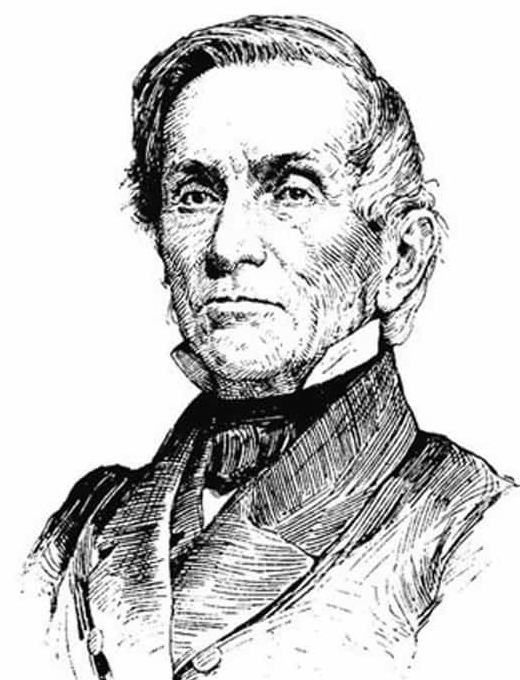 Freylinghuysen, Tennent and Edwards. This spiritual “awakening” actually started rather quietly here and there in the colonies, for instance in the Dutch-cultured Raritan Valley region (New Jersey) where, beginning in the 1720s, Dutch Reformed pastor Theodorus Freylinghuysen preached a form of pietism (similar to the Puritans), calling on his people to examine their lives deeply, and take careful note of where their lives stood in relationship with God in Jesus Christ. In doing so, he was able to reach deeply into the hearts of what soon became a growing congregation, fanning the flames of Christian revival – which others began to take note of.
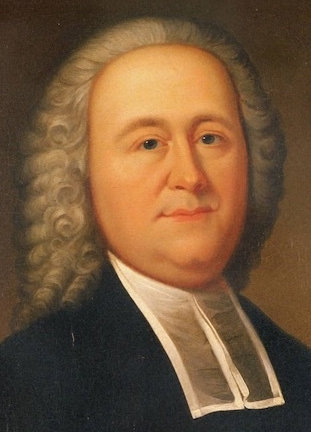 One of those was the young Presbyterian minister, Gilbert Tennent, pastoring a church in nearby New Brunswick. Tennent picked up Freylinghuysen’s message (the two often preached in each other’s pulpits), and Tennent began to have his own impact in bringing a growing number of people to Christ. Something was clearly stirring here.
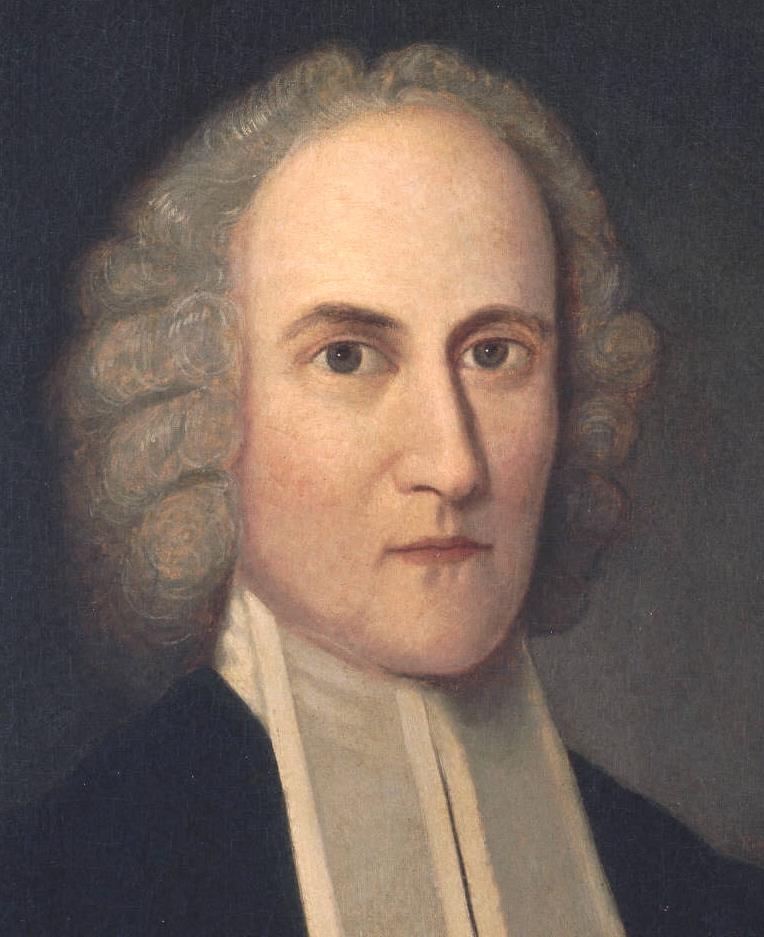 That same spirit was to reach also into New England, where a young and very scholarly Jonathan Edwards, in taking over his father’s pastorate in Northampton (Massachusetts) in 1729, began to take a similar interest in awakening his congregation to the need to look deeply into their lives and see where sin had blinded them and cut them off from God’s powerful grace. Calmly, but steadily, he got this message across to his congregation, until by the winter of 1734-1735 it was quite obvious that his message was stirring deeply the hearts of a growing congregation. Clearly a spiritual awakening was underway in Northampton.
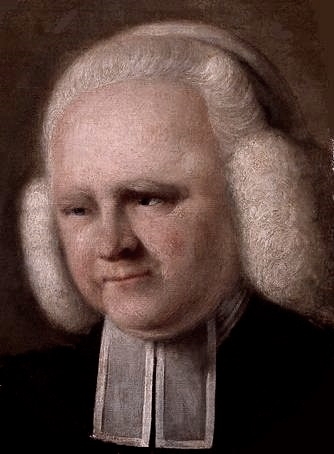 George Whitefield. Then the dynamic seemed to begin to stall somewhat, only to get underway again with the arrival of George Whitefield to America at the end of the 1730s. Whitefield would preach a message of spiritual revival which would reach deeply into the hearts of Americans, from Georgia in the South all the way north to Maine.
When Whitefield was a student at Oxford University, he befriended Charles Wesley, who in 1733 invited him to become involved in his brother John’s Holy Club … the “Methodists,” as they were contemptuously called by fellow students – because of their efforts to discipline themselves to a life of holiness. But try as Whitefield might, he just could not achieve the holiness he craved, and finally crashed spiritually, only then to be filled by a strange new spirit, which he recognized came solely from the grace of God, not from Whitefield’s own efforts to be holy. This discovery would stand at the basis of everything Whitefield was to teach and preach from that point on.
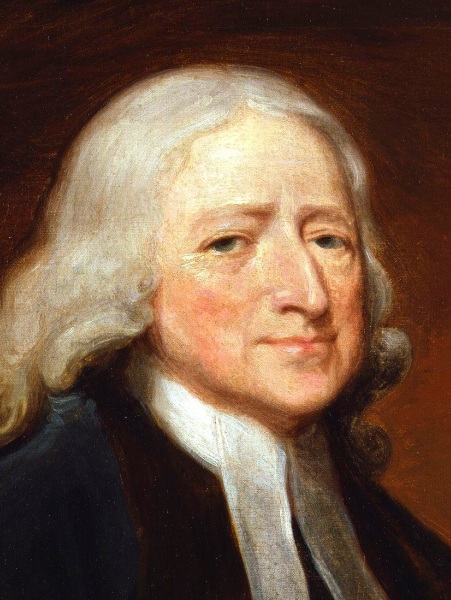

John Wesley Charles Wesley
Finally ordained to pastor the area of Bristol (England) in 1736, he found that his message of immediate salvation through simple repentance before God was touching the hearts of the British working classes, the way the doctrinal and ritualized pattern of Church of England worship did not. Soon Whitefield had a huge revival ministry going on in England, even in its fields and streets.

But in 1738 he felt called to go to the new colony of Georgia, where, once there, he took a great interest in building an orphanage (his Bethesda Orphanage). Thus after a short stay in Georgia, he returned to England to raise funds for his orphanage project. To raise that money (and bring his listeners to salvation at the same time), he took his preaching wherever he could, to churches, or, as back in England, to the streets and fields if necessary. This very unorthodox method of preaching to the masses gained him a great deal of attention, both positive and negative. Thousands would come out to hear his preaching, falling into tears of repentance and calling for God to retake the lead in their lives.
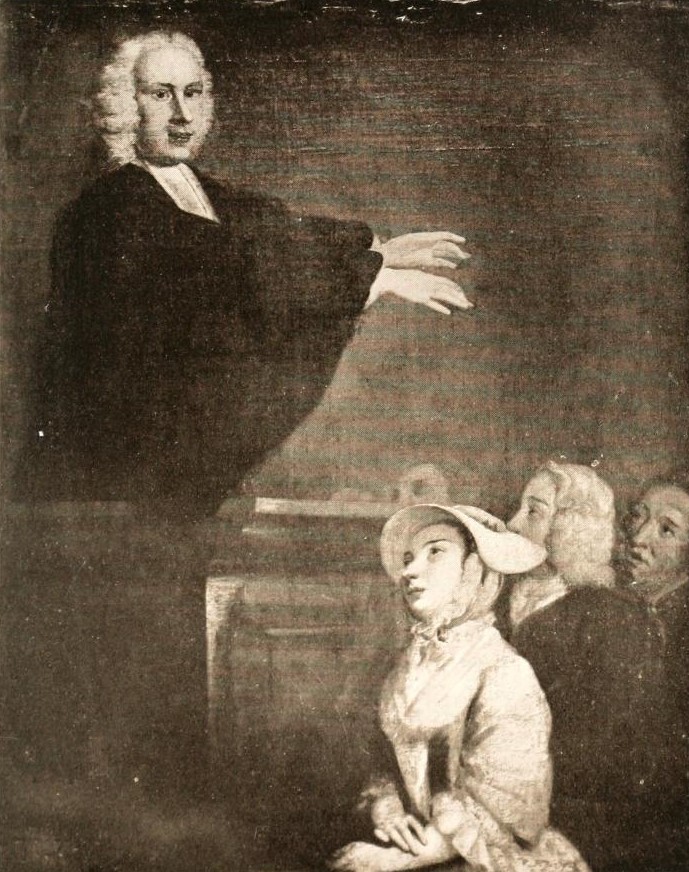
Now Whitefield undertook to cover the broader reach of the colonies, taking himself to Pennsylvania with the intention of founding an orphanage there in partnership with the Moravians (a large religious group in the rural region north and west of Philadelphia, who founded towns of their own named Bethlehem and Nazareth!). On his way there, he found himself preaching every step of the way – often several sermons a day! Then Tennent and Edwards invited Whitefield to New Jersey and Massachusetts to preach. And thus it was that Whitefield’s open-air revival method reached north.[2]
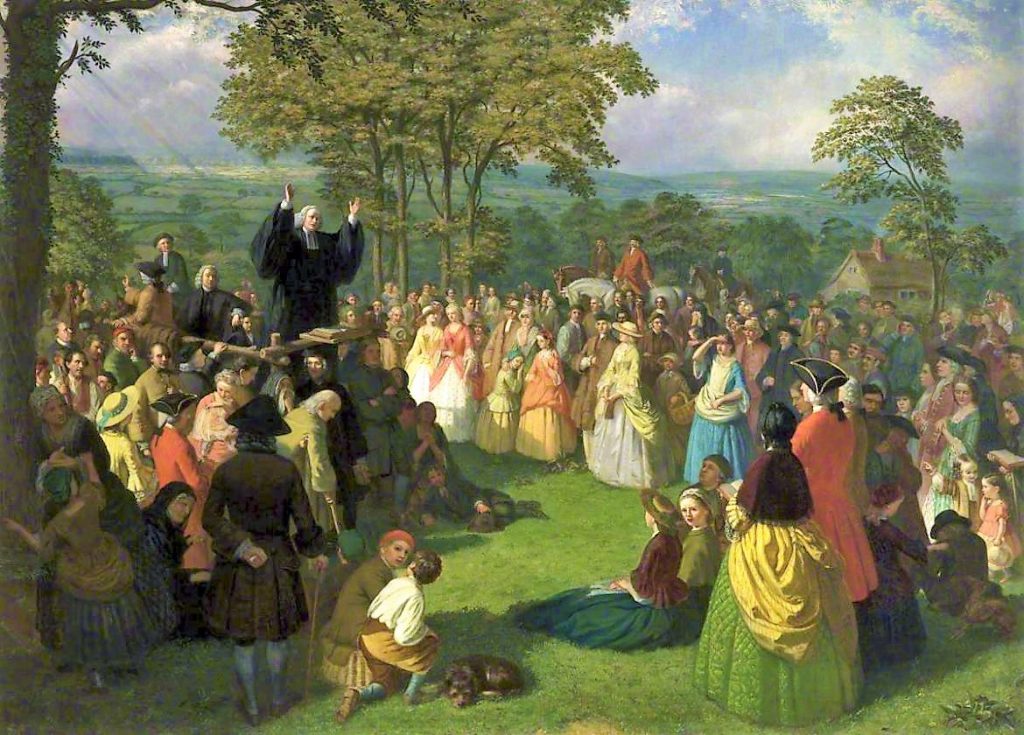
Most surprisingly, the greatest American sage of the time, Ben Franklin, found himself warmed at least intellectually by this massive religious revival of Whitefield’s. In fact, he personally saw to the publishing of forty or more of Whitefield’s sermons on the front page of his newspaper, the Pennsylvania Gazette. Indeed, Franklin and Whitefield formed a friendship that lasted the entire span of Whitefield’s remaining life (he died in America on a preaching tour in 1770).

Opposition to the “style” of this Awakening. Once again, there were Christians who found all this open-air activity rather un-Christian – because it did not occur in churches with people properly arranged in their pews in front of real pulpits. Also, the idea that everyone should be called to repentance for their sins seemed scandalous for those “proper” Christians who were quite certain that they had nothing serious to repent of. Such repentance was to be directed only to wastrels and scoundrels, not proper Christians. Also there simply was a certain amount of bitter jealousy on the part of frustrated pastors who watched the huge crowds gather in the fields – when they still faced somewhat empty pews on a Sunday morning. It just wasn’t right. Eventually even church leaders, or the “Old Light” group began to challenge the theological correctness of the so-called “New Light” revivalists – causing splits to occur within the traditional denominations, especially the Congregationalists of New England and the Presbyterians of the Middle Colonies.

who was very strongly opposed to the New Light style
But there was great Divine purpose in this strange event. Yet, with this Great Awakening, God was being faithful to keep his side of the Covenant with America in bringing on this very spirit. And Americans were responding, by awakening to their own responsibilities taken on in this covenant with God, responsibilities that would require all the spiritual empowerment that God – and God alone – could, and would, provide.[3]
God was strengthening the colonists as “Americans,” citizens of a budding nation in which its members were well aware of their connectivity with him, through such events as these revivals, ones which reached from the north to the south of Colonial America. This larger sense of social unity and purpose defined them once again as a unique people “called” to take up the old Covenant – to be a Light to the Nations in the way they went at life as born-again Christians.
And also they would need this new spirit, this Divine empowerment, to hold their ground against what the King of England would one day soon be throwing at them to get them back under his total authority as their King. But as a renewed Christian society, they knew fervently that they had “no king but Jesus.” They would not be broken by the rising political ambitions of a far-away English king.
[1]Actually the term “Great Awakening” was not itself used at the time. It was first applied to this event a century later with the publication in 1845 of Joseph Tracey’s book, The Great Awakening: A History of the Revival of Religion in the Time of Edwards and Whitefield. But it has been known as such ever since.
[2]But at the same time Whitefield never lost interest in orphanage development, continuing to travel back and forth between England and America to promote the development of orphanages (in Georgia and Pennsylvania principally).
[3]Thus it was that by the later 1700s, God would frequently be identified as “Providence”, or “The Provider,” as in “The One Who Provides.” They were well aware of how God’s provisions worked so well for them.
THE WAR TO CONFIRM AMERICAN INDEPENDENCE (1775-1783)
Growing troubles in America with the monarchy back in England. When the last of the Stuart monarchs (Queen Anne in this case) died in 1714, the English had to go all the way to Germany to find a Protestant relative to take her place as their monarch. But George was thoroughly German, spoke no English, loved to hunt and involve himself in the dynastic disputes on the European continent among Europe’s other monarchs – and was content to leave English business affairs to his English Cabinet. And George II (also quite German) who took his father’s throne in 1727 operated much the same way in carrying out his duties as king.


English Kings / German Dukes George I and George II
Since its very founding, colonial Americans had learned to take care of themselves against Indians, face the challenging natural world around them … and of course take on the even greater challenge of working together to build a stable society. Thus the politics and leadership of England played only a minor role in the life of the colonies. And with the Georges on the throne – busied in things other than the affairs of their American colonies – this independent spirit only anchored itself even more deeply in colonial America.
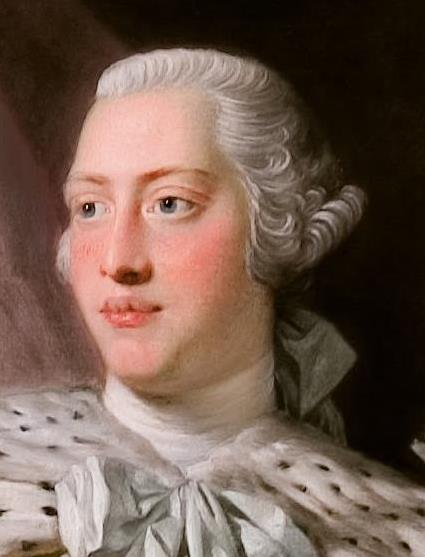 But things would change drastically when the young George III took the English throne in 1760. He was thoroughly English and thoroughly royal – on the model of the French kings who at the time set the European standard of royal absolutism. According to the theory of royal absolutism, God alone had chosen the peoples’ kings – and thus by “Divine Right,” kings were to rule in an unquestioned fashion over their lands and people. And to George III that doctrine applied also to his subjects in the American colonies. Trouble began to develop immediately.
Taxes. At this time royal armies were somewhat like private armies financed by the kings’ own personal treasuries – treasuries which, given the frequency of the bitter quarrels among the various royal dynasties ruling Europe, were easily drained almost to the point of bankruptcy. This was no less the case for the young English King George III – who, so as to replenish his empty royal treasury, pushed the English Parliament to approve new taxes – including taxes on his English colonies in America. The Americans were very upset, for they had not been consulted on this matter, and had supplied – at their own expense – American militia or “minutemen” (citizen-soldiers normally called quickly to action to ward off an Indian attack) to fight George’s French enemies and their Indian allies.
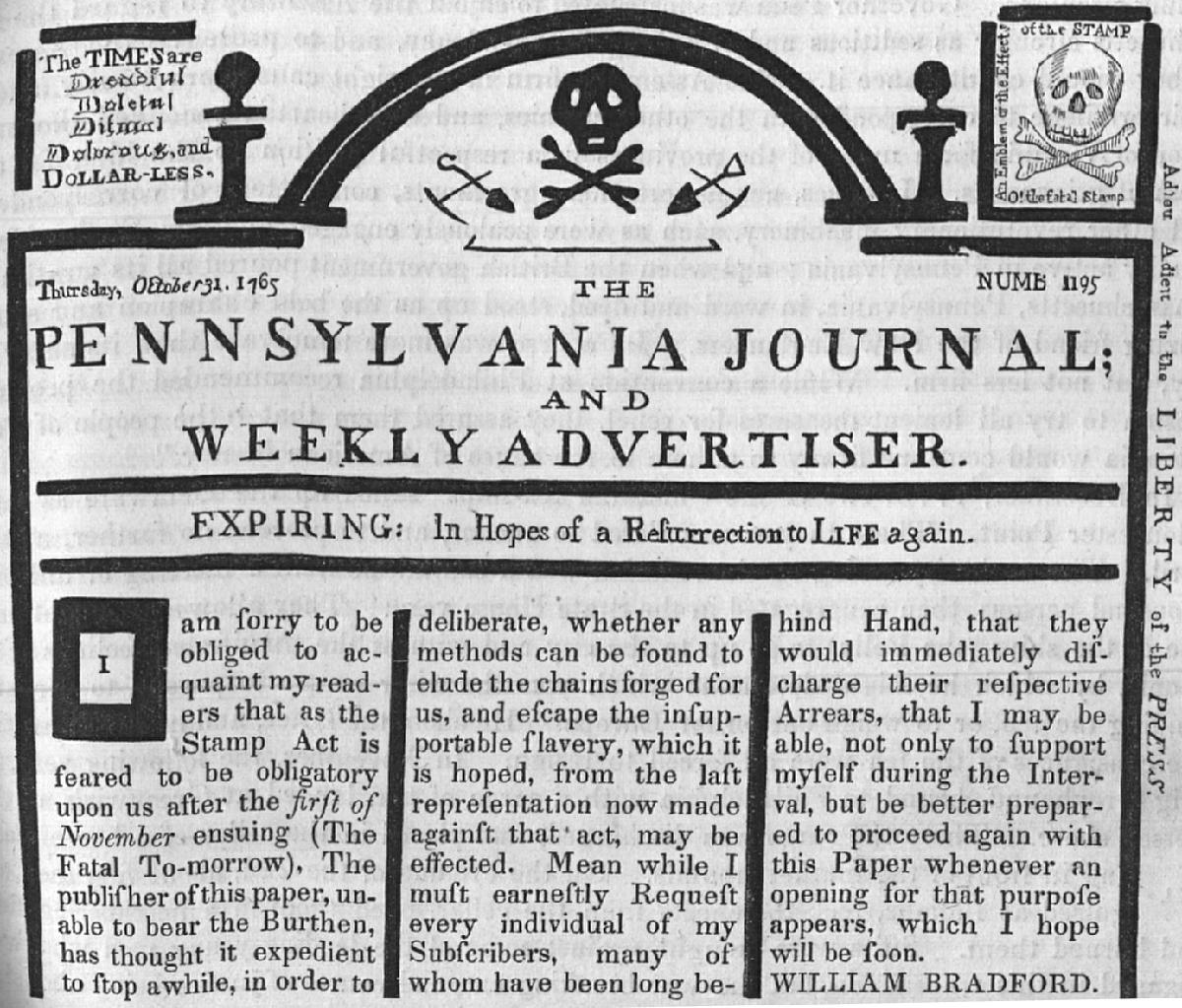
Protests. Protests over the new taxes led George to send British troops to the colonies to protect his tax collectors.

Bostonians reacting to the Stamp Tax
Library of Congress
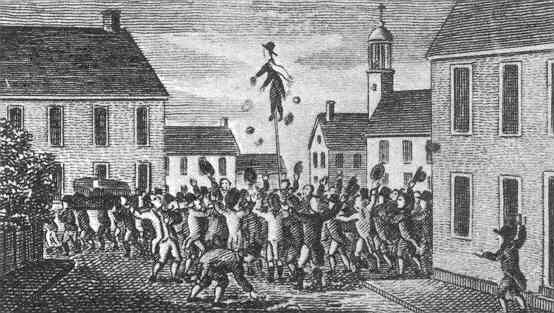
Metropolitan Museum of Art
This in turn sparked an incident in March of 1770 when a group of Bostonians taunted a small squad of very nervous British soldiers (“Redcoats”) who reacted by firing on the crowd, killing three and wounding eight Bostonians (two of whom would die of their wounds).
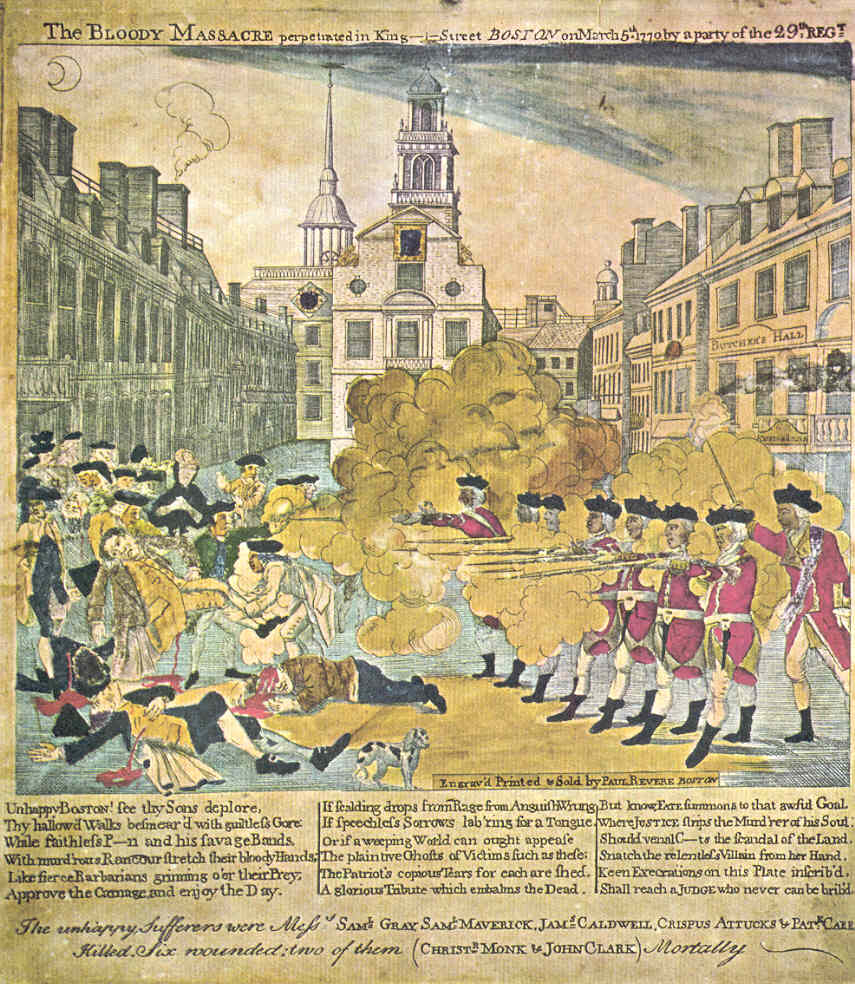
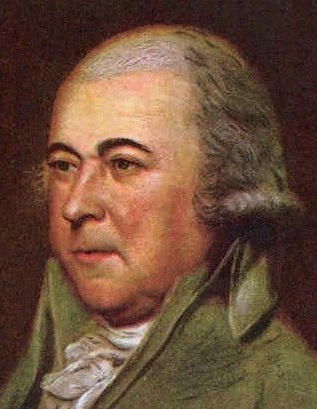 Surprisingly, a relatively unknown lawyer, John Adams, stepped forward to defend the soldiers, bringing considerable notice to him as one who was a definite Patriot, but one dedicated to being totally “just” in his patriotism. The world would see more of John Adams as a result.
George also forced the colonies to stop buying Dutch tea and instead buy the more expensive tea of the British East India Company (the English company was in deep financial troubles). When a group of Bostonians in 1773 dumped a shipment of English tea into their harbor in protest,
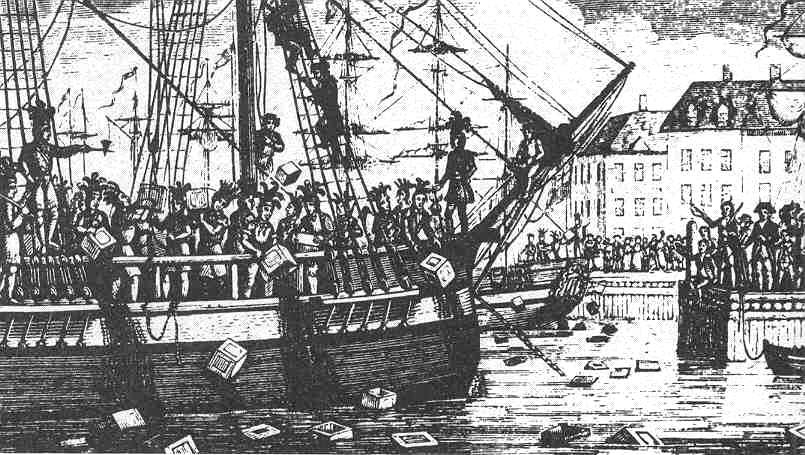
George was so angry at this insolence on the part of his subjects that he sent royal troops to shut down Boston harbor – and strangle the city economically so as to force its submission to his royal will. And to make sure the citizens of Boston got the point, he forced the Bostonians to house personally the rowdy troops sent to discipline the city.
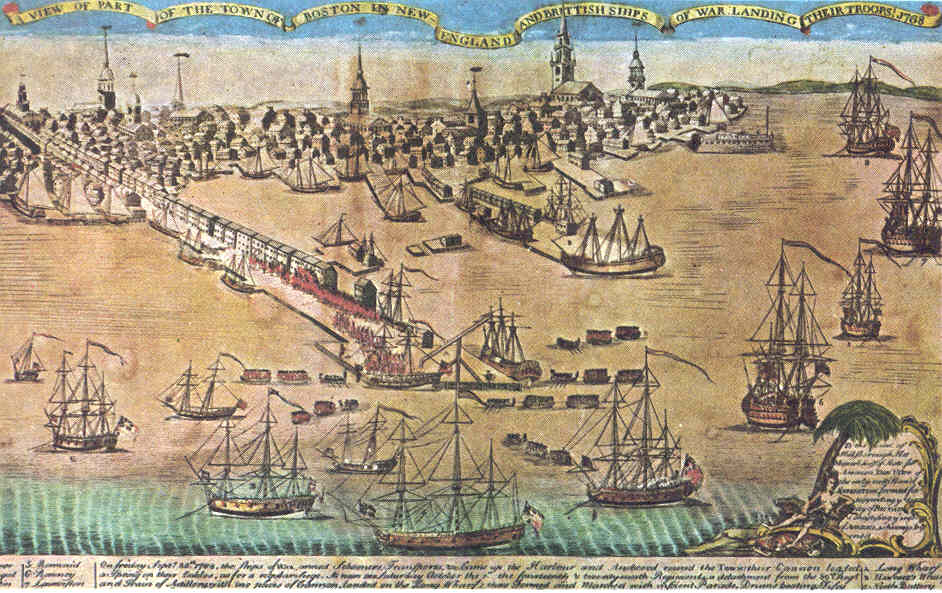
Then he irritated the colonials further by promising his Indian allies west of the Appalachian Mountains that he would stop Anglos from moving west into their lands; he promised his French subjects in Quebec that he would authorize the Catholic faith (and its church officers) full authority not only in Canada, but also in an expanded Quebec province which reached into that same territory to the west of the Appalachian Mountains; and to top that off, he discussed openly the possibility of also placing the American independent or congregational churches under the hierarchical authority of his Church of England officers (archbishop, bishops, etc.). He was quite aware of the religious foundations of the American colonials’ independent-mindedness, and wanted that spirit broken.
War breaks out at Lexington and Concord (April 1775). Tensions thus mounted in the colonies, and the king decided to make a move to disarm their colonial militias in order to better secure his position there. In April of 1775, his troops were sent out to seize the military stores at Concord, Massachusetts, but ran into resistance at Lexington – firing on a gathering crowd there, killing eight and wounding ten Americans.
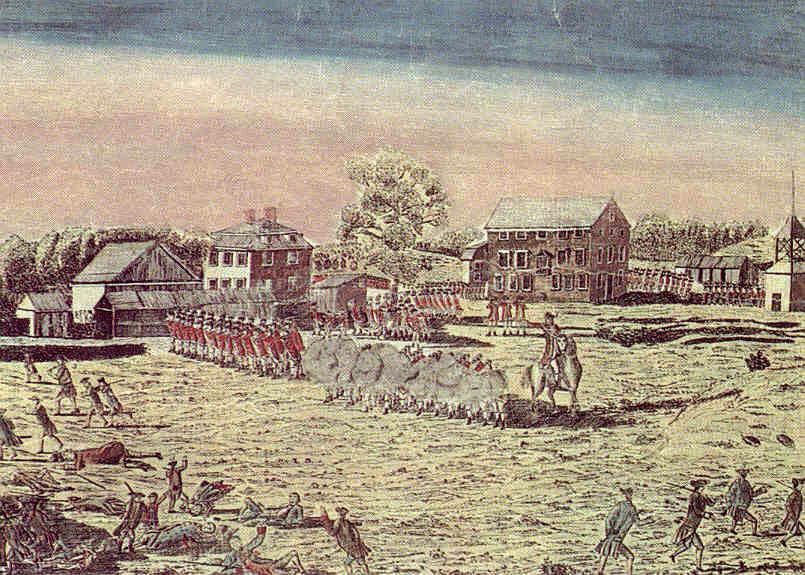
His troops then moved on to Concord, where American minutemen were waiting for them. Fighting broke out between the two groups – with the British taking a bad hit.
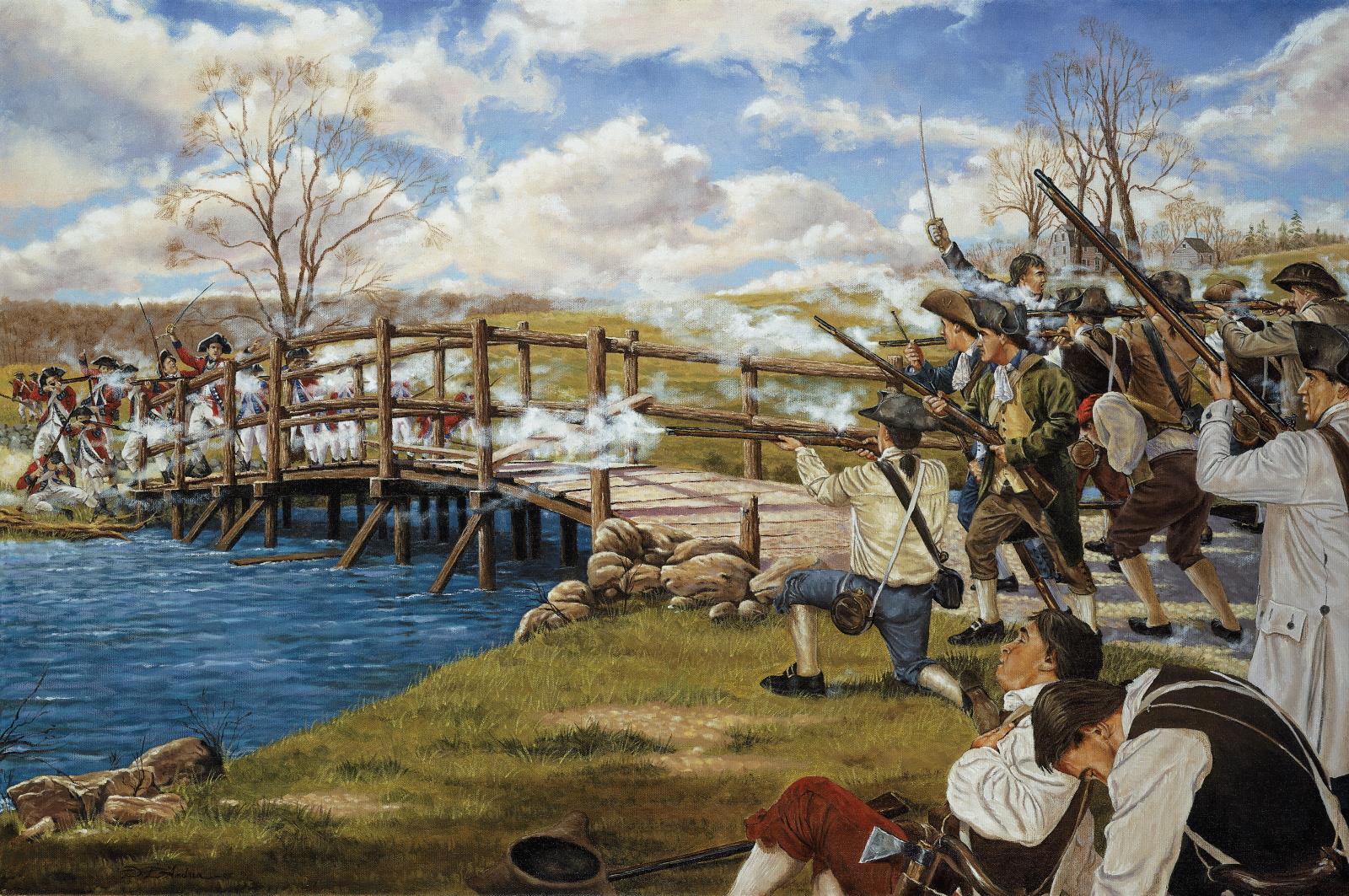
But later that morning at the North Bridge at Concord, the British are met by gathered minutemen … who decimate the British troops
They found the military stores empty and, as it was late, decided simply to head back to Boston. But American minutemen gathered to fire on the returning troops, inflicting heavy casualties on the British in the process. This now gave the appearance of the existence of a full state of war between the colonials and their would-be British masters.
The forming of the Second Continental Congress (May 1775). Thus in May, delegates from the various American colonies met in Philadelphia to form the Second Continental Congress, to coordinate the American response to the British challenge. In the process, they agreed to authorize an American Continental Army, and called on the Virginian George Washington to command it – a smart move designed to improve the likelihood of Virginia agreeing to join the rebellion, which at this point appeared to be mostly a New England rebellion.
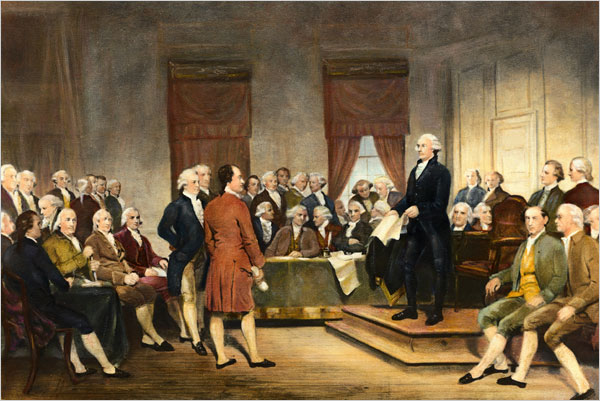
Washington and the Second Continental Congress
The Congress had just appointed him commander-in-chief of their Continental Army (June 1775)
This decision of the Continental Congress to authorize a full rebellion against their king was a very brave thing to undertake, for in essence if this action ended in failure, it would mean that these Congressmen would all be hunted down and hanged or shot as traitors. Furthermore, history offered no example of how this kind of action really ever was successful. However, they counted not on historical statistics but on serious aid from God, with whom their ancestors had first covenanted a special relationship, one which they understood had brought them successfully to the present, and would take them successfully into their future.
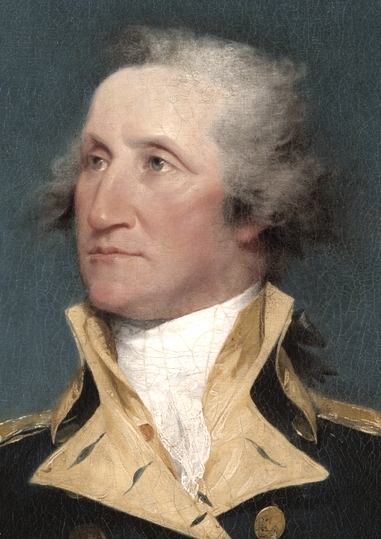 George Washington. The selection of Washington as Commander of the Continental Army was a brilliant move, not only politically in the way that it helped pull Virginia into this dangerous rebellion, it was brilliant in ways that the Continental Congress had as yet no way of knowing. But they had selected someone who was truly a God-send to their cause.
As a young man Washington was typical of someone born to the ranks of Virginia aristocracy. He came of a highly respected family, and was very ambitious, seeking every opportunity to see his social rank improved even further. But he had to work at this matter, which he did, diligently. In being bold in this matter, he would make mistakes, suffer professional setbacks, but learn from the experience. A big part of this was that from very early on, he felt that he was someone – chosen by Providence no less – destined to greatness. And he would rely heavily on that divine hand in his life to move forward in the very competitive game of life.
As the younger brother of a prominent Virginia family, he would not inherit high status, but would have to work at his own advancement in life. And thus Washington took up surveying, and soon found himself called to survey Virginia’s land claim on the frontier (which at the time reached all the way into the Ohio Valley). He thus learned a lot about land, and its challenges and possibilities, and added such land to his own holdings. It also made him very knowledgeable about the lay of the frontier, which he would soon be called on to put to good use.
Along the way, Virginia Lieutenant Governor, Robert Dinwiddie became impressed with Washington’s frontier work, and put Washington in charge of one of Virginia’s four military districts. Actually, Washington’s first military engagement against the French in the Ohio region brought “shame” in victory for Washington when his Iroquois allies killed and scalped surrendered French troops[4], and his second action at Fort Necessity actually brought him a humiliating defeat. Washington thus resigned his position as commander.
But he was called back into service the next year, serving under British General Braddock, but efforts to dislodge the French from the Ohio region once again ending in disaster – General Braddock even losing his life in the contest. Yet Washington held up valiantly in the battle, having two horses shot out from under him and bullets hitting his hat and coat.
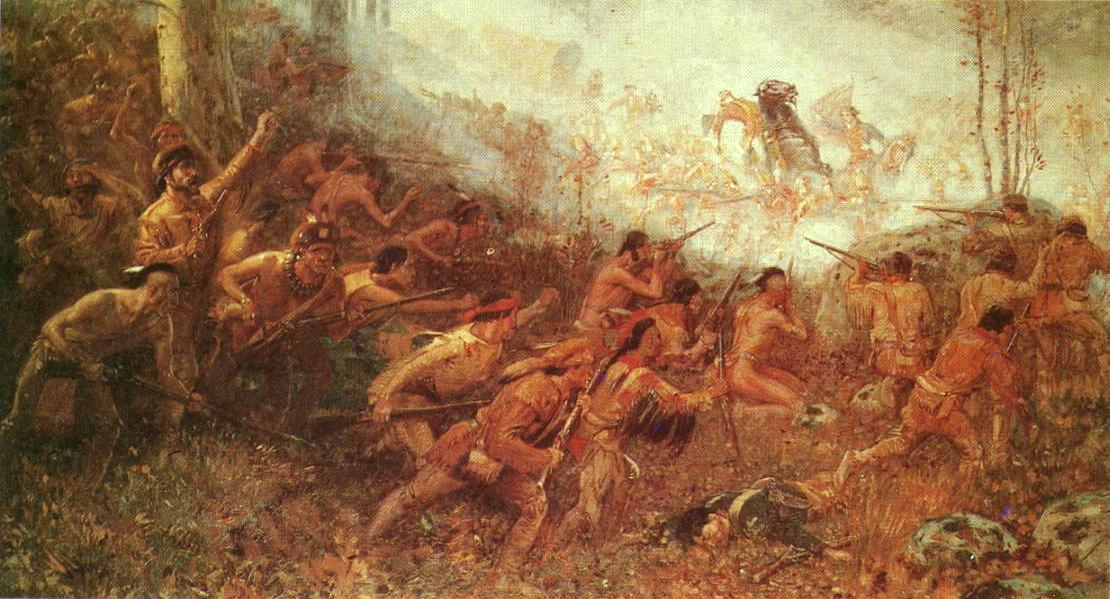
State Historical Society of Wisconsin
This so impressed Dinwiddie (and some of the Indians) that Washington was asked, and agreed, to take command of the much-enlarged Virginia Regiment. But in doing so, he would find his command challenged by another ambitious officer – something that Washington would have to get used to, and learn to get around in order to keep going!
And in his only serious engagement as commander, he was able to finally take French Fort Duquesne in 1758, when the French abandoned it just before his arrival!
The following year he married a very wealthy widow, Martha Custis, and settled himself down as a Virginia “planter”, now possessing huge estates worked by hundreds of slaves. Furthermore, being such a planter, he was expected to be active in Virginia political affairs. Thus he was called on to represent Frederick County in the Virginia House of Burgesses. During this time, he began to distinguish himself as a very strong opponent of the effort by the British King and his Tory-dominated Parliament to bring the colonies under royal control, especially the effort to tax the colonies without their consent (supposedly a basic British right belonging to the people). Indeed, working closely with George Mason, Washington was able to bring Virginia to support the boycott of British goods (1769).
Then as tensions mounted, particularly with the British effort to strangle Boston into submission, again working with George Mason, in 1774 he drew up a list of resolves (the “Fairfax Resolves”) put forward by the Fairfax Committee that Washington chaired, which called for the creation of a Continental Congress. And when a Continental Congress was actually called into being (autumn of 1774), he was sent off to Philadelphia to represent Virginia. At this point he also took up the challenge of organizing Virginia militias, in anticipation of troubles ahead.

George Washington in uniform, as colonel of the First Virginia Regiment (1772) – by Charles Willson Peale
And when a Second Continental Congress was called in May of 1775, Washington headed off to Philadelphia to participate in its doings. Things were looking very serious after the battles at Lexington and Concord. War actually seemed to be unfolding, wanted or not.
And there in Philadelphia, he quickly impressed the Congress, particularly the Massachusetts firebrand Samuel Adams (organizer of the “Boston Tea Party”), and his cousin John Adams. Thus it was that Washington was chosen (over Massachusetts commander John Hancock) to command the new Continental Army.
The Battle of Bunker (and Breed’s) Hill (June 1775). Meanwhile, the colonies also began to send aid to Boston – including American militiamen (soon to be termed “Patriots” or “Whigs”), who in June gathered in the heights above Boston at Bunker Hill and Breed’s Hill. Here they found themselves armed with cannons and guns seized from Fort Ticonderoga by the troops of Ethan Allen and Benedict Arnold. When English troops were then ordered to dislodge these threatening militiamen, it took several charges and a huge loss of British officers (by American sharp-shooters) to do so. And even then, the American retreat was orderly – taking place only when the Americans ran out of ammunition.
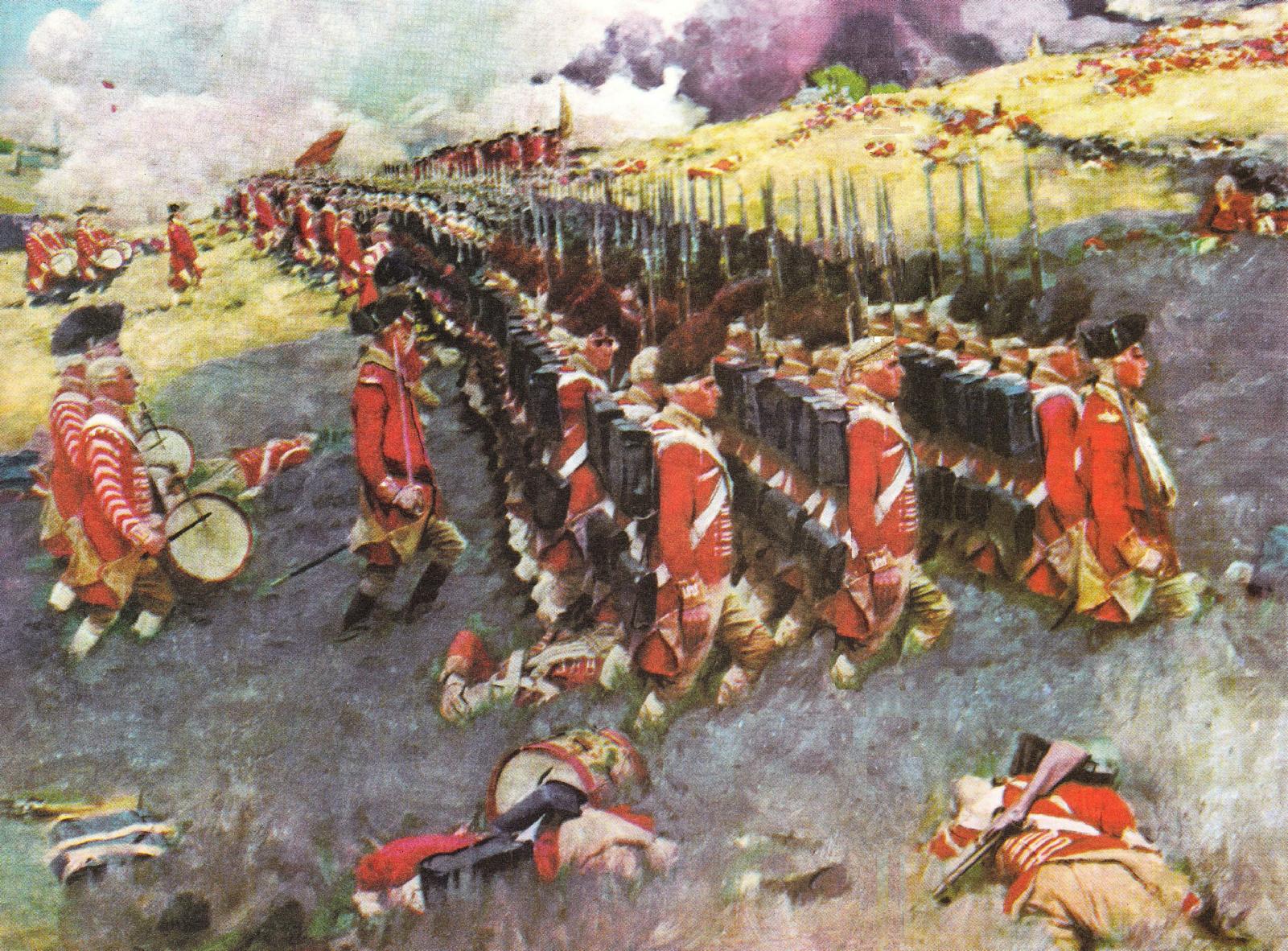
Redcoats advancing against Americans at Breed’s Hill – June 17, 1775 by Howard Pyle
Wilmington Society of Fine Arts
But the next spring (1776), the Americans had resumed their positions above Boston, but with even more cannons – and Washington in place as commander. At this point the English troops, understanding the resolve of these colonials – and the danger of the position they now found themselves in – withdrew from Boston. Along with them went the “Loyalist” or “Tory” (pro-king) colonists who had taken refuge there. They would not attempt a return to Boston during the remainder of what had now become an all-out war.
The Declaration of Independence (July 1776). That summer, while the newly self-proclaimed independent states (Massachusetts, Virginia, Pennsylvania, Maryland, Georgia, etc.) busied themselves drafting new constitutions for themselves, their representatives in Philadelphia drafted and adopted a formal Declaration of Independence from England.
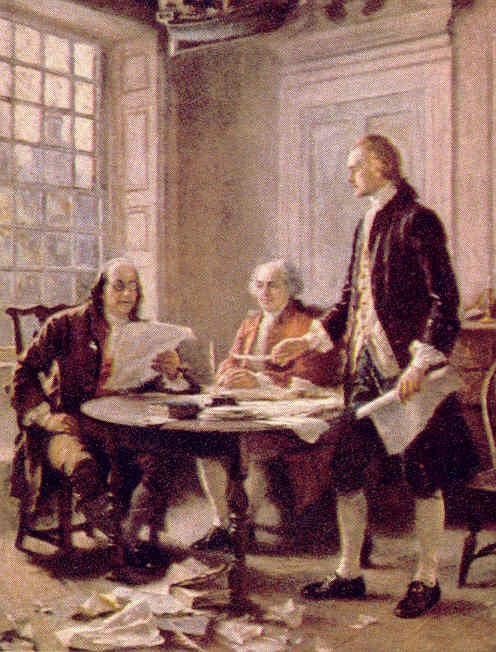
Franklin, Adams and Jefferson working on the draft copy
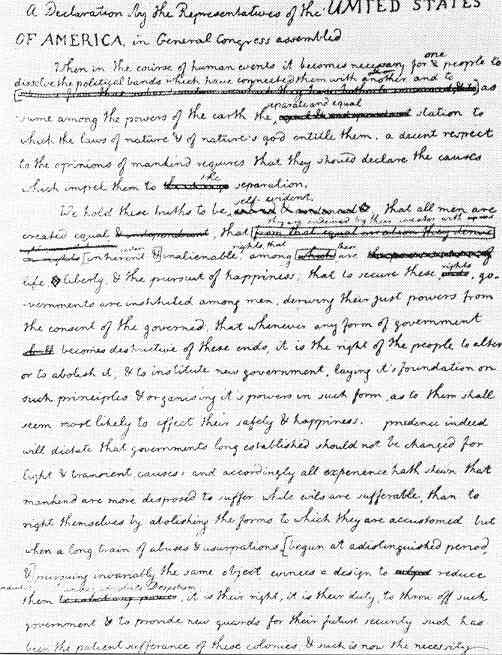
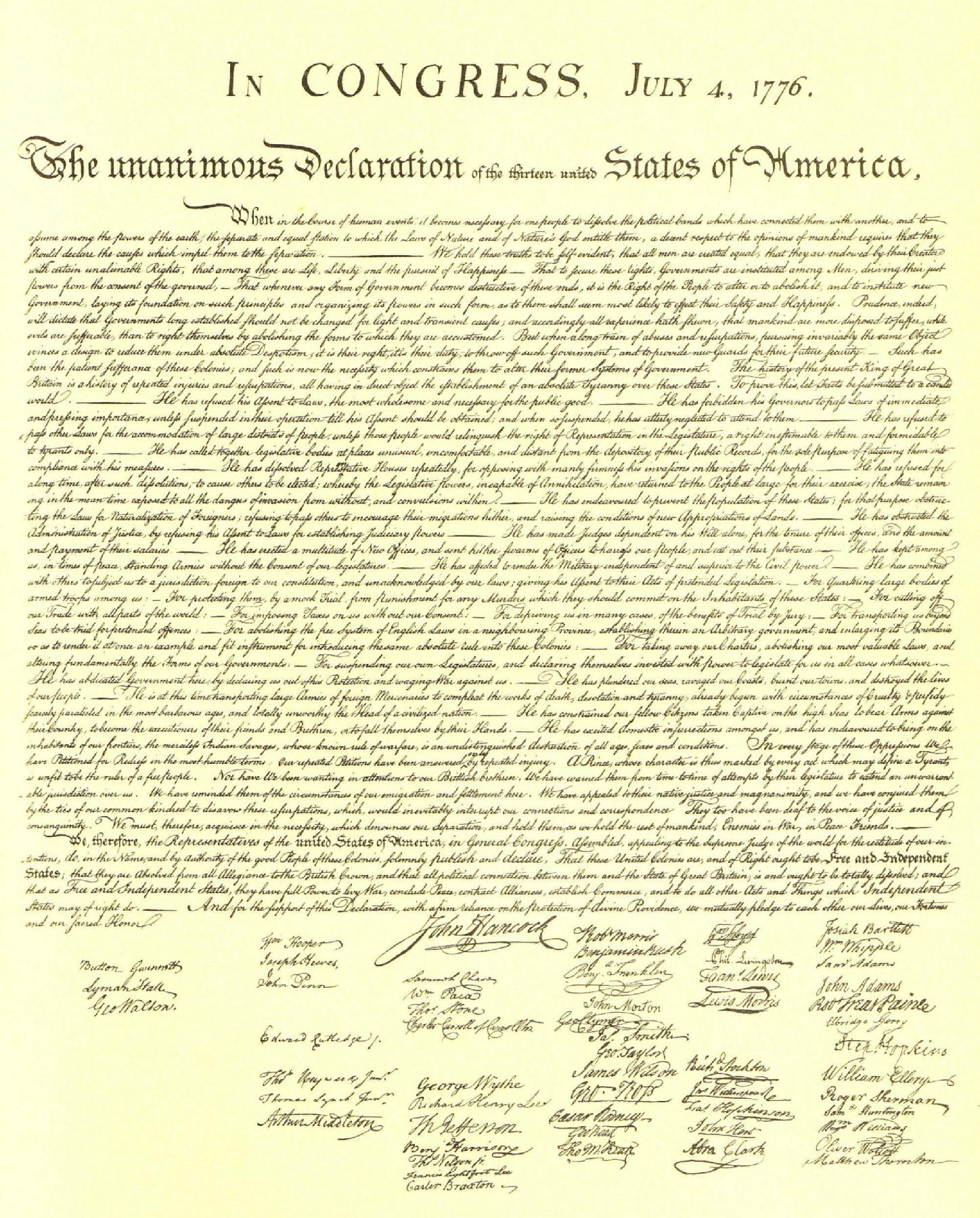
Its preamble became very well known to Americans over the generations:
We hold these truths to be self evident, that all men are created equal, that they are endowed by their Creator with certain unalienable Rights, that among these are Life, Liberty and the pursuit of Happiness.
That to secure these rights, Governments are instituted among Men, deriving their just powers from the consent of the governed, That whenever any Form of Government becomes destructive of these ends, it is the Right of the People to alter or to abolish it, and to institute new Government, laying its foundation on such principles and organizing its powers in such form, as to them shall seem most likely to effect their Safety and Happiness.
Notice that this declaration, originally designed by the young Virginian Thomas Jefferson, makes it clear that Americans were created as equals, with unchanging rights that came from their Creator (God), not some human authority – not a king, not a parliamentary body, not a huge church establishment (such as the King’s Church of England).
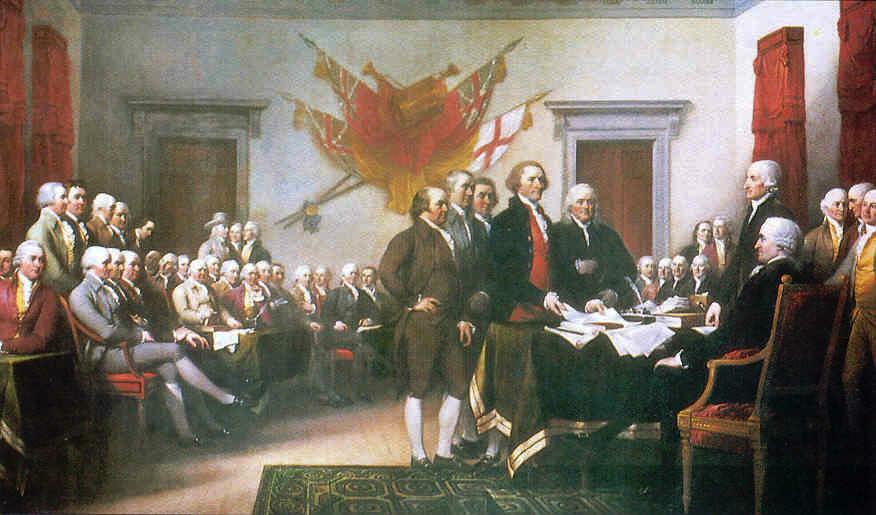
Architect of the Capitol
Then the delegates began work on drafting a new constitution for their Confederation of American States, a structure designed to help them work together in facing the task of securing that independence against the efforts of the British king to force them back into submission.
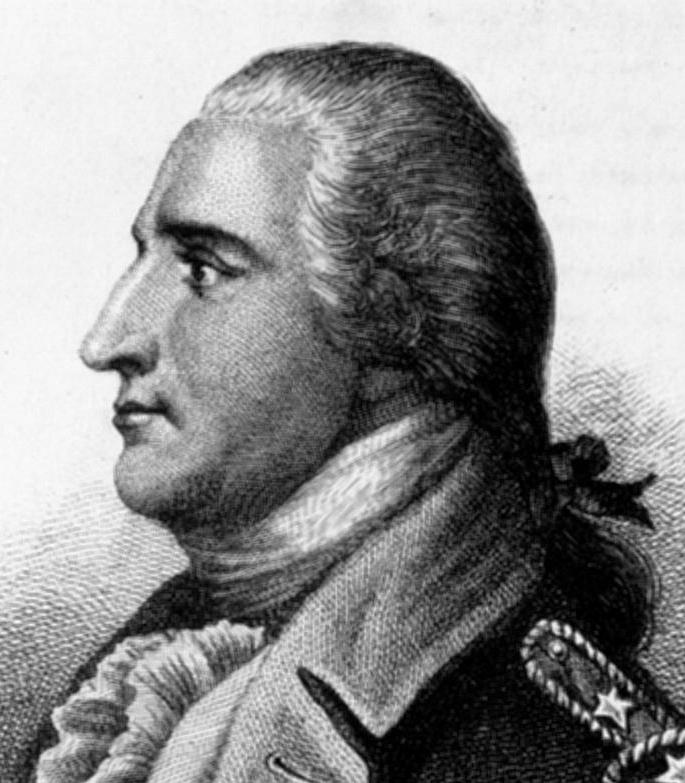 Serious problems. This was not an easy matter, because the war at that time seemed not to be going well for the American “Patriots.” American General Benedict Arnold’s efforts over the winter of 1775-1776 to pull Canada into the war on the American side had, despite a very valiant (and costly) effort, failed miserably; Washington’s attempt in the summer of 1776 to block the British takeover of New York had also failed miserably[5] (Washington nearly losing his army in the effort); American soldiers were deserting the cause; and other American officers were conspiring behind Washington’s back to have him replaced (by themselves of course).
Trenton and Princeton. But on Christmas night of 1776 Washington took his men across the icy Delaware River
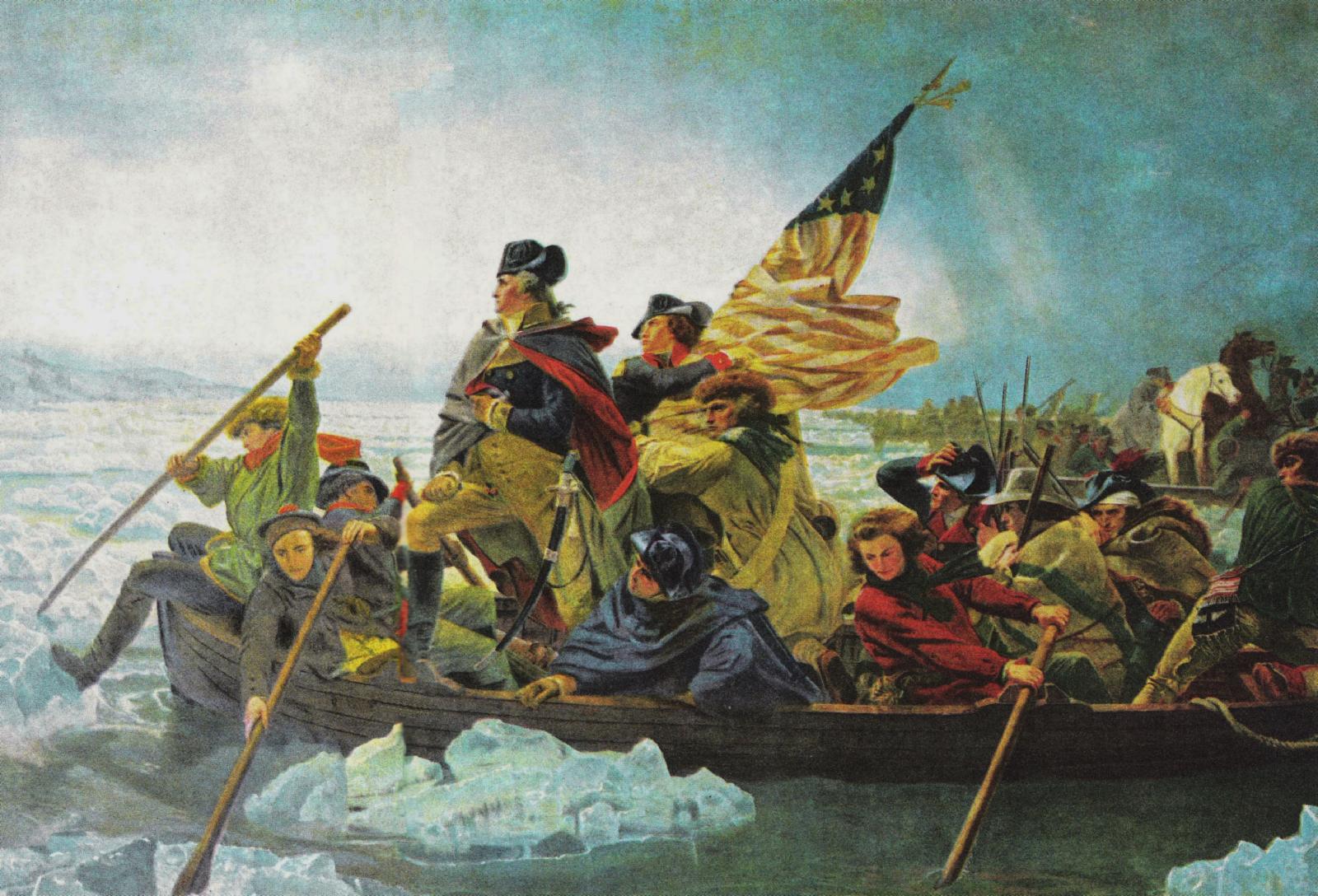
and marched them ten more miles during a drizzly/snowy night to Trenton (New Jersey) – to catch an unsuspecting German unit of George’s Hessian troops off guard and completely rout them – then hold off a British counterattack at nearby Princeton a week later – giving new courage to the American cause.

The Battle of Princeton – January 3, 1777
Historical Society of Pennsylvania
British failure at Saratoga (September-October 1777). The British responded to this humiliation by putting together a plan to converge on the northern States from different directions and cut off New England from the middle States – thereby hoping to cripple the American rebellion (running strongest in the North). But the various British units failed to connect. British troops coming from Canada turned back when their Indian allies deserted the cause upon hearing that Benedict Arnold was involved as an American commander (despite Arnold’s failure to take Quebec, he was well known to be a fearless fighter); another British group was badly mauled in a battle which took place at Bennington; and the group which was supposed to come up from New York City went off on another venture. Thus the main British force under John Burgoyne arrived at Saratoga, and then waited for the others to show up, as Americans gathered under the command of Horatio Gates, and for weeks the two armies sat there facing each other, but doing little. Finally, Arnold disobeyed Gates’ order to stand down and instead led his men on an attack, which inspired the rest of the American forces to join the action. And thus it was in October of 1777 that a huge British army of 6,000 men was brought to surrender.
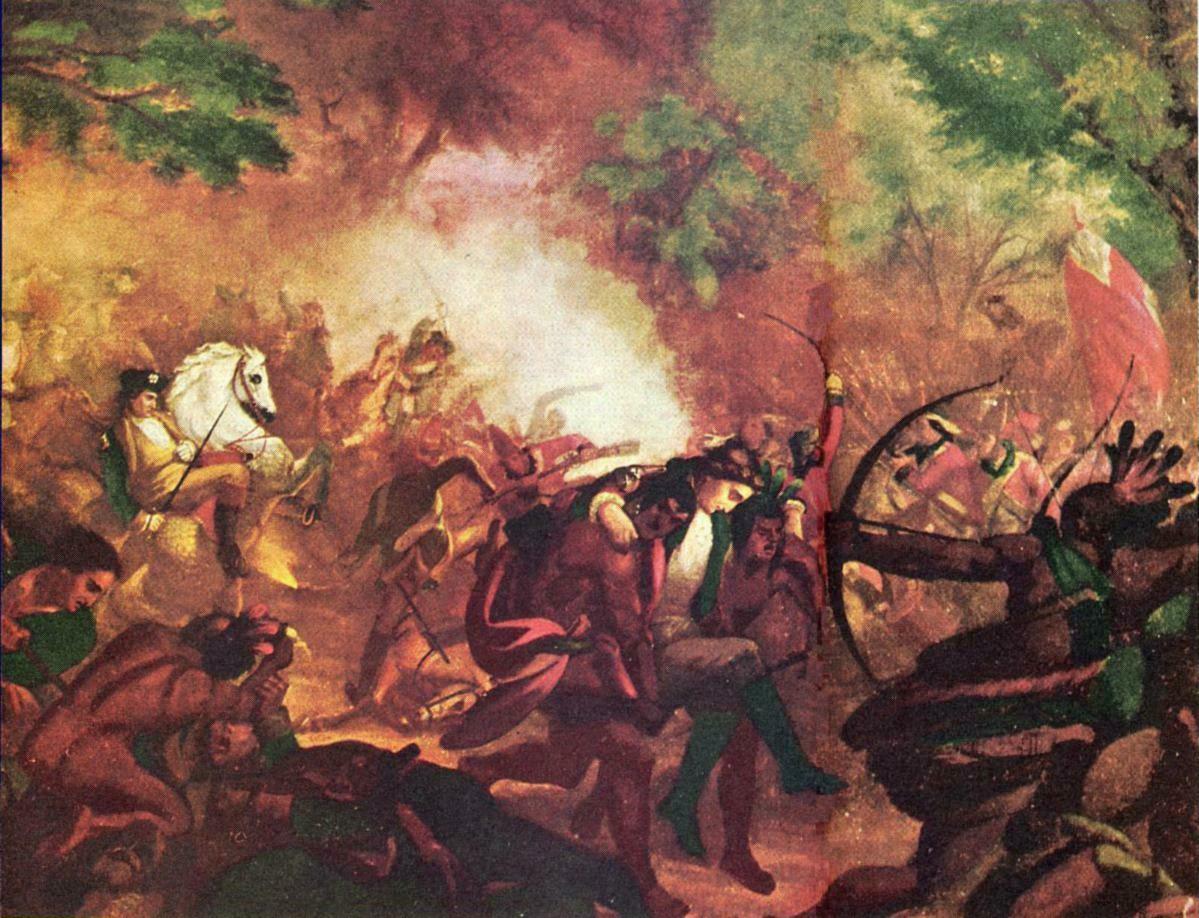
Benedict Arnold leading American troops against British regulars and Indians at Freeman’s Farm south of Saratoga – October 7, 1777
Fort Ticonderoga Museum

United States Architect of the Capitol
But typical of the politics of the day, in Gates’ victory report to the Congress, he failed to mention Arnold’s role in the affair, Gates taking full credit for the victory as the “hero of Saratoga.”
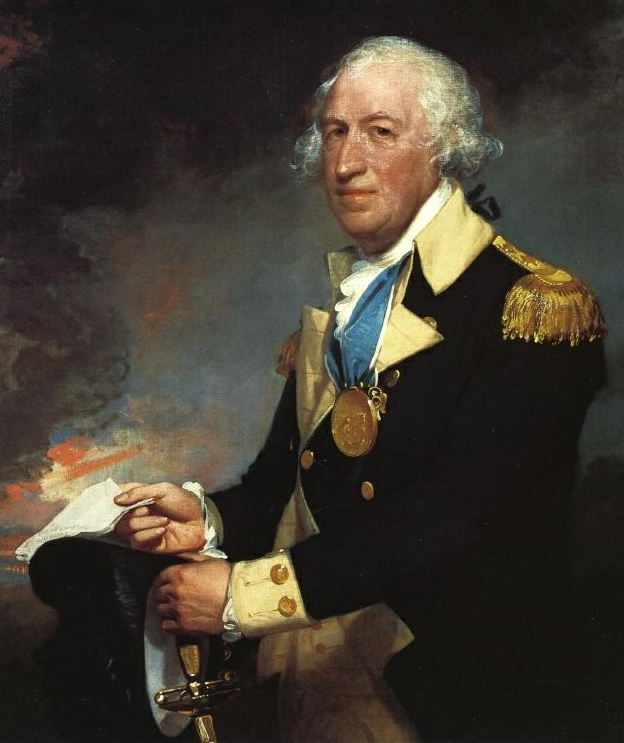
Continental Army general Horatio Gates – by Charles Willson Peale – 1782
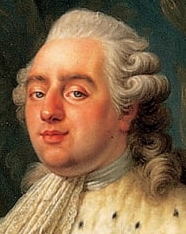 The French ally with the Americans (February 1778). Nonetheless the victory was real, and majorly significant. With this American victory, the following February, French King Louis XVI decided to jump in the fray to do some serious damage to his British rival George III by supporting the American rebellion. Little did Louis realize that he was setting loose forces that would be the undoing of his own rule. In any case, the French help would come to weigh importantly in the outcome of the American War of Independence.
The winter at Valley Forge (1777-1778). Meanwhile, Philadelphia was lost to the British when they marched on the city (October 1777), the Continental Congress fleeing into the Pennsylvanian hinterland, and Washington having to take his troops into winter quarters at nearby Valley Forge, with nothing to show for his effort – except (most importantly) that the British had failed to bring the rebellion to a close.
But the Valley Forge winter would produce a highly disciplined American army – among those who survived the winter’s ordeal anyway. 2.500 of his 10,000 troops would die that winter. But the remainder would emerge as a highly disciplined fighting force. Prussian Baron von Steuben’s discipline and Washington’s own example as a highly disciplined – as well as spiritually disciplined (including daily prayers) – individual served to produce that result with his men. Indeed, the idea of an army at prayer grew right alongside the now well-understood role of physical training (and tightened discipline) caused by the death and dying.
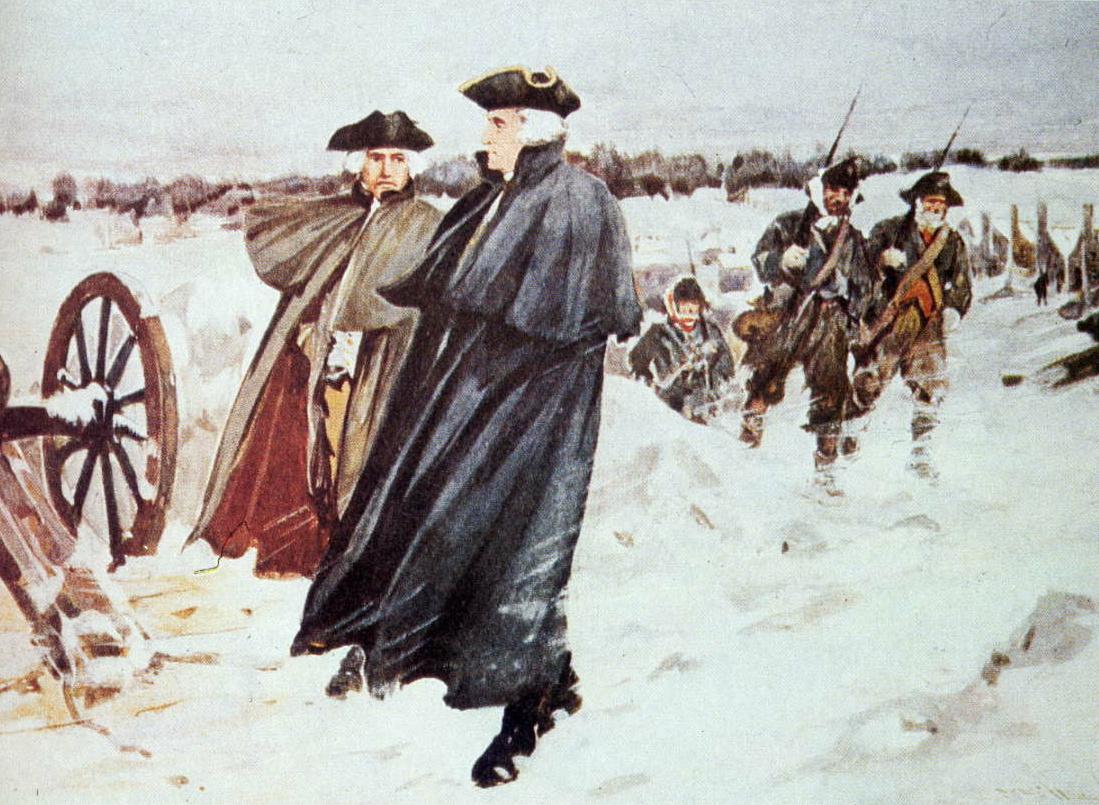
Washington and von Steuben at Valley Forge
Washington: military insight. Washington understood the nature of the challenge in front of him as few others (if any) did at the time. While other generals typically understood the war between America and Britain as involving simply a battle of armies (ones they themselves commanded), Washington knew most importantly that this war was about a battle of wills, of human resolve, of sheer determination not to quit no matter how grim things looked.
The goal of all war is to make the other side tire of the game first and simply quit. How that was to occur in colonial America with mere militia coming up against experienced and vastly more numerous British troops would entail far more than armies and battles, although they certainly weighed importantly in the matter. But wars are won as a matter of the commanding officer’s ability to see things from a much higher perspective than the viewpoint dictated simply by immediate circumstances, which is what lesser souls tend to focus on. True, immediate circumstances had to be answered – as best as possible given the greater weight of military power of the British enemy. But ultimately Washington’s job was to keep the courage of the Patriots intact, to keep them focused on victory, while at the same time undercutting the morale of the British (and American Tory or Loyalist) adversaries – until the latter were willing to call it quits.
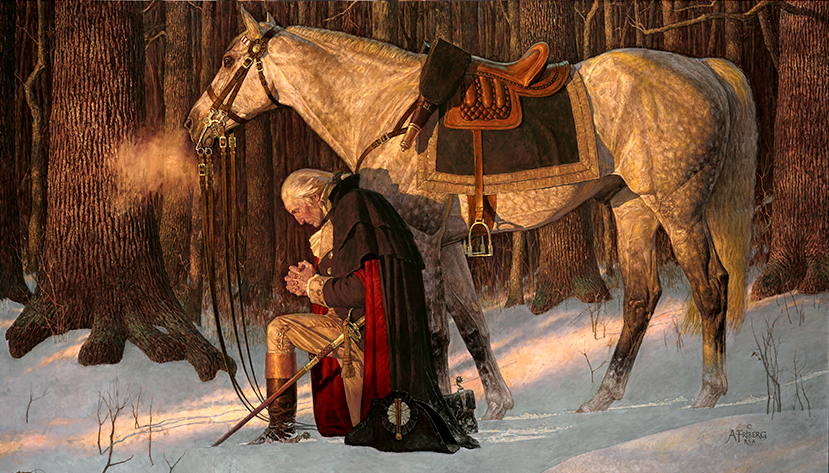
The mindset and spirit of a great leader. Here is where leadership – true leadership, the kind that Washington offered America – came into play. And, as is typical of great leaders, although Washington was as sensitive to public opinion as anyone else, ultimately he went to God, not public opinion, to take full measure of his own actions. Washington was a man of very, very deep faith in God, in God’s personal call to him to take up such dangerous and often very unrewarding service (materially speaking).
The role God played in Washington’s life is well illustrated by a particular example recorded for us in the Diary and Remembrances of a Presbyterian Minister Rev. Nathaniel Randolph Snowden, who recorded a conversation he had with Isaac Potts of Valley Forge, Pennsylvania (at whose home Washington was residing that winter):
I was riding with him (Mr. Potts) near Valley Forge, where the army lay during the war of the Revolution. Mr. Potts was a Senator in our state and a Whig. I told him I was agreeably surprised to find him a friend to his country as the Quakers were mostly Tories. He said, It was so and I was a rank Tory once, for I never believed that America could proceed against Great Britain whose fleets and armies covered the land and ocean. But something very extraordinary converted me to the good faith.
What was that? I inquired. Do you see that woods, and that plain? It was about a quarter of a mile from the place we were riding. There, said he, laid the army of Washington. It was a most distressing time of ye war, and all were for giving up the ship but that one good man. In that woods, pointing to a close in view, I heard a plaintive sound, as of a man at prayer. I tied my horse to a sapling and went quietly into the woods and to my astonishment I saw the great George Washington on his knees alone, with his sword on one side and his cocked hat on the other. He was at Prayer to the God of the Armies, beseeching to interpose with his Divine aid, as it was ye Crisis and the cause of the country, of humanity, and of the world.
Such a prayer I never heard from the lips of man. I left him alone praying. I went home and told my wife, I saw a sight and heard today what I never saw or heard before, and just related to her what I had seen and heard and observed. We never thought a man could be a soldier and a Christian, but if there is one in the world, it is Washington. We thought it was the cause of God, and America could prevail.
This was what gave Washington the power to answer unflinchingly the call to service, one that would morally exhaust others and make them quit.
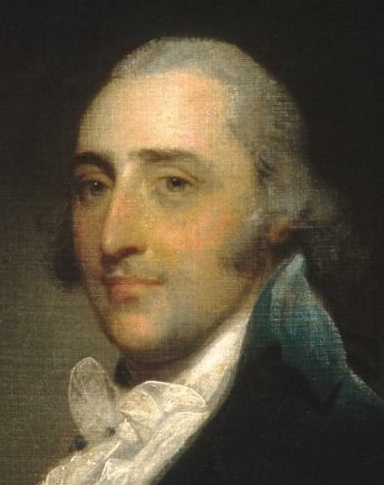
Tragically, this was the case for Benedict Arnold, who switched sides to the British because after giving the American cause his all, he finally tired of being undercut constantly by other colonial leaders, including fellow American generals.[6]
Washington too (as all leaders) had his detractors, eager for his job as commanding officer (Gates and Lee for instance). But Washington paid little attention to their maneuverings with the Continental Congress behind his back. He simply stayed focused on the job at hand, the job he had been called to by God. And to God and God alone did he answer.
But Washington’s spirit infused his troops (and again, the American people) with the same spirit: to keep moving forward against huge obstacles – and not get lost in a concern with those immediate obstacles – because there was a higher calling to be answered.
He had his men pray with him, to understand that their cause was much bigger than just personal success; it was to preserve the precious independence of their American society, so that America could itself continue to serve God to great purpose. His men were not just soldiers, they were crusaders, crusaders for the world’s “little guy,” the average person like themselves – average in social status but awesome in action!
 Disappointment at Monmouth (June 1778). As an example of the agony that Washington had to constantly overcome, the following June (1778) Washington had skillfully put his army in a position to deliver a crushing blow to the huge British force that had decided to abandon Philadelphia and head back to New York. But his plan was itself brought to near defeat by an arrogant American General Charles Lee, given actual command of the operation (officially second in command, although a constant thorn in Washington’s side), who lost courage at the very moment that the action actually got underway. Instead of pushing forward the American advantage dependent on a surprise attack from behind, Lee ordered a retreat, which immediately turned into a panicked rout of the American troops. Washington miraculously was able to rally his fleeing troops, and then turn the battle ultimately into at least a military standoff. That night an exhausted British army was able to slip away from an equally exhausted American army. And thus a grand opportunity for the Americans to end things right there had been lost. But at least it enabled Washington to finally get rid of the troublesome Lee. And it made very clear to all that Washington’s army was now a serious fighting force.

And actually, this led the British to decide to give up the war in the North and take the battle into the American South.
The war in the South. Had the British attacked the South first, rather than the North, the war may have early gone in the British favor – for pro-British Loyalist or Tory sentiment was much stronger in the South, where many Americans saw no need for the rebellion against their king. In fact many Southerners formed Tory military units to fight American Patriot units in support of the British effort to put down the rebellion. But the British efforts in the South in the first years of the war had been quite timid – and the Patriots not only held off British efforts there but also humiliated the American Tory military units.
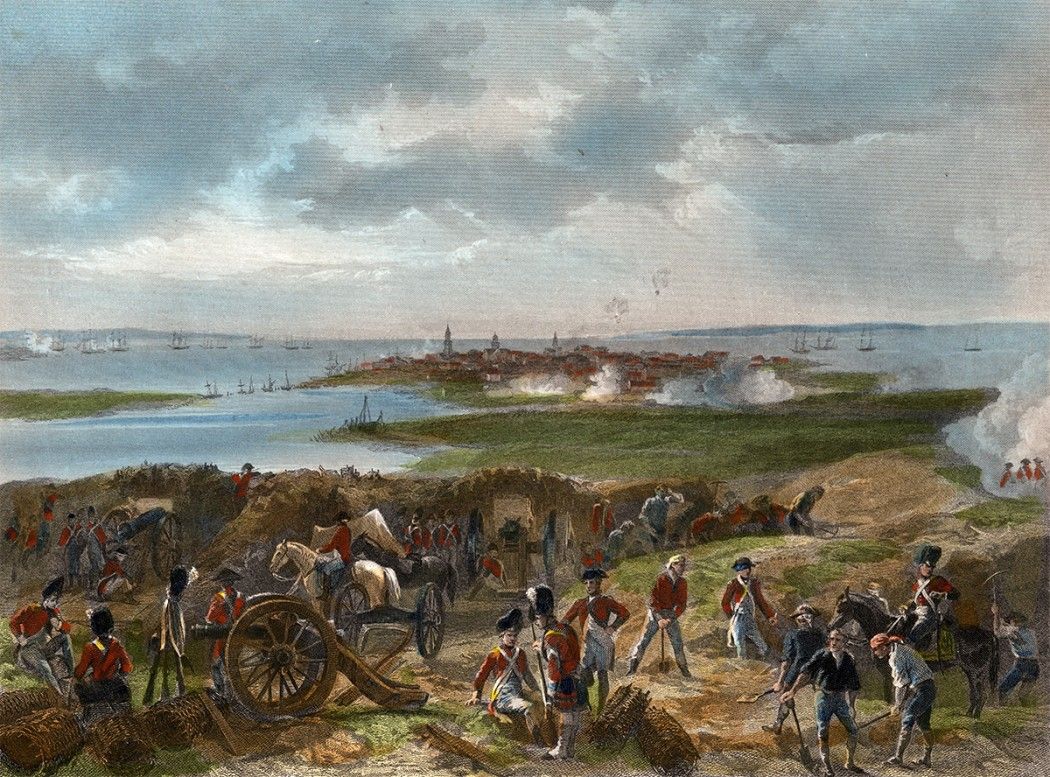
Disaster for the American Patriots (December 1778 to September 1780). But at the end of 1778 the British finally decided to go all-out in their offensive in the South, hoping that American Tories would join them in the effort. Mostly they didn’t! But huge British units captured the weakly defended Savannah (December 1778); they did the same in Charleston (May 1780) when 14,000 British troops, surrounded, cut off and defeated the 5,000 Americans attempting to defend the city.
And then they repeated that success in August at Camden (South Carolina) when incompetent Gates foolishly attacked directly British General Charles Cornwallis’ well-disciplined army, and Gates’ troops broke and fled – resulting in the loss of another 2,000 American troops.

American General Gates’ troops are routed at the Battle of Camden (August 16, 1780). America loses 2,000 troops (half of them captured) and an enormous amount of military supplies … compared to a relatively light loss of British troops, most of them American Tories.
Then in September it was learned that Arnold had changed sides and was now fighting on the British side. At this point the Patriot cause looked as if it were about to go down in defeat.
The war begins to turn in American favor (late 1780 – early 1781). Yet the fortunes of war began to shift dramatically – when in October of 1780 an American Tory unit of about 1,400 was decisively defeated – ending any further ideas of American Southerners joining the British cause.

The Battle of King’s Mountain (October 7, 1780), in which Patriot troops destroyed an army of Loyalist troops, collapsing Loyalist support for the British … an important turning point in the war in the South
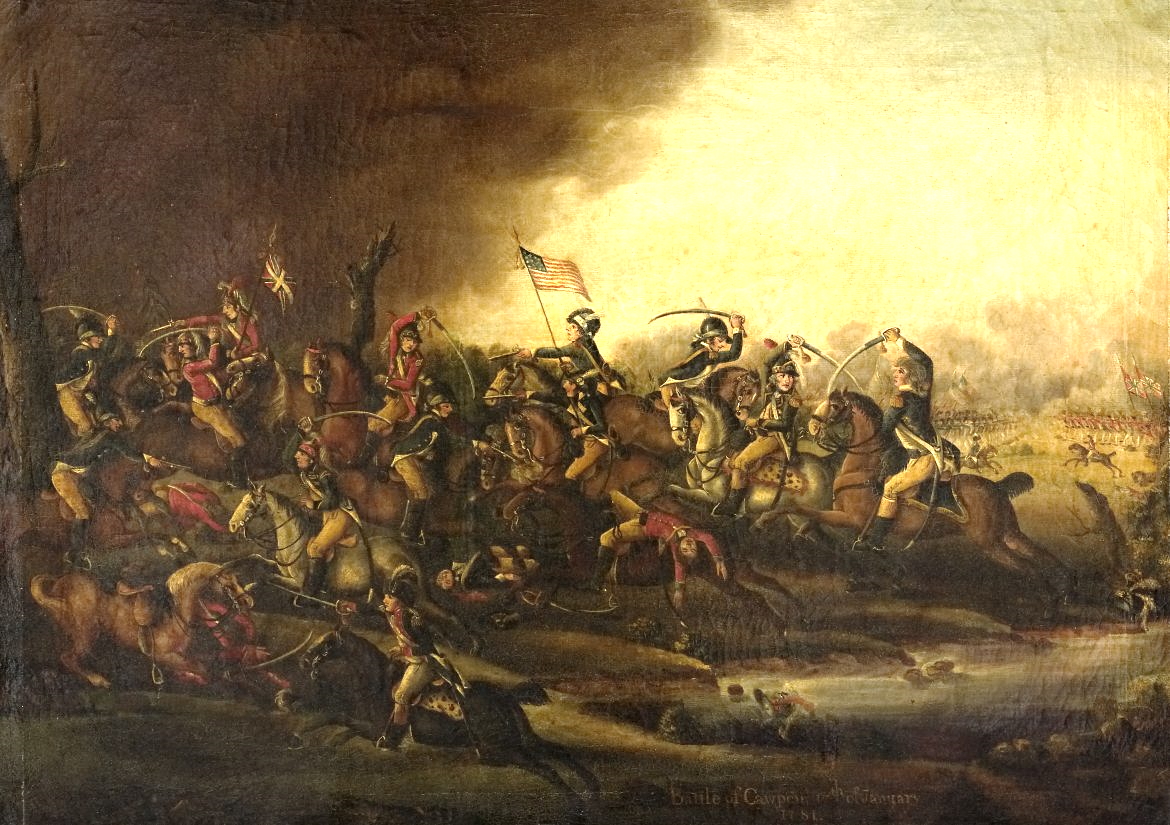
Then the following January (1781) at Cowpens (South Carolina) the famous British cavalry raider Banastre Tarleton was delivered a humiliating defeat (barely escaping with his life).

by Sir Joshua Reynolds
London, National Gallery
Cornwallis decided to counter by chasing down the American army under the Southern commander Nathanael Greene – and indeed humiliated him at a battle in March (Guilford Courthouse, South Carolina) – but a humiliation that Greene managed to shake off with his army still intact – leaving the “victor” Cornwallis with the loss of a huge number of troops that Cornwallis could ill afford – something of a Pyrrhic victory!

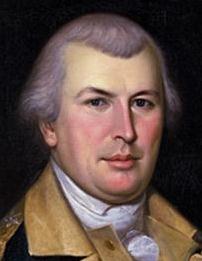
Charles Cornwallis Nathanael Greene
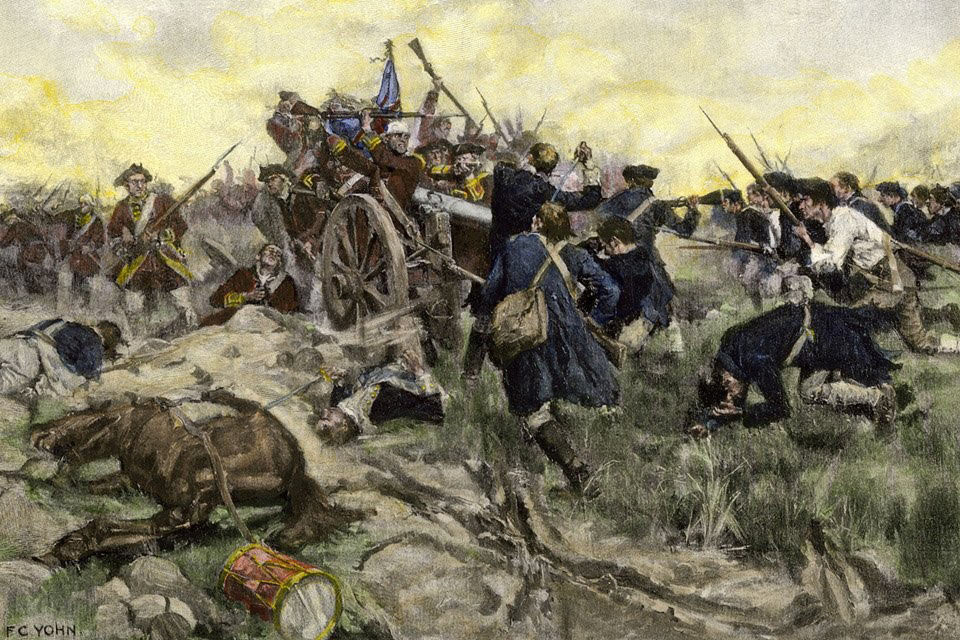
The Battle of Guilford Court House (March 17, 1781)
Yorktown (September-October 1781). Cornwallis badly needed more troops and supplies – and decided to head his army north into Virginia to the port of Yorktown to await reinforcements shipped in to him there by way of the Chesapeake Bay. But he had marched himself into a trap, when Washington slipped his troops from New York (where the British were expecting Washington’s attack) to a position surrounding Yorktown – along with General Lafayette’s French troops who joined him there.
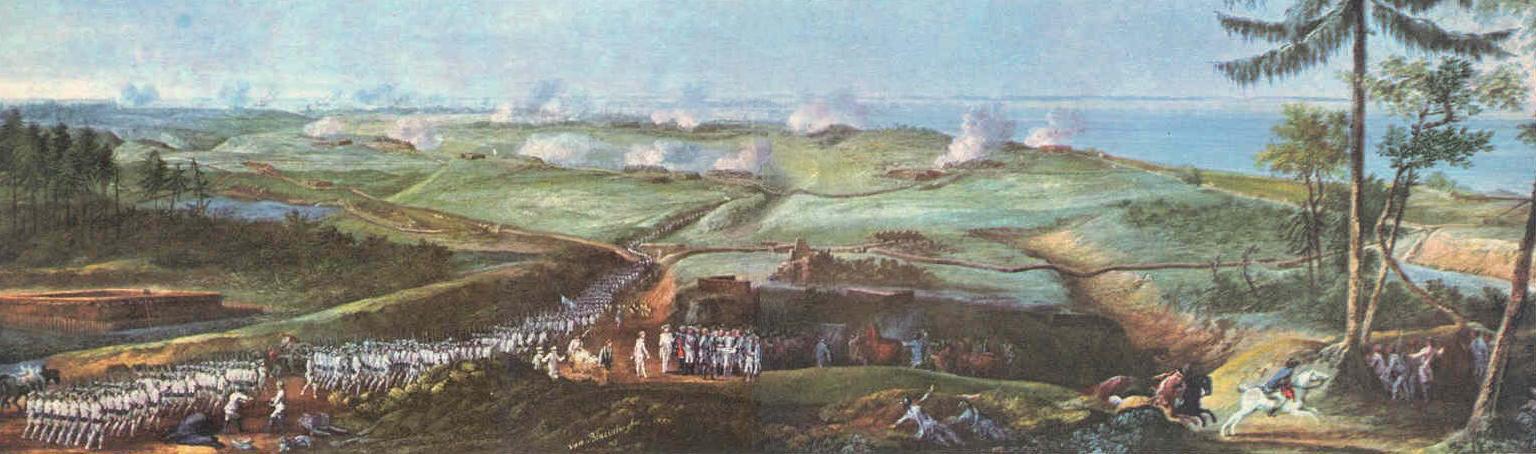
The French heading towards Yorktown
And the French navy was able to defeat the British ships sent to relieve Cornwallis. Thus Cornwallis found himself with nowhere to go and no help on the way. A final assault on his position by the French (led by Lafayette) and the Americans (led by Washington’s top assistant, Alexander Hamilton) forced Cornwallis to surrender his 8,000-man army to Washington. This was the event that finally broke the British will to continue the war.


The Marquis de Lafayette Alexander Hamilton
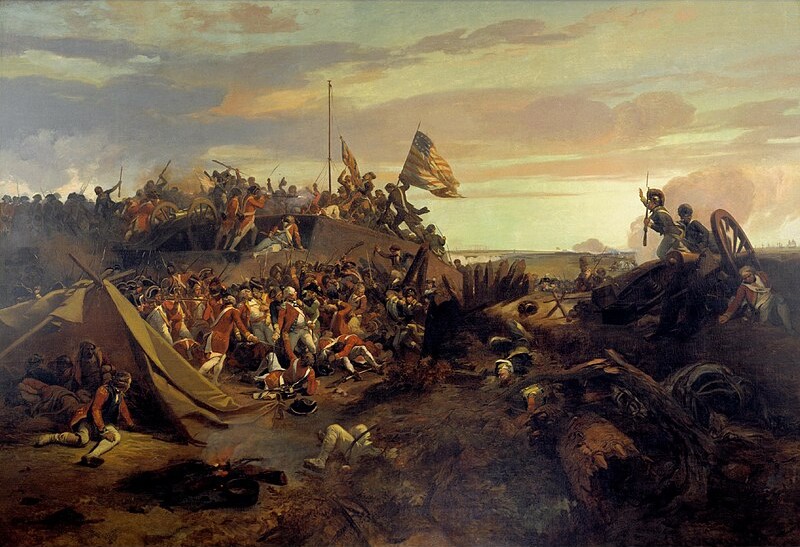
Alexander Hamilton’s American troops overrun the English Redoubt-10 at Yorktown – October 14, 1781
Virginia State Capitol

The British surrendering to French and American forces at Yorktown
(October 19, 1781) – by John Trumbull (1820) (Cornwallis was actually not himself present at the surrender)
Rotunda of the US Capitol
When news reached England of what had happened at Yorktown, British Prime Minister Lord North declared “Oh God, it’s all over.” And indeed it was. Although British troops still held New York City, the British would undertake no more military ventures in America.
The Treaty of Paris (1783). It took some time for the British and Americans to work out the terms ending the war. But basically, the agreement drawn up in Paris (notably through the efforts of John Adams, Ben Franklin, John Jay, and a few others representing the Americans) acknowledged that the Americans were indeed an independent people, no longer part of the British Empire.
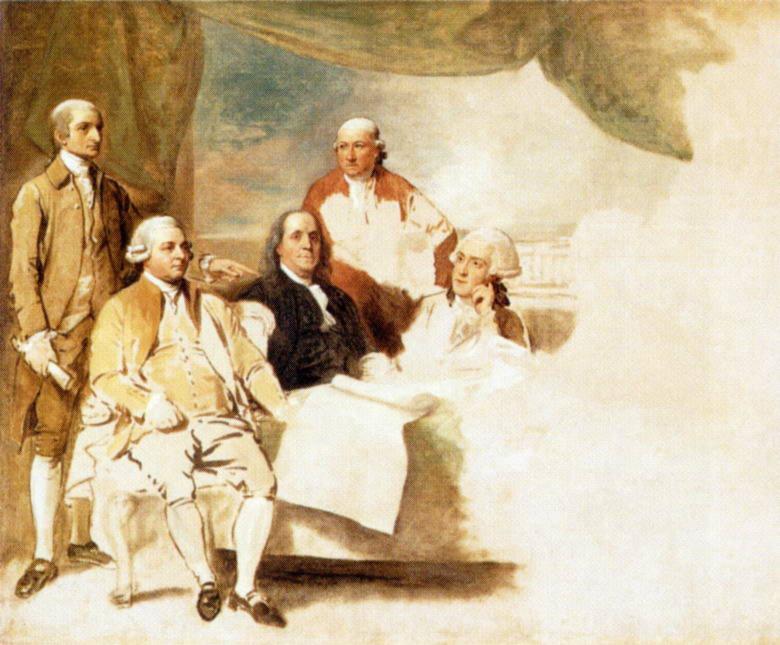
The signatories of the Treaty of Paris (unfinished … because the British refused to sit for the painting!)
[4]Ironically this event became the initiating cause of the French and Indian War (1754-1763), and ultimately even Europe’s bigger Seven Years’ War!
[5]He and his troops managed to escape entrapment and complete destruction by the British only because a thick and long-lasting fog allowed them to escape the Brooklyn Heights across the East River to Manhattan. This was clearly an intervention of God himself, which Washington was well aware of.
[6]Arnold had given the Patriot effort his all, and got virtually no support from the politicians at the Continental Congress. Individuals there even had the nerve to complain about his request for troop funding, after Arnold had exhausted all his own personal financial assets to support his men. Finally, his pretty Tory wife, Peggy Shippen, convinced him that he was supporting a cause that was directed by the wrong element, and that instead he should put his effort in supporting the Tories. This he did (to Washington’s great distress, for he was the one general Washington had trusted), and would come to regret this decision deeply. He had to live out the rest of his life in Britain, far from his native Connecticut. And in his will, he asked that he be buried in his American, not his British, officer’s uniform. Truly sad!
The need for unity. The thirteen colonies were now thirteen independent states, each state able to go about its own business on a fully sovereign basis. And that’s where the problems began. Each state wanted to conduct its own diplomacy abroad with the major European powers – and promote its own industries and trade overseas – in competition with the other American states. But these smallish American states were like mere children messing with the big boys of Europe – very liable to get themselves into trouble – and even worse, become tempting targets for sophisticated and highly ambitious European powers to grab them in their ongoing wars for territory, territory, territory. There was no reason to think that the British, given a new opportunity to do so, might not come back across the Atlantic to reclaim their former colonial territories. After all, treaties at that time had very short lives – merely pauses in the on-going game of big-power politics. Just because England had signed a treaty acknowledging American independence did not mean that they weren’t able to put it aside at their earliest convenience and retake some – or even all – of their former colonies.
And the American leaders of these newly independent states, men who had just gone through the horrors of achieving their states’ independence through bloody battle, were well aware of how the game was played. Something needed to be done to correct the vulnerable position that these new states were in. Somehow, they were going to have to come together as they had during the recent war – as a “United States of America” – or they would be lost. But with the immediate pressure of war removed, the incentive for unity was not as strong – at least in the eyes of those who did not understand the dangers now facing them.
Maintaining domestic tranquility. There was another problem on their minds at this same time: the rebellious spirit affecting soldier-farmers, typified by those in rural Western Massachusetts. American soldiers had returned from the war only to find that their mortgage debts to banks and taxes owed the local and state governments had merely accumulated, to monumental proportions. They received no forgiveness or even reduction of these obligations – or even some kind of compromise in being permitted to pay in goods rather than currency, something they just did not have at war’s end. They were furious – not yet on the scale of Bacon’s Rebellion a century earlier – but headed in that direction (1786-1787).
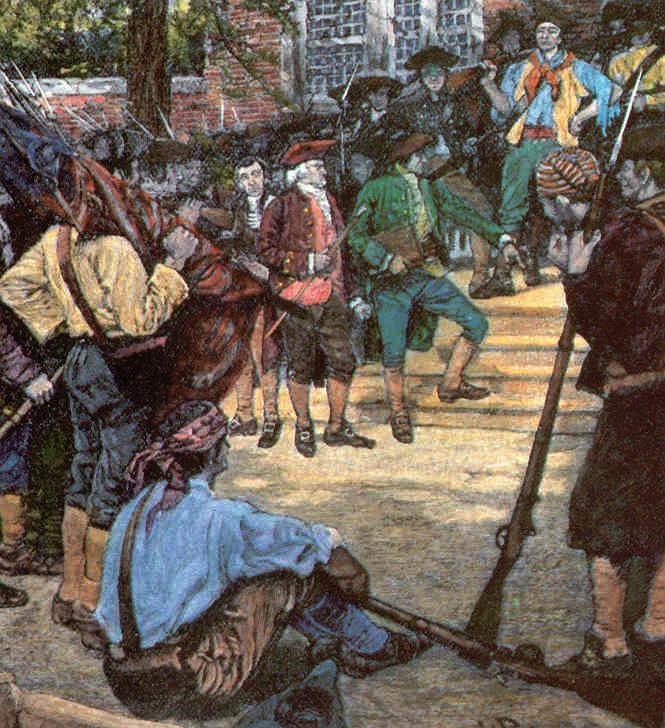
It took Washington, appearing with the Massachusetts militia, to break up the Massachusetts (or Shay’s) Rebellion, a task which Washington undoubtedly disliked intensely, but one that had to be done. The newly independent country could not simply let such rebellious behavior infect its budding social order.[7]
The Constitution of the United States of America (summer 1787). At first the general assumption in meeting these challenges was that the Continental Congress would continue after the war, conducting meetings much as it had done during the war. But the Continental Congress quickly demonstrated that with no common enemy looming before it, the Congress had no serious powers of its own to insist on a higher degree of American unity than the feeble effort it was getting at the time. So – the idea came up of reforming the organization, carefully giving it some new powers to restore a degree of American unity and stability among and within the states. Thus in mid-May of 1787, representatives of the various American states gathered in Philadelphia to begin the process of correcting this huge problem (tiny Rhode Island however refused to attend, fearing the loss of its independence to the stronger, larger states).

Independence Hall where the Constitutional Convention was held – Summer of 1787
The immediate challenge: big v. small states. Rhode Island’s absence pointed to a major hurdle that those who gathered in Philadelphia had to overcome. The big states (Massachusetts, New York, Pennsylvania, and Virginia principally) understood that they carried the largest responsibility population-wise and finance-wise for these United States – and resented the fact that in the Continental Congress they had no more say in things than did the small states (Vermont, Connecticut, New Jersey, Delaware, etc.), because the states had merely a single vote each. Thus Virginia arrived at the meeting in May with a plan for a bicameral Congress of two legislative houses – similar to the British Parliament with a House of Lords and a House of Commons (the Continental Congress had been unicameral, with only a single legislative house). The Virginia Plan called for varied representation in both houses based on the relative size of the states, the larger states receiving more votes than the smaller states in each house.
And that was exactly what the small states feared – that they would simply be reduced to irrelevance because of their small size. Thus they proposed a unicameral legislature, one with each state, large or small, allotted equal representation (a single vote each), similar to the Continental Congress. However, this legislature would possess stronger powers than the Continental Congress.
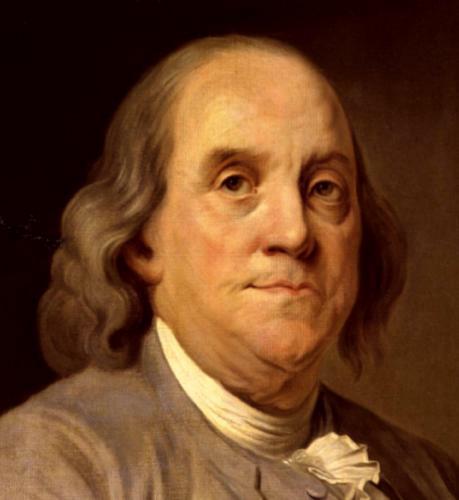 Bringing God’s guidance into the proceedings. Most amazingly, at a point when the discussions seemed to be going nowhere, Ben Franklin – always the voice of simple, straightforward reason – spoke to the group (June 28), reminding them that these discussions proceeding from the biting logic of mere self-interest were going to take this assembly nowhere. They needed to put their self-serving logic aside and instead consult God through prayer, and draw strength from his guidance – just as had been the case during the war when they began their meetings each day in prayer. Franklin reminded them:
In this situation of this Assembly, groping as it were in the dark to find political truth, and scarce able to distinguish it when presented to us, how has it happened, Sir, that we have not hitherto once thought of humbly applying to the Father of lights to illuminate our understandings?
In the beginning of the Contest with G. Britain, when we were sensible of danger, we had daily prayer in this room for the divine protection. Our prayers, Sir, were heard, and they were graciously answered. All of us who were engaged in the struggle must have observed frequent instances of a Superintending providence in our favor. To that kind providence we owe this happy opportunity of consulting in peace on the means of establishing our future national felicity. And have we now forgotten that powerful friend?
I have lived, Sir, a long time, and the longer I live, the more convincing proofs I see of this truth – that God governs in the affairs of men. And if a sparrow cannot fall to the ground without his notice, is it probable that an empire can rise without his aid?
We have been assured, Sir, in the sacred writings, that “except the Lord build the House they labour in vain that build it.” I firmly believe this; and I also believe that without his concurring aid we shall succeed in this political building no better than the Builders of Babel: We shall be divided by our little partial local interests; our projects will be confounded, and we ourselves shall become a reproach and bye word down to future ages. And what is worse, mankind may hereafter from this unfortunate instance, despair of establishing Governments by Human Wisdom and leave it to chance, war and conquest.
I therefore beg leave to move, that henceforth prayers imploring the assistance of Heaven, and its blessings on our deliberations, be held in this Assembly every morning before we proceed to business, and that one or more of the Clergy of the City be requested to officiate in that service.
Miraculously, Franklin’s call for daily prayer seemed to be the point at which things settled down and real progress began to be made in the discussions!

page 2 of Franklin’s call for prayer
Benjamin Franklin. This Franklin was greatly loved – but not always well understood – because he was intensely complex. That was because he served the world around him in so many different ways in the course of his lifetime. Born in Boston as the last of 17 children, he was early-on expected to become a pastor, but chose apprenticeship in the publishing business of one of his brothers. But in his teens, he abandoned this duty and ended up in Philadelphia opening his own printing shop, and soon produced not only a local newspaper, The Philadelphia Gazette, but also published annually (1732-1758) the very popular Poor Richard’s Almanac – the sales of this book of simple advice making Franklin quite prosperous.

But his huge sense of curiosity about the surrounding world led him also into the world of science, where he became a very well-known expert in the new field of electricity (a very dangerous enterprise, as some were soon to discover!). He then took his learning into the world of higher education, helping to write educational curriculum, and helping to set up a college that would eventually become the University of Pennsylvania.
And he made his way easily into the world of politics, being sent in 1750 to London to represent the interests of the Pennsylvania colonies, which put him in the heart of the rising tensions between the colonies and the British crown.
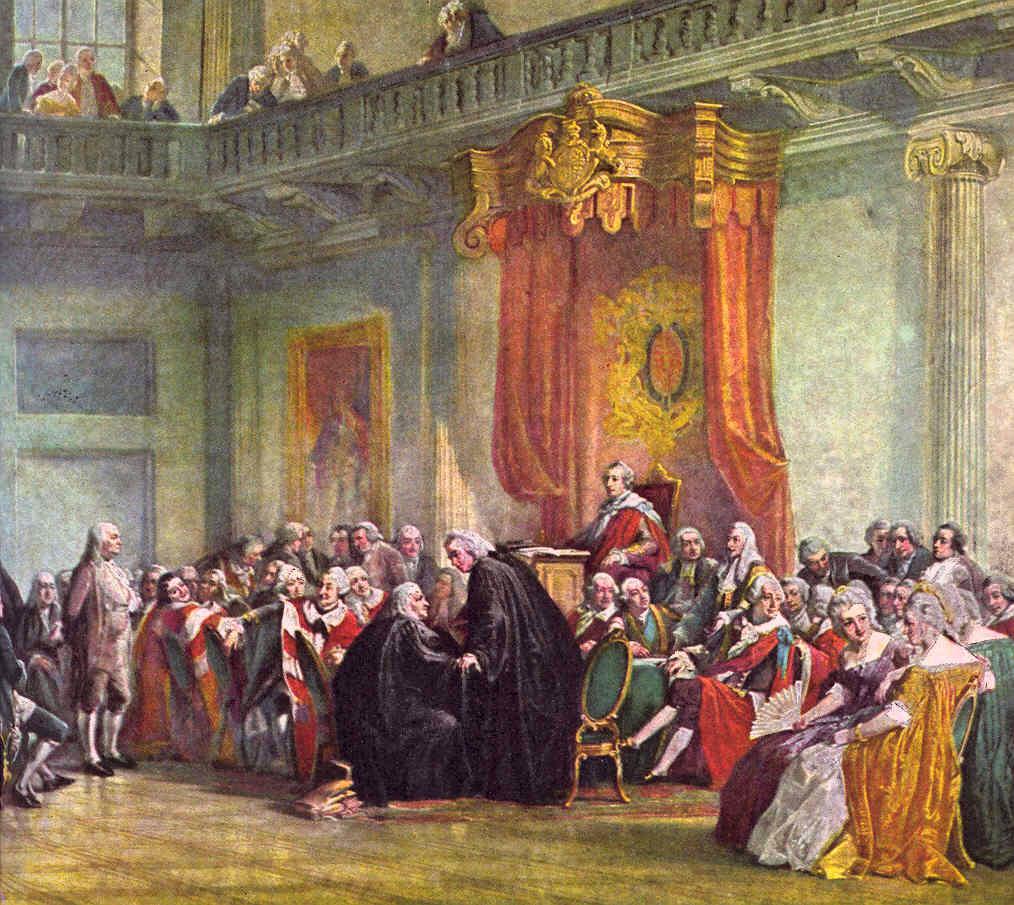
Franklin appearing before the King’s Privy Council – 1774
 And when in 1775 the Second Continental Congress gathered in Philadelphia, he not only was there to represent Pennsylvania, but was sent by the Congress to Paris to try to bring the French in on the American side of the growing American-British conflict. And there he would remain during the duration of the war, being part of the group that finally negotiated the Paris treaty ending that war. He then returned to the States in time to become part of the Constitutional Convention of 1787.
As a person of enormous importance, he took on the ways not of an aristocrat, but almost something of quite the opposite: a homespun American farmer! His ways were simply theatrics that Franklin employed in his effort to get across to others an understanding of what it was, as an American, that he stood for. But he could, at the same time, come across as a supreme “wise one” – for indeed, he was brilliant, and recognized as such in all those fields of science, politics, education, and just the philosophy of the times.
At a deeper religious level, Franklin seemed at times, notably in his earlier years, to be merely a standard Deist, one who believes in a Creator-God who long ago put all of life into operation, but who now sits back and watches his creation unfold naturally. But Franklin went through many changes in religious thought over the span of his 84-year life – at first very reactive to the intense Puritanism of his parents, then probably indeed something of a Deist, but eventually aware of the importance of a religious spirit that transformed life dramatically (thus his long friendship with Whitefield), and ultimately, as we have just seen, someone who believed that God indeed was very active in the affairs of both individuals and whole societies.
But, in any case, he pursued his Christian faith so removed from dogma that many denominations (ranging from Catholics to Quakers) could have believed that he was, underneath it all, one of them! This was because he lived as he saw Jesus having lived, inspiring a higher morality that brought a deeper happiness to life, despite life’s material circumstances.
The Connecticut Compromise (July 1787). Soon after Franklin’s intervention in the stalled proceedings of that Convention, Connecticut came up with an idea (July 5th) that both sides could – after yet more debate – agree on. Congress would be made up of two houses. Congress would have a lower house, like the British House of Commons, that would serve more directly as the voice of the people – and thus base the relative size of each state’s representation in that house on the size of the states themselves, the larger states having more representatives and thus more votes in this House of Representatives. But Congress would have a second or upper house, a Senate – similar to the British House of Lords – with each of the states having an equal voice of two Senators and thus two votes each, regardless of the size of the states. And to get any real work done, the two houses would have to work together … so that neither of the two houses would have dominant influence in the new government.
This was eventually (July 23rd) agreeable to all the Philadelphia delegates. Thus they were finally able to move on to shape the rest of the new Constitutional order.
At the end of that long, hot summer, they finally (mid-September) had put together a new Federation, a Republic in form – something that looked like it would build that unity among the states they so badly needed. Under the new Federal Republic they would indeed be “the United States of America.”
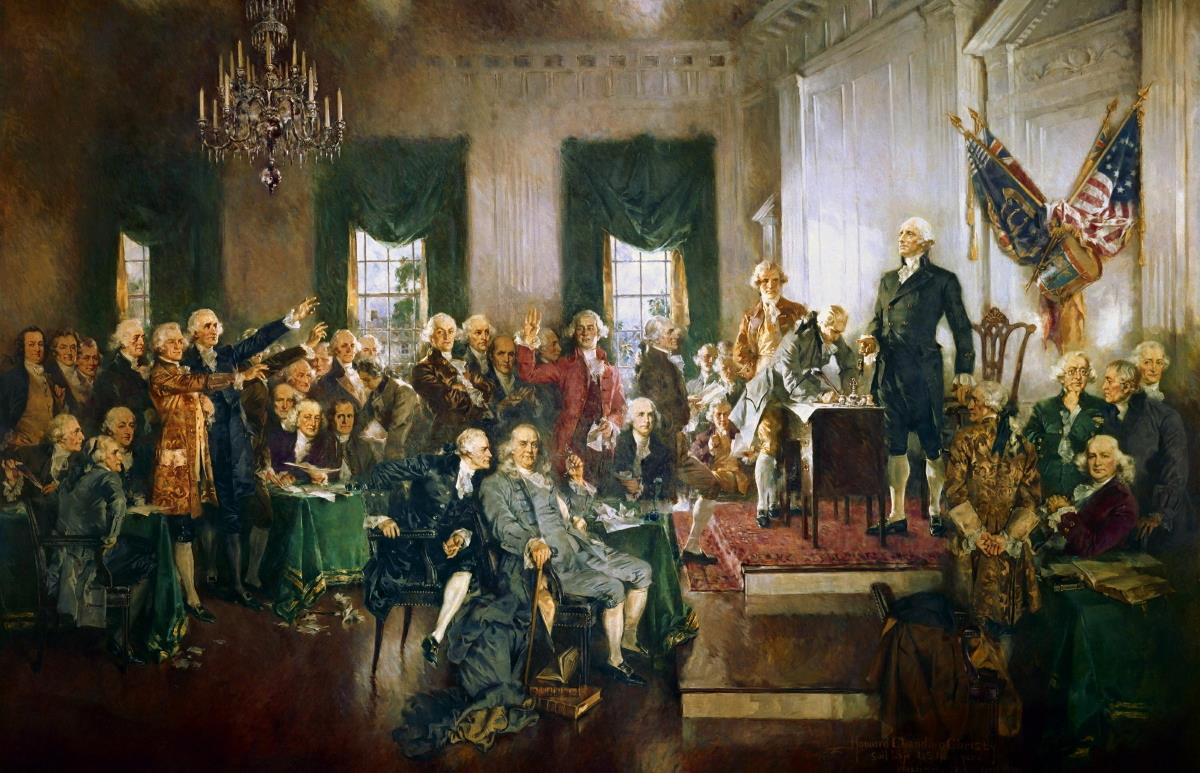
An alliance of 13 sovereign States. It is important to note that this Constitution did not set up a new government to rule over the people. Such rule still belonged to the states – and the people themselves (as clearly stated in the 9th and 10th Amendments attached to the new Constitution:
- The enumeration in the Constitution, of certain rights, shall not be construed to deny or disparage others retained by the people.
- The powers not delegated to the United States by the Constitution, nor prohibited by it to the States, are reserved to the States respectively, or to the people.
Thus instead of a new government over the people, like some kind of monarchy that the world was well familiar with at that time, the new Constitution provided for an alliance of independent states, bringing them together in vital areas – most importantly in the realm of foreign affairs – so as to protect them from the ambitions of European empires – and also to protect them from any competitive ambitions among themselves that would weaken and thus make the states more vulnerable to just those hungry empires abroad.
The Federal Congress. This new political order was definitely not a democracy – as it is so often supposed in today’s cultural climate. The creators of this Constitution knew too much history to simply turn the federation directly over to the popular will – where “enlightened” demagogues could easily manipulate the gullible masses into doing something really stupid and self-destructive as a society.
The House of Representatives. They did give the people their voice in a House of Representatives – and recognized the particular responsibility of the American citizenry in the realm of finances and economics by making the House of Representatives the house that would originate all legislation of a financial nature – much in the same manner that the British House of Commons worked.
The Senate. But the Constitution also set up the new Senate with the clear intention that it would serve as the voice of the individual states – sort of a check on the popular will driving the House of Representatives. Senators were expected to be senior statesmen chosen by the legislatures of each of the states (as per the Constitution’s original provisions in Article I, Section 3[8]), whom the states esteemed to be the ones to best represent in Congress the interests of the sending states. In other words, Senators were expected to be senior statesmen (like the British Lords), older, wiser, deeply experienced in public affairs. In line with this expectation, the Constitution specified that ratification or approval of all treaties, all ambassadorial appointments and other key areas in the conduct of the foreign policy of the new Federal Union was to be the special responsibility of the Senate – in conjunction, of course, with the President who initiated all action in these areas. Also, the confirmation of appointments by the President of all Federal judges was to be the matter only of the Senate. Again, this was because a greater dignity and political maturity was expected of the Senate.
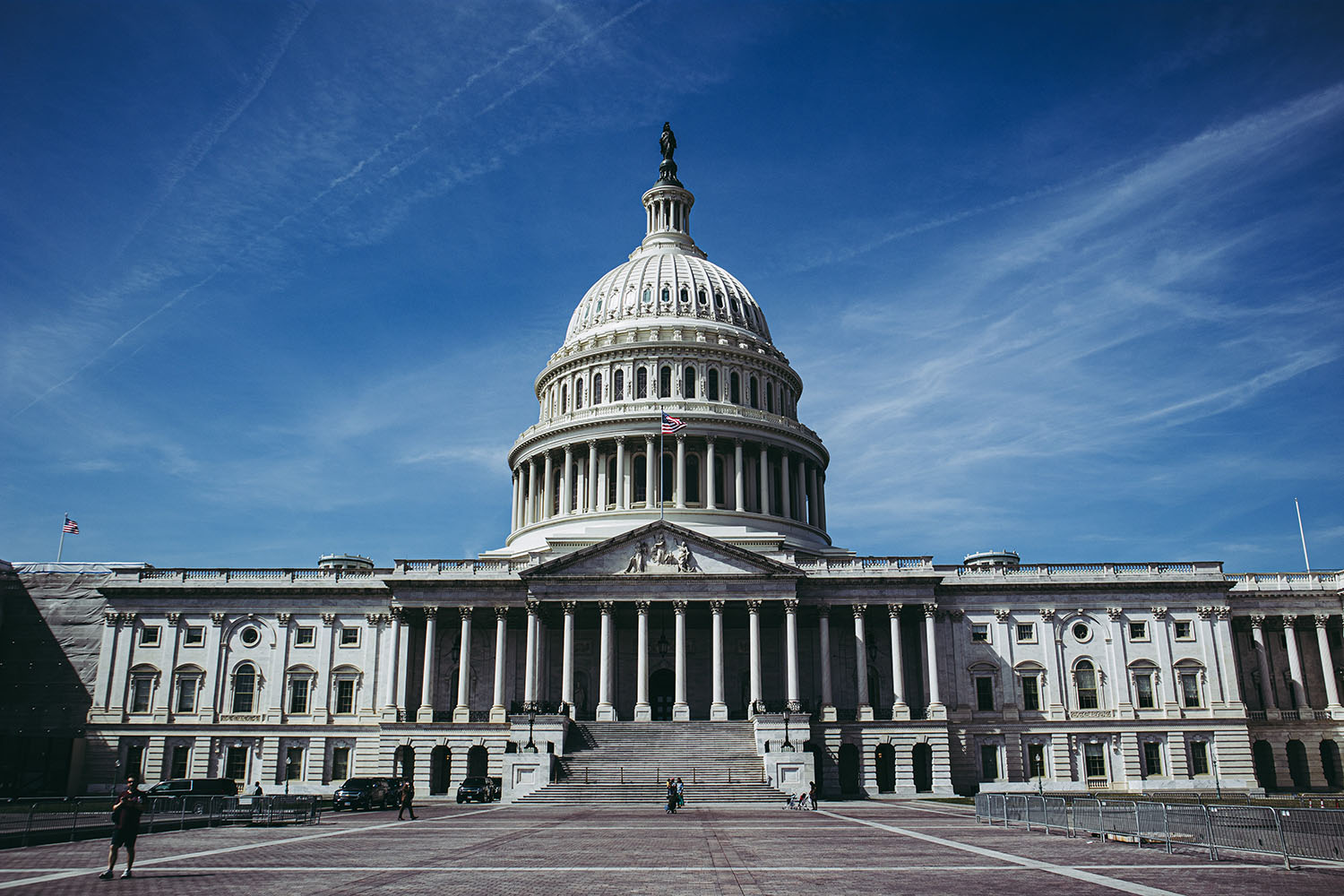
Congress’s Capitol Hill building
The President. As permanent head of the Union, the President had executive responsibilities – to call Congress into session, to address it annually with his estimation or appraisal concerning the State of the Union, and as a permanent officer to see that the laws of Congress were faithfully executed as Congress itself had directed. But he was also to serve somewhat like a king, in sending and receiving diplomats to and from other countries (the states no longer had such foreign policy rights) and he was to serve as the top commanding officer of the army and navy serving the United States. And, rather unanimously convinced that Washington himself would be the one called on to fill that position, the Framers of the Constitution had a fairly clear idea of how this high office would likely shape up – even though Washington himself had given no indication whatsoever that he was interested in that responsibility. But if not Washington, who then? There would be pressure coming at Washington to accept the job.
In any case, the President – functioning as one who presides rather than rules – would himself be chosen by the states – not by the people. Each state would appoint its own members of the Electoral College, the institution assigned the task of choosing a new President every four years. The number of voting members of the Electoral College allotted each state would be determined by the size of that state’s presence in Congress (the total number of their Representatives plus their two Senators – although Congressmen and Senators themselves could not serve as presidential electors). Furthermore, each state was given the right or responsibility of deciding exactly how they would choose those presidential electors (Article II Section 1).
As previously mentioned, the President was to supervise the actual application of the laws of Congress in specific situations facing America. It was not expected that the President would have a great influence in originating the laws. That was supposed to be Congress’s job … in doing so representing the will of the sending states (the Senate) and their citizens (the House of Representatives). No, the President was not supposed to be the maker of the laws, only the supporter and enforcer of the laws enacted by Congress.
However, the President’s required approval of Congress’s new laws was a key part of the whole legislative or law-making process. If the President himself felt for one reason or another that he could not approve a proposed law coming out of Congress, the President could veto that law. That would not totally stop further progress on the enacting of that law. But it might – or at least it could – slow its passage up considerably, because to get past a presidential veto of a proposed law, Congress would have to make another attempt at its passage – needing not just a simple majority this time, but instead a 2/3 vote in favor of the law so as to actually put a vetoed law in place. That would not be an easy thing to pull off.
In any case, the general idea was that all laws designed to guide the country would have to have the very broadest of political support in order to be operable, and not be simply the will or design of one or another particular interest group. The new Republic was intended to be built on a foundation of national consensus, not on the partisan interest of this social group or that social group – not a king, not a privileged ruling class, not some military or bureaucratic faction, not a particular ethnic group, regional faction or religious sect.
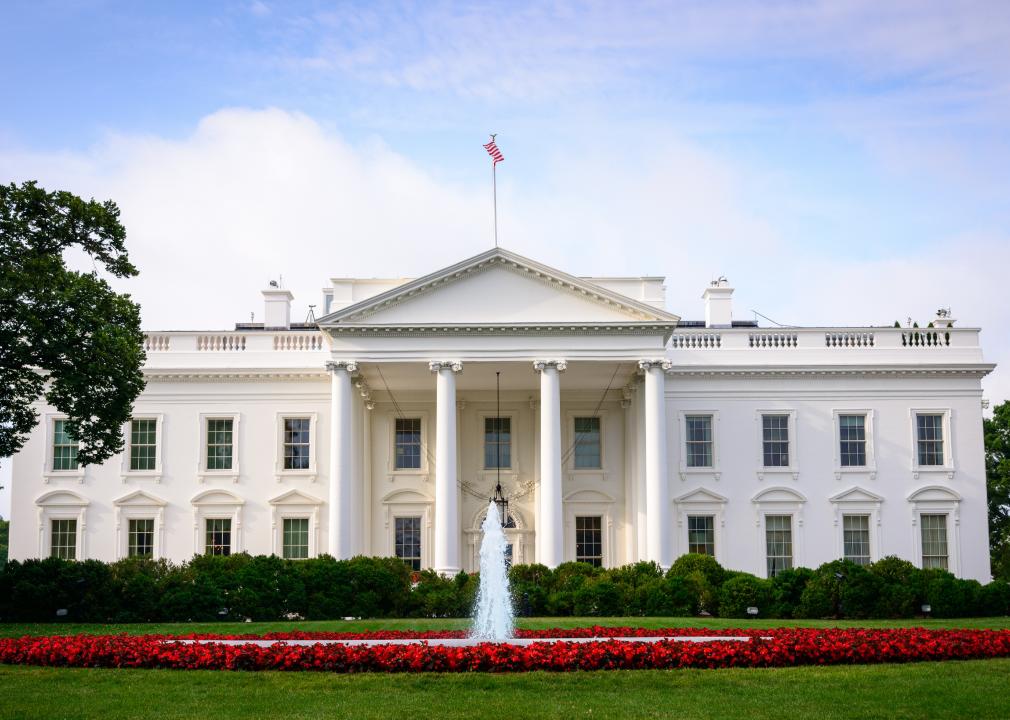
The President’s White House
The Supreme Court. Then too, the Constitution briefly provided for a judicial branch of the new Union, the Supreme Court, given the power to see that Congress and the States adhered strictly to the rules of the Constitution when disputes arose (law cases) over the actual functioning of the Federal legal system. These Supreme Court Justices – and the judges serving below then in the lower-level federal Circuit Courts – would be appointed to life-time service by the President (but confirmed by the Senate) – lifetime meaning there was no way to remove them once in place – except under the unlikelihood of them committing some great crime. This gave the Federal judges unlimited power.
Hopefully they would remain neutral in their judgments. But expecting judges not to have distinct political philosophies of their own was/is most unrealistic. The Framers, however, seemed not to be aware of this power possibility because judges in the English legal tradition that they personally were well familiar with actually had only very limited powers.
The Framers in no way anticipated that the Supreme Court would eventually become the one part of the Republic able to dismiss or reshape the nation’s laws as it chose to do so – without any further recourse anywhere in the legal system by which such actions could be blocked or reversed. These justices would step by step take on virtually unlimited or total political power, awarding themselves the authority to reshape the Law of the land to read in any form or fashion as they personally saw fit.
In short, these federal judges or justices would eventually make the Supreme Court – not Congress – the supreme legislative authority of the Federal government.
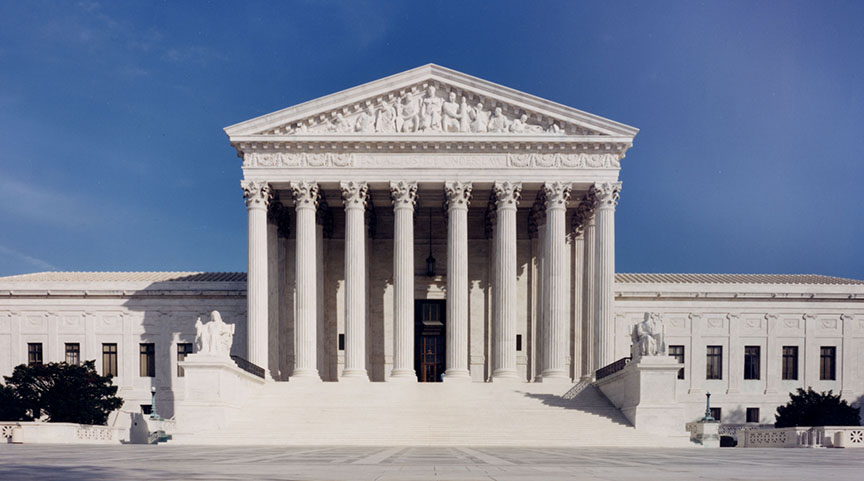
But at the time, this was not even suspected as a possibility.
Ratification. Once the Constitution was drawn up it had to be approved or ratified by the states – usually by the calling together of special state conventions for the express purpose of voting on the new Constitution. In some cases, ratification was quick – and in other cases it took a fair amount of time to get the Constitution approved. There were those who opposed this new Constitution (“anti-Federalists”). But through the writings of those who supported and explained carefully the beneficial features of the new Constitution (notably James Madison and Alexander Hamilton and their many newspaper articles later collected as The Federalist Papers), the pro-ratification or Federalist group carried the day.
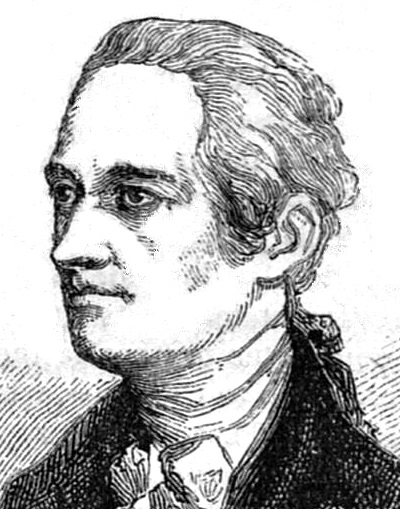
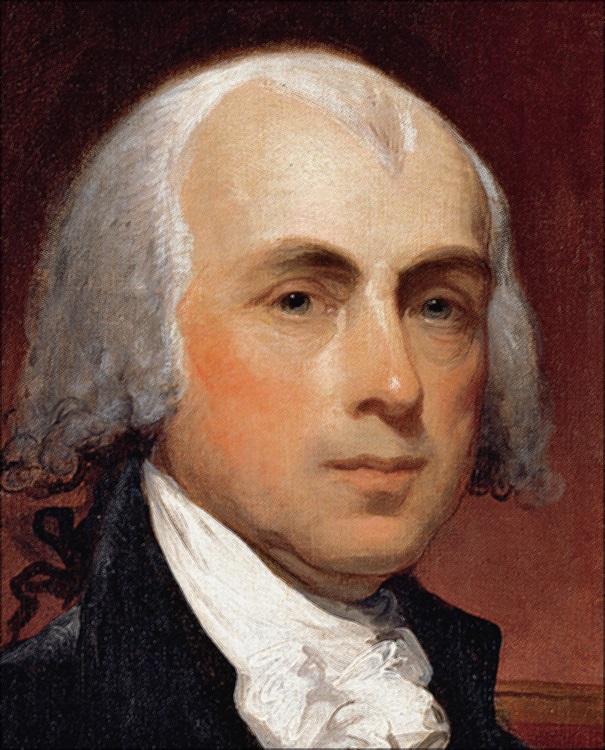
Hamilton Madison
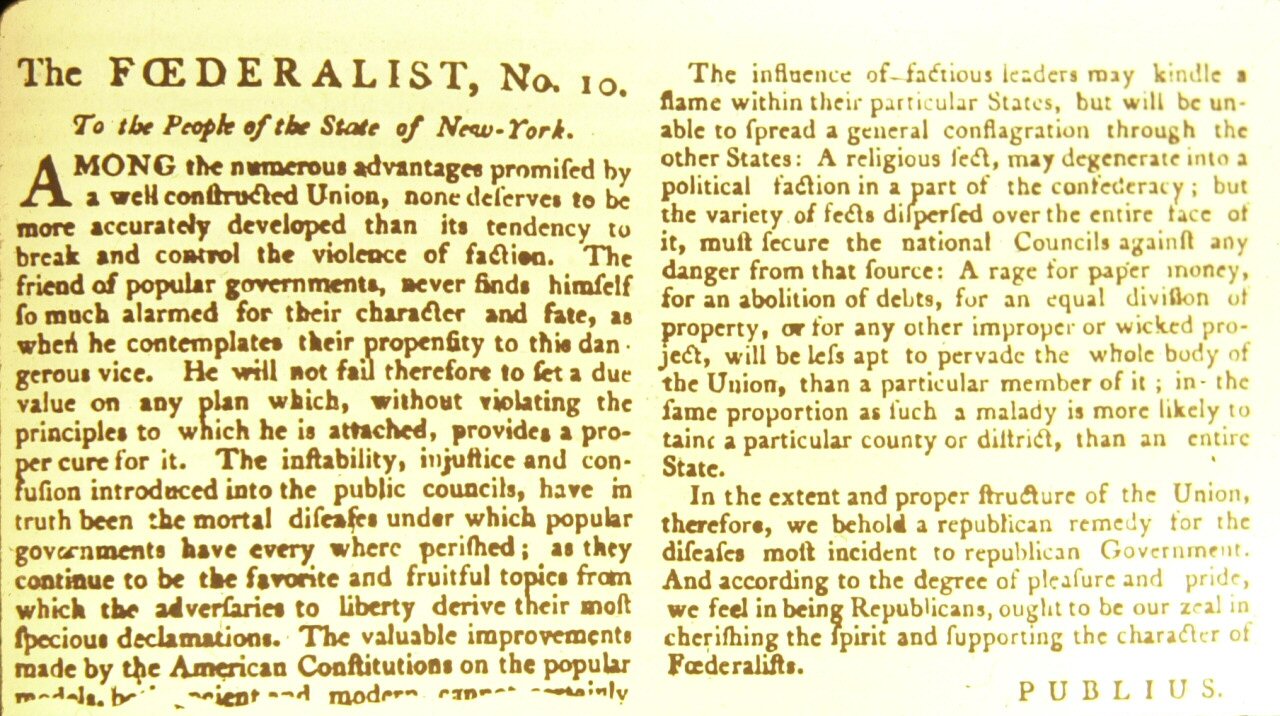
The promise to add a number of Amendments to the Constitution (the Bill of Rights comprising the first ten Amendments) – guaranteeing that the new federal system would not be able to take away the rights of the people and the states – also aided in getting the new Constitution ratified.
Thus, two years later, in 1789, the Constitution went into full effect – and the new Republic immediately took up its duties of uniting the states in their encounter with the larger world. America was now officially a Federal Republic.
“A Republic, if you can keep it” (Franklin). When coming out of that long and hot Philadelphia convention of 1787 and asked what it was that the delegates had come up with for America as its new governmental form, Franklin most insightfully replied, “A Republic, if you can keep it.”
A Republic, if you can keep it, indeed. A major concern at the time was the question of how such a Constitution could hold against the political forces that seem inevitably to drag all political orders eventually into some kind of tyranny (a tyranny of one, of the few or of the many). Those that put the Constitution together were very aware of history and the lessons it taught about the immense difficulties that societies had holding to their original political purposes. Unbounded political ambition had invariably brought societies of the past to tyranny and ultimately self-destruction, repeatedly.
And more recently, in their own lifetimes, they had seen how the lure of power had changed the English monarchy from a distant and largely inactive agency in the life of the Americans – Americans who had therefore developed the very special talent at that time of taking care of life’s challenges themselves. However, recently had arisen a very interventionist, even dictatorial king who loved political power so much, and similar to the French kings, supposed that he had the right, even the necessity (by way of his own superior “enlightenment”) to rule directly and fully over the American “peasants.” But Americans were no peasants. They were very self-sufficient citizens of a quite free land. And they not only intended to keep things that way but were willing to die for such a right, as indeed many – very many – just had.
But they clearly now needed a larger political system of their own, to protect their small, but independent states. But how were they to set this up so that there would be just the right amount of power to provide that protection – but no more than that, lest it stir the ever-human lust for just a little more power here and there, just a little more power to put themselves in greater control of life’s outcomes?
In short, how were they to protect themselves from the temptation to turn themselves into little gods, striving to bring their free (but challenging) world under control by some overbearing human agency? This problem had never been solved successfully in the past. Historically aware, they understood very clearly the necessity, but also the dangers, of power. The Greeks had struggled with the issue. The Romans had struggled with the issue. And it had been a source of great controversy during the West’s long “Christian” era. Power was a very tricky matter.
Thus they well understood the question in front of them: how was this new venture in government design likely to prove to be any different?
A system of checks and balances. As Madison pointed out in his Federalist Papers articles, the system was set up in such a way that cooperation among a number of various branches of government would be required to make the system work at all. And cooperation meant compromise, the necessity of having to give up the desire for total power, in order to employ any power at all. If one of the branches of government (that would include also the member States themselves as part of the branches of this federal union) would start to assume more power for itself (a rather certain possibility) this would stir the indignation of the other branches, which out of a self-serving sense of the relative loss of their own power, would gang up on the usurper of their joint power! A very ingenious system!
Unfortunately, Madison did not give any indication as to how the Supreme Court could likewise be checked – except to wait for vacancies to be filled by new appointments as seats on the court were vacated by death or self-chosen retirement. And Madison had no way of understanding how a U.S. president’s Executive Orders (not part of the original constitutional design) could bypass this constitutional system of checks and balances, and become a source of presidential dictatorship.
Yes indeed, power was a very tricky matter!
The very hand of God. But by no means did the Framers of the Constitution rely entirely – or even mostly – on this ingenious mechanical system. They were well aware, just as Franklin had stated, that this whole enterprise would succeed or fail on the key issue of God’s (not man’s) will. They needed to stay closely in line with the will of God – who after all had given them the victory against royal tyranny in the first place. Otherwise nothing, not even clever mechanics, would protect them from human evil.
As we have already noted, the hand of God in establishing the rights and leading the behavior of American society was made very clear in the opening of the famous Declaration of Independence:
We hold these truths to be self-evident, that all men are created equal, that they are endowed by their Creator with certain unalienable Rights, that among these are Life, Liberty and the pursuit of Happiness.
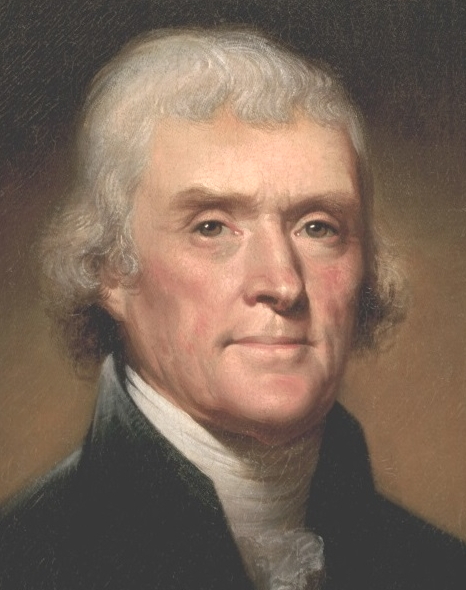 Thomas Jefferson would expand on this idea a few years later in his Notes on the State of Virginia (1781):
God who gave us life gave us liberty. And can the liberties of a nation be thought secure when we have removed their only firm basis, a conviction in the minds of the people that these liberties are a gift from God? That they are not to be violated but with His wrath? Indeed I tremble for my country when I reflect that God is just, and that His justice cannot sleep forever.
Likewise, George Washington stated the case very clearly in the speech he addressed to the nation as he took office in 1789 as America’s first President:
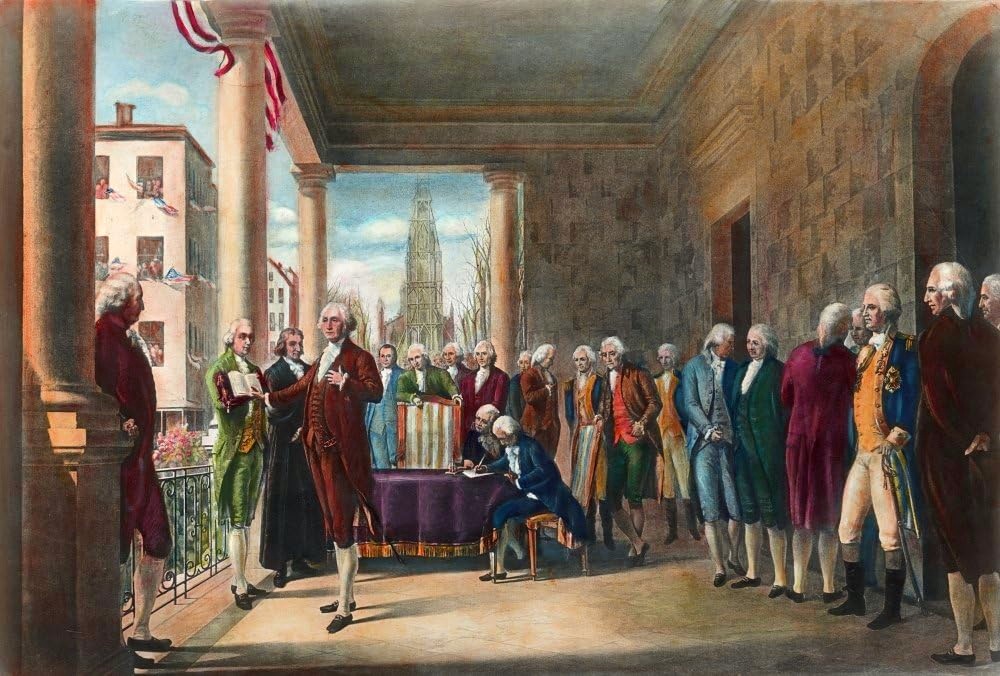
It would be peculiarly improper to omit, in this first official act, my fervent supplication to that Almighty Being, who rules over the universe, who presides in the councils of nations, and whose providential aids can supply every human defect, that His benediction may consecrate to the liberties and happiness of the people of the United States . . .
No people can be bound to acknowledge and adore the Invisible Hand which conducts the affairs of men more than the people of the United States. Every step by which they have advanced to the character of an independent nation seems to have been distinguished by some token of providential agency.
. . . [W]e ought to be no less persuaded that the propitious smiles of Heaven can never be expected on a nation that disregards the eternal rules of order and right, which Heaven itself has ordained.
This was not mere political posturing, Washington’s reference to God as the ultimate provider behind America’s development and recent success in preserving its independence. It was very serious business – for it rested on a Truth that recent experience had made very, very clear. This was not just religious platitude, designed by Washington to comfort the people with an assurance that he was a proper church-going Christian (which he frequently was not). This was testimony to the reality of politics that all of these quite astute practitioners of politics had come to understand – at a very deep level. The American venture would not fail – as had Athens’ and Rome’s and Israel’s attempts at self-government – as long as it retained a very deep sense of connectedness to God and his hand in the affairs of man.
[7]This is not a dynamic understood by American Humanists, who blanche at the thought of having to maintain necessary social order, even if it is a most unpleasant, most unwanted task, which it certainly can be. It is a duty of those responsible for the ultimate order to society (which a society, after all, is exactly that: an institution of human order), a duty that Humanists typically run from. In fact, they will easily turn on those (such as the police) in ideological fury when this dynamic explodes – which it will do from time to time – and blame the police, not those burning away at the social order, for the disaster in front of them.
[8]The 17th Amendment to the Constitution, put into effect in 1913 at the beginning of the Wilsonian Era, would however “democratize” the choosing of the states’ two senators, by taking this responsibility or right from the state governments and awarding it directly to the people, a move that the Framers of the original Constitution would have been strongly opposed to because of their fear of unchecked democracy.
THE AMERICAN AND FRENCH “REVOLUTIONS” COMPARED
In 1789 – the same year that the American Constitution was ratified and thus in full effect – the French Revolution broke out in Paris, as the French, taking their cues in part from America, attempted their own rebuilding of French government around the popular will. Certainly the experience of the French fighting alongside the Americans in their rebellion against their own king served to inspire the French to look to the possibility of doing the same to their own bankrupt monarchy. And the Americans coming up with a written program (the American Constitution) certainly also gave rise to the French hope that something similar by way of a perfect social design could also become the foundation for a new French government, a Republic, like the American Republic.
But in fact the results at this French effort to undertake something similar to the American program ultimately proved to be quite different for the French than for the Americans – tragically different.
The American effort. The simple fact was that despite the tendency to want to call what the American colonies went through in the 1775-1783 period a “Revolutionary War” – there was nothing very revolutionary as to what actually took place in America at the time. No new social order was put in place. Only political practices of self-government, ones that had long been operative in America (over 150 years by that time), were simply being protected and preserved – against the designs of an English King intending to end such political independence and put “his” colonies completely under his despotic or dictatorial control (the political lust that comes to all people able to assume unlimited power).
The American colonies had been self-governing according to carefully written social contracts that birthed these colonies in the 1600s. And now years later in the mid-1770s when they decided to not yield to the King’s pressures but to go fully independent instead, they easily and quickly drew up new state constitutions (for Massachusetts, Virginia, Maryland, etc.) outlining the political institutions and procedures that would govern their newly independent states. And then when they gathered some ten years later in 1787 to put together a Union of these newly independent states, they handled quite maturely the political differences that naturally were there, given the various differences in the makeup and cultural traditions of these different American states. They well knew what they were doing – being long experienced in productive governmental reform. They were simply building on that same long experience.
The French effort. That was not the case for the French. Prior to their rebellion against their king in 1789, the French people had absolutely no experience whatsoever in self-rule. They certainly talked about the possibility a lot, especially at the polite gatherings in fashionable French homes of French intellectuals and socialites – where the dreams of political reform were often the central topic under discussion. These enlightened dreamers could come up with the most beautiful of ideas about constructing a more perfect political world. But these were ideas not based on any real experience, but only on the fanciful dreams that these Idealists held about human nature – and the possibilities of marshaling such human nature in order to build a utopian society. In short, they had no idea of what it was they were talking about – as events would soon prove.
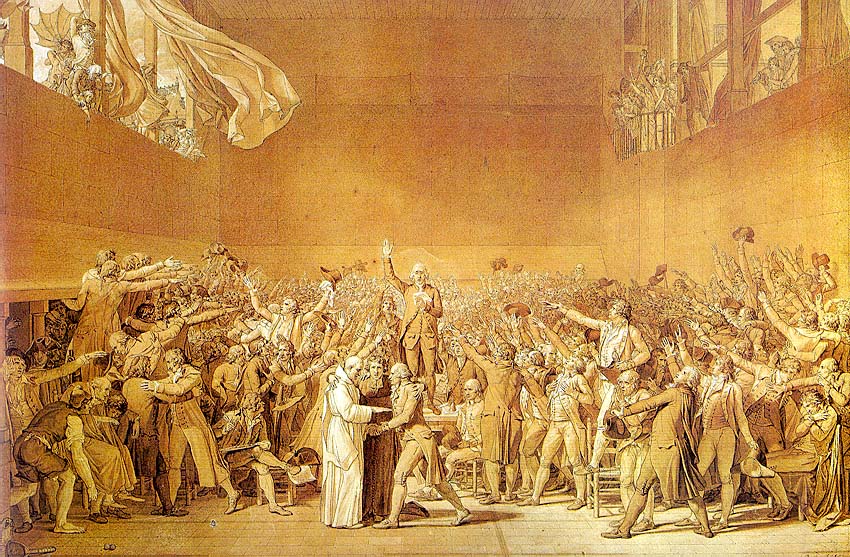
French “reformers” take the “Tennis Court Oath” promising to reform the French political system – June 1789
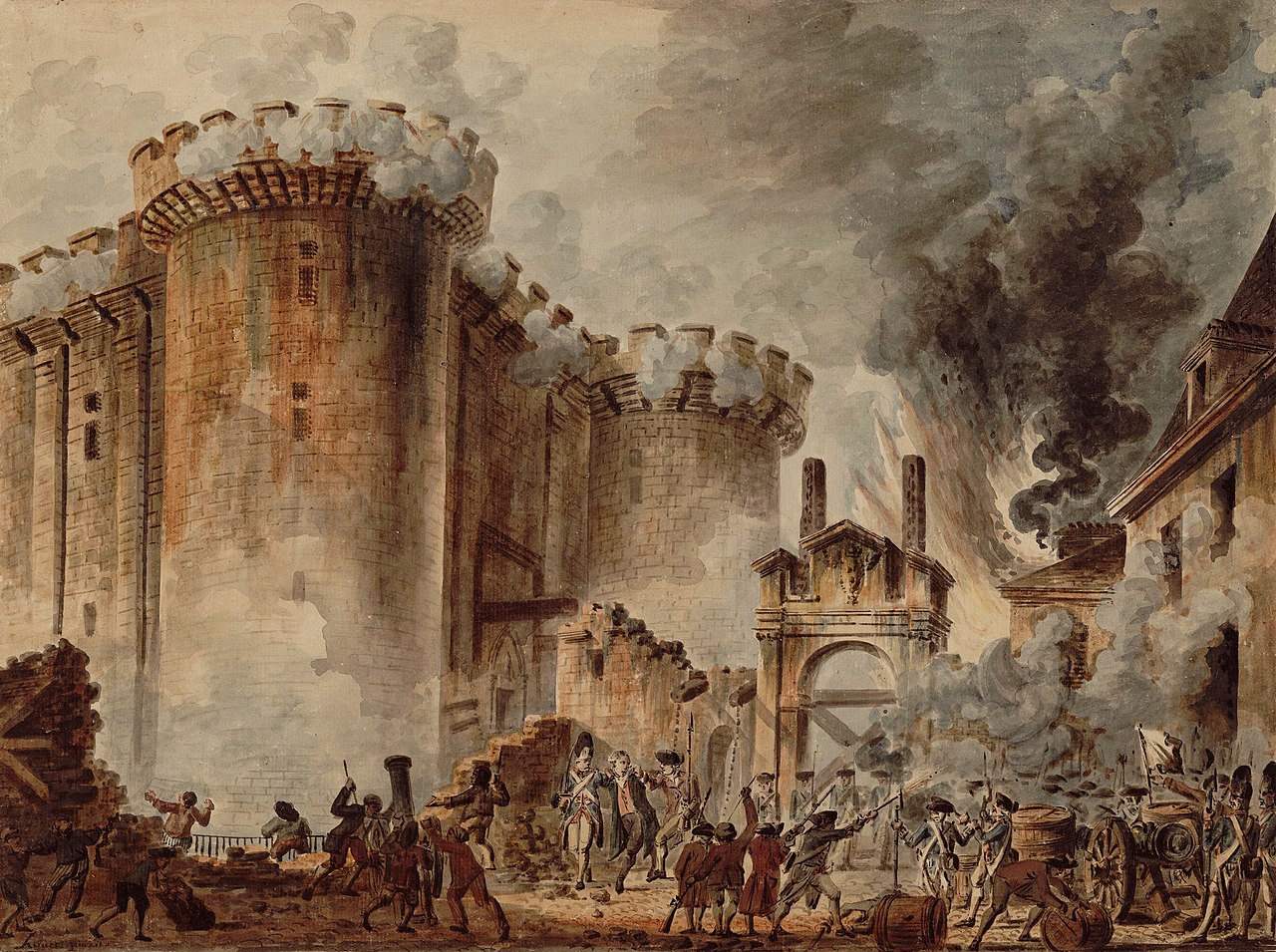
Then Parisians storm the Bastille over unfounded rumors of numerous political prisoners being held there. The “French Revolution” is now underway! – July 1789
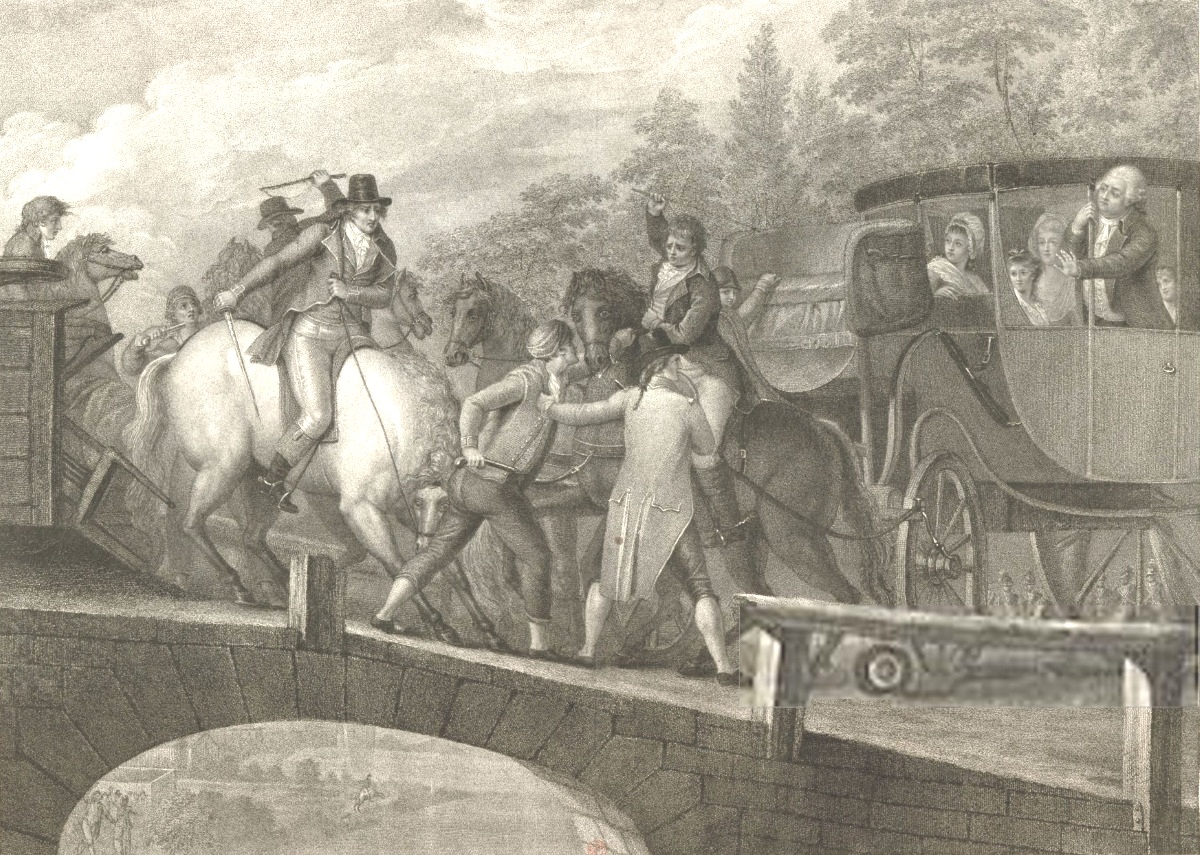
King Louis XVI is caught trying to flee France – June 1791
King Louis XVI is executed – January 1793
Once they succeeded in collapsing the monarchy, they then took on the privileged feudal aristocracy – and then also the French church and its prestigious hierarchy of bishops and priests.
But slaughtering off the keepers of the Old Order (the Ancien Régime) did not automatically open the way to the establishment of a stable, working Republic – for French society had no particular moral foundations at this point on which to erect their radically new society.
The “Goddess of Reason” is brought to Paris’s Notre Dame Cathedral as the revolution’s own “altar piece” … indicating that Reason had replaced Christianity as France’s new moral foundations – November 1793.
Chaos thus reigned in France – and only got worse when then the intolerant intellectuals (Girondins and Jacobins) then turned on each other as betrayers of the Revolution – because they differed with each other on points of Reason – or just because of intense political jealousy. By 1793-1794 a “Reign of Terror” consumed France, the guillotine busy night and day cutting off the heads of enemy intellectuals, including most ironically, the most idealistic of the French revolutionaries, Maximilien Robespierre!
Georges-Jacques Danton – early leader of the Girondins … replaced by the more radical Jacobin leader, Maximilien Robespierre
The mass-murderer Robespierre himself is finally guillotined (July 28, 1794) … the beginning of the slowdown of the Reign of Terror
At this point, no one was in command of the hungry mobs that prowled the streets of Paris – and in a good part of the French countryside.
It finally took the dictatorship of Napoleon Bonaparte (approximately 1799 to 1815) to bring France back to order.

He did so mostly by calling on the Paris mob and fired-up French nationalists of the countryside to join his new French army in its thrust outside of France to “liberate” the rest of Europe from the monarchs whose families had long ruled the continent.
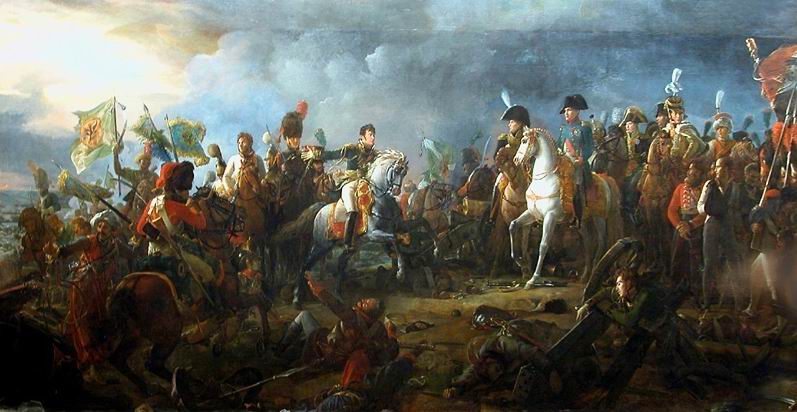
Napoleon and his French army victorious at Austerlitz against their Austrian and Russian enemies – December 1805
This solved the problem of violent discord among the French – but now pitted the highly nationalistic Frenchmen against the kings, barons and commoners of the rest of the European continent (all the way to Russia) – and also the British just offshore to the northwest of France.
The impact on the politics of the Western world. Eventually (1814-1815) Napoleon was defeated by a grand coalition of European monarchs – and the Bourbon monarchy was (briefly) restored in France. But Europe would never be quite the same again with all this nationalism stirred to life – as the English, Spanish, Germans, Italians organized themselves as nations in order to counter aggressive French nationalism. But in finally ending French nationalist domination, this new spirit of nationalism awakened in Europe would not then go away – but merely grow more aggressive – nation by nation – until it resulted in the mindless war of mutual national slaughter which was termed at the time “The Great War” … and which we know today as World War One (1914-1918).
Meanwhile a young Republic – fully engaged with challenges of its own over in America – did its best to stay out of all this dynamic that was rattling Europe. In this it would be only partially successful.
But at least the American Republic itself would hopefully remain strong – a system of fixed laws rather than changing personal political wills, which popular governments had the tendency to turn into, such as France had just become, and later, such as the “People’s Republics,” would become under their “enlightened” Communist dictators.
Indeed, as Franklin put matters: “A Republic, if you can keep it.”