CONTENTS
 Leadership shapes the character of the Republic
 Growing sectional tensions
 Madison and the War of 1812
 Expansion
 The American economic dynamic at this time
 America’s ongoing spiritual development
The textual material on this webpage is drawn directly from my work, America’s Story – A Spiritual Journey © 2021, pages 101-135
LEADERSHIP SHAPES THE CHARACTER OF THE REPUBLIC
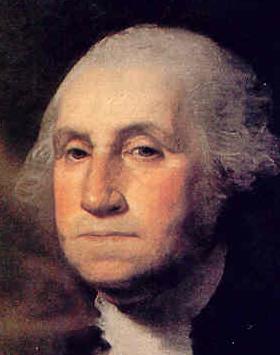 Washington as America’s first president. There had never been any question about who would head up the new Republic as its president. George Washington’s power of leadership was fabled. He had led the small American army through the darkest of times – by personal example of his own steadiness, his own willingness to sacrifice personally for the cause, his own obvious devotion to the God on whom ultimately all things were dependent. Even during the heated debates that took place constantly the summer that the Constitution was being worked out, Washington had sat there quietly as its presiding officer, his mere presence reminding those present to stay focused on the task before them – not to get caught up in petty rivalry. This is the power of true moral leadership.
But there was nonetheless a big question on people’s mind as Washington now took office as the country’s President: would he simply serve one four-year term – or, like so many of the colonial leaders, stand repeatedly for reelection, becoming something like President-for-Life – like a European monarch?
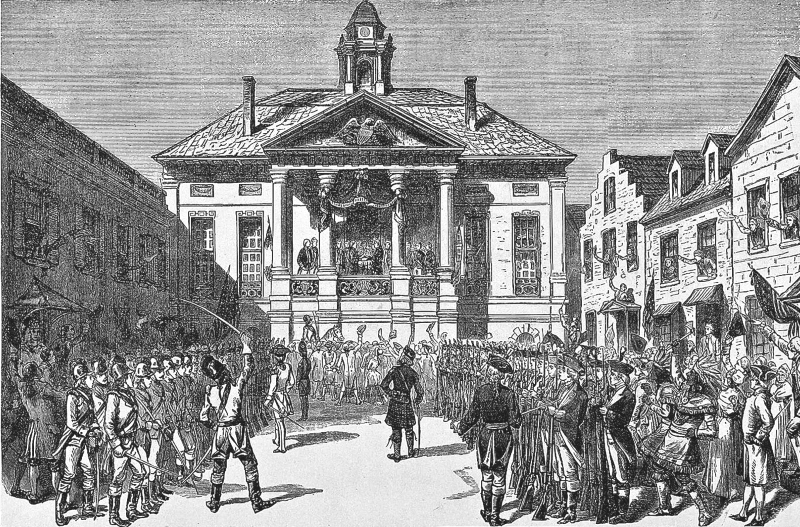
Washington takes the Oath of Office (April 30, 1789)
Actually, Washington was hoping, after serving his country as military general and then chairman of the Constitutional Convention, to retire to his farm at Mount Vernon – and only rather reluctantly agreed to serve – just one term, he assured them.
A number of very big issues faced him as he took office: the massive indebtedness of the American states resulting from the long war for independence, the uncertainty of where exactly the lines of authority were to be found under the new regime, and where America stood in the constant tension between France and England – which America was not going to be able to avoid getting caught up in.
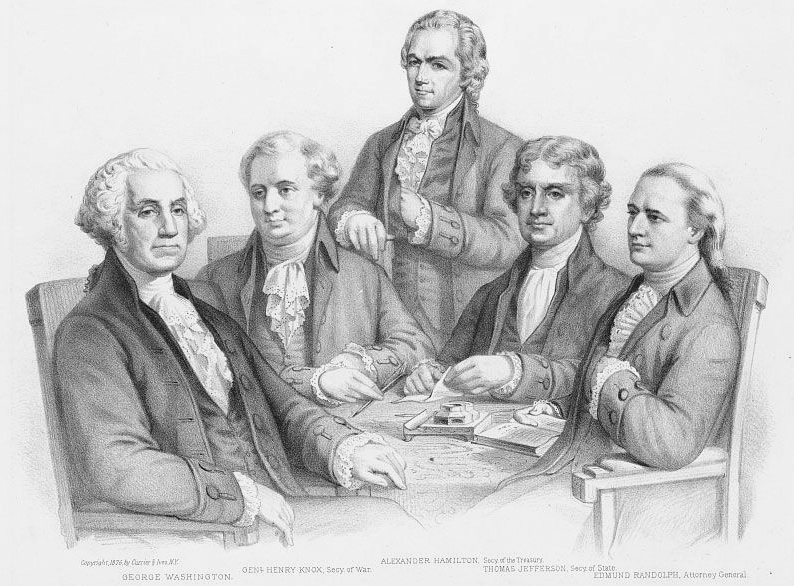
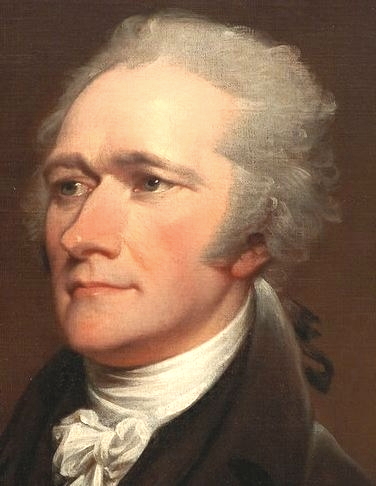 Alexander Hamilton. The first issue – America’s huge money problem – was handled swiftly by his newly appointed Secretary of the Treasury, Alexander Hamilton – who had served Washington bravely and faithfully during the war.
Hamilton was the classical Realist – born of questionable circumstances in the Caribbean Islands, orphaned at a very young age, but able early on to demonstrate a brilliance of mind that got him a scholarship, allowing him to head off to New York for study at King’s College (the future Columbia University), where he prepared himself for a law career. During the rising contention with King George, Hamilton wrote numerous articles in defense of the colonies’ rights in opposing the King’s ambitions – yet jumped to the personal defense of the college president when an angry mob wanted to take the president down for his Tory loyalties.
When fighting finally broke out, Hamilton undertook the study of military history and tactics, eventually organizing an artillery company of Patriot militia and becoming the unit’s captain. His company served bravely in Washington’s army – all the way from the near-disaster in New York City to the victories at Trenton and Princeton. Hamilton was courted by various commanding officers to become part of their staff. But he said yes only when it was Washington himself who made the request.
Washington soon came to depend heavily on Hamilton – who seemed to have a well-informed understanding of what to do in various situations, diplomatic as well as military – and let Hamilton himself issue orders to both military and diplomatic officers on his own behalf. And it was Hamilton – much to the deep concern of Washington – who begged for and was finally permitted the dangerous honor of leading the Patriot charge on the last of the British defenses at Yorktown.
After the war Hamilton went back to his law practice, often defending Tories who were having enormous financial, social and personal difficulties in the post-war period. At this point Hamilton took up the study of finance and in 1784 founded the successful Bank of New York. Recognizing his brilliance, but also serious grounding in life’s hard realities, the State of New York chose Hamilton to be one of its delegates to the Constitutional Convention. We have also seen that he and Madison wrote most of the articles of the Federalist Papers, very insightful commentaries that explained brilliantly why support of the new Constitution was so critically important to the country.
And ultimately it was to Hamilton that Washington once again turned in his quest to have a strong team working with him in his new role as US President. And the country’s economic difficulties being the most challenging of the issues facing the country, Washington asked Hamilton to serve as the nation’s first Secretary of the Treasury.
Hamilton’s debt assumption program – and the “Whiskey Rebellion.” As Treasury Secretary, Hamilton decided to have the new Federal government assume all the debts of the states, restoring vital confidence in the country’s finances necessary to get the country up and running again – but requiring the imposition of new taxes to pay off these debts. This however caused frustration among many of the Patriot soldiers who had sold their service payments to speculators for a mere fraction of their face value, believing that this was the best that they would ever get out of these payments – only now to see the value abruptly rise – and the speculators being paid off in full by Hamilton’s new policies. They felt enormously cheated – especially then when in 1791 they had to face new taxes on their whiskey (whiskey being a major source of income to these farmers) to cover the costs of Hamilton’s policies.
A huge rebellion broke out in 1794 among the veterans (the Whiskey Rebellion as it is known in history).

One of Hamilton’s federal revenue collectors being tarred and feathered by irate farmers during the Whiskey Rebellion in Pennsylvania
Washington once again regretfully had to send the standing army (with himself in command) to break what was becoming a violent rebellion – in order to make it clear that the new government intended seriously to follow and defend its laws. Whiskey taxes would always remain difficult to collect. But at least the country now understood that they had a strong hand in Washington’s command of the new country.
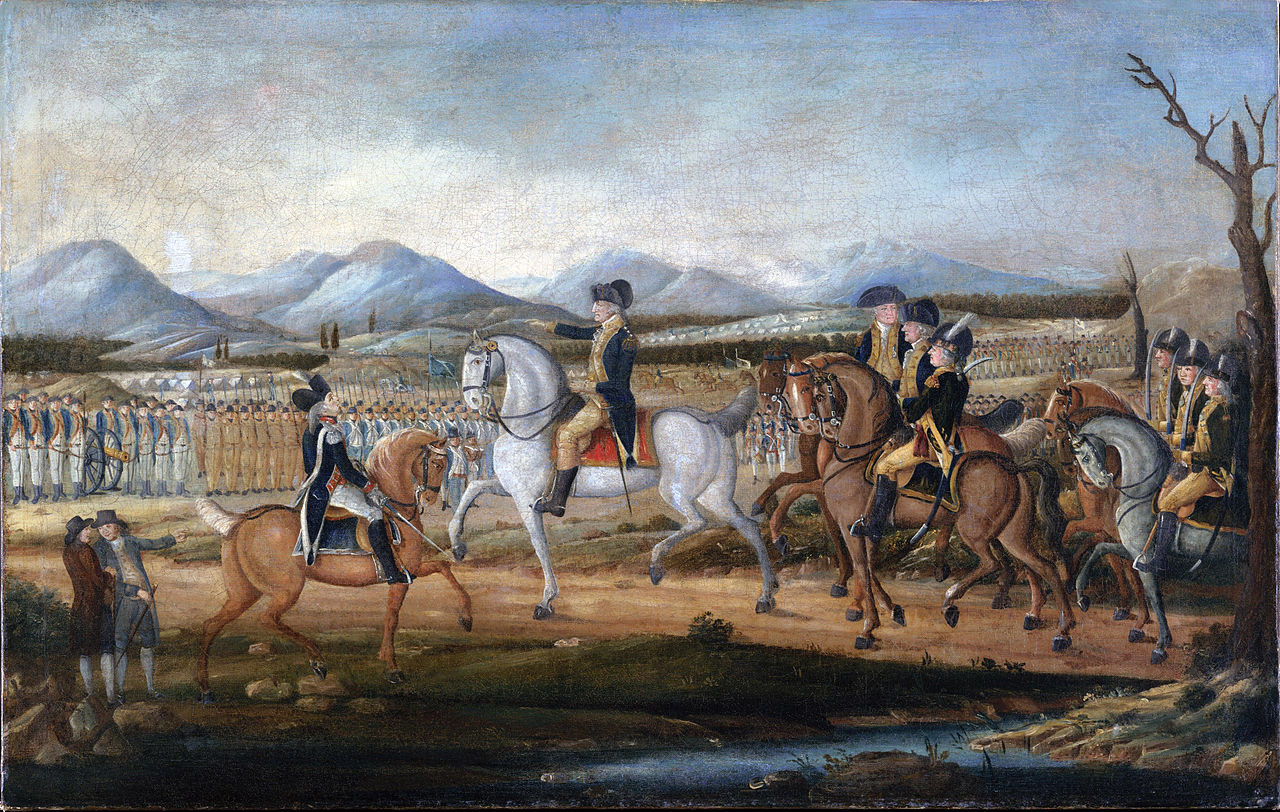
Indeed, Washington made it clear that the federal laws were not up for challenge in the streets. America was not going to let itself become like Revolutionary France (the French Reign of Terror was in full swing at this time). Laws put properly in place under the new constitution would be obeyed. Period.
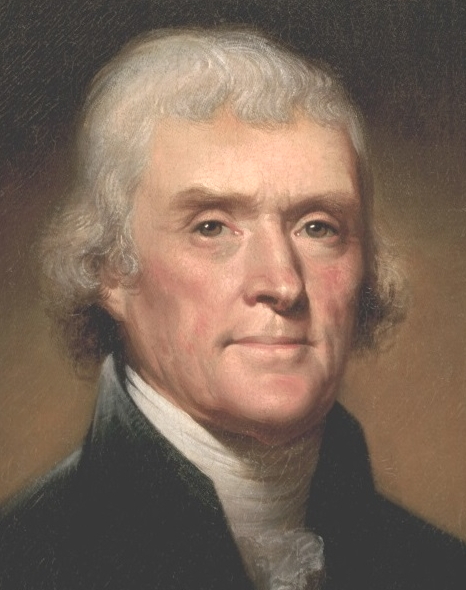 Thomas Jefferson. As much as Hamilton was the arch-Realist, Thomas Jefferson was the arch-Idealist. Much of that resulted from the fact that they grew up differently – very differently. Whereas Hamilton had to fight for everything that came his way, Jefferson was born to privilege – and found that this carried him forward in life quite nicely. Jefferson was born within the ranks of the Virginia aristocracy, his mother being of the prestigious Randolph family – with young Thomas joining his Randolph cousins in being tutored in the classics of language, literature and science. He continued his studies of the classics at the College of William and Mary, and upon graduation took up the study of law under the prestigious George Wythe. At age 21 he inherited from his father 5,000 acres and 52 slaves, including land where he began his designs for the place of perfect habitation – Monticello – which as a fervent Idealist he would work on for the rest of his life in the attempt to use the powers of reason to bring it to full perfection (which also led him “unreasonable” financial debt!).
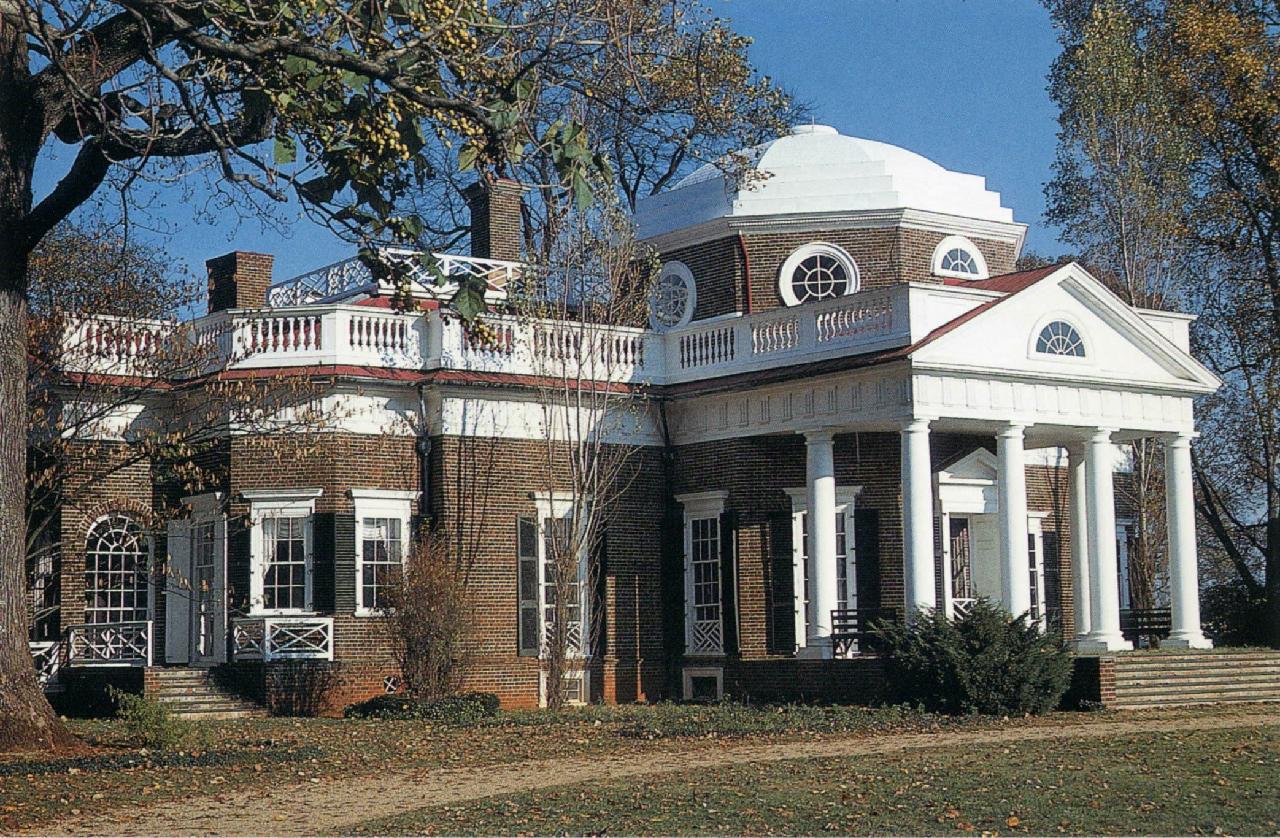
Monticello (1796-1806)
As a practicing lawyer he became a delegate to the House of Burgesses (1769-1775) and in 1772 married a cousin, Martha, adding 11,000 acres and 110 more slaves to his estate. With the calling of the Second Continental Congress in 1775, the young aristocrat was sent to represent Virginia. Here he met John Adams – and joined the small committee called on to draft a Declaration of Independence – a task that Adams turned over to Jefferson to initiate. In completing this task, Jefferson would gain for himself great fame, even though much of what he wrote was simply a rephrasing of Locke’s philosophy. And – much to Jefferson’s deep annoyance – not only was some of his wording amended by the full Congress, about a third of it was rejected because it went overboard in the way that it tried to justify the American revolt.
That same year he was elected to the Virginia House of Delegates and joined the committee designing a new Virginia State Constitution. This gave him the opportunity to advance his agenda of keeping the religious “establishment” out of the affairs of state, in sponsoring a bill entitled, Establishing Religious Freedom. He understandably disliked intensely the dominating role that King George’s Episcopalian Church of England had played in Virginia life. However his bill failed to pass in the Virginia House.
But two years later he was able to participate in the task of reviewing all the laws of Virginia, thus finally allowing him to recast these laws according to his rather Deist/Humanist worldview (religion).
The next year he was even elected Virginia governor – putting yet more power into his hands as a designer of the perfect legal domain. However, his work was interrupted in 1781 by the attacks in Virginia of the turncoat Benedict Arnold – who burned Richmond to the ground, and sent Jefferson and his government officials scurrying pathetically here and there to avoid capture.[1]
After the war (in 1784), as a member of the American Confederation’s Congress, he chaired the committee that was to plan the development of the Northwest Territories – in which Jefferson outlined nine territories (with very exotic-sounding names!), eventually trimmed down to five territories (with largely Indian names).
But that same year he was sent by the Confederation to join Franklin and Adams in Europe, to secure various diplomatic agreements with England, France, Spain, the Netherlands, etc. At this point Jefferson fell completely in love with the French lifestyle, especially French intellectualism – which was becoming increasingly aggressive at this point. And he came very close to being an on-site spectator to those events that broke out in July of 1789 – except that, in what was supposed to be a brief return to America for the summer, he was called on by Washington to take the post as America’s first Secretary of State. Thus Jefferson had to watch events unfold in Paris from a distance.
But his heart was clearly with the wildly enthusiastic French Revolutionaries. He was certain that – in overthrowing the Old Order of Monarchy, Aristocracy and Church – the Revolution would be bringing France to an Ideal realm of pure Reason.
Jefferson vs. Hamilton. Soon, because of all the political turmoil unleashed by the French Revolution, facing America was the matter of France versus England – and where America would position itself in the midst of the ongoing feud between these two countries. Jefferson, now (at least theoretically) in charge of American diplomacy – was all-out in his support of France – to a point of dangerous blindness when he refused for the longest time to see any injustice in the way the French Revolution was turning itself into a violent, cruel and bloody mess.[2]
On the other hand – although they had personally fought the English fiercely in their effort to maintain American independence (while Jefferson had spent the war avoiding the English enemy) – Washington and Hamilton understood that England, despite that recent war, was still the more logical American ally.
But this pro-British stance of Washington and Hamilton so infuriated Jefferson that at the end of 1793 he stepped down from Washington’s Cabinet – to form an anti-Federalist faction designed to fight Washington, Hamilton and the Federalists.
Now also Madison switched sides and joined Jefferson to develop the new Republican party (led at the time mostly by Virginians – not connected at all with the modern Republican Party!).
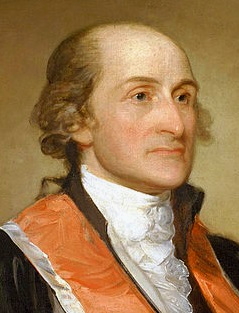 Jay’s Treaty. The British did not help their case in America by refusing to abandon their forts located to the west across the Appalachian Mountains – and by maintaining their alliances with the American Indians living in that region. But most infuriating to the Americans was the British practice of stopping American ships and seizing their hardiest sailors, claiming these to be Englishmen avoiding English naval service – when this was seldom the case. Americans protested – and in 1794 sent Supreme Court Chief Justice John Jay to England to try to straighten matters out. Actually, the English were not greatly impressed by American power and Jay returned home with only small concessions – giving Jefferson’s Republicans all sorts of opportunity to mock “Jay’s Treaty” and attack Washington and the Federalists.
Washington’s second – and final – term. When Washington had approached the end of his term in office in 1793, the Federalists had pleaded with him to accept another term, for there was no one else with the stature to oppose the Republicans. He very reluctantly agreed to do so – more than ever determined that this would be his last term of service to the country. As it turned out, it was – as Washington by the end of his second term in office was exhausted by the slander coming from Jefferson’s Republicans about how pro-monarchy he and Hamilton were for supporting the English monarchy against the French Republic. Certainly Washington and Hamilton’s choice of Britain over France had nothing at all to do with somehow being pro-monarchy – which definitely they were not (it was they, after all – and not Jefferson – who had just put their lives on the line in fighting the British)! The accusation was simply a case of emotionally-charged cheap-shot politics against the Federalists waged by Jefferson’s Republicans.
But in any case, Washington’s departure thus helped establish the tradition that two terms of service (eight years) was the absolute limit on Presidential service. It would eventually even become a written Constitutional law in 1951 (the 22nd Amendment) – after Roosevelt abused this principle by running for a third and then a fourth term in the 1940s.
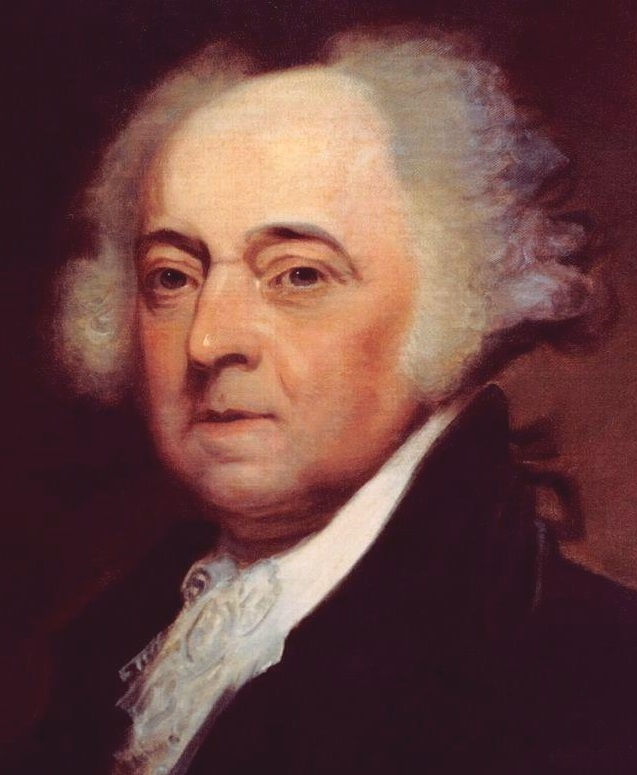 John Adams. Washington’s Vice President John Adams was barely elected as the next President. Adams was a small man with very big ambitions – but also very measured in the way he worked out the moral lines of events going on around him, and what he expected of himself in response. He was always subject to a battle that raged within between the strict Puritan structuring he underwent growing up – and his desire to prove himself as a man ahead of the times. His father was disappointed that John’s Harvard education led not to the ministry but instead to the law – the son seeing in the law a better road to the greatness that he hungered for so deeply.
But his Puritan side would put his law practice under moral restraints that lawyers do not usually worry about. Thus it was that Adams provided the defense in court of the Redcoats who fired on the Boston mob that was assaulting them, potentially putting him in great disfavor with the Bostonians – but instead earning a degree of admiration for his bravery, such that took him several steps down the road of greatness that he sought.
Then speaking and publishing strong defenses of the rights of the colonies to oppose the King’s attack on their long-standing ability to govern themselves fully, he put himself out in the lead of the growing movement against the king. This earned him the appointment as a Massachusetts delegate to the First and Second Continental Congresses, the latter which asked him to head up a committee to draft a Declaration of Independence. The fact that he let Jefferson take the initiative rather than he himself in actually providing the original draft – and thus Jefferson gaining fame forever for doing so – would remain for Adams a perpetual torment!
Adams served on a number of committees of Congress over the next years. Then from 1778 onward he was sent back and forth (along with Franklin) to Paris to develop a working alliance with the French. And he too was part of the discussions that produced the Treaty of Paris formally ending the war in 1783. But in the meantime, he had also been working with the Dutch to coordinate with them their role in supporting American independence – and Dutch banks in helping post-war America financially. Then in 1785 he was sent to London as America’s first Ambassador to the Court of St. James (as that position has always been known). While there, he contributed his own excellent writings in support of the adoption of the new American Constitution (which, because he was in England at the time, he had no direct part in drawing up).
By this time he was so well known in America that he came in second in the Presidential vote – and thus, by the understanding at the time, the recipient of the position as America’s first Vice President. But as Adams would come to discover, it was a position with a title only, and no real political power or importance of any kind. But finally it did put him in position to run for the presidency when Washington stepped down.
And thus in 1796 he was elected President (barely) over his competitor Jefferson – and only when the election was placed in the hands of the House of Representatives because no candidate had a majority of votes. In the House, Hamilton and his Federalist supporters finally decided that they disliked Jefferson more than they disliked Adams! Thus in electing Adams to the presidency, this made runner-up Jefferson the new Vice President – and Hamilton even more greatly disliked by Jefferson and his Republicans. In the end this action in support of Adams put Hamilton on the Republican hate list.[3]
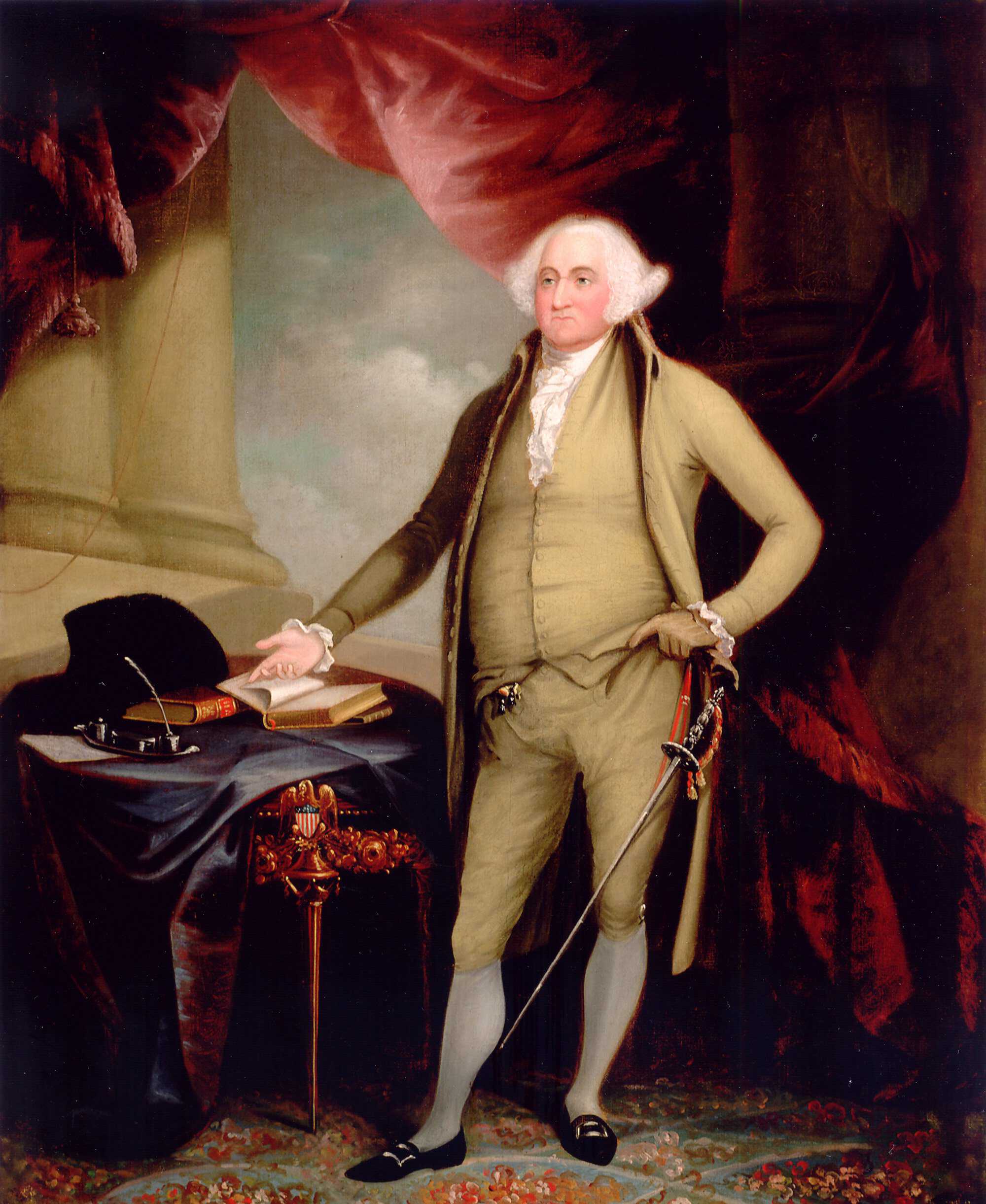
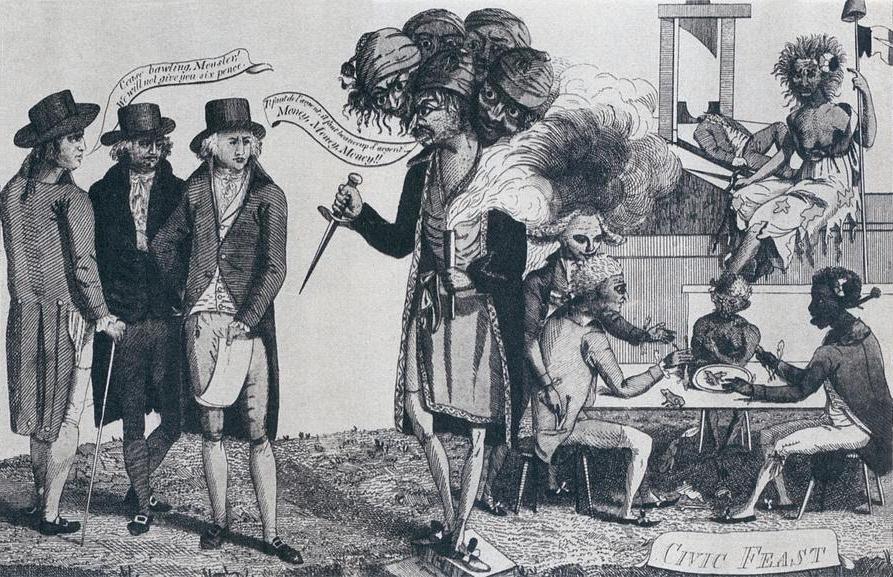
Adams as President. In any case, with Adams as President, he had to face the fact that it was now the French who were seizing American ships – embarrassing Jefferson and the pro-French Republicans. Hamilton and the Federalists now called for war against the French. It was all that Adams could do to keep tempers cooled down – especially with the “XYZ Affair” that scandalized Americans when Americans were sent to try to solve this problem, but were told they would first have to pay enormous bribes to French agents (self-identified only as X, Y and Z) in order to get discussions going. They refused. Consequently, Americans became even more enraged at hearing of the French behavior.
Then in 1798, Congress passed (and unfortunately Adams signed) the infamous Alien and Sedition Acts, which branded as punishable “traitors” anyone (principally Jefferson’s Republicans) who supported France – or who opposed the position of the President or the heavily Federalist Congress. They would be subject to expulsion from the country.
By the next year (1799) it seemed as if America was actually at war with France (the “Quasi War”) on the high seas. And with a large sweep of the 1798 congressional elections by the Federalists, the demand for an actual declaration of war was now very strong.
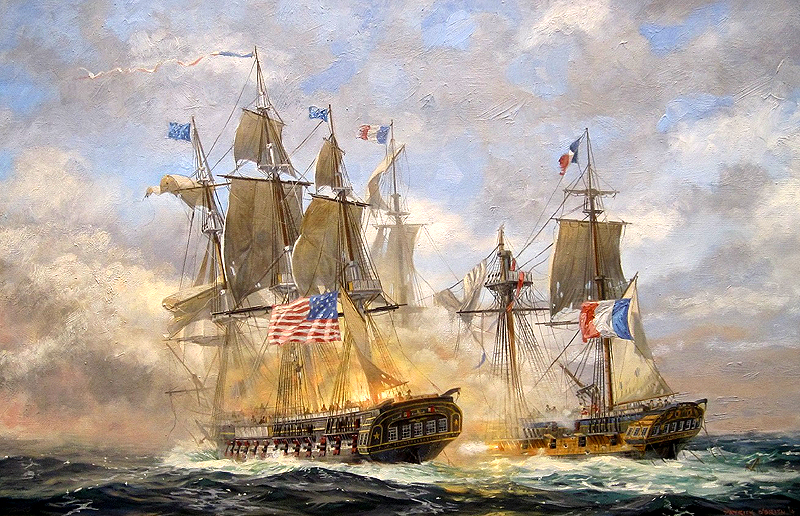
The American Constellation fighting and defeating the French L’Insurgente (February 9, 1799) during the “Quasi War” (1798-1801)
It was at this point the doctrine of “nullification” began to be discussed openly by the Republicans – as they claimed that sovereign rights in the new Federation belonged with the States and the people, not the Federalist-dominated Congress. And any laws that Congress might want to pass (such as the Alien and Sedition Laws) could simply be nullified by a decision of the states. The congressional majority of course ignored the challenge. But the right of nullification by the states of decisions made in the nation’s capital would be heard all the way up to the outbreak of the Civil War some 60 years later.
In the end, to avoid war at all costs, Adams sent an envoy to Paris to work out some kind of understanding with the French that could reduce diplomatic tensions. The envoy came back with a treaty in which the French agreed to leave American ships alone – a treaty which Adams signed – understanding that this would hardly satisfy the war-hungry Federalists, nor bring the angry Republicans back to a cooperative spirit in Congress. In fact, he understood that by signing it he was undercutting any chance he had of victory in the elections coming up only a month away. He was right. But it was a brave thing to do – sparing the country from a war it did not need to fight.
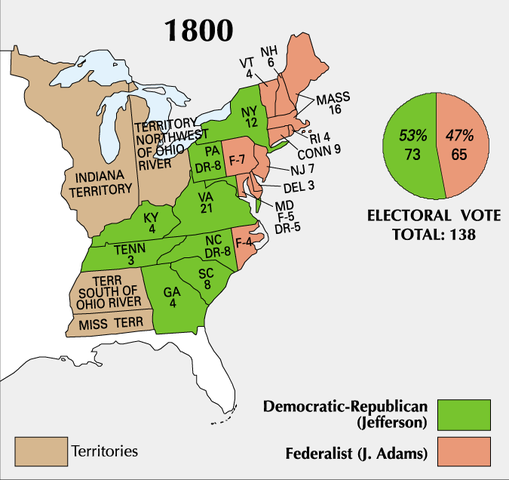
One final act of Adams just as he was about to leave office was the rush to sign some six dozen appointments to positions in the Federal Judiciary – including the all-important appointment as Chief Justice of the Supreme Court the Virginian (but, exceptional for the Virginian group, a very strong Federalist), John Marshall. This action would not only upset the wave of new Republicans voted to Congress – but would put at the head of the American judiciary an individual who in so many ways would rewrite the American Constitution with respect to the role that the Federal Courts would come to play in the nation’s political affairs – putting in the hands of the Supreme Court justices powers never intended by the Constitution’s original Framers.
Anyway, having completed his service as the country’s second president, Adams slipped quietly out of the new capital at Washington, D.C., as America’s new president, Jefferson, was sworn into office there.
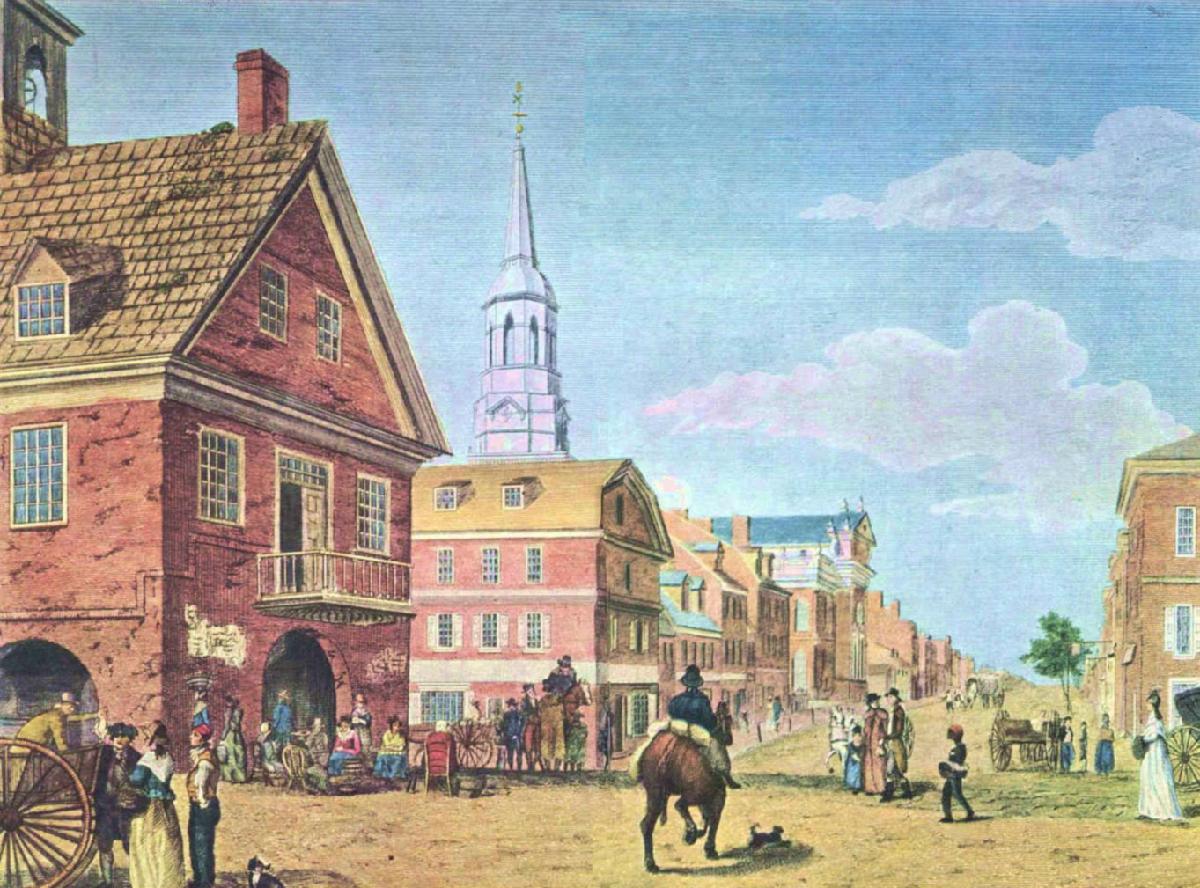
At this point, life is settling in nicely at home in the new republic.
Philadelphia – 1799
Historical Society of Pennsylvania
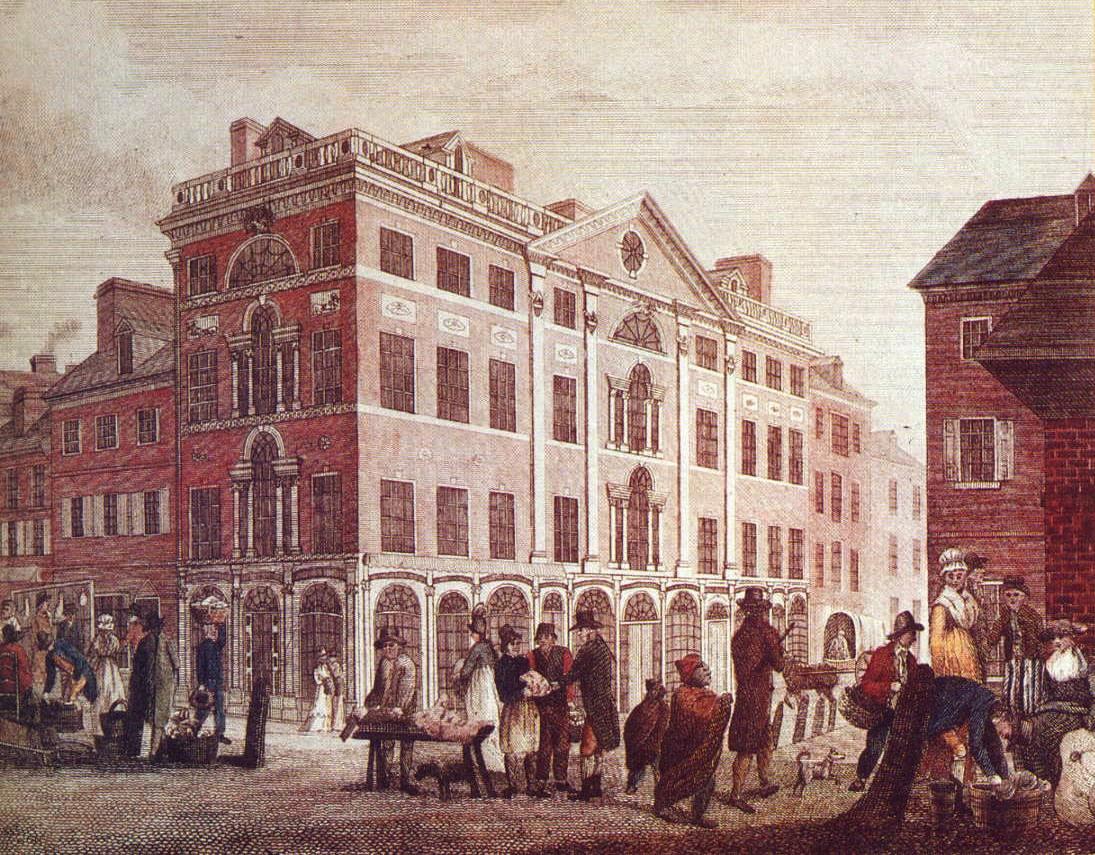
Philadelphia street scene

Tontine Coffee House in New York City – (around 1797)
New York Historical Society
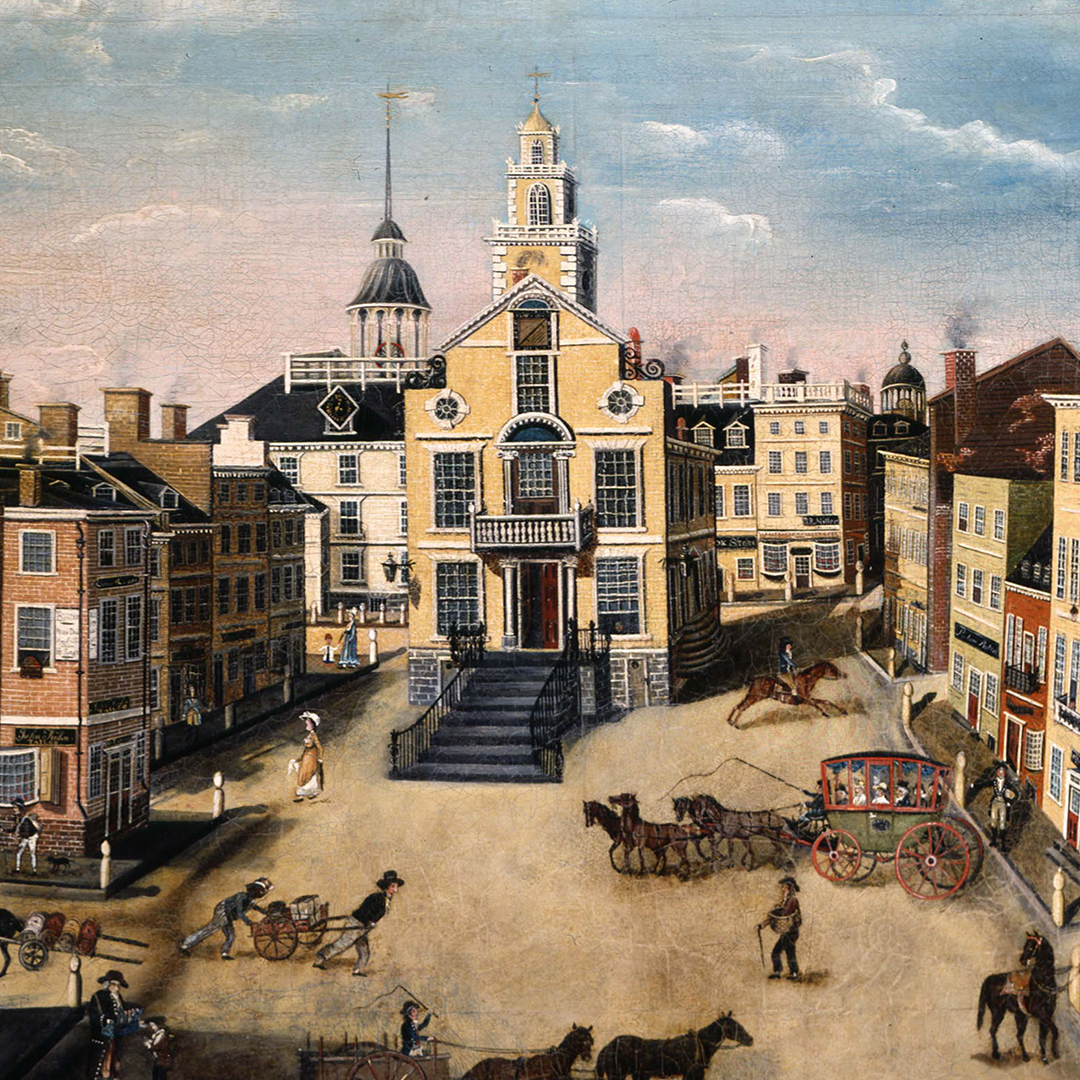
Boston – 1800
Jefferson as President (1801-1809). And once in office Jefferson began to undo the Federalist legacy – by removing the land taxes imposed on the farmers – making him very popular in the South and the West – and shifting the source of revenue to customs duties imposed on (largely Northern) imports and exports. He also raised revenue by selling (quite cheaply) Western land to new settlers – another very popular move among Westerners or those headed West – which came at a great cost to the Indians living there of course! Thus Jefferson built the Republican Party into a great political powerhouse.
To Jefferson’s great credit,[4] it was during the early years of his presidency that America purchased from the French the huge Louisiana territory to the West of the Mississippi (the Indians living there not being consulted on this matter, of course) – blocking the possibility of any European power getting there before the Americans – who were spreading westward rapidly. This purchase effectively doubled the land claim of the American nation!
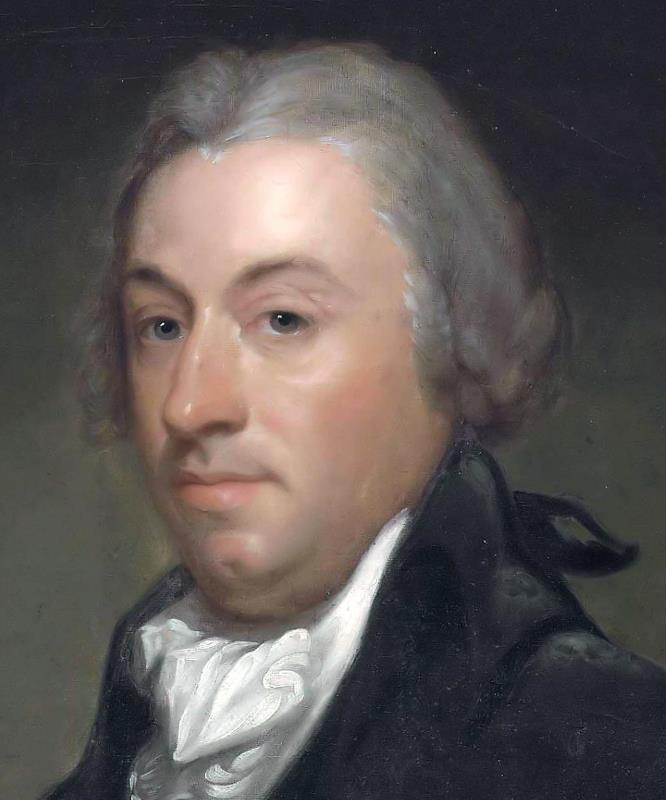
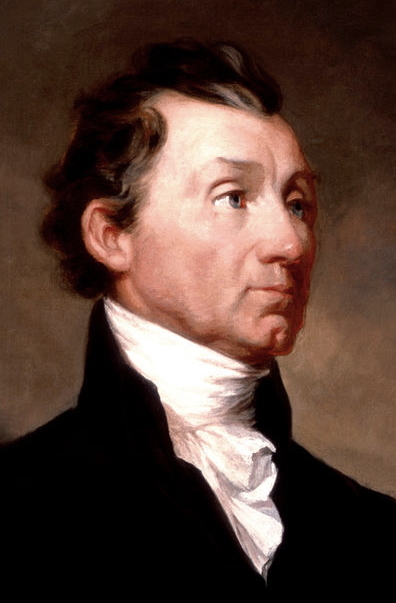
Robert Livingston James Monroe
These were the two Americans who actually negotiated the purchase not just of New Orleans but of the entire Louisiana Territory!
And in great part this bargain purchase had been made possible because American public finances had such a very strong credit rating – due to Hamilton’s monetary policies, ones that Jefferson had so recently hated intensely!
Lewis and Clark explore this new region. What it was that America had exactly come to in this Louisiana Purchase was largely unknown to its new owners. Thus Jefferson commissioned Captain Meriwether Lewis (accompanied by William Clark) and a team of fifty men to explore this new territory (1804-1806).[5]

They followed the Missouri River West, hoping to find a water route to the Pacific. But as winter set in they found themselves bogged down in the Dakotas, and thankfully were able to bring on a French fur trapper and his Indian wife Sacajawea to guide them westward.
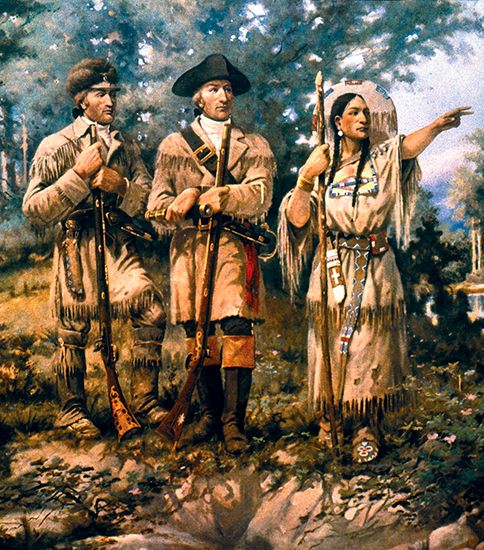
The next summer they reached the Rocky Mountains, crossed them, and in November finally arrived at the Pacific Ocean. They wintered there, then in early 1806 began their trek back East, arriving in St. Louis as heroes.

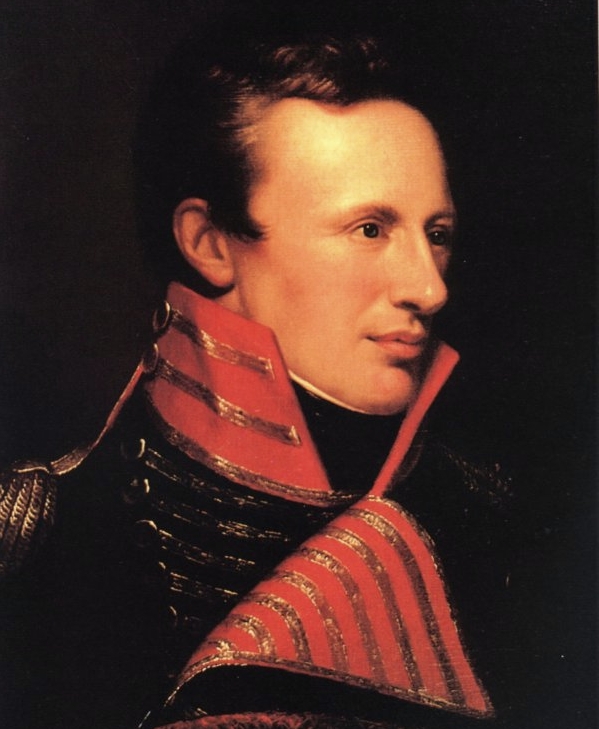
Zebulon Pike led two additional explorations into the American West (1805-1806 and 1806-1807)
To the shores of Tripoli. Further to his credit, Jefferson had the navy tackle the problem of Muslim pirates operating out of the Mediterranean towns of North Africa. Jefferson refused to pay tribute any longer (formerly paid out to release hostages or just prevent attacks on American shipping in the Mediterranean), instead sending American ships in concert with the Italian King of Naples against the pirates. This worked somewhat – but would need the end of the Napoleonic Wars in 1815 before the task could be completed.

The bombardment of the harbor at Tripoli (August 3, 1805)
U.S. Naval Academy Museum, Annapolis
Jefferson takes command of American foreign trade. But on the negative side of his political balance sheet, Jefferson imposed an embargo on the sale of American goods to Britain, in response to the ongoing British impressment of American sailors – the logic of this move being that this would deprive the British of vital American goods and bring Britain to its senses. But Jefferson’s commercial boycott served only to make America appear to the British to be clearly a French ally – at a time when French dictator Napoleon, who had managed to seize control of nearly all continental Europe, had also placed an embargo on all European trade with Britain – in an effort to collapse the British economy. So England’s response to Jefferson’s policy was to become more, not less aggressive, against America – at a time that Jefferson had weakened considerably America’s own military capabilities.
Then to make things “fairer,” Jefferson decided to extend the same restriction against trade with France as well, shutting down pretty much all of America’s export business – and nearly collapsing the American economy.
Jefferson cuts back on the navy. To make bad matters even worse, Jefferson then chose to meet the European challenge by not building more warships (frigates), the likes of which had proven themselves so capably in the war with the Barbary states. He figured that not having a fighting navy would help keep Americans from making the mistake of wanting to go to war with either France or Britain.[6] Instead he chose to build a number of much smaller gunboats. These would not be terribly effective in defending American shipping overseas, but certainly could be used to help prevent the American smuggling that his embargo encouraged.
Thus it was that Jefferson continued to see himself not as a warrior but as “a man of peace” – unable to understand how international power actually works, and consequently leaving America increasingly vulnerable to European power politics abroad – and vengeful Indians at home.
It is also important to note that for one who had been so loud about protecting “states’ rights” against the assumption of autocratic power by an uncontrolled government in Washington, Jefferson had no problems personally acting in such an autocratic fashion when he himself was president (imposing his restrictions on American trade and downsizing America’s military defenses).
But of course Jefferson was among the most “enlightened” of Americans, and that justified his autocracy (as “enlightenment” always does!).
But thankfully, just as he was about to leave office in 1809, Jefferson somehow awoke finally to the realization of the magnitude of the disaster his economic policies had produced – and he finally repealed his ill-conceived embargo. And the American economy soon revived.
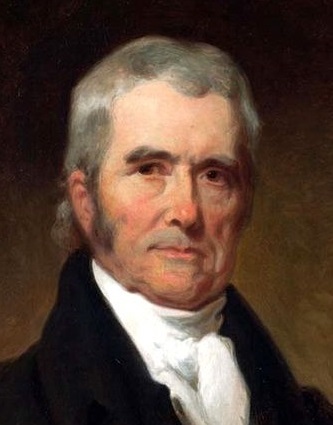 John Marshall – and the empowerment of the Supreme Court. As we have just noted, one of the last things Adams did before he turned the presidency over to Jefferson was to make the last-minute appointment of John Marshall to the position as Chief Justice of the Supreme Court. Marshall would go on to hold that position from 1801 to 1835. This would have a huge impact on the shaping of American government, for Marshall would gradually, case by case, assign to the Supreme Court increasing powers to decide which laws of Congress – and the states – were “constitutional” and which were not, and if not (by the Court’s own decision on the matter), then that they would not be supported by the judiciary as the law of the land. Or even the Court might decide that the law ought to be interpreted in this or that particular manner – in essence revising (even extensively) the very purpose of such law. As stated before, this would make the Supreme Court, not Congress, the highest legislative body of the land!
Why did the Supreme Court assume such power for itself? Basically because Marshall saw that it was there for the taking – and because no one at the time understood the dynamic and thus did nothing to block this huge assumption of power by the Supreme Court. Eventually because nothing was done, it became simply assumed that the Supreme Court had such constitutional powers. But unlike the rest of the federal system, which was put in place with a number of built-in checks on its various powers, the Supreme Court was originally defined with no known checks on its power.
The presumption was that a long-held Anglo legal ethic would somehow direct the action of the Court. But such an ethic would prove over time susceptible to being interpreted widely and deeply in a number of quite different ways, depending on the personal political or ideological makeup (always well rationalized, as lawyers are indeed trained to do) of the nine members of the court – or even just five of the justices constituting a slight voting majority for any particular case. That’s a lot of unrestricted power to put in the hands of a very small group of enlightened individuals!
[1]It was later that year decided by the Virginia Assembly that Jefferson had acted appropriately in taking himself and his officials into hiding in his various plantations. But he had lost such stature that he was not reelected governor.
[2]When William Short, a Jeffersonian supporter, wrote Jefferson from Paris that mobs had taken over the French Revolution and had even butchered some of their French friends, Jefferson in January of 1793 wrote back a sharp rebuke: “My own affections have been deeply wounded by some of the martyrs to this cause, but rather than it should have failed I would have seen half the earth desolated; were there an Adam and an Eve left in every country, and left free, it would be better than it now is.”
[3]In 1804, Aaron Burr shot and killed Hamilton in a pistol duel over insulting comments Hamilton had made in letters about Burr as Republican candidate to the position of New York governor, comments Hamilton intended to remain private but got printed somehow.
[4]Actually, such credit belongs to his envoys sent to France, Livingston and Monroe, who were originally authorized to purchase (for an amount not to exceed $10 million) only the town of New Orleans located near the mouth of the Mississippi River – but who on their own authority answered with an immediate “yes” when Napoleon offered them the entire Louisiana Territory for $15 million. In part this came about so easily for the Americans because Napoleon was short on funding at the time and found American money rather than American land more supportive of his ambitions.
[5]Jefferson would also send out other teams to explore the new territory, including that of Gen. Zebulon Pike who in 1806 ventured as far west as the territory that would become Colorado (who also was captured by the Spanish in the process, but released in 1807!).
[6]Liberal Humanists such as Jefferson have always supposed that it is weapons that cause wars – and thus disarming the people will automatically cut back on the dangers of the people falling into a war with someone else. But in fact self-disarmament – that is, disarmament if not mutual on the part of all contending societies – will merely undercut the ability of a society to protect itself against another society that has come to hold such power that it no longer fears the consequences of its efforts to bully others into submission. Weapons are not the problem. The political-moral intentions of societies are what are critical in matters such as this.
Economically speaking, the American South had always functioned as a supplier of raw materials to England: tobacco, dyes and – at first – small amounts of cotton. New England on the other hand had geared its economy largely around the idea of meeting its own needs locally, from agriculture to finished industrial products.
The impact of the industrial revolution. The New England or “Yankee” temperament also made for a lot of industrial creativity – with Samuel Slater in the 1790s for instance setting up first in Rhode Island, then Massachusetts, then Connecticut and New Hampshire, spinning mills which turned cotton into thread – at about the same time that Eli Whitney invented the machine that could do the work of masses of individuals (slaves mostly) in removing the troublesome seeds from cotton balls, revolutionizing the cotton industry in the American South – able now to fill the industrial needs not only of the spinning and weaving factories of Britain, but also similar factories in the American North.
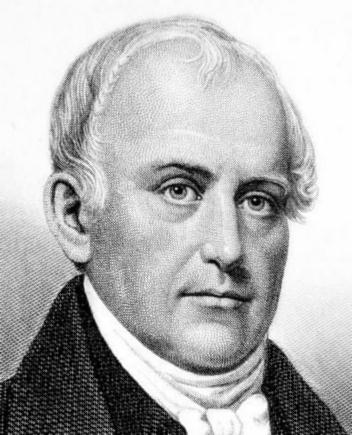
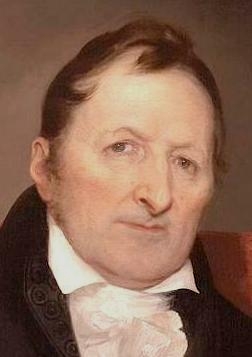
Samuel Slater and Eli Whitney
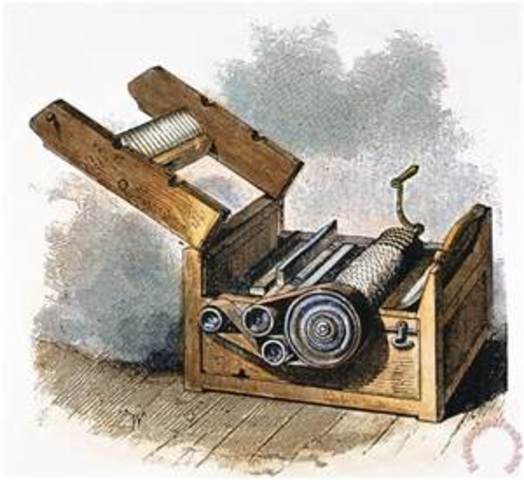
Whitney’s 1793 cotton gin – much faster way of removing seeds from raw cotton revolutionizing the South’s cotton farming industry (and the slavery to support it)
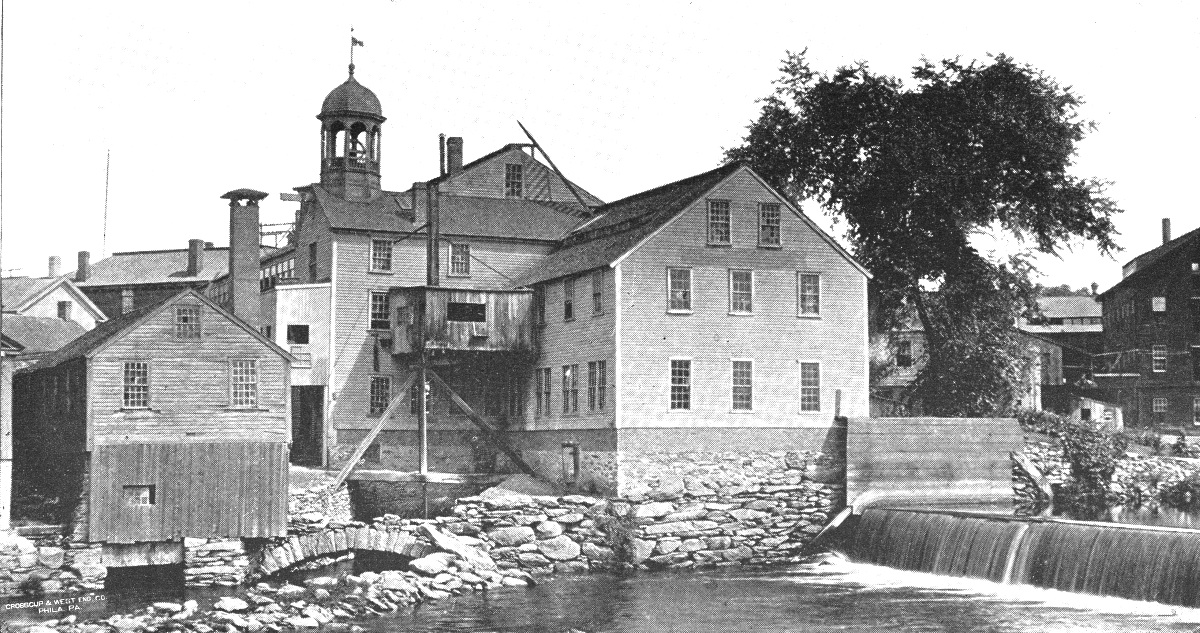
The Old Slater Mill, Pawtucket, Rhode Island (first built in 1793). The first cotton-spinning mill successfully operated in America

Robert Fulton’s paddle-wheel steamboat (August 1807) making its way up the Hudson River from New York City to Albany in 32 hours of travel time
While this vital North-South industrial relationship should have strengthened the ties between these two sections of the country, actually the reverse resulted. While such developments in the North encouraged the ambitious, hard-working and inventive character of Yankee culture, the South tended to see in this economic development the ability to go deeper into its traditional feudal social dream of a leisured gentry standing atop a social order of hard-working slaves – slaves stripped of any ambition or ability to think inventively. To be sure there were plenty of poor Whites in the South found well outside this romantic dream, living desperate lives trying to compete with the huge plantations in the cotton export business. But these poor Whites themselves were caught up in the same Cinderella dream – hoping, even believing, that they too one day would be sitting on their own verandas, sipping Mint Juleps while discussing social affairs and grand ideas.
Over time such an industrial dynamic was pushing the North way ahead of the South in terms of overall economic development. Factories were going up everywhere and infrastructure in the form of major roads, canals, and even the first of the railroads was being laid out everywhere. To be sure, some of this same activity was taking place in the South, but not at nearly the same degree as in the North. Industrial entrepreneurship certainly did occur across the South. But it did not bring the prestige or stir human ambitions and readiness to undertake the hard work to bring about entrepreneurial success the way it did in the North.
Jefferson vs. Hamilton. In some strange ways the growing differences between these two lifestyles were summed up in the personal differences well illustrated in the lives of Hamilton and Jefferson. Jefferson was the very epitome of the Southern gentleman – naturally and gracefully born to noble status, reflected in the way he approached life. Hamilton on the other hand was the type that the Yankee world seemed to symbolize: self-advancing from even the humblest of social beginnings, through incredible self-discipline and hard work – and a resolve to take life head on, no matter what it threw at you. To Hamilton, Jefferson probably represented everything he detested about a social snob – and Hamilton represented to Jefferson the vulgarity of the typical social climber. There really was no meeting point between the two personalities.
But over time, it would be revealed that the same held true for the entire realm of Northern and Southern culture. As neither side was willing to back down in holding such absolutely positive attitudes about itself and equally absolutely negative attitudes about the other, trouble – bloody trouble – lay ahead.
MADISON AND THE WAR OF 1812
(ACTUALLY 1812-1815)
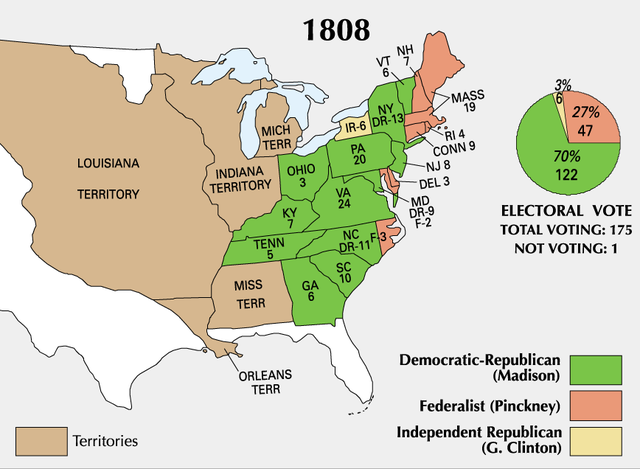
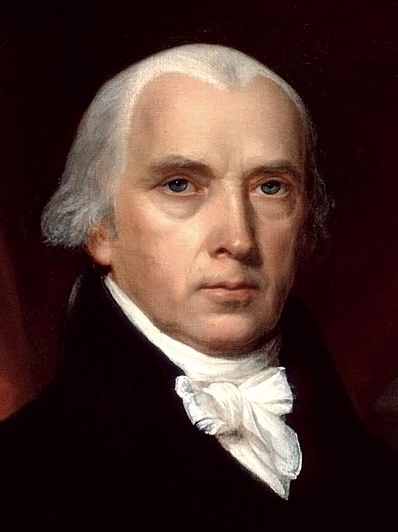 James Madison. Jefferson’s ever-faithful ally James Madison had served as Secretary of State under Jefferson. And with Jefferson’s move to leave office after eight years, the Republicans looked to Madison to head up their party – and run for the office of President. The Federalists were easily defeated and Madison entered the White House in 1809 – to head up a nation that was up in arms about a rise in Indian attacks (headed by Tecumseh) – made easier for the Indians because of Jefferson’s weakening of the American military.


Shawnee Chief Tecumseh and his brother Tenskwatawa, “the Prophet”
They headed a huge Indian federation in the Northwest Territories, received a huge setback at the Battle of Tippecanoe (November 1811), but continued to make considerable trouble for the Americans as British allies during the War of 1812
Madison was a man who learned to compensate for his small stature and frail health by taking on huge intellectual challenges. He started out life as the oldest son of a typical aristocratic tobacco planter-family of Virginia, well-schooled in math, the sciences and classical languages. But he chose to go to the College of New Jersey (the future Princeton University) rather than the College of William and Mary. There he eventually took up even post-graduate studies under the college’s president, the Presbyterian minister John Witherspoon – and developed a strong worldview based on the philosophy of the European Enlightenment (with Christian touches here and there!).
Madison eventually became self-taught in the law. But being of an aristocratic background, Madison never felt the need to take up law as a profession. Instead he simply served as a strong supporter of Virginia’s political interests locally, and ultimately, with the outbreak of the war in 1775-1776, in the Continental Congress as well. Key to his own future, both in Virginia and in Philadelphia, he found himself working closely with Jefferson.
After the war he continued to pursue his political interests, eventually being the author of the Virginia Plan that got the Constitutional Convention off and running in 1787, at the same time keeping excellent notes of the entire event. And he used his sense of political dynamics to write insightful follow-up articles in defense of the ratification of that new Constitution (his contribution to the Federalist Papers). And he authored and supervised the passage in Congress of the Bill of Rights as the first ten amendments to that Constitution.
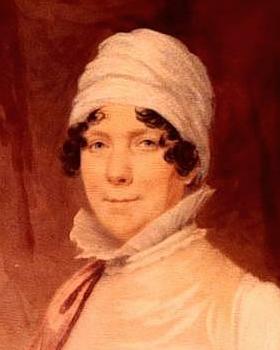 But he was also empowered by both his very active wife, Dolly and his friend Jefferson, and joined with Jefferson in opposing Hamilton’s Federalists because of the way Hamilton was “over-building” (as he and Jefferson now saw things) the power of the central authority through Hamilton’s strong economic measures. This was what impelled Madison ultimately to form the Democratic-Republican (or just “Republican”) Party, and thus also what led him to be called to serve as Jefferson’s Secretary of State during Jefferson’s eight years in office (1801-1809).
And now Madison was President of the country, and had to take on the young nation’s challenges on his own (with the “First Lady” Dolly’s considerable help!).

The young republic goes to war (1812). The biggest problem at the time seemed to be the British, who not only continued their seizure of American ships and crew … but also armed Tecumseh’s warriors, infuriating the Americans.

British board American ships to “impress” (force) sailors into British naval service claiming that these were simply British escapees … when in fact most were truly American.
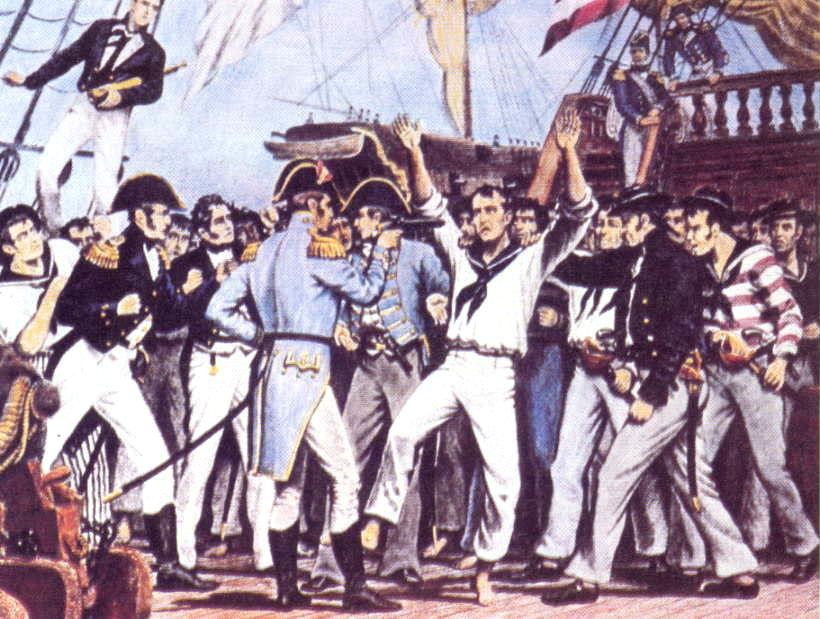
Indeed, British arrogance had succeeded in stirring a younger American generation among even the Republicans into the status of being “War Hawks” – eager to take on both the Indians and the British – to restore America to peace. Thus finally in June of 1812, under the sway of the Republican War Hawks (led by Henry Clay of Kentucky and John C. Calhoun of South Carolina), Congress declared war on the British.
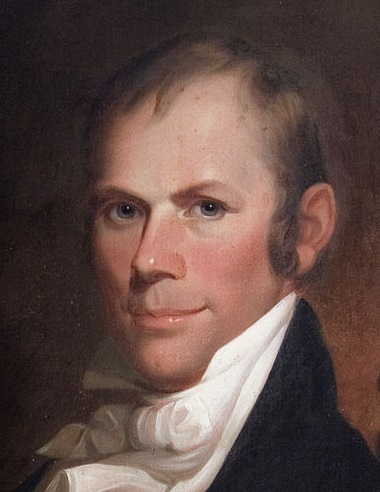
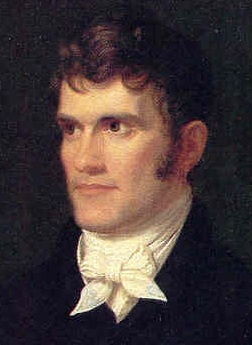
Young Republican “War Hawks” Henry Clay and John C. Calhoun
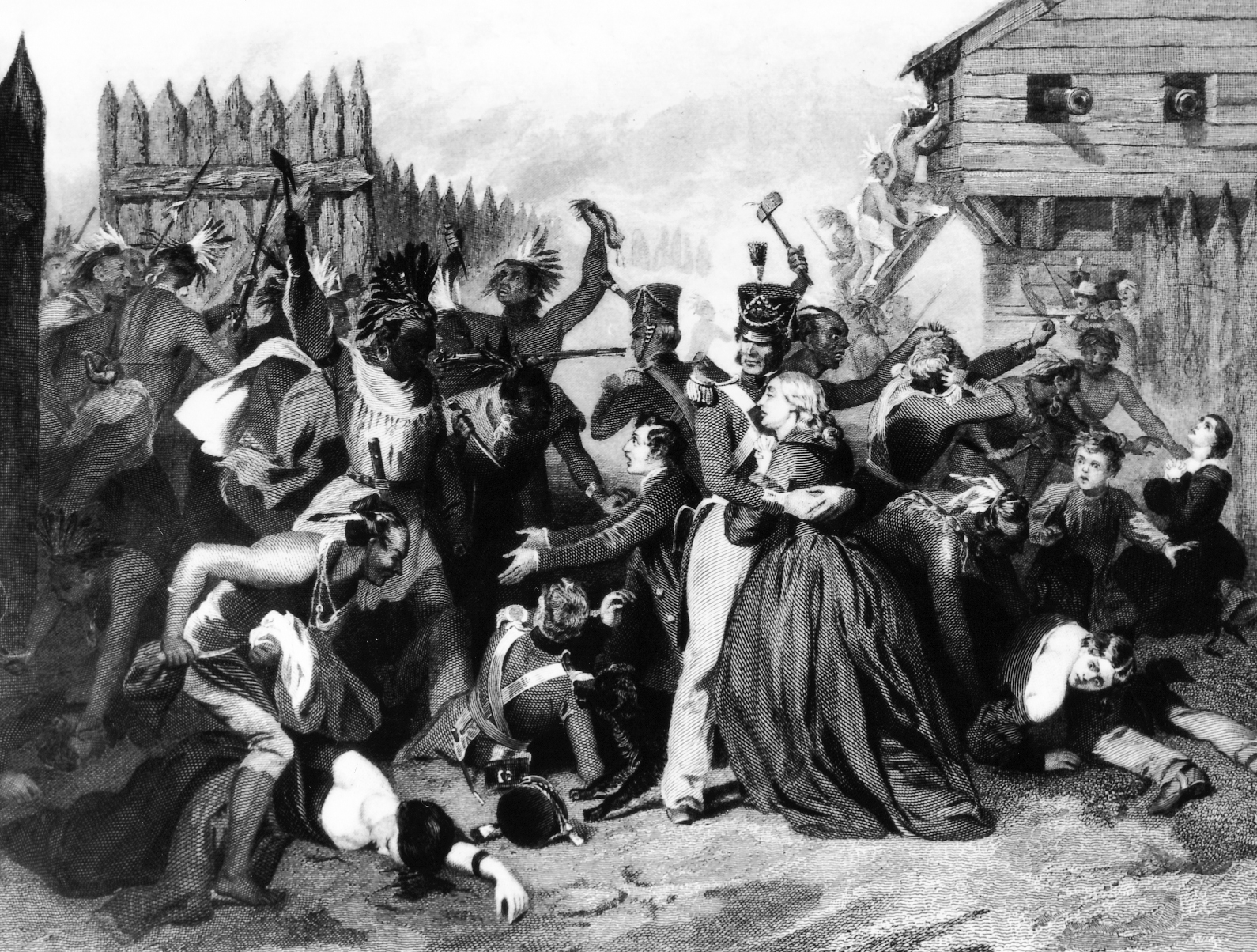
How they intended to win that war without a navy or an army was not given much thought. At first the Americans made a move on Canada – with the goal in mind of expelling Britain from the last of its American holdings. The results were disastrous for the Americans – being defeated by unwilling Canadians, crushed by encircling British troops at Detroit, and slaughtered by vengeful Indians who set upon surrendered Americans at Fort Dearborn (Chicago).
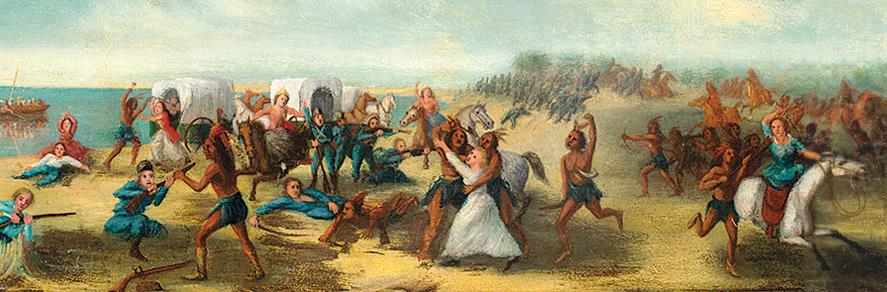
1813. The next year, an effort in January to retake Detroit ended up with nearly 400 Americans killed in the action and 500 taken away as prisoners – with the rest slaughtered by Indians. In reply, in April a vengeful America attacked the Canadian capital of York (Toronto) and burned and plundered it – inspiring the thoughts of revenge among the British and Canadians.
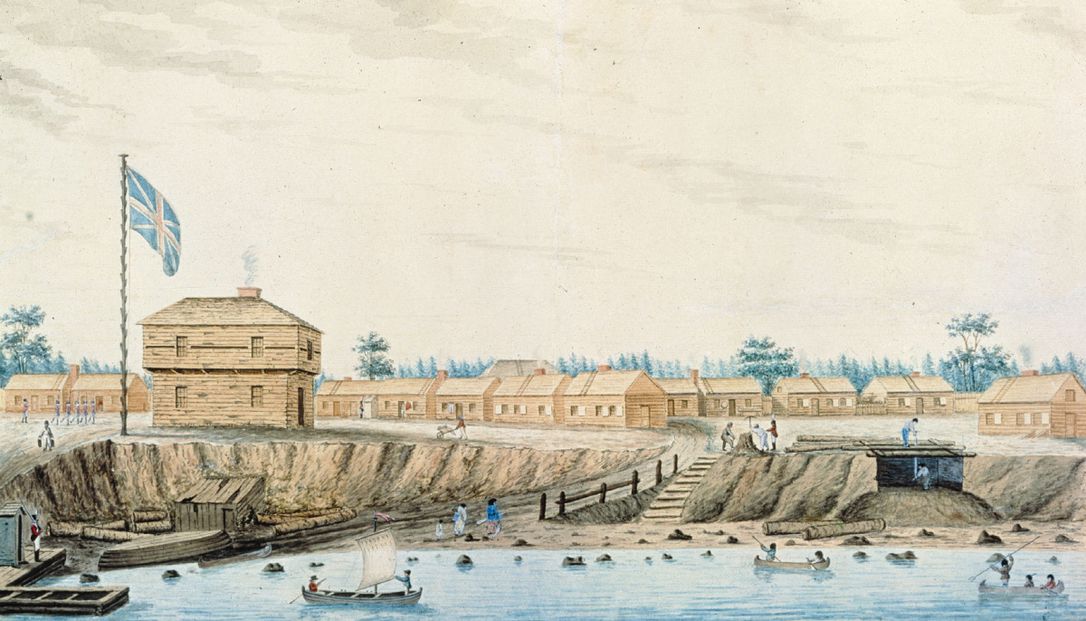
The barracks at York (Modern Toronto) – capital of Upper Canada
That August “Red Stick” Creek Indians attacked Fort Mims (Alabama) and slaughtered those who had taken refuge there.
On the other hand, the Americans authorized the building of six new frigates (the British possessed some 175 such ships!) – which conducted themselves admirably – as well as American “privateers” who did the same.

The Battle of the Thames (Ontario) – October 5, 1813. Americans under the command of Captain Oliver Hazard Perry soundly defeated the British in this strategic battle
Also, a huge victory came to the Americans in defeating a British army in Ontario and killing the Indian leader Tecumseh – shattering the huge Indian coalition he had put together. This gave much needed courage to the Americans – although it hardly shifted the war in America’s favor.
1814. The following year, the war did go in America’s favor in the West, when in March, American General Andrew Jackson delivered a smashing blow to the Red Stick Creeks in Mississippi.
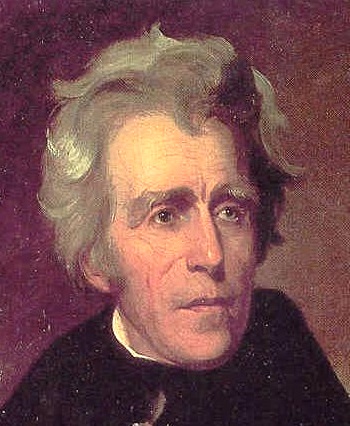

Jackson’s men attacked a well-built defense of the Red Stick Creeks at the bend in the Tallapoosa River. The Indians were slaughtered and the power of the Upper Creek tribes shattered.
But it went devastatingly against America in the East when, having defeated and imprisoned Napoleon in Europe, the British felt free to march on the new American capital at Washington, D.C. in August of that year and burn it to the ground – payment for the burning of Canada’s capital at York.
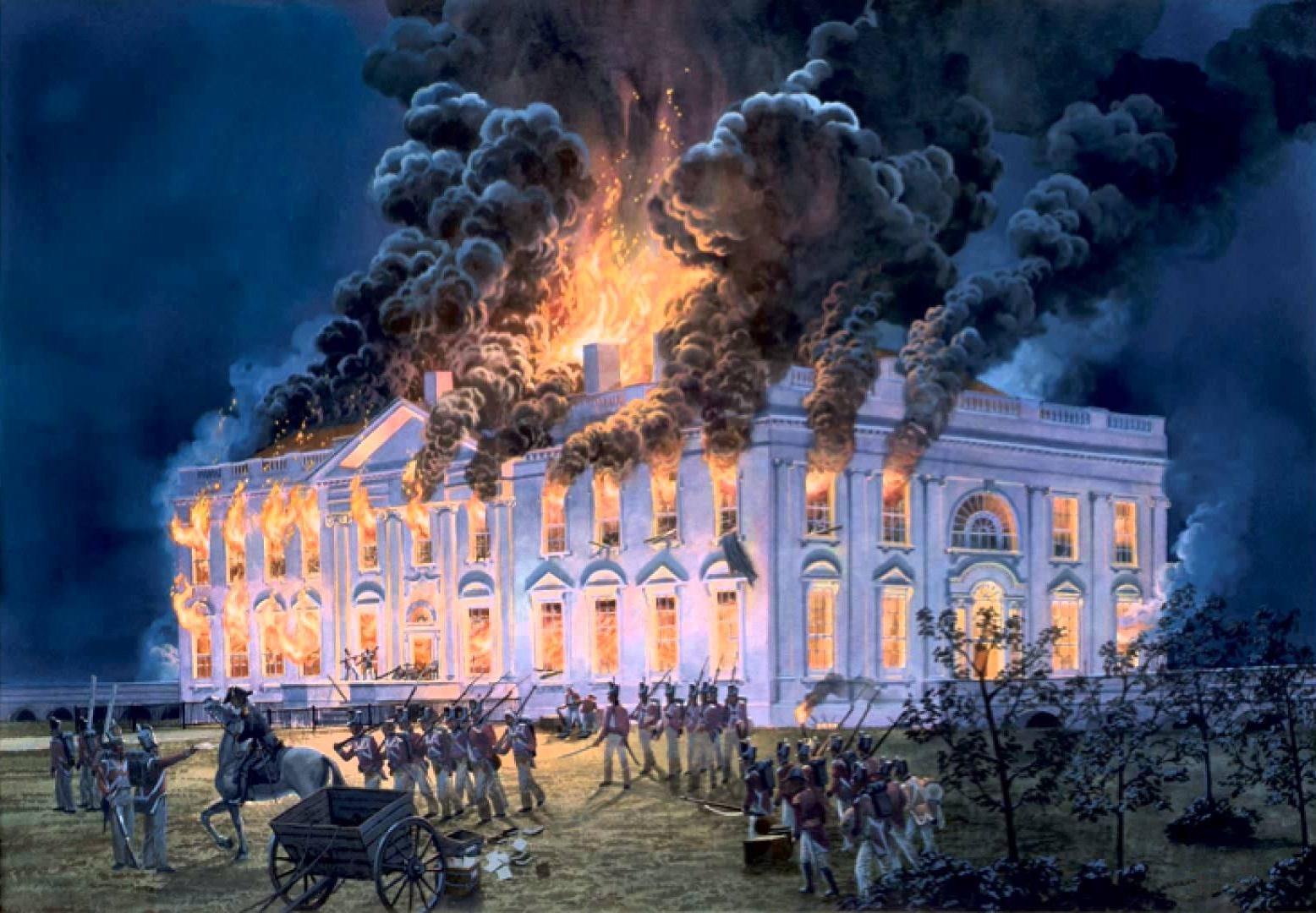
British troops burning an abandoned White House on that same night.
First Lady Dolly Madison had already removed all the documents
and other valuable items ahead of the arrival of the British troops.

George Munger – The President’s House (White House)
after the burning of Washington
White House

George Munger – The unfinished United States Capitol
after the burning of Washington
Library of Congress
The Treaty of Ghent (December 1814). But with Napoleon finally defeated and imprisoned on the Island of Elbe, the British found themselves very tired of all the fighting that had consumed them over the past decade or more. Also, British revenues were running low because of the Napoleonic wars – and now this war with the Americans as well. Likewise, the British now no longer saw the need to grab American sailors to fill their own ranks – a major American grievance against the British. Consequently, both sides were ready for peace. Thus it was that British and American envoys gathered in Ghent (Belgium) to negotiate a peace treaty.
At first the terms that the British were offering the Americans were harsh – and the Americans refused to accept them.
However, fighting still going on back in America now began to turn in the American favor.

British efforts in September to take Baltimore failed completely.[7]
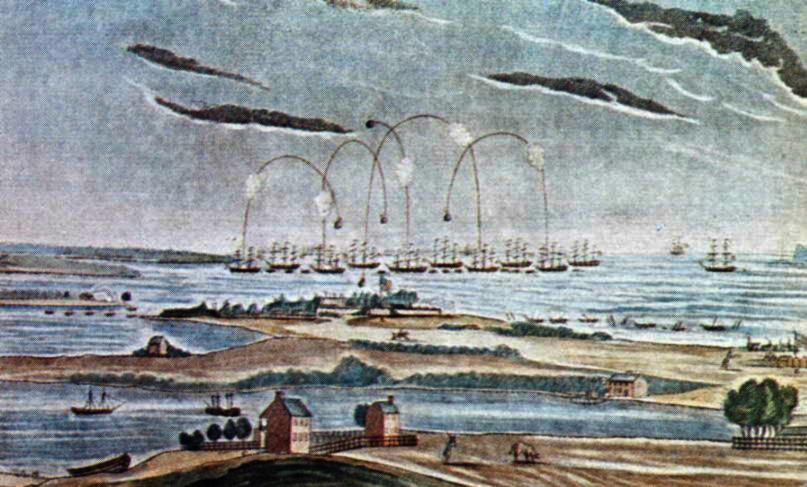
The British advance up the Chesapeake towards Baltimore (September 12). But they can’t get past the defenses at Fort McHenry (September 13-14) … and have to turn back

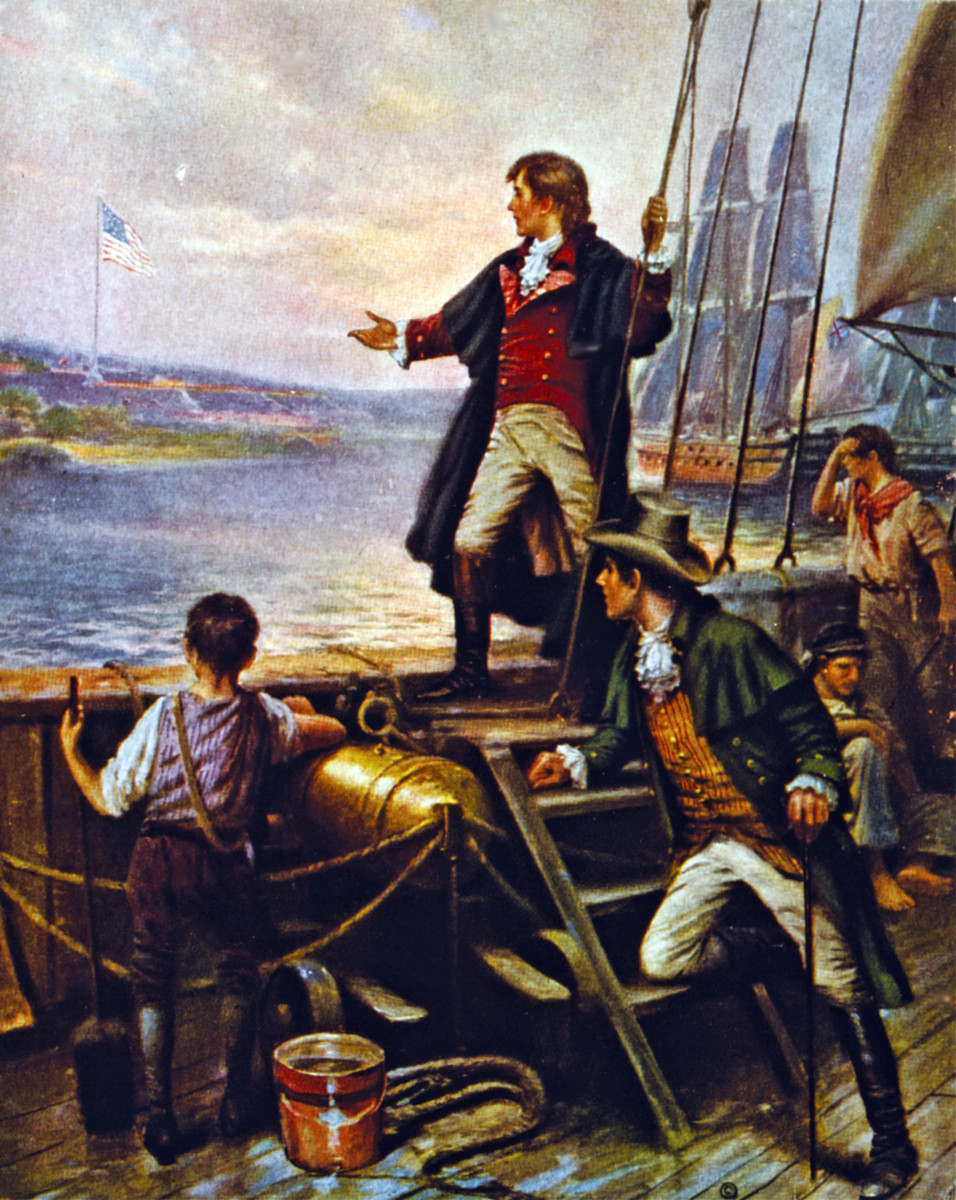
Francis Scott Key observing the British failure to take Baltimore
And the Americans’ naval victory on Lake Champlain (New York) at the same time stopped the British attempt to march on America from the North. Thus before the end of the year, American and British diplomats finally agreed to a peace treaty based on much more equitable terms – largely returning things to the way they were prior to the war.
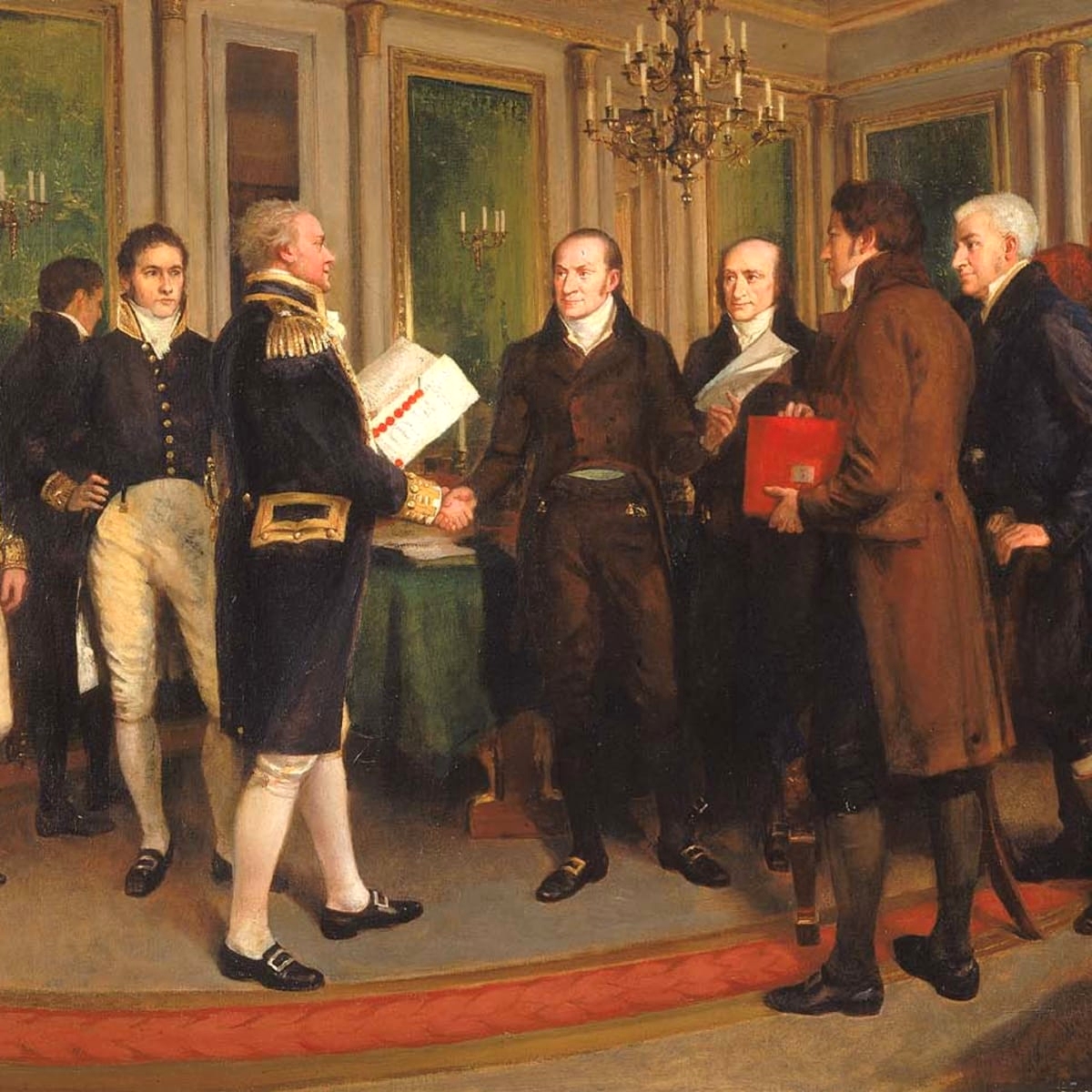
The signing of the Treaty of Ghent – December 1814
The Battle of New Orleans (January 1815). But news of the treaty signing had not yet reached either the American forces (under Jackson) or the British forces gathering for a huge battle at New Orleans. But the British attack on the well-defended American position (behind a huge wall of cotton bales) led to a humiliating defeat for the British: 291 British killed, 1262 wounded, and 484 captured or missing – with only 13 Americans killed and 39 wounded.
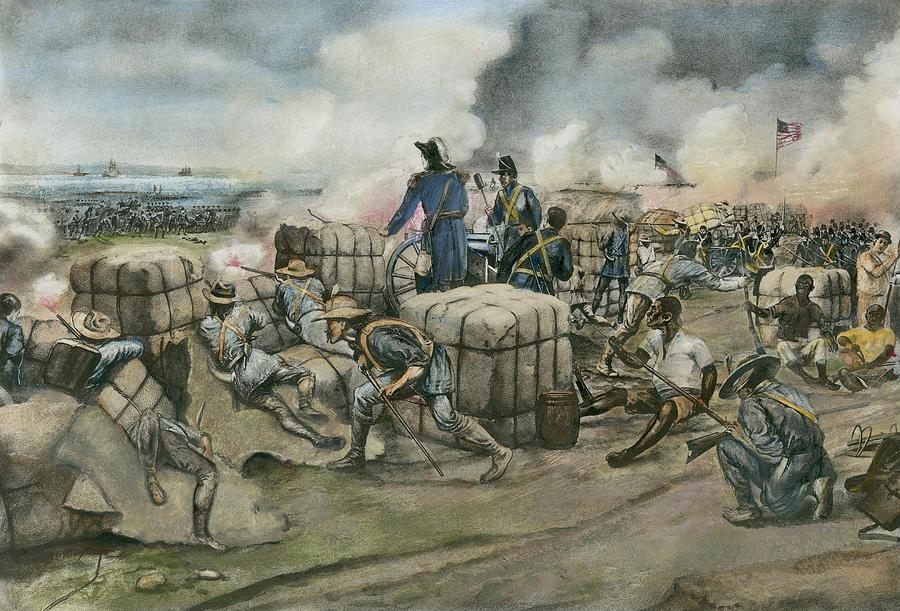
Although the battle was unnecessary (for it changed none of the peace terms), it fueled a huge sense of national pride among the Americans, made Jackson a national hero, and in a way gave the announcement to the world that America was a rising player in the game of international politics.
[7]A witness to this British failure at Baltimore’s Fort McHenry was Francis Scott Key, who wrote a poem about the flag remaining aloft through the night of heavy British bombardment. The poem was eventually put to music and became the American national anthem, The Star-Spangled Banner.
Florida (1818). The Napoleonic wars (1800-1815) had undercut Spanish power considerably – both in Europe and in America. Not only had independence movements (Mexico, Colombia, Argentina, etc.) developed in Spanish America as a result, but the Seminole Indians in Florida had used this opportunity to conduct raids north into Georgia and Alabama. Now, with the fighting against the British over, General Jackson was thus ordered into action to defend American territory from these Indian raids. But Jackson took this as authorization not merely to block Seminole raids into the American states, but to take the action against the Indians all the way into Spanish Florida (1818). And he ended up not only defeating the Seminoles but laying claim to the whole of Florida as U.S. territory.
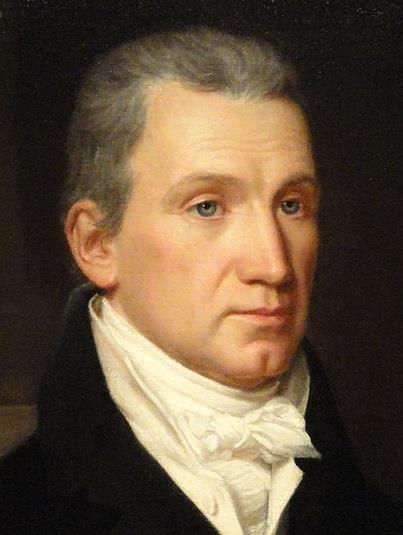 President James Monroe (the 5th U.S. President and 4th Virginian to hold that office) was embarrassed. But Americans in general were greatly delighted. Spain quickly decided simply to sell Florida to America for $5 million – ending further humiliation for Spain. Now Jackson appeared to be even more of a giant in American eyes.
But economic crisis (1819-1821). The years after the War of 1812 seem so settled and the national spirit running so high that a Boston newspaper in 1817 termed the times they were living in as “The Era of Good Feelings.”
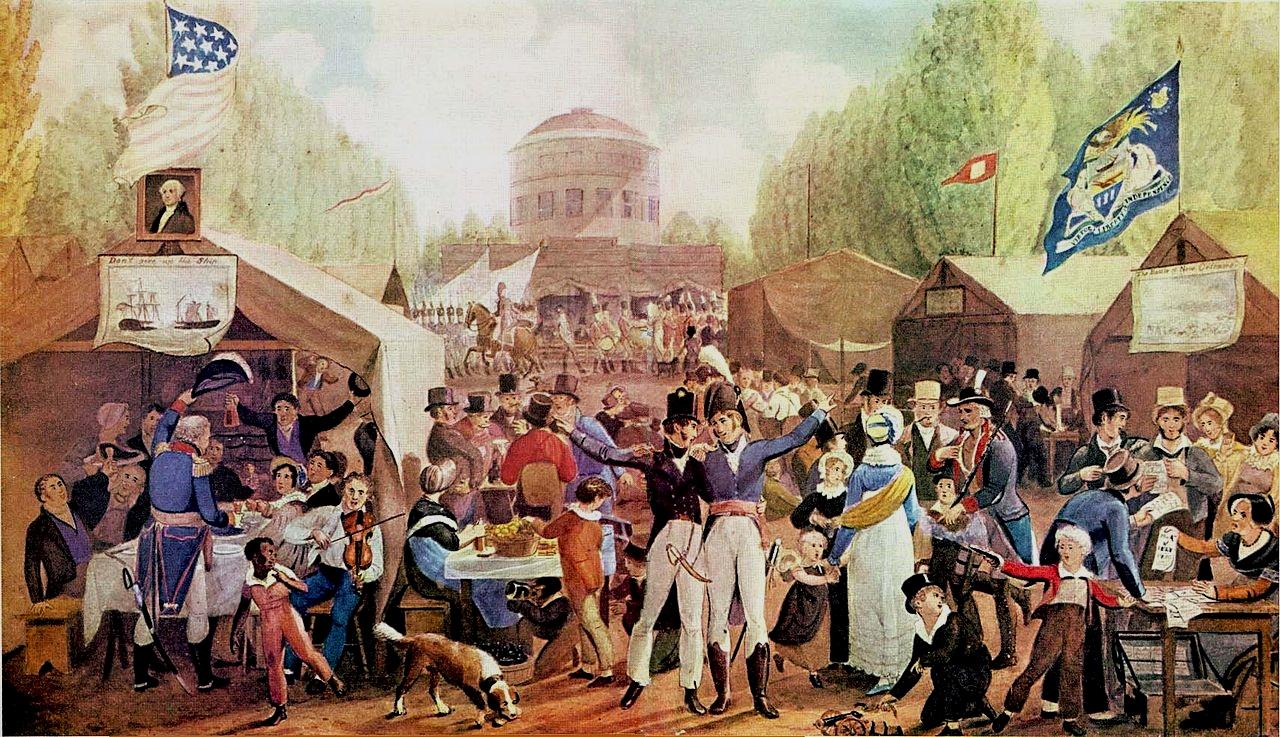
Americans celebrating the 4th of July in Philadelphia – 1819
But those Good Feelings were not destined to last, for in the return of Europe’s national soldiers back to their farms and factory jobs, the glory days of American agriculture and industry suddenly came to a crashing end. The demand in Europe for American products disappeared overnight, leaving completely bankrupt the enterprising Americans who had formerly borrowed money to expand their farming and industrial enterprises to meet Europe’s high demands during the Napoleonic Wars. But the banks soon joined these businesses in the growing disaster, because instead of having paying customers (interest and principle on the loans to these businesses) they ended up with only the bankrupted property of these businesses in their hands – whose value had dropped away to a mere fraction of what it previously was. The banks did not want worthless business property, they wanted payments on the loans. But that just was not going to happen. Thus the banks also woke up to find themselves bankrupt right along with their former business customers. And no one knew how to come out of this crisis.
In fact, this was all a big mystery, one that would now repeat itself on numerous occasions in the future.[8] Efforts to put in place commercial, financial or economic rules that might counter these swings in economic fortune would be attempted. But still, for various reasons not always deriving from things that the Americans themselves did, there was usually very little to be done except wait for the shakeout of weaker businesses and the slow return of economic confidence to society – through helpful instruments which would come upon the scene almost as mysteriously as had the earlier causes for the crash.
Slavery serving to intensify “identity politics”, and the Missouri Compromise (1820). Then when Missouri applied for statehood in 1819, another brewing controversy boiled over. The five states of the American Northwest Territories (Ohio, Indiana, Illinois, Michigan and Wisconsin) had been admitted into the Union as free (non-slave) states, and Louisiana had recently been added to the roster of slave states, making a political balance of eleven states each, slave and free. Missouri itself was about half and half (the state itself divided mostly north and south) and thus the issue exploded onto the political stage: how was Missouri to be admitted, as slave or free?
In Jefferson’s days there had been some vague idea that slavery would soon end itself naturally. Europe was fast moving to outlaw the vile practice, though hardly naturally – as, even there, much bitter debate was involved in Europe’s coming to the anti-slavery decision. But in America, as time went on, the South dug in more deeply in defense of the practice, showing no willingness to give it up. Further, any talk of ending the practice (now coming mostly just from the North) seemed to be an attack on Southern culture – a culture which now placed slavery emotionally at the very heart of its social-cultural order. Slavery was a central element (becoming its key item) forming the distinct Southern identity.
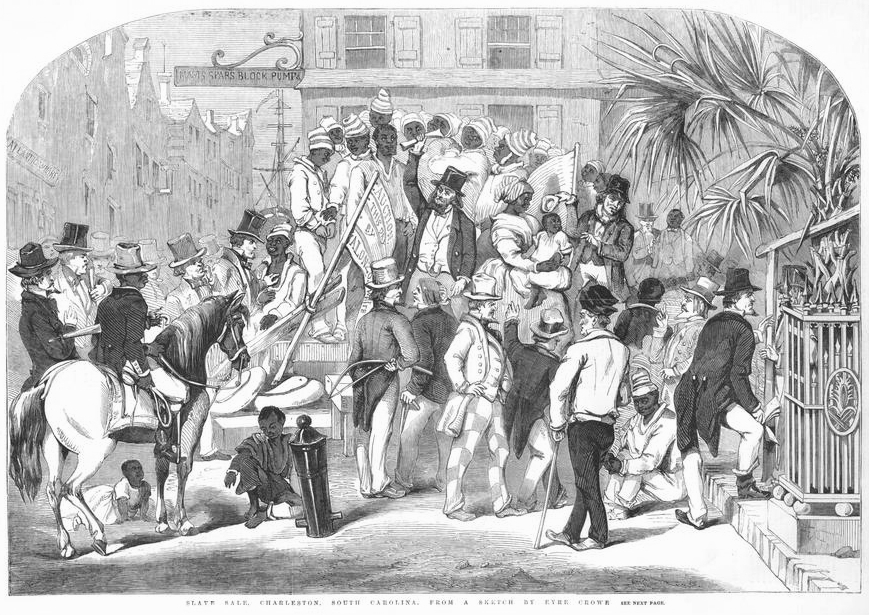
The “Great Compromiser” Senator Henry Clay of Kentucky offered a solution: to create some kind of line across the country from East to West, with slavery allowable below that line as territories advanced to the status of states – but Missouri (north of that line) being exempted and admitted as a slave state – because now Maine was requesting admission as a free state, thus continuing to preserve the numeric balance. So it was that everyone breathed a huge sigh of relief – believing that they had solved the problem. But in fact, slavery now had become a huge political issue clearly defined publicly, separating both North and South.
Social issues, such as the slavery matter, once they get in people’s heads (or hearts) as a key social identifier, simply do not go away on their own. Rather they become major social causes for a society, leading its people to do the most extreme (even highly irrational) things. At some point people would even prefer to engage in bloody battle – rather than appear to be retreating on the matter.
Thus it was that the inability to find a “rational” answer to the divisive issue of slavery only made that social division all the deeper and more emotional with time. Finally, there really was no compromise available – as each side became more deeply invested in its own particular stand as the socio-political identity issue dragged on, and on.
The Monroe Doctrine (1823). Despite Spanish efforts to hold onto its American colonies, Mexico moved to full independence (1821) and various others of Spain’s American colonies also did so soon thereafter. As a result, Britain was seeing in all this the opportunity to trade with these newly-independent countries in America, something not permissible under the principle of mercantilism, previously in force in Latin America – which allowed only the mother country (Spain or Portugal) to trade with its colonies.
But not looking for another conflict, Britain approached America to see if it was willing to enter an understanding with Britain that would keep any European power (whether Spain or possibly even France) from taking advantage of the infancy of the new Spanish-American regimes to try to draw them back into a Spanish or even a French imperial circle. Britain would provide the muscle (its navy) if America would take the political lead in the matter. And thus in 1823, President Monroe announced in Congress that America would protect the independence of its neighbors to the South (and also the right of Americans to now trade with its southern neighbors as well!).
European monarchs at first laughed at American presumptuousness. But ultimately, they did nothing when they realized that British power stood behind this “Monroe Doctrine.”
Adams II. The New England Federalists had not been active supporters of the American effort in the War of 1812 – and paid dearly for this decision by losing so much support that the Federalist Party simply died away soon thereafter. With only one party (Jefferson’s Republicans) now in existence, the Republicans then themselves split into a number of contending factions – which in the presidential election of 1824 threw the election to the House of Representatives to decide.
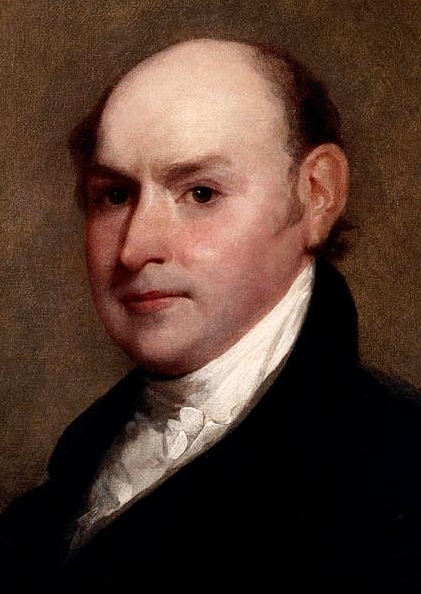 When it chose John Quincy Adams as President (John Adams’ son) Jackson was furious, because he had more votes than the others – though not a full majority. Thus he sat offstage fuming while the younger Adams tried to guide the country – although there were not many issues, because as Secretary of State under Monroe, Adams had taken care of most of the diplomacy problems facing the country (the Executive Branch of government at that time was still pretty much just focused on foreign policy issues anyway.) Indeed, it was actually Adams that had negotiated the agreement that led to the Monroe Doctrine!
But sadly, Adam’s quiet (also not very charismatic) presidency did not connect well with the hearts of American commoners – and four years later (1828) Jackson (with the Southerner South Carolina Senator John C. Calhoun as his running mate) finally won the presidency.

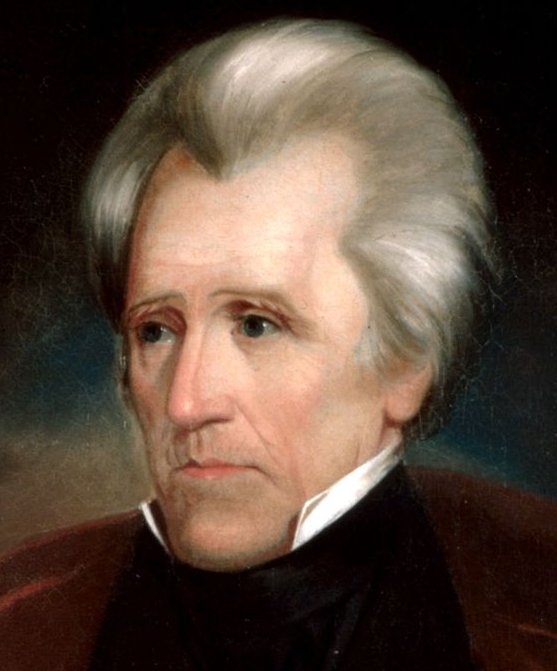 Jackson’s world (1830s). Although Jackson was something of a Southern aristocrat, he knew how to relate to the interests of the American commoners – especially of those in the rapidly expanding American West and Southwest. Jackson had organized (with considerable help from his political ally, the New Yorker Martin Van Buren) his own political party, which took the name “Democrats.” With this development, American politics took on a more earthy, even vulgar, character – as the political interests of rural and frontier America took the political lead in the country’s affairs.[9]
Jackson would become famous for the way he played to the crowds. Indeed, on inauguration day, throngs of very ordinary people attempted to gather to see and hear their hero being sworn in as president, and then join him at the White House for a major reception.
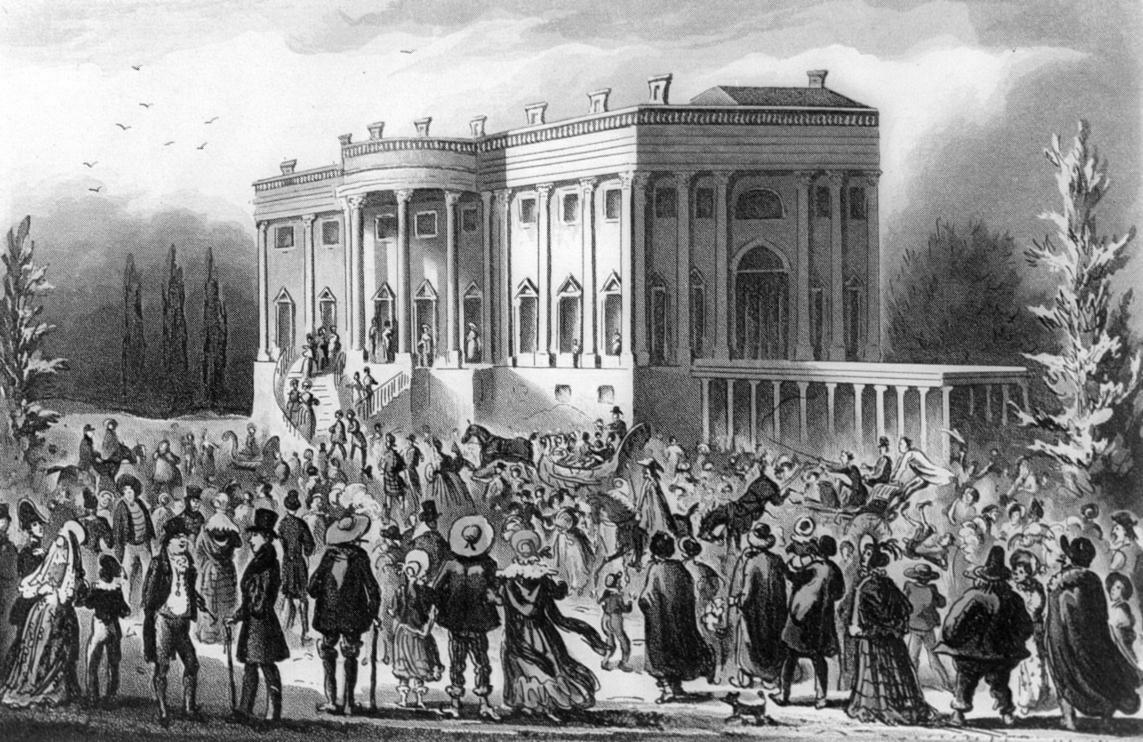
Even in through the windows the crowds came, muddy boots and all, stepping on the furniture, knocking over tables, smashing china. Jackson slipped away from the adoring crowd and quietly had dinner with close associates.
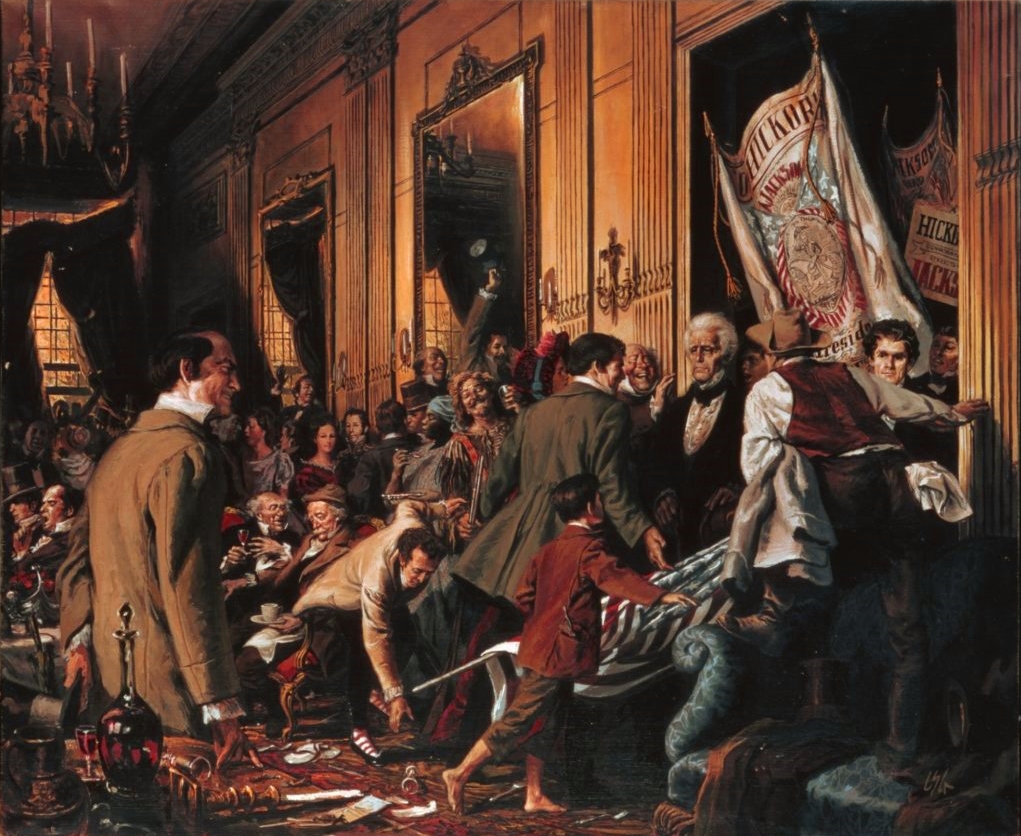
In short, Jacksonian democracy was all a grand show, but one for which Jackson himself had no personal interest. He would let Van Buren take care of the political image-making. As for Jackson, he had other things he would rather be doing!
 So, the age of elite-led politics was over. The noblemen (Washington, Adams Sr., Jefferson, Madison, Monroe, and Adams, Jr.) who formerly had quietly assumed the presidency in order to serve the nation, would now be replaced by the politically ambitious, who knew how to work the political imagery necessary for getting elected to public office. In this, Martin Van Buren, on behalf of Jackson, was a genius. He understood what it took to appeal to the common voter. He understood the press and its ability to create reality. He knew how to line up voters and get them to the polls, especially in the newly emerging democratic age of the general electorate.
The “spoils system.” This was a term coined by New York Senator Marcy in 1828 after Jackson’s victory: “To the victor belong the spoils.” Politics now seemed to have one goal for those who served: to get reelected. And to achieve that, politicians would need social assets they could give their supporters as payoff for their votes – government jobs mostly, though sometimes just offering a free round of beer on election day would achieve the same result.

The journalist Thomas Nast looking back on Jackson’s “spoils system” (1877)
Jackson would become a specialist in this spoils system, for instance, undercutting the vital national bank, the Bank of the United States (BUS) – not because he was opposed to national banking, but because he was afraid that his political arch-rival Henry Clay, who sponsored the renewal of the BUS’s charter, would put himself in the position of being able to offer all the BUS’s jobs (and loans) to his supporters. Thus Jackson saw to it that the federal government’s financial operations would be done instead through Jackson’s regional and local “pet banks” rather than the national BUS, thus crippling the BUS – and in the process much of the national government’s financial powers as well.
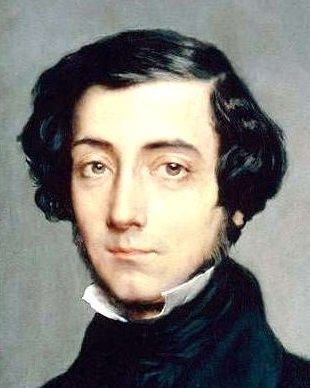 De Tocqueville‘s Democracy in America. An individual who put on record his own observations about the peculiar cultural nature of this Jacksonian America was the Frenchman, Alexis de Tocqueville, who recorded his observations in his Democracy in America (two volumes, 1835 and 1840). He noted the highly individualistic spirit of the typical American – tending to take on new challenges without ever having completed the old challenges! Americans simply loved to “move on” to America’s ever-expanding frontiers (not an option in a France with very fixed and well-filled-in national boundaries). He also noted the deep impact of the Puritan moral legacy (quite different than France’s much looser attitudes about sex – yet much stricter attitudes about social status).
And indeed, America was a very different society than the ones back in Europe. It was young, aggressive, and ever-expansive in its social vision.
The Indian removal (1830s). This factor pointed to another political problem that was brewing in those days. Americans looked greedily at Indian lands still located inside an expanding America – in particular the various tribes located principally in Georgia – but also Alabama and Mississippi. When the Georgia governor indicated that his government was going to take action on the matter of relocating the Indians tribes out of Georgia, Jackson decided not to be upstaged by the governor, but to take the lead in the matter himself. Thus it was that Jackson had Congress push through an Indian Removal Act (1830), calling for Indians everywhere to be relocated to the west of the Mississippi River, principally to the Indian territory of Oklahoma.

The Indian removal – 1830s
Wikipedia
However, the Cherokee, who had made every effort to adapt themselves to Anglo-American-Christian culture, fought the move by appealing to the Supreme Court – which under Marshall simply nullified the right of both the Cherokee and the State of Georgia to act on this matter – presumably blocking removal – or did it? Anyway, Jackson ignored the Supreme Court’s intervention, supposedly inviting Marshall to come and enforce the Supreme Court decision himself personally, if he wanted!
The Indian Removal Act was also opposed by the newly rising party of Whigs (heavily Eastern-industrialist in membership) – who claimed that the removal policy violated Christian principles in every way possible. But opening up these western lands for Anglo settlement also stole from this business class the workers they were counting on to man the machines in their new industries back East.
The Indians themselves resisted this removal as best they could. In Illinois the Sauk and Fox Indians, led by Chief Black Hawk, revolted against the order and had to be put down violently by the Illinois militia (including in its ranks Captain Abraham Lincoln). But one by one the Choctaw (1831), Seminole (1832), Creek (1834), and Chickasaw (1837) were forced to move. The worst removal occurred among some thirteen thousand Cherokee, who in 1838 were first herded into camps in Tennessee and then force-marched westward through a freezing, snowy winter by General Winfield Scott’s soldiers. Cold, disease, and starvation took a huge toll in their numbers. Thus many died along this “Trail of Tears,” possibly as many as a third of all Indians involved. In all, some 46 thousand Indians were relocated in order to open the way for Anglo-American settlement into these Indian lands.
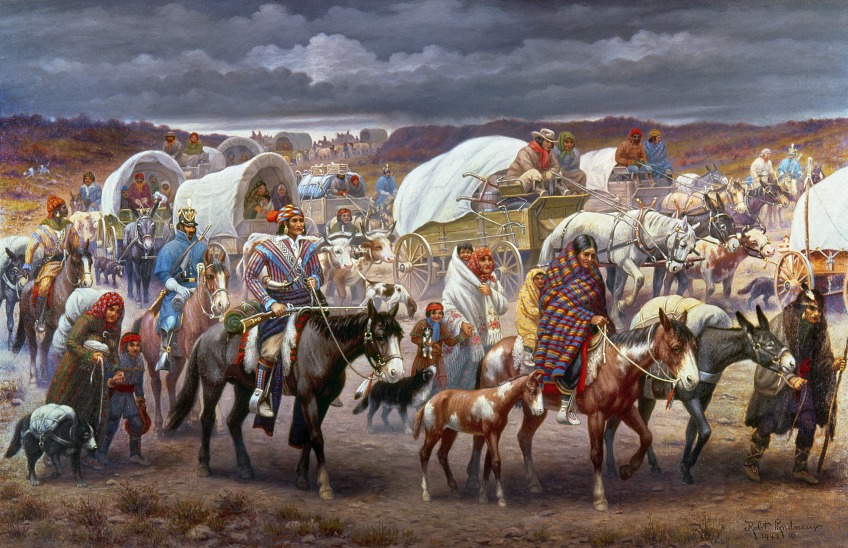
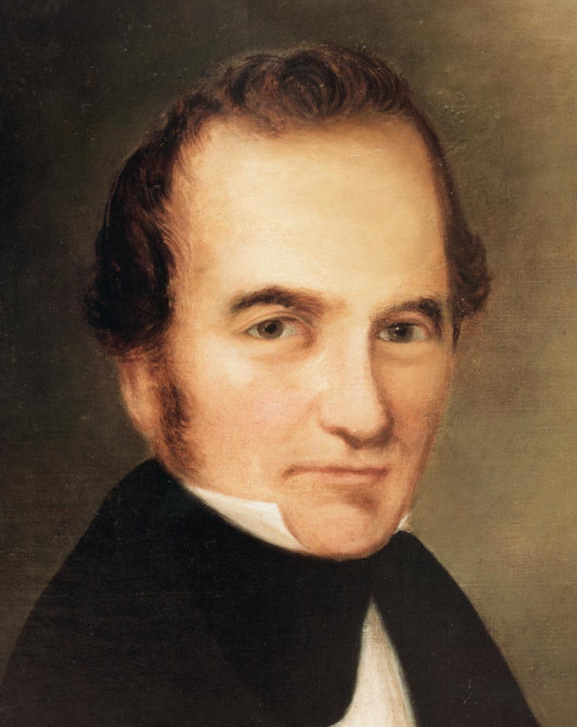 Texas. Texas was originally a huge but very sparsely settled northern section of New Spain (the latter after 1821 constituting the newly independent “Mexico”). Comanche Indians were such a problem in that region that the Mexicans decided in 1824 to invite Anglo-Americans to come and settle the area – in the hopes of displacing or at least subduing the Comanches. Stephen Austin had already brought a group of 300 Americans to settle along the Brazos River in 1822 and the idea was to invite other impresarios or group organizers to do the same.
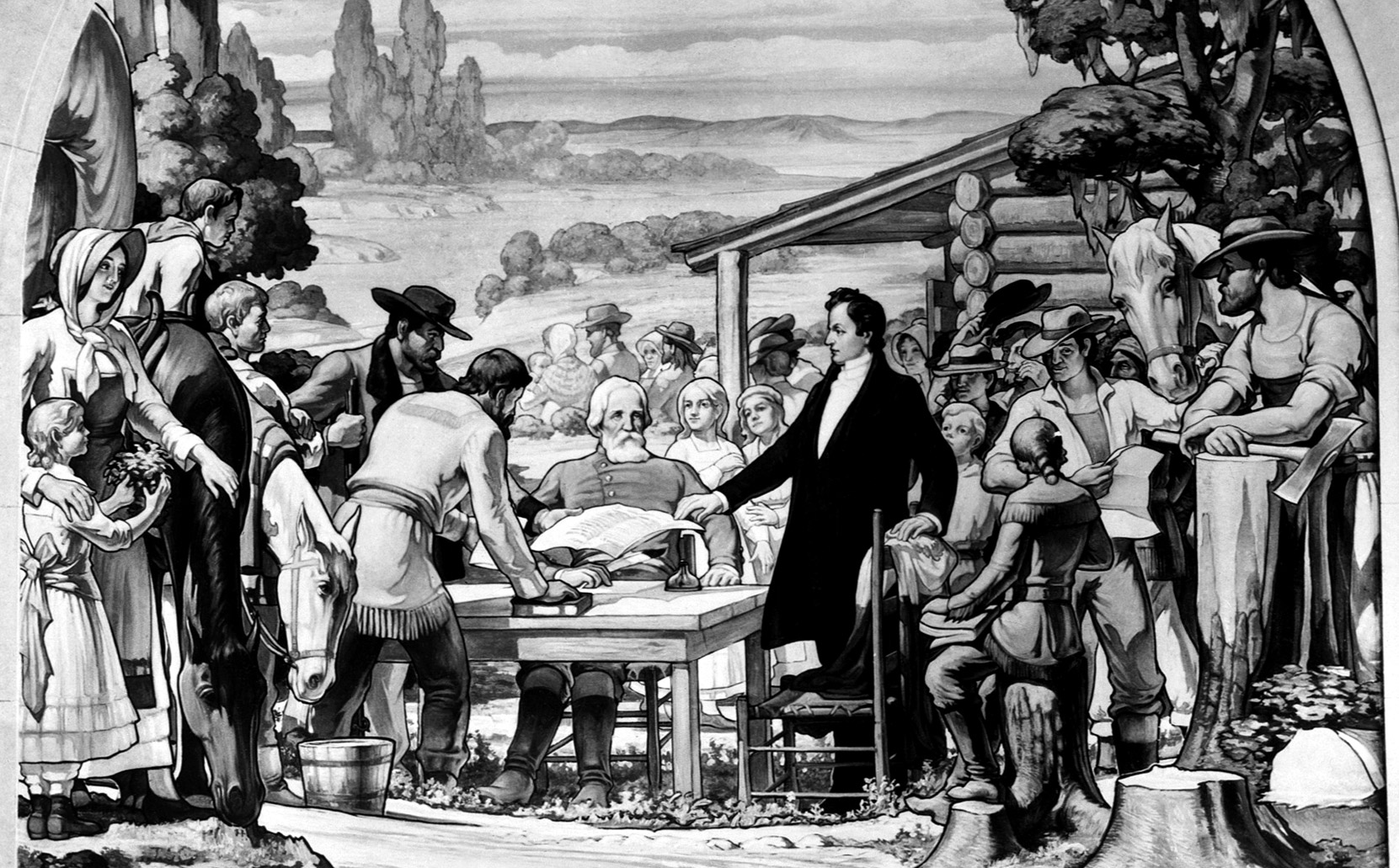
Austin registering Texas settlers
But by 1830 the flow of Americans into Texas had become so extensive that the Texas region was in danger of becoming thoroughly Americanized – and thus the flow was officially stopped.[10] But the Texans immediately understood this to be an effort of the Mexican authorities to isolate their huge Anglo community – stirring deep resentment among these new settlers. This mood also found itself developing at a time that Mexico was itself in a state of near civil war between its Centralists and Federalists.

German immigrants making their way to Texas
Texas Independence (1836). Thus it was that a group of Texans gathered near Austin to write the Convention of 1832, demanding a lifting of the immigration restrictions – and greater political autonomy for Texas itself.
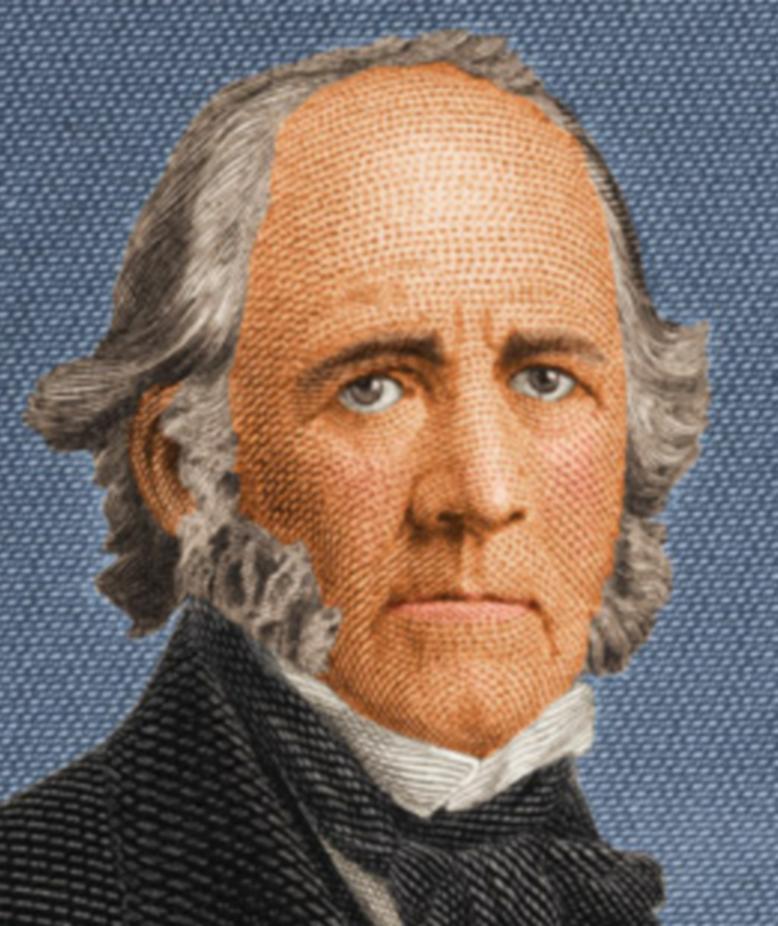 The Mexican Congress attempted to answer some of these demands (even authorizing English as a second language). But this failed to satisfy many of the Texans who were becoming more insistent on total Texas independence. Then in 1835, when a small Mexican force was sent north to subdue this spirit of independence, it met armed resistance at Gonzales – leading Texans to move to set up their own Texas army under the command of Sam Houston. The following year (1836) the Texans moved to decree full independence – as the Republic of Texas.
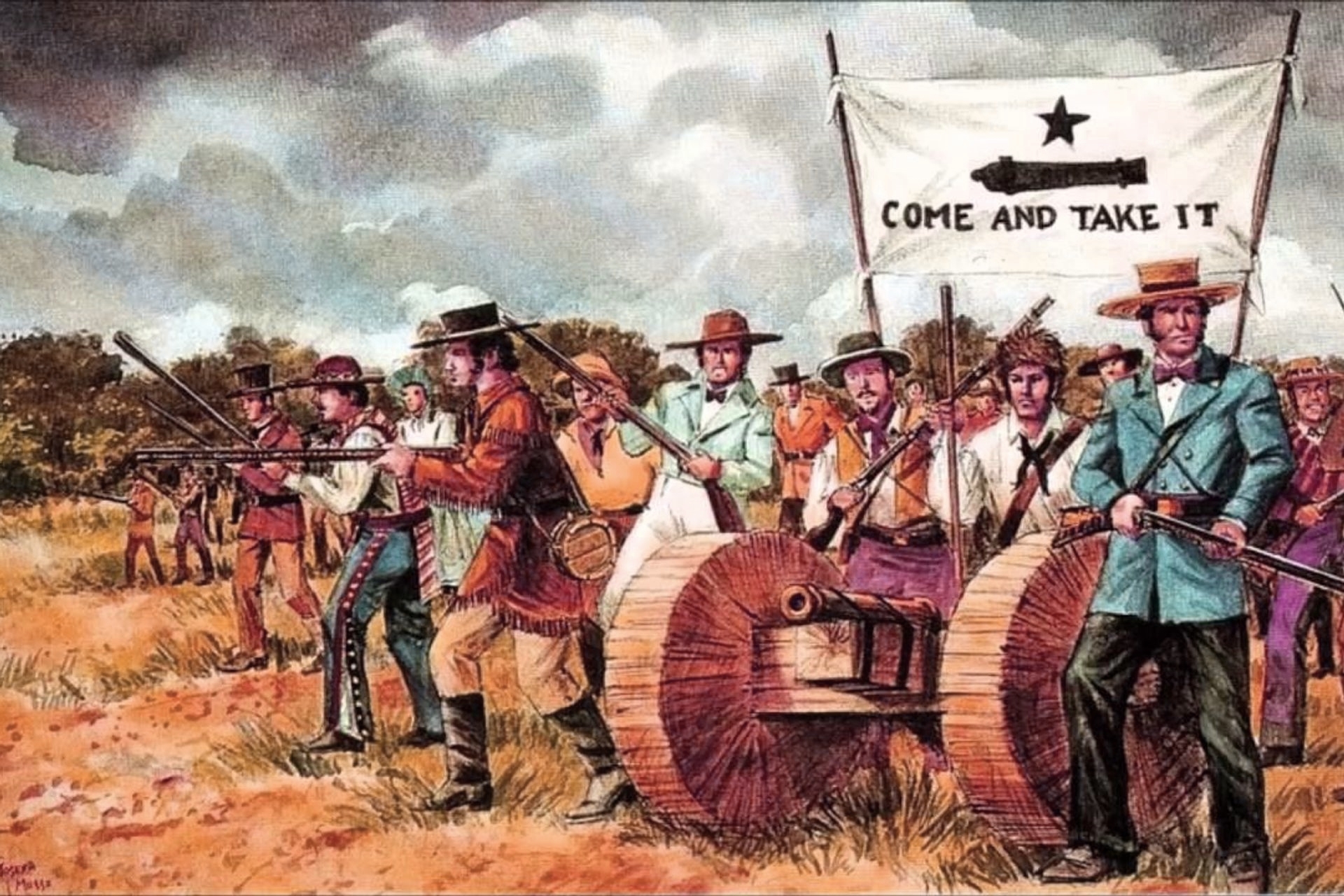
The Battle of Gonzales – October 2, 1835
A small group of Texans challenging a group of about 100 Mexican soldiers sent north to seize a canon from the Texans
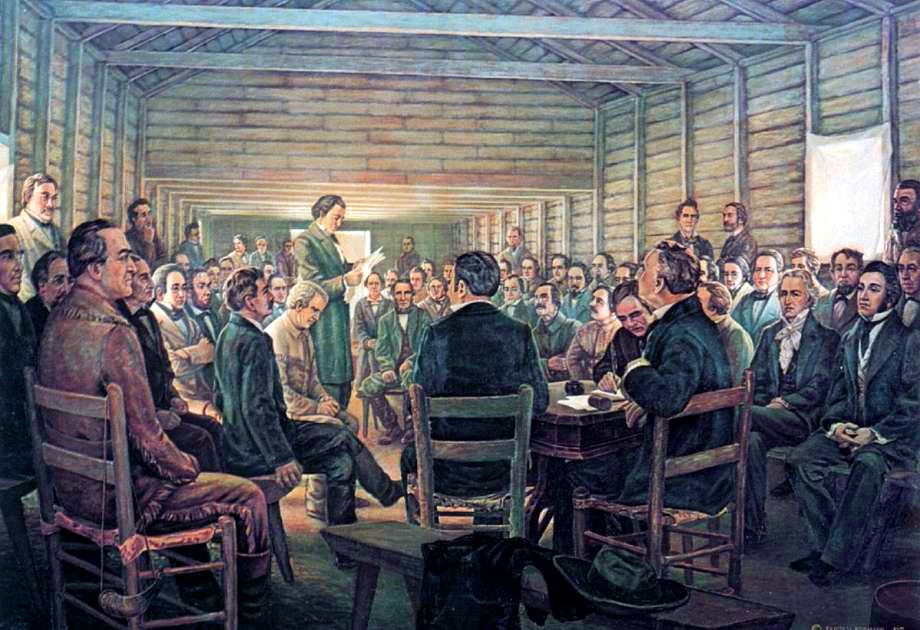
The Battle of Gonzales drove the Texans to gather for a “Consultation” (mid-October 1835) … where they decided formally to take the path of independence … and to appoint Sam Houston to head their army
The new Mexican President Santa Anna responded quickly by sending 4,000 troops north – to crush the approximately 185 Texans taking a stand at the Alamo (February-March 1836) – killing the Texans almost to the last man.

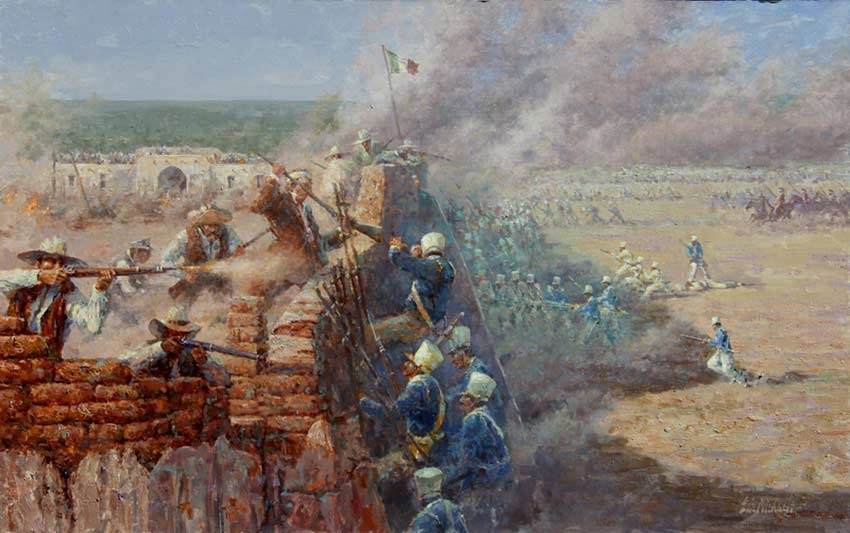
Then Santa Anna brought up more Mexican troops, took on more Texans, defeating them, and then moving them to a prison at Goliad. Then to everyone’s shock, he ordered the massacre of the 300 Texan prisoners at Goliad.
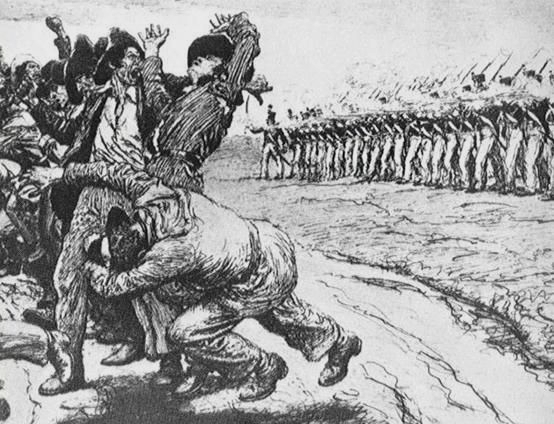
 The Texans vowed to never forget what Santa Anna’s troops had done. “Remember the Alamo” and “Remember Goliad” subsequently became the Texans’ battle cry. A month later (April) the Texans had their chance for revenge – smashing the Mexicans at San Jacinto, capturing Santa Anna, and forcing him to sign a peace treaty recognizing the independence of the new Texas Republic (although he would repudiate the treaty once he was back in Mexico).
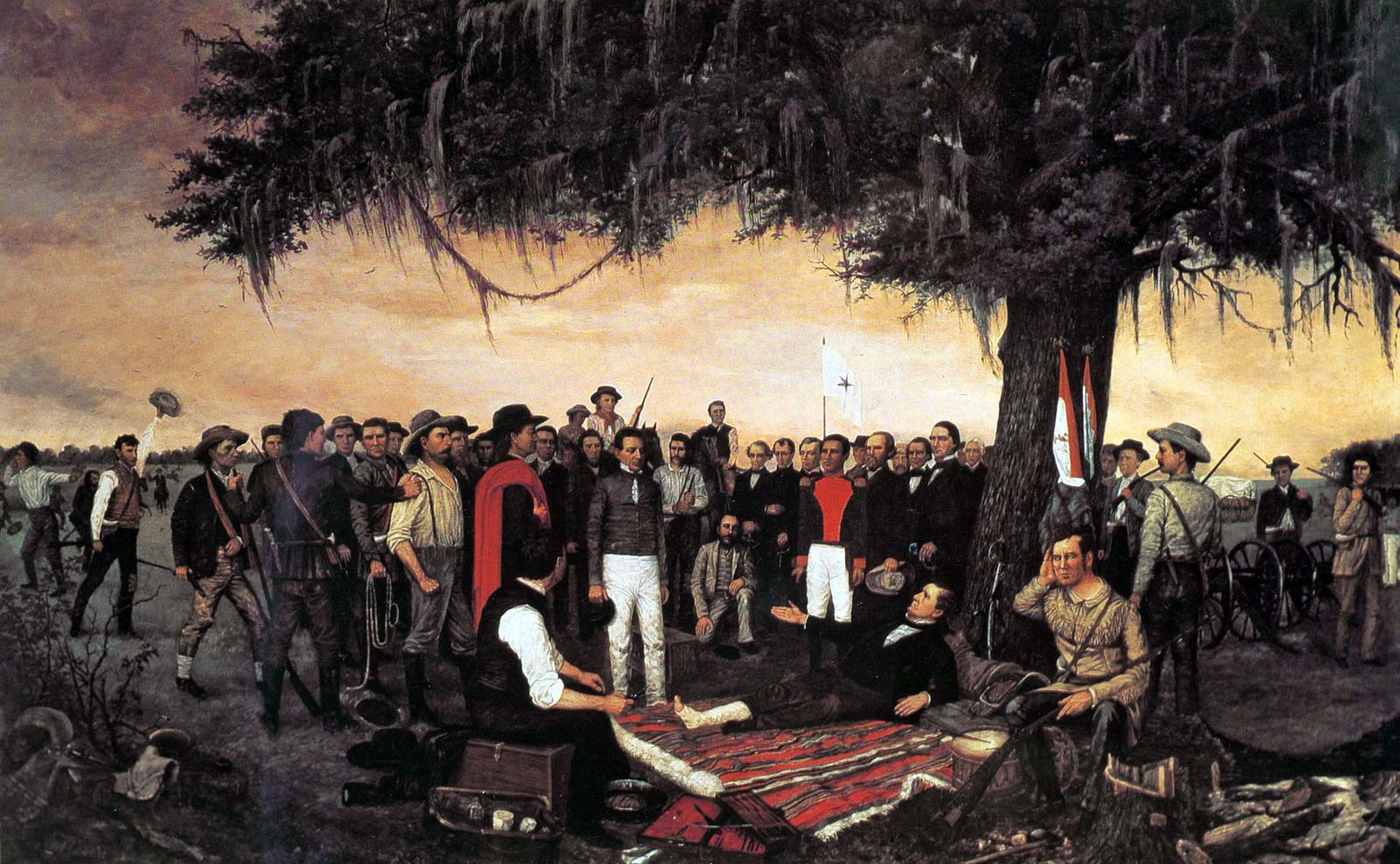
A captured Santa Anna is forced to surrender to a wounded Sam Houston
At this point a huge question posed itself to the Texans: was their newly independent Texas to remain an independent Republic, possibly expanding itself all the way to the Pacific, or was it more logical simply to prepare Texas to become a new state in the American Union? The matter was soon resolved when Mexico sent troops north to undo Texan independence, pushing the debate in favor of those wanting to join the U.S.
But this then raised the question in the U.S. itself – would Texas be admitted to the Union as slave or free? Debate in Congress on the matter turned heated, as identity politics always does. Meanwhile, President Van Buren was struggling with the great economic Panic of 1837 – and was not looking for more contention to trouble America’s political waters.
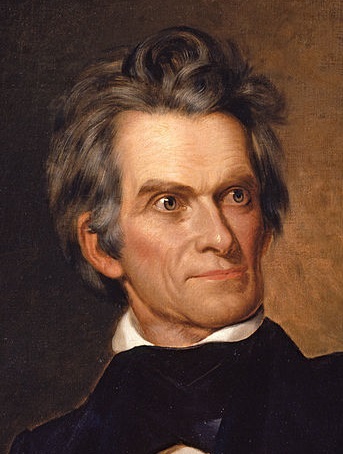 But South Carolina Senator John C. Calhoun (who in the 1820s had switched from being a strong nationalist to instead being a strong pro-slavery Southerner) had made the admission of Texas as a slave state a matter of high principle for the South. He warned Congress that the Southern states themselves resolved either to stay – or depart from – the Union, depending on how this Texas matter was resolved.
 Meanwhile, John Quincy Adams had returned to Washington as a member of Congress – and for three weeks led the opposition to Texas’ admission to the Union. Ultimately nothing was resolved on the matter, and the issue simply settled into a tense stalemate.
Finally, a number of years later (1845), at the end of his one and only term (another huge economic crisis had hit the nation) President John Tyler, though a Whig, decided to push through a “Lame Duck” Congress[11] an invitation to Texas to join the “Union” as a new state. Thus the incoming President James Polk would have the honor of overseeing the admission of Texas to the Union as the country’s 28th state. At this point, the South was happy, the Whigs moody, but the Mexicans furious.
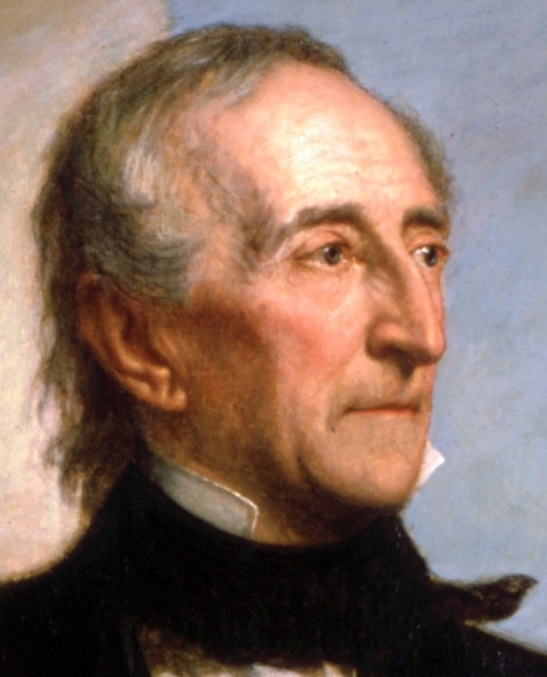
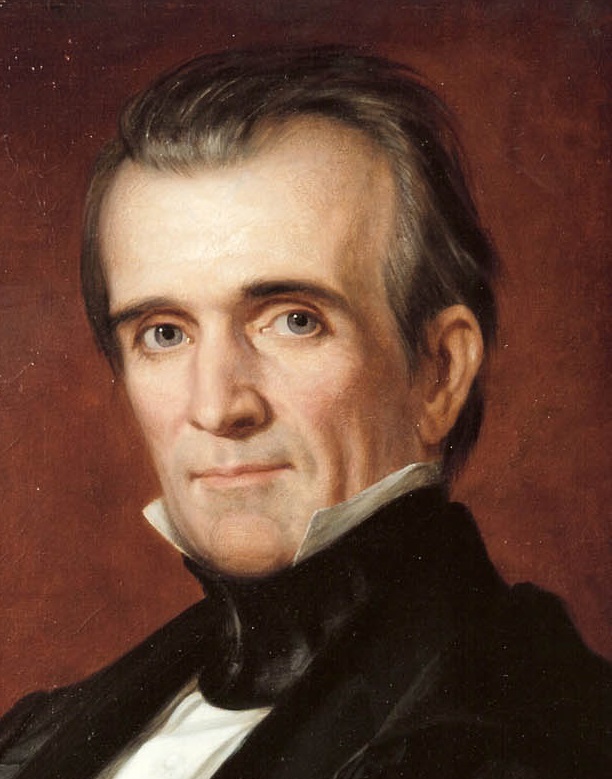
Tyler Polk
 Manifest Destiny. In the midst of this debate, John L. O’Sullivan, publisher of the Democratic Review wrote an article (1845) explaining that it was America’s “manifest destiny” to expand itself all the way west to the Pacific Ocean. All sorts of reactions resulted when this term became part of the national political conversation. Eastern Whigs considered it nothing more than a crude excuse for imperialism, although their reaction was in part a result of seeing themselves lose their workers to an opening West. Then there were those who supported the idea whole-heartedly – including importantly Christians, who compared the American westward expansion to the Israelites entering and clearing out the Promised Land to make way for the People of God to develop there. To such Christians, America had the same divine calling on it, and nothing should get in the way of this call. It was, after all, their “manifest destiny.”

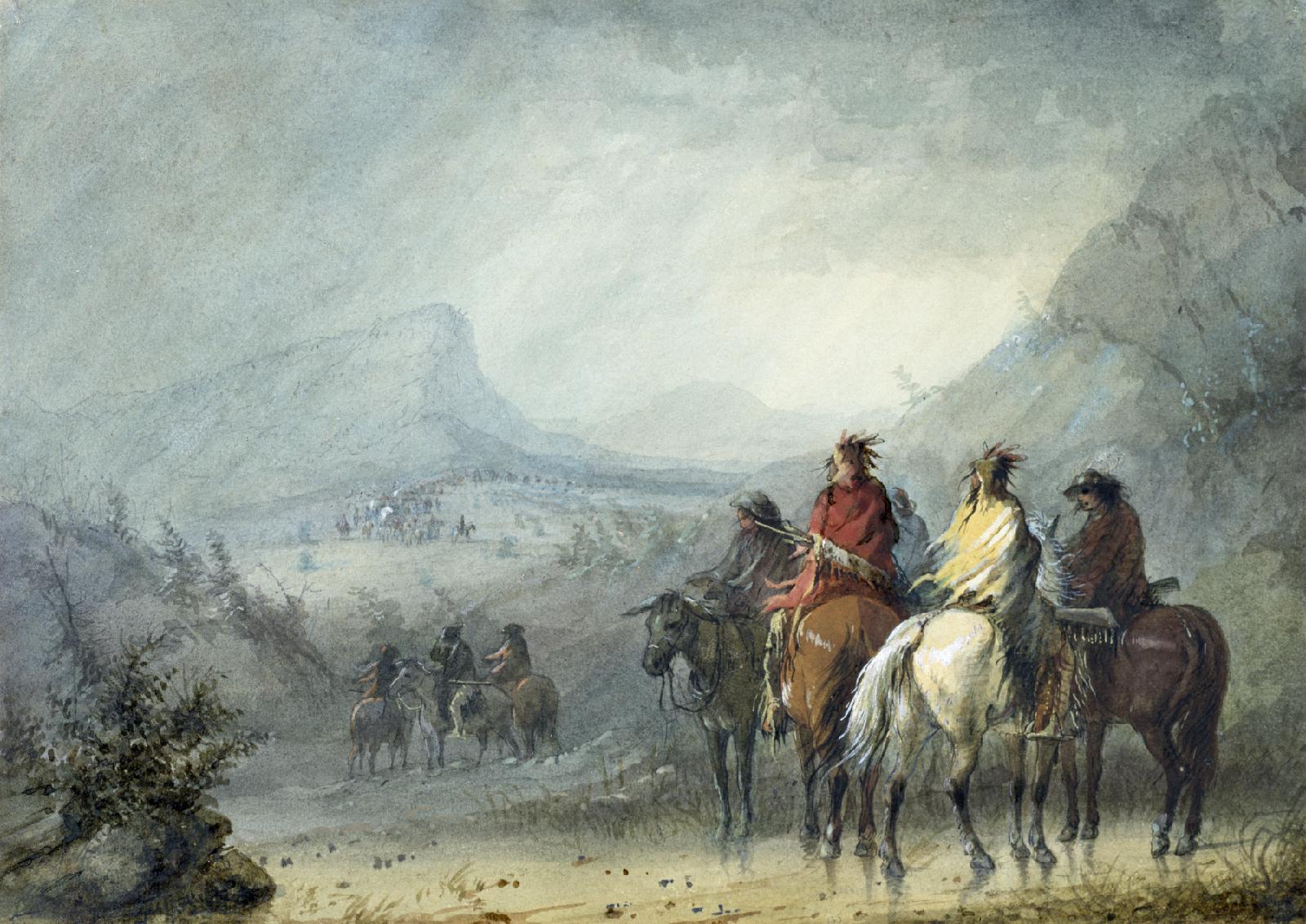
As the lands of the East filled up and the soil got overworked through the generations, streams of Anglos headed westward, looking for new land to set up their homes

Life on the frontier was very, very tough
Of course the Indians and the Mexicans had a very different view on the subject. But ultimately, they were not invited to become part of the conversation. Nonetheless, they did not intend to be left out of the matter.
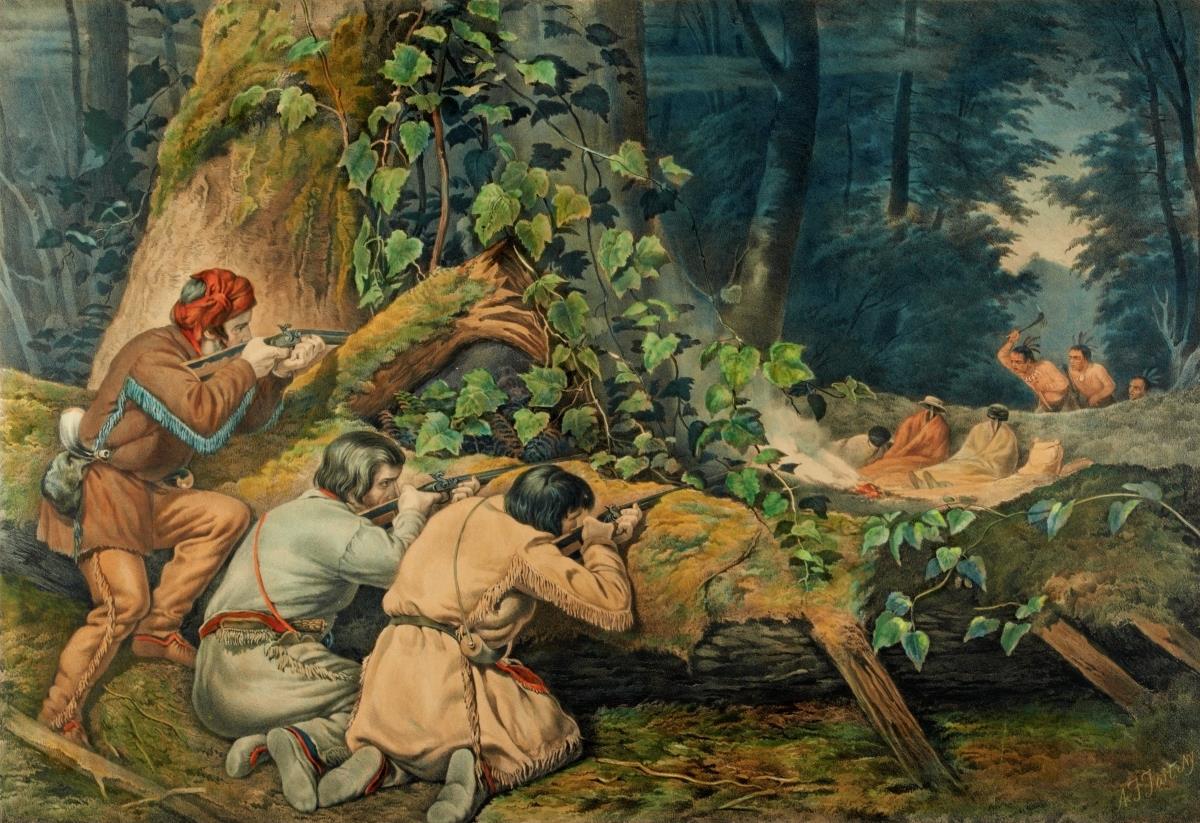
Indian raids were of course common on the frontier

And Indians played by their rules, not the Anglo rules of warfare
The Mexican-American War (1846-1848). The new President Polk at first tried to negotiate a settlement with Mexico over the Texas issue, even offering to pay substantially for the acquisition of Texas – as well as other territory all the way to the Pacific. But Mexico itself was in a state of massive political chaos at that time – and the Mexican leaders themselves could not agree on how to respond to Polk’s offer. When the Mexican Centralists finally won against the Mexican Federalists, the answer to Polk was a very loud “No”!
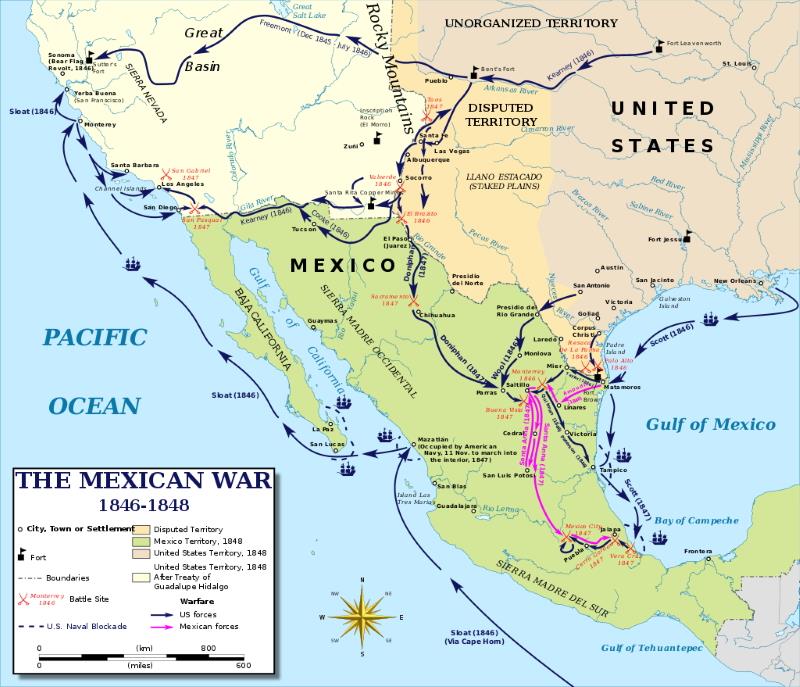
Then Polk responded to the Mexican “No” by moving U.S. troops through Texas – past the Nueces River which the Mexicans had (grudgingly) acknowledged as the southern border of Texas – all the way south to the Rio Grande. To the Mexicans this constituted an all-out act of war – and they sent 2,000 troops north to reclaim their territory. There they overwhelmed a small patrol of 70 American soldiers. A furious Democratic-Party-controlled Congress now responded with a declaration of war (April 1846) – with the Whigs opposing this move.

The Battle of Palo Alto (May 9, 1846) fought in the region between the Nueces River in the North (Mexico’s understanding of the Mexican-Texas border) and the Rio Grande (American view on where the border lay). About 2,200 U.S. forces under Zachary Taylor took on Mexican General Arista’s force of 3,700 … in which American artillery devastated the Mexican army.
American General John C. Frémont then led Americans in California to rise up against Mexican authority there as well. Briefly the Californians took up the Bear Flag Revolt (symbolizing California’s independence) – but quickly declared themselves as Americans. Then with the help of American General Stephen Kearny joining them from the East, the Californians took San Diego, cutting the Mexicans off from California. The next year (1847) Mexico was forced to recognize its full loss of California.
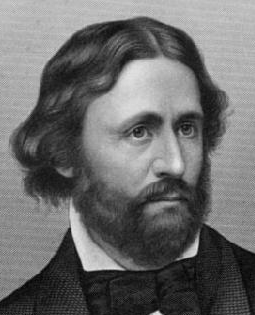
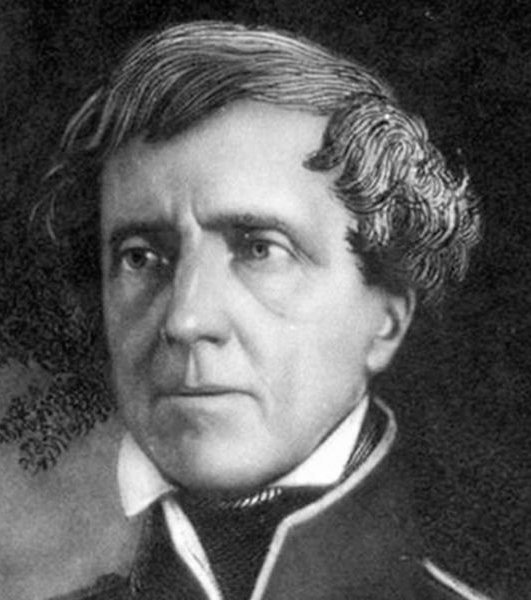
John C. Frémont Stephen Kearny
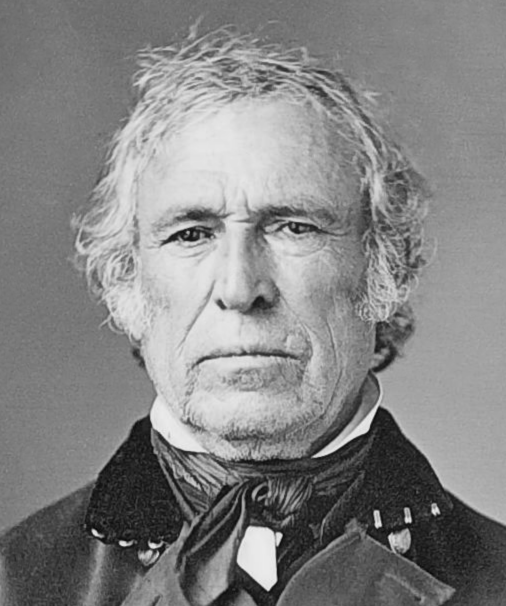 General Zachary Taylor then took his rag-tag army of volunteers deep into Mexico, where he was met by Santa Anna, who had again seized control of the Mexican government. But a stalemate resulted, broken only when Santa Anna had to leave the battle and head back to Mexico City to protect his political position there. At the same time, American warships were attacking Mexican towns along the shores of the Gulf of Mexico. They then unloaded their Marine troops, who headed west to Mexico City (to the “Halls of Montezuma”) – and there delivered a knockout blow to Santa Anna and his troops – leaving American troops in total control of Mexico.
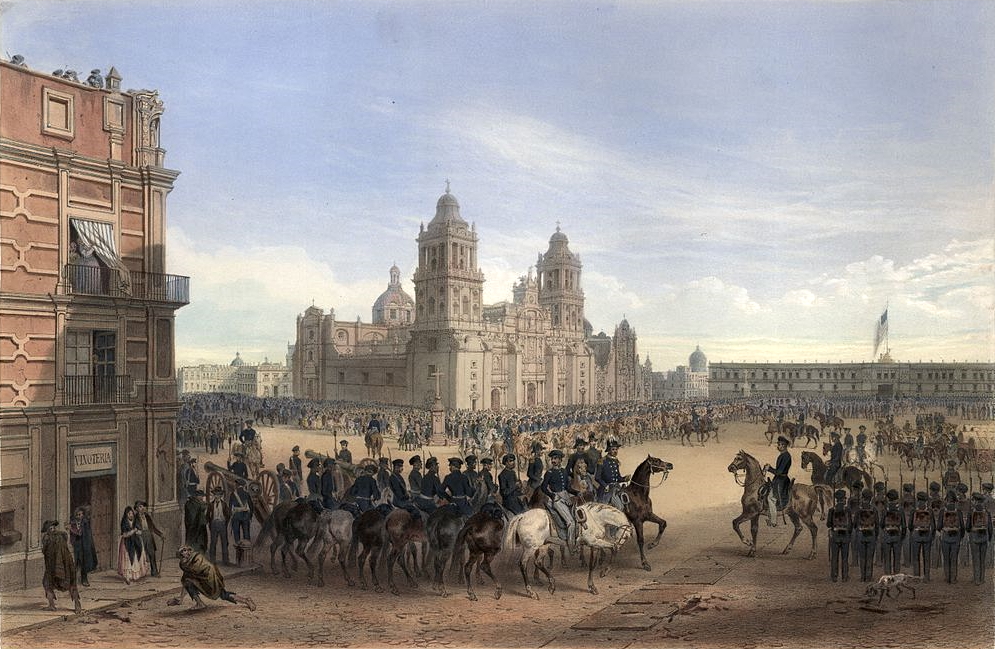
American General Winfield Scott in Mexico City – September 1847
Wikipedia
At this point some discussion arose about simply annexing Mexico – though not only did the Whigs fight this, but the idea found little support among most Americans. Consequently, negotiations in January of 1848 resulted simply in an offer of a $15 million payment to Mexico for the acquisition of the land reaching from southern Texas west to California. The payment was a major face-saving move awarded the Mexicans (the Mexicans had not invested very deeply socially in those areas anyway) – and removed the temptation of Mexico to try to retake the region – especially important at a time when America was soon caught up in its own civil war and would have been weakened greatly in any effort to hold onto this territory.
The Oregon Territory. The British and Americans had been able to agree on a Canadian-American border extending westward along the 49th parallel from Minnesota to the Rocky Mountains. But the territory to the west of those mountains was disputed by both Americans and British, the British claiming the Oregon Territory and the Americans claiming the land in the Pacific region north to the Russian border of Alaska. The feelings in America grew increasingly heated over this, with some calling for “Fifty-Four Forty[12] or Fight.”

Finally, in 1846 the British and Americans came to an agreement to simply extend the 49th parallel border all the way west to the Pacific (but swinging just south below Vancouver Island). And thus the Oregon Territory came formally into American hands.
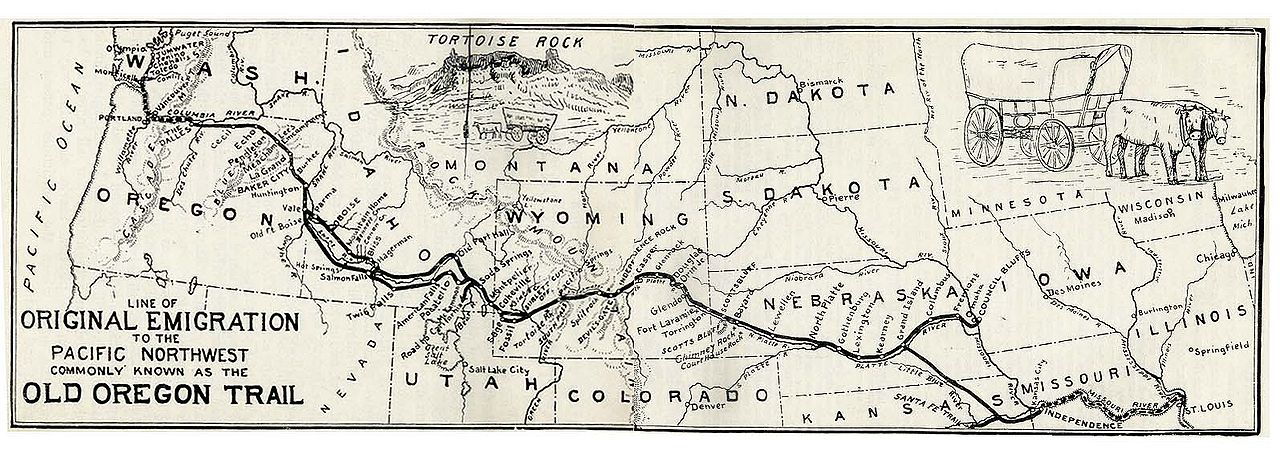
The Oregon Trail
Wikipedia
Even before the treaty was signed, both Christian missionaries seeking to bring the Indians to Christ and land hungry Americans had begun pouring into Montana, Idaho, and the Pacific Northwest. Starting their trek from Independence Missouri, they followed the Missouri and Platte Rivers west to the Rockies, crossed rivers, mountains, snow and ice before descending down into the lush Oregon territory along the Columbia River. By the time of the 1846 treaty more than 6,000 Americans had already made their way to the Oregon Territory, to begin a new life there.

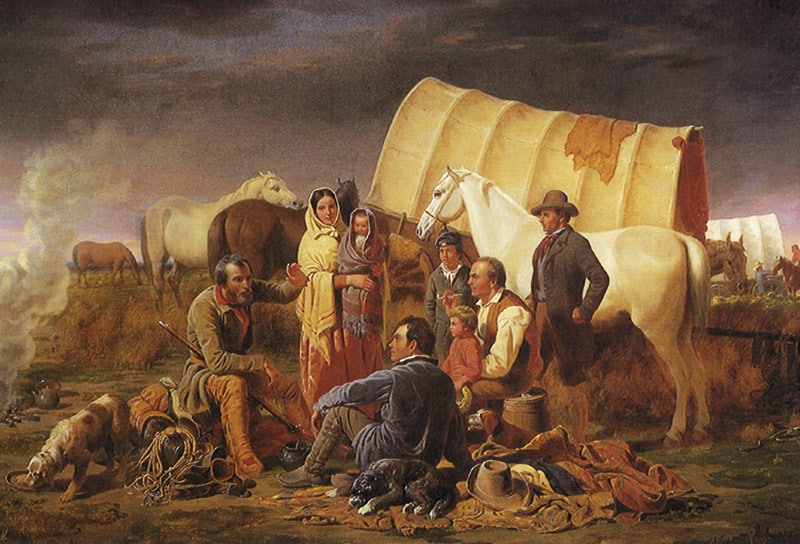
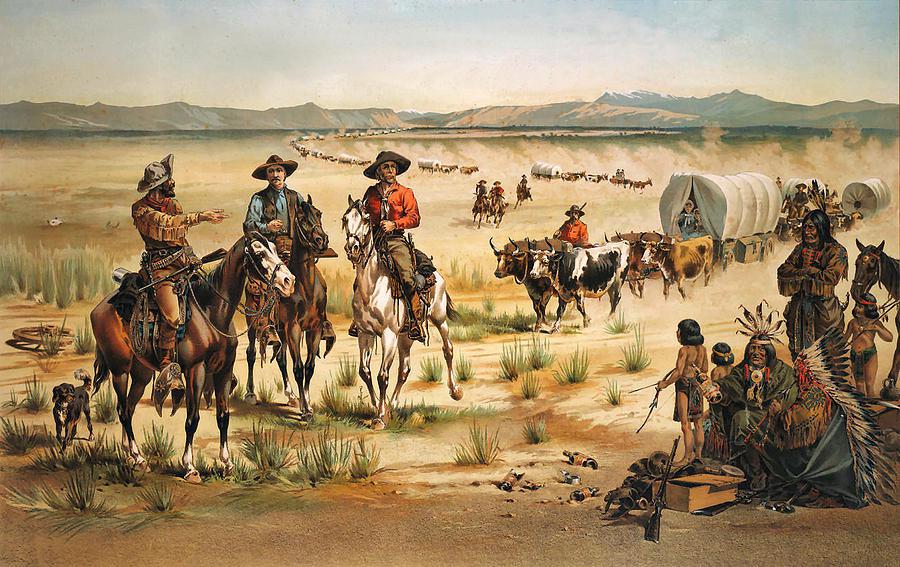

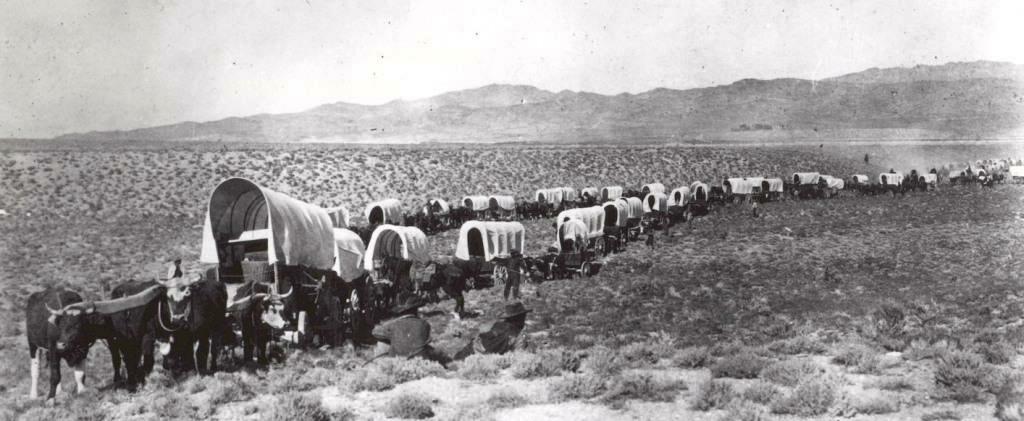
An actual photo of the Oregon Trail
[8]1837, 1857, 1873, 1893, 1907, 1919, 1929, 1979 – and more recently, the near national economic meltdown in 2008.
[9]The election of 1828, for instance, had been particularly vulgar in tone, with candidates, or their supporters anyway, hurling coarse insults against each other. In the case of Jackson, it was slander about the legality of his marriage to his wife Rachel, so vicious that it may have been the reason Rachel died of a heart attack in December 1828, shortly after Jackson’s presidential victory, but before he was sworn into office. Jackson, understandably, remained forever bitter about this personal tragedy.
[10]At the beginning of the migration in 1825 there were only about 3,500 non-Indian settlers in Texas, mostly Hispanic. Less than ten years later that figure was over ten times that size, about 80% of them Americans – with a large number of slaves among them.
[11]When an election has changed the makeup of Congressional representation, but the older members are still in position for a few months to do business before they are replaced by the newly elected representatives.
[12]The line of latitude which formed the southern border of Russia’s Alaska territory.
THE AMERICAN ECONOMIC DYNAMIC AT THIS TIME
President Jackson’s decision in 1833 to withdraw all government deposits from the Bank of the United States – and move them to his “pet banks” located here and there around the country – undercut New England’s world of industrial/financial capitalism deeply. But this action found wide approval among Jackson’s rural supporters, who generally hated the banking world (most farmers found themselves in debt to banks in order to finance their farming operations). They were hoping that Jackson’s stripping the BUS of its powers would make money cheaper (inflating the value of the dollar, making the repayment of their debts less costly to them). The Whigs, however – representing the banking community of the Northeast – demanded tight discipline of the money supply and the value of the dollar.
The national economic crisis of 1837-1840. An economic bubble of prosperity – built on the huge printing of paper money and the pricing of Western land at nearly give-away rates – suddenly burst in 1836 when currency problems back in London forced banks there to have to raise interest rates dramatically – in turn forcing American banks closely connected with the London banks to have to do the same. At the same time Jackson, oddly enough, reversed course on Western land sales – and demanded that payment be made in gold or silver coin rather than paper money – ruining land speculators, who had bought huge amounts of land rights with paper money, now finding potential purchasers of those lands backing away. Also, people began to make a run on banks, demanding that their deposits be refunded in hard currency (gold or silver) – something banks did not themselves possess in their vaults. Suddenly the American economy seemed to crash.

A graphic commentary on the crisis – 1837
 Jackson’s Vice President Martin Van Buren, now newly-elected U.S. President, did not cause the crash – but was the one everyone looked to in order to solve the crisis. But the crisis was one of fear, not policy. Paper money simply was not trusted and gold and silver were not easily expanded items. All anyone could do was ride out the panic – and hope that somehow the crisis would resolve itself. But that crisis was still on several years later when in 1840 Van Buren stood for reelection. Slowly a bit of confidence had been returning to the American economy – and businesses and banks were getting back on their feet (somewhat). But the process was too slow for Van Buren not to take the hit for it all.
Consequently the Whig candidate and former war hero (Indian fighter) William Henry Harrison was elected president – although he served in the presidential office only briefly, having caught a bad cold speaking long at his inauguration ceremony and dying a month later. Thus his Vice President John Tyler stepped into the presidency. Now the pro-BUS Whigs commanded the situation – and slowly put the American finances and thus the economy back on a stronger footing.
Lessons about careless handling of the nation’s wealth by a government seeking to gain popularity by making wealth appear to come very easy (thus inflating a huge speculative bubble) should have been learned from this experience. But this would not be the last national financial crisis to hit the nation because of unwise government financial policies (the crisis of 2008 being a recent example.)
America’s Industrial Revolution. Moving goods from field to factory and Americans always on the go (usually westward) was greatly facilitated by the development of rail and canal transport – those two technologies requiring the development of massive infrastructure (the laying of tracks and the digging of canals) – not to mention the steam power that drove the boats and trains (and factory machinery).
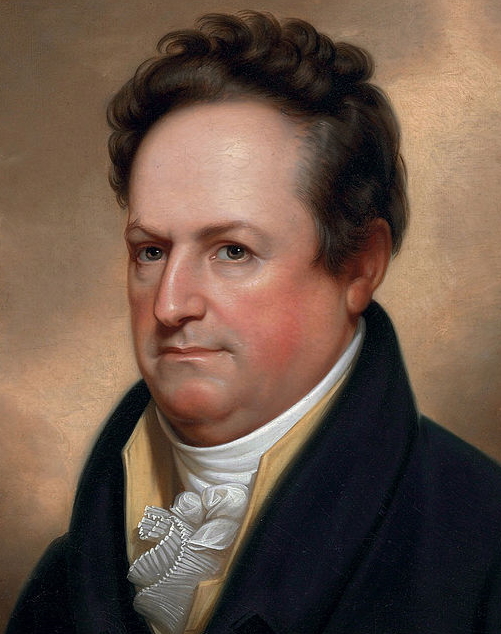
New York Governor DeWitt Clinton
Authorized the building of the 363-mile Erie Canal (1817) which opened for
business in 1825 … and a big supporter of industrial development in general

New York Governor DeWitt Clinton opening the Erie Canal – 1825
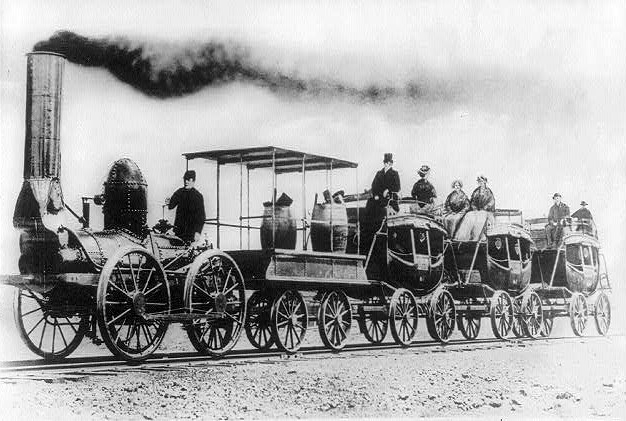
The DeWitt Clinton locomotive – 1831
But despite the economic setback of the late 1830s, by the early 1840s there were some 1,200 cotton mills in operation (mostly in the Northeast), the Erie Canal was in place with the Baltimore railroad linked to it (actually the Baltimore and Ohio Railroad had its first section in place as early as 1830), the McCormick reaper was harvesting huge wheat harvests, steam boats were making regular runs on the Great Lakes, etc.

Locks on the Erie Canal
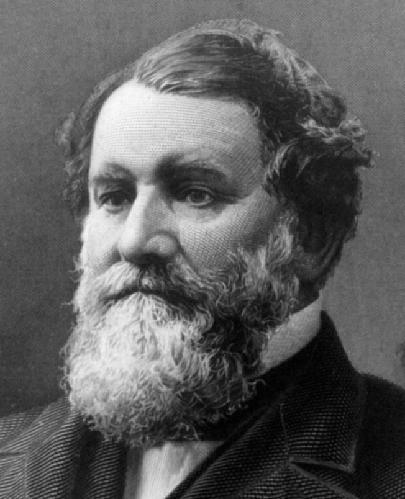
Cyrus McCormick
His reaper helped revolutionize the American farming industry

The McCormick reaper
 And by the early 1850s, railroads had reached from the East coast all the way to the Ohio River in the North and the Tennessee River in the South – and soon thereafter all the way to Memphis on the Mississippi River. America at this point was an industrial giant, not yet quite acknowledged by the European powers.
AMERICA’S ONGOING SPIRITUAL DEVELOPMENT
America “wanders” again spiritually. For a number of Americans – located especially in the American East – a comfortable small-town life (dependent on an economy other than just agriculture) seemed to have a natural peace and prosperity to it. Not surprisingly, life took on a more “rational” character – stepping the people back from their previous Christian spirituality. Americans, especially among the more leisured classes, found themselves less interested in what God might do in their lives and more interested in what they might achieve for themselves under this more rational social realm clearly emerging around them.
They did not abandon Christianity – because being Christian was understood to be the same as being “civilized.” But the authentic faith component was once again disappearing. Its place was being taken by a rational morality – a key part of Enlightenment Humanism – that was sweeping intellectual circles once again, in America as well as in Europe. Such Humanism usually claimed the moral teachings of Scripture, especially the teachings of Jesus, as its Christian foundation. But in the end no such connection was absolutely necessary, for these were self-evident truths that presumably any rational person would understand as the foundation of any life well lived (French revolutionaries had gone so far as to disdain even this slender Christian connection with their utopian Idealism).
Once again (as in the late 1600s and early 1700s) “Enlightened” Americans of the early 1800s were convinced that Human Reason was vastly superior to the pre-scientific superstitions about life held by Americans who were intellectually unable to shake off the silly old beliefs about people walking on water and raising the dead back to life. Consequently, they were deeply disdainful of those who clung to a religion drawn from a supposedly darker past.
They failed to notice that their new Rational Humanism as a substitute religion was no newer than the story of Adam and Eve’s fall in the Garden of Eden, or the long Biblical narrative about the repeated wandering of ancient Israel away from the counsel and discipline of God – and its tragic results. And America itself had already evidenced this same occurrence a century earlier. But they had learned nothing from such historical experience.
Christian Unitarians. Among those moving in this Humanist or Unitarian (or even Deist) direction were a number of Congregationalist pastors – concentrated heavily in the Boston area. In 1825 over a hundred of these pastors – mostly from New England – came together to form the American Unitarian Association – in part to undo the Calvinism that had earlier formed the foundations of the Congregationalist Churches of the region. Their goal was to bring Christianity more in line with the recent discoveries of science – and with simple Humanist logic that found much of the traditional Biblical claims of Christianity and its miraculous powers to be completely unbelievable.
Once again (again as in the late 1600s/early 1700s) the “more-enlightened” Christians were certain that in making these adjustments, they were strengthening the foundations of the Christian religion that underlay a fast-developing American society and culture.
 Jefferson’s Unitarianism. An individual to figure big in this rising Humanism/Unitarianism was former President Thomas Jefferson. In 1822 Jefferson wrote his friend Dr. Benjamin Waterhouse attacking the foundations of traditional Christianity, pointing out in particular the ancient apologist Athanasius and the more recent Calvin as “false shepherds” and “usurpers of the Christian name”
teaching a counter religion made up of the deliria of crazy imaginations, as foreign from Christianity as is that of Mahomet. Their blasphemies have driven thinking men into infidelity.
In that same letter Jefferson (who had compiled an updated Bible eliminating all the miracle stories and focusing only on the moral teachings of Scripture) professed that the simple doctrines of Jesus (to love the only God with all one’s heart and one’s neighbor as oneself) had been perverted by adding Platonizing doctrine (Jefferson did not like Plato very much either) which he claimed – quite incorrectly – was most evident in Calvinist dogma. But he was confident that such dark days of primitive Christianity were becoming a thing only of the past. Thus he states:
I rejoice that in this blessed country of free inquiry and belief, which has surrendered its creed and conscience to neither kings nor priests, the genuine doctrine of one only God is reviving, and I trust that there is not a young man now living in the United States who will not die a Unitarian.
For those living in the comfort of a secure existence, such enlightened Humanism seemed to be beyond all serious question as the true path to knowledge and happiness. This was the true religion of any enlightened person after all.
The Transcendentalists. Another, somewhat later (1840s), example of this development was that of the Transcendentalists – who pursued the quest for God – not through the way of Christ, but rather as a higher order of “pure thought.” They sought, through mental discipline, to be broad in their intellectual reach, encompassing a variety of refined efforts to embrace God both in a oneness with nature and a sense of reaching beyond even the natural. They sought to be as fully human as possible, so as to find God as fully as possible. They too tended toward lofty communalism in the hope of reaching beyond the coarse nature of selfishness and sin, to find a more perfect human harmony.
Ralph Waldo Emerson, Henry David Thoreau, and Amos Bronson Alcott (father of novelist Louisa May Alcott) were neighbors in Concord Massachusetts who set the pace of Transcendentalism. Thoreau attempted to find serenity in two years (1845-1847) of relative isolation in the woods at Walden Pond, Alcott in his experimental school in Concord, and Emerson in his many philosophical lectures and writings.

Emerson Thoreau Alcott
 Emerson presenting a “higher” worldview
The earthier intelligentsia. But for those less comfortable, where life’s dangers were not guaranteed to be manageable, where life could suddenly take a violent turn (hunger, disease, Indian massacre) such Humanist rationality seemed as absurd to hardened Realists as a personal trust in a God of miracles seemed absurd to the Humanists. Indeed, even Nathaniel Hawthorne, who once was a neighbor of the Concord Transcendentalists, eventually became something of an anti-Transcendentalist, tending to delve more into the darkness of the religious ethical issues of his era in his stories The Scarlet Letter (1850) and The House of the Seven Gables (1851). Likewise, Edgar Allan Poe could be just as abrasive in his dislike of the romantic optimism of Transcendentalism.
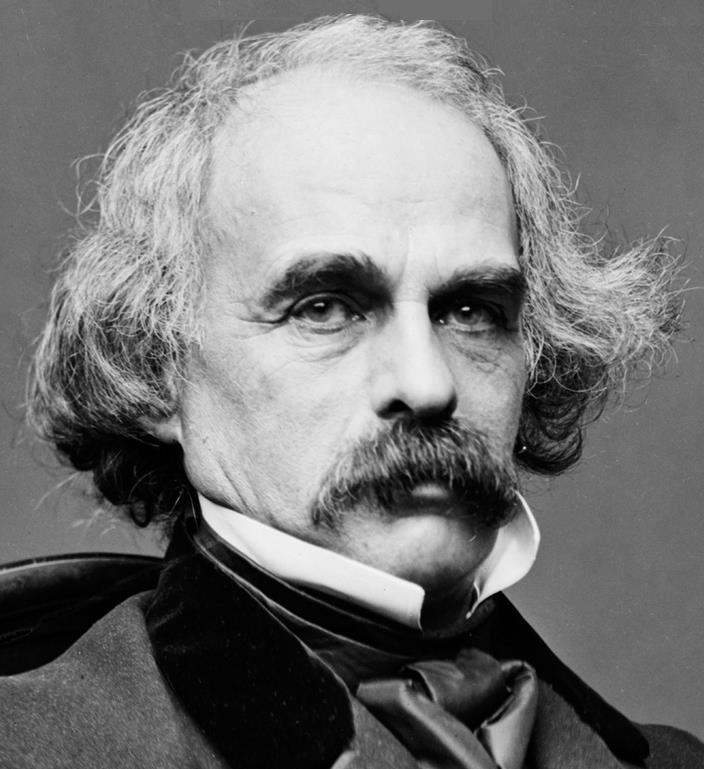
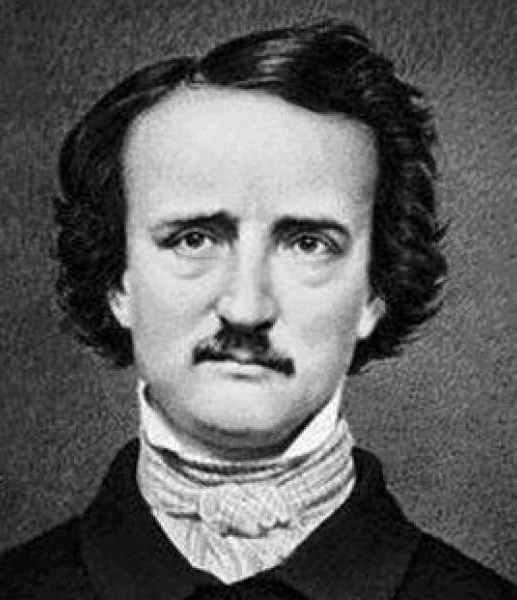
Hawthorne Poe
The rekindling of America’s Christian fires. The highly individualistic but also highly isolated life on the part of those Americans that lived well away from the comforts of the East produced among Westerners a hunger for personal meaning within the context of community – membership in larger society being a rare but well-appreciated commodity. Most frequently this took the form of huge gatherings whenever a local Christian revivalist appeared in the region. Thousands would turn out to spend a week at an improvised encampment listening to an array of preachers, singing and dancing, shouting and fainting, and having a thoroughly good time.

Particularly prominent in this matter were the Baptists and Methodists (the latter a denomination that had only recently come over to America from Wesley’s England) – both groups very different in style from the sober worship styles of the Congregationalists of New England, the Presbyterians of the Middle Colonies and the Episcopalians of the South. Unlike the latter groups whose pastors generally came to the pulpit by way of years of college and seminary training, the preachers of this newer group of Christians were simply common folks who received a call from God to take up preaching directly, without having to go through all the formal schooling of the older Christian denominations.
These new preachers fit more closely the democratic mood of the Jacksonian era and were able to relate better to life on the frontier – where they gathered huge numbers of spiritually hungry Americans to their flocks with their frequent open-air preaching.
Asbury – and the frontier revival. Francis Asbury had been one of the two Methodist pastors who had remained behind in colonial America when, at the outbreak of the American rebellion in 1776, Methodism’s founder John Wesley called his pastors (part of the Anglican episcopal system and thus answerable to Wesley as their bishop) back to England. But after the war Wesley ordained Asbury as one of his two American superintendents (essentially a Methodist bishop) – and Asbury began to take up revivalist preaching alongside his supervisory duties (1784-1816).

Wesley Asbury
Asbury’s travels and preaching on the widening American frontier by becoming himself one of his Methodist “circuit riders” soon became legendary: in the face of cold, heat, hunger and angry Indians, he traveled some 275,000 miles to deliver 16,000 sermons – helping to increase the size of the Methodist denomination from 1,200 to 214,000 members and bringing 700 ordained preachers to join him in this work.
A typical circuit rider … perhaps even Asbury himself
The African Methodist Episcopal (AME) and AME Zion churches. A similar revival was to come among America’s free Black population, most notably in urban America … most notably in the American North. In Philadelphia Richard Allen and Daniel Coker (inspired by Asbury) set up a number of new Methodist churches, and were able to call their first national conference in 1816, the startup of another large American denomination.


Allen Coker
 Meanwhile in New York City, James Varick was able to do much the same in bringing an expanding Zion church into the Methodist union. The two Black denominations would compete quite successfully in bringing the free-Black world more widely and intimately into Christianity.
Thus it was that the Methodists – and the independently-operating Baptists – grew to be the most numerous Christian groups in America.
Finney – and the “Second Great Awakening.” But some of the Presbyterians also saw the challenge and took up a similar path. But as in the 1740s, this would create a deep division within the denomination between the New School, supporting the revivalist trend, and the Old School, disdainful of the emotionalism of this trend.
 Among these Presbyterian New School revivalists was Charles Grandison Finney, who in New York during the mid-1820s to mid-1830s developed a quite precise revival style that others would pattern their own revivals after. Indeed, upstate or rural New York became the scene of wave after wave of revivals such as his – so much so that Finney himself termed the region the “burned-over district.”[13]
A more favorable term for the same event was the Second Great Awakening – actually a period of Christian revival that began slowly after 1790, gathered momentum in the early 1800s, and reached something of a peak in the 1830s and 1840s, slowing down finally in the late 1850s.

Christian-mission societies. But even Old School Christianity had its own way of contributing to the “awakening” sweeping America. Notable in this regard was the growth of a large number of interdenominational Christian societies that sought to set Christianity to the task of taking on social problems – to provide Christian answers to such issues as poverty, illiteracy, and just plain ignorance of the Christian gospel. Working even across denominational lines (Congregationalist, Presbyterian, Dutch Reformed, Baptist, Methodist, etc.), Christians were very active in forming such groups as The American Bible Society (to help every American family find itself in possession of a Bible), the American Sunday School Union (to develop Biblical literacy among the children of all social classes), the American Tract Society (to put in the hands of everyone the simplest explanation of and call to Christianity), the American Anti-Slavery Society, and the American Temperance League (both fighting particular social evils). These volunteer organizations became a vital part of the American social-cultural dynamic that developed in accompaniment with America’s spread across the North American continent.
Christian colleges. From the time of the Puritans’ early settlement in America, higher education was a matter of vital necessity, not only in training the pastors who would be expected to lead the Christian communities the Puritans were establishing but also in training others who would be entering such fields as the law, business and finance, and teaching – all vocations greatly vital to the self-sustaining life of their communities. And even the South caught on to the importance of founding new educational institutions. Thus Christian America founded Harvard, Yale, William and Mary, Princeton, Georgetown, New Brunswick and Andover Theological Seminaries – as well as colleges such as Mount Holyoke, designed to give women the same opportunity at a higher education. In fact, in the period between the founding of the colonies and the mid-1800s, over 500 colleges were founded by America’s various denominations. This too was a key part of Christian America’s larger mission to be a Light to the Nations.
Perfectionism. In any case, behind all this religious “awakening” was something very much of the spirit of the Jacksonian times. Americans had a strong sense of personal destiny – an urgency to accomplish some greater work, to move forward, to fulfill some nobler purpose in life. Life was viewed as a challenge, one faced with many obstacles, many of them deficiencies in the people themselves, personal sins that needed cleansing, that required some act of purification that would clear the way for them to move toward some personal victory. Christian revivals offered exactly just such an opportunity for “getting things right with God.”
Millennialism.[14] Empowering this activity was an abiding sense that history was about to find completion in the form of the second coming of Christ and his final judgment of all people, saints and sinners – a widespread sentiment of the times due in part to the horrible 1837-1841 Depression which undercut severely the American belief that life moved forward along largely logical lines. Surely this grand catastrophe pointed to the ultimate and thus final judgement of God – in the form of the long-awaited coming of Christ as the supreme judge of life on earth.
Consequently, many Americans came easily to the conclusion that they were approaching the millennium described in Scripture (Revelation) in which all must be made perfect in preparation for that coming of Christ. Sinful behavior needed to be corrected, both for society as well as the individual. Perfectionism or social reform was thus urgent. The institution of slavery in particular needed to be abolished – immediately. Alcoholism, which was rampant on the Frontier and in the workshops back East, needed to be curbed. Caring for the poor became a priority. Injustices of whatever variety needed to be addressed – the treatment of women being one of the issues taken up by a new generation of feminists.
Social experiments accompanied this mood – in which varieties of utopian programs were put in place to answer the challenge of the times. Most of these failed miserably. But failure did not seem to discourage others from trying.
William Miller – and the Seventh-Day Adventists. One group (the “Millerites”) that survived failure were the followers of the Baptist preacher William Miller, who gathered on hilltops and rooftops in March, again in April and finally in October of 1844 in anticipation of the rapture, when they expected to greet Jesus as he came to earth. A “Great Disappointment” occurred when Jesus failed to show up on schedule, causing his following to break up.
But others picked up Miller’s millennial vision, importantly the female prophet and religious writer Ellen G. White, who cultivated a huge group of followers that would eventually take the name “Seventh Day Adventists.” They took up perfectionist ways in the avoidance of alcohol, meat, and other foods, advocating instead vegetarianism.[15] From this group would eventually come such famous breakfast food producers as Kellogg and Post.


William Miller Ellen G. White

 Joseph Smith and the Mormons. But perhaps the most amazing phenomenon to come out of the burned-over district of New York during this period were the Mormons or Latter-Day Saints, a group that followed the prophecies and teachings of Joseph Smith. As a teenager (early 1820s) Smith had a number of visions, the most important being a visit by the Angel Moroni, who he claimed directed him to a place where he uncovered a book of golden plates on which were written in some form of “reformed Egyptian” the story of the ancient Jews and of Christ and his visit to America. Using a special technique, he translated what he saw written there by ancient authors (Mormon being chief among them) – which in 1830 Smith published in English translation as the Book of Mormon.[16] That same year he formed his first congregation as the Church of Christ, teaching his followers the new doctrines, and then sending them west to spread the new revelation as “Latter-Day Saints.”
Ultimately, like the Puritans of old, Smith wanted to found a community that could live to the high principle of (his version) of the Christian religion – and moved with thousands of followers first to Ohio, then to Missouri, and – being driven from there – he and 8,000 of his followers moved across the Mississippi River back to Illinois. But they ran into trouble with the locals there as well, and in 1844 he and his brother were killed by an angry mob.

Smith’s Temple at Nauvoo, Illinois

 Smith’s movement splintered into several distinct factions – although Brigham Young was able to take the lead of the largest of these factions – and move them west to Utah (1847) where they could then build their new Zion without upsetting any neighbors.
But eventually even there, conflict would erupt from time to time between the Mormons and those who eventually came West to build homes and farms of their own.

Mormons on their way to the West
[13]Actually much the same level of activity was going on elsewhere, especially along the American frontier to the West. But Finney’s “burned over district” did indeed produce some very exceptional religious developments.
[14]A belief that the coming of Christ will usher in a 1,000-year Golden Age, a long period of time prior to the Day of Judgment, and the establishment of a New Heaven and a New Earth.
Actually, there was something of a big divide within this community of Christian Evangelicals or Millennialists. “Progressive” Christians tended to be “Postmillennialist” in believing that the thousand-year reign of Christ (the Millennium) would come only after a fully successful conversion of the world had taken place, a matter requiring ever greater effort of Christians to bring Christianity and its civilizing qualities to the world. The “Premillennialists” on the other hand believed that only a time of great tribulation (not human progress) would announce the arrival of the Millennium – requiring of the faithful spiritual vigilance, rather than the progressive social works of the Postmillennialists.
[15]Vegetarianism was a common trend among the millennialists, who believed that meat-eating made man a brutal beast.
[16]The book states that an ancient tribe of Israel had managed to get themselves to the New World, as well as Jesus himself, who appeared to the Indians soon after his Resurrection, producing a period of exceptional peace among the Indians lasting several centuries.