CONTENTS
 America in the Age of National Imperialism
 America enters World War One as the Champion of Democracy
 The “Roaring Twenties”
 The Great Depression
The textual material on this webpage is drawn directly from my work, America’s Story – A Spiritual Journey © 2021, pages 203-237
AMERICA IN THE AGE OF NATIONAL IMPERIALISM
American nationalism. Nationalism was not a new thing at all for the Americans – although it took a Civil War to clarify key features of that nationalism. There were a number of European countries that had also earlier developed a similar national spirit – based on the common language of the people – such as the English, Dutch, French and Spanish. This national spirit was a big part of what made these societies so powerful. Americans themselves had encountered these other nationalisms in various ways – merely strengthening their own sense of American nationalism.
But even as Europe entered the second half of the 1800s, there were all sorts of potential nations still striving to join the nationalist ranks: the various German-speaking groups of North-Central Europe, the various Latin-speaking people of the Italian peninsula, the various Slavic-speaking people of Eastern Europe, with Romanians, Hungarians and other “minorities” (such as the widely-scattered Jews) mixed in – all of them either fighting each other for dominance, (such as the German-speaking Prussians versus the German-speaking Austrians) or trying to unify at a higher level (such as the Italian city-states). In these situations, the hunger for national identity often turned out to be a huge source of very bloody social violence – one that would eventually erupt into World War One (1914-1918).
Certainly this can be said of what America went through in its Civil War, fought bitterly to confirm the social-cultural foundations of some kind of America (which the Southern states attempted – but failed – to pull away from). Although the Northern version of America emerged triumphant, it was still going to take considerable effort to give the sense of American nationalism some precision. For instance, where did freed Blacks fit into the picture (there was far from unanimous agreement on this matter even in the North)? What about Southern Whites, especially those who had fought against the North? What about the Indian tribes of the West? What about the Hispanic population in the Southwest? What about all the Catholics flowing into Protestant America from Ireland, Poland and Italy?
America’s supposed national model was the rural and small-town America of the American interior. But this America was losing out to the rapid growth of urban-industrial America to the East – which was highly diverse in ethnic character – and very different in lifestyle from small-town America. So – who or what was America as a nation at this point?
Directing the matter abroad. Always – the easiest way to resolve the issue of national identity is to find some great mission abroad to bring the various sub-communities together in unity. Foreign wars often prove to be quite useful in this regard. Prussian Chancellor Bismarck successfully carried off this trick in 1870 by drawing the French into a war against the various German states – and letting the Kingdom of Prussia take the German lead in producing a carefully laid out and quite smashing German victory against the French. The net result was a new federated Germany of multiple German states – united under the leadership of the Prussian king – now serving also as the new German Emperor! So it was that the German nation was finally birthed in 1870.

Wilhelm I crowned officially as German Emperor – January 1871
British imperialism. Imperialism abroad (dominating weak societies overseas) is another such means of solidifying national pride. For the British, such imperialism would develop out of the commercial expansion of the various trading companies that began to appear in the 1500s and early 1600s – similar to the Virginia Company that launched English expansion into North America. The English had taken an early interest – along with the Italians, Portuguese and the Dutch – in expanding their business operations eastward, for instance forming the Muscovy Company in 1555 in the search for a Northwest Passage to the wealth of the East – and at least to trade in Russian goods. An even bigger venture was the English East India Company, formed in 1600 to gain the wealth in trade with India and Southeast Asia. In this the Company became deeply involved in the internal political affairs of the Indian subcontinent – the natural competition among India’s rajas (princes or kings) inviting English alliances here and there. The English, seeing also the Portuguese, Dutch and then also the French getting involved in India, began to take the attitude that India was their turf – and moved to secure the English presence there all the more tightly.

By the mid-1800s the British were very proud of their ever-expanding Empire – Queen Victoria even taking the title as Empress of India. But it did not stop there. The British were also deeply involved in the “opening of China” – for the highly profitable sale of opium to the vulnerable Chinese. Then in the latter part of the 1800s the British became very active in the “opening of Africa” – all in the name of bringing the blessings of English industrial and financial culture to primitive Africa – a responsibility the English themselves termed “White Man’s burden.”
This certainly justified imperialism by giving it a very noble character – if you were inclined to believe that destroying the traditional cultures of non-Westerners in order to introduce “superior” English ways was well worth the cost in disrupted social orders and destroyed lives. But few questioned the supposed nobility of British imperialism – at least not until the Boer War in Africa (1900-1902) in which the British attempt to take over the valuable gold mining in the Boers’ (Dutch farmers) state of Transvaal in South Africa proved to be well beyond any moral justification – even in the eyes of the British themselves. Although the British won the war, a widespread moral outrage throughout Europe ultimately forced the British to have to restore the entire region to the control of the Dutch-descendant South African Boers or “Afrikaners.”[1]
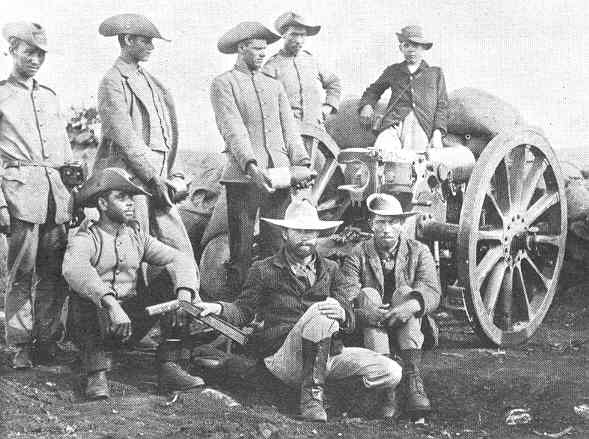
South African Boer commandos fighting off the British military

Boer wives and children herded off by the British into concentration camps … for their “protection”
 French imperialism. Not to be outdone by the English, the French sought a similar imperial status during the mid-1800s under the new French Emperor, Louis Napoleon (Napoleon III), nephew of the famous Napoleon of the earlier 1800s. The French were having a hard time emotionally with the fact that the fabulous French culture – which had during the 1700s and much of the 1800s been a central part of the culture of Europe’s ruling classes – was now in decline in the face of rising linguistic nationalism everywhere in Europe (Germanic, Slavic, Italian, Romanian, Hungarian, Greek, etc.). This loss of interest in things French proved to be a major blow to French pride. Consequently, France’s imperial mission in the later 1800s seemed to be to compensate for this loss by taking French culture abroad – trying now to plant French culture among the ruling elite in French Indochina (Cochin China or Vietnam, Cambodia and Laos) and at various points along the African coast (Senegal, Guinea, Ivory Coast, etc.).

French explorer Pierre Savorgnan de Brazza in the African Congo – c. 1880
This urge to assert French national pride became especially strong after the national humiliation delivered to France by Bismarck in his successful effort to unite Germany in 1870 with his carefully executed war with France.
And of course, morally speaking, the French found no difficulty in justifying their larger program of imperialism – because by bringing the backward societies of Africa and Southeast Asia into the world of French culture, they were supposedly doing these Africans and Asians a great favor.
America’s position on the matter. Americans however congratulated themselves on being anti-imperialistic; they supposed themselves to be totally unlike the aggressive powers of Europe. After all, America itself was forged in the latter part of the 1700s out of a huge struggle against the imperialism of English King George III. America’s anti-imperialist position had been even clarified to all in America’s 1823 Monroe Doctrine – in which America announced boldly its readiness to defend the independence of its fellow American states to the South in Latin America. American national pride was in fact built heavily on the idea that America was destined to help all the world come to a similar national independence – even if it meant coming up against the imperialism of other nations.
But Progressivist America began to take the attitude toward the end of the 1800s that it also had a huge moral duty to help young nations come to real strength as viable democracies – for America increasingly was looking to Secular “Democracy” (not the hand of God) as the source of its own strength as a fast-rising society. Thus America saw itself taking on the obligation not only of helping the peoples of the world to achieve “self-determination” (national independence) but also of helping them develop proper democratic institutions, ones that guaranteed the success of their national birthing.
But ultimately, this paternalistic attitude of having to “help” budding democracies would become for America its own version of imperialism, much like France’s cultural mission and Britain’s commercial mission – giving moral justification for a lot of uninvited intervention in the affairs of other peoples.
However, democracy-building was not the only moral instrument called on to justify America’s increasing involvement abroad. Christian missionary effort was also a big component – as Americans endeavored to bring Christ’s salvation to the rest of the world. This did not (thankfully) normally require the accompanying hand of the American military, the way the political agenda of democracy-building usually did. Like the French cultural mission abroad – also usually heavily Christian (although the Catholic rather than the Protestant version of Christianity) in many ways – American Protestant missionary activity abroad tended to be met more gracefully by the locals invited to receive the blessings of such a mission.

Then too there was the business angle to the American involvement abroad – fairly similar to the British effort – especially in the way Americans set up profitable businesses to the South in Latin America. These operations “blessed” the Latin locals with jobs – but also involved the policing action of the U.S. Marines when locals were not inclined to feel so blessed by this Yankee intrusion into the centuries-old feudal life of Latin America. But like the British and the French, Americans assured themselves that such involvement was for the good of these “backward” societies. Thus to Americans, such noble involvement abroad could not possibly be considered as just another form of imperialism!
American involvement in Japan. Back in the 1500s the Japanese military dictator or Shogun had shut down the extensive missionary activities of the Spanish Catholics in Japan (slaughtering thousands of Japanese Christians in the process) and closed Japan to further European involvement. But in 1852 the American navy was sent to Japan to “open” the country to Western trade and diplomacy – and to return shipwrecked sailors who disappeared when washed ashore in Japan – by blasting its way into Tokyo harbor. The net effect of this was not only to open up Japan to the West, but to shape the decision of the new (1867), young and highly determined Japanese Emperor Meiji to transform Japan itself into an industrial-military power on the Western model – as a means not only of self-defense, but as entry into the international realm as an imperial power by its own right.

Japan as a result of Perry’s Convention of Kanagawa – 1854

The Japanese emperor Meiji – 1873

Imperial officers of the “new” Japan – 1877
The Spanish-American War (1898) in Cuba. America soon had the opportunity to put its “anti-imperialistic” imperialism to work by moving to support the rebellion of Cubans against their Spanish rulers – especially when the U.S. battleship Maine, which had come to monitor this activity, mysteriously blew up in Havana Harbor.

The USS Maine arriving in Cuba – 1898
Outraged Americans rallied to the cause of Cuban independence and joined official and unofficial military groups which traveled to Cuba to join the fight. This would include Roosevelt’s Rough Riders.
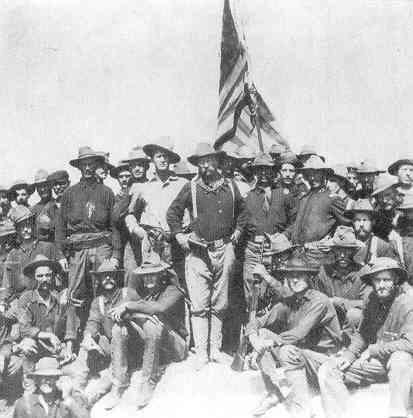
Ultimately, the Spanish were humiliated by the American “assistance” in Cuba – having to call it quits after only a few months of action.
Americans could thus feel proud that their military intervention had helped free from Spanish imperial tyranny their Cuban neighbor to the South. America would continue, of course, to keep a watchful eye over how a “free Cuba” would subsequently develop, economically and socially as well as politically. But of course this type of American paternalism was never viewed as imperialism – except for the few Americans (such as Bryan) who were loud in their pronouncements that all this was indeed nothing other than pure imperialism.
The Philippines. At the same time a similar American action against the Spanish Empire took place in the Philippines, which (like Cuba) had been under Spanish rule for centuries. Here too local Filipinos had been making the move to independence – and here too anti-imperialist Americans showed up to help their Filipino friends secure that independence. But problems between the Americans and Filipinos soon developed when it became apparent that the Americans were planning to put the Philippines under American “protection” – until such time as America itself decided that the Filipinos were ready to take up the democratic responsibilities of self-rule.
Now the Filipinos turned their wrath on the American occupiers – and guerrilla warfare broke out as Filipinos took on these Americans. Finally, in 1903, a compromise was achieved which settled the Filipinos down a bit, by giving the Filipinos limited self-government in the form of a Philippine Assembly, elected by a select section of Philippine society. Eventually (1916) the Filipinos were promised that full independence would come their way soon (but actually not be achieved until thirty years later – after the end of World War Two).
China. China proved to be less able than Japan to fend off growing Western involvement in its national life, not being blessed at the time with the leadership talent able to get China’s act together. The Chinese themselves were divided on this matter of Western culture making its way into Chinese society, with many Chinese, especially along its long coastline, rather willing to cooperate with Western imperialism – even to the point of taking up Western ways (business, education, religion). America was just about as involved as the other Westerners in this opening of China – seeing itself however as some kind of protector of Chinese rights – by declaring in 1899 (again, in conjunction with the British) an “Open Door Policy” which would keep sections of China from becoming the exclusive imperial domain of any single outside country. In other words, all of China would be open to the business of any Westerner (including now the Japanese) – something that gave entrepreneurial Britain and America the assurance that they could continue to conduct business anywhere within the huge Chinese economy. China would not be carved up into smaller colonial holdings like Africa had been.
But traditional Chinese, especially prevalent in the Chinese rural interior (but still found also in the fast-expanding coastal cities), took huge exception to this Western intrusion – and masses of Chinese commoners rose up in violent rebellion not only against the foreigners in their land but also the masses of Chinese who had accommodated themselves to Western Ways. This “Boxer Rebellion” (1899-1901) became very bloody, and required the armies of numerous Western (and Japanese) powers, including American military units, to finally suppress it.
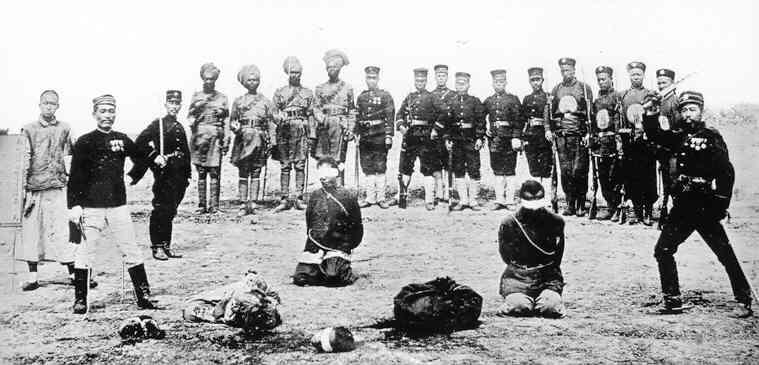
Boxer rebels being executed (Japanese and Indian Imperial troops looking on) – 1900
But ultimately (again, because of a lack of decisive leadership) this disaster left undetermined the direction China needed to go to bring itself back under order. Unlike Japan, China would remain severely handicapped by this challenge.
Teddy Roosevelt and American foreign policy. As we have just seen, Roosevelt was very active as U.S. President serving as a strong Progressivist in the way he took on American industrial and financial monopolies. But he was no less active in the realm of foreign policy – loving to play along with the European powers the international power-politics game.

For instance, he hosted and helped negotiate the peace talks ending the war between the Russians and Japanese in the Far East (1905). He was a personal participant in the conference in Spain called (1906) to defuse a huge crisis caused by the feud among Germany, Spain and France over the rights to “protect” the still-independent sultanate of Morocco. And he ordered U.S. military assistance in creating the more compliant country of Panama, carved out of Colombia when the Senate of Colombia refused to ratify a treaty recognizing the transfer of canal-building rights from the French to the Americans. And he continued to push forward with the Panama Canal project – staying on top of the project until it was completed in 1914 – even after he had left office.

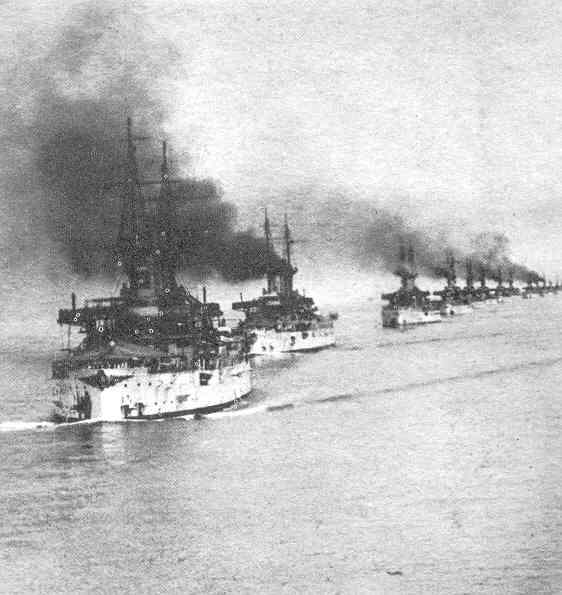
And he loved to display American military power any way he could – even forcing a reluctant Congress to finance a grand display of American naval power, when he sent an American fleet of 16 battleships around the world (1907-1909) – for all the world to see that America was very much up on naval power (at the time considered the key to imperial power).

[1]These Dutchmen were “Africans” in the same way that Anglos had come to America and become “Americans”, both events in America and South Africa first occurring as far back as the 1600s.
AMERICA ENTERS WORLD WAR ONE AS THE CHAMPION OF DEMOCRACY
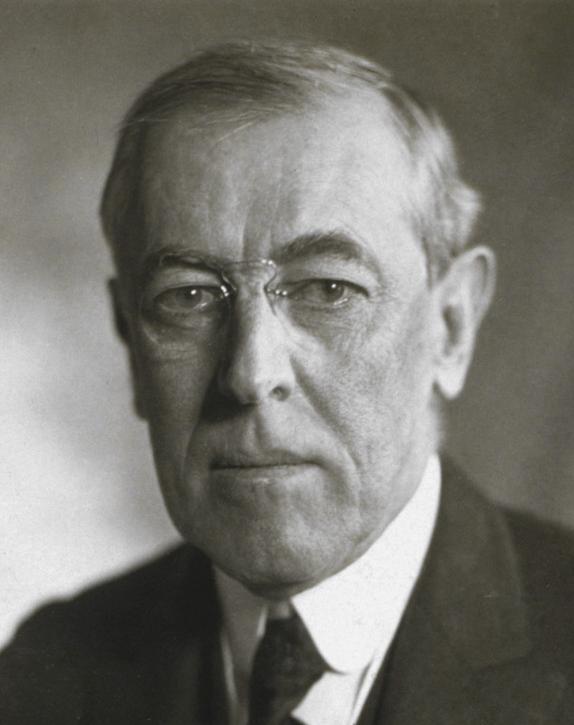 Wilson – the autocratic intellectual. Then with the election of Woodrow Wilson in 1912, America was to head even more deeply into the realm that glorified democracy, as virtually a civic religion.
Woodrow Wilson was Southern-born (1856), growing up in an aristocratic and originally slave-holding clerical family headed by a father who was a co-founder and ultimately administrator of the Southern breakaway branch of the Presbyterian denomination. As a youth Wilson was sent north to Princeton (still largely Presbyterian in character at the time) and after graduating from Princeton (1879) studied for the doctorate at Johns Hopkins University (1886), went on eventually to be a Princeton professor (1890) – and ultimately the university’s president (1902-1910).
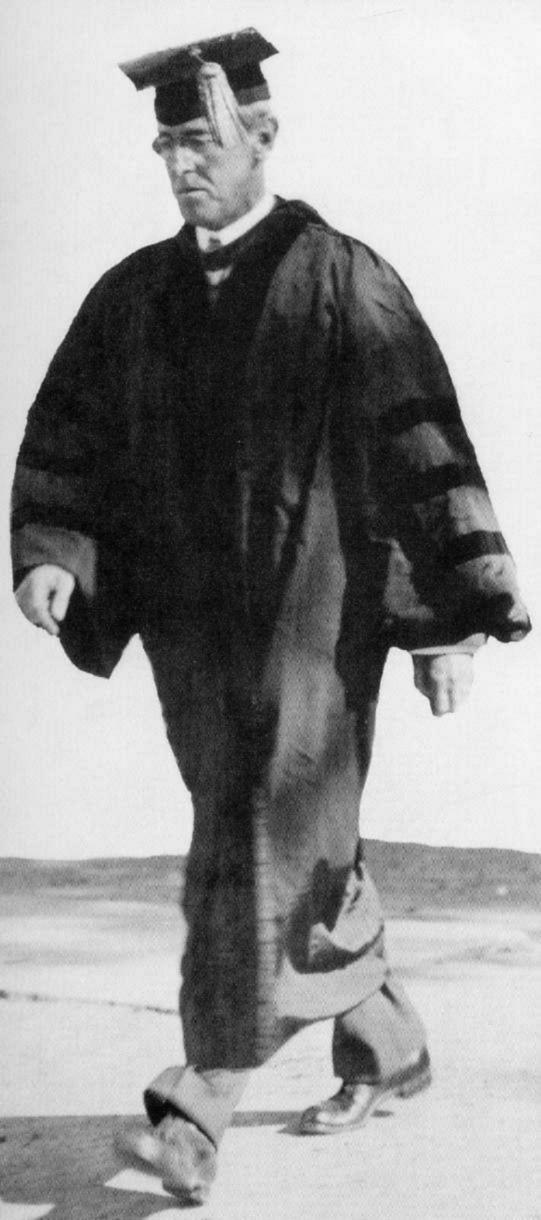
However, his autocratic (dictatorial) ways did not sit well with the other Princeton professors – who resented deeply his high-handed running of the university. Eventually Wilson decided to move on to the world of politics – when in 1910 the bosses of New Jersey invited him to run for governor (believing that they could then control this idealistic intellectual for their own purposes). But in Wilson’s gaining the governorship, the New Jersey bosses found themselves up against a very determined individual – who quickly began to clean house and rid New Jersey of some of its political corruption. This is what got the attention of the Democratic Party, which decided that it needed to steal the Republican Party thunder by appearing to be more Progressive themselves. Thus Wilson got the 1912 Democratic Party nomination – and because of Roosevelt’s third-party involvement, thus also the U.S. Presidency.
Wilson’s autocratic Humanism dressed up as democracy. Wilson’s autocratic style was well illustrated by his doctoral dissertation[2] and his several textbooks he published – which advocated for a stronger central authority presiding over the nation’s affairs (he preferred the more centralized British Parliamentary model over the U.S. separation-of-powers model) – believing that social-political reform could take place more quickly and more efficiently under a strong hand at the head of society – certain that this was always the best way to serve democracy – thus democracy supervised by society’s “betters” – rather than by the people themselves. This was a view that many Progressive intellectuals were beginning to take at the time, including Lenin, the future Communist leader of Soviet Russia.
1914 – War breaks out in Europe. Meanwhile, by 1914, things were growing darker in Europe, looking with each passing month as if the continent were headed for nationalist war – something that America wanted to have no part of. But true neutrality in the face of European events would prove to be almost impossible for America to maintain.
Conflicting nationalisms. The problem began as a conflict of budding nationalisms arising from the hearts of European commoners who wanted a “place in the sun” for their own people – a voice in their destiny, something just recently coming to the common people as politics began to open up from being just the affairs of the aristocratic upper classes of Europe – to the common people themselves. Consequently, in 1860 the peoples of the Italian peninsula finally got an Italian state and government of their own – as did Germany, ten years later (1870). But other national groups began to demand a similar development of their own nations: Greeks, Bulgarians, Serbs, Czechs, Moravians, Poles, Hungarians, etc. But national boundaries really were not clear (people lived mixed among other people groups) – and ethnic groups found themselves disputing each other over territorial rights. Also, the empires that many of them lived under were themselves multinational (such as the empires of the Ottoman Turks, the Russian Romanovs and the Habsburg Austro-Hungarians) – and in no hurry to see their subject peoples attain national independence.
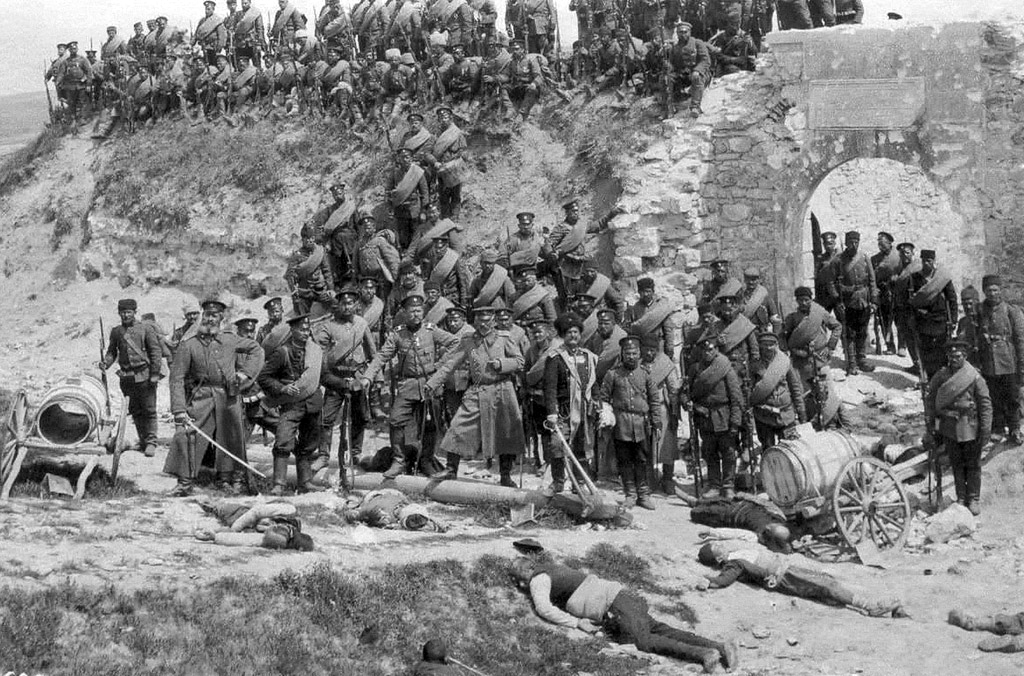
Bulgarians defeating troops of their former overlords, the Turks, at Adrianople (Edirne) – 1913
The imperialist urge. Then there was the matter of the imperial late-comers (Italy and Germany) who wanted themselves to get into the imperialist game, only to find that the Spanish, English, French, Dutch, and Portuguese got to most of the world ahead of them. There was not much left to build their own imperial greatness on – mostly just pieces of Africa. When Germany tried to grab Morocco, not once (1906) but twice (1913), the Germans came up against the opposition of the English, French and Spanish. They almost came to blows over this.

The German gunboat Panther sent to Morocco to pressure the Moroccan sultan to come under German “protection” … resisted strongly by the British and French – 1911
Meanwhile Austria-Hungary, which had lost to Prussia the battle to head up the German nation, was looking for more territory in the direction of the Balkan peninsula, where Turkish power was slipping rapidly – but where local nationalist impulses already had the Greeks, Bulgarians and Serbs fighting over the region. In all, it was a confusing mess.
Treaties – and more treaties. Imperial jealousies had inspired the Russians to offer the Slavic-speaking nations of the Balkans (notably Serbia) protection if culturally-Germanic Austria-Hungary should make a move on them. But Austria-Hungary had countered this arrangement with an arrangement of its own with the new Germany, which promised German aid if Austria-Hungary should come into conflict with Slavic Russia. France, still smarting from the loss of territory to Germany in the Franco-Prussian War (the war in 1870 that marched the many German states into unity behind the leadership of Prussia), was looking for revenge – and decided to ally with the Russians against the Germans. Then there were the British, normally neutral in such matters – usually waiting to see which of the continental powers was on the rise – and then swinging support to the weaker side in order to balance and contain the growth of a rising power in Europe. But they had actually begun to side closely with France as the problems with Germany seemed to grow more threatening.
America stays out. Meanwhile, America stayed far away from all this political intrigue. America had its own hands full dealing with problems that had arisen along the border with Mexico. Mexico was going through another of its revolutions and had fallen into political chaos.
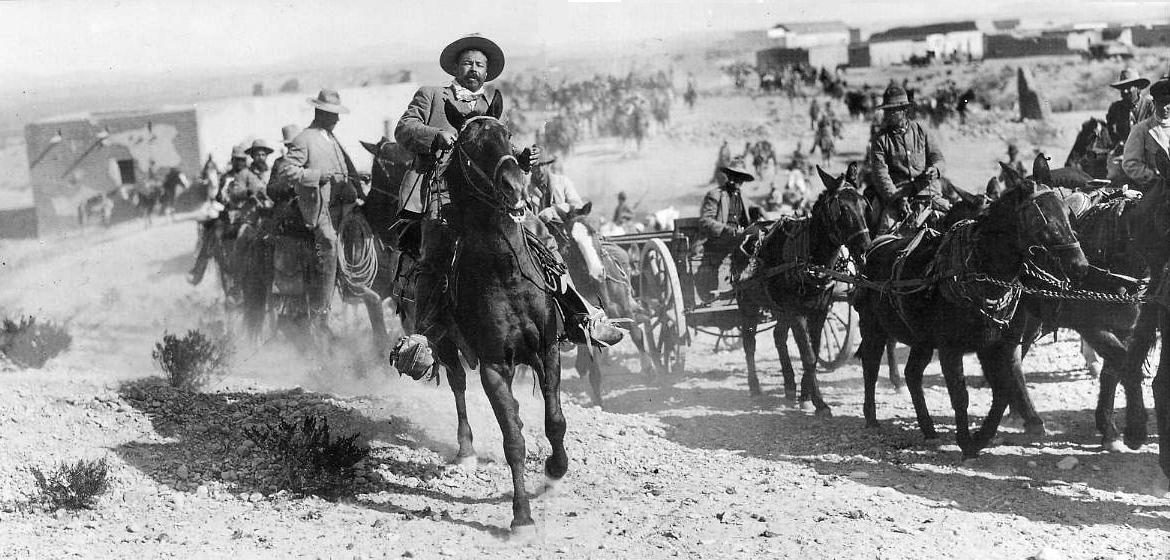
Mexican border raider Pancho Villa leading his own small army – 1916
America’s small army under General Pershing was trying to keep the chaos (and Mexican border raiders) from reaching into U.S. territory.
War – and stalemate – on the Western Front. Finally Europe moved to full-scale war when the incident of the assassination of the heir to the Austrian-Hungarian throne in a visit to Serbia failed to achieve diplomatic resolution – and the European powers finally mobilized for war at the beginning of August (1914).

German boys happily off to a great crusade to defeat the French!
But within a month, those that had happily joined the nationalist cause, expecting to find glory at the finish of a brief conflict, began to realize that this might be a war without any obvious outcome – much less possible victory (France lost over 200,000 men in the first month of the war alone).
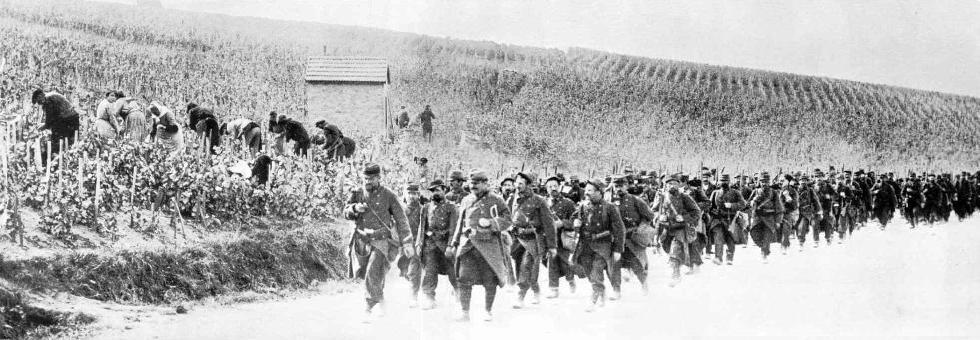
Just one month into the war, the average Frenchman was sick of the conflict. Notice that the workers do not even look up from their work to salute the young men headed off to battle.
A stalemate resulted – caused by well-imbedded trenches – and machine guns and barbed wire to defend those trenches – and artillery to empty enemy trenches of human life (until new recruits could be brought in to replace those slaughtered there).
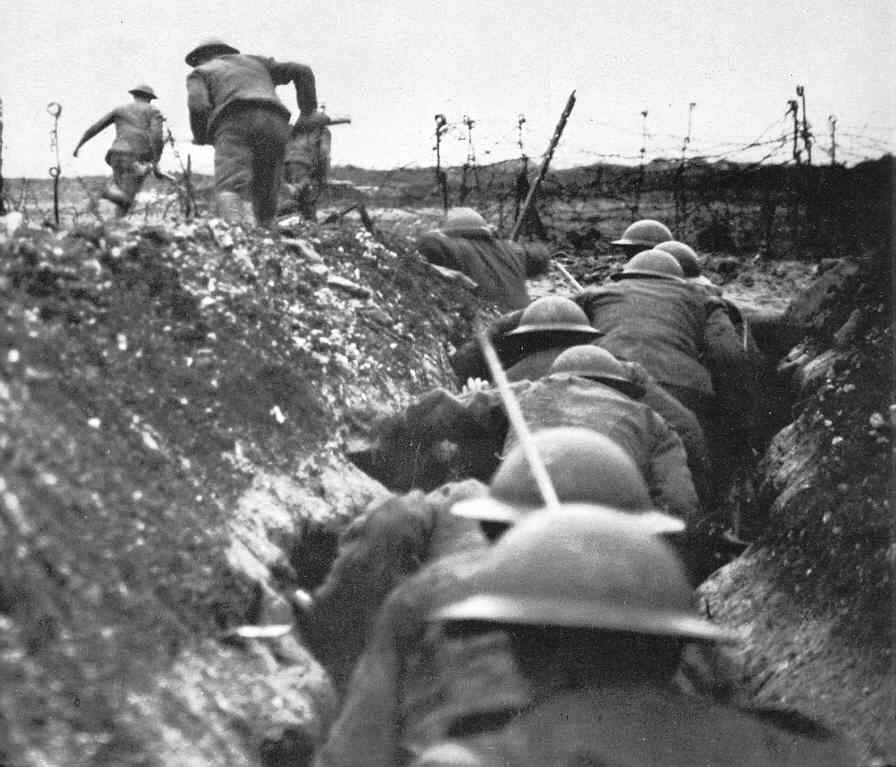
British troops ordered to attack … and give up their lives in the pointless process – 1915

A pointless French assault on German lines – 1917
The war was headed nowhere – except to the slaughter of hundreds of thousands – then millions – of young European males. And this would continue almost unchanged for the next four years – at least on the Western Front running across Northern France and Western Belgium.
The collapse of Russia on the Eastern Front (1917). Despite the massive size of the Russian army in comparison to the numerically smaller Germany army, the Russians made a very poor showing for themselves. Arms were lacking, leadership was lacking – especially when Tsar Nicholas took command away from his cousin (who was doing the best that could have been expected of a very poorly armed military) – making the military effort of the Russians even more pathetic. Worse, families on the home front were going hungry with the men on the lines rather than in the fields producing crops for the nation. Morale within the army was sagging – and by early 1917 women were in the streets protesting the lack of even basic bread for their families. Having Cossacks gun down these street protesters did not improve the mood any.
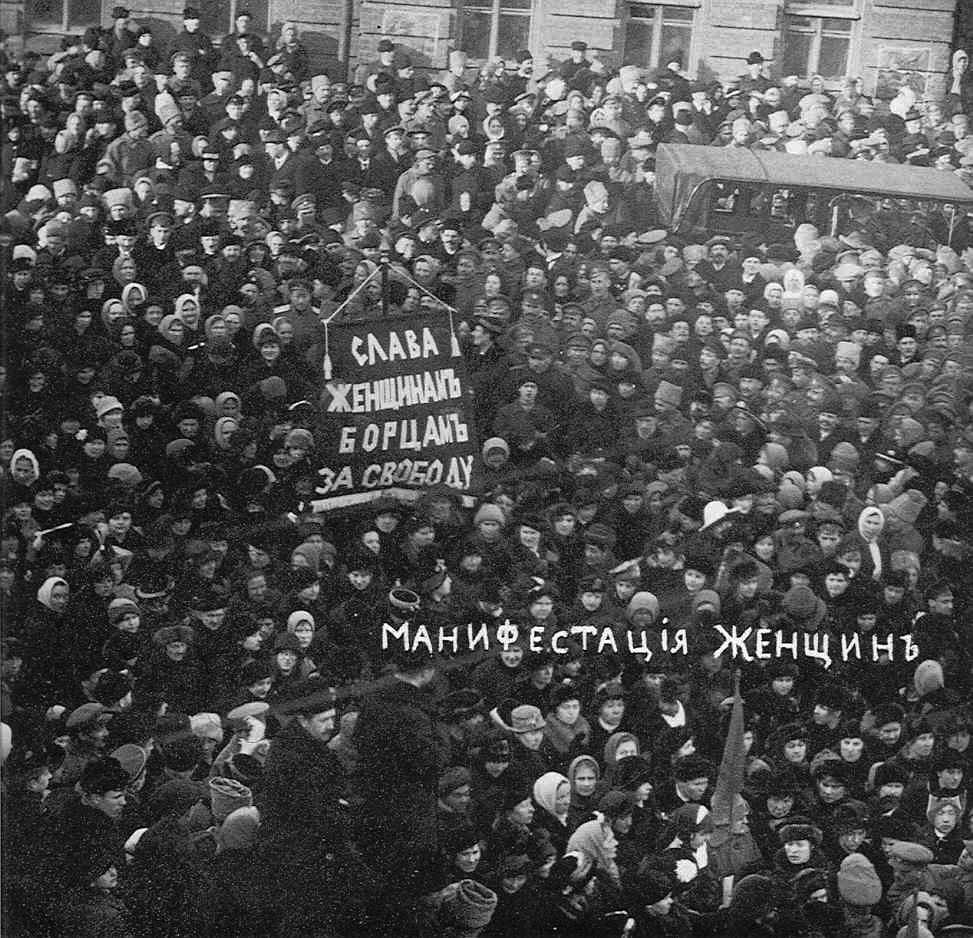
Food riots in the Russian capital Petrograd (St. Petersburg) Note: this was about food, not democracy

Protesters being shot down in Petrograd
And when Nicholas (at the front) got news of the growing crisis, he simply abdicated – abandoning further responsibility for the Russian Empire. Who at this moment was expected to take over was not clear. Nonetheless, the Russian Duma (their national legislature) announced that Russia would continue forward in the conflict under a new Provisional Government – also promising a more democratic Russia led by local soldiers and workers councils (Soviets).
Had Russia suddenly become a democracy at this point? Maybe on paper – but hardly so in reality. The people had not been clamoring for democracy. They most likely did not even understand what that meant – and certainly had no idea of the personal responsibilities that accompany democracy. Besides being totally disillusioned with their Russian leadership, they simply were tired of the war, the enormous loss of life for a cause not entirely clear to them – and furious about the huge disruption that the war had brought to the Russian social order.
Tragically, the decision of the new Provisional Government to continue the “patriotic war” indicated that it had no earthly idea of what was happening among the Russian people themselves. Thus a huge civil war broke out at home – at the same time that the Russians were trying to hold off the advancing Germans.
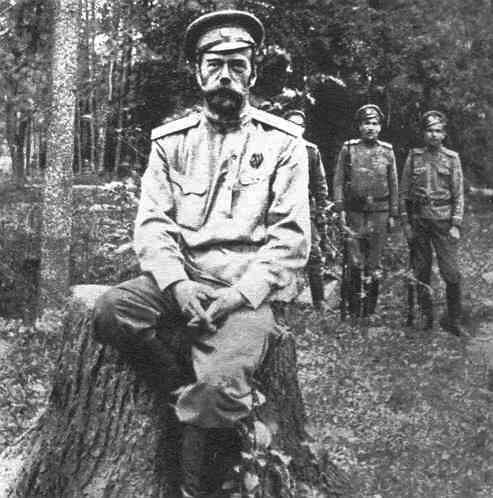
The Russian Tsar Nicholas under arrest – March 1917

The leader of the new Provisional Government in Russia, Alexander Kerensky … who foolishly decided to keep Russia in the war as an ally of the fellow “democracies” Britain and France

Russians fleeing the action – mid-1917

Lenin indicates that he wants to take Russia out of the war … in order to build a new Soviet Republic. A civil war thus erupts over the issue of what direction politically Russia should now take.
America’s pseudo-neutrality. From the outset, Americans had theoretically remained neutral – although it quickly turned into a one-sided neutrality (which of course amounts to no neutrality at all). With European men in the trenches in all the countries involved, women were required to look after the farming – when they weren’t in the factories making war materiel. This turned out to be a huge boon for the American farmer who found the Europeans hungry for American food products – except that a naval blockade that the British threw around sea access to Germany prevented American (and other countries’) farm products from reaching Germany. The Americans complained to the British about this most unfair treatment of their rights as neutrals to ship non-military items to all combatants. But Britain ignored the complaints (starving Germany into submission was a key part of their strategy of war) – and eventually America simply settled into the position of selling food products only to England and France – making enormous profits in the process.
A very hungry Germany developed the U-boat (submarine) to sink the ships blockading their country – and loud complaints arose from the British (and Americans) that somehow this was inhumane (but what part of war is not?) – and way beyond the rules of war (whatever those might happen to be). A major crisis then hit when a German U-boat sank the passenger ship Lusitania in 1915 off the Irish coast, killing 1200 people (128 of them American). But the ship was carrying a huge amount of ammunition – and the Germans had issued a warning to passengers about sailing on a boat carrying such items into a war zone patrolled by U-boats.
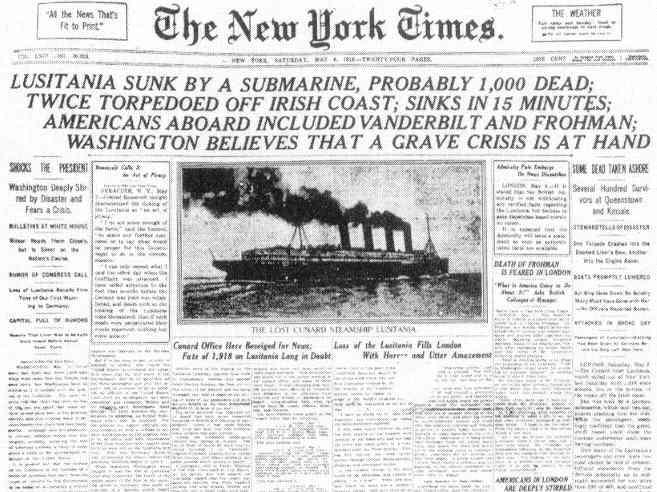
Reaction of President Wilson to the sinking of the Lusitania was one of outrage – although his Secretary of State Bryan was upset at the inability of Wilson to understand that putting American civilians on ships carrying war materiel was also immoral. Bryan ultimately resigned his position when Wilson would not tone down his public reaction.
In any case the Germans called off such attacks for the future – that was until early 1917 when a desperately starving Germany resumed those attacks in order to break the British naval blockade. Once again American shipping to Europe (England and France) found itself in danger.
Wilson decides that it is time for war (April 1917). Wilson had just been re-elected President in the national elections of 1916 – in part on the boast that he had “kept us out of war.”

But only one month into his second term Wilson abruptly changed his mind – citing in his request for Congress’s declaration of war against Germany (and its allies) this resumption of submarine attacks to be the primary cause, blaming the German government for such barbarity that it required America to act to restore the realm of law in the world (as if Britain were behaving any better in respecting the rights of neutrals under international law).

But to add moral weight to this dubious military enterprise, he also stressed how this would advance global democracy – encouraged by how the Russians had just freed themselves from their own autocracy in their recent advance toward democracy. On this matter Wilson waxed eloquent (and amazingly wrong) in his description of how recent events in Russia had finally brought that country into the ranks of the world’s “democracies:”
Does not every American feel that assurance has been added to our hope for the future peace of the world by the wonderful and heartening things that have been happening within the last few weeks in Russia? Russia was known by those who knew it best to have been always in fact democratic at heart, in all the vital habits of her thought, in all the intimate relationships of her people that spoke their natural instinct, their habitual attitude towards life. The autocracy that crowned the summit of her political structure, long as it had stood and terrible as was the reality of its power, was not in fact Russian in origin, character, or purpose; and now it has been shaken off and the great, generous Russian people have been added in all their naive majesty and might to the forces that are fighting for freedom in the world, for justice, and for peace. Here is a fit partner for a league of honour.
What he was describing to the American people was pure fiction, devised inside his own Idealistic bubble. It was about as far from reality as a person could dare go.
Ultimately, Wilson sought to bring America into the war as a great moral crusade which all Americans needed to answer – “to make the world safe for democracy.” Americans would have this great opportunity to destroy the autocrats who stood in the way of human progress. Bringing them down would free up the world to finally find its way to some kind of Rousseauian bliss, some kind of natural “democracy” based purely on the primal instincts of a truly free people.
So, lots of American young men would soon be going to their deaths to support Wilson’s dream of a world of democracy freed from the tyranny of autocracy. Somehow it would all be worth the sacrifice that these young men would be making (Americans were quite well aware by this time of the slaughter taking place on the European battlefields to which they would be sending their boys). Ah yes – but well worth it, or so said the President.
There are, it may be, many months of fiery trial and sacrifice ahead of us. It is a fearful thing to lead this great peaceful people into war, into the most terrible and disastrous of all wars, civilization itself seeming to be in the balance. But the right is more precious than peace, and we shall fight for the things which we have always carried nearest our hearts – for democracy, for the right of those who submit to authority to have a voice in their own governments, for the rights and liberties of small nations, for a universal dominion of right by such a concert of free peoples as shall bring peace and safety to all nations and make the world itself at last free. To such a task we can dedicate our lives and our fortunes, everything that we are and everything that we have, with the pride of those who know that the day has come when America is privileged to spend her blood and her might for the principles that gave her birth and happiness and the peace which she has treasured. God helping her, she can do no other.
America’s “democratic” allies have a different agenda. Tragically, Wilson’s take on the war was not exactly how America’s new allies England and France saw the war. At their home front, in their national capitals, they were indeed democracies. But actually, Germany was no less democratic, governed by political institutions very similar to Britain’s. And actually, both England and France were empires too, controlling vast domains in Africa and Asia – and with clear intentions of extending their imperial grip into the Muslim Middle East once the Ottoman Turks were knocked out of the way.
But they played along with Wilson. They were certainly glad to get American help in crushing their “autocratic” enemies, and thus played along with Wilson’s crusading Idealism. American assistance would likely break the terrible stalemate that had set in on the war and finally bring their side to victory in this long and bloody (and largely pointless) nationalist conflict.
The Americans join the fight. America’s involvement in the war was rather brief – and also rather limited in comparison to the long and deep involvement of its French and British allies. At first there was only a very small contribution to be made – and many men to be trained before America was ready to get going (the spring of 1918, approximately a year after the Declaration of War was issued).

American troops being greeted in London
The Russian-German Armistice. In the meantime, Lenin’s Communists had seized both the Russian capital Petrograd (St. Petersburg) and the key city Moscow in the unfolding civil war there. Then Lenin’s associate Trotsky had signed at the end of 1917 an armistice agreement with Germany taking Russia out of the war, a very popular move with the Russian commoners at the time – although it was actually designed to refocus the country’s military powers on helping the Bolsheviks win the Russian civil war (which would continue for several more horrible years).
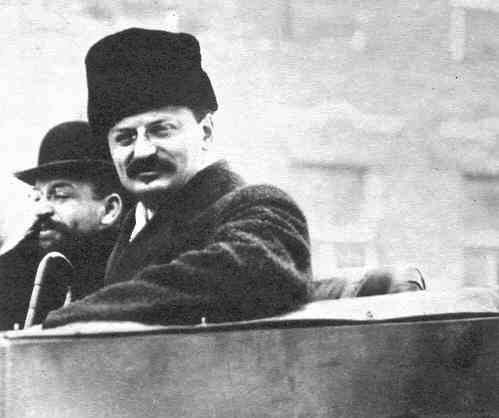
Trotsky – who helped negotiate the Russian-German peace deal at Brest-Litovsk – December 1917

Soviet leader Lenin urging the Russians to continue to move forward in building the new Soviet Republic – 1918
But the Russian-German armistice also allowed the Germans to quickly move their troops from the Eastern to the Western Front in anticipation of the eventual arrival of the Americans in large numbers the next spring.
Thus it was that the Germans put into operation a huge and desperate early spring 1918 offensive on the Western Front, with the goal of overrunning Paris before the Americans could get in position. But that failed. And now the Germans found themselves highly exhausted. And the Americans at that point were beginning to arrive in large numbers – here and there along the middle of the Western battle line.

Americans of the 23rd infantry in the Argonne Forest – 1918
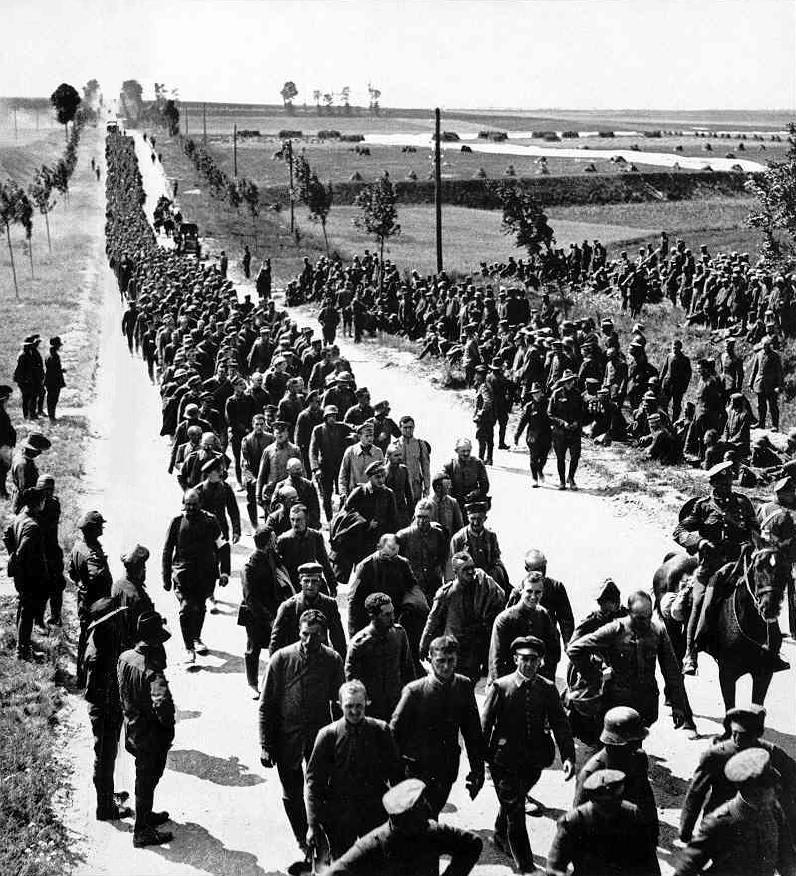
Long lines of German prisoners – 1918
Wilson’s Fourteen Points. In the meantime (January of 1918), Wilson went before Congress to outline what he expected to be the specific terms of the peace that America was fighting to secure. The terms were presented as Fourteen Points, including the end to secret treaties (which Wilson supposed were a major cause of the war in the first place), the guarantee of full freedom of all navigation on the high seas (a major source of American annoyance with both the Germans and the English), the adjustment of territories such as would restore Russia, revive Poland and return to France territory lost to Germany in 1871, the opportunity for independence of the various nations making up the Austro-Hungarian and Turkish Ottoman Empires. But most important (in Wilson’s eyes), was the fourteenth: the creation of a general association of nations empowered to defend the political independence and territorial integrity of all states, large or small. This last point was the intellectual foundation for what would become the first truly international diplomatic organization: the League of Nations.
He made it clear that even for the Germans he sought only a fair or equitable peace – though he would negotiate such a peace with only a German delegation representing the majority members of the Reichstag (the German National Assembly) – and not the “military party and the men whose creed is imperial domination.” This was a clear indication that America would not deal with the Kaiser but instead with only a German group representing the broader or democratic interests of the people of Germany.
The Germans are humiliated. The Germans, sick of the war and starving at home, found themselves in rebellion – along the same lines as what had just happened in Russia. But they eventually were able to come under the order of a group of political leaders determined to end the monarchy (as Wilson demanded) and form a German Republic. German Emperor Wilhelm then took himself off to exile in the Netherlands – and a newly assembled German government accepted Wilson’s offer of an Armistice (November 1918). They then sent off to Paris (the suburb of Versailles actually) representatives authorized to work out a final peace agreement. At this point the Germans still held on to a fair amount of French and Belgian territory. No enemy had entered Germany itself.
The “Phony Peace.” At the peace talks Germany was actually represented by individuals largely unknown to (and thus only weakly supported by) the German people.
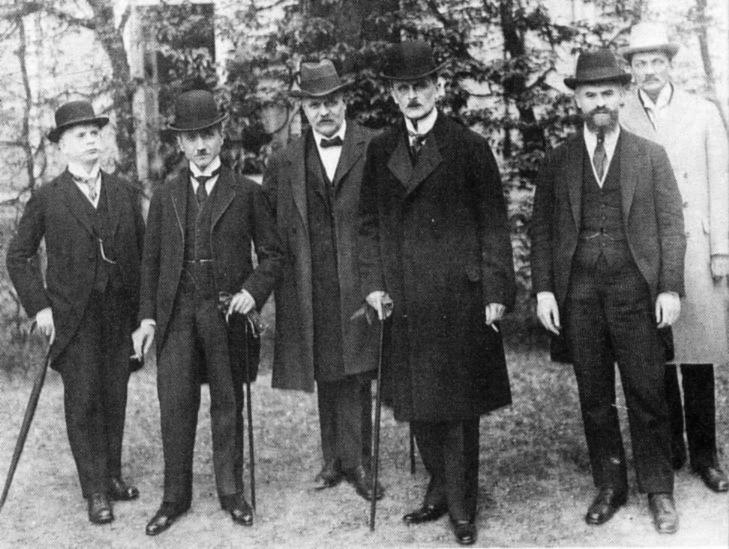
Consequently, the German negotiating hand turned out to be extremely weak when it came time to outline a final peace settlement as a follow-up to the Armistice or cease-fire.
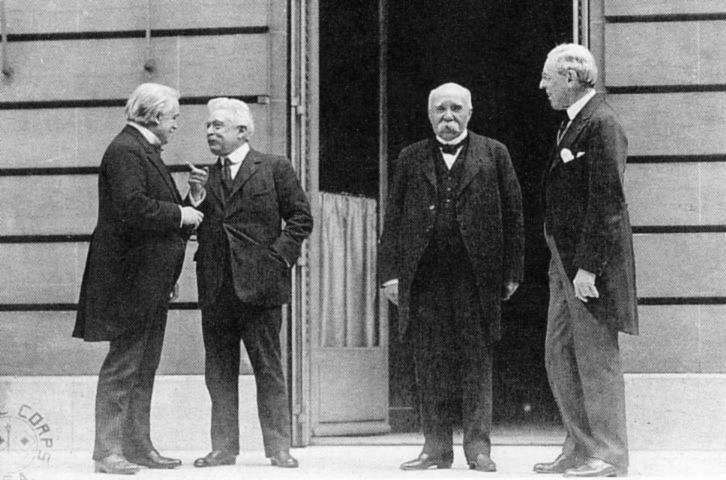
The “Big Four” in Paris for the treaty talks: David Lloyd George (Britain), Vittorio Orlando (Italy), Georges Clemenceau (France) and Wilson
Being the Idealistic Humanist that he was, Wilson failed to connect American power with American diplomacy – and thus the English and French took the opportunity to pounce upon the exhausted Germans, to wreak an expensive revenge (including a massive indemnity payment that Germany was in no position to pay) – despite Wilson’s protests. What Wilson failed to understand was that probably no English or French politician who failed to bring home to his people some major exaction of retribution against the Germans would have had a political future there. But Wilson had power he could have used to move things more in the direction he wanted to see them go. However, caught up in his world of beautiful ideas, he failed to see the political opportunities he actually possessed in order to direct negotiations along the lines he had desired.
Also Wilson found himself shocked as he discovered that the English and French were not interested at all in assisting him in spreading his idea of the “rights of national self-determination of people everywhere.” They were not about to do that because that would have meant having to give up their own multi-ethnic or multinational empires. Indeed, they were even planning to expand their imperial presence by establishing new Arab states carved out of the defeated Turkish Empire, new monarchies placed under French and English “protection.”
Also, to Wilson’s great distress, things were not doing well in Russia – because not blissful peace and prosperity but instead a violent civil war had accompanied Russia’s move to “democracy.” And this civil war had Russia’s democrats lined up on the same side with the old Russian autocrats (the Whites) in a ferocious battle against a Marxist-Leninist Communist insurrection (the Reds).
Wilson’s proposed League of Nations. On the other hand, Wilson was able to get his allies at least to accept his idea of a world assembly (the League of Nations) where he presumed cooler heads could eventually come together once the fever of war had subsided – and then right the wrongs of the abominable peace treaties foisted by the English and French on their defeated enemies.
But ironically, the one country he could not get to sign on to his project was his own, America. The Senate, which is required to approve all treaties, balked at the idea that possibly America would be giving over control of its foreign policy to the new organization. Wilson seemed unable or unwilling to answer their concerns on this matter – and the Senate vote ultimately fell short of the 2/3 approval required for all treaties. Thus the United States did not join Wilson’s cherished organization! Wilson was devastated.

Senate majority leader Henry Cabot Lodge is unwilling to surrender certain American sovereignty rights required by the Treaty of Versailles.
The German sense of betrayal. Likewise, the betrayal of Wilson’s promise of an equitable peace, to which the Germans thought they were agreeing when they laid down their arms, would become the source of German ideological opportunity for those (Hitler and his Nazis) who sought to exploit this sense of betrayal (Dolchstoss or “Stab in the Back”). They would eventually use this opportunity to overthrow Germany’s new democracy and institute a Neuordnung (New Order) in Germany.
In short, the Peace of 1919 merely set the scene for a return engagement of the nation-versus-nation contest 20 years later in the form of World War Two.
American disillusionment. Ultimately, Americans came quickly to the conclusion that they had been deceived in taking up arms to fight for the cause of democracy. The results of the peace were not at all what Wilson had promised that the sacrifices of the war would produce. Americans quickly became cynical about Wilson’s great crusade – and determined never again to be smooth talked into getting involved in a European war.[3]
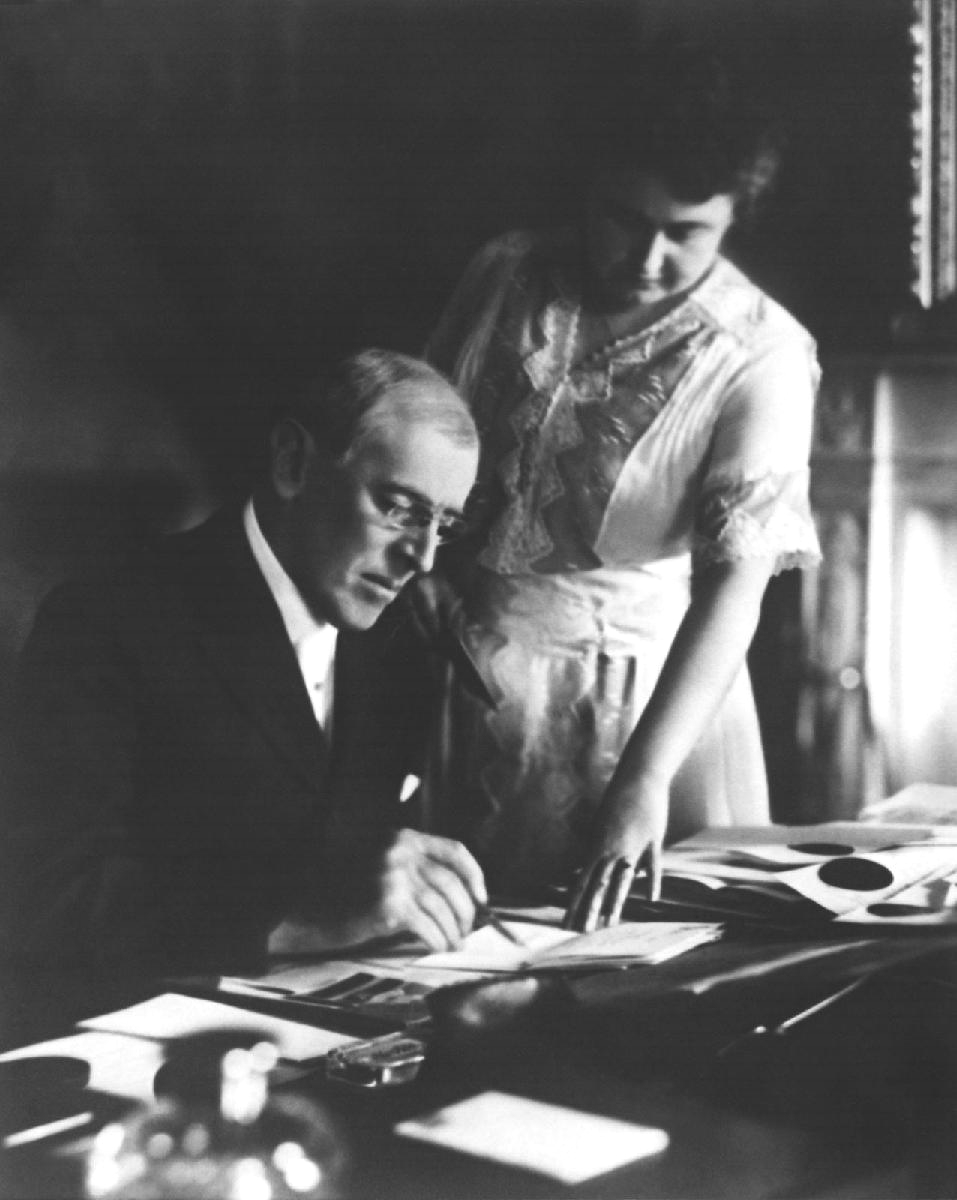
A very broken Wilson being helped by his wife Edith in the conduct of his remaining presidential duties.
The 1918 Spanish Flu. Then just to make the mood of America even darker, a massive and deadly case of flu hit the country during the fall of 1918 – just as the war was coming to an end. Americans (like the Europeans) were hit so badly that more than half a million (675,000?) Americans died from this flu (compared to the 53,400 American soldiers dying from combat in World War One). And those it did not kill, it produced permanent effects for approximately a quarter of the US population. In a few short months it lowered life expectancy in the US by 12 years.

[2]He thoroughly disliked the idea of checks and balances on federal power. In his dissertation he described the checks and balances system as …” manifestly a radical defect in our federal system that it parcels out power and confuses responsibility as it does. The main purpose of the Convention of 1787 seems to have been to accomplish this grievous mistake. The ‘literary theory’ of checks and balances is simply a consistent account of what our Constitution makers tried to do; and those checks and balances have proved mischievous just to the extent which they have succeeded in establishing themselves.”
[3]This failure of his dream to come true ultimately helped break the spirit of the President himself, and he ended his last couple of years in office as a spiritual and physical invalid (which was never revealed at the time to the public at large).
THE “ROARING TWENTIES”
The postwar “Red Scare.” Also in this post-war period, a major “Red Scare” gripped America – as it watched Russia, then Germany and Hungary come under angry social revolutionaries willing to engage in bloody class warfare in order to push their social-political agenda forward. A big question thus hit Americans hard: was this infection of political radicalism headed in the direction of America? Part of this fear was based on the fact that almost nothing seemed to have gone the way Americans were promised – throwing doubt into any thought about where the country was headed. And part of it was that immigrants flooding to America from war-torn Europe were of a new variety, coming from Southern and Eastern Europe – many bringing with them their anarchist attitudes about any and all social authority (in part because of the psychological damage inflicted on these people by the war). Also, a bomb destroyed the home of the American Attorney General Mitchell Palmer – who then turned around and had the FBI hunt down suspected anarchists, ultimately arresting thousands in the process. Then another bomb was set off on Wall Street (September 1920) – killing 30 people and injuring 150 others. Americans were outraged – and had a fairly good idea that an Italian anarchist group was behind it, especially when its leader slipped off to Italy immediately afterward.

Eventually things would settle down a bit (a famous case of two Italian anarchists, Sacco and Vanzetti, would drag on for years however).

But there would always remain a level of apprehension about the dangers to traditional America brought on by the surge of immigrants to America in the post-war period.
Depression in rural America. With European farmers taken away to the trenches of World War One, Europeans (at least the French and British) became heavily dependent on American farm products. Consequently, during the war the American farmer did very, very well as an agricultural businessman. Thus he borrowed heavily from his local bank to purchase more land and the machinery to work that land. Unknowingly, all this was creating a situation very similar to the one that occurred a century earlier during the Napoleonic Wars, which in the longer run did not go well for the American farmer.
At the end of the war, European soldiers naturally returned to their farms, and the need for American farm products dropped away accordingly – as also did the prices for their products. Thus for example: wheat prices in 1919 were at $2.15 a bushel. The farmers were doing very well! But by the fall of 1920 the price had fallen to $1.44 a bushel. And by 1922 the price was down to 88 cents a bushel! It seemed even at times that the earnings of the American farmer did not meet their production costs. Farming had become a most unprofitable enterprise.

A struggling Minnesota farming family
Thus at the same time, the farmers could no longer meet the requirements of the heavy payments to their banks on the loans they had taken out during the good years to buy more land and machinery. Bankruptcy swept through the farming industry when farmers found themselves unable to make those payments. That meant losing their farms and machinery to the banks.
But the banks had no use for seized farms and machinery. Nor could they find customers to buy this property off their hands. Thus the banks, by way of their loans to their farming customers, found themselves having invested way more money in these farms and equipment than they were now worth. And so the banks were now holding “assets” (farms and machinery) in current value far below what they themselves owed their depositors. Thus seeing looming failure facing their banks, panicked depositors made runs on their bank to get their money back before the banks folded. And indeed, fold the banks did, one by one, until there was a mass sweep of bankruptcies through the world of the rural banks.

Now deep misery set in on rural America. In actuality, the Great Depression had set in there ten full years before it was to hit urban America.
But party-time in America’s cities. In post-war America a very different picture presented itself in the country’s booming cities. During the war the cities had also been the picture of economic wonder, producing all sorts of war goods, including uniforms, rifles, artillery, ammunition, trucks, airplanes, etc. But the money accumulated among the urban entrepreneurs, plus an ever-expanding technology, led easily to a transition to post-war production of cars, radios, home appliances, new housing – to meet the huge demand of a prospering urban society.
Consequently, a sense of new things, a desire to explore and innovate, was felt strongly in urban America – especially among the youth. In part it was because of a hope that the nightmare of the recent past was put behind permanently. In part it was simply the energy that naturally comes from youth – as they find themselves ready to try new things, new clothing styles, new music, new social styles. It was the age of the Charleston (dance), bobbing (girls cutting their hair short), cigarettes (young women and men, both), scantily clad bathing suits – and drinking at the speakeasies.

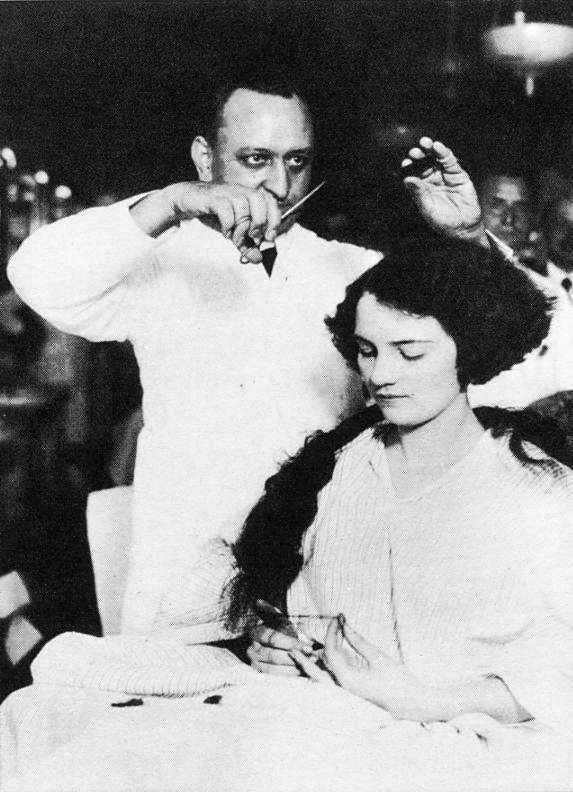
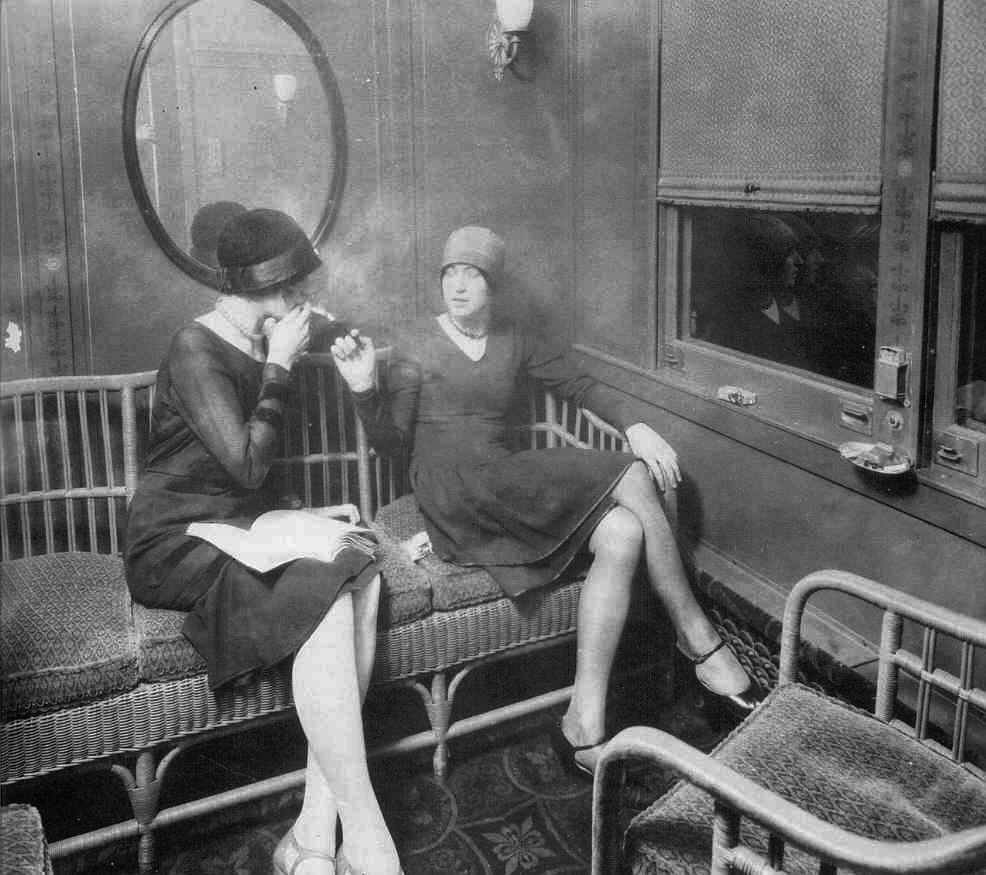


Thus, while rural America – once the basic symbol of heartland America – was floundering in economic depression, urban America was aglow with prosperity – and a cultural gaiety that merely deepened the hurt of rural America. At a time when immigrants were pouring into American cities, this growing difference between city and country, not just economic but now also cultural – and even spiritual – made rural/small-town Americans all the more resentful of the fact that they were completely cut off from whatever was going on in urban America. Troubles brewed.
Prohibition. Alcoholism was a huge problem in industrial America, especially in the mining and manufacturing towns of America – where wearied laborers drowned their sorrows at the local bars with the week’s paycheck – making their problems all the worse. As we have seen, women took up the challenge to begin a huge crusade against alcohol – which went from a call for temperance to an all-out demand to shut down completely the sale of any and all alcoholic beverages. They finally got what they wanted when the 18th Amendment to the U.S. Constitution went into effect in January of 1919 – with the beginning of full enforcement a year later.

At this point it became most un-Christian to indulge in any alcohol usage – at least within Protestant rural and small-town America. But to urban America, not only vastly more secular but also home to numerous immigrant groups (accustomed to having beer, wine, vodka or other alcoholic drinks as part of their everyday diet), this made no sense at all. Prohibition was immediately perceived by urban America as a clamping down on its freedom by a resentful rural America (which indeed it was). Thus the very idea of Prohibition – prohibiting the enjoyment of a drink or two – became the call to counter-action – usually in the form of open defiance of the law.
Speakeasies paid off city cops to look the other way and not raid their businesses – encouraging massive corruption among local law enforcement agents.

The charade of an arrest of New York City Speakeasy hostess Texas Guinan … who would be immediately released because of her friendship with the city’s mob boss James Hines
And the number of urban speakeasies multiplied rapidly – to a number greater than the open bars that had existed prior to Prohibition. And then there were the alcohol entrepreneurs – running booze illegally but very, very profitably – so profitably that various groups or mobs competed violently against each other for the lucrative trade in alcohol.
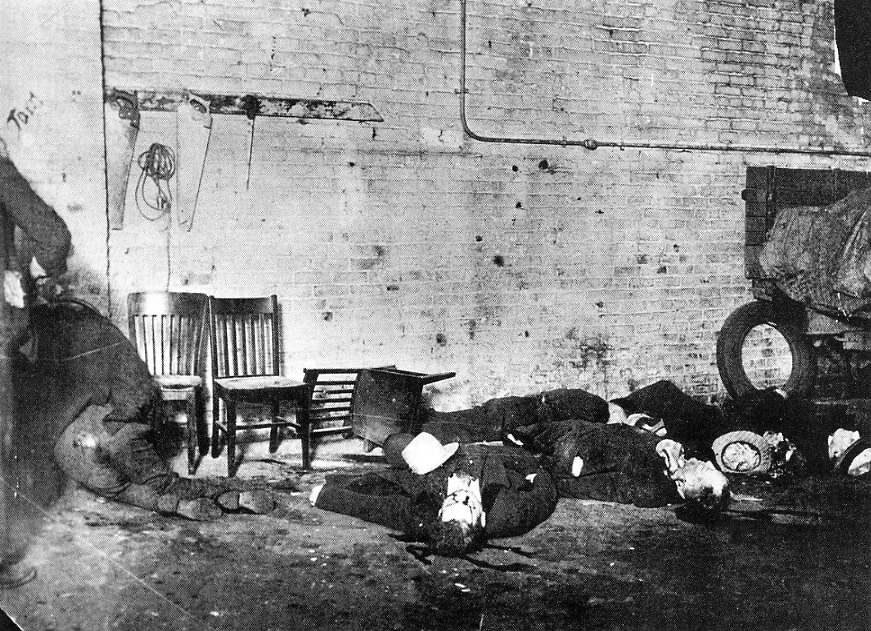
Chicago’s St. Valentine’s Day murder of mobster Buggs Moran’s guys … presumedly by guys working for mobster Al Capone – 1929

Former Chicago alderman Al Prinano sitting with mobster Al Capone – 1931
From the point of view of traditional rural/small-town America, the nation was sliding down into a moral cesspool.
The “Lost Generation.” Off on another front, for those who had once held the highest hope that Western Civilization was entering the completion of its rise to greatness, the war had come as a massive nightmare, one that they could not shake. Despite the huge rise in the West’s material culture after the war, that was not enough to shake the depression of those who felt so deeply about civilization and its offerings. Notable in this regard was a group of American writers who gathered in Paris, this greatest of Western cultural citadels, to try to recover their cultural enthusiasm. Famous American writers such as F. Scott Fitzgerald and Ernest Hemingway gathered there to find intellectual and cultural support. But alas – not even Paris could offer this to what Gertrude Stein – who basically presided over this expatriate group – termed the “Lost Generation.” It was very symptomatic of the times. Those who explored deeply the psyche of Western culture were bound to be very disappointed, cynical, even depressed, about what the recent war had done to Western civilization.
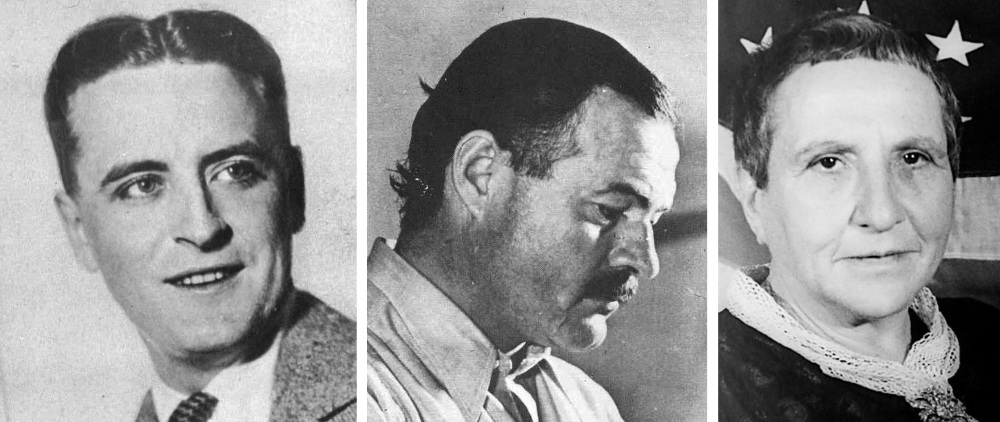
Fitzgerald Hemingway Stein
 The Scopes Monkey Trial (1925). Then there was another matter tearing at 1920s America: a trial going on in Dayton, Tennessee, contesting a Tennessee law that made it illegal to teach Darwinism. The trial was itself a clever scheme of some of the townsfolk to bring an issue to the town that would put it on the map. And indeed it did, as the “Progressivist” American Civil Liberties Union (ACLU) jumped into the action and brought in famous New York lawyer Clarence Darrow to challenge the law.
Certainly there seemed to be something un-American about civil authorities dictating what the people of their state were to believe or not believe. But as it would turn out, this was more than just a matter of protecting the civil liberties of the Tennesseans. This was the point at which “civil liberties” ACLU-style meant rolling back Christian culture in order to make the way for Secular-Humanism to replace that culture as the nation’s fundamental worldview or religion. It was the 1920s, after all, and time for the ACLU to “progress” America to a more “scientific” understanding of how life works.
Thus, like Prohibition, this would end up being just another hot-button issue separating traditional or “conservative” (Christian) rural/small-town America from “progressive” (Secular) urban America.
As the trial unfolded, the matter at hand became clearly one of deciding the question as to whether nature was a result of the hand of God in its creation and ongoing life – or whether nature operated simply mechanically according to scientific laws that required no divine hand to make them fully operative. Was God at the heart of all life – or was he just something that unscientific or superstitious people made up to help them cope emotionally with life’s challenges?
Of course both sides had already made up their minds on this matter. That’s why the law was enacted in the first place, supposedly to protect the traditional Christian worldview. But the opposition arrived on the scene with their own understanding of things well in place, helped immensely by the writings of the very popular Austrian psychiatrist Freud. Freud had already made it clear to many “hip” urban Americans that religion was merely a neurosis or deep urge to fantasize that people resorted to in the face of difficult circumstances.
Thus it was that America watched very closely the debate going on between the old Christian warrior William Jennings Bryan defending Christian traditionalism and his adversary Clarence Darrow doing the same on behalf of Secular Progressivism during that hot Tennessee summer of 1925.
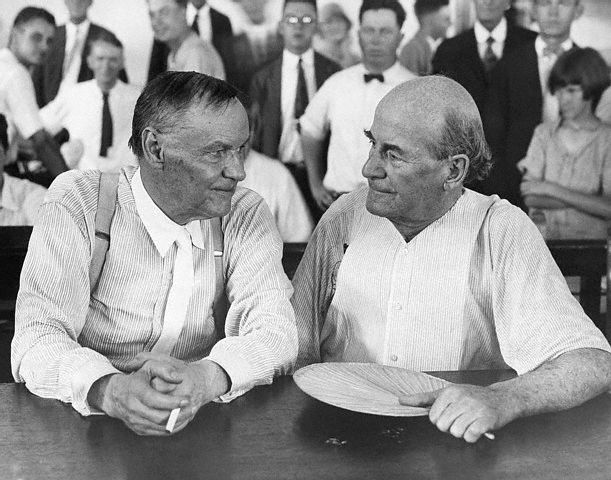
Darrow and Bryan at the trial
As with most matters of human reason or logic, America’s judgment as to which side ultimately won that debate depended on which worldview the observer came to the contest with in the first place. Ultimately the trial solved nothing – but certainly clarified the depth to which America was finding itself divided on the most basic questions of life and its origins – and purpose.
Corruption in high places. Of course, all this 1920s “attitude” would find its way into the nation’s politics as well. America’s traditionally Christian moral fundamentals found themselves under deep challenge in that very realm.
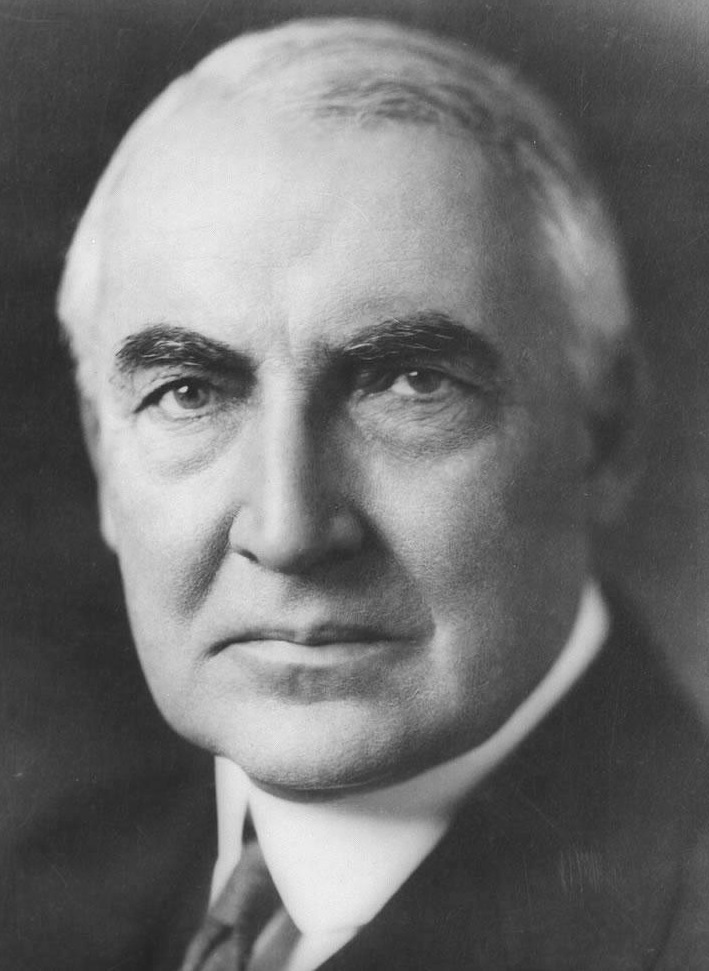 Consummate nice guy Warren G. Harding, former Ohio Governor and Republican candidate, was elected President in 1920 by the largest majority on record – and brought to his cabinet a number of old Ohio buddies. He was hoping that his advisors would help him manage the federal budget and continue to advance social reforms in favor of American women, immigrants and Blacks. But when it came to the personal behavior of many of these Ohio Gang advisors, Harding seemed to exercise little or no control. The results were embarrassing to the President (it would have been even more embarrassing had he lived a few more years to see his friends get what was due them!) In fact, Harding died as a result of a heart attack he experienced in 1923 following a trip across the country in which he had set out to give answer to the growing rumors about the corruption of his presidential team.
The corruption was rampant: his Secretary of the Interior sold off public lands to private companies – at a great profit to himself personally; his Attorney General was personally involved in this transaction – as well as others – as was perhaps also his deputy who committed suicide (or was murdered?) just as a Senate investigation was closing in on him (and just before Harding’s ill-fated trip).
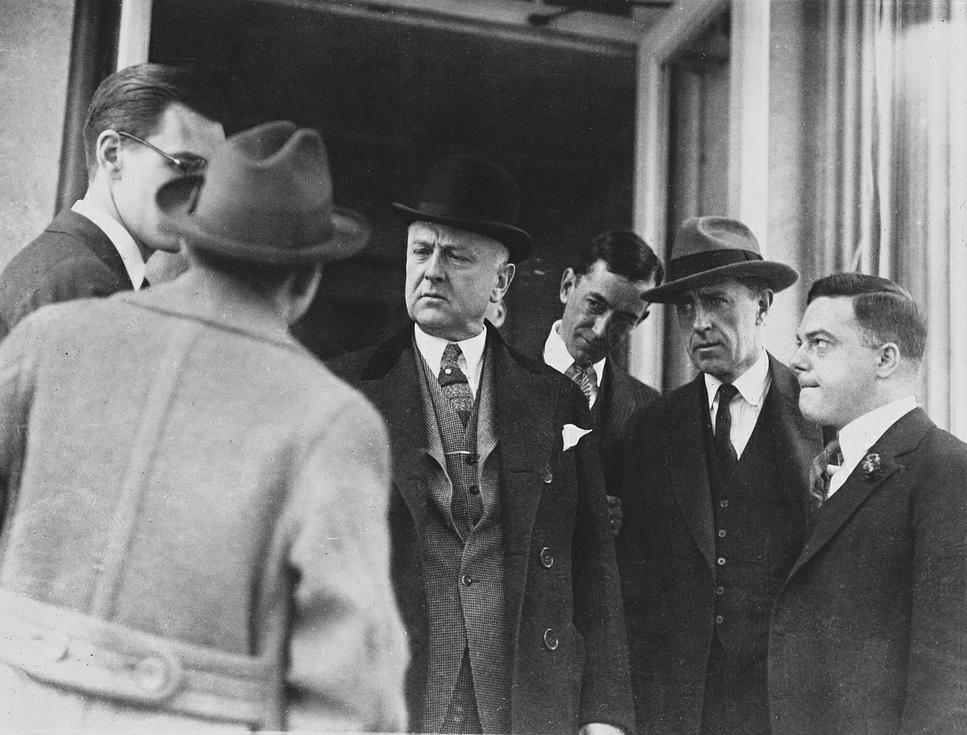
His Attorney General Harry Daugherty was popularly known as “The Fixer” (for a price!)
 Calvin Coolidge (1923-1929). Upon Harding’s death in 1923 his Vice President Calvin Coolidge was automatically elevated to the U.S. presidency. However, to almost the same extreme that Harding was the picture of loose personal standards, Coolidge was the opposite: the picture of authentic Puritan morality – authentic because his family could trace its roots all the way back to the founding of Puritan New England in 1630!
As president, his attitude conformed nicely to the old adage: “the government that governs least governs best.” Although he gave personal public support to the quest of Blacks and Indians for improved civil rights, when it came to government programs and spending, he was strongly opposed. He worked to cut back federal spending, balance the budget, and leave the nation’s economics to American business, which was doing quite well at the time. Thus in 1924 he was returned to the White House with 54% of the popular vote, despite there being a third party in the race (Progressive Party candidate La Follette).
He finished out his four years in office in 1929 with no major programs of note (he believed that those matters belonged to the states, not the federal government) and no scandals. As there were no major foreign policy issues burning at the time, American foreign policy during his presidency was also quite low key. But that was the way Americans wanted things. They had other things personally to focus on – like getting rich fast.
THE GREAT DEPRESSION
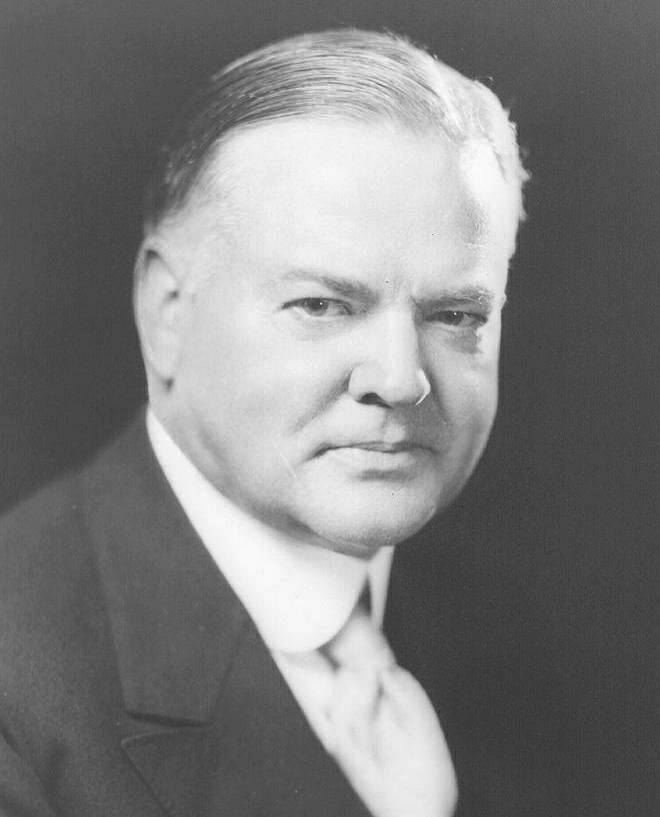 Hoover takes over (1929). In 1928, as his term approached a close, Coolidge made it clear that he would not take on another term – although many expected him to do so. He was tired and ready to go home. The Republicans thus chose his highly respected Secretary of Commerce, Herbert Hoover as its nominee – who then went on to easily win the Presidency. When Hoover took office in 1929, America was expecting to see the fabulous economic journey that the country found itself embarked on expanded even more. Little did the country realize that the very opposite was soon to occur.
Collapse of the Wall Street Stock Market (October 1929). The business in consumer goods during the years after the war was so hot that huge profits were being made by those investors who had come up with the funds to get these businesses up and running. Such funds were acquired by selling shares of the company’s ownership and profits on the open market – to anyone who wanted to get involved in such economic activity. At first it was professional investors who came up with the funds to buy the shares. But eventually American “moms and pops” got involved – sometimes using their life’s savings to get in on the very profitable game – sometimes just borrowing money from banks – expecting to be able to soon repay the bank these loans when their holding of stocks quickly increased in value in this hot market. Thus it was that, as the 1920s rolled along, such speculative fever became ever hotter. The market rose and rose – and people saw themselves getting ever richer – on paper at least.
Market saturation. But almost no one was paying attention to what was happening in the real world of economics. “Market saturation” was developing as Americans, towards the end of the 1920s, had mostly bought their cars, radios and home appliances. The sales of the goods produced by America’s companies were thus slowing up – and companies were having to cut back production (and let workers go) as well as drop their prices to stimulate new sales. Profits and dividend payments to investors began to dry up – creating concern among some of the more knowledgeable investors. Some of them began to back out of their investments, selling their shares at a somewhat lower price in order to find buyers. Suddenly the value of shares on the stock market stopped climbing – and more people took the step of trying to sell off their shares. This in turn panicked other investors – who rushed to dump their stocks before they lost even more value. Overnight (late October of 1929) the value of stocks on the market fell away – leaving investors bankrupt because they owed banks more money than the stocks were now worth.

Efforts were made to pump some money back into the market and for a while (April 1930) the worst seemed to be over (though by no means did the market return to a point anywhere close to where it had been previously) – then once again it began a slide downward – reaching a point of almost a total loss of all value as of July 1932.
Hoover addresses the crisis. Hoover had absolutely no idea of how to meet this crisis. From his point of view the matter was purely economic in nature – and the federal government had no constitutional role to play in such matters. At first he expected that the market would simply correct itself. This was how capitalism worked. Weak producers were shaken out of the market during such times of crisis – leaving room for stronger producers to move more widely into the market. It was not the government’s job to get involved in this dynamic.
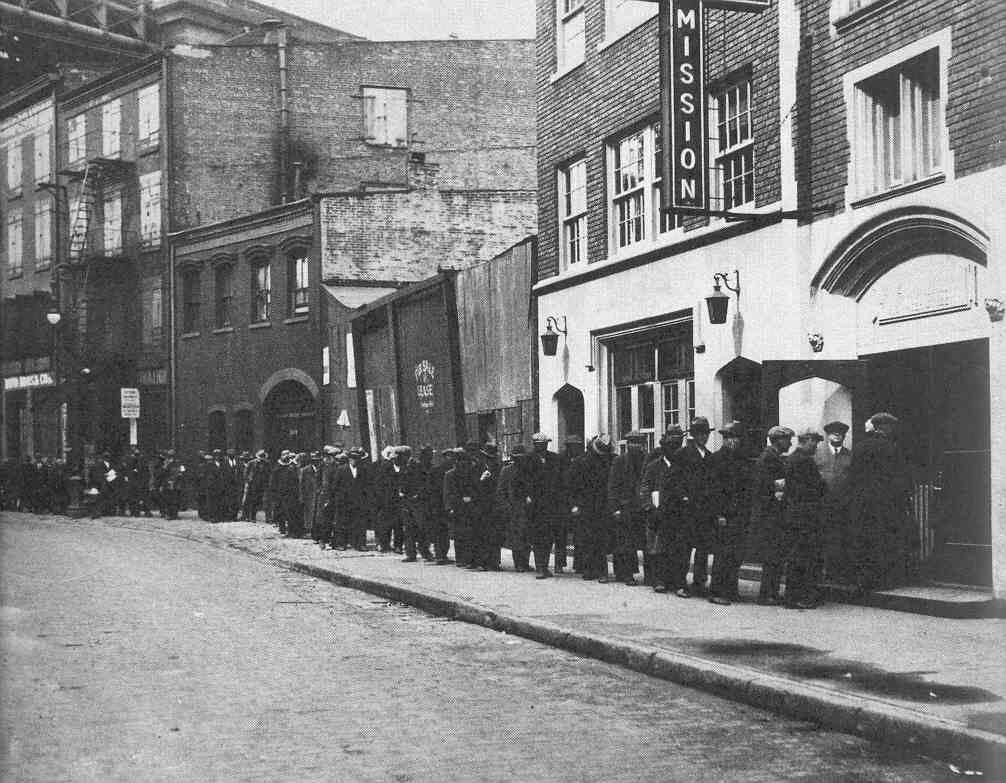
But by two years into his presidency, Hoover’s Darwinian approach to market economics was clearly not seeing a turn-around in the nation’s economy. Unemployment was rampant and people were clamoring for somebody to do something. Churches offered food lines for the unemployed – lines which were becoming longer and longer. But otherwise nothing seemed to be bringing the country out of this catastrophe.
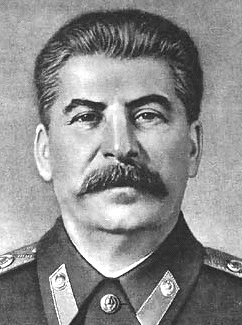 A Communist or Socialist alternative? Much of Europe had fallen into this same state of affairs – Europeans and their banks having themselves become closely connected to the financial world of Wall Street. But Russia – now under the Communist dictator Joseph Stalin and a country which of course was not only not involved in this commercial relationship with capitalist Wall Street, but was its dedicated enemy – seemed to be from all appearances (such as Stalin allowed to be publicized[4]) doing awesomely well in building hydroelectric dams, steel mills, industrial plants of all varieties (mostly military-related of course) – at a time when America and most of Europe lay hungry and depressed in their state of economic collapse. Some Americans of the more Progressivist variety were even suggesting the need to look to the Soviet or Communist model as a possibility for America at this point.[5]
Hoover’s belated efforts. Finally and belatedly, as the American economy continued to fail to revive (one fourth of American workers were now unemployed), Hoover began to propose government measures to try to help out the worst parts of the economy.

Seattle’s “Hooverville” where the unemployed set up homes
The 1932 Emergency Relief and Construction Act attempted to start up public works programs to put the unemployed to work and to provide government-secured capital to help start up industries. But these measures came too late to swing the country back in support of his presidency. Besides, the Democrats smelled political victory in the coming November 1932 elections and were not in a mood to be very cooperative with the Hoover Presidency, which they were pleased to blame as the cause of the Depression – even accusing Hoover of attempting to introduce Socialism into the economy with his Emergency Act – which ironically would be exactly the path the Democrats would take soon after Roosevelt came to power in 1933!
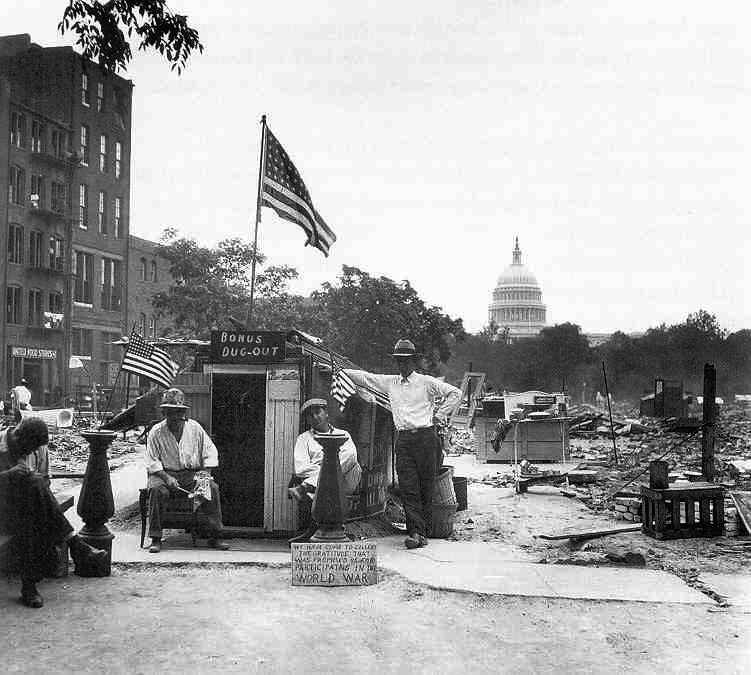
The Bonus Army. In the upcoming presidential election (1932) there was little chance that Hoover would be re-elected – although his cause was hardly helped by turning U.S. troops on war veterans who had come and camped themselves in Washington that summer in a desperate attempt to get a promised pension or “bonus” due in 1941 paid to them now – even if in a greatly reduced form. They needed that money now. But ultimately they were dispersed – rather brutally.

 Roosevelt takes command. In his nomination acceptance speech at the 1932 Democratic Convention, the aristocratic – and always cheerful – Franklin Delano Roosevelt mentioned a “new deal” he would be offering Americans – connecting this promise with the song “Happy Days Are Here Again” to drive home the point. He was all optimism – although he offered no details about what he meant by his “new deal.” Probably he himself was not sure what exactly he was going to do – evidenced in his attacks on Hoover’s “extravagant spending” in order to buy the country out of the economic crisis. It is ironic because this was the central strategy of what eventually became Roosevelt’s New Deal.

Actually at that point, no one was exactly sure of what needed to be done. Capitalism had failed. That much was clear. And Roosevelt had campaigned repeating the understanding that Americans themselves had failed by making “obeisance to Mammon” (worshiping wealth and the providers of such wealth, the capitalists). Roosevelt repeatedly used Christian ideals and language, drawn right out of the Social Gospel, promising that the Democratic Party would do the “Christian thing”, unlike the insensitive pro-capitalist Republicans. And in the end, it was an easy win for Roosevelt, who received 57.4 percent of the popular vote to Hoover’s 39.7 percent, with the electoral college going 472 for Roosevelt and 52 for Hoover.
In his inauguration speech he delivered not only his famous words “the only thing we have to fear is, fear itself” but went on to continue his attack against capitalism (again using familiar Biblical terminology):

The money changers have fled from their high seats in the temple of our civilization. We may now restore that temple to the ancient truths. The measure of the restoration lies in the extent to which we apply social values more noble than mere monetary profit.
He also promised the American people that his administration would now take over the matter, and undertake action, such as capitalism had failed to do, in the face of this national tragedy.
I am prepared under my constitutional duty to recommend the measures that a stricken Nation in the midst of a stricken world may require. These measures, or such other measures as the Congress may build out of its experience and wisdom, I shall seek, within my constitutional authority, to bring to speedy adoption.
In short, Roosevelt’s Washington, D.C. – not Wall Street – would bring the country back to health. But this was unprecedented in America. And yes Roosevelt was right to mention “within my constitutional authority” because what he proposed raised all sorts of questions about America’s constitutional legacy. What he was proposing sounded very much like what was going on in a number of European countries, such as in Russia under Stalin’s state Socialism (his brand of Communism), or in Italy under Mussolini and his Fascists, or in Germany, challenged deeply by Hitler’s Nazi or National Socialism. Was America to join the world in a basically state socialist undertaking? But “Socialism” was a taboo word to Americans. Indeed Roosevelt never identified his program as such, but let it be termed the “New Deal.” But what exactly did that mean? What were these “measures” that Roosevelt was going to propose to Congress to speedily adopt? America would soon find out.
Franklin Roosevelt – the man himself. Roosevelt was born in 1882 in the Hudson River Valley town of Hyde Park to a very prominent New York family, was raised as an only child in considerable privilege, and was watched over carefully by a doting mother, Sara.

As a youth he attended the prestigious Groton Academy in Massachusetts and then went on to Harvard, where he proved to be in the middle ranks of both schools academically.
With the death of his father James at the end of 1900, Roosevelt’s mother Sara became even more directly engaged in her son’s life (she had even followed him to Boston when he was at Harvard). But Franklin finally found that a relationship which developed in 1902 with Eleanor Roosevelt (Teddys niece and thus a distant cousin of Franklin’s) allowed him to free himself considerably from his mother’s domineering ways (Sara was very opposed to Franklin and Eleanor’s relationship).
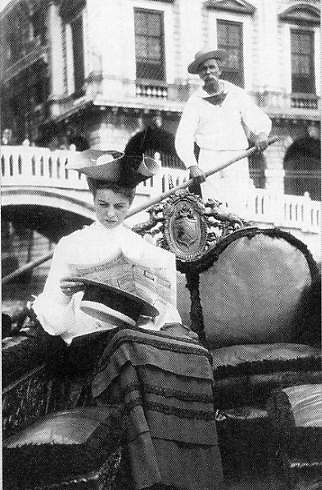
He went on to attend Columbia Law School in New York City, but dropped out after two years when he passed the bar examination, and went on to be a corporate lawyer with a Wall Street law firm.
His relationship with Eleanor meanwhile was quite mixed, the two of them having six children in fairly short order. But he, meanwhile, was involved with other women, most notably her personal secretary, Lucy Mercer. Rather than divorce, they settled on an agreement to continue the marriage, as long as he cut back on his womanizing (which he did not, especially that with Lucy). Meanwhile, Eleanor would busy herself with a number of social-political activities, which brought her public attention by her own right.
The name “Roosevelt” gave him a lot of political leverage. And the Democratic Party was very glad to have him on board, when the name was otherwise associated with the Republican Party, thanks to his uncle Teddy. Thus Franklin became a New York state senator (being a “Progressivist” himself like his uncle), then brought on to Wilson’s cabinet as assistant secretary of the navy (also like his uncle), serving as such through the years of World War One. After the war he was selected as the party’s vice-presidential candidate, campaigning with Ohio Governor James Cox.

But the Republican Harding easily won the 1920 election and so that effort came to nothing for Roosevelt.
Worse, the next year (1921) he contracted polio, leaving him permanently paralyzed from the waist down. A man of iron will, he refused to admit defeat by the disease, and maintained his law practice, while at the same time attempting various therapies. In 1926 he purchased a resort at Warm Springs, Georgia, not only for his own treatment, but for others also afflicted with the disease. He also developed immense upper body strength and the ability to walk (short distances) with the aid of iron braces, often also leaning on the arms of an assistant – so as not to have to appear in public in a wheelchair. Indeed, his disability was well hidden from the public, which knew little about his disability.
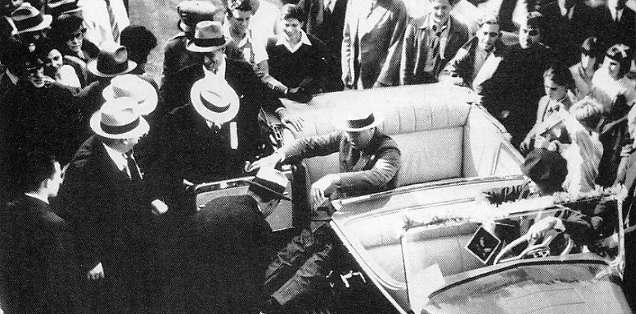
Thus he continued his career in national politics, intensely determined that his handicap not stand in the way of his desire to go to the top politically. He was a strong supporter of the Tammany Hall political machine, supporting Alfred Smith in his race for governor in 1922 and 1924 (which Smith won) and then for U.S. president in 1928 (which Smith lost).
At the same time Smith encouraged and supported Roosevelt’s candidacy for New York governor in 1928, which Roosevelt won (twice) making him the state’s governor from 1929 to 1932, when he chose to run for the U.S. presidency – easily becoming the Democratic Party’s candidate in 1932. And, with the country caught in the depths of the Depression, his win over his Republican opponent Hoover (naturally blamed for the tragedy) was also fairly easy: Roosevelt was elected to the U.S. presidency with one of America’s widest margins of victory (14 percent) over his Republican opponent.
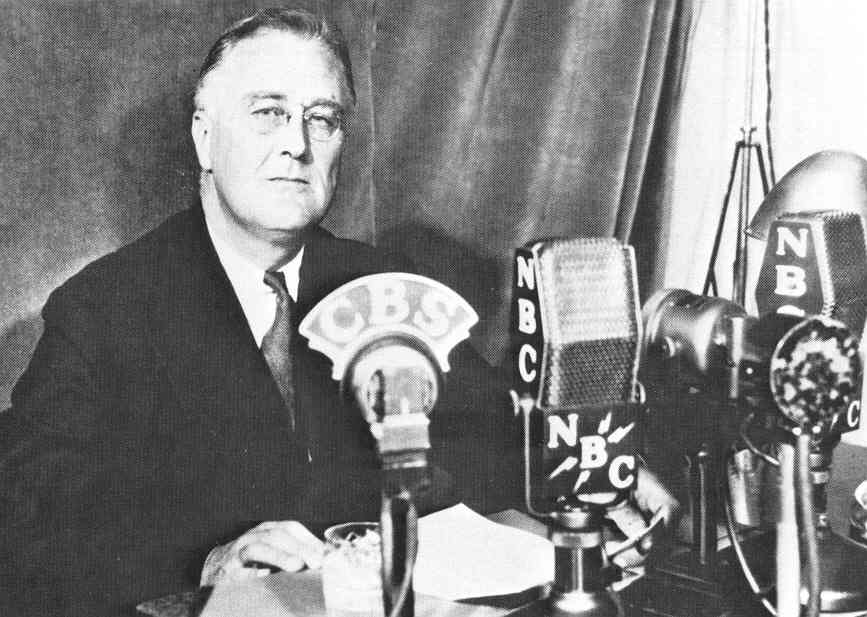
 He was an ambitious man, yet one who relied heavily on his own Christian faith, for its offerings of personal strength (rather than for its moral standards as a husband!). He had been raised an Episcopalian, and was personally very devoted to his Groton headmaster, the strongly Episcopalian Endicott Peabody, who not only taught him the social responsibilities that fell on the shoulders of the well-born, but presided at Roosevelt’s wedding with Eleanor, and then the weddings of their children as well. And Roosevelt’s polio served greatly to lead him to find his dependence on powers greater than his own, or of the surrounding society. And he would be quite successful in conveying that same understanding and approach to life in his frequent counsel (his famous fireside chats on radio) to the nation, especially as he took America through the dark days ahead.
Roosevelt’s “Brain Trust.” And to do that he gathered around himself a team of bright advisors as visionary as he was – university professors and corporate lawyers – soon to be termed his “Brain Trust.” Together they were going to pursue a strategy of putting into action a massive set of government programs designed to provide the forward thrust economically that now-failed private capitalism had so recently offered American society. Government investment on a massive scale would presumably do the trick of getting America back to work.
Roosevelt’s New Deal. By the time he took office in March of 1933, Roosevelt was ready to go with a full barrage of such programs designed to get the U.S. economy back up and running again. He asked businesses to join his program of setting prices, wages and services at certain levels – rewarded by being able to display a special window sticker indicating cooperation with the program (supposedly encouraging people to shop there). He offered jobs to young family men (ultimately 3 million jobs) working on state lands planting trees and developing the areas as vacation resorts (the Civilian Conservation Corps – CCC).

CCC workers clearing the land
National Archives
He set up a huge project to bring flood control, fertilizer manufacture, and electricity to the mid-South through the creation of the government corporation, the Tennessee Valley Authority (TVA). He moved to have farmlands taken out of use in order to increase the price of farmers’ grains (but making that food now more expensive for everyone else!). And he got Congress to pass the Glass-Steagall Act giving the Federal Government certain controls over the banking industry – including a bank insurance program (Federal Deposit Insurance Corporation – FDIC) offering government insurance for bank deposits lost in bank closures, designed to help put confidence back in America’s banks. Most of this was undertaken in his first “Hundred Days” in office.
But this was just the beginning of Roosevelt’s use of the Federal Government to monitor and guide the nation’s economy. In 1934 he set up the Securities and Exchange Commission (SEC) to bring some government control over the speculation that crashed Wall Street – and that same year established the Federal Housing Authority (FHA) to monitor and stabilize the mortgage market.[6] The next year (1935) he even became ever bolder as chief investor in America’s infrastructure with his Works Progress Administration (WPA) – building national highways and municipal buildings across the nation, even simply employing artists to beautify public buildings with their artwork.

WPA’s Lincoln Tunnel into New York under the Hudson River

WPA’s Boulder Dam across the Colorado River – Nevada-Arizona border

WPA’s highway building
And that same year he established the Social Security System, a government-supervised trust-fund designed to help the elderly provide for themselves in their retirement.
The rise of Intellectual or Secular Humanism. The depth of the crisis that America was forced to face going into the 1930s not only changed dramatically the direction that American government and economics were taking at this point – from free-market economic foundations involving very limited federal government involvement to a government-commanded or state-socialist economy – but also to new directions culturally, intellectually and spiritually as well. All the social certainties that seemed to have been in place during the Coolidge period (in many ways reaching back to the very founding of Puritan New England) seemed to have simply collapsed, disappeared, vanished. It was difficult to believe in anything with any certainty at this point. A huge moral-spiritual vacuum had taken the place of the former national self-confidence – and quite naturally a whole group of individuals we can term as intellectuals stepped into this vacuum to offer their advice as to how America should be getting out of its predicament.
To such “forward-looking” or Progressivist American intellectuals of the early 1930s, everything America had long relied on had failed – clearly so. Capitalism had failed. Limited government of the Republican variety had failed. In the estimation of these intellectuals, even Christianity had failed. It was thus time to consider a new way of going at life, a new world view, a new social program – one designed not only to correct the errors of the past but lead the country to a bright new future. America needed to find its way to a new Enlightenment.
The Humanist Manifesto. Thus it was that in the early summer of 1933, self-proclaimed Humanists signed and published a Humanist Manifesto that was intended to serve as a call to head the nation in a new direction. And this change of direction needed to be fundamentally thorough – from a change in world views – even a new religion as they themselves termed this new worldview (a religion it was indeed!) – to the particular social programs needed to put the new Humanist religion into place at the heart of the nation. Signatories included John Dewey, a number of other university professors (Tufts, Cornell, Chicago, Illinois, Columbia, Pittsburgh, Michigan), news editors, and numerous Unitarian pastors.
The Manifesto’s fifteen affirmations gave very clear explanation that in its Humanism it was intending to bring forward a new religion. “Religious Humanism.” For instance, its Eighth Affirmation states:
Religious Humanism considers the complete realization of human personality to be the end of man’s life and seeks its development and fulfillment in the here and now. This is the explanation of the humanist’s social passion.
It clearly states its new religious beliefs as: no divinely-ordained creation, but simply self-existent creation; man as an evolved natural creature; truth only through scientific study; the end to theistic (God based) religion; social concern and service to replace the self-serving profit motive of capitalism; the need to embrace life rather than flee from it (seeing traditional religion as “escapist” in nature)
Humanism claimed that it was the path to social and mental hygiene and that it discouraged sentimental and unreal hopes and wishful thinking. However, there cannot be a philosophy that has again and again built more unreal hopes and wishful thinking on utopian dreams of a new or revolutionary society founded on human perfection. Instead again and again Humanism has produced horrible failures that have accompanied every such attempt, beginning with the utopian French Revolution and continuing with every utopian Marxist or Communist revolution since then. Even German Fascism (“National Socialism”) was built on what the Germans believed to be “reasonable and manly attitudes” dreamed up by a utopian rationalist named Hitler.
Admittedly, the Humanism of 1933 had not yet been permitted to see the worst of utopian Humanism of the Marxist and Fascist variety. But the seeds of disaster were always there if you actually looked closely at the philosophy. But the religious blindness of the Humanists caused them to fail to see that their philosophy was about the furthest thing possible from social and mental hygiene.

Problems with the Supreme Court. Meanwhile, the U.S. Supreme Court was still under the domination of some very conservative justices. They did not agree with the Humanist idea – or the core idea of the Rooseveltian New Deal – namely, that enlightened individuals in governmental service should take over the responsibilities of power because the people themselves obviously were not in a position any more to help themselves. The members of the Supreme Court did not see things Roosevelt’s way at all. Thus a number of key programs in Roosevelt’s New Deal were shot down in 1935, with the Supreme Court repeatedly declaring them to have no constitutional warrant. Roosevelt’s programs fell way beyond what was permitted by the Constitution – even when stretching the interstate commerce clause to its fullest extent possible. His programs were therefore unconstitutional.

Roosevelt was so upset by this personal rebuff by the Supreme Court that in early 1937, just as he began his second term in office, he announced that he intended to introduce to Congress a bill designed to authorize an increase in the number of the Court’s justices. The political intent was clear to all: through the presidential power of appointment, he was looking to pack the Court with enough new “Progressive” justices to swing the Supreme Court rulings in his favor. But in this the reaction was very negative – among the American people in general (who looked upon these Federal judges as the very picture of legal purity) – but particularly also within Congress itself, despite its Democratic Party majority. Debate dragged on in Congress – while Roosevelt began to lose rather than gain political ground there.
But in the meantime a switch of votes in the Supreme Court had occurred, with one of the justices changing sides from anti to pro New Deal, and another justice retiring, thus giving Roosevelt the opportunity to make a new appointment. He now had a voting majority without having to pack the Court. Roosevelt backed down on his court-packing scheme. But he had lost a lot of political standing in the process. Many Americans felt that Roosevelt was taking notes from the high-handed ways of the European dictators, Stalin, Hitler and Mussolini. Roosevelt not only had gambled personally and lost in this contest, he had greatly weakened his ability to continue the political reforms he felt the country needed to undergo in order to get back to economic health.
No … the New Deal did not bring America out of the Depression. This event was also timed with another slowdown in the American economy which hit in 1937, resulting in the growth again in the number of unemployed Americans. Roosevelt had built all the national highways needed by the country, he had put hydroelectric dams wherever there was some logic for doing so, the national parks were completed, etc. The market for federal projects was therefore fully saturated (just like the consumer market of the late 1920s had become) – and there was very little else for the government to undertake by way of projects designed to hire unemployed Americans.
Private industry had not swung back into business with the arrival of the New Deal. No new products to stir the interests of the American private consumer were brought to market during the 1930s. And the stock market that funded such possible industrial growth remained idle – Americans too afraid to get involved there again. And what money the American workers did gain they “put under their mattresses” – meaning, saving rather than spending their scarce dollars – and thus providing no help to the market either.
So, yes … the New Deal put in place some much-needed social or national infrastructure items (highways, dams, national parks, etc.) that private industry would not have offered America. Thus the New Deal was a very good thing economically (although somewhat questionable politically or constitutionally), and helped reduce some of the massive unemployment that America was suffering from – at least for a few years anyway. But ultimately the American economy is shaped not by government decisions (as in Socialist countries) but by what the American people themselves bring to the national economy. And during the latter 1930s, those American people were still too fearful of economic dynamics to risk their small hold on their own personal wealth to buy into an economic rebuild.
The Midwest “Dust Bowl.” Then, just to make the 1930s even more horrible, on top of this return to economic depression a massive drought which hit the American Midwest dragged on year after year in the mid-1930s, pulling down even further the farming economies of states ranging from Texas in the south to the Dakotas in the north.


With this the American highways were filled with farm families making their way West as best they could, to find some kind of work in the California vegetable fields.
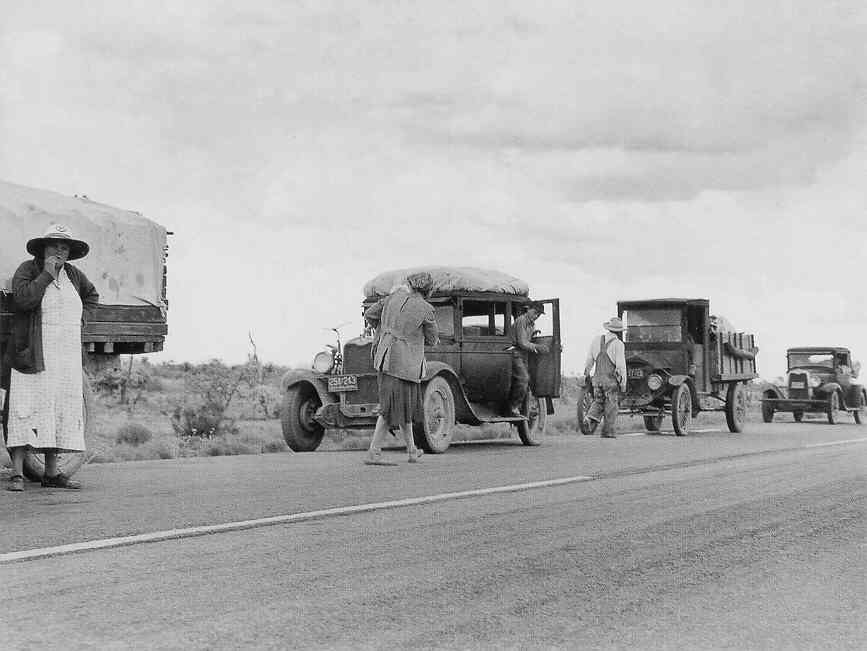
These migrants were a very sad-looking lot, reduced to living in cardboard shacks and moving from area to area as the California plantings and harvests came and went.


Thus by 1937 America was again sliding back into economic depression. 1938 was not any better economically – and 1939 saw only a very slight economic recovery.
No … the New Deal had not brought America out of the Depression – as is so often claimed. It would take something else to do that – something very big and quite different, namely, World War Two – and America’s entry into that war. But that was still a few years away for America.
Christianity’s ongoing struggle with Enlightened Humanism. We have already seen how in the late 1600s / early 1700s Christianity was losing its foundational position in Western society due to the rise of a new age (actually only just another such age) of human Enlightenment. We saw how this humanism revived itself in the comfortable world of America during the early years of the 1800s (the Era of Good Feelings). And now a century later, Christianity found itself again under the challenge of personal faith in God’s caring hand versus social management from above by self-enlightened or “scientific” wise ones (Sophists).
And once again prominent voices even inside the Church were calling for a more “rational” faith – one based more on a logical or scientific commitment to seek social morality – or peace and social justice – rather than one based on the personal quest for personal salvation and consequent faith in God’s deliverance. Man needed to deliver himself – Jesus’s way, of course.
At the heart of this debate (or even fight) was the huge Presbyterian denomination – caught up in a split that started at the turn into the 20th century and only deepened as the denomination headed into the 1930s. At first Christian traditionalists or conservatives seemed to have the upper hand. But bit by bit, the weight of Presbyterian opinion seemed to be clearly swinging away from such Christian conservatism or Fundamentalism in the direction of Christian Humanism, which recast Christianity as basically centered on social progress through programs of social improvement (the Social Gospel).
 Princeton Seminary professor John Gresham Machen found his conservative views slowly being rejected by the growing trend at Princeton to take the more “Liberal” or Humanist view – until in 1929 he left the seminary and founded Westminster Seminary in nearby Philadelphia. But the tide of Presbyterian Humanism continued to mount – and in 1933 Machen was even excommunicated from the Presbyterian denomination.
Christian Liberals felt that history and time was on their side and that soon all reasonable people would be joining them in their modernizing religious camp (just like Jefferson expected a century earlier!). But sadly, the more churches drifted further and further in this Liberal or Humanist direction, the more they lost their strong, clear voice – once the moral bedrock of American politics. The churches were once again fast making themselves irrelevant. How ironic: it was their claim that by making themselves look more like the world, they would enhance their influence in the world’s affairs. But in fact the end result was quite the opposite!
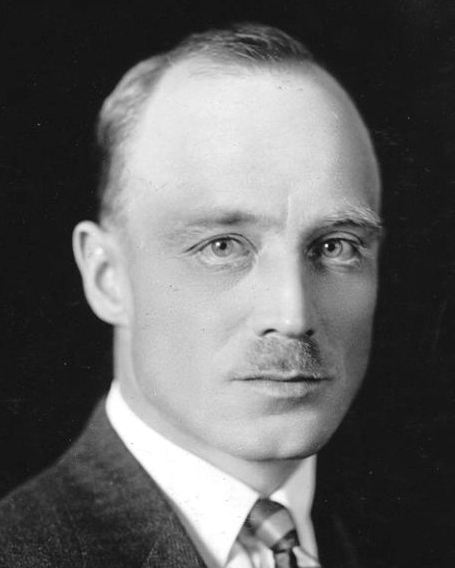 In the midst of this religious transition one of America’s greatest theologians, H. Richard Niebuhr, so tellingly described what was happening to the message of the American church:
A God without wrath brought men without sin into a kingdom without judgment through the ministrations of a Christ without a cross.[7]
 Fifield’s Spiritual Mobilization movement. Yet outside of the world of theological academics there was some action underway to get the country back on course with God, and away from an increasing dependence on salvation by social design coming from FDR’s Washington experts. Los Angeles Congregational pastor James W. Fifield, Jr. – who had some of the same bold instincts as did once the greatest of the American capitalists – in the mid-1930s founded Spiritual Mobilization, a grass-roots movement dedicated to getting the gospel of personal independence out to the nation through the sermons preached from the pulpits of the movement’s extensive pastoral membership. Fifield was able to gain enormous financial backing from key business leaders so as to hold conferences, bring in speakers, and publish materials to enlighten America’s clergy as to the role they needed to play in bringing the country out of its drift towards Socialism and back to America’s tradition of personal freedom, one that prompted personal initiative and responsibility, and ultimately personal success, something they were certain was mandated by God himself. This broad mix of Christianity with conservative political values during the last half of the 1930s (continuing through the 1940s and into the 1950s) brought thousands of pastors (and hundreds of businessmen) to active support of Spiritual Mobilization.
 Vereide’s prayer breakfast movement. On another front, and also originating in the American West, was Norwegian-born Methodist minister Abraham Vereide’s City Chapel program, bringing businessmen and local political officials (across the broadest religious and political spectrum possible, although basically Protestant in character) to “breakfasts” where extensive prayer would be offered – for the local community, the nation and the world.
Vereide had earlier founded and led the Seattle operations of Goodwill Industries, a company focused on offering employment to those who had such disabilities that they would not likely find employment elsewhere. Vereide proved to be an outstanding organizational leader, building up the Seattle operation to involve tens of thousands of workers and supporters. But gradually he grew disillusioned with the failure of charity to change people’s circumstances for the better, and resigned – to look for life’s answers elsewhere. He too was a strong believer in personal initiative rather than governmental dependency.
His next direction in life came when he visited San Francisco during the violent longshoremen’s strike of 1934, and found himself invited to lead the local businessmen’s association in prayer during those dark times. Then when he returned to Seattle (where the strike was also ongoing) he deliberately set up an early morning breakfast prayer meeting at his City Chapel for some of Seattle’s business leaders, soon joined as well by some local politicians.
These prayer breakfasts proved so encouraging to Seattle’s demoralized business class that they continued their existence year after year, growing all the while. Here too, in the early 1940s, the war would only amplify the sense of need of such prayer gatherings, spreading Vereide’s movement from city to city across the nation so that they would eventually become a key part of the American national religious and political scene, eventually including the president’s annual Prayer Breakfast, started up in 1952.
America toughens up. The sad irony is that the Great Depression actually came as something of a blessing – for it brought America out of the silliness of the 1920s as well as the foolish intellectual idealism of the early 1930s – and readied America for a very serious challenge that was waiting for the country in the form of the highly aggressive Japanese and German Empires. Had America attempted to answer these dangerous challenges going at them with the attitudes of ten years earlier, America would have been another of those “democratic wimps” that just was unable to muster the self-discipline and determination to go sacrificially into battle. But by the end of the 1930s the Americans had turned themselves into a tough breed, able to face very hard times without quitting.
This is not to say that Americans thought of themselves ready to go into action. Mostly they were quite content to stay out of the drama that was going on in Europe – although the Japanese treatment of the Chinese after their invasion of China in 1937 troubled Americans deeply, because there was among Americans a natural tendency to look to the Chinese sympathetically. Eventually that sympathy would be turned to Japanese counter-action – which would finally bring America directly into the global conflict that was well underway as the 1930s headed toward the 1940s.
[4]The fact that millions of people in Soviet Russia were dying of hunger, disease or simply exhaustion (multitudes of them in Siberian work camps) – because of Stalin’s industrialization program – was carefully hidden from the view of the larger world. In fact, idealistic American youth who traveled to Russia to see the Stalinist “wonder” typically never left Russia alive, because they saw what was really going on.
[5]During the 1950s McCarthy Era witch hunt for possible American Communist sympathizers, those same Americans would come to regret having gone on record making such a recommendation 20 years earlier in the first years of the Depression.
[6]Unfortunately much of the regulatory work of the SEC and FHA was cut back by the Bush Jr. Administration in the opening years of the 2000s – helping produce through the so-called “shadow banking system” the subprime mortgage crisis which started in early 2007 and reached the level of a major financial meltdown in September of 2008.
[7]Niebuhr, The Kingdom of God in America (New York: Harper & Bros., 1937), p. 193.