CONTENTS
 The 2008 national election
 Obama’s program of deep social and cultural change
 The Obama economy
 Obama’s foreign policy
The textual material on this webpage is drawn directly from my work, America’s Story – A Spiritual Journey © 2021, pages 428-454
The 2008 candidates. Not surprisingly, given the weariness of the Americans over the apparently highly expensive but also highly pointless Bush-led military effort in Iraq, but especially given the state of the nation’s economy as the Americans went to vote in November, the Republicans took a huge beating, both in the presidential and congressional elections.
The centrist Republican candidate, Arizona Senator John McCain, did what he could to liven the party’s conservative political base by appointing Alaska Governor Sarah Palin as his running mate. But the chemistry was just not there.
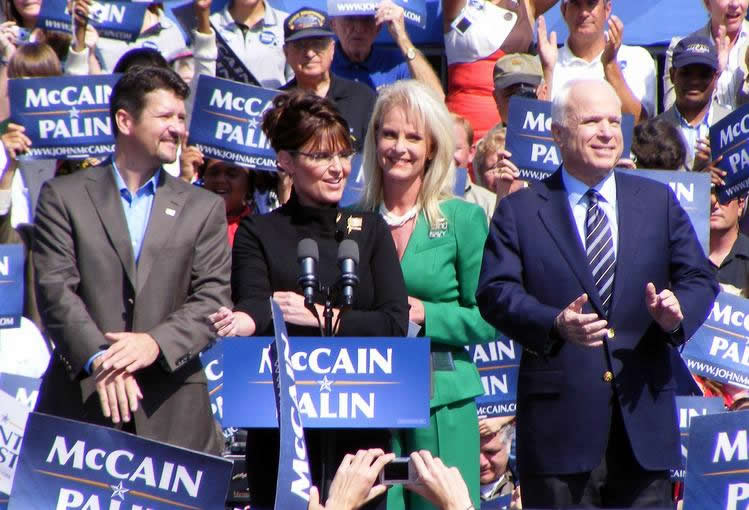
He himself was 72 years old – considered at the time to be way too old to be assuming the presidential office. But his family’s long history of naval service (his father and grandfather were U.S. Admirals, and he himself was a U.S. Naval Academy graduate in 1958), his bravery as a navy pilot shot down over Hanoi (1967) and one who refused, as a 6-year war prisoner, to offer his captors propaganda advantages in denying his country before cameras,[1] his continuing service in the navy until 1981, and then Congressional service as an Arizona Representative (1982-1987) and then Senator (since 1987), should have been very compelling reasons to want to put him in the White House.
Thus the American Left (dominant in the news media) had redirected their attacks away from the proven patriot McCain and instead aimed them at Palin, whom they portrayed unceasingly as being merely a “beauty-queen bimbo” (she was in fact no bimbo) and only a single, dangerous heartbeat away from the presidency, because of the incredibly old age of McCain (they would sing a very different tune 12 years later when they were running the 78-year-old Biden for the presidency!).
On the other hand, the Democratic Party candidate, Barack Obama, was portrayed in the most glorious of terms by a fawning press – which loved especially his bi-racial origins. And he had the most powerful TV figure of the time, Oprah Winfrey, not only endorse him but put her full weight behind her request for him to run for the presidency, when he had very little national political experience behind him.
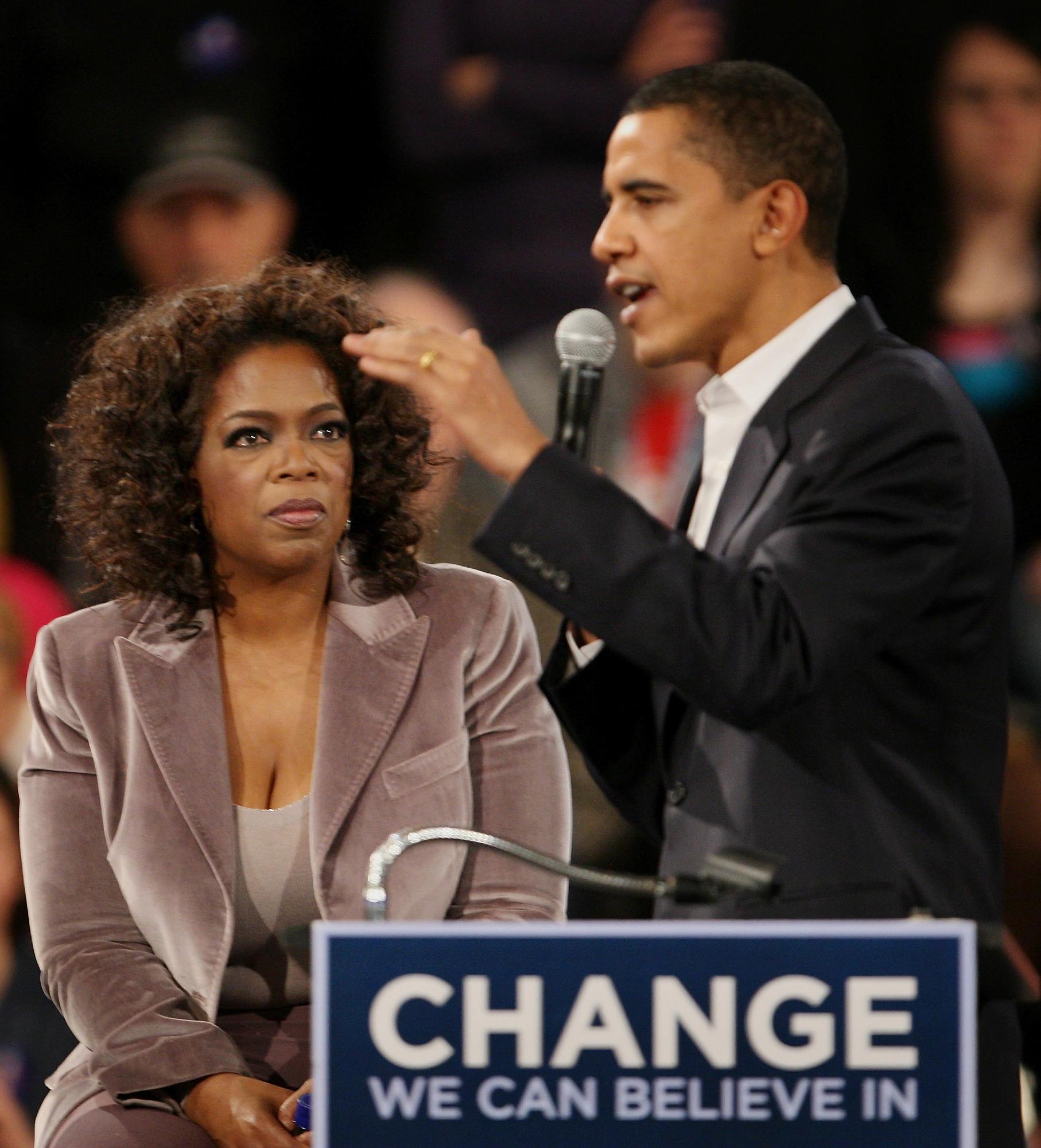
Deep “change.” But he was such a wonderful living symbol of political dreams, able to speak movingly to the idea that America needed to undergo thorough “change” – in all areas of its national life. This was deeply inspiring to all those Americans who would find it easy to identify themselves as “minorities” – like Obama – and dream the dream that with Obama in office, they would no longer be “victimized” by Middle America. And Obama played the victim card splendidly.
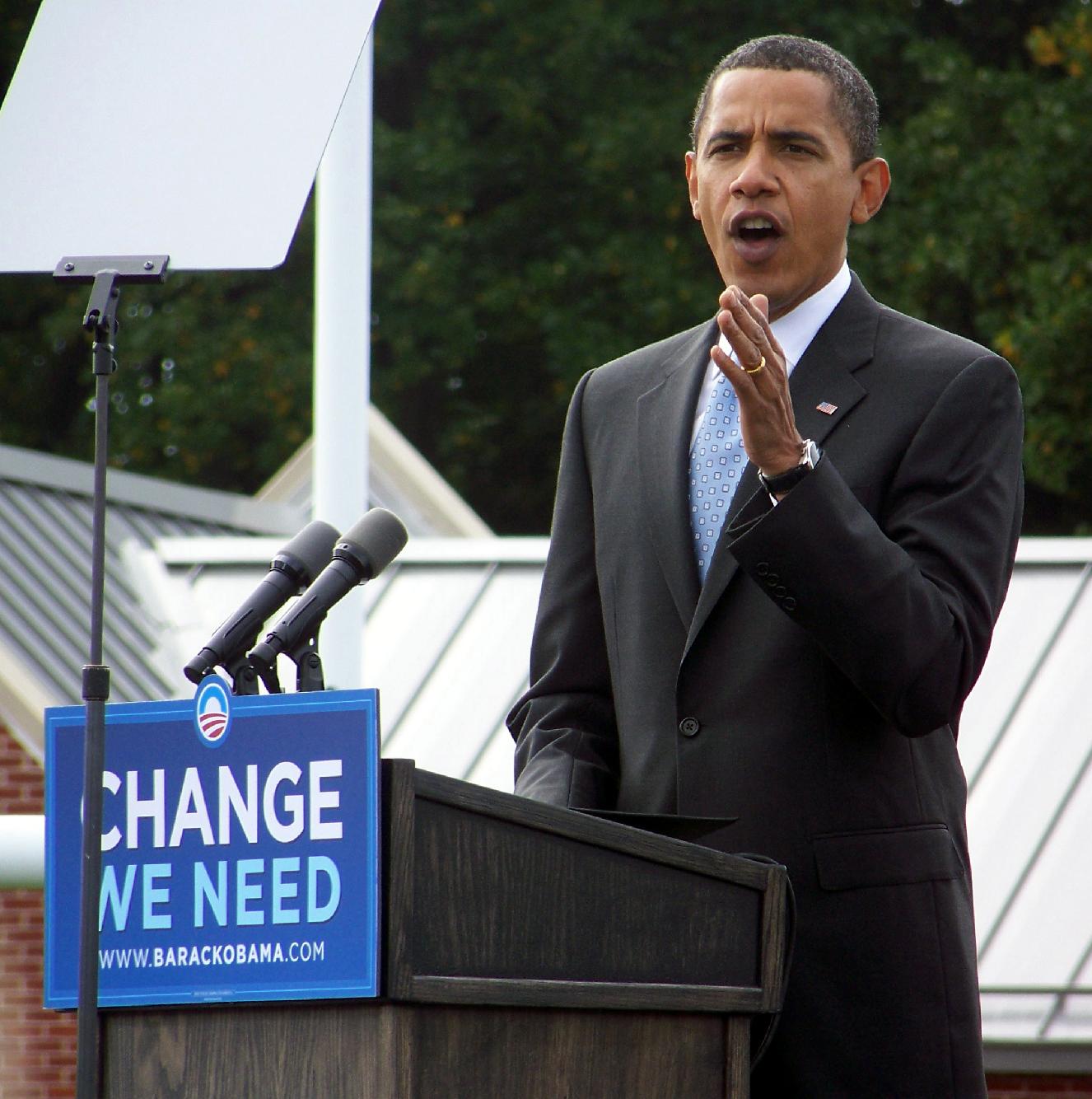
In so many ways he disliked intensely the Middle America that had been at the heart of the founding, development, wartime self-defense, and ultimately grand social success as the sole standing superpower at the end of the 20th century. All that mattered little because – as he saw things – none of that had worked out well enough for him personally, although it certainly did not prevent him from becoming president of the United States! But he was absolutely determined to change whatever he could about Middle America. Middle America was too White, too Anglo, too masculine, and too sexually “straight.” He would do everything he could to promote the interests and empowerment of those who did not fit one (or more) of those despised categories … in full support of the minority “victims” of Middle America and its oppressive values.
He would thus end up being the first American president unable to personally identify with, much less exemplify, the heart and soul of what had been since its founding the very cultural heart of America. But in the age of the Boomer and the rising Gen-Xers, this would no longer be a matter of great importance. And thus he would find it easy to change, change deeply, the very identity of America itself, in every way possible.
“Generation X.” Indeed, just as McCain was typical of his “Silent” generation, so Barack Obama was typical of his, the Gen-Xers.
The “X” part referred to the way in which this generation, children of Boomers, had no particular ideals, no particular heroes (though something of a fascination with media celebrities), and no particular sense that their lives were going anywhere special. They answered to no particular standards – except the need to prove that they had no such standards – finding that just “fitting in” with fellow members of their generation was standard enough.
Male heroics based on the ideals of male self-discipline passed down traditionally from fathers to sons did not play a major part in their lives, as many of them (especially the 70% of the Blacks of that generation) were raised by single moms. Thus it was that Gen-X males tended to look to their peers to secure their male identities. Not surprisingly those identities were quite fluid and thus also quite shallow, except in the case of taking on very strong sectarian, racial and even gang identities (not uncommon) – identities which had a strong base of anger in them, anger at the larger world where they personally were having a hard time figuring out how to find a respectable way to fit in. Blaming that world became a political centerpiece for them.
And this male social feebleness and lack of direction is also why Gen-X women were found in the 1990s entering the academic and professional worlds in greater numbers than their male counterparts.
Barack Obama. Obama was born in 1961 to two students at the University of Hawaii – a White mother, Ann Dunham, from Kansas and a Black father, Barack Obama, from Kenya, the two marrying just before Barry (the name he went by during his pre-teen years) was born.
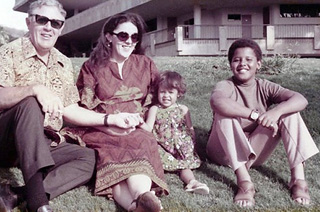
Ann Dunham with her father and children at Barry’s Punahou School (mid-1970s)
But soon after his birth, his mother took Barry with her for her studies in Washington State, and his father the next year moved on to study at Harvard. Then, following their divorce in 1964, his father returned to Kenya (actually he was already married to a Kenyan woman at the time). Young Barry would see his father only once more, very briefly in 1971 when he was age ten.[2]

His mother returned to Hawaii, married an Indonesian student, Lolo Soetoro, a Muslim by background but quite Western in attitude – at least as long as they were still in the States. But the family moved to Indonesia in 1967 when Barry was six (his step-father worked with American oil companies), where Barry would take up schooling, first at a Catholic school (three years) and then a public school (Islamic, as Indonesia itself was largely Islamic). Actually, this highly varied religious experience did not dig deeply into Barry’s life, especially as his mother was something of a self-designed spiritualist.
In 1971 Barry was sent back to Hawaii to live with his White grandparents, joined the next year by his mother, who had returned to Hawaii to finish her doctorate, and his younger half-sister Maya. That fall Barry was able to enter 5th grade at the prestigious Punahou School, thanks to a scholarship – and the hard work of his grandmother, who paid the balance of the costs (his grandfather was retired). Four years later (1975) his mother returned to Indonesia and Barry would continue on at Punahou, finally graduating in 1979 as “Barack,” now preferring the more exotic sound of his father’s name.
Indeed, although Hawaii was a land of many races, young Barack had found getting a fix on his own identity problematic. As a male, he had grown up with largely only strong-willed women to guide him in his personal development, the male input (again, typical of Gen-Xers anyway) largely lacking. He would idealize his African father[3], but receive no actual direction from him on the path of male development. And high school drug use would not help the situation any.
He headed on to California and Occidental College, but two years later, with a scholarship in hand, transferring to the more prestigious Columbia University in New York City – to major in political science. While he was there, he naturally explored that world, in the process discovering the Black cultural world of Harlem to be very inviting. And thus it was that he began to secure his own identity – despite his “White” upbringing – as “Black.” And he would eventually become quite purposeful in confirming that particular racial identity. The White world would no longer be his, but instead a highly problematic matter for him.
This process did not happen immediately, but instead developed in stages. At first, upon graduation in 1983, he took a job with a corporation helping businesses invest and operate abroad. But that work did not appeal to him. Then he joined Ralph Nader’s campus activist organization, before moving to Chicago (1985) to work with a Catholic organization doing community development work in the city – helping to administer a number of developmental programs, including legal support.
Thus he found himself fascinated by the power of law, and after three years in Chicago headed off to Harvard Law School. Here he became a very focused, hard-working law student. Indeed, at the end of his first year he was elected as an editor of The Harvard Law Review. The next year he was even elected president and editor-in-chief of the Review.
During the two summers between classes, he headed back to Chicago for internships, the first summer (1989) interning under Michelle Robinson, a Princeton University and Harvard Law School graduate, who had joined the firm only the previous year. By the end of the summer they were actually dating (they would marry three years later, in October of 1992).

Upon graduation in 1991 from Harvard Law summa cum laude (with highest honors) he returned to Chicago and took a position at the University of Chicago as a Visiting Fellow, also working hard in directing a massive voter-register drive designed to get Blacks on the voting lists. His work in this matter would bring him serious national political attention (as well as his book, Dreams from My Father, which he was putting together at the same time).
Soon he was appointed to the board of directors of a number of major community development corporations, at the same time that he moved up the ranks as Lecturer at the University of Chicago Law School.
But the death of his mother in 1995 would shake up his world, when uterine cancer forced her to return to the States in early 1995 – to then die that November. Not only had her disease and death been a heartbreaker for Obama, all the hassle to get medical attention and accompanying medical insurance coverage for such treatment had also deepened his despair greatly. It would leave him deeply committed to the idea that something was badly needed to improve such a draining medical system.
The following year (1996) Obama would enter the elective-office world, taking up a vacated seat in the Illinois Senate, then being reelected in 1998 and again in 2002. Meanwhile he had made a run for the U.S. House of Representatives in 2000, but lost that race rather substantially. But he was determined to enter national service, and took on the challenge of a race for the U.S. Senate in 2004 – easily winning the spot as the Democratic Party candidate. And as the election approached, his Republican opponent resigned his candidacy over a sex scandal, opening the door for Obama to an easy win (70% of the state’s vote) that November.

The fast-rising political star Obama delivering the keynote address at the Democratic Party national convention in 2004
Now a U.S. Senator (January 2005) he was assigned to several committees as a junior member, the Senate Foreign Relations Committee being the top of the list in importance … allowing him some considerable travel abroad.
Then Oprah stepped into the picture in September of 2006, finding in Obama everything she longed to see in a political figure, and worked hard at promoting the idea that, although Obama had no serious amount of experience in political administration, he would make a wonderful U.S. president – representing personally all the values that she supported. She put more muscle into the effort, interviewing Obama again the following month, with his wife Michelle also participating. And Oprah pushed Obama’s second book, The Audacity of Hope to the number one spot on both The New York Times and Amazon’s bestseller list. And thus it was that Obama became a very serious contender in the 2008 race for the U.S. presidency.
As for the presidential campaign itself, a large field of contenders had narrowed down by early 2008 to only two contenders, Obama and Hillary Clinton.

Hillary supporters at the Democratic National Convention – August 2008

A defeated Hillary will join the Obama campaign … and be rewarded for her services by Obama then appointing her to be his Secretary of State!
Along the way a sad event had taken place for Obama, when a sermon delivered by the Chicago pastor Jeremiah Wright was presented in part on the ABC News, showing the Rev. Wright repeatedly cursing America for its failings.

Despite the fact that this pastor had served as something like the father that Obama had long needed – for twenty years, in fact – Obama distanced himself not only from the comments, but from the man himself. Indeed, Obama soon went before the nation in a televised address to deliver a speech “A More Perfect Union,” in which he explained his negative views on racism, racism of any sorts.
In the end the controversy and his public response probably helped considerably move his candidacy ahead within the Democratic Party primary process. For indeed at this point he pulled ahead in the race, and in June Clinton dropped out. But this had an additional side effect, for in distancing himself from the Rev. Wright, Obama would not find another such pastoral figure to support his spiritual journey as president.
This would merely increase the Secular nature of the leadership flowing from the White House with Obama in place there (January 2009). This was sad for both the Obama family and the nation.

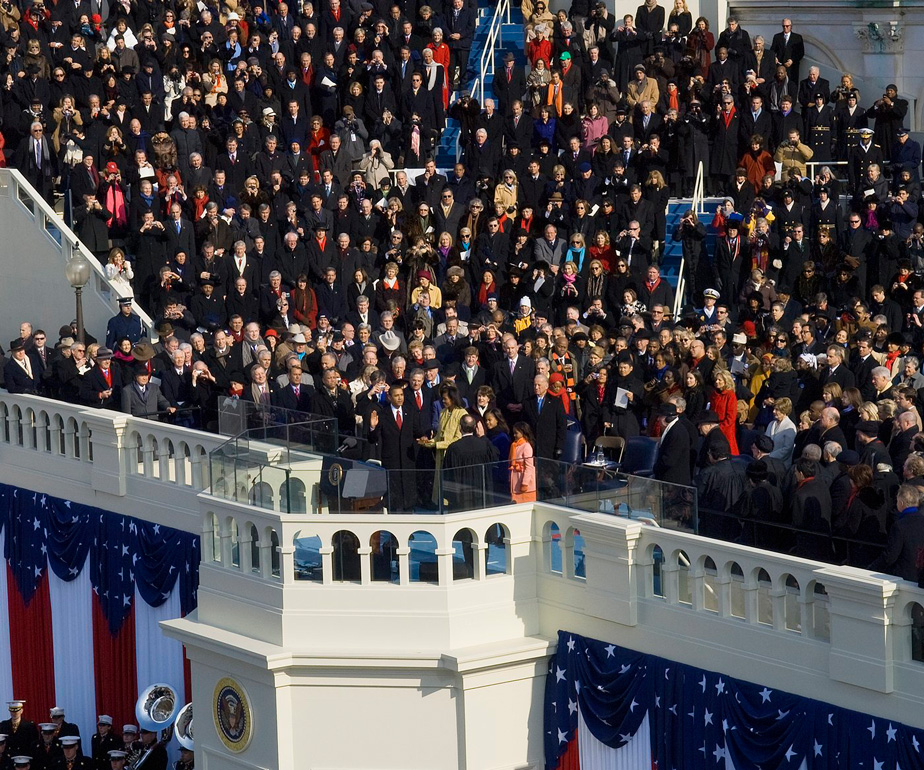
[1]In his refusal to do so, his torture was worsened. He was however released in 1973 as part of a peace settlement between America and North Vietnam.
[2]The senior Barack Obama was killed in a car accident in Kenya in 1982.
[3]Expressed beautifully in his New York Times best-seller, Dreams from My Father; A Story of Race and Inheritance, New York: Crown Publishers, 1995.
OBAMA’S PROGRAM OF DEEP SOCIAL AND CULTURAL CHANGE
Supreme Court appointments: “identity politics” in action. This move into a much more Secular world demonstrated itself clearly in two early and very important Supreme Court appointments that Obama made, ones that would aid considerably in Obama’s determination to “change” America. Both appointments were of unmarried and childless women, pointing to the degree of support that the traditional American family was likely to get from the all-powerful Supreme Court.
 The first appointment (May 2009), that of Sonia Sotomayor, was of a Puerto-Rican-born Hispanic militant who distinguished herself in her college years by leading a movement to force Princeton to hire more teachers of Hispanic background and to offer more courses on Hispanic culture. And her general outlook on life did not change much over the years, offering a comment on things in 2001: “I would hope that a wise Latina woman with the richness of her experiences would more often than not reach a better conclusion than a white male who hasn’t lived that life.” This was the kind of minority mentality that Obama found so appealing.
 A year later Obama was able to make his second appointment, that of Elena Kagan, who had never served as a judge, but had been called out of academia as Dean of the Harvard Law School to first become Obama’s Solicitor General – before receiving the Supreme Court appointment (May 2010). She was a strong opponent of “homophobia” and as Harvard Dean had opposed the military’s recruiting efforts on campus because of the military’s “don’t ask, don’t tell” policy concerning homosexuality. This too pointed to where the Supreme Court was likely to head things. And she would be the third Jewish member of the nine-member Supreme Court (which at this point included not a single White Protestant male!). Middle America was in for some changes, deep changes.
Obama’s own assault on “homophobia.” In October of his first year in office, Obama was able to sign into law (thanks to the Democrat-controlled Congress) the Hate Crimes Prevention Act, making any act motivated by a person’s antipathy towards homosexuality a “hate crime,” and thus subject to a doubling of the penalty for such a crime.

It was at first simply the belief that this law merely protected homosexuals from abuse, not itself authorizing the pro-homosexual world to go on the offensive politically against those who still held the view that homosexual behavior was a serious social problem (as America and most other societies traditionally had viewed things almost eternally). But indeed, this step of the president and Congress would be the first in exactly that direction. And in very short order, from that point forward, any opposition to homosexual activity (even just holding such a “homophobic” opinion) would now be considered the truly serious “social problem.”
A year later, Obama took the next step down this same path, but only after the Democratic majority in the House of Representatives had been overturned by that November’s Congressional vote (2010). He was quick in response to the Democratic Party setback to run through what was at that point a “lame duck” Congress an amendment to the Small Business Act (?!!) repealing the military’s “don’t ask; don’t tell” policy.
It passed, not surprisingly, largely along party lines in both houses (it would have failed passage if it had been put before the new incoming Congress a month later). So this was how Obama was going to “change” America.
Then also in February of the new year (2011) Obama had his Attorney General send a letter to Congress announcing that the Department of Justice would no longer enforce the 1996 Defense of Marriage Act (DOMA).

Attorney General Eric Holder announcing the end of support of DOMA
So much for the president’s inaugural vow to faithfully enforce the laws of the land! So, “change” thus also now meant that the president could enforce whichever laws he himself personally decided to enforce, and could ignore the others if he chose to do so.
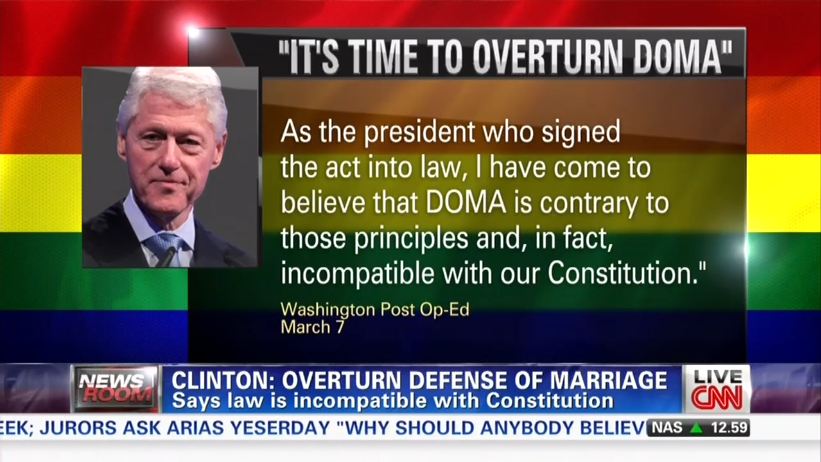
Increasingly Liberal America has “seen the light” and decides to come out strongly against DOMA
But ultimately it was the Supreme Court, not Congress or the president, that in two steps overturned DOMA as law. In United States v. Windsor (June 2013) and Obergefell v. Hodges (June 2015), by a 5-against-4 decision, Supreme Court politics first cut down one of the provisions of DOMA and then finally dismissed the whole thing. 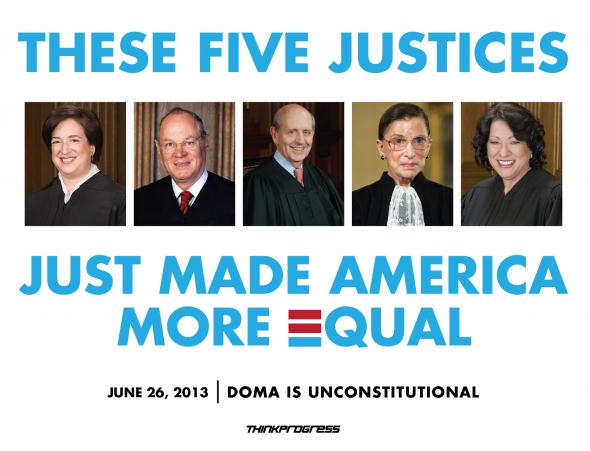
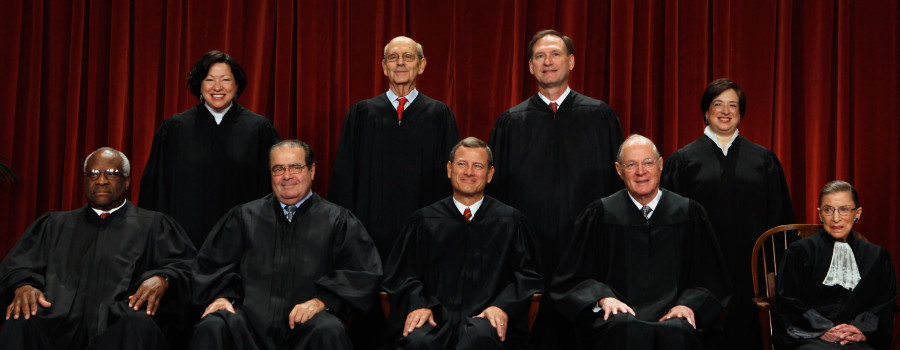
Thus five lawyers in black robes decided for America what constituted marriage and what did not.[4] And there was no known way for Congress to get its law back as the law of the land, because those five (which of course included Obama’s two court appointees) had made the final decision as to what was national law and what was not. And there exists no known way for Congress, through its own legislative power assigned by the Constitution, to counter the Supreme Court’s greater legislative power, one simply assumed by the Court itself.
“Change” now includes the bullying of Christians for failing to hold “politically correct” views on sexuality. It did not take long for the new attitude of Obama’s Washington to make its way to the nation’s streets. When the president of Chick-fil-A, Dan Cathy, commented in an interview by the Baptist Press in July of 2012 that he held a traditional view on marriage (being ordained by God himself as only between a man and a woman), the attacks against him and his restaurant business were fierce. Chicago mayor (and former Obama chief of staff) Rahm Emmanuel and Chicago Alderman, Proco “Joe” Moreno” announced that they would block the opening of any new Chick-fil-A restaurants in the city. This position was also immediately taken up by Boston mayor Thomas Menino. But this violation of Cathy’s right to express an opinion was even too much for the very Liberal ACLU, which joined the voices protesting against such political bullying. Both the Chicago and Boston mayors backtracked from their announcements. But from that point on, Chick-fil-A would find itself constantly in the middle of controversy over this issue of marriage.


Then things ramped up even more the following year (early 2013) when a young couple, the Kleins, owning a small bakery, told one of their customers that they would not be able to bake a wedding cake for her because their Christian beliefs would not allow them to support a lesbian wedding. She would have to go elsewhere for a wedding cake.
So hurt was the lesbian couple that they turned the hurt back on the Kleins, filing a complaint with Oregon’s Bureau of Labor and Industries. This soon hit the news, which brought protesters stationed outside their bakery, finally forcing the couple to close down their bakery and try to continue their work from their home.

But the countering hurt did not end there. In 2015 Oregon authorities hit them with a $135,000 fine
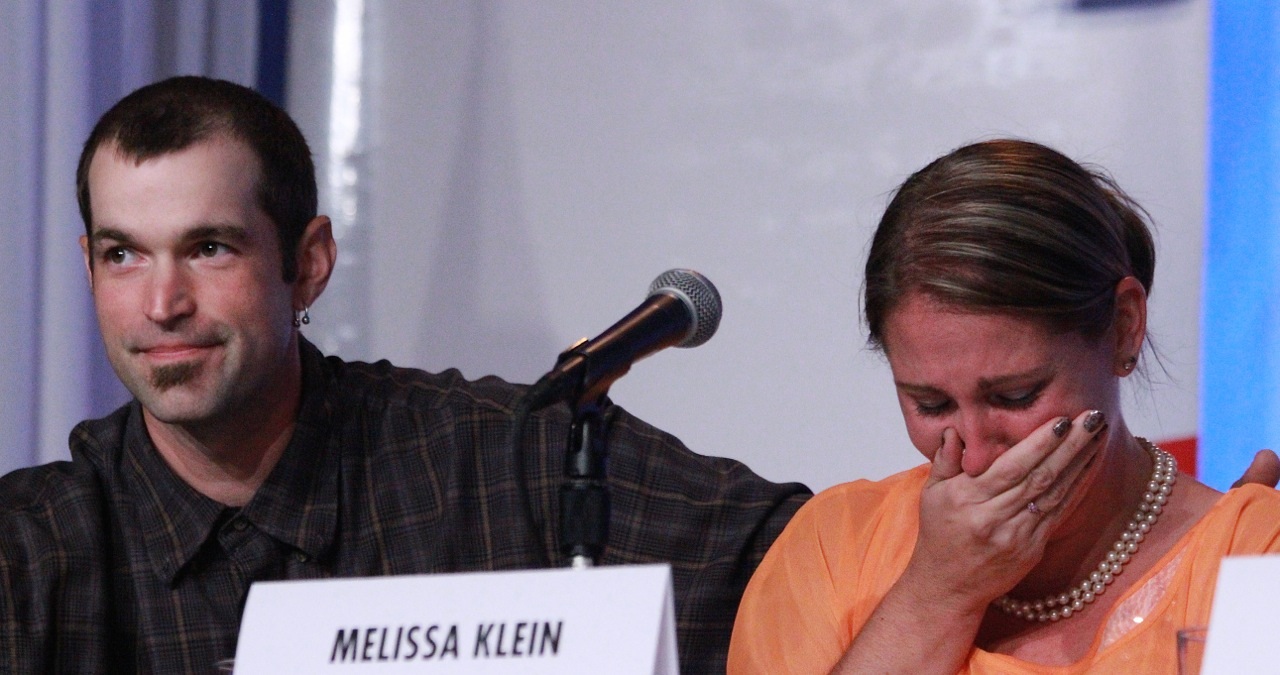
(but the Kleins in turn received considerable financial support through the Go Fund Me website – which then got shut down when those managing the website discovered the purpose of the funding!). The decision against the Kleins was appealed in 2017, but went against them – as well as did the appeal all the way to Oregon’s Supreme Court (June 2018). Christian “homophobia” was going to be eliminated, by force if necessary.
Racial hostilities fire back up again. An incident that occurred in Florida in early 2012 pointed to how a local event was once again going to become a national matter – and a revival of bitter “identity politics” – especially when the President and his Department of Justice signed onto the matter. A man (of mixed race) George Zimmerman, who was undertaking nighttime community watch (the neighborhood had been hit by a number of burglaries), got into a fight with a young Black, Trayvon Martin, and Martin was shot and killed.

Zimmerman was of enough “whiteness” that the incident, pushed heavily by the national media, was slanted into a new example of White v. Black racism, supported even by Obama, who went on record stating that “if I had a son, he would look like Trayvon” (Obama had only two daughters). Others, such as sports figures and celebrity stars, also signed in on the event, including (naturally) the Reverend Al Sharpton. An online campaign run by “Change.org” gathered over two million signatures calling for Zimmerman’s arrest for murder, even before the full evidence in the matter was assembled. It simply had become Black v. White, with Obama himself part of the chorus demanding “justice” – also, even before the matter had been put under the scrutiny of a court trial.

But interestingly, leaders in the Black organization NAACP came out against this very racial hyping – convinced that such heightening of racial tensions served no very good purpose in improving the nation’s race relations. Ultimately a jury also found that under the circumstances, Zimmerman, in the struggle, had acted fully within the law and thus was guilty of no crime.
Even when Obama’s Department of Justice looked into the matter, try as it might, it could not find any grounds for Zimmerman’s arrest either. And the effort to cast mixed-race Zimmerman as a racist just could not stand up to the facts of the matter, though it did nothing to satisfy those determined to depict this event as nothing more than White racism in action.
Ultimately, Zimmerman and his family had to leave their homes and go into seclusion as the threats against them mounted (and still continue to this day). Overall, the whole incident heated up the nation to the point that it would take months for America to get past this tragedy.
But that was mild in comparison to what happened across the nation as a result of an event in Ferguson Missouri in August of 2014, when a White policeman, Darren Wilson, shot a Black youth, Michael Brown, in a conflict between the two.

Once again, even before the facts of the matter were in, Americans began to take action against “police brutality,” especially when undertaken by a White policeman. Protests broke out immediately once the event hit the national news, and soon local pillaging and torching began to take place across the nation. Naturally, the Reverend Sharpton was quick on the scene to cultivate the outrage of Blacks, registered in the refrain “hands up; don’t shoot” which Brown’s friend had (falsely) claimed Brown had uttered just before being shot.

Protests in Ferguson Missouri were quick to form

And quick to jump into the new political opportunity was the Rev. Al Sharpton, ever ready to stir up racial anger in the name of “justice.” Here he is on the steps of the St. Louis Court House with Michael Brown’s father Michael Brown, Sr. (t-shirt), St. Louis attorney Crump, and Lesley McSpadden, Brown’s mother.
Most ironically the main theme of the protests that hit the country (including in many college campuses) was “Black Lives Matter.”

Certainly they do. The death toll of young Blacks in America is a huge national tragedy. But it only seems to matter when a White is involved, which is actually only a small percentage of the time. And why does it not seem to matter when it is a case of Black-on-Black? Those deaths are just as tragic. And yes, their lives matter too.
But that is not how this incident was being developed. Again, this was simply identity politics in action. And also, once again, President Obama quickly signed on to the event, identifying with the young man who died so tragically (Obama certifying that he too had felt the racism that Brown had experienced), and once again promising to send the Department of Justice, even its Attorney General Eric Holder himself, to look into the matter, to make sure that the local police investigation did not just sweep the matter under the rug (implying that this was what could easily be expected in such events).

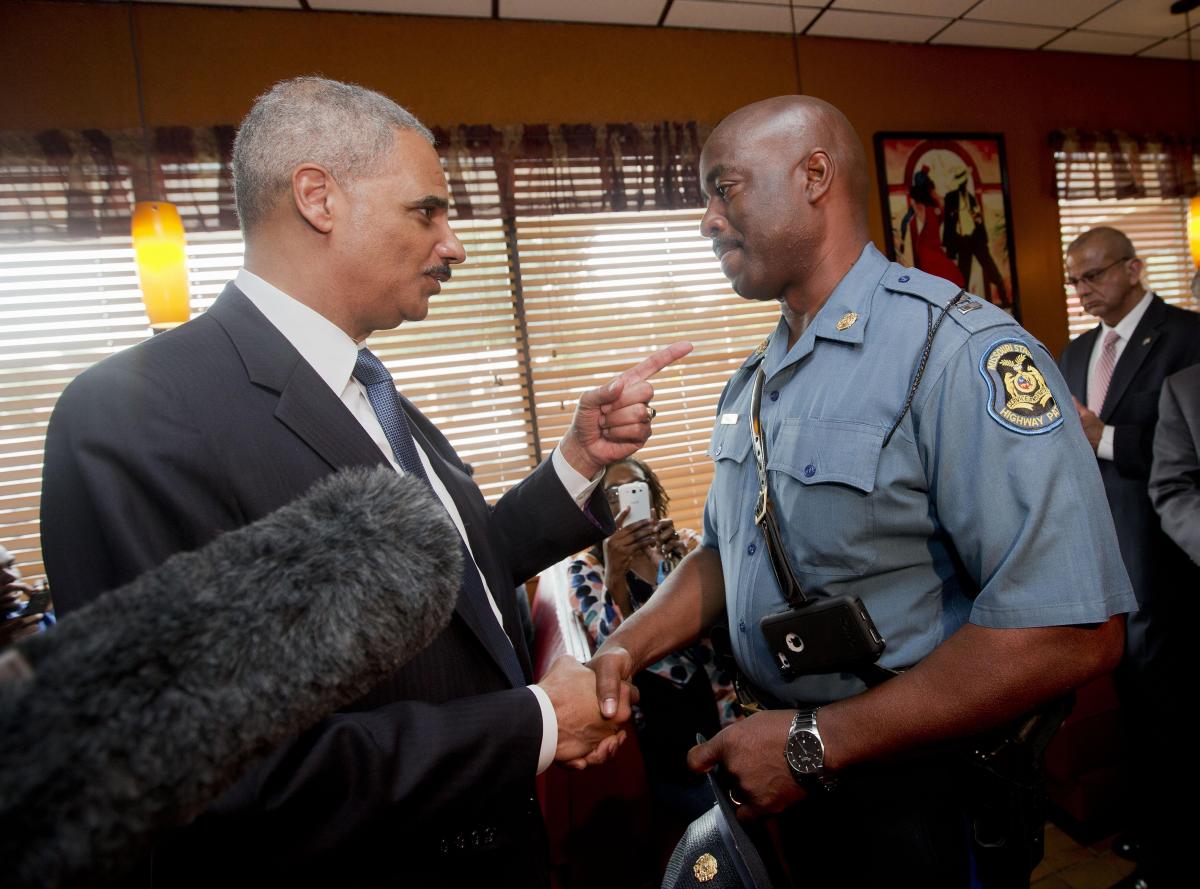
Holder in conversation with local police Captain Ron Johnson … emphasizing the fact that “justice” must be served.
However, little by little the actual facts in the case began to come out, though it did not seem to matter much to those committed to defending the “Black Lives Matter” crusade. It seems that Brown was hyped up on PCP, the huge youth had just pushed aside a store clerk who was contesting him over some cigars that Brown was determined to walk out with (caught on a security camera),

and then was walking down the middle of the street with his friend Dorian Johnson when officer Wilson pulled up alongside them and told them to move to the curb, an order that Brown was in no mood to obey. A struggle ensued when Brown reached into the car in an attempt to grab Wilson’s gun, shots were fired inside the police car, Brown and Johnson then ran off, with Wilson in pursuit – until Brown turned and charged Wilson, and got shot and killed in the process. The “hands up; don’t shoot” statement coming from Johnson was countered by observers at the scene who said that Brown had said no such thing, and that officer Wilson was under full assault when Brown was shot and killed. Forensics confirmed the latter account.
And although cleared by the evidence in the case, here too officer Wilson had to leave Ferguson under death threats.

Once again, Black “justice” demands the torching of the community (Ferguson) that failed to deliver the verdict that Blacks demanded
And again, try as he might, Holder’s Department of Justice also could find no basis for further action against Wilson – although Holder could not pass up the opportunity to deliver a sermon about the deep racial injustice that governed American society, and, being a minority himself, he could feel the pain of America’s minorities. In short, Holder was inviting America to pursue its cultural animosities through bitter identity politics, rather than find higher ground to come together over. But that seemed to be the theme of the times … or at least the theme of the Obama Administration (and many of the Congressional Democrats).
The Obama moral-spiritual legacy. Eight years of Obama’s “change” indeed left the country just that: deeply changed. In attacking and bringing down Middle or “White” America at every opportunity, he left Middle America bewildered, and Blacks and other self-identified “minorities” very vigilant against any effort of Middle America to reassert itself. Obama (along with the federal courts and the lawsuit-happy ACLU and its associates) had succeeded in branding Middle American social-moral standards as racist, homophobic, sexist, etc., in other words, prohibited by law on every front.
But worst of all for America, this same group had finalized the understanding that the Christian religion was prohibited in public everywhere. Religion could be touched on publicly, but only as long as it was non-specific (“spiritually generic”) in nature.
Worse, the legacy was to live on (supported strongly by Obama even out of office) in the form of the refusal of professional athletes to stand in respect during the playing of the national anthem, but to kneel as a sign of protest against all these “isms” that caused minorities to suffer so. This included very well-paid and highly popular football players, who just could not get enough of a social payoff to make them loyal supporters of the very idea of the American nation.


September 2016 – Obama signs in on the issue in support of Kaepernick, underscoring the huge problem of racism afflicting America … and the importance of opposing this evil (White America being the source of the problem, of course)

September 2017 – The racist “anti-racist” legacy lives on
Black lives do matter … greatly. Racism in any form, Black as well as White, serves no one honorably or even profitably. It’s a sign of insecurity rather than any serious understanding of life and its challenges. Racism, just like nationalism (English and French killing Germans because … well they’re just Germans and need to be killed … or so went the thinking of World War One), simply finds some great source of evil that, in being brought down, will supposedly make life much, much better. So racism in the 1950s and 1960s not only gave Southern poor Whites some sense that fighting the “Black peril” brought some logic to their difficult lives, it in no way improved the picture … for anyone. Well, anyone except the segregationist politicians who promoted such racism in order to get themselves elected and reelected. And Joe McCarthy did the same thing with the Red Scare … until the shallowness of what he was up to finally got exposed.
There’s much the same problem in the way Blacks explode easily over the difficulties they are having gaining the social standing that any person naturally craves. No one can claim that there are no serious problems confronting Black life. That just isn’t so. But the problem is very complex … with all kinds of causes behind this issue. Blaming Whites is, of course, the easiest explanation … one that hustling Black politicians at all levels of American society have been exploiting for their own political purposes. But as with all racist responses, this is not likely to bring serious solutions to the social problems facing the Black community.[5]
The Black murder rate is most disheartening. A government report that came out in 2011, early in the Obama Administration, pointed out that murder constitutes the biggest cause of death of Blacks in the 15-34 age group, almost 40 percent of those deaths (compared to 3.8 percent in the same age group of Whites). Most all of that is Black-on-Black action … though the police are sometimes involved. Actually, police shooting of Whites is twice the number involving Blacks … a tragedy for everyone involved. But nearly all of even those incidents show that the police were doing exactly what they were hired to do … in the line of duty in often very violent neighborhoods. There were tragic exceptions of course … but quite few considering the hundreds of thousands of police serving the country.
In any case, this very serious problem facing America is just not getting the serious attention it needs and deserves … because it has become much too politicized. Again, easy racist answers do not ever offer wisdom in the search for a solution to major social problems.
But thankfully a number of Black public figures have been speaking out about how racism is the wrong approach to the problem … something that racist politicians do not want to hear. But at least this former group is trying to get some serious action underway to improve the lives of young Black males – and Black neighborhoods – caught in a serious social crisis.
[4]DOMA had been approved in 1996 with a huge majority vote of 342-65 in the House and 84-14 in the Senate. But, with the encouragement of the Obama administration, it would take only a 5-4 Supreme Court decision to overturn that socially strategic law.
[5]In 1965, as Johnson’s Great Society got underway, 25% of Black children were born out of wedlock. That number now runs at 70%.
Even Obama himself in one of his more lucid moments once commented, on Father’s Day of 2008 (when running for the presidency), “Children who grow up without a father are five times more likely to live in poverty and commit crime; nine times more likely to drop out of schools, and 20 times more likely to end up in prison. They are more likely to have behavioral problems, or run away from home or become teenage parents themselves. And the foundations of our community are weaker because of it.”
Government grants. Obama inherited a national economic mess in coming to office at the beginning of 2009. Bush’s emergency loans enacted during his last months in office seemed to slow up the disaster rocking the banking industry. But America’s “Big Three” auto manufacturers (General Motors, Ford and Chrysler) were still in deep trouble. And Obama agreed that they would need some additional funding to get through the crisis.
But what he actually called for in taking immediate action on the nation’s economic crisis with his $787 billion American Recovery and Reinvestment Act in fact was not loans to help American businesses to get back on their feet but instead a simple giveaway of government funds for expanded unemployment benefits, health care, green energy, education, infrastructure development and various job creation programs.
Again, the Republicans balked at this, seeing the roots of rising Socialism and not just assistance to a hurting corporate world in the program. But the Democrats were delighted. America was back to doing “New Deal” programming like those of the Roosevelt and Johnson administrations. Thus the measure passed quickly in Congress (late January of Obama’s first weeks in office), 244-188 in the House and 61-37 in the Senate – almost entirely along Democratic-Republican party lines.
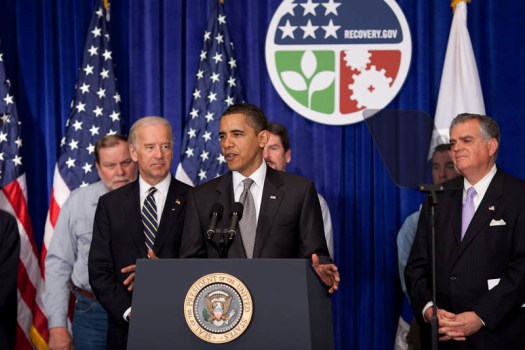
April 2009 – Obama celebrating Congress’s approval of his 2,000-project – $787 billion – American Recovery and Reinvestment Act (ARRA) set up by Obama to stimulate the economy
Bankruptcy in the auto industry. As far as the troubled auto industry was concerned, Chrysler was on the verge of bankruptcy – and General Motors was not far behind. In February, an agreement was made with the two companies that in receiving $20 billion in funding, they would close five plants (and 50 thousand jobs) and shut down hundreds of local dealerships. But in April, Chrysler filed for bankruptcy anyway, with Fiat agreeing to gradually come in alongside Chrysler as partner to rebuild the company. Then in June, General Motors also filed for bankruptcy, with the U.S. government taking 60 percent ownership of the company, the Canadian government 12.5 percent and the rest going to the labor unions. The original stockholders (a lot of them members of Middle America) were left out in the cold in the deal.
“Cash for Clunkers.” Then Obama put into effect the Car Allowance Rebate System (“Cash for Clunkers”) in which the government would offer from $2500 to $4500 towards the purchase of a new car, by turning in gas-guzzling cars (trucks and SUVs mostly) and buying smaller, more fuel-efficient automobiles.

Thus since trucks and SUVs were American car companies’ big income earners, “Cash for Clunkers” merely served to worsen the situation for the American companies, at the same time benefiting greatly the Japanese, Korean and German car manufacturers making the smaller sedans. Furthermore, almost $1.4 billion in car value was lost over any fuel-efficiency gain, because these “clunkers” exchanged in the deal could not be resold, but instead had to be destroyed, cutting back enormously the number of used cars that poorer Americans looked to for purchase.
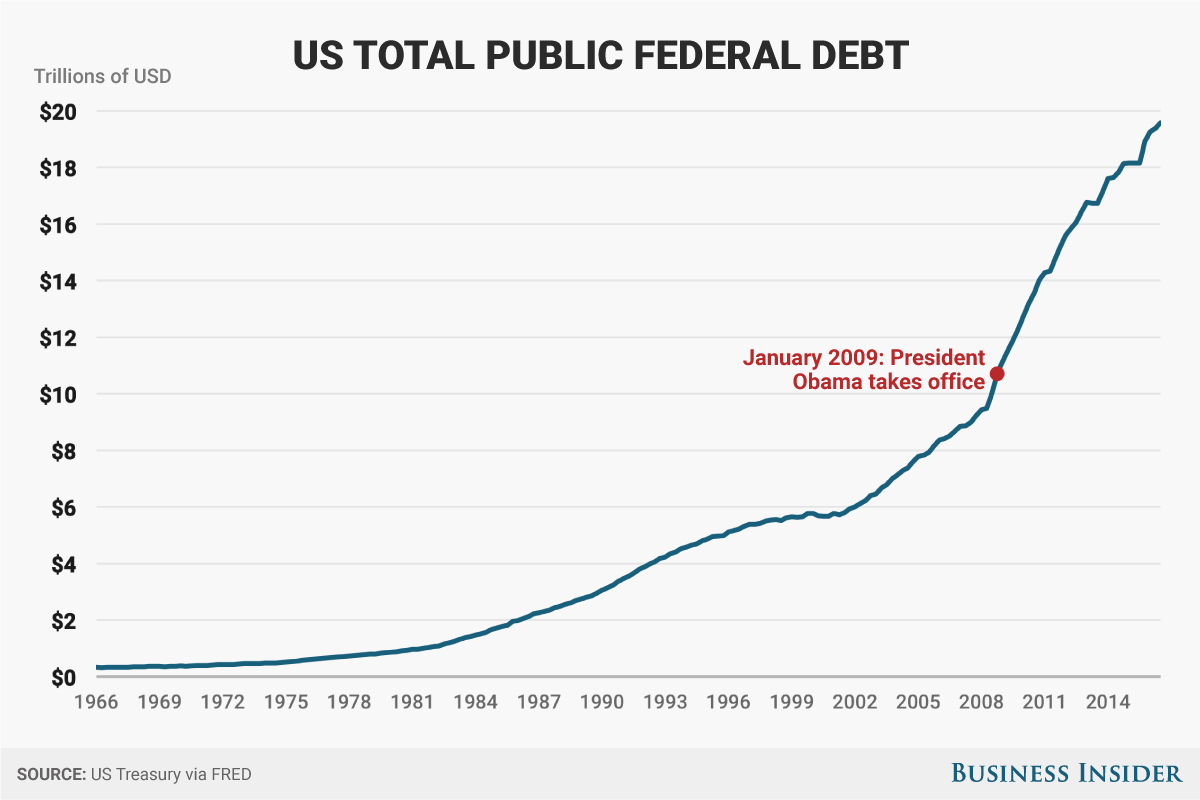
The rising national debt. And of course all this government giveaway merely increased enormously the national debt, already doubling from $5 trillion to $10 trillion in Bush’s eight years and now rising even more rapidly in these first years of Obama’s presidency, with $1.9 trillion added to the figure in 2009 and another $1.7 trillion in 2010. At this point the government deficit was calculated to be about 94 percent of the nation’s total productivity, up from the 57 percent figure it stood at when Bush first took office in 2001 and 70 percent when Obama took office in 2009. The government debt, now running close to the full value of the nation’s productivity, was a very dangerous economic indicator.
And still it had little impact on the poor showing of the American economy, whose official unemployment rate was rising, from 9.4 percent in 2009 to 9.9 percent in 2010, a figure which would actually have been much higher (around 15.9 percent) if those who simply had given up looking for work altogether (and thus no longer on the books) or were merely able to find part-time work were added into the calculation.
“Obamacare.” At the same time, the American medical industry was in crisis mode, although not because the health industry was in financial difficulties, but because ordinary Americans seeking medical help were finding it financially impossible to meet skyrocketing healthcare costs. The American medical industry boasted about the sophistication of the industry itself in comparison to the European healthcare industry. But the fact of the matter was that Europeans could receive rather normal medical care without being thrown into deep debt, whereas for many Americans just a 15-minute visit to the local doctor cost the equivalent of a full day’s wages, making medical visits as rare as possible. And costs for a single night’s stay in a hospital could easily amount to a several months of a person’s income. Worse, problems that required a “lengthy” stay (meaning more than a day or two) in a hospital could run costs up into the $millions.
Of course there was medical insurance to cover those enormous costs. But Insurance companies were not in the charity business and covered expenses by way of very expensive insurance premiums available to the Americans. And those costs were rising rapidly.
And what did these rapidly rising costs have to do with “improvements” in the medical industry? With insurance costs rising 5 to 10 percent annually, did this imply that healthcare was also improving at that rate? What was driving up these costs? And the answer can only be, greed on the part of those involved in the industry – fancy hospitals, high-status doctors, wealthy insurance companies, but probably most of all, medical liability lawyers who were more than happy to bring a client’s lawsuit against any doctor who made medical mistakes (doctors are not supposed to make mistakes, even though medical analysis is a highly risky matter). The rewards for the medical “malpractice” industry ran medical costs up into the clouds.
But this meant that the problem was more that of a social or ethical matter than a political or governmental matter. Nonetheless, Obama would attempt to take the problem head-on with his July 2009 1017-page document (which no Congressman had the time or ability to read in its entirety) Affordable Care Act (ACA) – or “Obamacare” as it was popularly termed. Again, Republicans balked at the bill, especially the part that proposed to put a government health plan into effect in competition with the private health insurance companies – Republicans claiming that this would give the government the power to drive those companies out of business and leave the country with only a government or “Socialist” medical program for the country. Also the Congressional Budget Office’s analysis revealed that this would run the government deficit up another $1 trillion, minimally (if not even more than that figure). And polls were indicating that the American voters themselves were deeply concerned about what this “change” in the American medical industry would mean to them personally. Democratic Party House Speaker Nancy Pelosi’s comment “just trust us” was not very reassuring to the general public.
Thus the fast action on this bill that Obama was hoping for just simply did not happen. By the end of 2009 only the Senate had passed the bill, 60-40 (along party lines), and at that point it was greatly changed, having dropped the government insurance program option. When early the next year (2010) the House finally voted on the measure, it narrowly passed with a 219 to 212 vote. On March 23, Obama was pleased to finally sign his signature Obamacare bill into law.

In the end, although Obama had his law, he forfeited a lot of popular support in the deal. And in the Congressional elections that November, the Democrats lost their majority to the Republicans in the House, the latter picking up 63 seats, the biggest swing in party fortunes since the 1938 election. With Republicans now holding 242 seats to the Democrats’ 193 seats, Obama had lost his former position in the House. But this was also when he pushed to overturn the “don’t ask’ don’t tell” rule in the military, before those 242 Republicans could take their seats in January of 2011 and he would no longer have full control of Congress.
The national debt continues to climb. By August of 2011, the government debt was approaching its debt ceiling, preventing the government from borrowing (selling bonds) beyond that figure. But the Republicans were much opposed to simply adjusting upward the debt ceiling, and instead wanted government spending to be brought under reduction in order to bring the budget closer to a balance of income versus spending. It was even proposing a constitutional amendment requiring government spending to stay within the limits of its income.
But all this speculation was making investors very nervous, and even the global stock markets began to take big hits. Worse, Standard & Poor downgraded the U.S. credit rating from a solid AAA to a reduced AA+, the first downgrade since 1919. Ultimately there seemed nothing left for the Republicans to do except to give in to the inevitable: the debt ceiling would have to be raised in order for the government to continue its operations. It repositioned the figure at $14.5 trillion, a new ceiling which government spending quickly reached by the end of the next year (2012).
But at this point increased borrowing had simply become a debtor’s habit for the government, and the debt ceiling had to be “temporarily” suspended in 2013, then again in 2014, again in 2015. By the end of Obama’s presidency in January of 2017, the national debt had reached the figure of nearly $20 trillion or 104 percent of America’s annual productivity – the debt having also doubled, like Bush’s administration, in Obama’s eight years as president.

The “New Look.” Sounding very much like Jimmy Carter in his first days entering the White House, Obama made it very clear that with himself in the White House a very new look would come to American foreign policy. Towards Russia he offered a “reset” in Russian-American relations and in Cairo he addressed the Muslim world with much the same message … although what this new look would actually entail was by no means clearly outlined. But this new attitude so impressed the Norwegian Nobel Committee that in February (with just a month in office) Obama was nominated for the Nobel Peace Prize, and in fact the final recipient of that honor that October.

Many stood in amazement, because he had actually done nothing in particular to deserve such a high honor, other than advocate publicly the kind of Idealism that touched the hearts of the “Liberal” world. But being the head of the world’s supreme superpower would require a lot more than nice-sounding language. Obama was about to discover this.
Iraq. In campaigning for the presidency in 2008, Obama had promised that if he were elected president, he would bring American troops home from Iraq.

Obama and Iraqi Prime Minister al-Maliki in Baghdad – April 2009
And indeed upon entering the White House, he announced that U.S. combat operations would be ended in Iraq by August of the following year (2010) … and the 142,000-troop level there would also be reduced to 30,000-50,000 by that date. Those remaining would serve only as trainers and advisors. And all troops would be gone by the end of 2011. And indeed, he was able to keep to this timetable, having problems only with negotiating an understanding with the new Iraqi government as to the status of American troops remaining as advisors.
Meanwhile Iraqi “democracy” made little headway in resolving the Sunni anger at the loss of power to the Shi’ites. The Nouri al-Maliki government continued to represent the hard-core Shi’ites, despite American efforts to promote the more moderate Ayad Allawi and his party – which had actually gained a slightly larger vote in the March 2010 elections, although both groups were unable to operate without going into coalition with other parties.
Anyway, Obama finally decided to simply leave the Iraqis to their own fate. And as soon as the Americans departed at the end of 2011 al-Maliki issued a warrant for the arrest of the Iraqi Vice President Tariq al-Hashimi (a Sunni), who fled to Kurdistan to avoid arrest.

The Iraqi vice president Tariq al-Hashemi and his son are sentenced to death in absentia – September 2012
Thus with the American departure, Iraqi politics was now allowed to take a more natural Middle Eastern profile! So much for Bush’s extremely expensive “democratic nation-building” in Iraq.
Afghanistan. However when it came to the Bush legacy in Afghanistan, Obama met it with a different strategy, attempting a “surge” there, one that had worked so effectively in 2007 in Iraq. Thus in his first month in the presidency he announced that he intended to deploy an additional 17,000 American troops in Afghanistan.
But increased deployment seemed to take on more the older Vietnam profile than the more recent Iraq profile. Trying to run down the Taliban proved to be pointless, largely because of the Taliban’s ability to retreat into Pakistan (where American soldiers dared not go) when the Taliban found itself hard pressed by the American and European troops.
At the same time, America’s ally, Afghan President Karzai, saw it wiser to undertake negotiations with the Taliban, shocking Americans who saw in this some kind of betrayal of their alliance with his government. Obviously, those Americans had no idea whatsoever about how Afghan politics worked, and had worked since time immemorial!
Not finding much success in his initial “surge,” Obama in December (2009) announced that he would be upping the American military presence in Afghanistan even more, adding another 30,000 troops to the American force there. But facing growing opposition at home, he also announced that he would be bringing all American troops home by the middle of the next year. This strange announcement only emboldened the Taliban even more – who, with the promised departure of Western troops, were willing to wait out all of Obama’s back and forth military moves. And it put Karzai in an even tougher position in trying to govern Afghanistan.
Pakistan, and bin Laden’s takedown. Meanwhile tensions were rising with America’s former ally Pakistan over the protection that the Taliban was finding in that country. And with Wikileaks publishing thousands of classified U.S. documents, it became quite clear to all that America was very upset over the fact that the Pakistani Intelligence Service (ISI) was actively supporting the Taliban.
But in the meantime American intelligence had discovered bin Laden’s location in Pakistan (less than a mile away from the Pakistani Military Academy) and on May 2, 2011, sent two Black Hawk helicopters with a dozen Navy SEALS to take out the hated enemy, and then fly bin Laden’s body off to the Arabian Sea to dump him there (after appropriate Muslim burial rites!). The Pakistanis were furious about this violation of their country’s territorial rights. But there was really little they could do at that point.
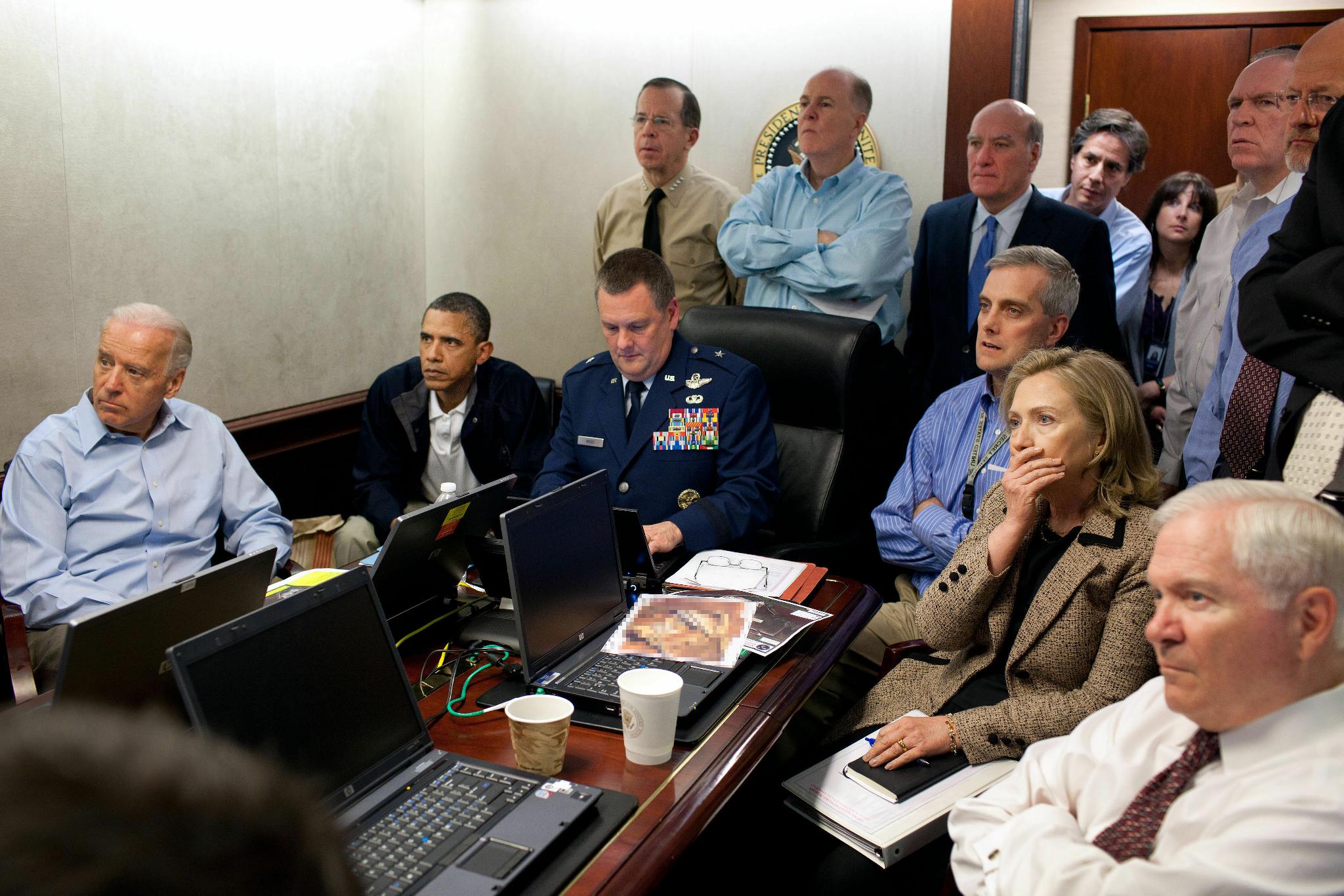
Obama and the national security team await updates on the bin Laden takedown
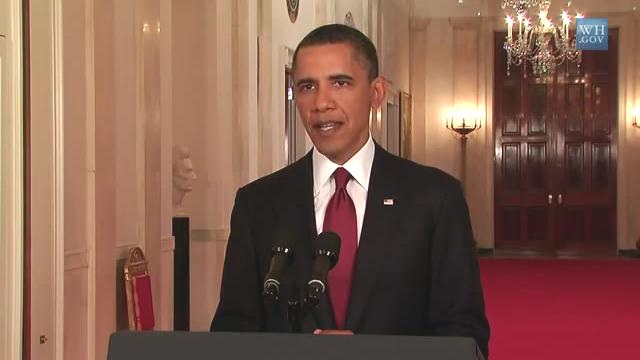
Obama announces the death of Osama bin Laden – 11:00 p.m. that same night
And Obama came away from this risky event looking very presidential! And thus also ended a 10-year-old chapter in American life.
NATO troop draw-down in Afghanistan. The draw-down of the Western troops went ahead on schedule, with Obama signing a partnership agreement in 2012 with the Karzai government, promising continuing support despite the withdrawal of the Western or NATO combat troops. Thus at the end of 2014 a formal withdrawal of the NATO troops finally took place, although staying behind (with even official United Nations approval) would be some 17,000 multinational troops, plus “private” or contract soldiers – their purpose being solely to train Afghan government troops. Nonetheless, this departure would be the signal for the Taliban to begin their move to retake villages (and punish villagers) that had cooperated with the Western forces.
The “Arab Spring” breaks out in Tunisia (2011). Part of Obama’s “New Look” included his widely watched televised speech “A New Beginning” that he delivered to the Arab world during a visit to Egypt in June of 2009.
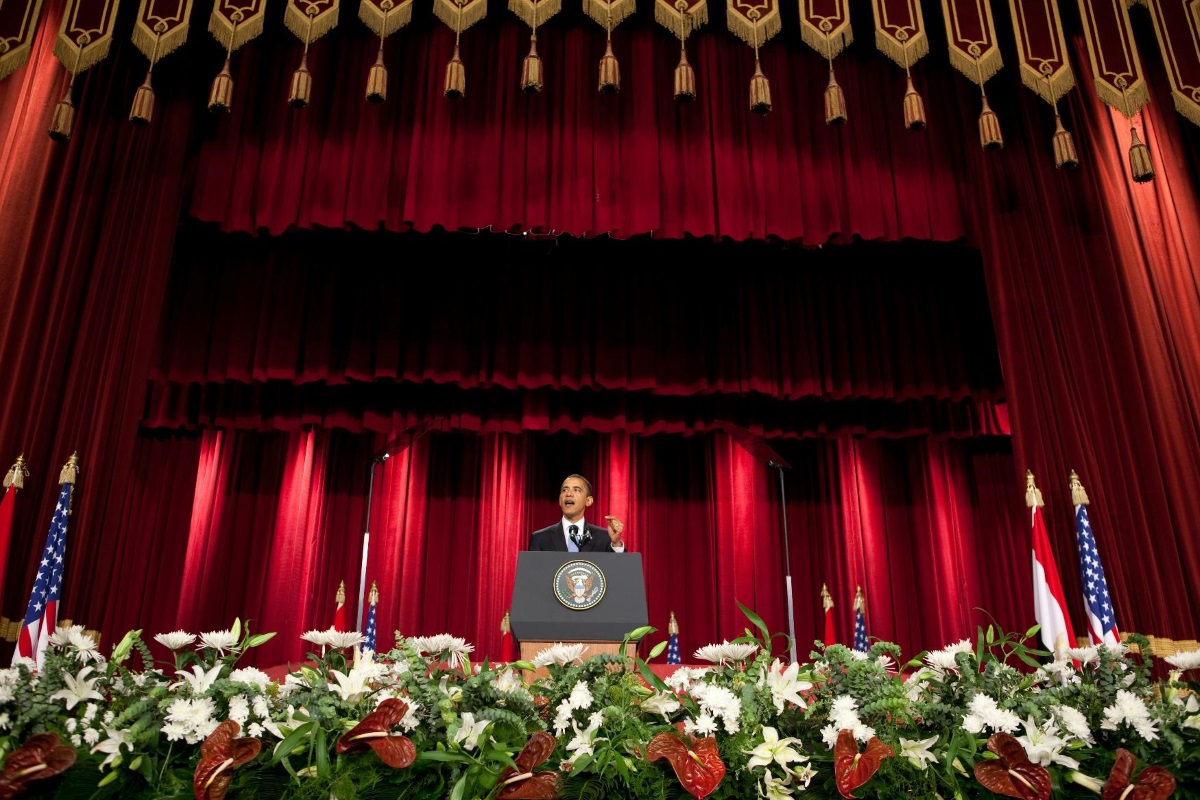
In that speech, he emphasized his commitment to helping develop a greater spirit of personal freedom, political democracy and economic development in the Middle East, not exactly a novel ideal for Americans, for that had also been part of Bush, Jr’s intent in Afghanistan and Iraq. In short, America under Obama would remain in the business of supporting nation-building abroad. Would this work any better than it had for Johnson in Vietnam, Carter in Iran, and Bush, Jr. in Afghanistan and Iraq? Time would soon tell.
Troubles in the streets broke out in January of 2011, when Tunisian youth came out in huge numbers to protest a broad number of social issues that had them deeply angered. With this, the “Arab Spring” got underway.

The protest was characterized by much electronic connect through computers and cell phones, and the active involvement of the media in dramatizing the event.
 By the middle of the month Tunisian President Zine ben Ali had fled the country, and it seemed that the youth had achieved a tremendous political victory, although street action continued all the way up to October, when finally elections were held to appoint those who would write Tunisia’s new Constitution.
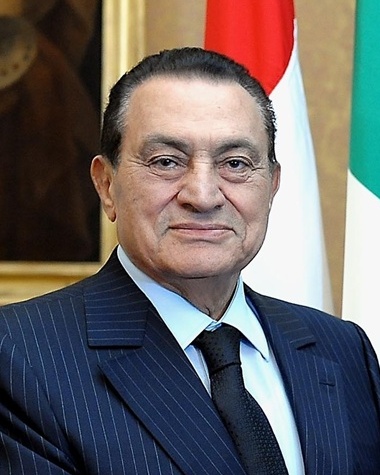 The Arab Spring comes to Egypt. But the rest of the Arab world was watching events in Tunisia closely. And soon the youth of other Arab states took up the same cause: to overthrow their long-standing governments, in order to replace them with new similarly “progressive” systems. Egypt would be hit hard with this rising mood, as Egyptian youth camped out in Tahrir Square in Cairo with the intentions of outstaying the Egyptian police until the nearly 30-year-long regime of Hosni Mubarak was brought to an end (actually the elderly and very sick Mubarak was preparing his son, Gamal, to take over his position as Egyptian president.)
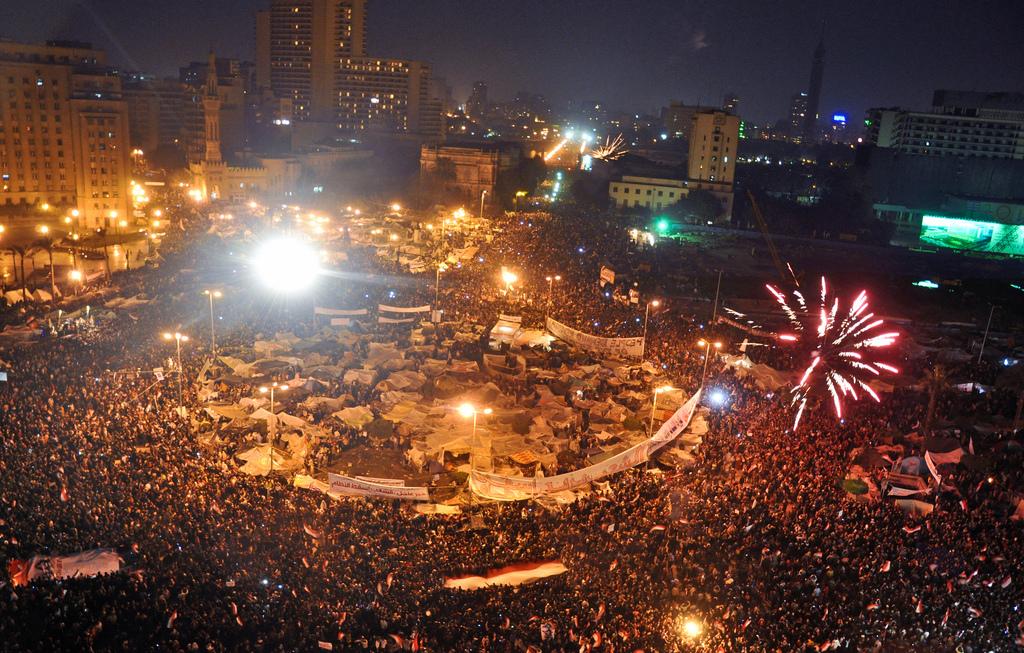
As the Cairo protest dragged on, Mubarak shut down the internet, but also made some efforts to appease the protesters with changes in the Egyptian government cabinet and the appointment of a Vice President (not part of the Mubarak family!). But this hardly satisfied the protesters, whose numbers gathered in Tahrir Square merely increased (similar to the way things had developed over the days and weeks in Tiananmen Square in Beijing). Seeing huge troubles developing, the Egyptian military finally stepped in and in mid-February arrested Mubarak and took control of the Egyptian government, promising constitutional reforms. But still, the protesters remained encamped in Tahrir Square … their numbers continuing to grow.

Protests mounting in Cairo – June 2011
Now Egyptians found themselves fighting fellow Egyptians as the days, weeks and then months passed, the level of violence continuing to mount through the summer and into the fall. Sectarian or religious-cultural violence became a key part of the chaos, as, for instance, Coptic Christians (about 10 percent of the population) became objects of Muslim retribution. Also Muslim groups themselves turned on each other, as well as against the more culturally secular of the Egyptians. By the time that elections for the new Constituent Assembly were held in November, Egypt was on the verge of civil war.
But hope ran high that elections under the new Egyptian constitution, held in May the following year (2012), would produce the step of Egypt into the world of democracy that Obama supported so strongly. In those elections, Muslim Brotherhood leader Mohammed Morsi won 51.7 percent of the vote, his Secularist opponent Ahmed Shafik coming close at 48.3 percent.
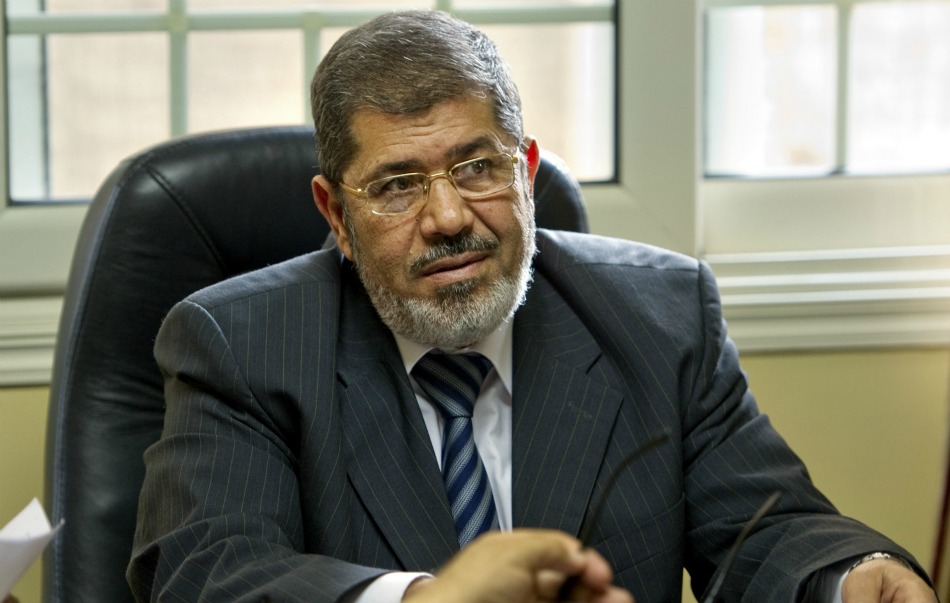
Obama was enthusiastic about the results and congratulated Morsi on this wonderful development. But a wiser Shafik left the country, just before Morsi put out a warrant for his arrest. So much for Third-World democracy.

And the chaotic situation in Egypt did not improve any – “forcing” Morsi to take an ever-stronger or dictatorial hand. The situation grew so bad that finally, with not just Tahrir Square but the very streets of Cairo filled with anti-Morsi protesters (June 2013),
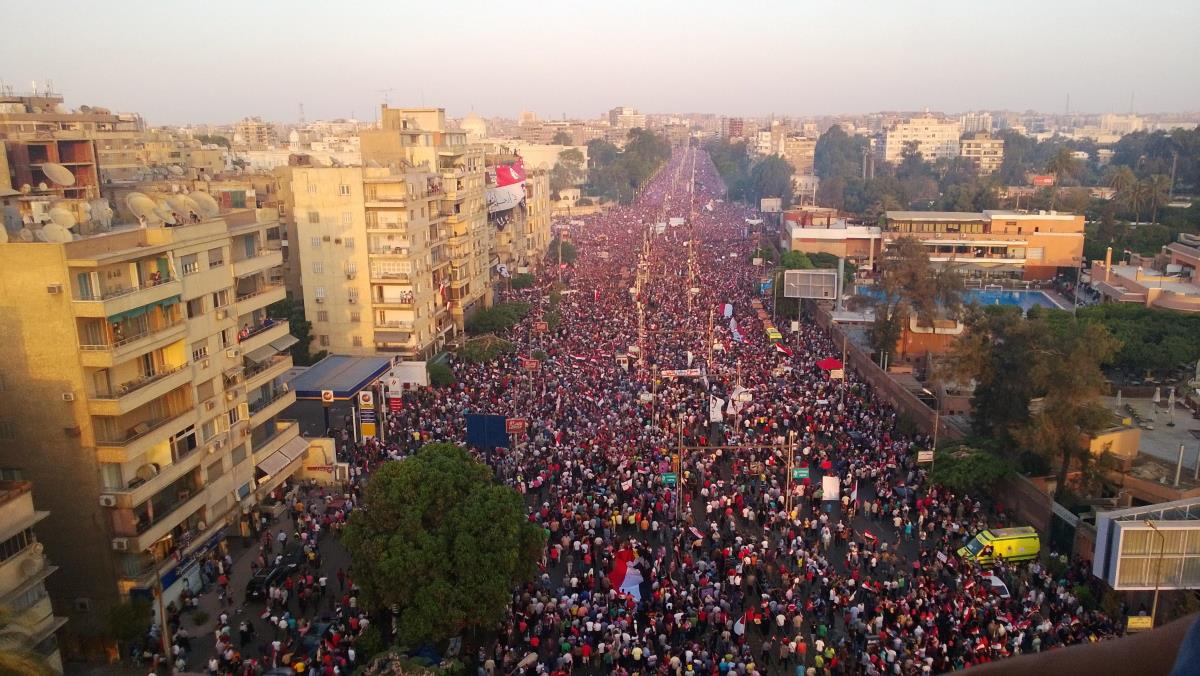
the Egyptian military again stepped in and deposed Morsi, finally bringing Egypt back to order.

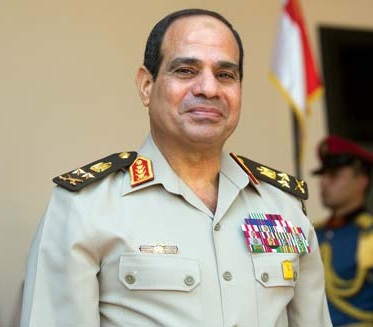
Obama was furious over this violation of “democracy.” But he could say little about matters in Egypt when another election was held (with Muslim radicals boycotting the election) and former General / now President Abdel Fattah el-Sisi gaining huge Egyptian civilian support for his leadership.
Then Syria. Meanwhile by mid-March of 2011, the mood of youthful protest had moved on to Syria, where protesters gathered in Damascus with their own list of demands for political and economic reform.
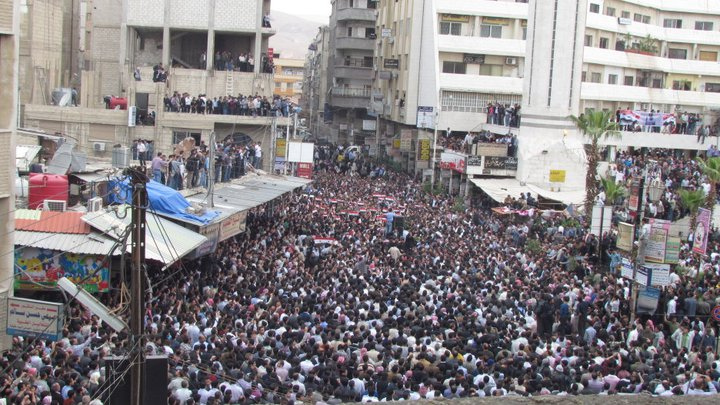
But as in Egypt, the demands became increasingly confusing as they intensified, some wanting more secular reform, others more Islamic reform, but deeply divided as well over whether that should take a Shi’ite or Sunni character. Even more than Egypt, Syria was a complex mix of all sorts of sectarian groups, not only Sunni versus Shiite Muslims, but also Druzes (semi-Muslim), Christians (from various versions of Eastern Orthodox to equally culturally diverse Catholic groups), not to mention long-standing family, clan and tribal loyalties. And of course there were a huge number of simply Secular Syrians, diverse in character as well.
Syrian President Bashar al-Assad was a member of the Alawi sect, part of Shi’ite Islam, but mostly Secular in political character.

He and his father before him had been holding this fragile social mix together, at times by forceful means. Actually, at first protests were for simple reforms, not for any end to the Assad presidency. But with time as the protests radicalized, they did indeed take on an anti-Assad position, which merely provoked an equally militant reaction of Assad supporters.

It was everything Assad could do to keep the country from falling into bitter civil war.
Then Libya. There was also the matter of Libya, where the “Arab Spring” had hit that country in February. Actually, in Libya the rebellion involved no more than a rivalry between the two chief cultural regions that made up the country, regions that had long competed against each other in that part of North Africa (Libya was assembled as a “nation” by the Italians in the early 1900s by lumping these mutually antagonistic regions into a single colonial holding). Thus the Arab Spring in Libya entailed simply a civil struggle between the groups, one found mostly in the eastern part of the country with its political center in Benghazi and one in the western part of the country with its political base in Tripoli.

July 2011 – (Green) Cities controlled by pro-Gaddafi forces (as of July 1, 2011); (Dark Brown) Cities controlled by anti-Gaddafi forces … supported by coalition (mostly NATO) forces
Wikipedia – “2011 Libyan civil war”
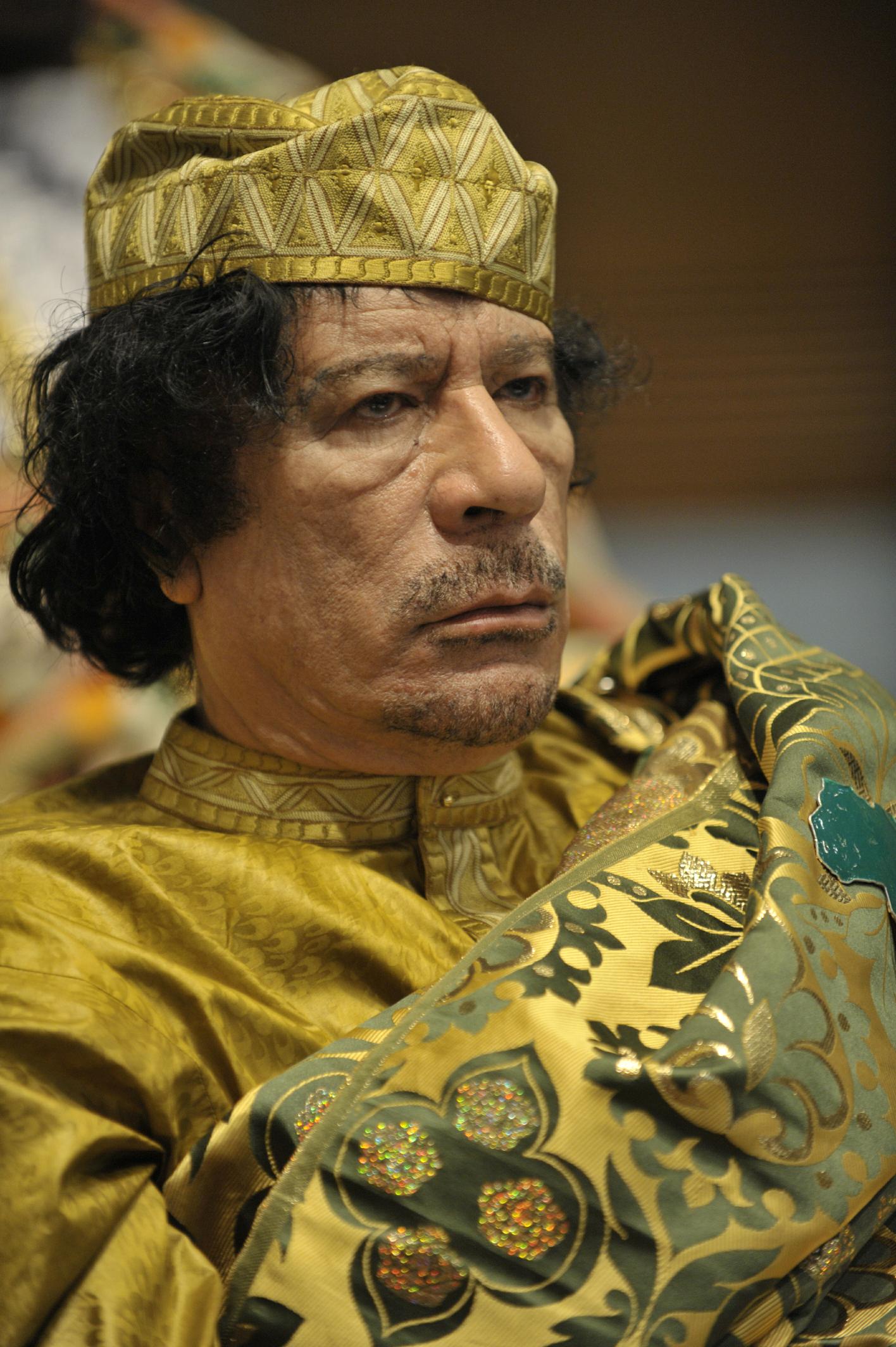 Libyan President Muammar Gaddafi held this together by building a strong political base in Tripoli, and keeping the country focused on foreign developments – which Gaddafi involved himself in constantly (and rather flamboyantly and recklessly) in order to keep his people distracted.
In the midst of all this confusion, Obama and his NATO allies (notably France) decided that this would be an opportune time to get rid of the very troublesome Gaddafi, and at the same time bring Libya to real democracy. So they called for a no-fly zone over the country (meaning that Gaddafi could not use air power in the defense of his government), and then “enforced” this decision by flying their own missions in Libya to bomb his forces, and to supply his adversaries, most notably the National Transition Council (NTC). And thus with considerable NATO (including American) support, the NTC was able to extend its position in Libya, until Gaddafi was trapped, caught and executed on the spot, all graphically displayed to the world.
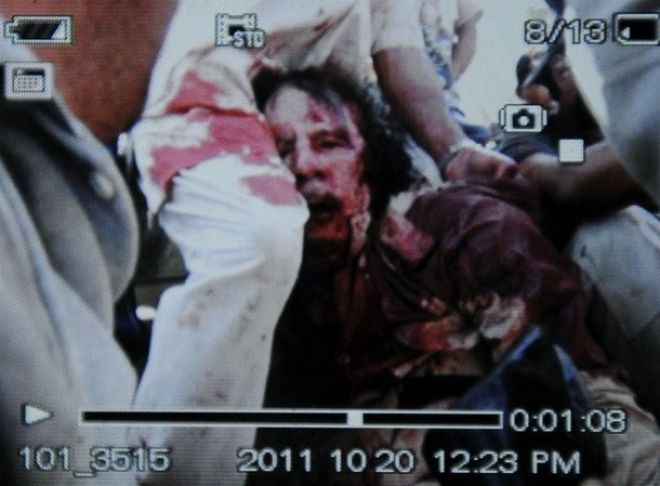
In Libya, part of the country cheered; part of the country seethed. But Obama felt well content that America and its NATO partners had just led Libya to the right kind of political dynamics.
The chaos worsens in Syria. Meanwhile, back in Syria, there too the international community decided that it needed to get involved in helping return Syria to some kind of social order. Shi’ite Iran decided that it needed to help fellow Shi’ite Assad in crushing the rebellion (which would also bring the reach of Iran all the way up to the Mediterranean Sea). Russia’s President Vladimir Putin noticed the same possibility of finding itself usefully stationed in Syria by offering Assad some military assistance (and thus also achieve in the process the long-sought goal of a Russian position in the eastern Mediterranean). And the Turks next door were growing increasingly concerned about the violence spilling over into their country and wanted something done to stop the chaos.
Once again, Obama decided to “help” Syria (like the help offered Libya), demanding in August that Assad step down in order to allow his country to move to actual democracy (like Iraq?). He was even more forceful in threatening Assad with “serious consequences” if he crossed a “red line” in the illegal use of chemical weapons and certain categories of bombs in his efforts to crush the rebellion.

But Assad was too busy trying to stop Syria’s collapse into complete chaos to pay much attention to Obama’s threats, and simply ignored them.

An embarrassed Obama ultimately came up with no compelling “consequences” and had to backtrack on his threats, prompting Putin to agree to step into the mess and help “mediate” between Obama and Assad. But instead Putin moved to full support of Assad, at the same time that Obama (in cooperation with the Saudis) began sending arms, even tanks, to one of Assad’s Sunni opposition groups.[6]
But unlike Libya, Obama’s intervention did not tip the balance in favor of a “democratic” group able to bring the war to a close by crushing Assad and his supporters. The intervention simply intensified the violence all the more.
Worse, Sunni jihadists who were escaping Shi’ite dominance in Iraq, were able because of the total chaos prevailing in Syria not only to position themselves in the eastern half of the country bordering the Sunni lands of Iraq, but were even able to set up a new caliphate (Sunni Islam’s highest religious-political office) as the nucleus of a new jihadist Islamic State, from which they could then cleanse the earth of unbelievers.

Abu Bakr al-Baghdadi, the Sunni caliph (head) of the newly founded Islamic State of Iraq and Syria (ISIS) … a militantly anti-Western (and especially anti-American) organization

As for the vast majority of the Syrians, they now found themselves with only one serious alternative if they were to survive at all: flee to other countries where they could live out at least a very minimal existence in refugee camps, or, if really lucky, possibly escape into Europe. Millions of Syrians now took flight. Syria was no longer a place fit for human habitation, thanks in great part to all the outside “help” the culturally-diverse country was getting.

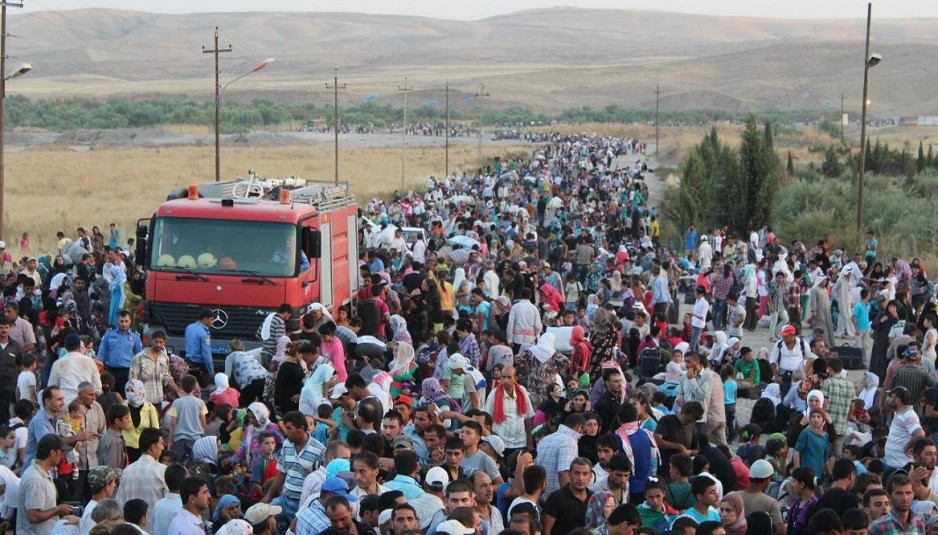
August 2013 – Syrian refugees heading toward Iraqi Kurdistan

A Syrian refugee camp in Jordan. By 2015, 25% of the population of Lebanon was made up of Syrian refugees and of Jordan some 20% of the population … with huge numbers scattered elsewhere.
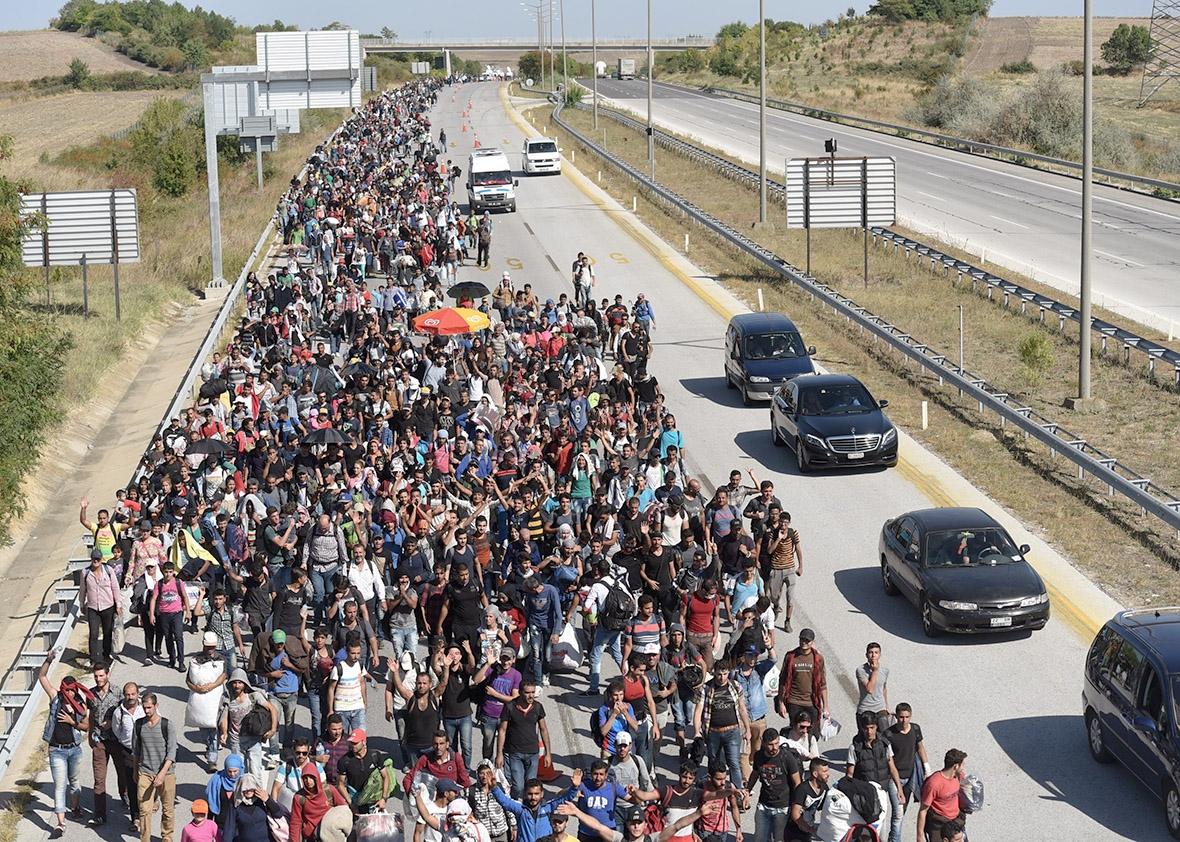
Syrian refugees heading across Turkey towards Greece

2015 – Hungarian police blocking the entrance of Syrians into Hungary
Yet, with Russian and Iranian help, Assad was surviving. And indeed, both Russia and Iran now found themselves positioned politically in a very strategic location along the Eastern Mediterranean coast. Furthermore, a very violent form of Islam found itself well-based in the wastes of Eastern Syria and Northwestern Iraq, ready to take on the world. And as for America, Obama had succeeded only in making America politically a persona non grata (unwanted personage) in what was left of life back in Syria.
Benghazi. Meanwhile now-dysfunctional Libya struggled to contain the mess that followed Gaddafi’s downfall. And the next year, 2012, on exactly September 11th, Muslim militants of Ansar al-Shari’a succeeded in attacking and torching the American consulate and the CIA annex located in Benghazi (the capital of the Libyan region Obama had been supporting in the war against Gaddafi), also killing the American Ambassador to Libya, Chris Stevens, and three other Americans.
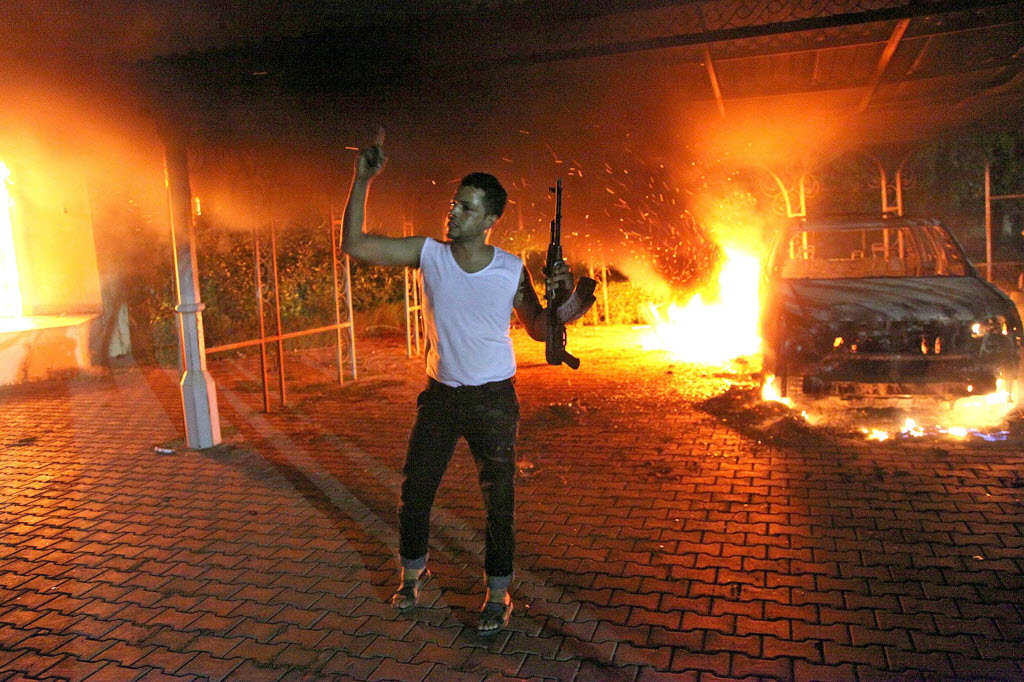
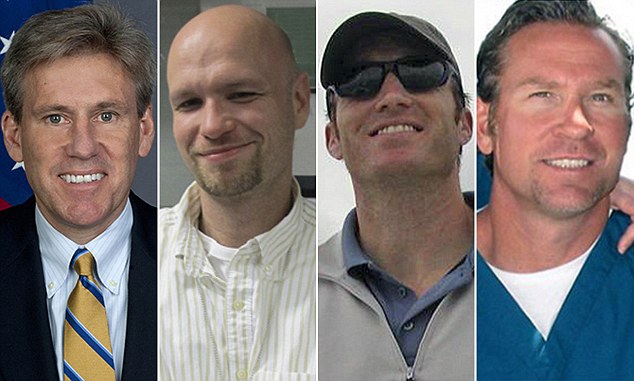
Chris Stevens, Sean Smith, Glen Doherty and Tyrone Woods
At first the State Department claimed that this tragedy was the result of a spontaneous uprising of local Muslims – because of a video offensive to Islam that had just come out. But very soon it was revealed that Stevens had previously warned the White House of a mounting danger with Islamic militants in the area, had requested extra security, but had failed to receive it, leaving him and his team totally defenseless. It was clear that this Muslim uprising was not “spontaneous” but instead an action long in development, one which Washington had basically ignored, until it blew up as it did.
With national elections coming up soon (that November) and expectations that the Republicans would run big with the story of the huge blunder, Obama answered by announcing the departure of a number of State Department officials, and that Secretary of State Hillary Clinton would be stepping down at the beginning of 2013, with Senator John Kerry taking over her position.
From this point forward, America simply looked the other way as the situation in Libya deteriorated even further, leading the Libyan army in 2014 finally to move strongly against the militant Muslim groups. But in doing so, while they brought an improvement in the Libyan situation, they also succeeded in driving these militant groups off to Iraq and Syria, where they then added to the strength of the Islamic State or Caliphate seeking to overthrow the governments of Iraq and Syria (and elsewhere).
Growing problems with Putin’s Russia. At the beginning of his presidency, in hoping to push a “restart” in Russian-American relations – in part by relaxing the American military posture in Eastern Europe – Obama ordered the abandoning of plans to place a missile shield in Poland (originally planned as a defense of Europe against a feared attack from Iran) as well as radar intercepts that were supposed to be placed in the Czech Republic.
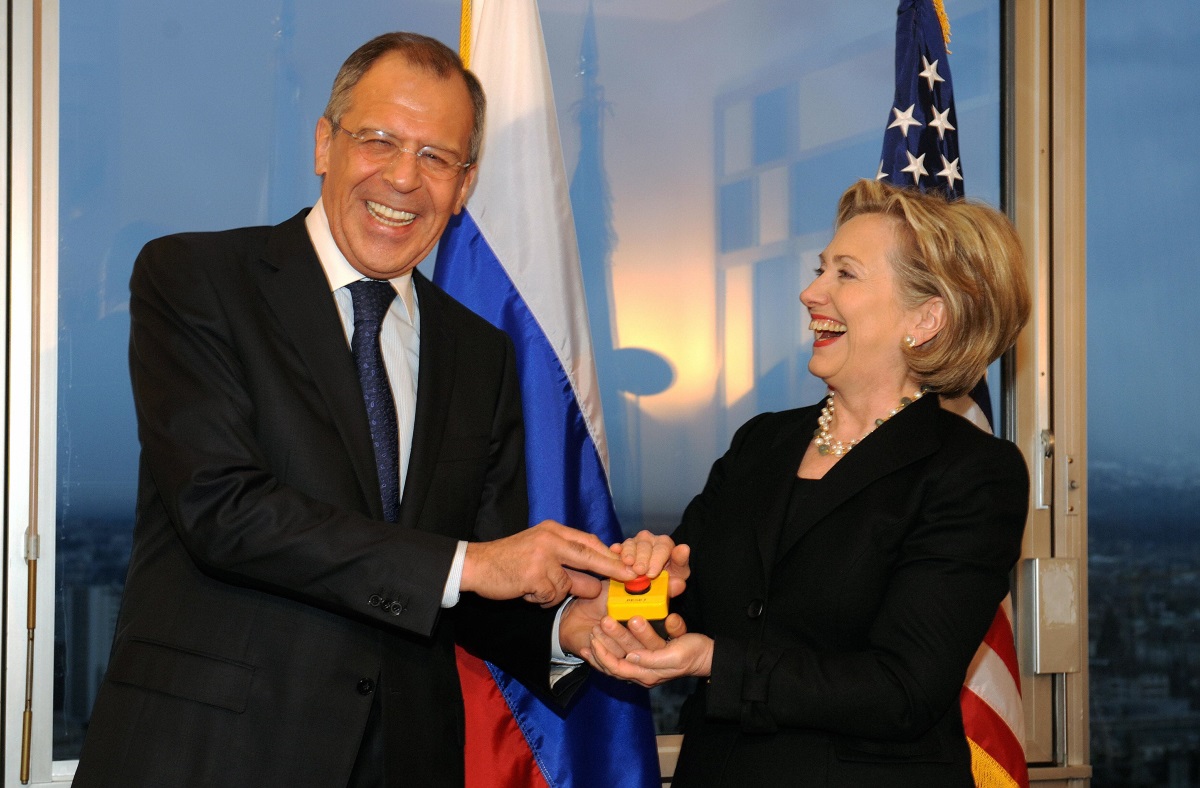
March 2009 – Secretary of State Hillary Clinton presenting Russian Foreign Minister Sergei Lavrov with a “reset” button … signifying the new Obama approach to Russian American relations. Actually the Russian word used was “overload,” startling Lavrov … until the confusion could be cleared up!
Obama claimed that American ship-based interceptors ready for service by 2018 would suffice in providing such security. Russia was delighted at this American step-back in Eastern Europe. But NATO partners Poland and the Czech Republic were left in a state of shock over the matter, wondering exactly what it meant in terms of their own larger security needs (such as against an aggressive Russia).
Then the “restart” would find itself in trouble with political developments occurring in Ukraine. This newly-independent Ukrainian Republic (part of the former Soviet Union) was deeply divided culturally and politically between a Ukrainian-speaking majority and a large Russian-speaking minority (the latter located in the eastern provinces of Ukraine). Ethnically, the two groups were close in character, except that politically a bitter division ran deep.
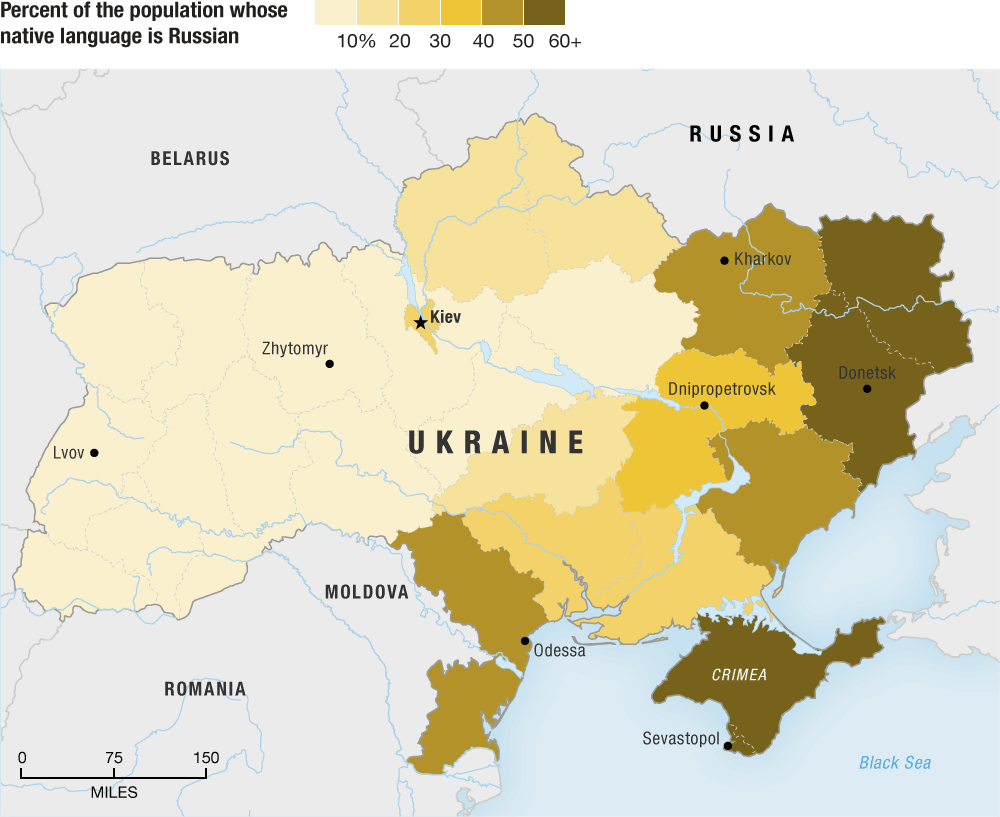
From 2007 to 2010 Ukraine possessed a Ukrainian-speaking Prime Minister Yulia Tymoshenko. But in 2010 she narrowly lost the national elections to Russian-speaking Victor Yanukovych, who, in rather typical “Third World” fashion, found cause in 2011 to have Tymoshenko arrested and imprisoned on “corruption” charges, which in turn set off demonstrations and then riots (Arab Spring style!) in the Ukrainian capital, Kiev, action which only grew more violent over time (termed the “Euromaidan Revolution”).
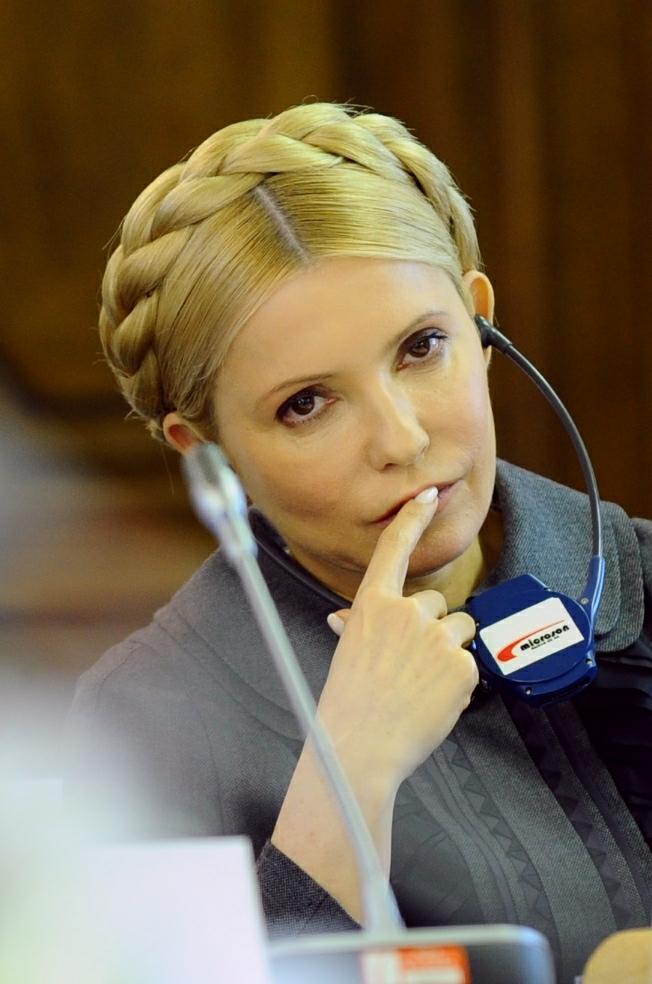
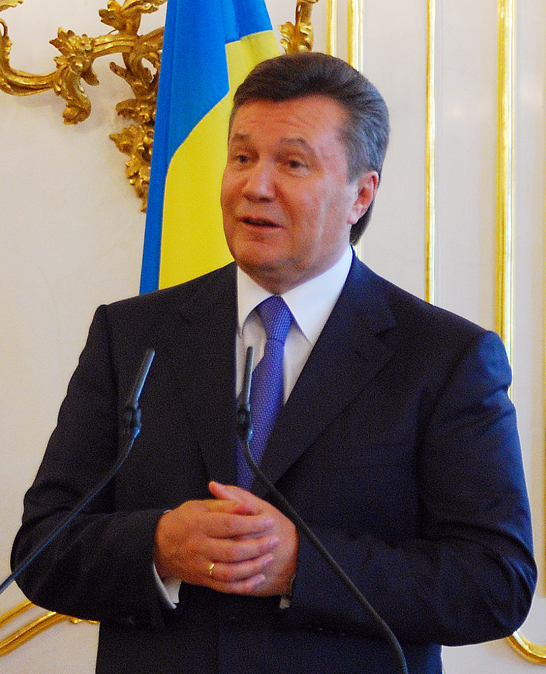
Tymoshenko Yanukovych

By February of 2014 the action was so bad that Yanukovych went into hiding, and Russia’s strongman Putin decided that it was time for Russia to act. Obama warned Putin not to get involved or, again, “serious consequences” would result. But by this time Putin had no regard for Obama as a strong leader whose word was to be fully respected.
Thus at the end of the month he sent Russian soldiers into eastern Ukraine, wearing no military identifications – and thus termed simply the “little green men!”

They seized the joint Ukrainian-Russian military base at Sevastopol in Crimea, turning it into a solely Russian base, and leading Putin to claim the whole of the Crimean Peninsula as now part of Russia.

But Putin went no further with respect to the rest of the Russian-speaking sections of Ukraine, which now found themselves living in political limbo.
Obama’s “serious consequences” ultimately turned out to be whatever action Obama was able to get America’s European allies to take, with France and Germany (not America) leading the 2014-2015 Russian-Ukrainian ceasefire talks, and economic sanctions taken up by both America and Europe in reduced trade with Russia (although Europe, especially Germany, remained heavily dependent on Russia’s oil and natural gas exports). In the end, all this changed nothing about the way the situation in Ukraine developed. But it also ended the “restart” of Russian-American relations. Putin’s Russia would become much more aggressive in opposing America any way it could at this point.
Growing problems with Xi’s China. Twenty years earlier America had invited China into the world of international trade and finance by favoring the struggling Chinese economy with all sorts of exceptions to the rules of the international economic game as played by the veterans of the West. The Chinese currency, the yuan or renminbi, was allowed to be offered at well-below market price in order to give the Chinese trading advantages they would need to get their own market economy up and running. And the results had been phenomenal: around 10 percent annual growth in the Chinese economy as vastly cheaper Chinese goods flooded the world market, improving vastly the Chinese employment picture – at the same time working deep harm on the American producers and their workers, who could not compete with the heavily subsidized Chinese products.[7]
At the same time, Chinese dollar earning from Chinese trade grew so vast that China was able not only to keep its huge workforce employed and allow the country to purchase scarce resources (such as oil) in which it was lacking, it enabled the Chinese to invest abroad in the production and sale of not only scare resources it needed, but also that the world needed. China was slowly putting itself in a position of market control of various strategic products, as well as bringing a lot of Third World countries into dependency on this Chinese economic “assistance.” The West was quickly losing diplomatic as well as economic leverage abroad to the Chinese.
Furthermore, with America running up a huge debt – accelerated greatly under Bush, Jr., but continuing at the same rate under Obama – China was able to purchase huge portions of that American debt, which placed America as a debtor nation even more deeply in a state of dependency on China and its economic policies.
 Obama tried to renegotiate the economic relationship with Xi Jinping’s Chinese government … especially on this matter of currency subsidies which were resulting in a one-way trade program which had Chinese goods flooding America (and the West) – with no significant amount of trade moving in the opposite direction. Understandably, Xi was not interested in changing the arrangement. And ultimately, short of some serious muscle applied to China – which was not Obama’s style – there was little that China would be willing to do to adjust the situation. And so things went.
Then there was this matter of Obama’s proudly proclaimed “Pivot to Asia,” in which America would shift some of its diplomatic attention to Asia – thus strengthening America’s relations with Japan, South Korea, Taiwan, Australia, etc. Obama affirmed that this Pivot was also intended to improve relations with China as well. But Xi did not see things this way, interpreting this as a move merely to put America in a better bargaining position in its relations with China.
Anyway, Xi had his own “pivot” in mind for Asia: his claim that the South China Sea, bordered by many Asian countries, was in fact Chinese territorial waters, not “high seas” as America (and the rest of the world) claimed. To support this claim, Xi ordered the dredging of coral reefs in the Spratly Islands (close to the Philippines) in order to create new islands whose political goal was kept mysterious, until it finally became apparent that these were to be Chinese naval and air bases, positions from which Chinese sovereignty over the entire sea could be enforced.
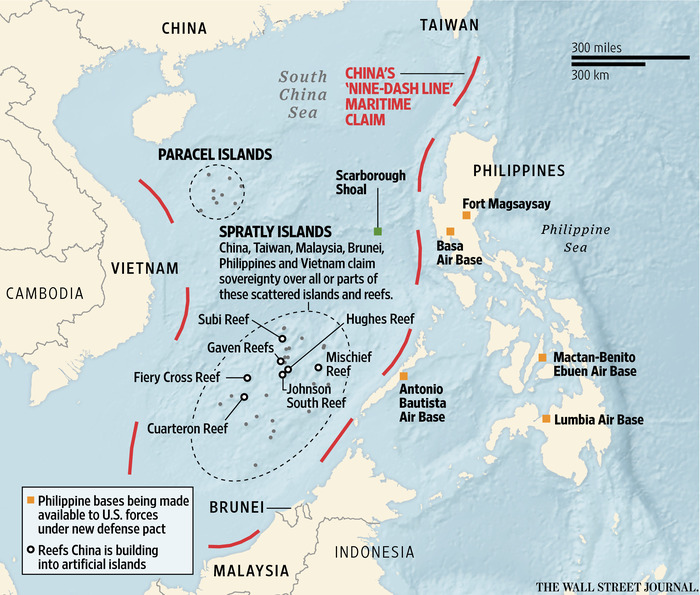


In 2014 the Philippines challenged China at the Permanent Court of Arbitration at The Hague in the Netherlands, resulting in a decision in the Philippines’ favor. But Xi had no interest in bowing to such international authority. To Xi, the South China Sea was Chinese, and it would remain that way.
In 2016 America conducted naval exercises there in order to confirm the South China Sea as international waters. But in the end it did nothing to change the fact that China was fast establishing itself as the dominator of the region. Obama could, of course, have dredged and built his own militarized islands in the area – to enforce the understanding that the area belonged neither to China or anyone else. But in the end, Obama did nothing. The “Pivot to Asia” – like so much of Obama’s diplomacy – came with no muscle.
“Improved” relations with the Islamic Republic of Iran. Then there was the matter of Iran, and the distinct possibility that it was attempting to turn itself into a nuclear power. As there was yet in the Middle East no country functioning as a nuclear power (excepting Israel, which might possibly be a nuclear power – although the yes or no concerning that matter has long been held in utmost secrecy) this would put Iran in a hugely dominant position in that part of the world. However, Iran claimed that its extensive nuclear research and development was merely for the production of new energy sources, which, considering the fact that Iran sits on top of huge oil reserves, made little sense.
 In any case, since the Iranian Revolution against the Shah in 1979 and the coming to power of the militant Shi’ite Muslim religious party led by the country’s ayatollahs, American relations with Iran had been very negative, especially under Iran’s constant theme of “death to the Great Satan America.” Things would remain tense between Iran and Obama’s America, especially with the 2009 reelection of the fiercely conservative Muslim President Mahmoud Ahmadinejad, and the outcry by many (both in and outside of Iran itself) that those elections been conducted very corruptly. Obama thus continued the American boycott of Iran and its oil sales (Iran’s almost sole international income earner), because of Ahmadinejad’s brutal hand in putting down the demonstrations against him that were rocking Iran at the time.
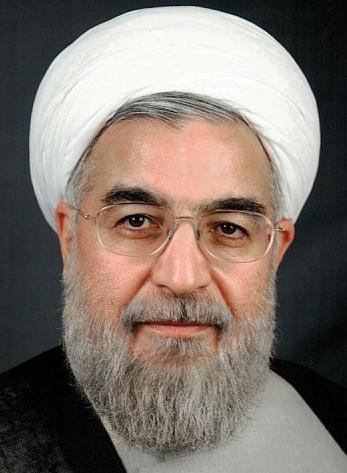 But in 2013, Iran succeeded in electing a more “moderate” Muslim cleric Hassan Rouhani as the country’s president, who indicated that he wanted to explore the possibilities of improving Iranian-American relations. The response of both Obama and the other leaders of the West was highly positive. And in 2015 negotiators (Secretary of State Kerry directing the American team) sat down to work out a deal to reopen (gradually) economic and diplomatic relations with Iran, including the gradual releasing of Iran’s frozen bank funds held abroad, provided that Iran place its nuclear development under certain internationally monitored limitations guaranteed to keep this development from producing weapons-grade nuclear material.
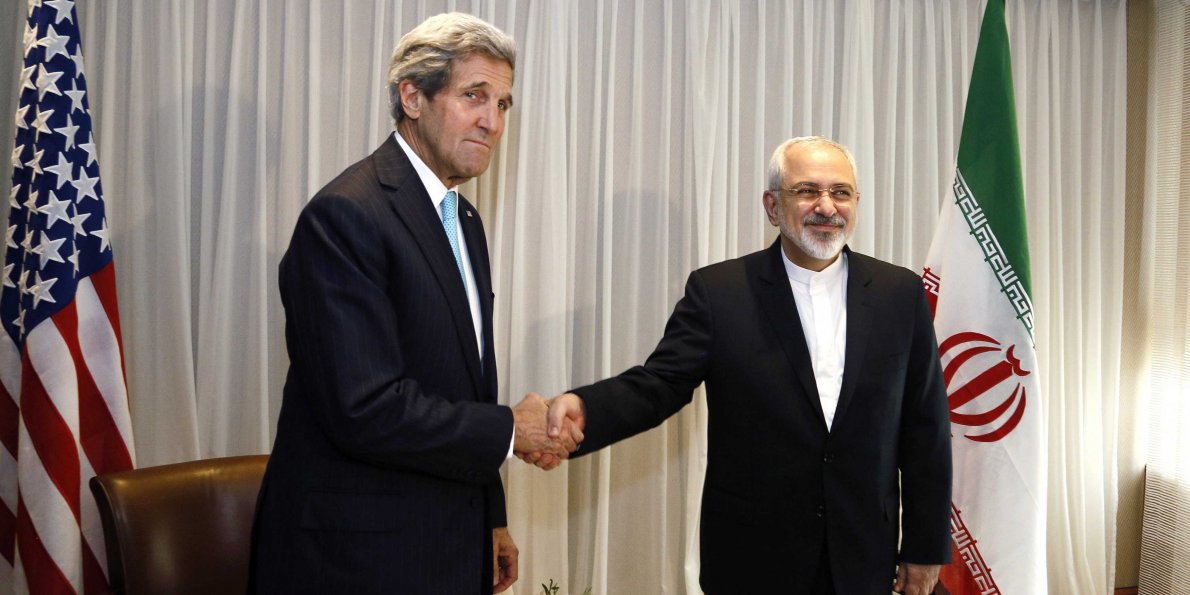
Secretary of State Kerry shaking hands with Iranian Foreign Minister Mohammad Javad Zarif, agreeing to begin talks concerning an Iran nuclear deal – Geneva, January 2015

Obama announces agreement on the deal – July 2015
In January of 2016, with the signing of the Joint Comprehensive Plan of Action (JCPOA) with Iran, Obama felt he had achieved a great break-through in American diplomacy. Many Americans were excited about this development, for it seemed to be a big step in the direction of reducing international tensions (especially with Iran playing an ever-bolder hand in Middle Eastern affairs). But others remained concerned that it left it all too easy for Iran to pull out of the agreement and move to full nuclear military power. Iran was known to have its own moral rules about dealing with the infidel West, and was never to be trusted. Here too, only time would tell which group got things right.
[6]Obama’s Saudi allies were of course totally uninterested in seeing Obama-style democracy (whatever that actually meant under the complex cultural circumstances of Syria) put in place in Syria, but instead a strong Sunni government that would replace Assad’s Shi’ite Ba’athist government.
[7]Also the fact that the Chinese were refusing to respect international trademark rights and were producing cheap copies of more expensive Western goods – as well as stealing patent information on products brought into being in the West through costly research and development – was producing in the West growing bitterness about Chinese economic policies.