CONTENTS
 Trump, and the Media kingmakers
 Domestic politics during the Age of Trump
 America and the world in the Age of Trump
 The chaotic 2020 elections
The textual material on this webpage is drawn directly from my work, America’s Story – A Spiritual Journey © 2021, pages 455-481
TRUMP … AND THE MEDIA KINGMAKERS
The media as kingmakers. The 2016 presidential primaries gave rather strong confirmation that the traditional nominating conventions, attended by seasoned politicians assembled to choose from among their ranks the best-qualified candidate for the American presidency, had given way to the new process of selecting presidential candidates by the national media, on the basis of social identity. This was not entirely a new thing, but it was becoming the determining thing. Indeed, this new driving force in American politics reached back to 2007-2008 when TV celebrity Oprah Winfrey helped considerably push the only slightly politically experienced Obama past the well-developed political machine of Hillary Clinton to win the Democratic Party’s presidential nomination in 2008.
Thus it was that in this new age of constant (24/7) barrage of entertaining news and media social hype – complements of not only the TV, but also the computer and the smartphone – the media would be the platform from which American leaders would now be selected. All the media needed to do was to shape and ultimately control the political narrative. And that is exactly what they lived for.
The “Trump Style.” And it certainly was the case when the 2015-2016 series of televised debates hosted by the various news networks helped push the totally governmentally inexperienced Donald Trump to the head of a huge list of presidential candidates, and thus gain the Republican Party’s presidential nomination in 2016. But this media coup Trump carried off all by himself, having served a dozen years as an aggressive TV director and host of the popular TV program, The Apprentice. Thus he made up in extensive media experience what he lacked in political office experience, and used that skill to run crudely over his Republican opponents in the primaries.

The unwieldy number of Republicans come to explain themselves at the CNN debate – September 2015

By March 3, 2016, at the 11th Republican debate, the number of Republican contenders was down to four: Marco Rubio, Donald Trump, Ted Cruz and John Kasich (with – as usual – Trump dominating the conversation)
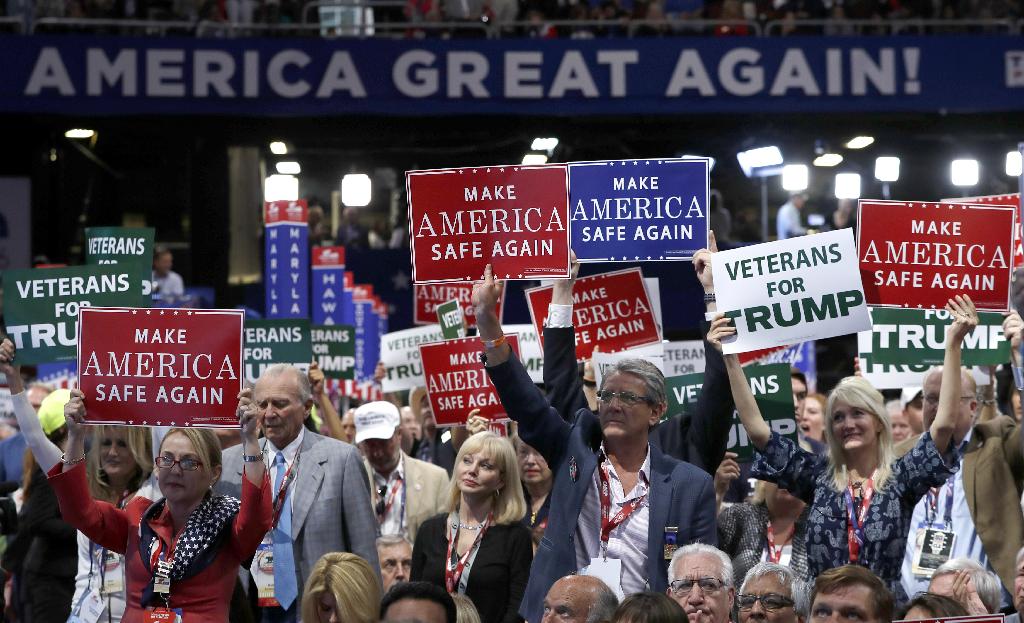
By the time of the opening of the Republican National Convention in Cleveland on July 18, Trump was clearly the frontrunner

Donald Trump and Mike Pence (his running mate) at the Republican National Convention – July 20, 2016
He was heavily engaged in Twitter in offering ongoing accounts of the failures of his opponents. Employing a stream of personal insults, he would run roughshod over his Republican opponents, issuing such ad hominem phrases as “Little Marco” (Senator Marco Rubio) or “Lyin’ Ted” (Senator Ted Cruz). About Republican opponent Florida Governor Jeb Bush, he had this to say:
Jeb failed as Jeb! He gave up and enlisted Mommy and his brother (who got us into the quicksand of Iraq). Spent $120 million. Weak no chance!
He even needlessly went after former Republican candidate John McCain (thus turning McCain into a dedicated political enemy):
. . . not a war hero, he’s a war hero because he was captured. I like people that weren’t captured.
But he kept up this attack also even during the televised debates – when he would offer very audible insulting side comments, drawing the attention of the cameras to himself, away from those whose turn it was to present their case before the viewing audience! And thus it was that he drove his opponents to defeat one by one, and ended up, by the process of such elimination, with the Republican Party’s presidential candidacy.
Then he turned on his Democratic Party opponent Hillary Clinton, whom he constantly termed “Crooked Hillary,” over the use of her personal email account to transmit Secretary of State messages, some considered top secret.
But the media act did not stop there. He also issued sweeping statements that had virtually no chance of being true, but which, repeated often enough in simple form, took on their own weight, thanks to media coverage, (even if the coverage was trying to be fully negative). Thus Trump keep repeating about how Mexico was going to pay for a greatly expanded wall along America’s border with Mexico (which refugees from Central America were breaching in massive numbers). But exactly how was he going to get Mexico to pay for that expansion? He never explained.
The 2015-2016 Democratic Party contest between Hillary Clinton and Bernie Sanders. Over on the Democratic Party side of the presidential contest, Clinton had stepped down from her position as head of the State Department back in February of 2013, allowing her to devote her energies to directing the Clinton Foundation – focused primarily on developing women’s rights globally (ah, identity, more identity!). But those years also saw her busy fending off Republican efforts to undercut her politically because of the Benghazi fiasco and the discovery of her use of her private email accounts to send confidential messages, in violation of Department of State policy. Basically she held up well under the accusations. At the same time, she was preparing herself for another run at the U.S. Presidency, gathering massive campaign support and hitting the speaker circuit extensively.

Bill and Hillary Clinton and their daughter Chelsea and her husband Marc Mezvinsky and their daughter Charlotte – 2014
Her only serious opponent within the Democratic Party was the Vermont Senator, Bernie Sanders, an avowed Socialist with all the political instincts Socialism stands for. Actually, the race was intense and Sanders did surprisingly well, indicating how far America had moved away from its traditional Middle-Class cultural roots.[1] Hillary had tremendous support from major corporate donors (such as the billionaire George Soros), as well as Blacks and Hispanics, and of course, women. Sanders’ support came from younger, White, and more small-town Americans, as well as the more independent-leaning of Democrats. But in any case, from a very nearly equal start at the beginning of primary season, Clinton began to pull ahead of Sanders in gaining pledged delegates – and arrived at the Democratic National Convention in Philadelphia in July of 2016 with approximately a 20 percent lead in the delegate count (still, an amazing count in support of the Socialist Sanders), ensuring her the Democratic Party nomination.
The 2016 campaign. Clinton gave indication that she would stand with the changes in American society undertaken by Obama, even protect those from any effort of her opponent, Trump, to reverse those changes, as Trump clearly indicated he would do if elected president. In a sense, the campaign between the two seemed to be a lineup (as a continuation of the Obama social legacy) of Middle America versus America’s many minorities, which included not only Blacks and Hispanics, but women, or at least the professional class of women working outside the home who saw themselves as part of that “minority” world. That was a huge segment of the American population. Thus Hillary was expecting a fairly easy win over Trump.

The 2015 Democratic Party debates
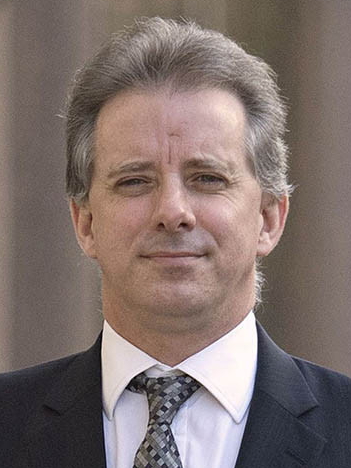 The Steele dossier. But just to make sure, Clinton campaign operative Marc Elias paid Fusion GPS $1.02 million to dig up dirt on Trump, and Fusion in turn hired for $168 thousand former British MI6 agent Christopher Steele to see if he could find some kind of political connection between Trump and the Russians. Steele obliged the Democrats, coming up with 16 different memos (based on information that Steele later admitted he had taken from a discredited CNN blog). Then in October of 2016 the periodical Mother Jones published rumors about the existence of Steele’s anti-Trump dossier, which was actually put in the hands of the FBI, US State Department officials, and the office of Senator John McCain – the latter whose office in turn would put the very damaging dossier in the hands of the nation’s press on January 10th, only 10 days before Trump’s inauguration. While this would have no immediate effect on the election – which Trump had already won handily in the electoral college – this would provide the fuel for efforts immediately to impeach Trump and chase the Democrats’ new “public enemy” from the White House.
The election itself. Trump, though indeed crude and vulgar, was no nitwit, and carefully targeted his campaign efforts with an eye on winning the electoral college vote (exactly as the Constitution specifies). And the results on election day (with only about 55 percent of eligible voters turning out to vote), he won 304 electoral votes to Clinton’s mere 227 votes.

The Democrats were shocked at the result, complaining bitterly about the way the electoral college weighted the vote in favor of Trump, because in the actual popular vote, Trump had won only 63 million votes to Clinton’s 65.9 million votes. Thus she “won” the popular vote. Actually she did not. 4.5 million votes went to the Libertarian Party (generally considered a party of the Right) and 1.5 million went to the Green Party (generally considered a party of the Left). If these votes were combined by actual political lineup, the Political Right won 67.5 million votes and the Politically Left won 67.4 million votes! Close, but in any case, not exactly a Hillary victory.
Angry protests about the election results broke out immediately, not only in America but across much of the world. Here too, telecommunications aided considerably in mobilizing this huge outcry. Younger generations of Americans took to the streets announcing “not my president.” And women dressed in pink also turned out to make it clear that there was no way they would ever consider Trump their president. And celebrities joined the anti-Trump chorus, some even announcing the possibilities of simply leaving the country, they were so angry.
They were all angry, very angry. Trump personally represented everything they had come to believe to be the source of great evil in the country: White privilege, toxic masculinity, homophobia and Christian superstition. And, with Trump’s slogan “Make America Great Again” (MAGA), it was obvious that Trump intended to undo all the wonderful changes Obama had brought to America. They would fight him over his MAGA program, from protesters in the streets to angry Democrats on Capitol Hill.
Already, Congressional Democrats were calling for Trump’s impeachment, even before he had formally taken office. Not only was the new president-elect vulgar and ridiculous, they were claiming that he was a dangerous sociopath. But to impeach him he had to be found guilty of having committed the high crime or misdemeanor of … ?

President Obama and President-Elect Trump meet in the Oval Office two days after the election

Anti-Trump post-election march – St. Paul, Minnesota, November 9

Trump taking the oath of office, with his wife Melania holding the Bibles
on which he pledged his service

The swearing-in with Donald Trump, his wife Melania, his son Donald, Jr., his son Barron, his daughter Ivanka, his son Eric, his daughter Tiffany, and Supreme Court Chief Justice John Roberts

Inauguration Day: Trump formally signing his Cabinet nominations …
with his family and Congressional leaders looking on
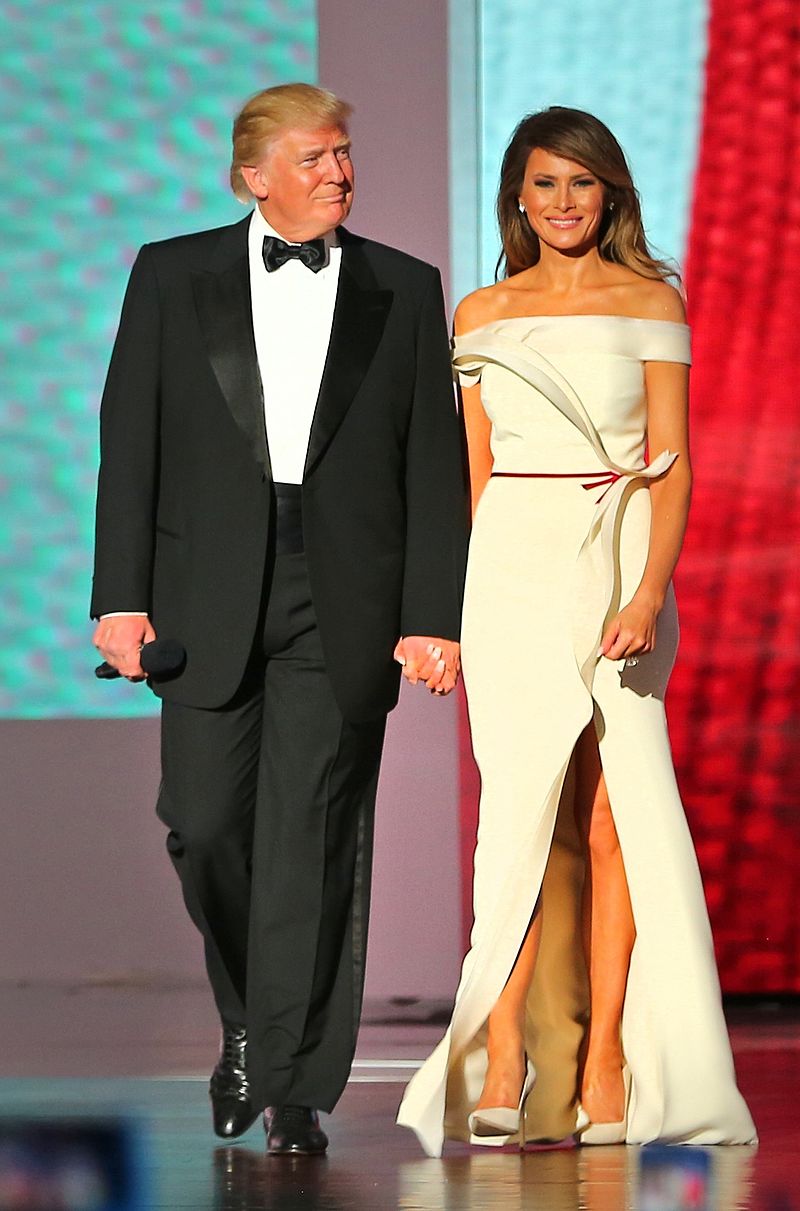
Donald and Melania Trump at the Liberty Ball on Inauguration Day
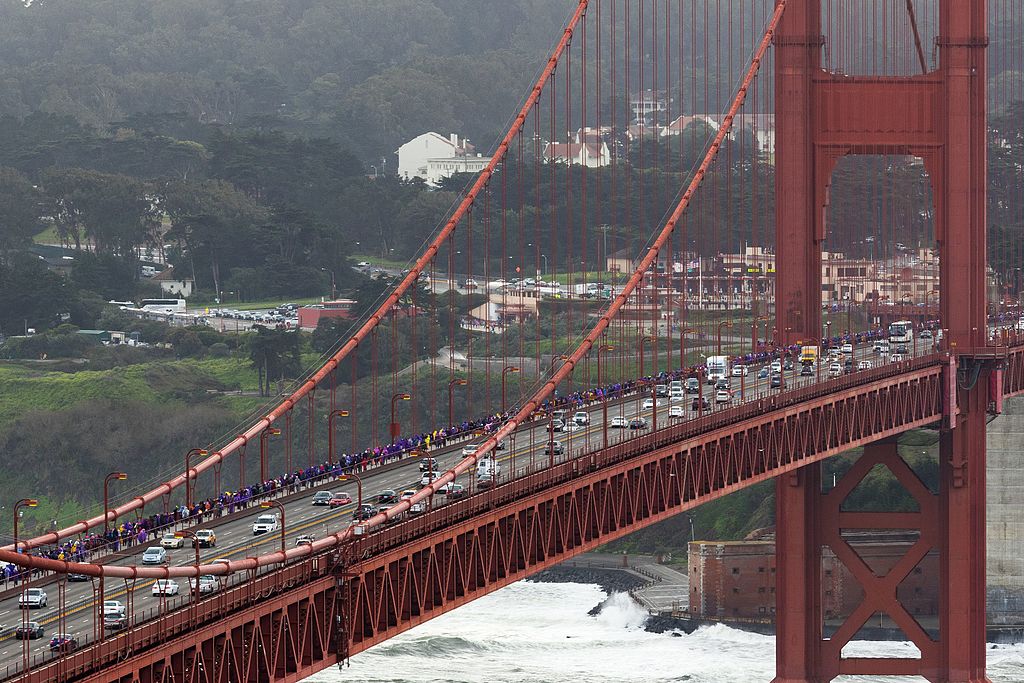
Anti-Trump chain of purple-clad protesters along the Golden Gate Bridge on Inauguration Day

The anti-Trump Women’s March in Washington, DC the next day (January 21st)

The anti-Trump protest in front of San Francisco’s City Hall on February 4th

“Not My Presidents Day” demonstration headed toward the White House – February 20th
The making of Donald Trump. And yes, Trump certainly came across most frequently as vulgar and ridiculous. And he could certainly be very theatrical. That was indeed a key part of his background. But he was a successful venture capitalist, who took on huge investment risks, sometimes failed, but never backed down (except one period of depression in his life), and pushed ever-onward to various goals he had set before himself – big goals. And certainly one of those goals included residency in the White House.
Trump was born in 1946 (just months apart from both Bill Clinton and Bush, Jr.) and came from a family line of successful entrepreneurs, especially his father, who developed a huge housing construction and landowning company in the New York City boroughs of Queens and Brooklyn after World War Two. Trump grew up in a dedicatedly “Middle Class” (despite the family’s enormous wealth) Presbyterian home as the fourth of five children (two sisters, one who went on to become a U.S. Circuit Court judge and another to become a Chase Manhattan Bank executive, and two brothers, one a TWA pilot and the other who eventually took over the family’s property-management business).

Donald Trump (leftmost) with his brothers and sisters, Fred Jr., Robert, Maryanne and Elizabeth

Donald Trump with his father Fred and mother Mary Anne at the New York Military Academy
Trump was raised fashionably, eventually entering (8th grade) the New York Military Academy, where he proved to be an outstanding athlete in several sports. Upon graduation in 1964, he started college at Fordham University, then transferring to the Wharton business school at the University of Pennsylvania, to prepare himself to take up the family real estate business. During those years he worked closely with his father in a major apartment complex redevelopment in Cincinnati, Ohio, and then, with $1 million in support from his father upon graduation, took on the challenge of major building construction in New York City (Manhattan).

Donald Trump and his father Fred at Donald’s graduation
from the Wharton School at the University of Pennsylvania – 1968
He would work hard at developing his professional world. But within a dozen years he was able, at a cost of $100 million, to convert an unprofitable hotel into the fabulous Grand Hyatt on 42nd Street, adjacent to the Grand Central Terminal. And things got only grander after this.

Trump with NY City Mayor Ed Koch, NY Governor Hugh Carey, and Urban Development Corp. VP Robert Dormer looking over plans for the new New York Grand Hyatt hotel and convention center

The Grand Hyatt – Manhattan – completed in 1979
Over the period 1979-1983, he built his Trump Tower ($200 million in expenses) on New York City’s fashionable 5th Avenue.

He then went on other projects: a casino in Atlantic City, an Eastern Airlines shuttle service, a skating rink in New York City’s Central Park, partial ownership of Miss Universe and Miss USA pageants, a New Jersey football team (briefly), and in 1985 ownership of the Mar-a-Lago estate in Palm Beach Florida, something that became a personal get-away home for him and his family.

Trump’s Mar-a-Lago Estate at Palm Beach, Florida (purchased in 1985) which was built by and lifetime home to the supremely wealthy Marjorie Merriweather Post. Ivana loved to “hold court” here with the rich and famous.
And along the way, he met and then a year later married (1977) the Czech athlete and model, Ivana Zelnikova, and soon father three children, Don Jr., Ivanka and Eric.


Trump and Ivana the day she received US citizenship – May 1988
Such a grand success was he that in 1987 he published something of an autobiography, Trump: The Art of the Deal (New York: Ballantine Books). It would become a New York Times bestseller for almost a year – and stay on the top of the list for three months – making the fairly young Trump one of Gallup Poll’s top-10 best-known Americans at the time.
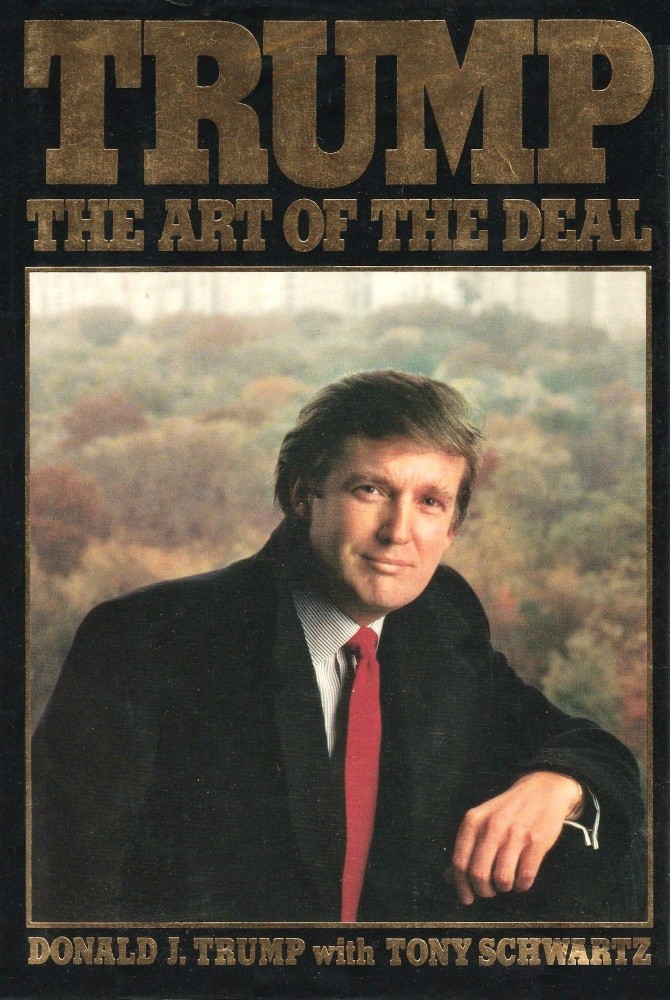
But ironically that same year financial disaster hit when the stock market crashed, and America slid into deep recession, throwing masses of people in the world of industrial and real-estate development into bankruptcy when the market for their products dried up.
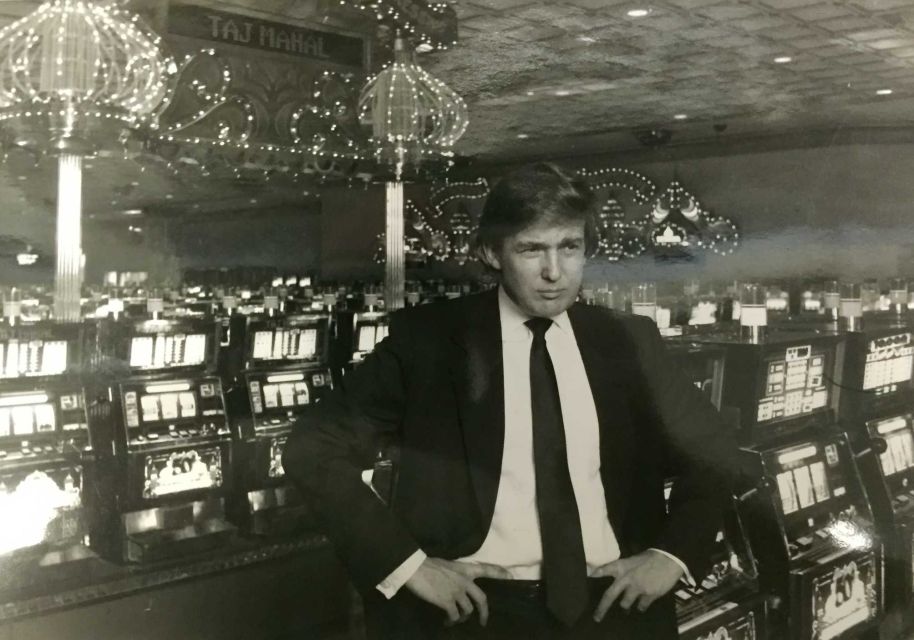
Trump inside his Taj Mahal casino in Atlantic City – 1990
Trump himself was deeply invested in his work, owing $billions to banks, and nothing moving on the sales front of his real estate projects. But fortunately, the banks were not interested in another bankruptcy (especially one on this scale) and worked out a program to help him pay out his debts, costing him the loss of a lot of property in order to do so.
And this was accompanied by the news that he was having an affair with a pregnant Georgia model, Marla Maples, shattering his married world as well. He and Ivana would go through a very expensive divorce in 1992, and Trump would then go on the next year to marry Marla after their daughter Tiffany was born.

Trump remarried with Marla Maples (1993-1999)
But that marriage was not really headed down a primrose path, an in 1997 they would separate, and then divorce two years later.
But 1997 was the year he published his second book, The Art of the Comeback (New York: Times Books).

And indeed Trump had slowly achieved just that, a true comeback. In 1994 he had been able to acquire 50 percent ownership of the Empire State Building, and in 1995 finally finish the restoration and then sell the Plaza Hotel (which he renamed the Trump Building).
The following year he met the Slovene model, Melania Knauss, though it would not be until 2005 that they would marry.

Attending the wedding were numerous political and media celebrities, including Bill and Hillary Clinton!

Trump’s third wedding (January 22, 2005) – at his Mar-a-Lago Estate
with his bride Melania … and Hillary and Bill in attendance!
A little over a year later Melania would give birth to their son, Barron.
Being the restless soul that he was, in 2003 he turned to the challenge of the world of television, becoming producer and host of the NBC show, The Apprentice … the program becoming very popular. Eventually he would take on celebrities as his show’s participants, thus in 2008 renaming the program The Celebrity Apprentice.

Trump as TV host for the TV series The Apprentice / The Celebrity Apprentice (2004-2015) with his daughter Ivanka and son Donald, Jr
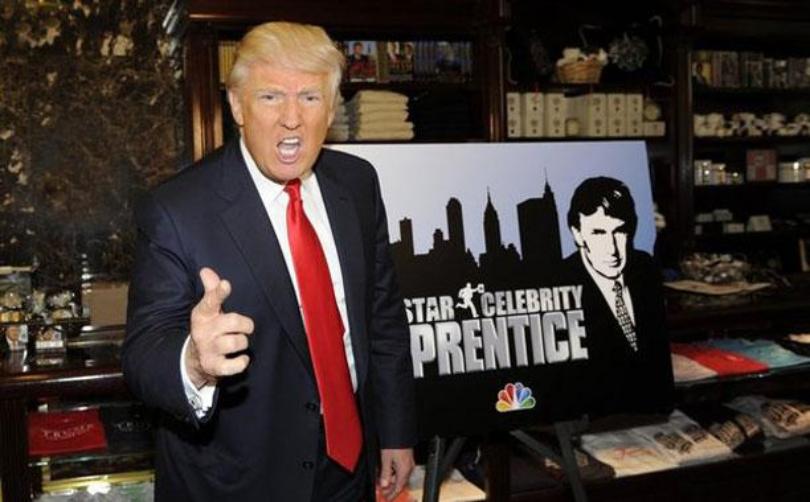
“You’re fired!” Trump employing the “Trump style” in hosting The Celebrity Apprentice
He would continue in this role until 2015, when he turned fulltime to his next challenge, national political office. At this point, Trump’s personal fortune was in the $3 billion range.
Trump had some earlier thoughts on the matter of politics, back in 1999 trying a run at the U.S. presidency via the Reform Party, then in 2004 even undertaking fundraising for the Democratic Party presidential candidate Kerry. But in 2012 he would return to the Republican Party, thinking of a presidential run himself, before throwing his support to Mitt Romney.
But in June of 2015, Trump announced his candidacy for the Republican Party presidential nomination, running on the challenge to “Make America Great Again” (MAGA).

Trump and his family at the Trump Towers at the formal announcement
of his presidential run – June 2015
This, unfortunately was a concept in total violation of the moral inclination of America’s younger generations, who believed that their “shaming” of America was a sign of personal nobility and that such patriotism as Trump was proclaiming was simply ugly Fascism, which they were personally dedicated to root out at all costs.
Nonetheless, employing the same careful calculation by which he had built up his huge business empire, Trump pulled ahead of his competitors, first of all to gain the Republican Party presidential nomination, and then to conduct a carefully strategized move to win the electoral college votes needed to gain the presidency itself.
No, Trump was no nitwit. Vulgar and abrasive at times, yes. Misleading in his broad public statements about what he planned to do with respect to this issue or that, often yes. But a nitwit. No.
Trump the Christian. Trump was also a dedicated Christian, but in a very Trumpian way. He was raised in a Presbyterian family, but once deeply immersed in the business world, religion seemingly played no particular role in his life. But in later years (around the year 2000?) he seemed to find an interest in Christian televangelism, eventually especially in that of Paula White, an attractive (and very wealthy) White woman leading a largely Black congregation. Her “prosperity gospel” version of the Christian faith, popular among many Evangelicals, touched Trump deeply (she is said to have finally “led him to the Lord” in 2011), and he found himself taking advice from her on matters of Christian faith, both before and then during his tenure in the White House. Thus it was that he was identified fairly closely with the American Evangelical community.

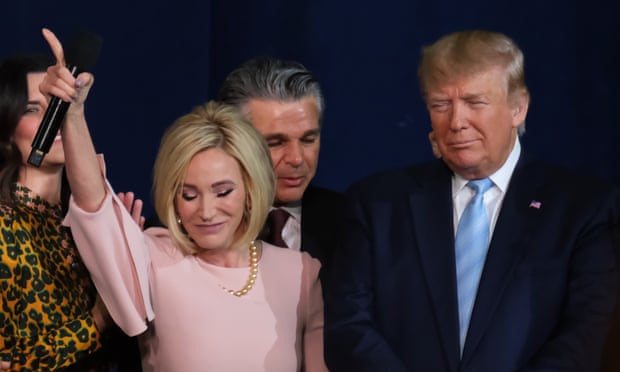
His political opponents accused him of course of taking on these Christian loyalties for purely political reasons. But then Trump was accused of a lot of things, which Trump was always quick to argue back in his own way. In any case, it will always be hard for anyone else to assess the reality of another person’s spiritual life. Indeed, religion can be a matter of much show. But privately, it can also be very sincere in a most individualistic way.
In any case, as President he would work closely with the Christian pastoral world (as had Presidents before him), but especially with the various members of his evangelical advisory council, and join them in attempting to free public Christian prayer from governmental prohibition (placed there by the courts), only minorly successful in the effort. And he would push (again only slightly successfully) to allow people whose faith did not put them in accord with the legal requirements of “political correctness” not to be punished by the courts for failing to obey the courts’ official social-moral directives.
He was accused of politicizing the Presidential prayer breakfast in February of 2020,[2] commenting on the religious hypocrisy of individuals “who use their faith as justification for doing what they know is wrong”, “nor do I like people who say, ‘I pray for you’ when you know that is not so.” It was generally understood that he was referring to political opponents, Mitt Romney who had just cited his Mormon faith as to why he, as a Republican, had voted for Trump’s conviction, and Nancy Pelosi, who had announced that she prayed regularly for the supposedly deeply misguided President (“He really needs our prayers”), while directing the ongoing effort to remove Trump from office. Trump apologized for his comments at the end of his speech “I’m sorry. I apologize. I’m trying to learn. It’s not easy. When they impeach you for nothing and then you’re supposed to like them, it’s not easy folks. I do my best.”
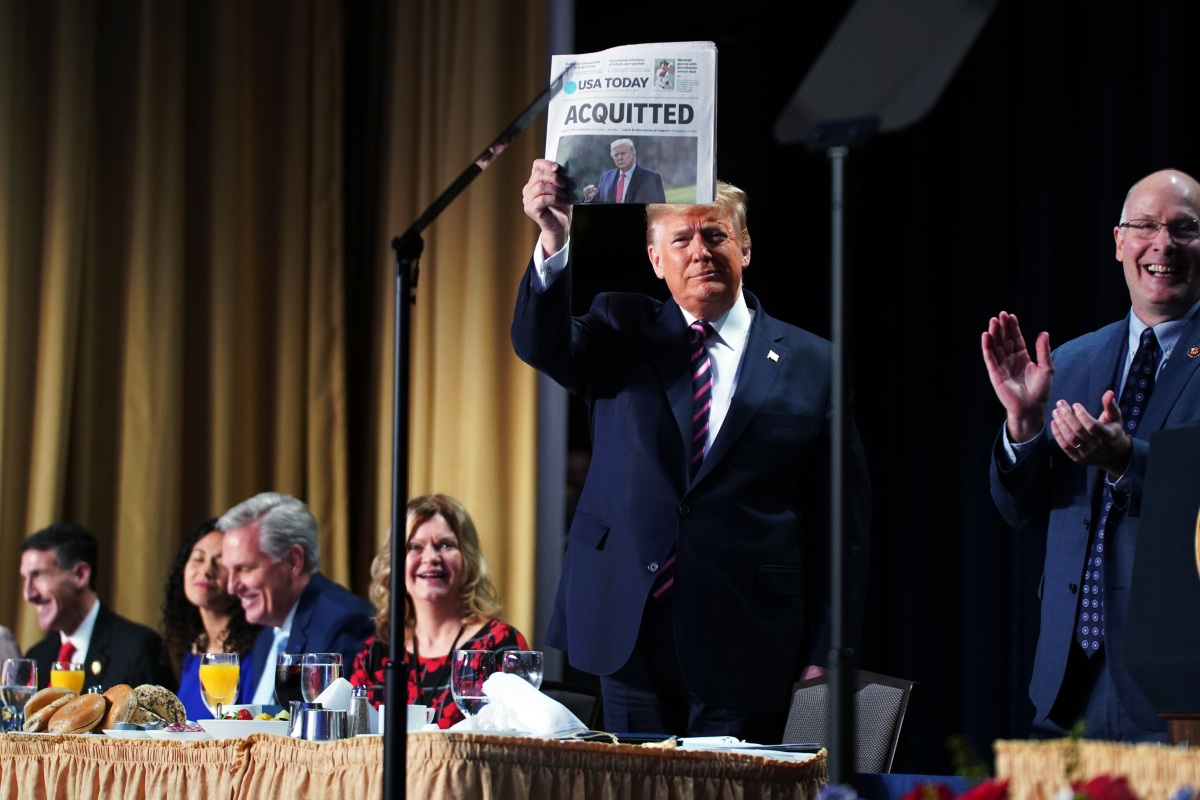
Trump – at the Presidential Prayer Breakfast – happy to show that the Democrats’ impeachment program had come to nothing
And indeed his Good Friday Message that April – and accompanying prayer by Pentecostal bishop Harry Jackson, who also praised Trump for his Christian work – was a deeply moving event calling for peace, reconciliation and deliverance in this time of national troubles, brought on especially by the Covid-19 pandemic. There were no Trumpian swipes at his Washington opponents in the message! And it was also another indicator of the very high standing that Trump had within key parts of the Black as well as White Evangelical community.

Harry Jackson and Trump delivering an Easter Blessing – April 10, 2020
DOMESTIC POLITICS DURING THE AGE OF TRUMP
Impeach, Impeach, Impeach
Leaders in the effort to impeach Trump (started even before Trump’s inauguration)
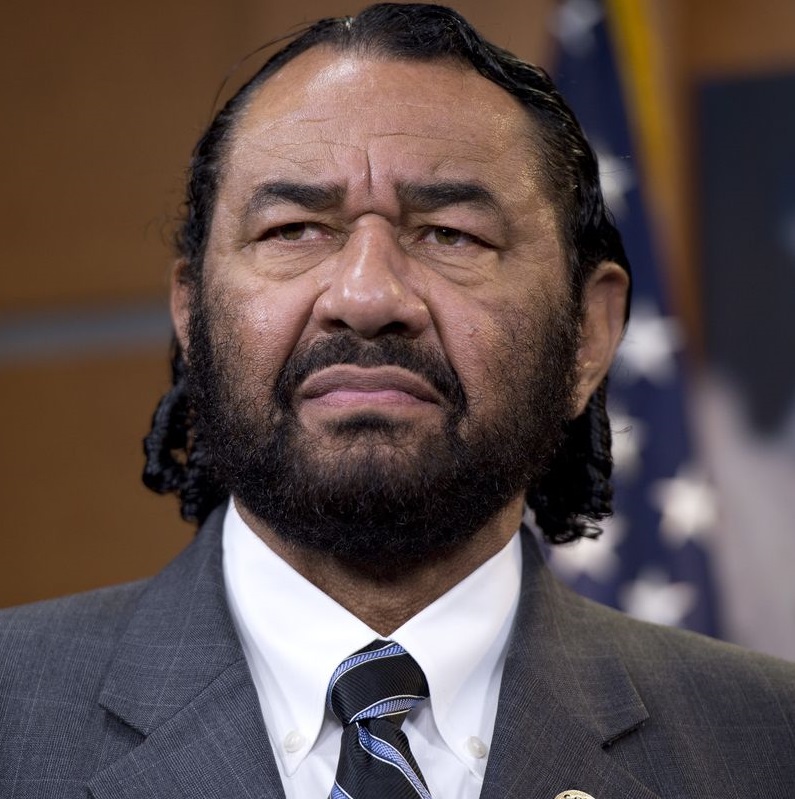
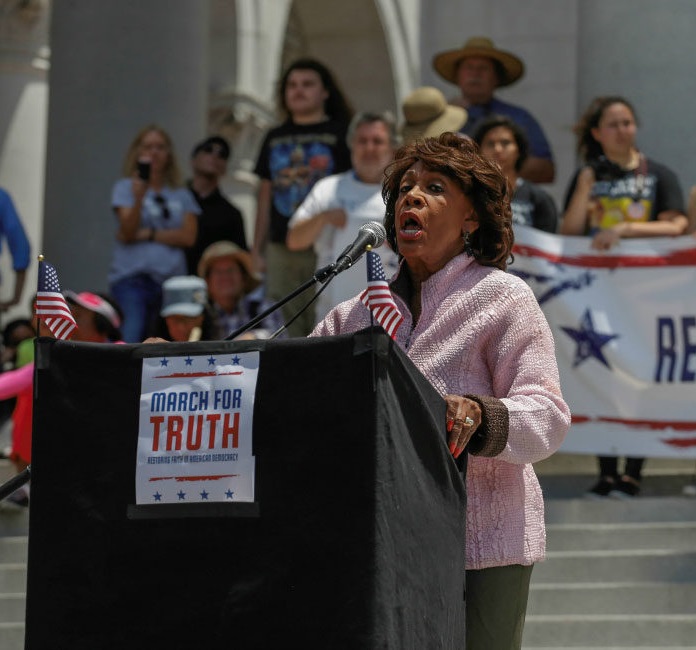
Rep. Al Green (Democrat – Texas) / Rep. Maxine Waters (D-California)
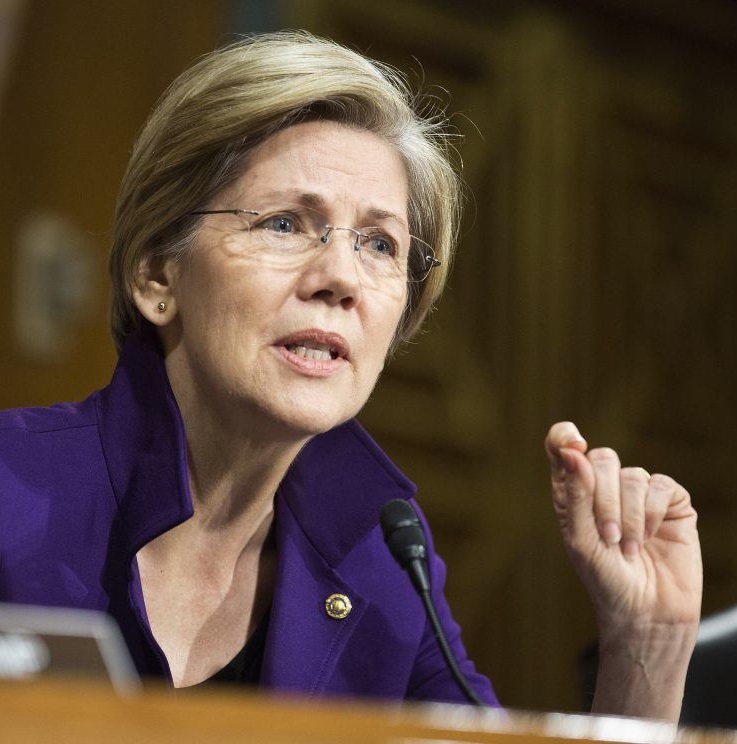
In the Senate, leading the effort to find something on Trump to bring him to impeachment is Elizabeth Warren (D-Massachusetts)
Special Counsel Mueller investigates the “Russian connection.” Once in office as President, by May of 2017 the Steele-inspired rumors of “Trump collusion with the Russians” had mounted so high – thanks to the scandal-hungry media and his dedicated opponents on Capitol Hill – that Congress called for the creation of a special counsel to look into these rumors.

March 2017 – Senators Richard Burr (Republican-North Carolina) and Mark Warner (Democrat-Virginia) head the Senate Intelligence Committee looking into the issue of Russian meddling in the 2016 election
Soon former FBI director Robert Mueller was assigned the task, given wide authority to find out whatever he could on the matter.

On May 17th (2017) Robert Mueller, longtime FBI Director (2001-2013) was appointed as a Special Investigator to look into this matter of the Russian involvement in the 2016 election
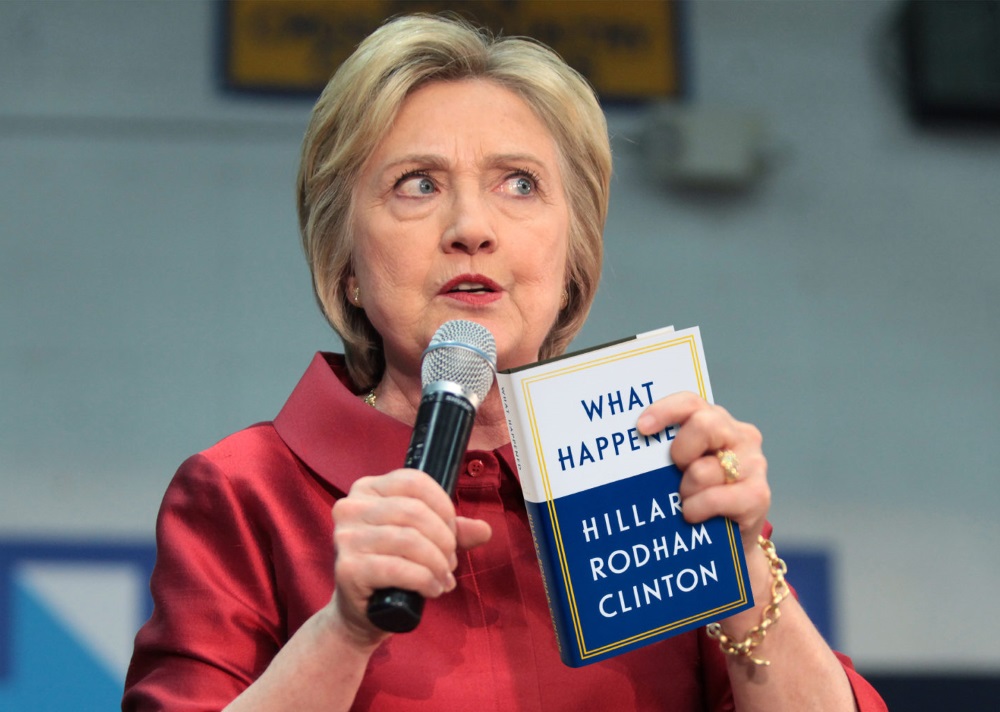
July 2017 – Hillary Clinton came out with her new book, What Happened, explaining all the things that acted against her to cause her to lose the Presidential election. The “Russian connection” plays big in the narrative
Then for the next two years, the world had to wait while Mueller’s investigation was conducted behind closed doors. This, however, did not keep the news media from speculating wildly about what certainly Mueller must be finding out about the criminal president.
But weren’t they horrified when finally in March of 2019 – after much federal expense in time and money – Mueller came up with the conclusion that though he did not approve of some of the things Trump did, he could find no basis for criminal charges to be brought against the president.
That was not what so many on Capitol Hill and the national press wanted to hear. Impeachment therefore would have to go down a different road than the much hoped-for Russian connection. They were not going to give up on this all-important crusade against the evil president.

Trump’s Federal Court appointments. In the last year of Obama’s presidency, Conservative Supreme Court Antonin Scalia died. Obama naturally sought to fill that appointment, but obviously not with a similarly Conservative individual. He proposed a “centrist” Merrick Garland, which simply would have cut further the Conservative voices countering the small but very Liberal Supreme Court majority. The Republican-dominated Senate let Obama know that they would hold up any replacement appointment until a new president was installed as a result of the elections coming up that fall. Thus no action was taken on the Obama appointment.
Then with Trump taking office, not surprisingly he appointed Neil Gorsuch, a judicial Conservative or judicial “originalist,” one that insists on a very limited role for federal judges in how federal law is applied. The appointment was ultimately approved in the Senate, 54-45, not surprisingly along purely Republican-Democratic Party lines. Okay, a conservative to replace a conservative.
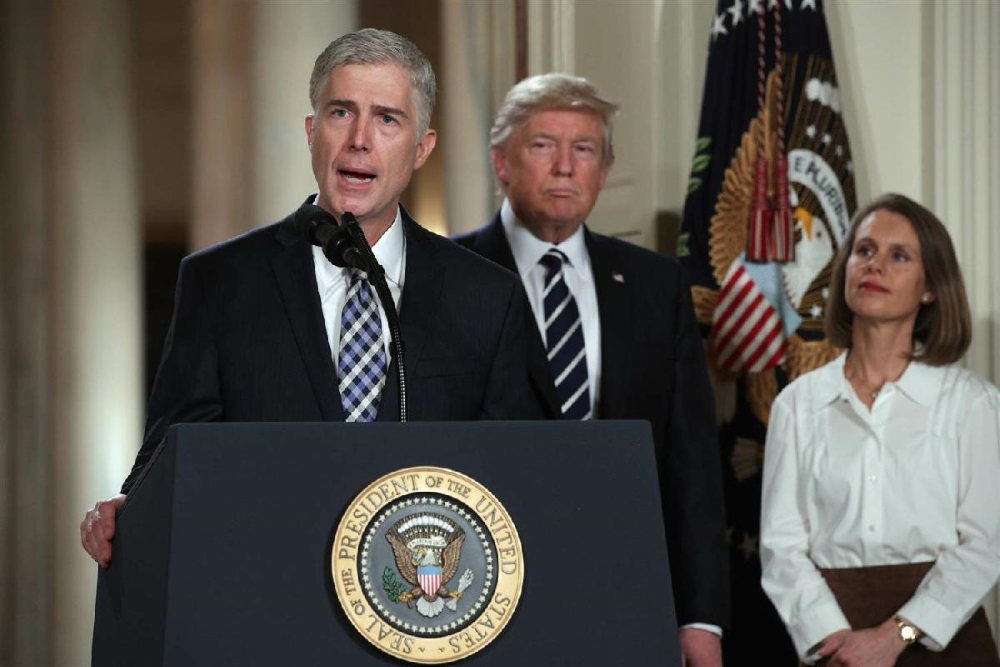
Neil Gorsuch speaking publicly just after the announcement (February)
of his nomination to the U.S. Supreme Court

Gorsuch undergoing Senate scrutiny prior to confirmation
But then the next year, “centrist” Anthony Kennedy (originally a conservative, who like so many, over the years had moved to the Left to become more “activist” in his judicial philosophy) announced that he would be retiring in July (2018).
When it became apparent that Trump was going to nominate another Conservative or “originalist” to that spot, the battle was on. The Supreme Court was, after all, the supreme legislative body in the land. And the idea that it would take a more Conservative view on legal matters was totally unacceptable to the Democrats, who looked for their ideological agenda to be enacted through the Supreme Court if they could not get it enacted through Congress. That’s how Congress’s strongly supported Defense of Marriage Act (DOMA) was overturned during the Obama years.
So they did what they attempted to do years earlier with the Conservative Justice Clarence Thomas, by bringing forward a female “victim,” Christine Blasey Ford, who narrated an incident that happened back in her high school days (36 years earlier) when she was accosted (“feared for her personal safety”) by a group of drunk teenage boys at a party. And she was sure that one of them was Trump’s new appointee, Brett Kavanaugh, although she did not know him personally at the time.
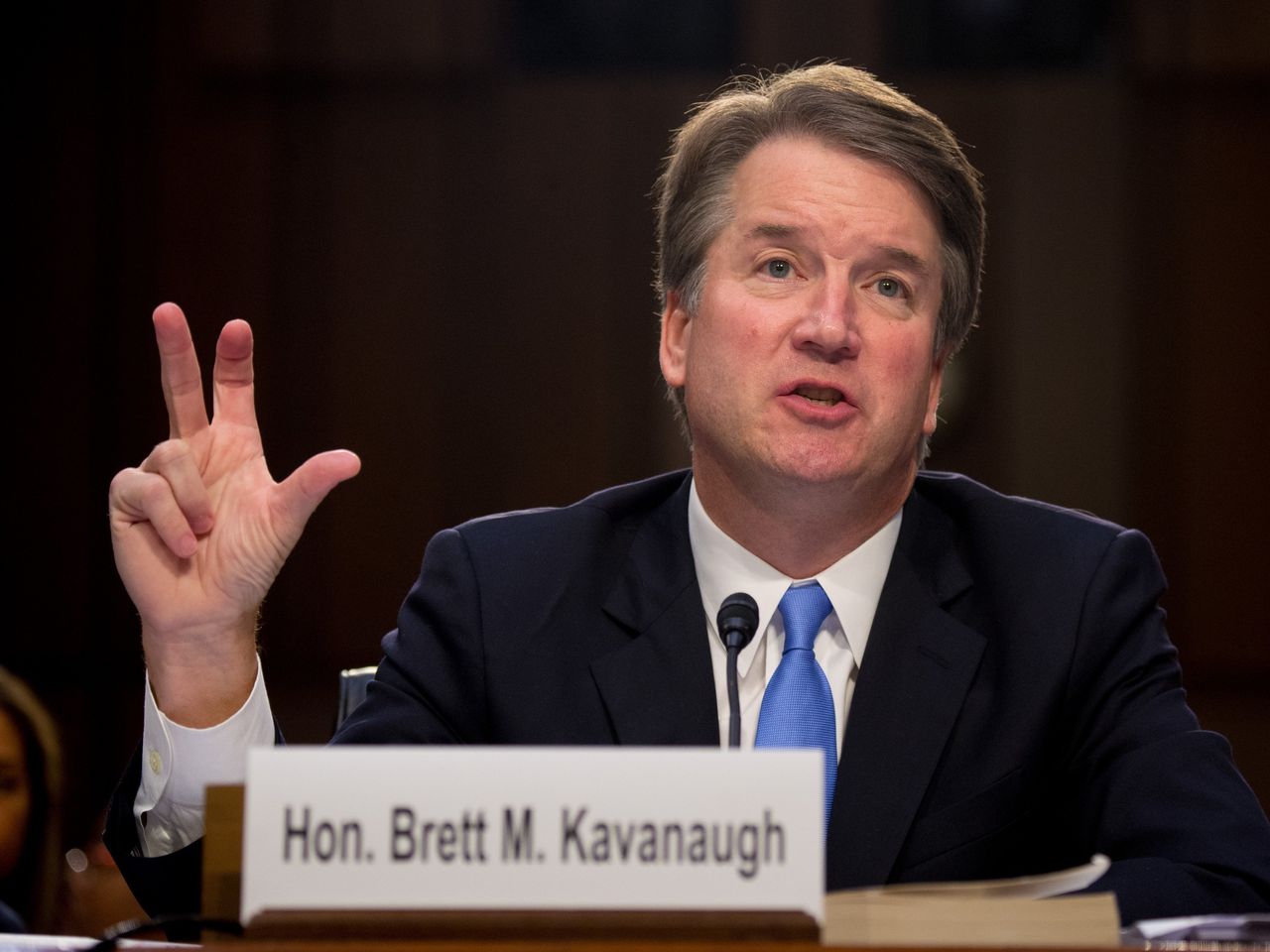
Conservative Federal Judge Brett Kavanaugh at his Senate hearing as a new Supreme Court appointee – September 2018

But the victim card the Democrats played did not work very well when a friend of hers who was with her at that party remembered no such event having taken place. And Kavanaugh’s friends attested to the fact the picture Ford painted was not possible of the Kavanaugh they had known in high school. And his record since then as a judge was spotless, though, yes, conservative. And that was the best the Democrats could offer in their attempt to destroy the character of Kavanaugh.
The news media however spun as negative a picture as possible in support of the victim narrative. Thus the hearings dragged on, until finally in October the Senate approved his appointment 50-48.
Then there was the matter of the Ninth Circuit Court – always reliably Liberal – and therefore the court that the ACLU and other “progressive” groups brought their cases to with the expectation of a very favorable decision in their litigation. But vacancies were occurring, and Trump was appointing more Conservatives, although the Democrats were doing everything possible to hold up the appointments. But even then, the Liberals needed not to worry, as only nine of the twenty-five Circuit Court judges had been appointed by Republican presidents. Trump had a very long way to go to get the Ninth Circuit Court out of Left field, so that he could shut down legislation through judicial decree.
Then in 2020, just a month (October) before the scheduled November elections, Trump was able to appoint yet a third individual to the Supreme Court, replacing Ruth Bader Ginsburg, who had died the previous month (September). The Democrats were furious, remembering how the Republicans had stalled Obama’s intended appointment in the last months of his presidency. But the Republicans, possessing a majority in the Senate, pushed ahead with hearings on the Trump appointment of Amy Coney Barrett to the position, a judicial “originalist” or conservative (and a Catholic) – replacing a very Liberal (and Jewish) Ginsburg.
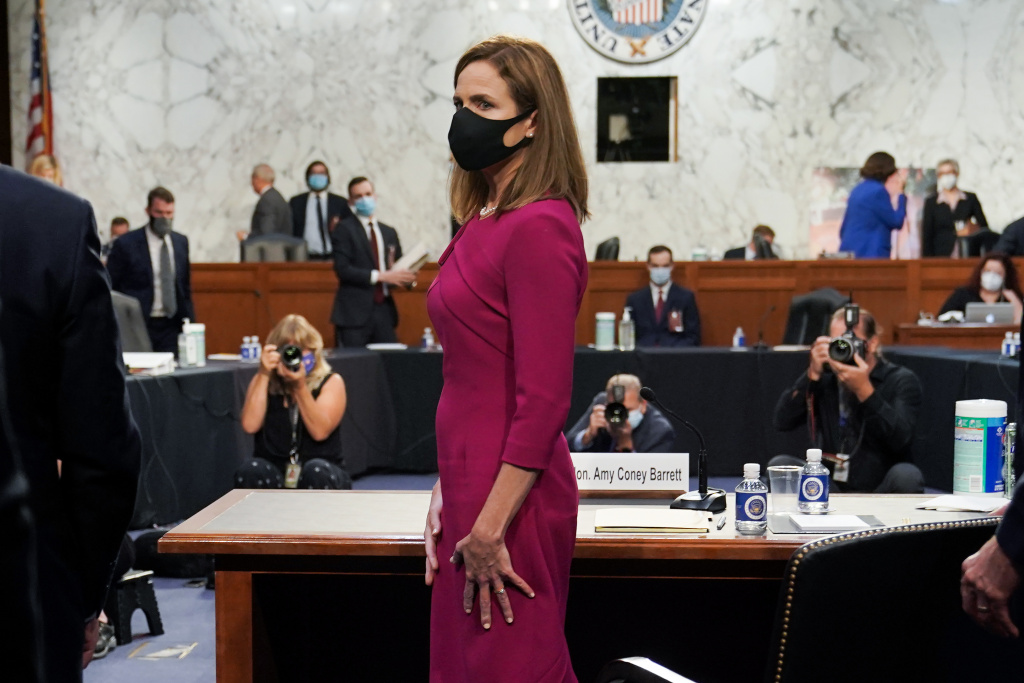

Needless to say, Barrett’s Christian loyalties (“dogma” it was termed by Democratic Senator Feinstein) came under considerable questioning by the Democrats (where did she stand on the matter of abortion and gay rights?). In the process the American Bar Association (which usually is listened to in such matters) gave her its highest recommendation, for “integrity, professional competence and judicial temperament.” But this did not bring on any support from the Democrats. In any case, in the end, the Republican majority was able to confirm her appointment 52-49, with none of the Democrats in favor and even one Republican (Susan Collins of Maine) voting in the negative.
Thus her appointment probably heightened the fear considerably of the Democrats that the Supreme Court would be even less likely than ever to be the ultimate recourse to put their “progressive reforms” into place by decree.
But they had not yet had the opportunity to see what a Democratic White House (soon-to-be-President Joe Biden) would be able to achieve simply through issuing multitudes of executive orders (presidential decrees) as the law of the land.
The 2018 Congressional elections. By long-standing political habit of the American voter, the midterm elections of Congressmen (all members of the House and one-third of the Senators) have typically produced a major setback for the party previously in power, especially if it is the party of the individual in the White House. Thus the Democrats were looking forward to some major electoral victories, ones that would finally give them the leverage to do what they wanted most of all to do: get rid of Trump. And indeed that is how the elections for the House seats went: the Democrats were able to regain their majority position, and all the political benefits that went with that.
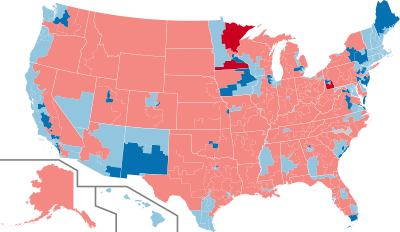
2018 House of Representatives results
Dark colors show gains / lighter colors simply holds – Democrats (blue) and Republicans (red)
Wikipedia – “2018 United States elections
But the elections for the Senate proved to be a shocker: the Republicans actually picked up more seats, thus increasing the size of their majority in the Senate.
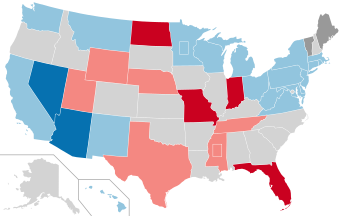
2018 Senate results
(Minnesota and Mississippi each held two Senate elections)
Congress would thus be divided deeply along party lines separating the agenda of the House (to impeach Trump) and the Senate (to move on to other things).
But most interesting, three new female House members – two Muslims and one Hispanic – received the political spotlight that freshmen Congressmen otherwise never get until they have accumulated some years of experience on Capitol Hill. But not these three members of the “Squad,” as they were termed by an adoring press.
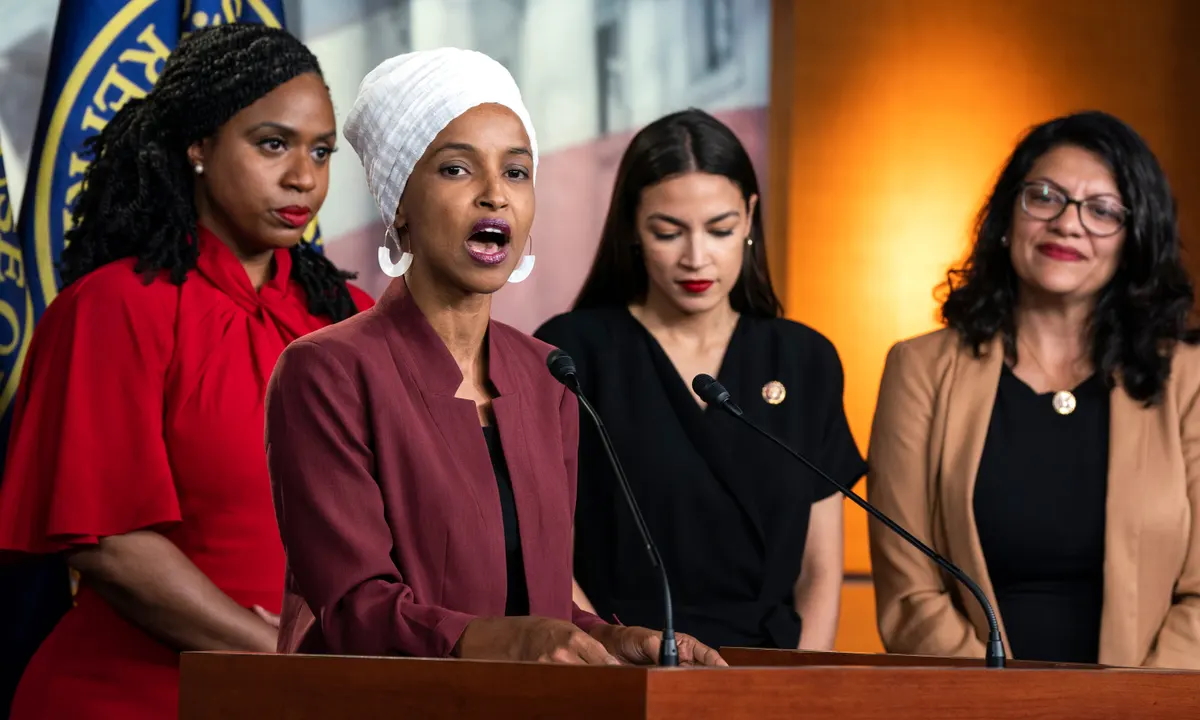
They held press conferences in which their very words carried the weight of long-established Congressional leaders, even more so. This was another indicator of how media interest – not actual political experience – had moved into position to shape the country’s political narrative. Where was that dynamic likely to take the country?
Impeachment, round two. Now with a majority in the House, the Democrats were ready to make the long-awaited move: impeach Trump. They, of course, would need some kind of legal grounds to do so. The Mueller investigation had failed to come up with anything they could go with. So they would have to find some new Trump action they could use to justify their actions.
And Ukraine, not Russia, would seemingly offer them what they wanted so badly. An unidentified “whistleblower” inside the Washington Establishment passed information to Democrat Adam Schiff’s House Intelligence Committee that in a phone conversation Trump had on July 25th (2019) with Ukrainian President Volodymyr Zelensky, Trump had requested help in getting information concerning corruption rampant in the Ukrainian business world, indicating they he would not release American assistance funds (which would typically end up in the pockets of Ukrainian officials) until this matter was cleared up.
The “issue” in all this was that the Ukrainian gas company Burisma Holdings, one of the most corrupt of the organizations, had Hunter Biden, Joe Biden’s son, serving on the company’s board of directors, for which he received a monthly salary of $50,000. Bringing Hunter Biden into the matter was what the Democrats were hoping to get Trump on, because they could claim that Trump was violating the federal law making it illegal to involve foreign influence in the conduct of American electoral campaigns. And as Joe Biden (former Vice President during the Obama years) was running as a strong Democratic Party presidential candidate, Trump’s request (which Trump did not deny that he in fact had made to the Ukrainian president) was an illegal effort to involve Ukrainian influence in the elections.
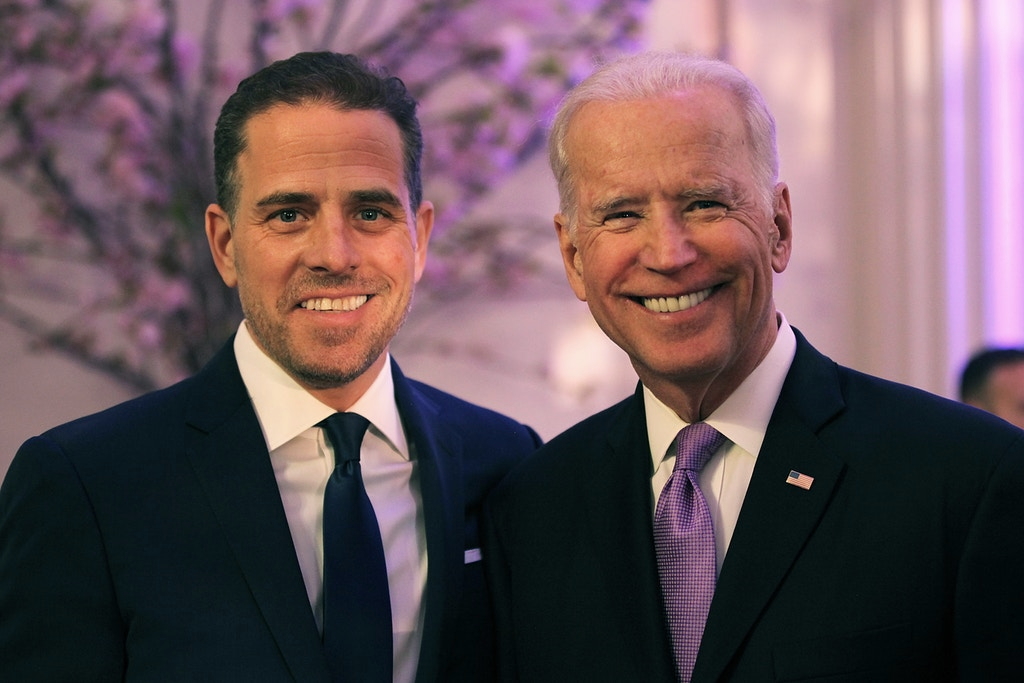
Former Vice President Joe Biden and his son Hunter
But Trump countered that looking into corruption in Ukraine before he released funding was an important responsibility he had as president, especially as Americans themselves were involved. It was unfortunate that the person involved was the son of Joe Biden. But Trump had a job to do.
So at this point, whether a Trump crime had been committed – or not – involved simply the matter of which ideological version of the event you wanted to go with.
Trump was in no mood to be dragged before Congress to be interrogated by a hostile Schiff and his Democrats – and simply refused to appear on Capitol Hill. So now the issue for the committee became one of Trump’s “obstruction of Congress” and “abuse of power.” So those two very vague procedural matters were what the Democrat-controlled House finally decided to impeach Trump over. The Ukrainian issue was dropped because it had become increasingly clear that pushing on that issue was not going to work well for the Democrats, and in fact might actually do some considerable damage to Biden if there was too much digging into the details of the event. So that part got dropped.
Thus on December 18th (2019) the House passed impeachment charges against Trump, almost completely along party lines, again, making the matter one of pure politics rather than the law. But then on February 5 (2020) it was dismissed by the Senate. There was no way that any Democrat-dominated House impeachment was going to get even close to a 2/3s vote needed to convict in the Republican-dominated Senate, although the “abuse of power” article did get the support of Republican Mitt Romney, another Republican whom the Trump mouth had succeeded in converting into a dedicated political opponent.
This was clearly a case of partisan politics, not the law, as indeed the impeachment urge had been since its origins in early 2017, in fact every time it had been brought into play since the 1970s. And unfortunately, what the American public would be forced to make of this now on-going event would be shaped (as always) entirely by the way the media wanted to present the “facts” of the case itself.
In any case, it appeared that “impeachment” was now going to serve as a regular instrument of American politics, to be called on to cripple the White House by a hostile Congress, even though the 2/3’s Senate vote requirement was going to make it difficult to ever get a conviction. But the impeachment proceedings would of themselves offer all sorts of political opportunity for an anti-White-House congressional opposition, not to mention a scandal-hungry national press.
This was a very bad policy to be bringing into America’s national political arena. But it was there, fully supported by Congressional leaders who should have known how dangerous such a new political procedure could make America’s national political life. This was nothing more than sleazy Third-World political antics … used regularly to negate national elections that did not go in the direction that certain politicians were wanting them to go. That is to say, elections themselves would no longer be treated as final in their outcomes. There would no longer be any graceful concessions by the defeated contestant, but instead simply an on-going contest of the election decision.

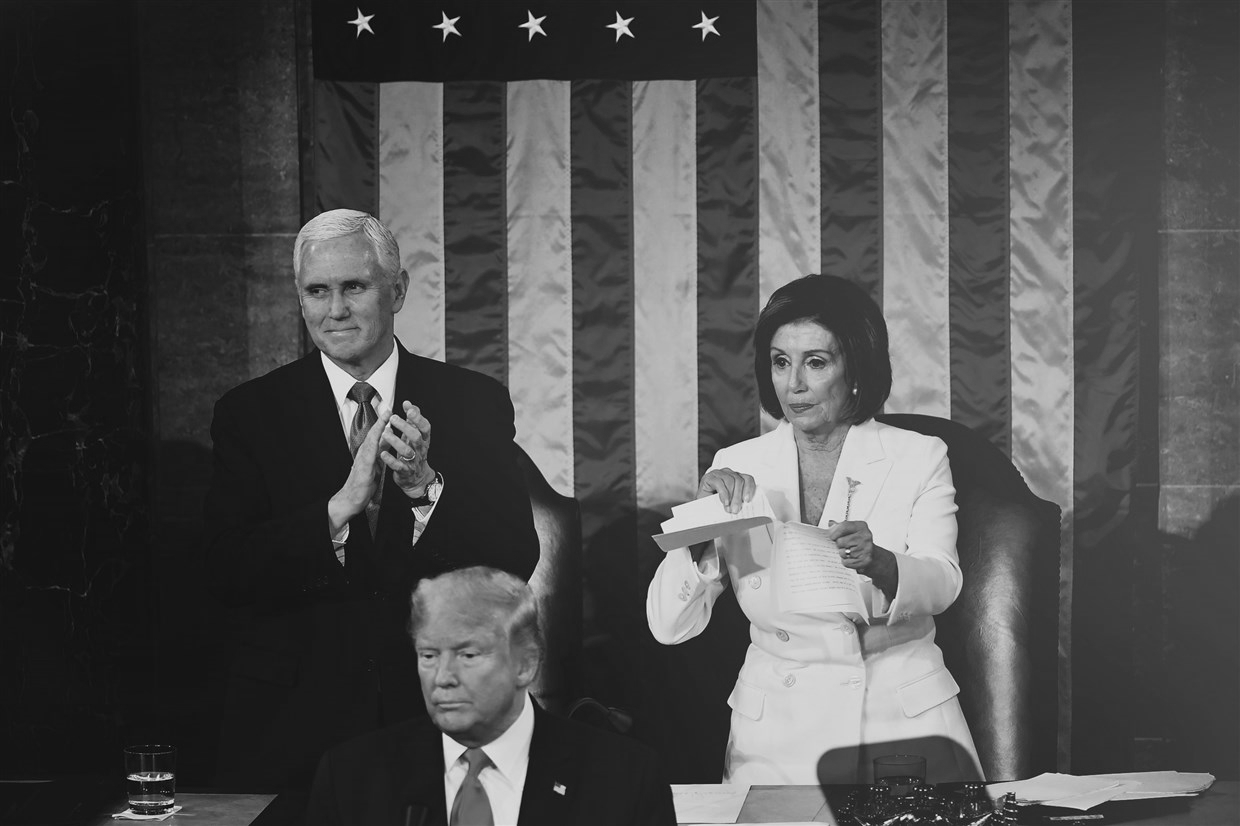
Political Fallout: the President’s February 4th 2020 State of the Union Address
Pelosi does not give the usual laudatory announcement of the President as he arrives to address Congress … and Trump refuses to shake her hand. He was still hurting from the impeachment effort she and her Democrat-controlled House had once again taken up against him in that very same room just weeks earlier … and which he had just been cleared of by the Republican controlled Senate).
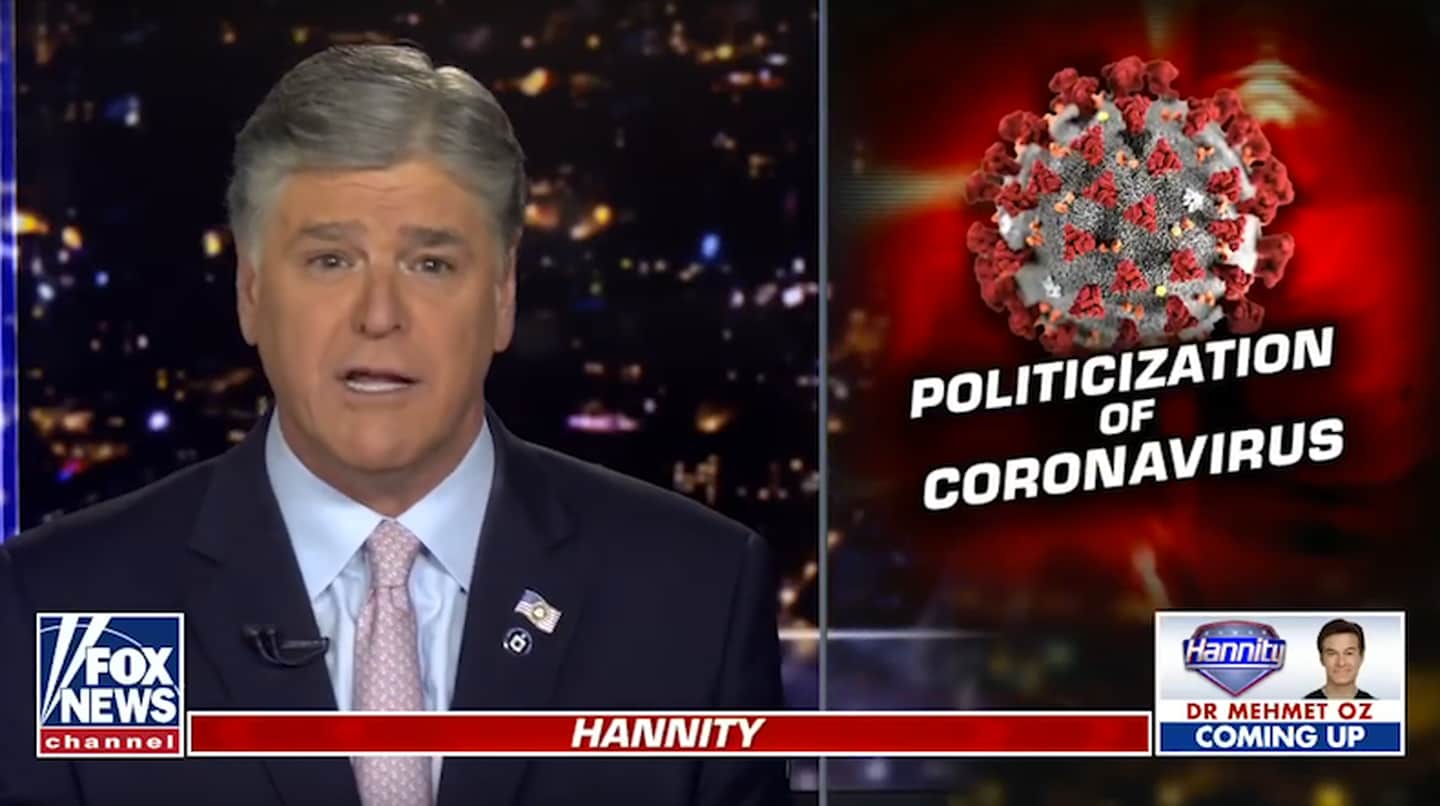
Coronavirus. While all this Democrat-Republican animosity was going on, a horrible pandemic caused by a new coronavirus hit the world. It seemed to have its origins in a Chinese food market in late 2019, spread rapidly across China, then hit Europe – finally moving on to America by January of 2020.

The Wuhan wet market
It is widely believed that the horrible corona-virus epidemic that cut across the world began in this wet market in Wuhan China. Others speculated that it may have started in a Chinese biological research lab … and got carried to that market. Others have different theories on the origins. Chinese were even to claim that it got started by American agents!
No one was quite certain what to do, or what this disease meant for the safety and strength of American society. Fearing a social and economic panic, Trump tried to play down the threat the disease posed to American life – but did attempt to restrict travel coming into America from China, being accused by his opponents of anti-Asian racism in the process! But watching things develop in Italy and Spain, hit especially hard by the disease, by early March it was apparent that something very serious was happening here. Seeing Italy and Spain respond to the disease by instituting the policy of “lockdown” (keeping people in their homes, allowing them out only for such “essential services” as food shopping), a similar lockdown began to be taken up at the state level by America’s governors. Thus shops, restaurants, schools, churches, etc. were closed down, and the American streets emptied.

As with the rest of the world, the virus hit America hard! New York City for instance
But the American economy also went into lockdown mode. How long America would have to remain under such economy-crushing measures was completely unknown.


Trump demonstrating how the Europeans were responding to the crisis. Trump himself shut down flights into the country from China, and put deep restrictions on other flights into the country. Democrats immediately complained that Trump’s actions were entirely imperious. Then later, as the virus did indeed hit America, he was criticized bitterly by the same voices “for not having acted soon enough.” Indeed, his discussions at press conferences (typical of the times) turned political … as the media made what it wanted of his explanations, either supporting his efforts to act against the virus or attacking him for the way he said this or that.
Trump’s federal response was in early-March to authorize $8.3 billion in emergency funding for medical research and hospital care – quickly realizing that this hardly met the severity of the crisis. By mid-March he put before Congress a request for $1.2 trillion in federal assistance, not only for medical assistance but also in support for struggling businesses and support for state unemployment insurance programs. Republican Senate Majority Leader Mitch McConnell was about to bring support to the request when Democratic House Speaker Pelosi entered the dynamic, demanding instead a $2.5 trillion … with a much wider range of financial support involved (education programming, environmental support, and other funding of Democratic Party goals) – including a cutback in the financial support Trump originally wanted for corporate America. This was to be more than an economic measure. It was to be a full social programming venture. And it would also be a huge addition to the national debt.

Pelosi explaining the Democratic Party’s much greater financial demands
in the economic relief program
But in the end a “compromise” was required to get any action at all on the matter, and the net result was a $2.2 trillion program – which included a $1200 or $2400 grant to every American household (depending on single or double adult status). But this was politics rather than economics. Of course. It’s what Washington does![3]
Meanwhile the virus lockdown was having its own impact – social and psychological – as March turned into April and April turned into May. How long was this lockdown going to last? Tempers began to heat up as debate, even street protests, began to break out over the ongoing restrictions.
In any case, this national crisis did not bring the country together … but once again seemed only to give political opportunists yet another cause to go against their ideological opponents
“Black Lives Matter.”

Black players on the Baltimore Ravens taking a knee rather than standing for
the national anthem as a point of protest against ….? They did however stand for the British national anthem (God Save the Queen) – September 24, 2017
Then in Minneapolis on May 25 occurred the arrest and death of a Black man, George Floyd, by a White cop, Derek Chauvin, involving Chauvin’s holding a resistant Floyd to the ground by keeping his knee on Floyd’s neck – as Floyd protested “I can’t breathe.” Indeed he could not, and died as a result. All of this was caught on video and shown repeatedly across all the media, Facebook and YouTube as well as the national news media.

George Floyd is brought down by Minneapolis policeman Derek Chauvin on May 25, 2020 … and Floyd dies as a result

Chauvin (left), plus three other officers (who did not intervene) are placed under arrest for murder (Chauvin) … or aiding and abetting a murder
Black fury exploded in Minneapolis – where the incident took place – and Minneapolis quickly began to look like Los Angeles during the Rodney King riots … and Fergusson, Missouri, during the Michael Brown riots. Shops were broken into, then burned to the ground, with whole neighborhoods coming to look like bombed out war zones.






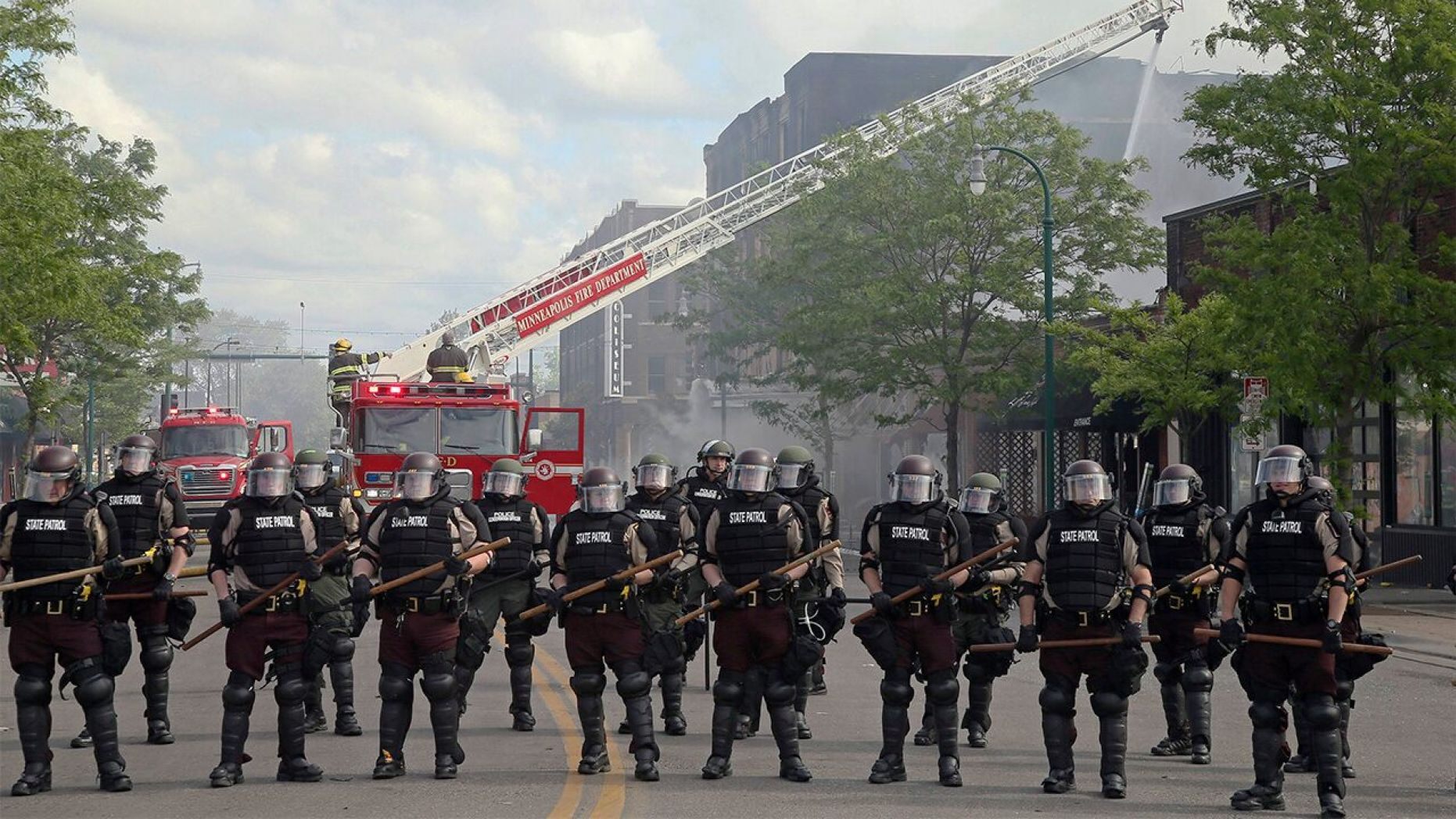
But the action did not stop there. It soon spread to city after city across America as Blacks (and Whites) turned out for “peaceful” protest on behalf of the cause, “Black Lives Matter.” Unfortunately, these peaceful protests were also soon accompanied by the looting and burning in city after city across America, similar to those continuing day after day in Minneapolis. Tragically, in St. Louis, Black retired police captain David Dom was killed defending a friend’s store … and many police (Blacks among them) were wounded (some killed) during the riots.

At this point even some prominent Blacks came out in opposition to the way the demonstrations were developing, complaining that this was not the way to improve race relations in America.
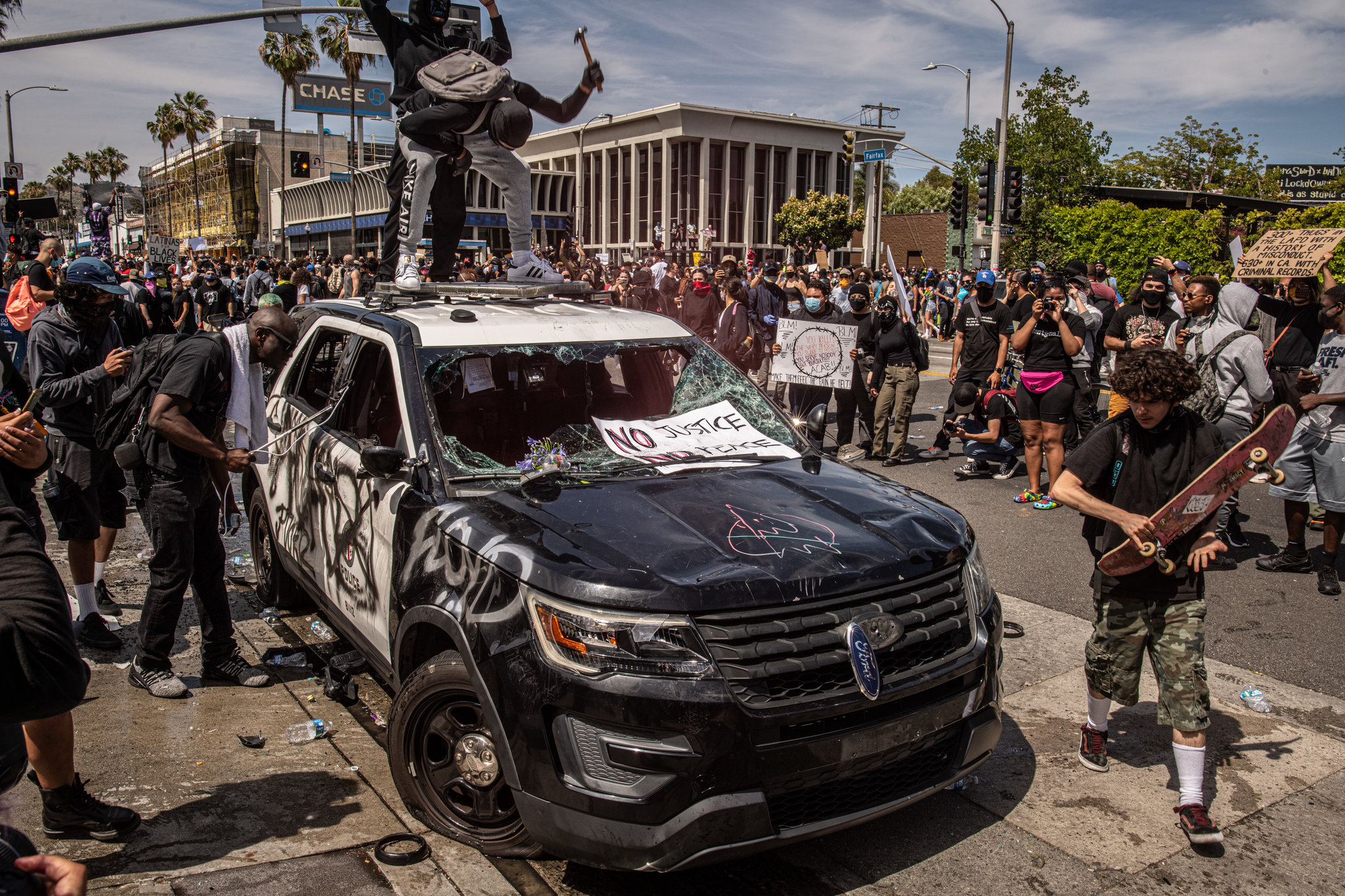
Antifa takes charge. Meanwhile, the cause was joined by angry, mostly-White, Antifa (“Anti-Fascist”) youth who turned the matter into a grand assault on all social authority – the pandemic restrictions being big contributors to the anti-authority mood.

An angry Antifa (“anti-Facist”) youth smashing a car in Tulsa, Oklahoma

A young man demonstrating his more “Progressive” social-political sentiments
And the dynamic became one of physical attack on the police (called out, of course, to contain the damage caused by the rioting) – characterized by Antifa rioters (and minority voices as well) as Fascist devils. So this dynamic became more than just one of racial tensions. It began to look like wholesale social revolution … especially in early June when Antifa youth took control of downtown Seattle and turned six city blocks into their police-free “Capitol Hill Autonomous Zone” … defended by fully-armed youth.
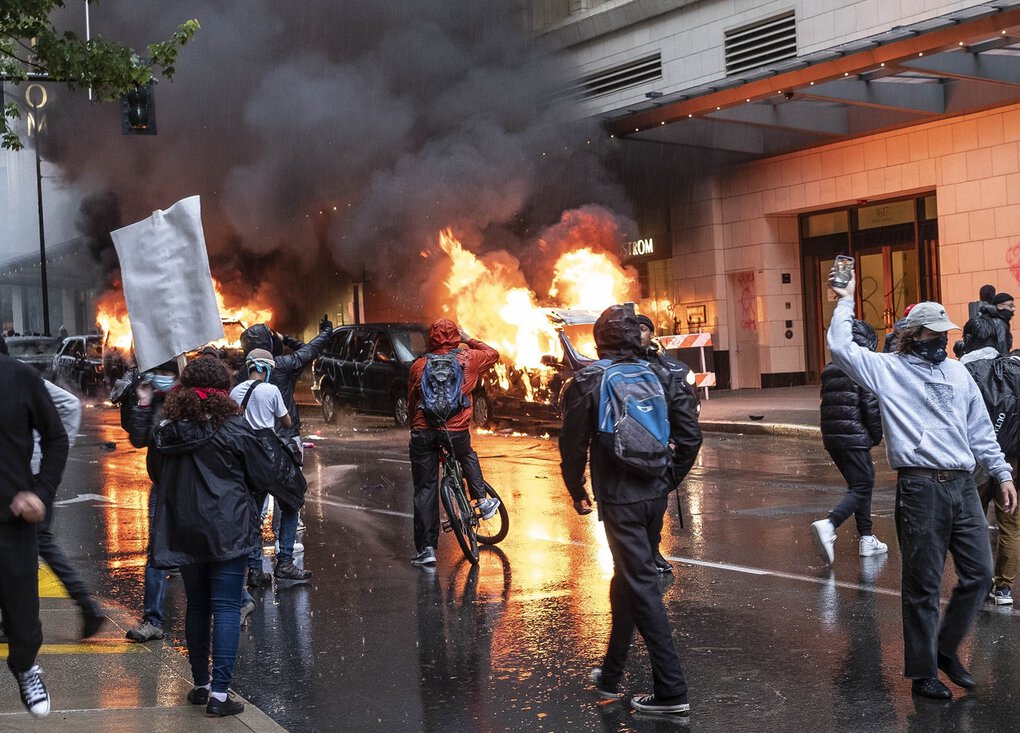
Young “progressives” take over 6 city blocks in downtown Seattle in early June to create their “Capitol Hill Autonomous Zone” (CHAZ), succeeding after two weeks of police and National Guard units versus activist violence … when the police were ordered to stand down by Chief Carmen Best


Then BLM supporter march on Seattle, demanding an end to “White Privilege” … a largely peaceful event except for the small group that advanced into White residential neighborhoods and demand that they give up their homes!
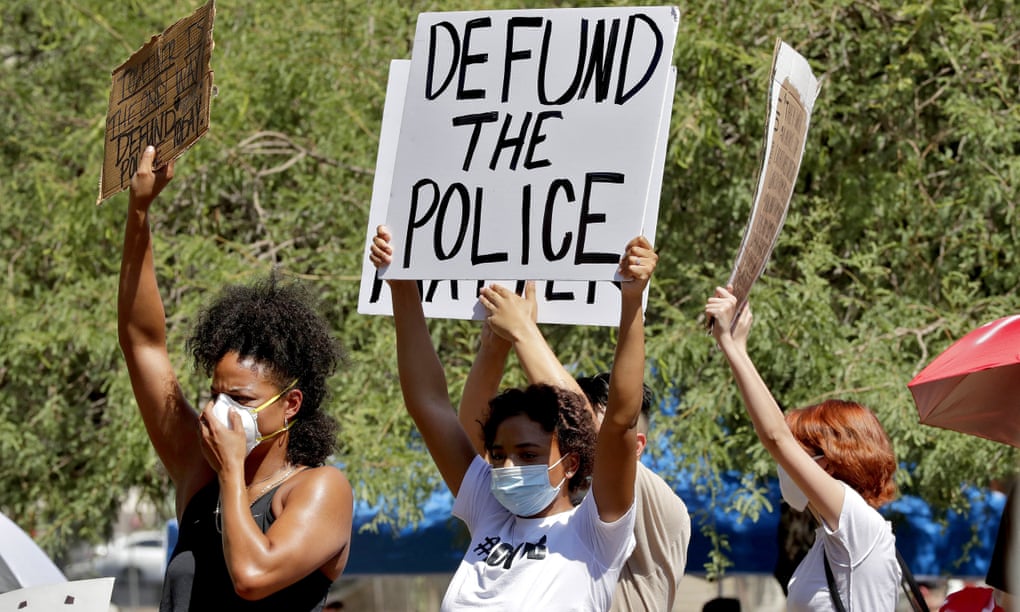
Finally … after a month of indecision (the Seattle police have been under constant condemnation for using oppressive measures to try to keep things from exploding out of order) CHOP is finally shut down (end of June). But the demand of protesters to “defund the police” becomes an ongoing chant by protesters, who demand that city finances should go to helping the poor … not the “fascist” police.
At this point, a number of big-city mayors (Liberal Democrats) came out with the announcement that they would be cutting back funding on their police budgets … to relocate that money into more “socially sensitive” minority-support programming. Soon this was becoming a refrain heard even more widely among America’s state and urban public authorities. Defunding the police was becoming the new thing in the world of “political correctness” … which a lot of local officials wanted to get on board with. Needless to say, with the police on the defensive as “fascists,” urban crime skyrocketed.
The Supreme Court expands the legal support of LGBTQ dynamics. In the meantime, America was so caught up in the street rioting occurring across the American political map, that it almost missed the importance of the decision that the Supreme Court came to in the case of Harris Funeral Homes v. Equal Employment Opportunity Commission (2020). On June 15th the Supreme Court announced that the 1965 Civil Rights Act included also protection of transgender sex … in deciding 6-3 that the Michigan Funeral Home had violated the law when it refused to allow one of its employees to cross-dress when meeting with grieving family members – in violation of the business’s dress standards. Interestingly, on the majority side was the supposedly conservative “originalist” Justice Gorsuch … who explained that Title VII of the 1965 Act did not include exactly the wording of transgender rights, but it certainly could be understood to have intended that in the category of “sex” discrimination outlawed by the Act.
What was this? Was Gorsuch sliding Leftward ideologically? Furthermore … although Kavanaugh joined Thomas and Samuel Alito in dissenting, he did so only out of the strictest of originalist principles. Personally, he expressed himself extensively in favor of all the progress happening elsewhere in LGBTQ rights.
But the Left paid no attention to his efforts to put himself on the Progressive side of politics … and attacked him for his vote nonetheless.
And so the politics of the highest court in the land continued to develop.
[1]Middle-Class Americans were noted for their strong support of the political idea that success in life is achieved through individual initiative and personal responsibility – rather than on the basis of a dependency on the offerings that larger society “owes” individuals as their personal entitlements, entitlements always paid for by someone else. This “something for nothing” or “everything for free” was viewed by Middle-America as the grandest political deception of all offered by ambitious political demagogues. To Middle-America, such Socialism always leads to a horrible condition of personal dependency on the state for whatever favors come to the people – a very destructive undermining of personal freedom, one which also invariably leads to the economic and spiritual collapse of the community, Venezuela being a most horrific recent example. But it is a mentality fundamental to most Latin American politics, and politics in other parts of the world as well.
It never belonged in Christian America, which was the moral-spiritual foundation of this idea of the sovereignty of the individual, and not the state.
[2]But this breakfast was taking place the very next day after the Senate had dismissed the impeachment charges delivered to it from the Democrat-controlled House, and just after the mainline Christian journal Christianity Today had strongly denounced the president. But it was also three days after Trump had been prayed for in the launch of the bi-racial organization, Evangelicals for Trump Coalition.
[3]The U.S. government has come to feel that it has the right (even some kind of duty) to run up a virtually unlimited debt, such as the astronomically high one it has accumulated today, totaling around $28.6 trillion (as of mid-2021) and still rising rapidly. That’s approximately $86,000 per person or $270,000 per the average American family of 3.14 members. Who (or what future generation) is ever going to be able to pay that off – or even cover the interest on that debt if it were allowed to move to a more realistic 6% interest rate, rather than the politically set rate today (thanks to policies of the Federal Reserve) which has been held below even 1%? A normal interest rate would consume all of Washington’s discretionary/non-mandatory spending, bankrupting the federal government. But it appears that nobody in Washington thinks much about this pending financial disaster. Instead Washington seems very willing to add even another $trillion or two onto the debt, if it is perceived as advancing the interests of this group or that group.
AMERICA AND THE WORLD IN THE AGE OF TRUMP
Trump’s wall. Trump had made it a central campaign theme of his that he was going to build a wall to stop the invasion of American territory by throngs of Central Americans (joined by others from different countries and with different agendas) fleeing the anarchy that reigned in Guatemala and El Salvador, but especially in Honduras.

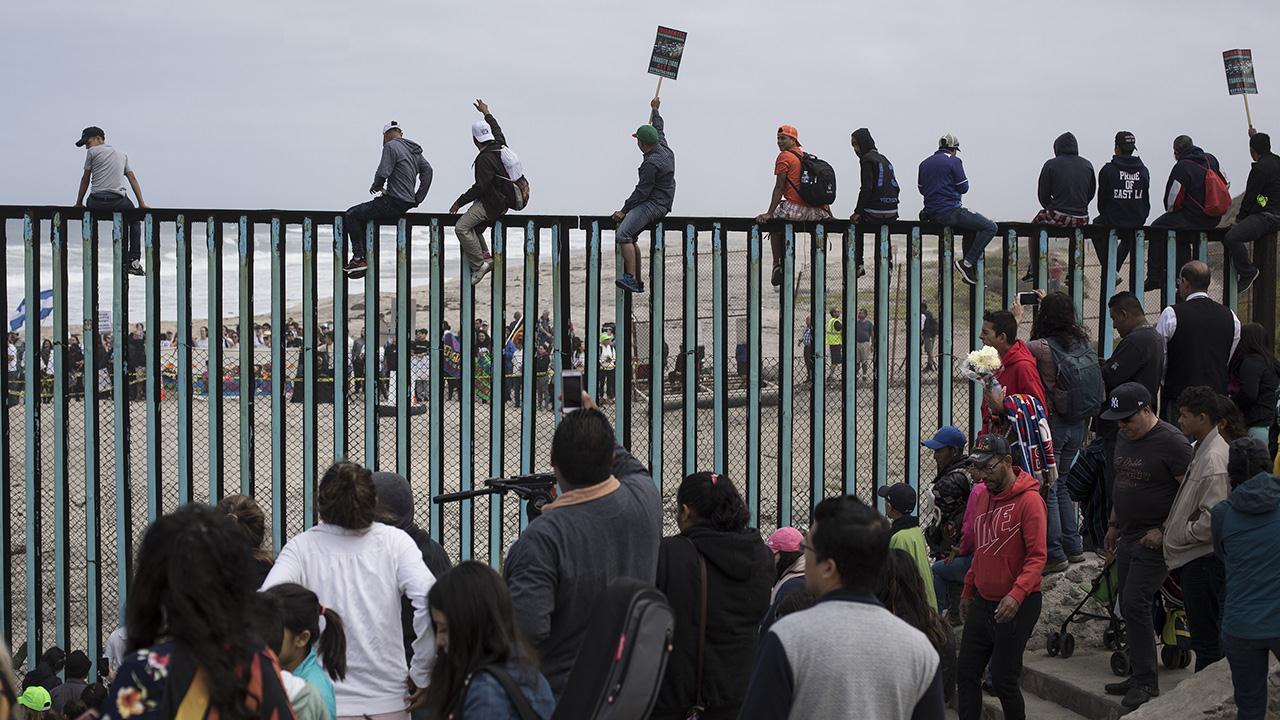
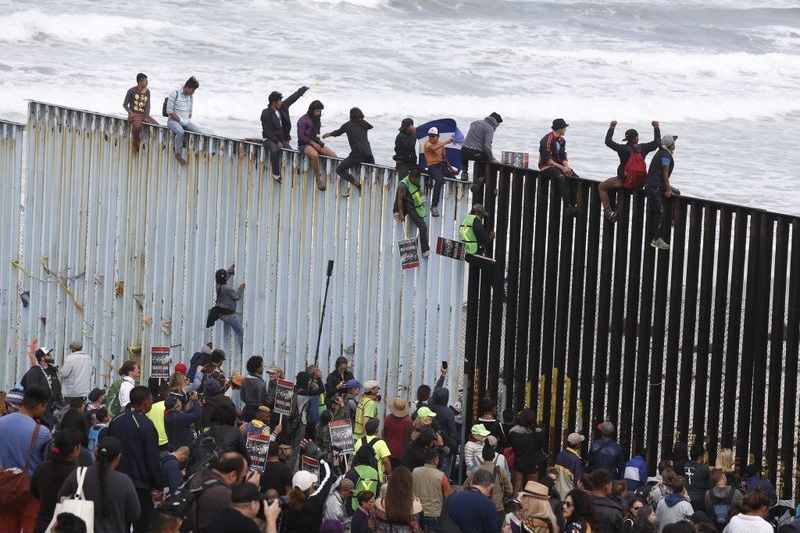

Hondurans (mostly) heading through Mexico towards the US
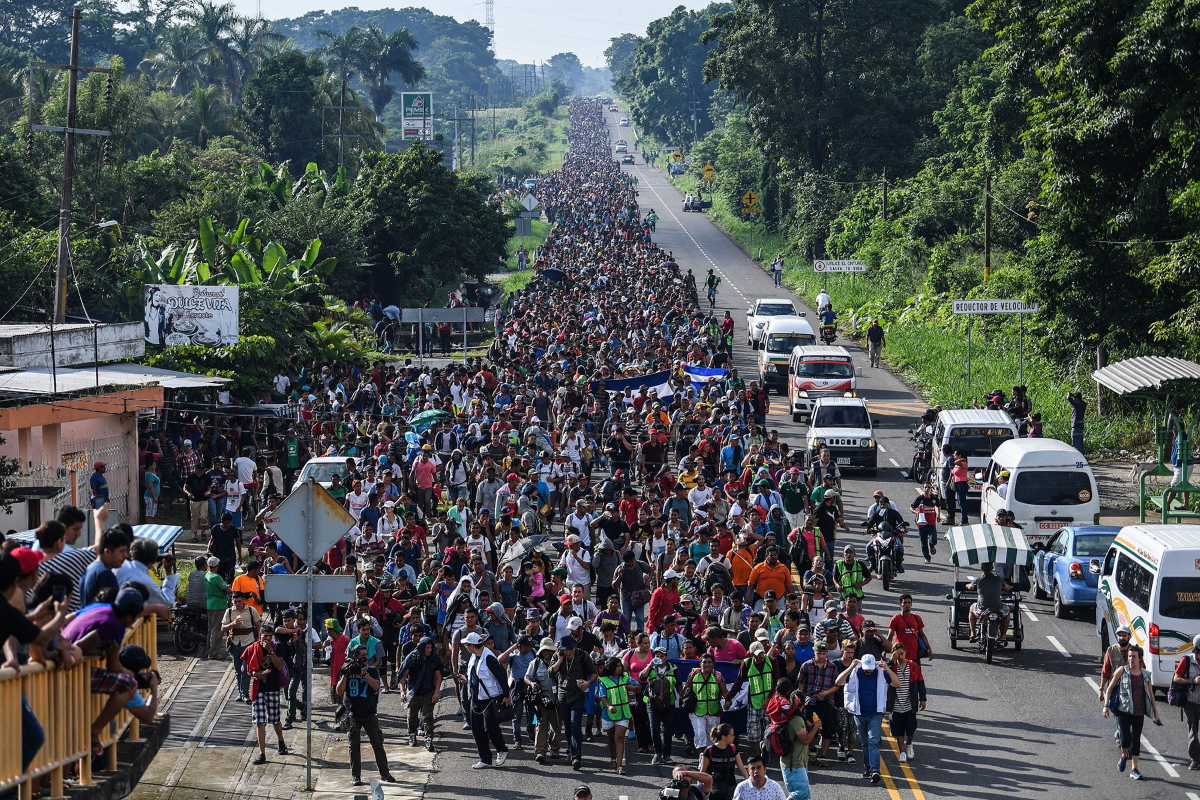

Liberals called Trump’s blocking of this massive influx of huge caravans of refugees “inhumane.” Some even called for an end altogether of the U.S. Immigration and Customs Enforcement (ICE), though it is doubtful that these same voices would have been willing to give permanent residency to these foreign refugees in their own homes. But it made for a very Liberal narrative, despite the fact that ICE had been just as active in protecting the U.S. border from invasion under Obama’s presidency.
But as the Democratic Party knows well, it gets the support of social classes that have come to expect those in authority to take care of them – such as the way things were supposed to work in Central America. But, as happens regularly, those countries had run out of economic assets they could continue to seize and redistribute to their supporters, and thus simply had failed as societies. Consequently, the mass exodus from Central America. And thus also, seeing potential votes (even if not yet citizens) in these government-dependent refugees, Liberals were very upset at Trump’s effort to block or just slow up the invasion.
Although Trump did not get Mexico to pay for the border wall (a rather ridiculous idea), he did get Mexican cooperation in slowing up and stalling the caravans passing through Mexico on their way to the United States. And he would indeed add (even though only slightly) to the reach of the border wall – or at least upgrade portions already in existence – a matter in which he took great pride.
A new trade pact with Canada and Mexico. Part of this Mexican cooperation was in response to the trade deals that Trump meanwhile had worked out with not only Mexico to the South but also Canada to the North. That in itself was a major Trump achievement, in an effort to get something of a balance in the trade between America and its neighbors. It had taken some Trump toughness economically to get economic talks underway – new tariffs on Canadian and Mexican steel and aluminum, and his threat to pull out of the North American Free Trade Area (NAFTA) altogether. NAFTA was the result of an agreement put in place back in 1994 to help Mexico get going economically – but which over time had come to disadvantage greatly American trade with Mexico (and to a lesser extent Canada). It took a whole year to reach a settlement. But it did cut back considerably the barriers Mexico had placed on American imports (through the mechanics of its own Valued-Added-Tax or VAT program) and provided a more equal flow of goods and services from country to country.
But at the time of the signing (November 2018) the Democrats had just been voted into a majority position in the House and were not in a very cooperative mood – until some additional provisions favorable to American labor and environmentalist groups were added, allowing finally at the very end of 2019 the new United States Mexico Canada Agreement (USMCA) to go into effect.
Venezuela. Further to the South, in Venezuela, similar problems had been developing with the putting in place there in 1999 of a strongly Socialist regime under Hugo Chavez (nationalizing Venezuela’s rich oil industry), a program then passed on to Nicolás Maduro with Chavez’s death in 2013. The Socialist government hoped to use oil assets to reward its supporters among Venezuela’s lower social classes. But the international pricing of oil had dropped considerably – cutting back severely that Socialist payoff. Now Venezuela found itself sinking rapidly into national poverty. Consequently, there was also a mass exodus of those able to escape the country (about 4 million or 12 percent of the population), headed mostly to other parts of South America and the Caribbean islands.
In 2017 Trump placed an embargo on Venezuelan oil[4] – but also exports of food and medicine to Venezuela. Then in 2018, Trump was joined by numerous European leaders hoping that Venezuelan elections that year would bring to power the more politically centralist Juan Guaidó, pledged to open the country’s economy internationally. But confusion, corruption – but most importantly, the support of Maduro by the Venezuelan military – foiled the effort.

Maduro greeting Salvadoran President (and other Latin America leaders) at Maduro’s inauguration to his second term as Venezuelan president – February 2019

Trump and Guaido – February 2020
But this in turn offered China, Russia, Cuba, Iran and even Syria and Bolivia opportunity to come to the aid of what was the strongly anti-American Maduro regime – with the intent not only of embarrassing Trump politically, but putting these “assisting” powers in a very strong position to influence political developments in the Western Hemisphere. And as long as Maduro remained in power so too would they remain as part of the political and economic dynamic in that part of the world. Especially for China and Russia, this was a big win.
Confronting China. China seems to be going down the same road as North Korea, strengthening the role of the Great Leader in society. Chinese President Xi Jinping had been making his firm grip on affairs both at home and abroad very attractive to the Chinese mind – that sees this strength only in a Tianzi or “Son of Heaven.” Thus in March of 2018, the Chinese National People’s Congress voted 2,964 to 2 to end the Chinese Constitution’s two-term limit on the presidency – put in place back in the 1990s by Chinese reformer Deng Xiaoping, to ensure the “collective” rather than personal rule of the Chinese Communist Party (such as had been the disastrous case under Mao Zedong). So, the Chinese found themselves heading down the road of unlimited personal rule again. That seemed to work best for them in their understanding of political dynamics.

Xi Jinping building Chinese power around his own personal rule
… as if he were founding a new Chinese dynasty!

Xi Jinping and his wife with Trump at Mar-a-Lago – April 2017

Trump in China – November 9, 2017
And indeed, the Chinese have reasons to be well pleased by the service Xi has been offering the country. He is a skilled player of political Weiqi (or Go), a Chinese board-game where a player wins by the careful placement of numerous checker-like pieces on the grid, and succeeds in finally isolating the opponent, who cannot make any further moves. The Chinese government has been carefully sending out technical advisors to numerous Third World countries, to help them develop their economies, in the process making the Chinese economic – and thus also political – position indispensable in their countries.
But China has also been taking an ever-stronger position in the West’s world as well. America (and many other Western countries) find their industries deeply dependent on governmentally subsidized and thus cheap Chinese labor to make their products inexpensive and thus marketable. At the same time, China has skillfully developed its electronic communications industry, financed also by extensive government subsidy – plus a lot of disregard of the World Trade Organization’s (WTO) international patent rights (just plain technology theft) – in order to advance China’s own technological position. China has been helping its 4G telecommunications giant Huawei now move into dominance in the 5G telecommunications sector, hoping to make as much of the world as possible China-dependent in the telecommunications field. Also, Chinese companies such as Alibaba and Tencent have grown to enormous size, both in China (near monopolies in their respective realms), but also to positions of dominance abroad by buying out foreign companies.
As a sign of the success so far in this venture, in April of 2019 the leaders of some 40 countries gathered in Beijing to celebrate the success so far of China’s “Belt and Road Initiative” (started up in 2013) designed to integrate closely the economies of these countries with the Chinese economy. Needless to say, America did not participate – nor did China’s Asian archrival India. But Putin did, as well as a lot of African and Middle Eastern leaders, and some European leaders (Poland, Hungary, Serbia, Greece, Italy, Spain. Czech Republic, Switzerland), even NATO ally Turkey, and some Latin American countries (Chile, Argentina). That was quite a show of Chinese support!
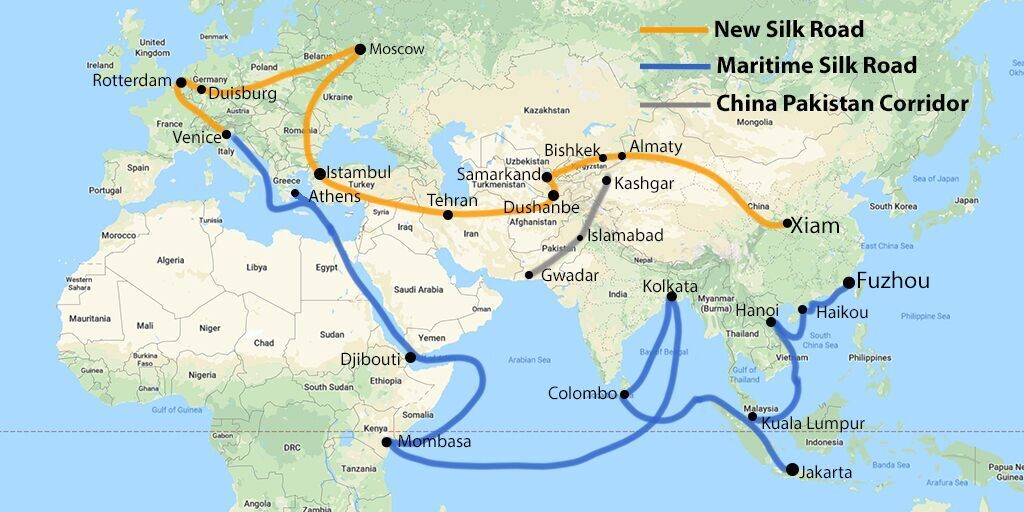
China’s “One Belt, One Road” or Belt and Road Initiative (BRI), initiated back in 2013, involves trillions of dollars in infrastructure development assistance offered to countries struggling financially to meet their economic challenges … something like a Chinese “Marshall Plan.” This puts China in a very persuasive position as to political as well as economic developments in the many (100 or more?) countries receiving BRI … and also China’s Asian Infrastructure Investment Bank (AIIB) assistance.
Trump responded in March of 2018 by putting in place tariffs amounting to $250 billion on Chinese goods seeking entry into American markets, in order to bring them closer in line with the pricing of unsubsidized international goods. China retaliated with $100 billion aimed at American goods coming to China (but the Chinese actually already import much less of the more expensive Western products). Efforts between Trump and Xi to renegotiate trade relations were attempted in 2019, but with little by way of results. But other Western countries joined the effort to not have Chinese products dumped into their economies, or have their companies bought out by Chinese profits gained in the government-subsidized economic competition.

“Partners” in the Belt and Road program meet in Beijing – April 24, 2019 to initiate a “Studies Network” The goal is a sharing of communications and ideas from universities and research centers across the globe
The coronavirus outbreak however could be quite damaging to Xi’s political position. Heaven’s withdrawal of its endorsement of the Tianzi is easily understood by the Chinese when some devastating event, such as a plague, occurs. Westerners do not fully appreciate the pressure Xi is under in China itself over this dramatic event. The virus is a very bad thing for Western societies (not just economically but also politically). But for China this can be totally devastating politically to the individual in power at the time. The world needs to watch to see how Xi handles this political challenge. Of course, he will attempt to hide the extent of the damage it is causing, or shift the blame elsewhere. But it is still there as a very serious threat to his personal rule.
And Trump’s pressuring the World Health Organization (he announced a pending withdrawal in May of 2020) to look into the origins of the pandemic and, as Trump saw things, stop protecting China, may have been done so, at least in part, for the very purpose of weakening Xi’s regime.[5]
Putin’s Russia. Russia’s “President-for-Life” Putin has been doing everything he can to bring Russia out of the Third-World status it fell into when it attempted “democracy” under Yeltsin – and return the country to the status of being something resembling more closely the superpower it once was. After all, it still holds an amazing quantity of nuclear weapons and possesses a well-developed military machine.

March 10, 2020 – Putin speaking at the Russian Duma … as the Russian Constitution is being amended to allow Putin to stay in power past his current term ending in 2024 … for an additional 12 years!
And, like Xi, Putin has been very aggressive in putting his country into the middle of global dynamics again, having Russia act exactly like the major power it once was. In fact the two, Putin and Xi, have been working closely together because they share the same goal: bring down America from its superpower status and have it join the company of the former international greats, Spain, Portugal, France, Britain, Germany, the Netherlands, etc., who now occupy at best only a secondary level of importance in the international scheme of things.
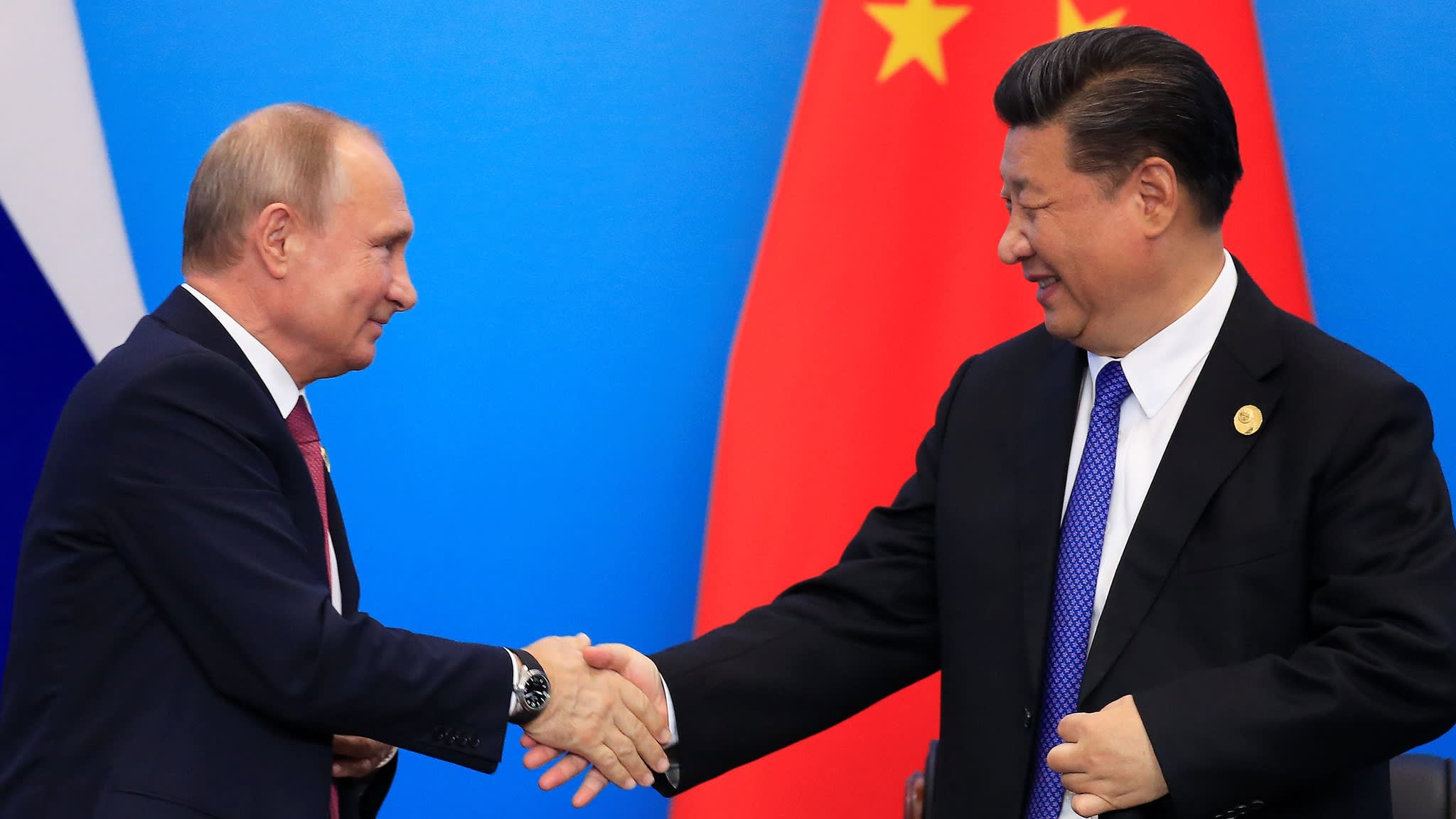
Putin and Xi recognizing that they have more in common rather than deep political differences in their desire to work together against an American-dominated world – June 2018
Thus it was that Putin was quick to come to Assad’s aid in Syria when Obama tried to weaken and then topple Assad’s government, merely undercutting America’s diplomatic position there, and advancing Russia’s at the same time.

Putin and Assad working closely together (May 2018) – since the Obama fiasco needlessly alienating Assad in the days of the Arab Spring
And thus it was that Putin was also quick to come to Iran’s aid when Trump attempted the same thing against Iran, in rejecting Obama’s treaty with the Muslim government and then deepening the boycott of Iranian oil. And thus also Putin jumped to the opportunity to be of help to Maduro’s government in Venezuela that Trump was trying to bring down.

Maduro and Putin – 2020
And so it goes, counter-moves (in alliance with China and others) whenever America attempts to exert influence over developments abroad. Indeed, Putin and Xi’s cooperation has been extensive, developing China’s Maritime Silk Road access to Europe across the newly open waters of the Arctic above Russia’s Siberia, at the same time working to complete the Russian pipeline with the goal of sending much-needed natural gas to the vast Chinese market. And the two countries are working together in the development of the new 5G network, as well as in other infrastructure and technology development.
And then there is also the matter of Russia’s natural gas pipeline to Europe, notably to Germany which also has been deeply dependent on that Russian gas. This helped put Russia in a pivotal economic position in Europe that America was finding it hard to compete with.
And thus it seems that the Russians in are no hurry to replace Putin with any other individual. The Russians are not as wed to the idea of “democracy” as America and the rest of the West. They had not fared well in the 1990s with their democratic experiment under Yeltsin. They have been very happy to have a strongman lead them, and – like the Chinese – see no need to turn over leadership on a regular basis. Indeed, a 2019 poll taken by the Levada Center[6] revealed even that 70 percent of the Russians believed that (what we consider a monster) Stalin played a completely or relatively positive role in the life of the country!
The world of Islam. It seems almost impossible for Americans to understand the world of Islam. When Sunni and Shi’ite Muslims are not fighting each other (their mutual hatred is ancient and deep, something along the lines of the Catholic-Protestant rivalry of the 1500s and 1600s in Christian Europe), they find the one thing they do agree on to be the danger that Western Secular-Humanism poses to their world. Unlike the Westerners themselves, they understand Secular-Humanism to be simply another religion, one which as Muslims, whether Sunni or Shi’ite, they deeply oppose, simply for the way it has placed Human Reason at the head of human life, not the God or Allah that created and directs all life. In this they share parts of the same worldview as Christians, although they are as anti-Christian as they are anti-Sunni or Shi’ite in their own world. It’s confusing. But not beyond understanding, if Western leaders – such as American presidents – would simply take the time to learn about these things. It would have saved America a lot of trouble in Iraq, Afghanistan, Libya, and Syria. And it was only the intervention of the Egyptian military in Egypt that spared America from making the same mistake in Egypt.
Bush never really caught on to this all-important dynamic. But Obama seemed to understand this dynamic no better than Bush, supposing that “democratic” Secular-Humanism would inevitably rise to dominance in the Muslim Middle East if we simply got rid of other Arab dictators, like we did with Saddam. Libya, Egypt and Syria became test cases for the Obama (and Bush, Jr.) idea that “democratic progress” would be the inevitable result.
And of course, as in Iraq and Afghanistan, such intervention merely spun these societies into a horribly cruel state of civil war, from which millions of people were displaced from their homes and thrust into refugee status. And in the end, this merely gave opportunity for fiercely anti-Western Sunni Muslims to advance the cause of jihad, even to the point of succeeding in establishing a new Sunni Caliphate (the Islamic State) in the war-torn zone of Western Iraq and Eastern Syria.

Southern Syria, March of 2017 … ISIS still very active in conducting and recording the beheadings of various individuals

Finally in October of 2017 ISIS troops have been driven from Raqqa by Iraqi and Syrian government troops

But Raqqa itself is vastly damaged

March 2019 – Syrian forces have taken control of the last ISIS stronghold, Baghouz
Dealing with Iran. But Obama did feel that he had achieved at least one foreign policy success (in addition to the taking out of Osama bin Laden in Pakistan) with his appeasement rather than confrontational approach to Iran, with the signing of the nuclear development agreement that would open the West (Europe as well as America) to Iran again.
But Trump didn’t see things in Iran the Obama way, claiming that a country whose motto was “Death to America” was not one to be trusted to keep its word on the agreement (there was already way too much secret activity going on in that part of the world concerning nuclear development) and he thus terminated Obama’s agreement with Iran.
Whether confrontation rather than appeasement will prove more effective in keeping an Iran determined to bring the West’s – and most notably America’s – Secular-Humanist cultural dominance in the world to an end remains to be seen. But Iran has been very busy allying with the Russians and Chinese wherever possible in undercutting the American-led Western position in the larger international realm. Would continuing appeasement have changed the direction of Iranian politics? Certainly not, at least as long as militant Shi’a Islam continues to dominate Iran.
Of course, there are still many Secular-Humanists in Iran, but they have been deeply undercut politically by the Muslim militants and the Iranian Muslim leadership in Iran. And American toughness does nothing to help the political position in Iran of these Iranian Secularists, who appear to other Iranians as highly treasonous in the way they seem to share the same values as the hated American enemy … an enemy under Trump clearly out to destroy Iran’s economy and thus society itself.
On the other hand, Trump also made the decision to start withdrawing American ground troops from other positions in the Muslim world, at the same time beefing up the American naval presence in the Middle East, especially in the vital Persian Gulf region where Saudi Sunni and Iranian Shi’ite oil interests are in direct conflict.
Sadly, it was the U.S. withdrawal from Syria that finally severed Trump’s stressful relationship with his Secretary of Defense Jim Mattis, who disagreed strongly with the move. But it was part of Trump’s effort to get the country out of the business of “nation-building” abroad, and instead finding other ways of working with the world of Islam. Indeed, Trump went on to actually hold diplomatic talks with the Taliban, which in turn opened the way for broader political negotiations among all the Afghan political parties. The Democrats, however, were not impressed (naturally), but said little about the matter. There was little interest in bringing attention to any diplomatic breakthroughs that Trump might have secured for the country.
The general withdrawal of American ground-troop involvement in the Middle East did not mean the withdrawal of American involvement in the region, as Trump demonstrated when he ordered a temporary beefing up of the American air and ground offense against the Islamic Caliphate at Baghouz, which Americans helped bring to collapse with the massive bombing in early January of 2019. This did put an end to the Islamic State. But of course it did not end the Islamic spirit of jihadism, although it certainly put something of a damper on that spirit.
At the same time, Trump worked very hard to strengthen relations with America’s old Arab ally, Saudi Arabia – plus others of the Arab Gulf states. But, for instance, his agreement to sell arms to Saudi Arabia drew a lot of opposition from the Democrats, for no particular strategic reason other than it was Trump who put the deal together. It seems that the Democrats instead would rather have him punish the Saudis for their involvement in the assassination of the Saudi journalist Jamal Khashoggi. Likewise the diplomatic agreement that Trump led the Arab States of Bahrain and the United Arab Emirates to enter into with their old enemy Israel received no acclaim from the Democrats, in fact very little mention at all by the American press corps of the enormous significance of this diplomatic breakthrough.
Trump’s relations with Europe. The Trump mouth turned out to be as big a problem in Europe as it had been in America. Trump found it easy to offend people, especially those that political necessity normally required a strong working relationship. It made little sense. And it offered the “never-Trump” groups in Europe plenty of ammunition for their crusades. Thus it was no secret how much Germany’s long-time chancellor Angela Merkel disliked Trump, although she and others tried to warm up the relationship as much as possible.
Of course Trump’s “hit hard and then negotiate a compromise” strategy (presumably developed during his many years in the business world) did have its positive results, in that his pressure did get some of America’s allies moving up to meet their full national financial responsibilities as members of NATO.

Trump and NATO leaders in the United Kingdom for a NATO conference – December 4, 2019. The press did what it could to portray Trump as the “man out” in the otherwise close circle of allies. Certainly there was stress over his insistence that others should pay their share of NATO’s costs.
But the world of politics is as much a matter of visible symbolism as it is behind-the-scenes deal-making, something that obviously Trump failed to understand. Thus his threat in June of 2020 to withdraw American NATO troops stationed in Germany tended to result merely in deepening the anti-Trump mood in Germany … and elsewhere in Europe.
[4]Anyway, America really did not need Venezuelan oil as it was basically oil-self-sufficient by this point thanks to American shale-oil production.
[5]Biden has since reversed Trump’s decision, announcing that the U.S. will not be withdrawing from the organization.
[6]FP Morning Brief (Foreign Policy), January 12, 2021.
THE CHAOTIC 2020 ELECTIONS
The critical role of the pandemic. Not surprisingly, the Covid-19 pandemic impacted the electoral process deeply, with both the Democratic and Republican parties having to hold mostly virtual (online) conventions, with few delegates able to attend physically, because of the new public participation restrictions.
In the process, the Republicans reconfirmed the Trump-Pence ticket. And the Democrats chose Washington veteran Joe Biden, who had served in the U.S. Senate from 1973 until his move to the position as Obama’s Vice President in 2009, also an unprecedently elderly 78 at the time of his selection as the Democrat’s presidential candidate! And out of the predetermined category of a “woman of color” to be chosen as his vice-presidential running mate – a bold act of politically-correct racism/sexism actually – Biden finally chose Kamala Harris, U.S. Senator representing California since 2017 and California attorney General prior to that (2011-2017).
The pandemic would also reshape deeply the way the November voting itself went … with the majority of the vote by way of mail-in voting rather than personal presence at a voting station. The latter in fact became itself a major campaign issue, with the Republicans claiming that mail-in voting could easily lead to massive fraud (it is after all easier to check on the authenticity of a registered voter at a polling station) … and with the Democrats supporting mail-in voting as a matter of justice as well as convenience.
Then President Trump contracted (a fairly mild) case of the virus in early October … and had to be quarantined, keeping him from attending rallies during this important month leading up to the elections. This did further damage to his presidential credentials, which were already suffering from voter discouragement over the whole pandemic issue. Being the president, he was subtly expected to have solutions to the crisis. He was working on the matter … but not as fast as much of the public expected, an expectation now heightened greatly by the Democrats.
A shameful political debate. But the real problem facing Trump going into this election was the behavior that went on during the first presidential debate held at the end of September. It was a repeat of Trump’s performance four years earlier when he constantly interrupted his opponents, in this case Joe Biden, during his presentation. Insults were sent back and forth dominating the conversation … rather than in-depth policy clarification. And the moderator, Mike Wallace, merely added to the confusion with his own frequent interruptions in the discussions. All in all, it was a bad scene – especially for Trump, whose rating suffered the worse of the two candidates … according to the media polls, which of course, varied substantially in their measurement on the basis of their own ideological preferences.
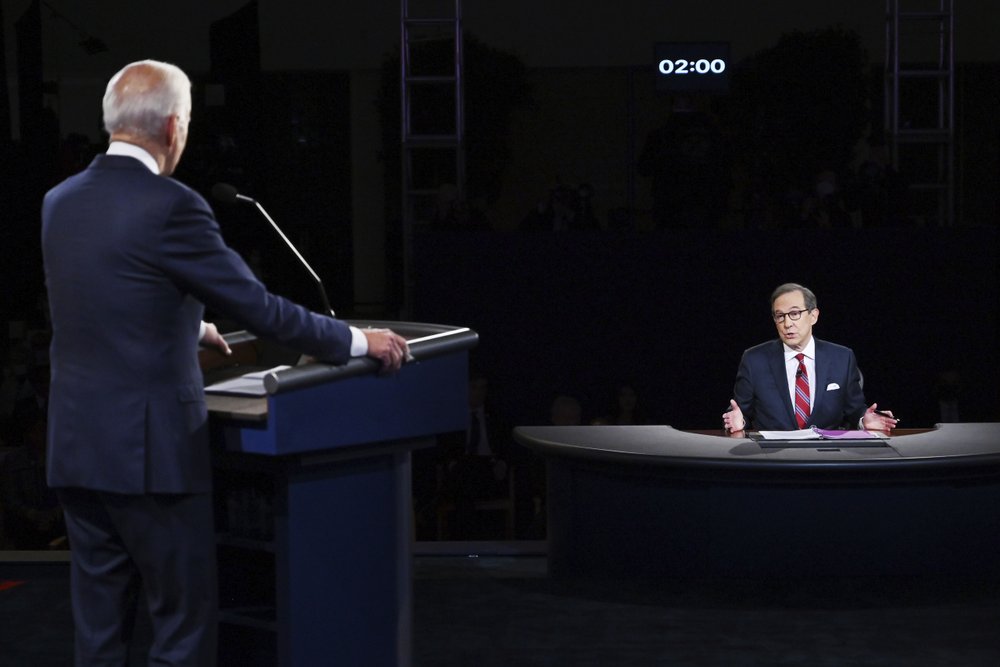

Wallace’s intervention did not help matters (creating the impression that he was not neutral in the contest)
A second debate had to be called off, because of Trump’s illness. So only one more debate was conducted (October 22nd) … much calmer and more to the policy point this time. But it seemingly changed little in the political standing of either candidate. Trump’s terrible first performance had pretty much decided the “undecideds” against him. Thus, according to the various polls, Biden was running well ahead of Trump at the approach of the elections.

But for Trump, a better second performance (October 22nd) would do little to bring his ratings back up. Most Americans had already decided where they stood in the election.
Biden wins. On November 3rd the nation “went to the polls” (the group that had not already voted by mail before that date). Because of the new voting dynamics, it would take several days before a fully clear picture of the outcome could be discerned … and that only when the close Pennsylvania vote was finally confirmed.
Ultimately, over 81 million votes went to Biden and over 74 million votes went to Trump. This was the largest number ever of votes cast in an American presidential election, with both candidates (even Trump) receiving more votes than any previous candidate. Both won 25 states each in the electoral college vote (Biden naturally also winning unfailingly Democratic Party D.C.’s 3 electoral votes), though Biden’s strength in both New England and the Pacific Coast put the actual electoral vote strongly in his favor, 306 to 232. And surprisingly Biden’s vote included (very narrowly) Georgia and Arizona, both Republican-leaning since the 1990s … and a matter of great interest to Trump.


Trump immediately makes his feeling about the results very clear:
His opponent Biden had “won” the election only through extensive voter fraud
A graceless political transition. There had been much previous speculation as to whether or not Trump would offer a graceful turnover of power to his opponent, should he lose the election. As it turned out, the transition was indeed far from graceful.
Rather than concede when it was clear to all (including even the conservative Fox News) that Biden had won the election fairly enough, Trump claimed that Biden had done so only through extensive voter fraud, illegal ballots having given Biden his victory. Trump – despite Attorney General William Barr’s announcement that an extensive FBI inquiry into the matter found no evidence pointing to extensive fraud – was going to challenge the results in court in a number of instances (a strategy he had learned years earlier as a businessman).
Despite the assurance of the state authorities that the voting had been amazingly clean, Trump pressed his case (most notably in Georgia, Michigan, Nevada and Pennsylvania) … not able to actually demonstrate any true amount of fraud he assured everyone was key to the illegal outcome.
It was simply Trump being Trump … using his own reasoning (notably with the help of a band of lawyers) to press his case, by whatever means possible. Ultimately the day of the vote of the Electoral College arrived (December 14th) and the earlier count in favor of Biden was reaffirmed.
Political damage in Georgia. Tragically for the Republican Party, Trump’s pressure on Georgia to reexamine the vote (and declare a Republican win) – not once but three times – did not play well in Georgia’s runoff elections held on January 5th. In the November elections, Republican incumbent Senator James Perdue had failed to receive the 50% required by the state to be returned to Washington as the state’s senatorial representative. Perdue had gained only 49.4% of the vote … with his Democratic opponent Jon Ossoff gaining 47.9% of the vote. But Trump’s behavior had created such ill feeling among Georgian independents, that when the runoff was held, the vote switched entirely, even with a smaller turnout: Ossoff with 50.6% and Perdue with 49.4%. Thus the Republicans lost a vital seat (and consequently its majority) in the Senate, largely because of all the Trump antics. The Senate was now tied, 50 Republicans (even some of those rather “independent-leaning”) and 50 Democrats, with the new Democrat Vice President Harris able to vote to break any voting ties that might occur.
The assault on Capitol Hill. Then on the following day – January 6th – just to make the transition even uglier, Trump called for a rally in front of the White House … and challenged a huge and very hyped-up gathering to march on the Capitol Building – and demonstrate to Congress (which had gathered that day to give official authorization to the Electoral College vote) their anger over the supposedly fraudulent elections.
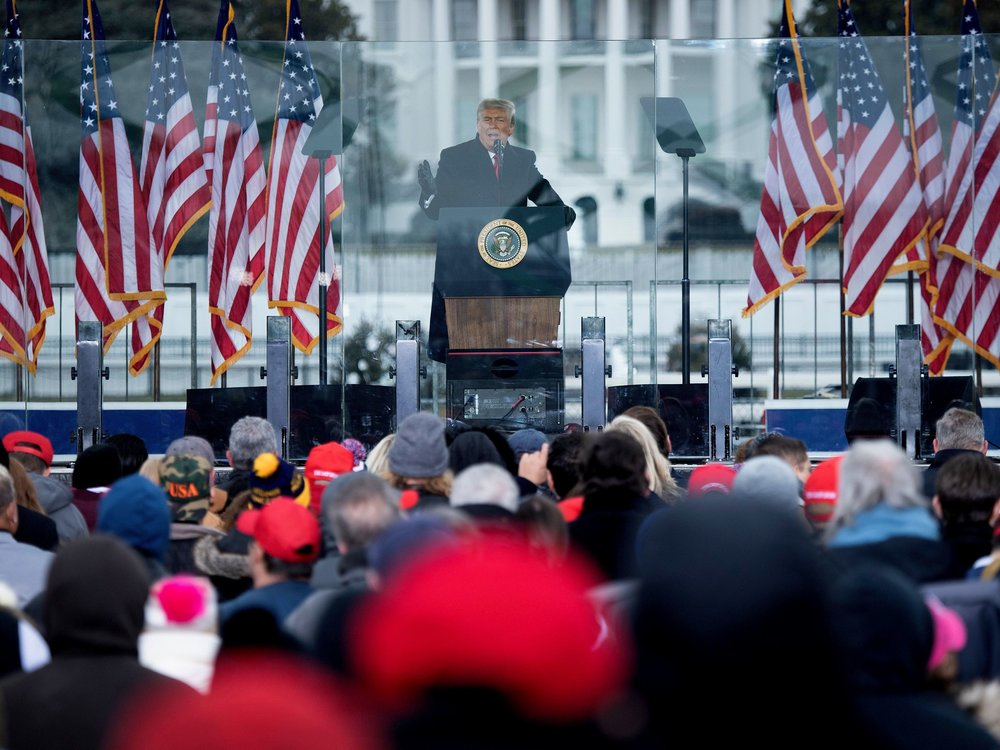
This they did … but not stopping merely on the lawn in front of the Capitol Building, but instead storming it … thus producing a very violent confrontation with the Capital police – and the retreat in fear of the gathered Congressional members.


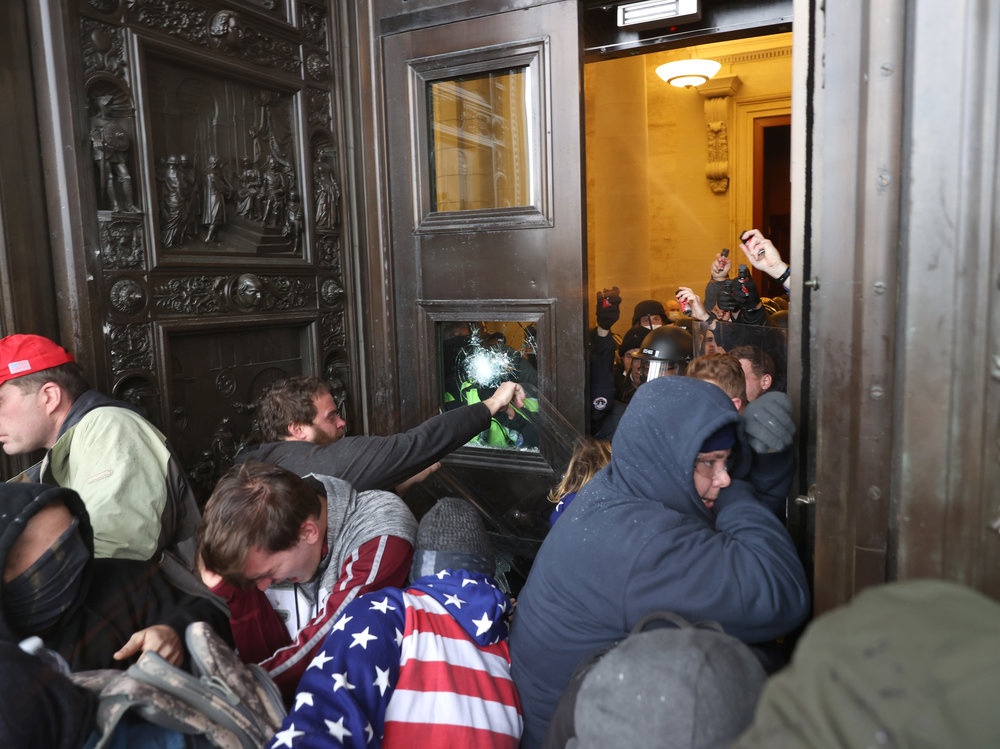
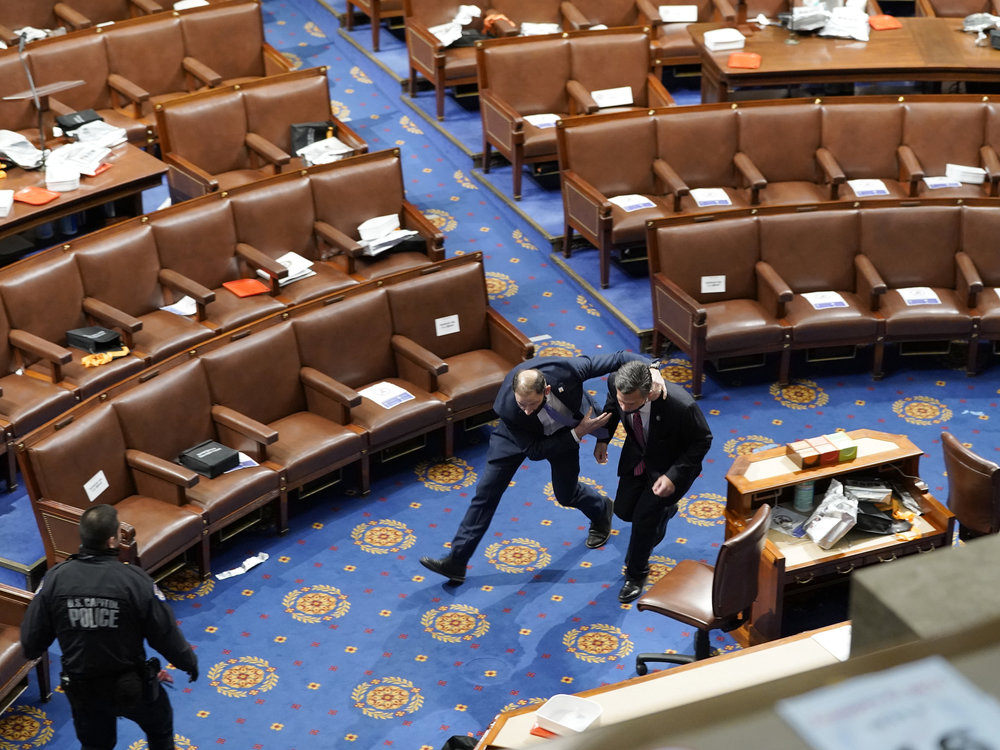
In the process, Representative stopped the vote and went into hiding

In the melee, one protester was shot, numerous people wounded, including a policeman who later died of his wounds. And others died of medical conditions that could not be attended to. It was a terrible show of a president leaving office.
In the melee, a female Trump supporter was shot and killed, several protesters died, presumably from medical emergencies, and numerous officers were hurt badly, one dying from his wounds, before they could be cleared out. Many of the participants would later be identified and arrested for what was clearly a federal crime.
Immediately calls were issued for the impeachment of Trump (the third attempt) … and indeed on the 13th of the month the House successfully voted exactly that. But of course this action would then have to go to the U.S. Senate … where, even with some Republicans switching to the side to convict, the necessary 2/3rds vote would not be forthcoming. 57 Senators (including 7 Republicans) voted to convict; 43 (all Republicans) voted to acquit. But almost immediately speculation arose as to the possibility of the Democrats finding another way to take Trump down … permanently, so that he would be unable to run again for the presidency.

AAnd it would, of course, become grounds for a new impeachment effort … voted on by Pelosi’s House on January 13th, 232-197 after a 2-day hearing

And again the Senate failed to gain the 2/3 vote necessary for actual conviction

Trump saying goodbye as he and Melania leave Washington early on the 20th just prior to Biden’s inauguration ceremony