CONTENTS
 Gathering storm clouds
 Secession and war
 America recovers (1865-1880)
 The battle for the West resumes
The textual material on this webpage is drawn directly from my work, America’s Story – A Spiritual Journey © 2021, pages 136-158
GATHERING STORM CLOUDS
The Second Great Awakening served to deepen tensions over the matter of slavery – spurring the growth in number of Abolitionists. They sought to have slavery outlawed everywhere within the country, fearing that not to do so would sooner or later bring God’s wrath upon the nation. But the Abolitionists of the 1830s and 1840s were way ahead of the rest of the country (not to mention the South) in their thinking about slavery. The country’s leaders even passed a gag rule in 1836 preventing anyone from bringing the matter up for discussion in Congress.
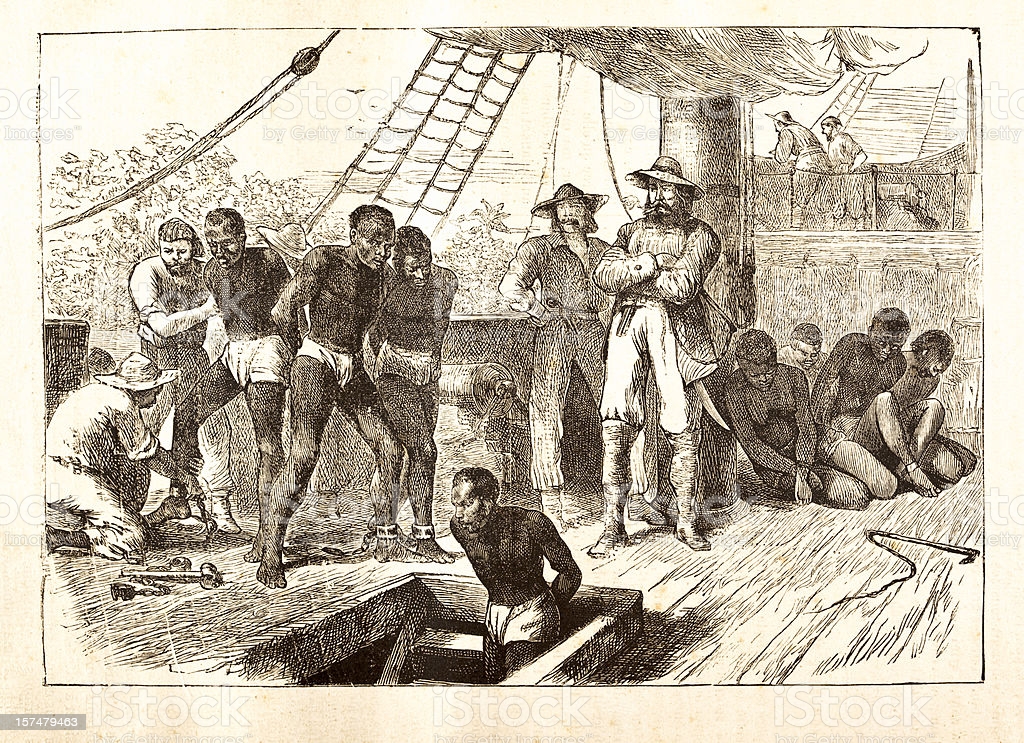
While the Europeans are moving to end the horror of slavery … Americans are still locked in bitter debate over the matter
Cultural variations. But the deep split dividing the North and the South merely continued to deepen as the years progressed. The two societies headed even further away from each other in terms of everything from economics to social and cultural dynamics, not to mention politics. The South seemed unable to get away from its dependency on cotton farming – that being such a central part of the image of highly idealized life on the Southern plantation. But actually, for most of the poor Whites – not to mention enslaved Blacks – their lives were tough and with virtually no possibility of improving things in any way. Passivity was thus the key to survival in much of the South. But the North was robust, even a bit on the wild side as it attacked life. And it was made even more vibrant with the rapid expansion of the population of the North, both in numbers and in outreach. Thus it was that the South was feeling highly defensive as it found itself being left behind in the country’s growth.
Bitter debate over the admission of new states. With Texas knocking at the door for admission to the Union as a new (slave) state, whatever compromise had been achieved in the 1820 Missouri Compromise now became ineffectual … for Texas was a huge addition to the geographical picture of the Union. But then also California wanted admission as a new state. But much of it too lay below the Mason-Dixon Line, yet would be clearly admitted to the Union as a Free State. Thus tempers flared in Congress as debate dragged on over the westward expansion of the American Union.
Another “compromise” in the face of bitter identity politics. Naturally there developed considerable ire among Southerners when in 1849 California (with key sections well south of Clay’s original North-South dividing line) applied for statehood as a free state. But once again Clay stepped forward to offer a compromise, admitting California into the Union. But also, in defining new Western territories as future states – such as Nebraska and New Mexico – he proposed the idea that these states should be allowed to decide for themselves whether they would be slave or free. That seemed fair enough at the time – but in fact merely shifted the controversy to the states themselves, producing in some cases terrible in-fighting (a prelude to the Civil War). To appease the Abolitionists, Clay called on Congress to regulate interstate trade in slaves. But to appease the South, he also directed the North to send back to the South any slaves attempting to escape to the free-state North. So supposedly Clay was offering a balanced program of partial support for both the pro-slavery South and the increasingly Abolitionist North.

Clay offering a compromise on the slavery issue – 1850
Actually, the willingness of moderates to accept this compromise only deepened the bitterness of the growing wings of extremism in both the North and the South. Abolitionists were outraged at the idea of having to send fugitive slaves back to their Southern masters – and Southern radicals began to talk more frequently about simply pulling out of the Union.
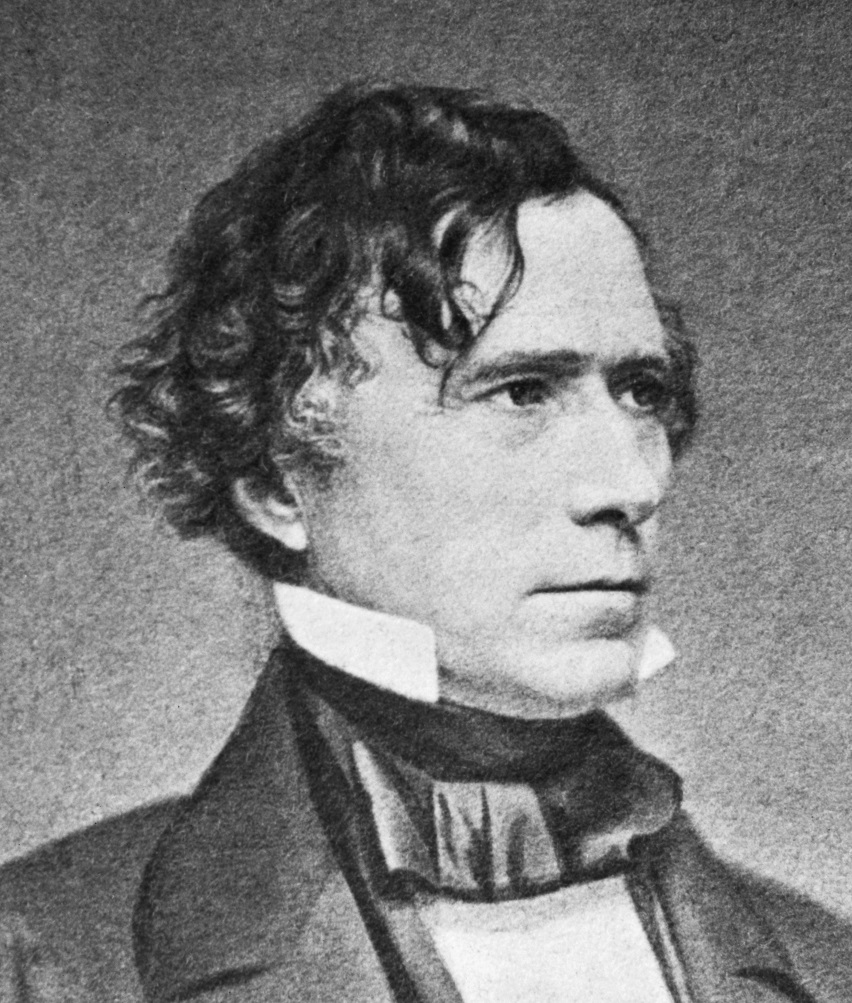 Ultimately the Whig Party would pay dearly for its efforts to follow this path of compromise, one which merely deepened the sectional divide within the country. In the 1850 elections the Democratic Party, claiming to bridge this sectional gap, completely routed the Whig position in Congress and in 1852 did the same with the presidency. Democratic Party candidate Franklin Pierce was elected President as a “Northerner of Southern principles.” And thus at this point the nation hoped that with a moderate Democrat in the White House, the country could now move on quietly past the slavery issue.
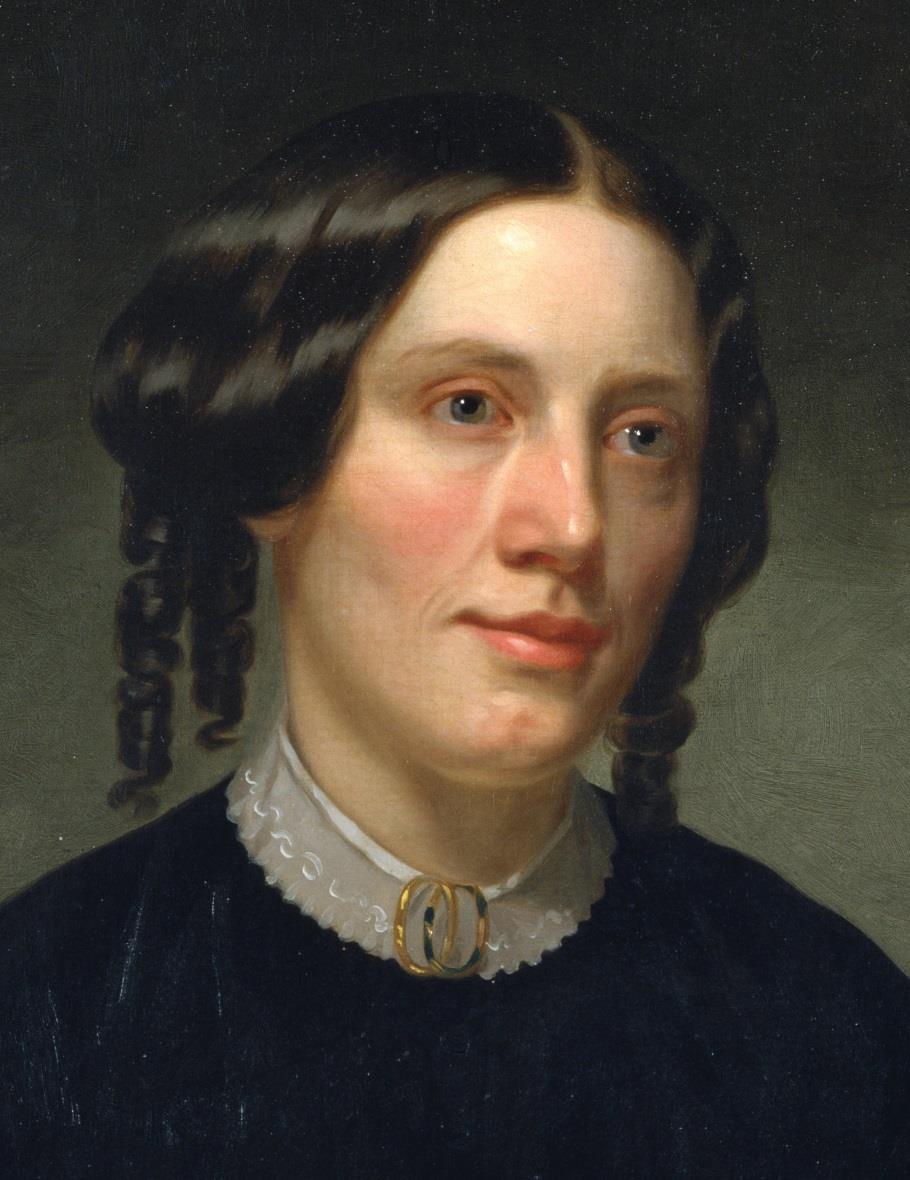 Harriet Beecher Stowe’s Uncle Tom’s Cabin. However, the publication of Harriet Beecher Stowe’s Uncle Tom’s Cabin (1851-1852) would keep the issue in front of the nation, where it would burn American passions deeply. It depicted the suffering and bravery of American slaves so touchingly that the idea of ever sending Blacks that escaped Southern slavery back to the South became virtually unthinkable to a Northerner, thus outraging the South because of the North’s unwillingness to obey the law (the Fugitive Slave Act of 1850).
The “Underground Railroad.” Then to infuriate the South even more, rumors began to grow about a secret program that was designed to help Blacks escape to the North, or even to Canada. Actually, it was neither underground nor a railroad but instead a series of safe houses along a trail of escape which provided support and guidance for those fortunate enough to break from their bondage. How extensive it was remained a great mystery, the numbers possibly expanded greatly – by the South to stress how terrible this violation of their “property rights” happened to be, and by the North, eager to show how widespread was the support in the North in the freeing of Southern slaves.
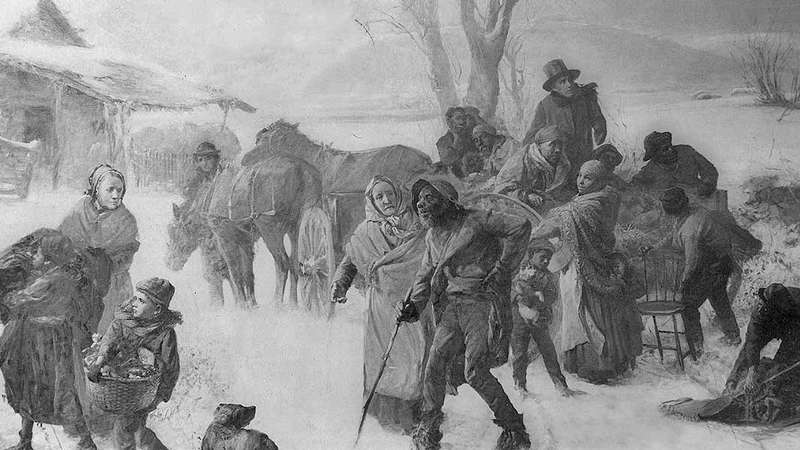
Thus it was that the spirit of Abolitionism finally took hold widely of hearts across the North, at the same time that it spurred a growing resolve throughout the South to simply depart from the Union.
Nebraska – and “Bleeding Kansas.” Things finally came to full violence with the question of what to do about the fast-developing Western territory of Nebraska – and how it might join the Union, whether slave or free. This matter was so divisive that it split the huge Democratic Party into two contending wings (the Whigs had all but disappeared at this point).
Ultimately the decision was made (1854) to divide the huge territory into two sections, Nebraska to the North and Kansas to the South. They would also repeal the Missouri Compromise which would have automatically made both states free – and instead, according to the new “compromise,” let the two new territories themselves decide how they might enter the Union, slave or free. Again, at the time, this sounded like a very good idea, letting the locals rather than Washington make this vital decision. Actually this decision made the situation worse – far, far worse.
For the northern portion or the new Nebraska, this decision presented no particular problem – as it clearly was inhabited by “Free-Soilers” opposed to slavery. But the southern portion or Kansas was another matter – with the inhabitants in the northern part of that territory also Free-Soilers, but the inhabitants to the south supportive of the slave option. Thus the new “compromise” immediately split Kansas itself into two warring factions – with two legislatures (one at Lecompton and one at Topeka) and all sorts of militias supporting one side or the other of the slavery issue (as were almost most all of the Kansas newspapers). And Americans began to rush to Kansas to increase the size (and thus vote) of one side or the other: pro-slavery “Border Ruffians” and anti-slavery “Jayhawkers.”
An example of how savage this Kansas rivalry became was in the action in 1856 involving John Brown and his family. He and his sons killed five pro-slavery farmers – in revenge for the sacking of Lawrence by pro-slavery forces.


Lawrence after the raid
In return, several hundred pro-slavery forces attacked Brown’s hometown of Osawatomie, killing two of Brown’s sons (and others) and sacking and burning the town.
Thus turning the matter over “democratically” for the citizens of Kansas themselves to decide merely escalated the problem into full-scale guerrilla-style warfare. Killing, looting, burning and ravaging the homes and farms of “Bleeding Kansas” now became common across the territory.
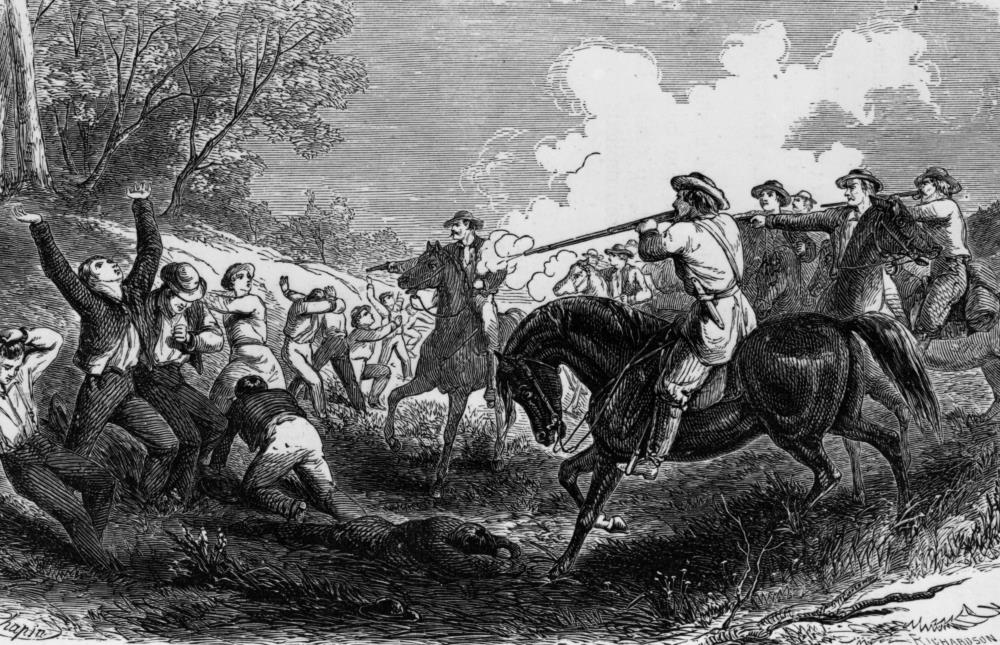
In short, by 1856, the American Civil War had already begun in Kansas.
The election of 1856. With the Whig Party gone, a number of parties – plus factions taking a stand on the slavery issue – took the political stage. The newly formed Republican Party (no connection with Jefferson’s earlier Republicans, but forerunners of today’s Republicans) basically took up the Whig cause – but could not get together on which candidate should represent the party in the presidential election that year. Ultimately one group nominated General Frémont and another group nominated Millard Fillmore, former President (1850 1853) when General Taylor, who had been elected President in 1848, died a year into his presidency.
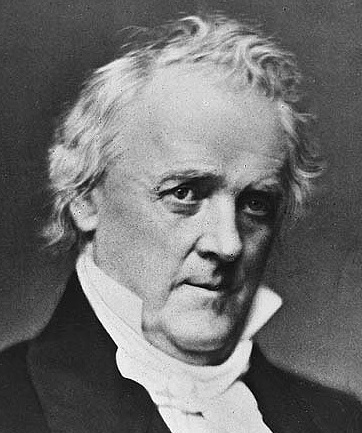 So also the Democrats found themselves deeply divided and ended up dropping Pierce and choosing Pennsylvanian James Buchanan, when Illinois Senator Stephen Douglas finally threw his vote to Buchanan on the 17th ballot. Buchanan had been away serving as American Ambassador to England and therefore had no record one way or the other about the deep split tearing at the country. Voted to office as President in the 1856 election, President Buchanan would try to stay above the battle – which meant only that the North-South split would deepen as national leadership tried to look away from the growing problem.
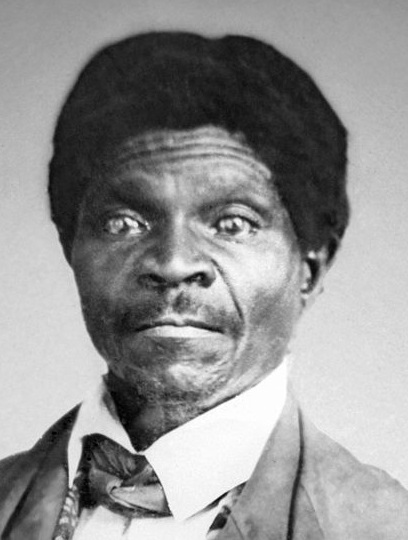 The Dred Scott Decision of 1857. Instead, the Supreme Court found itself taking the crisis head on with its decision concerning the return to a Southern master of a former slave, Dred Scott. Scott had accompanied his master to the North, been sold and resold several times – and after a lengthy residence in the North was being forced to return to the South. Scott ultimately (in his first civil suit in 1846) claimed that he (and his wife and daughter) had earned the right to freedom as longtime Northern residents.
 But after a lengthy process of multiple court hearings on the matter, the Supreme Court, led by pro-slavery Chief Justice Roger B. Taney, in 1857 ruled in favor of his latest master John Sanford, claiming that the Constitution was only intended for Whites and, since slaves were actually property, Congress had no authority to take property away from anyone – nor also had any authority to grant citizenship to Blacks … who were by God’s own decree intended to be a race perpetually in service to the Whites.
Southerners were elated by the decision, claiming that under Taney’s ruling, slavery could not be forbidden anywhere within the Union, North as well as South. The North on the other hand was furious at the ruling. In all, Taney’s decision did not resolve the question – but instead only deepened the bitter feelings separating the American North and South.
It was also a preview of how the Supreme Court would, from time to time (but with increasing frequency), take upon itself the task of deciding exactly how the laws of the nation should be read and understood … in accordance with the various justices’ ideological makeup, of course.
The Panic of 1857. The Dred Scott Decision also made it clear that the Western states were now to be brought into the Union as a decision of the people of those states themselves. This in turn meant that fierce battles (like the one going on in Kansas) would most likely result – something most people chose to avoid. Consequently, once again land values in the West collapsed as people backed away from Western land purchases – leaving private investors and banks holding worthless land titles – which in turn caused bank panic and collapse of the world of investment. But this crisis hit almost solely in the North – the South not being really part of the world of financial speculation. The very fact that the South escaped this crisis seemed to Southerners to confirm what they already supposed, namely that the Southern life and culture (slaves and all) was vastly superior to the Northern way of life – and that they were ready to defend that life and culture to the death. And indeed, Southerners would be called on soon to do just that.
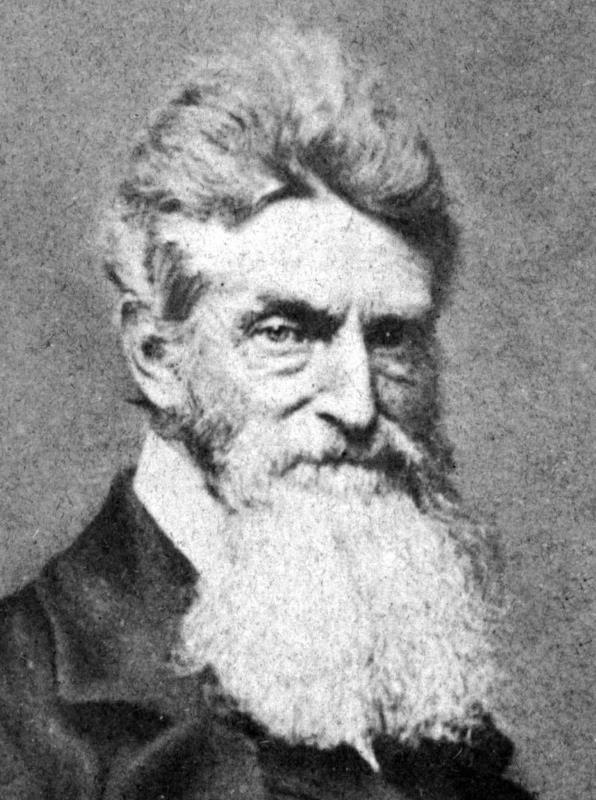 Revolt at Harpers Ferry (October 1859). Semi-crazy John Brown (and his remaining sons) decided to spark an event intended to lead to a massive slave uprising in the South – when he and a group of 20 followers raided the U.S. military depot at Harpers Ferry to grab its ammunition and supplies. But ultimately no slave rebellion took place. Instead U.S. Colonel Robert E. Lee surrounded the Brown party – killing ten of the group in the process. Brown and four others were tried and executed for this ill-fated raid. Overall, the call to the slaves to revolt made Brown the very personification of evil that Southerners saw in the North. But in the North, he became something of a hero, serving the greatest of all human causes: freeing the slaves.

Lincoln’s election (1860). The determining event in the move of the South to full withdrawal from the Union was the election of Abraham Lincoln to the U.S. Presidency in November of 1860. Two years earlier, in public debates for the position of Illinois Senator conducted between the Democratic Party Congressional leader Stephen Douglas and the new Republican Party’s candidate, Abraham Lincoln, the subject had focused heavily on the issue of slavery – with Lincoln taking the much stronger position against slavery. Very impressive was the presentation of this “country boy” Lincoln.
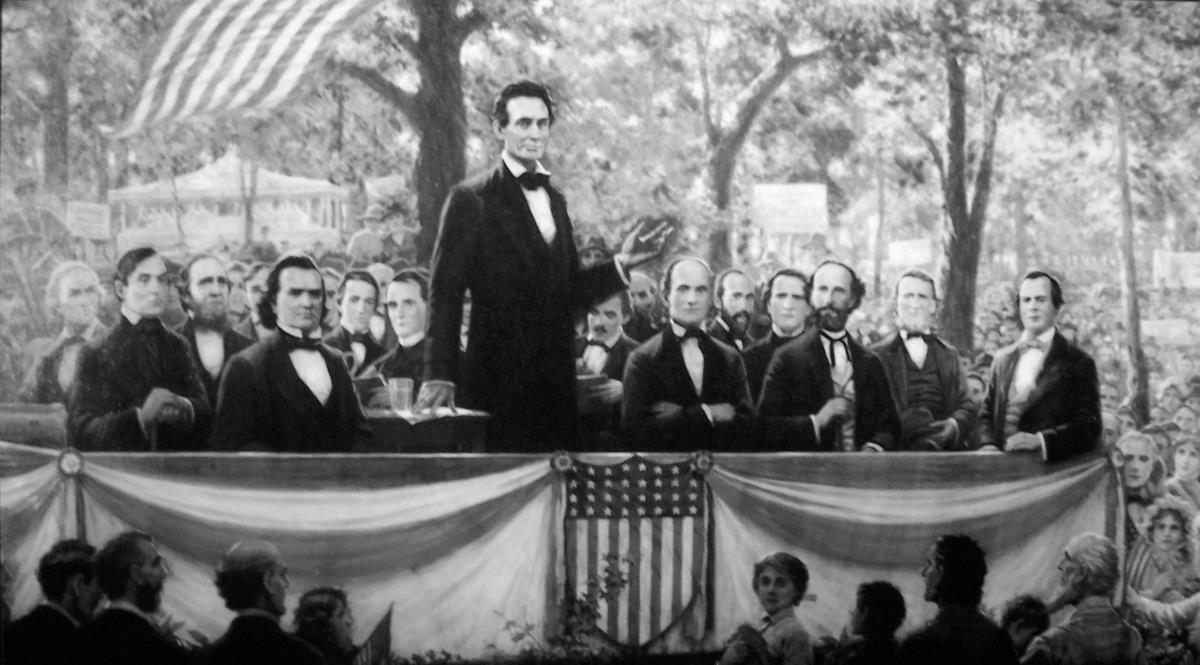
The Lincoln-Douglas Debates – 1858
However, a Democratic Party majority in the Illinois Assembly ultimately chose Douglas to represent the state in the U.S. Senate. But so impressive was Lincoln in his speech delivered at the Cooper Union (New York City, February 1860) in his stand on not just slavery but a wide range of issues impacting the country, that the Illinois Republicans got fully behind him as candidate for the U.S. presidency. And it took only three ballots at the Republican National Convention that May to put Lincoln ahead of William Seward and Salmon Chase in the selection of that party’s presidential candidate. And in November Lincoln was elected as the nation’s sixteenth President: 1.87 million votes for Lincoln, 1.38 million for Douglas, 850 thousand for Breckinridge and 589 thousand for a fourth candidate, John Bell – but an absolute majority of the electoral vote, 180 votes for Lincoln to his opponents’ combined total of 123 votes.
 Abraham Lincoln. This new president was a man shaped by tragedy. He lost his mother at an early age, lived under the direction of a disapproving father, grew up in an environment of tough poverty, and would himself lose two of his children to death, one even while serving in the White House as U.S. president. But he armed himself against depression by a highly developed sense of humor. He also possessed a most singular perspective on life, one that seemed to show up in the stories and tales that constantly shaped his conversations with those around him.
As already noted, he served briefly as a captain in the Illinois militia during the Black Hawk War (1832) … gaining some sense of what wars are really all about. However, his venture into the business world (also 1832) did not bring him success. He at that point ran for a position in the Illinois General Assembly, but just did not have the background to impress voters outside of his own precinct. But he was a voracious learner, and decided to teach himself the law, and became an excellent lawyer.
With a second attempt, he was finally elected to serve on the Illinois state legislature (1834-1846). He then went on to serve as a member of the Whig Party in the House of Representatives in Congress (1847-1849), though he had promised to serve in Washington only one term. He thus returned to his law practice in the Illinois state capital at Springfield, presuming that his political career was over.
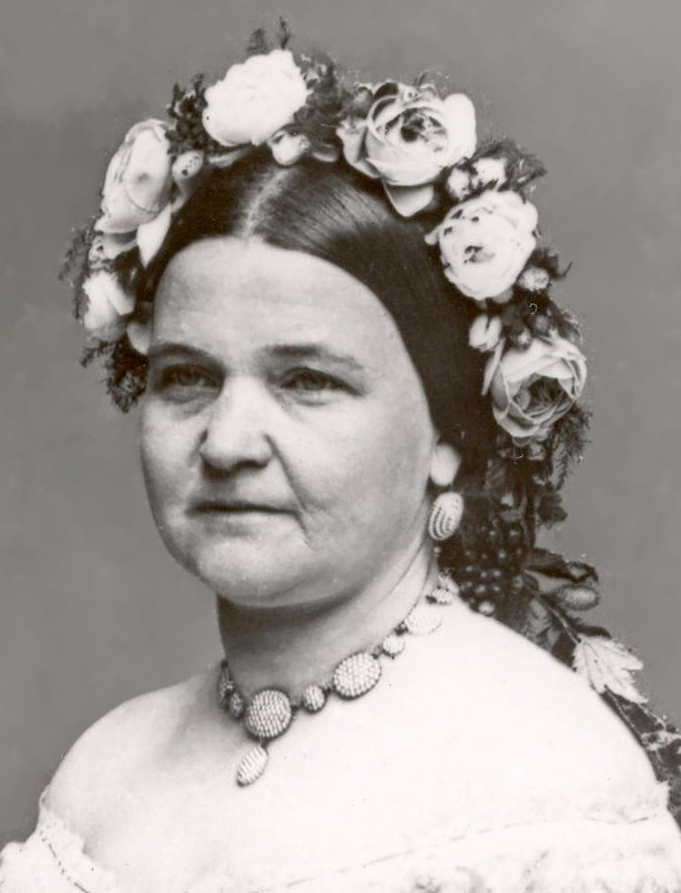 But his Southern-bred aristocrat (Kentucky) and highly strong-willed wife, Mary Todd, had plans for him other than his political retirement! But he was also touched deeply by the slavery issue – and what it was doing to the country – as the nation fought over the Kansas-Nebraska Act. And thus in 1854 and then again in 1858 he found himself running for the position of U.S. Senator as an Illinois candidate of the newly formed Republican Party. Indeed, in the Republican Party’s 1856 national convention, he came in a close second for the nomination as the party’s vice-presidential candidate. And thus it was that his national career got up and running.

Lincoln’s inauguration
Now, as newly elected U.S. President, Lincoln had facing him the deepest crisis the country had experienced since its revolt against King George a century earlier. Many Americans wondered how exactly Lincoln would face this explosive issue of slavery and the probable breakup of the Union, issues that so many before him had done everything possible to avoid.
But Lincoln was a man of incredible talent, a talent needed greatly by the nation at this point. Lincoln was steady, strong and very wise in personal character. From the very start, the wisdom of Lincoln was evidenced in the way he shaped his new presidential administration, by bringing onto his cabinet his strongest political rivals[1] – such as William Seward, Salmon Chase and Edward Bates. He knew the importance of uniting all the major pro-Union leaders, in order to take on successfully the huge challenges ahead.
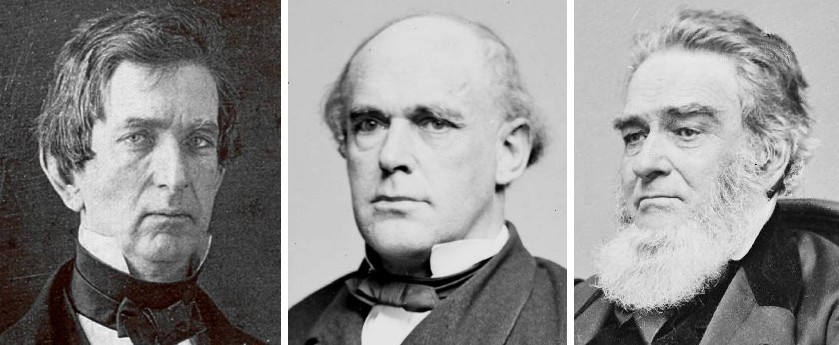
Seward Chase Bates
At first these political dignitaries tended to be contemptuous of him and his “country boy” ways![2] But gradually they all (except Chase, whom Lincoln finally moved onward in appointing him Chief Justice of the Supreme Court) came to see Lincoln’s true political genius, and moved to full support of him as their president.
[1]Doris Kearns Goodwin termed it A Team of Rivals in making it the title of her Simon & Schuster 2005 Pulitzer Prize-winning book.
[2]Seward, supposing Lincoln to be something of a naïve country boy, at first proposed to Lincoln to have him turn all real powers of the presidency over to Seward himself. And then Seward proposed a bizarre foreign policy in dealing with the South, all of which Lincoln politely ignored as he moved steadily ahead with his own policies for dealing with the rising crisis.
SECESSION AND WAR (1861-1865)
 Almost immediately upon the announcement of the results of the 1860 presidential elections, South Carolina announced that it would be seceding from the Union. Soon Mississippi, Florida, Alabama, Georgia, Louisiana and Texas did the same. In early February (1861) they met in Montgomery (Alabama) and agreed on the creation of a loose Confederation of Southern states – with Jefferson Davis as the provisional Confederation President.
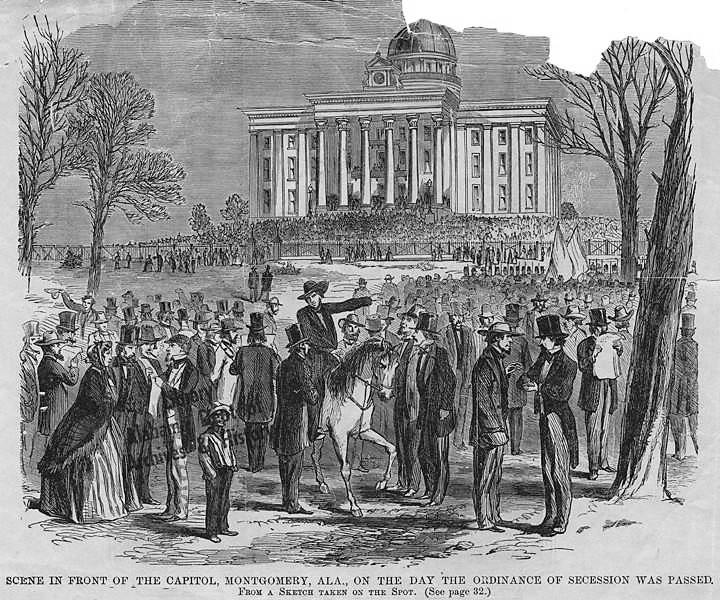

The Southern states voting for secession
Lincoln – and Davis. In contrast to his new adversary, Jefferson Davis, Lincoln had only his limited war experience in the Black Hawk War, and no formal military training. Davis however was a graduate of West Point and a commanding officer (colonel) in the Mexican-American War. But Lincoln had a keen mind for strategy, a deep insight into the character of others, and an awareness that he needed wise war counsel – which he got from the elderly Winfield Scott and eventually from his war cabinet. And Lincoln thought through objectives better than the majority of the military men serving under him – who tended to think mostly in terms of battle strategies – designed to win battles. Lincoln however thought in terms of war strategies (economics, diplomacy, ideology, morale – as well as military engagements) – designed to win a war.
At the same time, the very looseness of the Confederacy required as a matter of extreme necessity a strong, commanding hand to hold it together. Thus in the struggle of the South to secure its independence militarily, Davis and his administration would have to take on almost unlimited powers.
Lincoln’s Christian faith. But there was more to Lincoln than just profound political-social wisdom. Lincoln was a man of deep spiritual character, founded not on human support but instead on Divine support. Like Washington before him, Lincoln was fully aware of the huge trust that had been placed on his shoulders. He knew that thousands, even hundreds of thousands, of young men would die because of the decisions that he himself would have to make. Previous presidents had shrunk back in the face of this growing social division – precisely because of the obvious social costs involved in finally resolving the matter.
Lincoln of course would have his supporters. He would also have his detractors – and not just in the South. He even had this problem at home – a wife who very soon tired of the stress his position placed on their family (she wanted Lincoln just to drop the war effort so that their family could get back to normal).
We cannot say that Lincoln going into office was a man of deep Christian faith. But we can certainly say that as the war progressed, Lincoln found himself turning more and more to the very special support that God provided him during the very dark days of the war (a darkness that lasted almost up until the war’s very last days). Ultimately it was his deep faith that kept him going – when others would have quit. His faith, not human support, is what kept his leadership of the country strong during these most trying of times. It was indeed Lincoln’s deep Christian faith, even more than his profound political wisdom, that made Lincoln the truly great man that the world would eventually come to appreciate – appreciate as one of America’s greatest presidents (some might even say the greatest of all).
Southern or Dixie “nationalism.” At the same time, holding the Confederacy together was mostly the powerful ingredient: fear – fear White Southerners had of their rapidly growing Black population (both free and slave). Consequently, the South became an oppressive land – whose laws and cultural vigilance tightened down on society. Free Blacks living in the South soon found themselves under the threat of being forced into slavery. And war fever in the South demanded that any Northern Blacks captured in battle (those not just killed outright), or simply captured as farm workers in the process of the Southern armies advancing across the land, would be carried off into Southern slavery. As both Jeff Davis and his Vice President Alexander Stephens put it, Blacks by their very inferior nature were intended by God to thrive only within the context of eternal servitude to the superior race of Whites. Enslavement of any and all Blacks was actually a necessary part of the advance of civilization. This credo was thus the real glue holding the Confederacy together.
1861: The first shots of battle. In April (1861) Southerners fired on the Federal Fort Sumter located in the harbor at Charleston, South Carolina, a grand act of defiance – ultimately forcing the Federal troops there to surrender when no support was able to reach them from the North.

 Lincoln now called on the states to take up arms in defense of the Union – Southern states of course refusing. The real question however was how the border states (Maryland, Tennessee, Kentucky, Missouri, etc.) would align themselves. At first even Virginia hesitated, leading Lincoln to call on General Robert E. Lee to head up the Federal or Union army. But when Virginia finally chose to join the Confederacy, Lee turned down the request (he would eventually become the South’s commanding general). Maryland was about to join the Confederacy – but Lincoln ordered Federal troops to occupy the state – so that the nation’s capital at Washington, D.C., did not get cut off from the North. Tennessee soon joined the Confederacy – but Kentucky stayed cautiously neutral. And a deeply divided Missouri simply continued with its own civil war.
The strategies of war. As already pointed out in the section focused on America’s war of independence in the 1770s and 1780s, the purpose of war is to get an adversary to stop doing – or even being – what it is that a society pursuing war finds detestable in the thoughts and behavior of that adversary.
For the South, the strategy was quite straight-forward: simply pull out of the Union, and then dare the North to try to do something about it. Were Southerners truly expecting the all-out war that Lincoln called the Union to? Possibly not.
For the North, the war was a much less straight-forward matter. Was it just about preserving the Union? Did it have to involve the highly contentious issue of slavery? Or was it ultimately all about slavery in the first place?
In short, there was by no means unity of purpose in the North, making Lincoln’s job extremely difficult. Making Abolition the primary goal would undermine Lincoln’s support in certain circles in the North – and likely drive the people (such as the Kentuckians) along the neutral border regions separating the North and the South into the arms of the South. It would also merely strengthen the resolve of the South to fight on. After all, the purpose of the war was to weaken the resolve of the Southern adversary – not harden it.
For the time being, at least in the initial stages of the war, Lincoln kept matters focused merely on breaking the resolve of the Confederate states to secede from the Union – to force them back into Union membership. To do this, he would have to break their ability to hold out against his efforts. His major strategy was simply to close down the Southern economy – by surrounding the entire region by land and sea with his army and navy, cutting off the South’s ability to break out of this economic strangulation (the Anaconda Strategy) in order to sell the cotton that its dream-world so completely depended on.
This was going to hurt the textile mills of the North, which depended heavily on the ability to acquire Southern cotton. But that would be merely one of the many costs of war. And Lincoln was aware that this war was going to be costly – very costly – on a number of fronts. But the Union had to be preserved at all costs – or there would be no very good future for any of the states, North or South.
But Lincoln was well aware of the fact that military challenges also stood before him. An invasion of the Southern heartland itself would ultimately be necessary to finally break the Southern will. But here is where he was handicapped. America’s best officers tended to be Southern, not Northern – well experienced from recent service in the Mexican-American War. Sadly for Lincoln, his most capable general, Winfield Scott, was growing old and would soon have to be replaced by younger blood. But finding an equally capable replacement would be a trying matter for Lincoln – who would have to go through the less-than-impressive service of a number of commanding officers until finally (roughly two years into the war) he came up with the talent (Grant, Sherman, Thomas, Sheridan and others) capable of handling this enormous military challenge.
Thus at first the North seemed outclassed by the Southern armies. At the first major battle, Bull Run (July 1861, just south of D.C.), the Northern armies were routed – and the good D.C. citizens who had come out to watch the battle as if it were some kind of sporting event, found themselves fleeing back to the safety of the capital (itself well protected by a ring of forts surrounding the city).
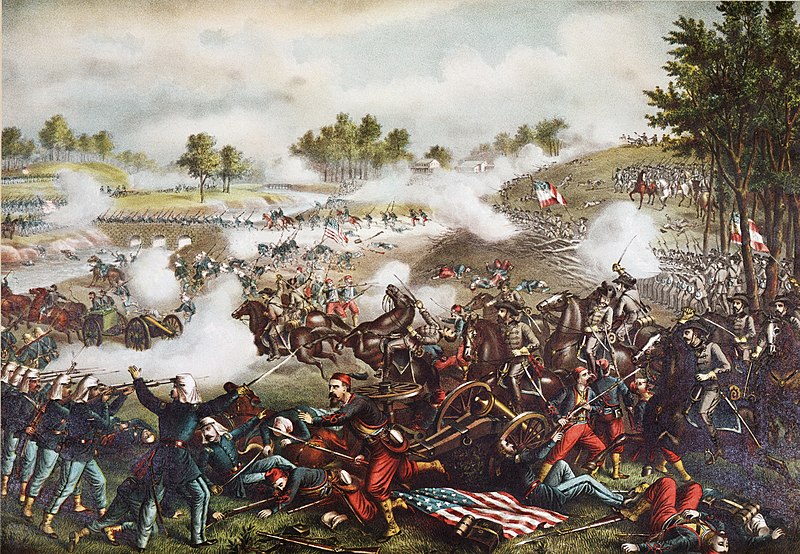
By the end of 1861 it became quite apparent that there was going to be no quick end to this growing civil war.
1862: Bloody stalemate. 1862 saw some great but ultimately inconclusive battles fought along the Mississippi River; in the Chesapeake Bay (the battle of the strange armor-clad ships Monitor and Merrimac);
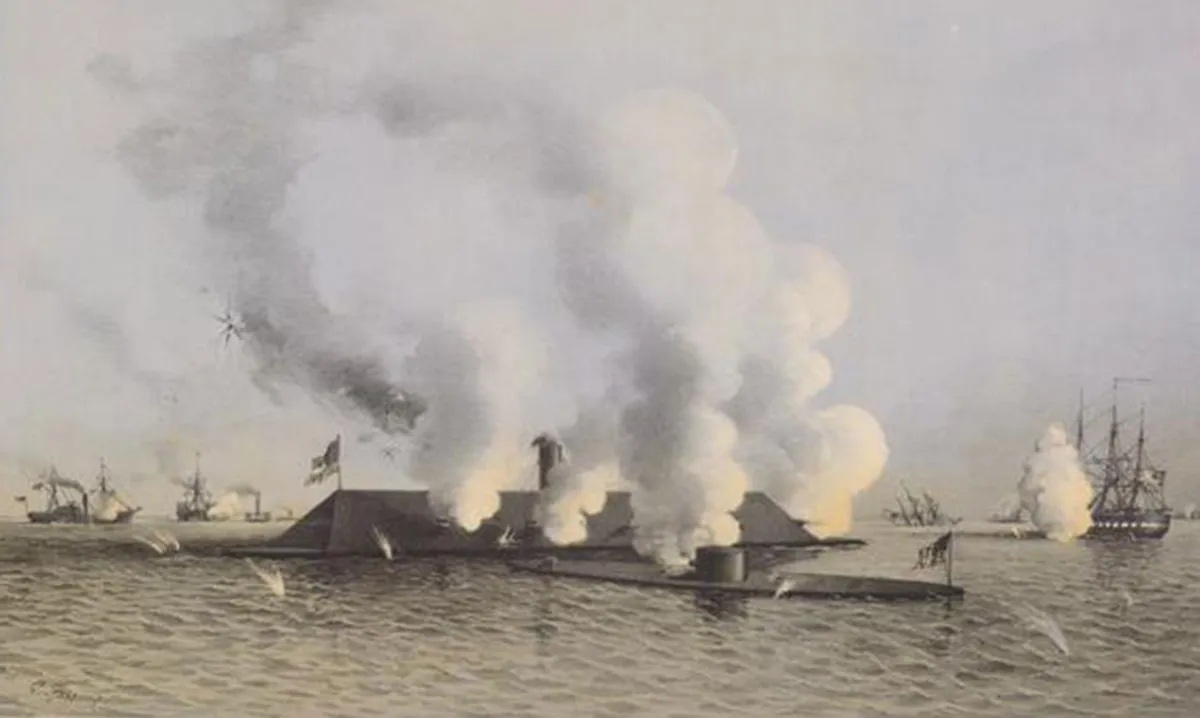
 in Eastern Virginia in June and July when the pompous Union General George McClellan proved to be more interested in winning minor battles that advanced his political career than in advancing the North’s cause of winning the war; again at Bull Run in August, which ended in something of a bloody stalemate costly to both sides; at Antietam in September when Lee attempted (unsuccessfully) to take the battle to the North into Pennsylvania;

Some of the dead at Antietam
and finally in December at Fredericksburg (Virginia) when the Union effort to take a well-defended Confederate position in the cliffs above the town turned into a bloody disaster for the North.
1863: The North begins to dominate. 1863 started out even worse for the North when a second attempt was made in January to take Fredericksburg – ending up just as badly as the December attempt. Meanwhile, Lincoln was having a very difficult time keeping the North in the war.
Resistance to the draft (which both North and South had instituted in order to keep their ranks full) turned violent in New York City when Irish immigrants discovered that in applying for citizenship they had also signed themselves up for the draft – at a time when wealthier Americans could buy their way out of the draft. To the Irish this smacked of the treatment they had received from the English upper class who dominated their lives back in Ireland. They were livid. Troops finally had to be called in to help the police put down the rebellion.

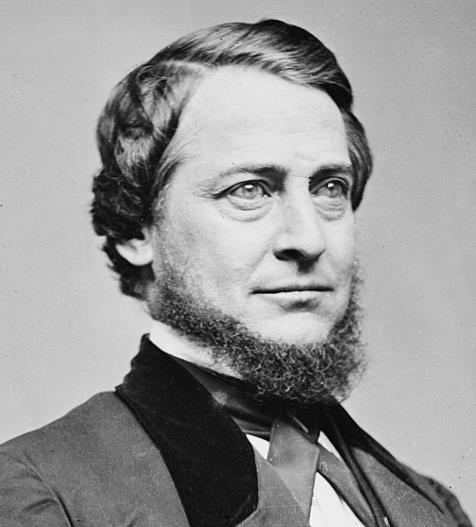
Also, a group labeled “Copperheads,” headed up by the politically ambitious Clement Vallandigham, had been working fervently to deepen further an anti-war mood growing in the North. Vallandigham was ultimately forced to escape to Canada. But Lincoln was well aware that this would hardly be the end of the growing anti-war fever infecting the North.
Vicksburg and Gettysburg. But finally, two major events broke in clear Northern favor on virtually the same day, the 4th of July, 1863 – the news adding tremendously to the country’s (the North’s anyway) national holiday!
 The Rebel (Southern) position along the Mississippi River had been cleared earlier by Union General Ulysses S. Grant – except for the strategic site atop huge cliffs towering over the river at Vicksburg. Grant had been trying since January all sorts of maneuvers to bring down this last Mississippi stronghold – and finally on the 4th of July brought Vicksburg to surrender – and sent the news to Lincoln to give him finally something to cheer about.

But also on that same day ended finally the four-day battle at Gettysburg (Pennsylvania) which had erupted when Union forces stopped Lee’s Confederate army in its second attempt to take the war into Union territory (Lee had been hoping to encourage the growing movement in the North of simply quitting the war effort and letting the South go on its way with its slaves). It was a great victory for the North.

Gettysburg – July 2nd

Gettysburg – July 3rd
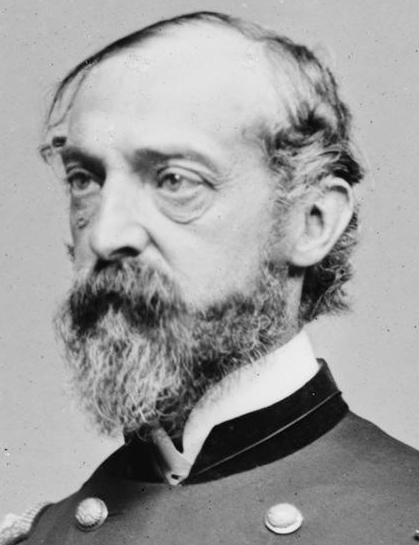 But once again, the commanding Union General, George Meade, decided to let his troops rest from their exhausting victory – and consequently let an even more exhausted Lee escape to the South – to fight another day. This inevitably led Lincoln to replace Meade with the tireless and relentless Grant.
At this point, with two key victories and a truly strategic Grant at the head of the Union armies, the fortunes of war began to turn decidedly in favor of the North.
Meanwhile Northern and Southern forces clashed repeatedly at the front along the Tennessee River in the middle of the states. The battles began as another Southern offensive – but instead resulted in a very costly stalemate at Chickamauga (September) and a rout of the Southern troops at Chattanooga (November), forcing Southern General Longstreet to have to give up his effort to take Knoxville from the North.
1864: The South under siege. 1864 turned out to be a grand disaster for the South. Grant led Union forces into Virginia – fighting battle after battle against Lee’s troops, neither side willing to give up (Grant would not break off his effort to allow his men to rest – except in one instance, which he would regret and learn from not to repeat). Thus Lee was forced constantly to give a bit of ground at each battle in order not to be outflanked and surrounded by Grant’s larger forces. Eventually Grant made a wide swing around Lee’s forces who were attempting to protect the city of Richmond and instead put the town of Petersburg below Richmond under Union assault. But Petersburg proved quite defiant – and the battle there seemed to settle into a stalemate.
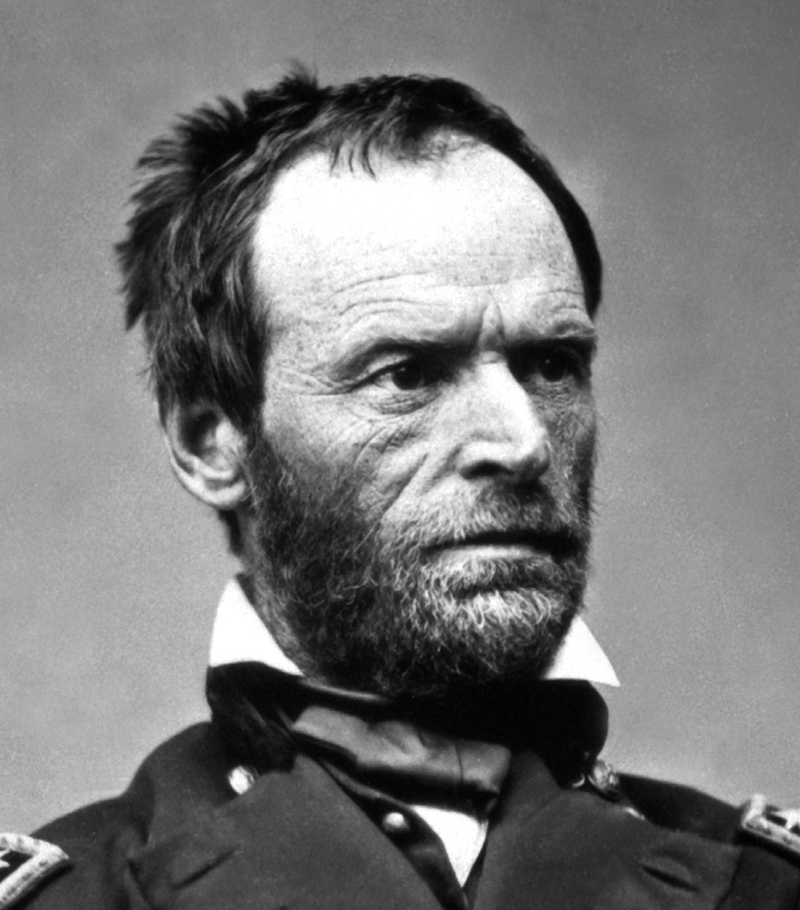 Meanwhile Union General William Tecumseh Sherman was ordered to slice through the middle of the South, starting at the Union position in Tennessee and swinging south from there to Atlanta – which the Union forces were able to take in September after a long summer-time assault on this key city in Georgia. From there they then headed southeast (November-December) to the town of Savannah on Georgia’s coast, Sherman’s troops cutting a 60-mile wide swath of destruction along the way – in order to break the spirit of Southern resistance.

Lincoln re-elected (November 1864). Lincoln was facing another national election in November that year – quite aware that no president had been reelected since 1832. But the fortunes of war had clearly by election day turned in the North’s favor – and Lincoln’s Republican Party was quite clear in its political goal: unconditional surrender of the Confederacy and a constitutional amendment abolishing slavery everywhere within the U.S. Thus it was that Lincoln overwhelmingly defeated his Democratic Party opponent, the self-important Union General McClellan.


Lincoln-Johnson vs. McClellan-Pendleton
1865: The Collapse of the South. Once in control of Savannah (Christmas 1864), Sherman turned his army and headed it north through the Carolinas, again burning and pillaging as it went – to arrive at a besieged Petersburg from the south. Very little Southern opposition at this point seemed to block Sherman’s path.
Lincoln’s 2nd inaugural address (March 1865). At Lincoln’s ceremony inaugurating his second term in office, Lincoln presented the nation with an address (found today etched on the north wall of the Lincoln Memorial in D.C.), focusing the entire second half of the speech on the role of God and his judgment in shaping past events and future responsibilities – and thus the necessity of all Americans moving ahead together to bind up the nation’s wounds and get on with the larger call by God himself to greater things as a nation.


At first his address surveyed the war experience that the nation had gone through – and God’s hand in the matter:
If we shall suppose that American Slavery is one of those offences which, in the providence of God, must needs come, but which, having continued through His appointed time, He now wills to remove, and that He gives to both North and South, this terrible war, as the woe due to those by whom the offence came, shall we discern therein any departure from those divine attributes which the believers in a Living God always ascribe to Him? Fondly do we hope – fervently do we pray – that this mighty scourge of war may speedily pass away. Yet, if God wills that it continue, until all the wealth piled by the bond man’s two hundred and fifty years of unrequited toil shall be sunk, and until every drop of blood drawn with the lash, shall be paid by another drawn with the sword, as was said three thousand years ago, so still it must be said “the judgments of the Lord, are true and righteous altogether.”
But he then turned to this matter of the task facing the nation, one to which God had called all Americans:
With malice toward none; with charity for all; with a firmness in the right, as God gives us to see the right, let us strive on to finish the work we are in; to bind up the nation’s wounds; to care for him who shall have borne the battle, and for his widow, and his orphan – to do all which may achieve and cherish a just, and a lasting peace, among ourselves, and with all nations.
This was another example of how Lincoln had developed the ability to persevere in the face of all this massive uncertainty and risk, simply by trusting that he was merely a servant of God himself. He made very clear his personal understanding that it was up to God – not Lincoln – to bring the true and the good to bear in this covenant nation that God himself had, centuries earlier, called into being.
Indeed, this was the kind of personal wisdom and spiritual strength that few American leaders after Lincoln would be able to match, even on a partial basis, a wisdom and spiritual strength matured out of having to face overwhelming obstacles, a wisdom and spiritual strength that had brought the Union through very, very dark times, to resolve finally a very, very divisive issue. Lincoln was truly a gift of God to the American nation.
April 9th: The collapse of the South’s rebellion. While one Union army was smashing South through Alabama (destroying the last of the South’s industrial capacity as it went) Lee’s army was finding itself overrun in the East at Petersburg, forcing Lee to pull out of both Petersburg and Richmond. Lee was attempting to link up with other Confederate troops trying to escape further South – but instead found himself surrounded at Appomattox. Thus on April 9th, Lee surrendered himself and his army to Grant.
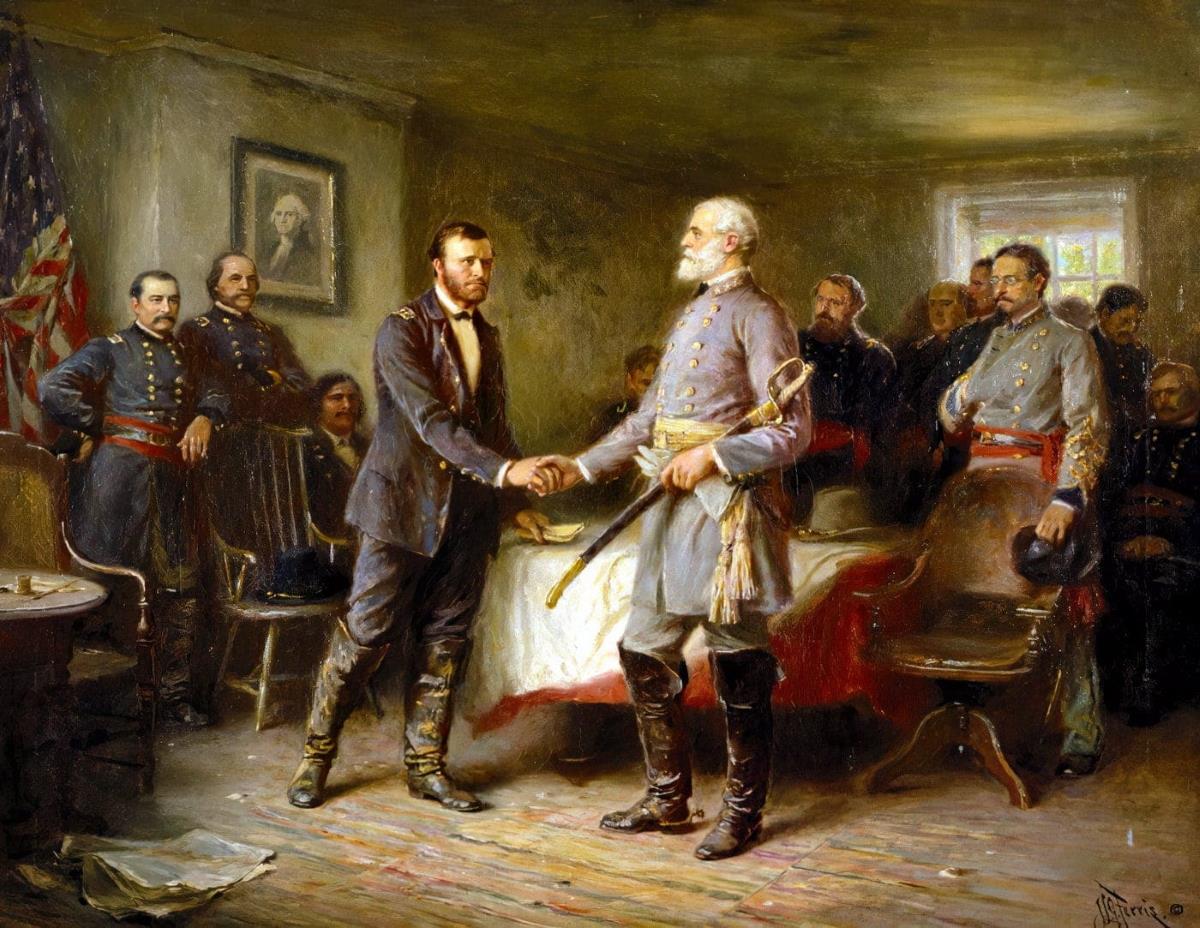
Although this did not mark the official end of the war (local skirmishes would continue for a while longer) – for all practical purposes the war was finally over.
April 14th: The assassination of Lincoln. Lincoln was already at work seeking ways to bring the nation back together – minus slavery. The 13th Amendment to the U.S. Constitution, ending slavery anywhere within the United States, had been ratified by the Senate all the way back in April of 1864 and in the House of Representatives at the end of January, just a few months earlier. It was yet to be submitted to the states – Northern only at that point – for their ratification. But the amendment was expected to be easily approved by the states.
As Lincoln had stated in his 2nd inaugural address, he was indeed looking for ways “to bind up the nation’s wounds; . . . to do all which may achieve and cherish a just, and a lasting peace …” That would not be an easy task, given the level of hatred still smoldering in many Northern hearts – and given the bitterness Southerners felt about their humiliating loss to the Unionists. However, achieving a just and lasting peace was where he was now directing all his efforts.
But success in that endeavor was not to be. On the night of April 14th the actor John Wilkes Booth was able to complete part of his plot to kill Lincoln and Grant while attending together the play Our American Cousin at Ford’s Theater in Washington (but Grant had instead left to visit his children in New Jersey) – as well as Vice President Johnson and Secretary of State William Seward at their homes. Lincoln was shot in the back of the head, Booth escaped by leaping from the balcony to the stage and then fleeing the city.

Lincoln died early the next morning. Meanwhile Seward was attacked and nearly killed the same night by another of the plotters, who after repeated attempts to stab Seward to death finally fled into the night when confronted by other members of Seward’s family. Seward survived.
Booth was found with a co-conspirator in Virginia twelve days later, surrounded and shot. Arrests of other members of the plot soon followed. On July 7, four of the conspirators were hanged.
Taking stock of it all. And so the war was over: the South found itself desolate and the North simultaneously found itself in a condition of profound mourning. The whole thing had been a sad tragedy, pushed to monumental proportions by the inability or unwillingness of American leaders before Lincoln to confront the slavery issue directly.
It finally took not political reason, but war and devastation of monumental proportions to bring this burning issue to a resolution. But so often is this the case. Passion, not reason, plus the mysteries of circumstances seemingly beyond human control, quite frequently bring human crises to a resolution – not pretty, but well resolved.[3]
Most tragically of all, a Southern bullet had taken the life of the one person who could have healed the nation’s wounds and brought the South back to life more quickly than turned out to be the actual case. As it was, that bullet left many in the North without pity for the South and its vast suffering – and left the South itself to begin a process of recovery that would take generations to complete. Such is the irony of history.
[3]Of the 2.6 million who had enlisted in the Union army and the 1 million in the Confederate army, 364 thousand Union and 260 thousand Confederate soldiers had died, and approximately 400 thousand each of Union and Confederate soldiers had been wounded for their respective causes.
AMERICA RECOVERS (1865-1880)
 “Reconstruction.” With Lincoln’s assassination, Vice President Andrew Johnson stepped into the presidency – hoping to pursue Lincoln’s policy of Northern-Southern reconciliation. But he lacked the political leverage that Lincoln commanded – and found himself intensely opposed by the Northern Radicals – who were in no mood for reconciliation. Instead, they wanted the South to pay deeply for its rebellion – and they were intensely focused on demolishing entirely the South’s traditional political culture. Johnson found himself vetoing bills coming out of a Congress dominated by the Radicals Thaddeus Stevens and Charles Sumner – only to have his veto overturned by a 2/3 vote in Congress.

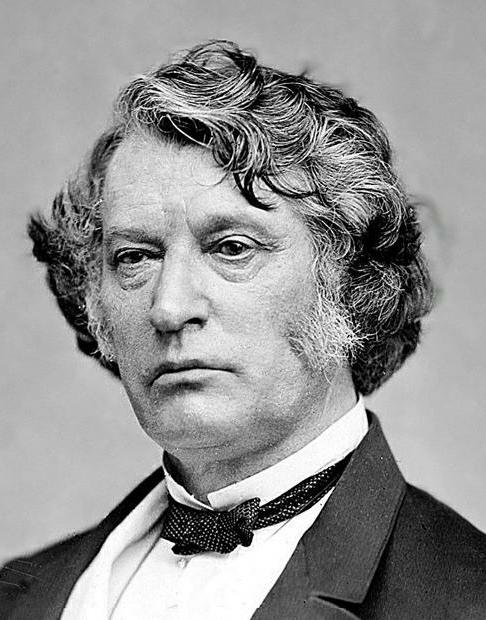
Stevens Sumner
Then he vetoed the Congressional bill sponsoring the 14th Amendment affirming the legal equality of all Americans – except for Indians and Confederate rebels – forbidding the latter even from holding office anywhere in the U.S. government – or getting compensation for any loss of property (slaves) or even pensions for service in the Confederate army or government.
Johnson’s veto of this last bill enraged the Radicals so deeply that Johnson lost all political footing with Congress. And in early 1868 the Radicals voted for his impeachment in the House of Representatives.[4] Ultimately, he avoided conviction when the Radicals came up one vote short of the 2/3 vote required for full conviction by the Senate. But from this point on, for the remaining two years in office, Johnson was totally powerless in the face of a Radical Congress.
Slaves were already being freed as the Union armies moved through the South – although there really was no place for them to go (except follow the Union armies). With the end of the war the economic picture of the South was so bad that not only did newly freed Blacks have no real opportunity to get themselves established in the New South – but also neither did the Confederate soldiers who had to return to devastated farms – not to mention demolished plantations and pillaged towns and cities.
At first the South was simply governed by Union army officers – and Northern administrators sent South by the Freedmen’s Bureau, individuals who arrived with their luggage (carpet bags) not only to take over local government but also to set up and run schools for the newly freed Blacks.
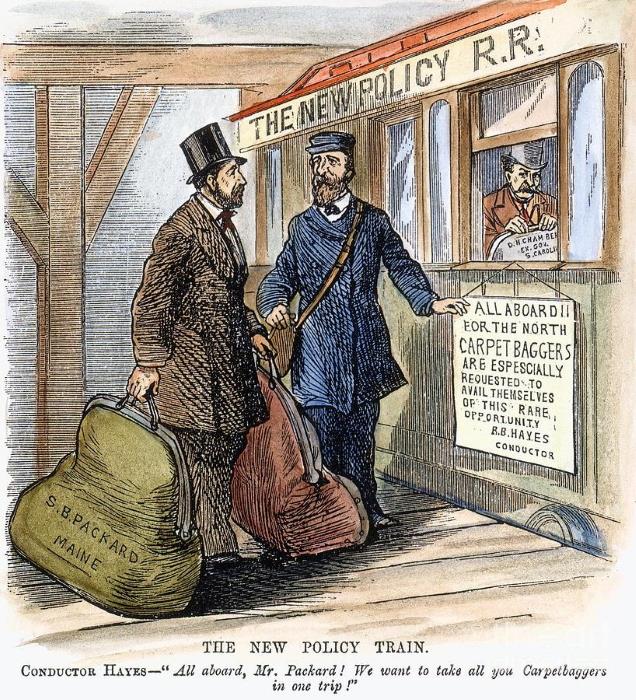

This helped the Blacks (somewhat) adjust to their new lives of freedom, but intensified the hatred of poor Whites towards Blacks – as well as towards the Northern “carpetbaggers” whom they detested intensely. Soon local groups such as the Ku Klux Klan began to form up – to defend the traditional South against those attempting to overturn (“reconstruct”) Southern culture. Things got very ugly fast.
 The Grant presidency (1869-1877). In the 1868 elections the Republicans were quick to nominate war-hero Grant – whereas the Democrats dropped Johnson (the Republican Lincoln had selected the Democrat Johnson as part of his national coalition) and chose New York Governor Horatio Seymour – holding racist views that were not that far away from the views of many Northerners, concerned that Blacks were really not ready for full freedom. The election was actually quite close – and only the ability of Blacks to vote gave Grant enough votes to win the election.
The closeness of the election stirred the Republican majority in Congress to come up with the 15th Amendment making it illegal for a state to deprive a citizen of the right to vote because of “race, color or previous condition of servitude.” As a condition for readmission to the Union, the last three holdout Southern states – Texas, Mississippi and Virginia – had to approve both the 14th and 15th Amendments – thus adding the 15th Amendment to the Constitution in 1870.
Scandal. But America was actually ready to move on to new things – or actually old things: making money. Scandals began to erupt in high places because of a new lax attitude concerning society’s moral requirements – one of them being the 1869 James Fisk / Jay Gould gold scandal – when these two Wall Street tycoons attempted to acquire the majority of the nation’s gold supply, make it scarce and thus more expensive, and consequently reap an enormous reward on the basis of this little ploy. Grant actually broke the Fisk-Gould project by releasing Federal holdings of gold – driving prices back down again.


Fisk Gould
Grant was actually not to blame for any of this – but there seemed to be no control over this atmosphere of cynical corruption hanging over the nation. Nonetheless people looked to the President for being in charge of the nation – and blamed him for letting this event occur in the first place.
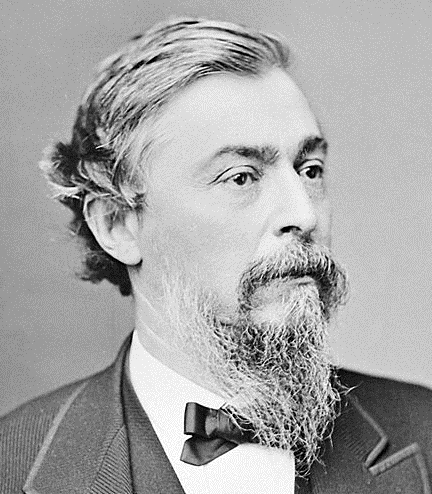
In 1872 another scandal broke out when it was discovered that Federal money authorized to complete the Union Pacific / Central Pacific railroad across the West to San Francisco had been manipulated in a way to enrich a bank, Crédit Mobilier (but no relationship with the French bank of the same name), set up by Union Pacific director Thomas Durant. He was enriching himself and his cronies to the tune of tens of millions of dollars, until the operation was brought to light by the New York newspaper Sun, and the scandal caused railroad and bank stock to suddenly drop away. Once again Grant was blamed for having let things get so far out of hand – though he had no direct role in any of it.
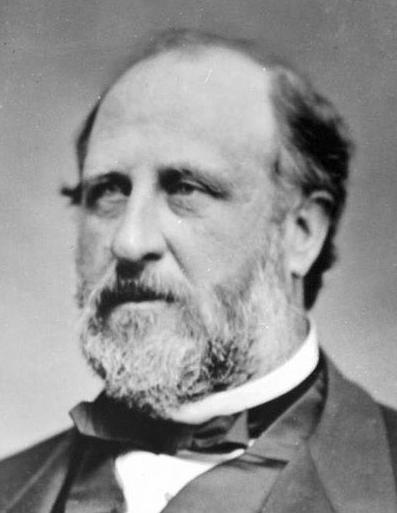 Another scandal typical of the times arose out of the operations of the New York political machine, Tammany Hall, controlled by William “Boss” Tweed. Tweed not only controlled the city’s immense patronage system but also much of that of the New York state itself, using his position to help Fisk and Gould in another of their schemes, the takeover of the Erie Railroad from another adventuresome individual, Cornelius Vanderbilt (who would develop his own vast economic empire) – through the issuing of fake stock. This would cost the New York taxpayers tens of millions of dollars (some say today as much as 100 million even in 1870 dollars) and made a number of Tammany Hall figures extremely rich.
Thomas Nast’s portrayal of Tweed’s “Circle of Corruption“
Nonetheless, Grant survived the scandals – and was reelected to a second term as president in 1872 – just before the huge 1873 financial panic.
The 1873 Panic. Certainly Grant thought he was doing the nation a great favor when he tightened up on the nation’s economy by “strengthening” the dollar – by removing readily available silver as a metallic standard for the dollar, leaving only scarce gold as the dollar’s basis. This was timed with the collapse of a major brokerage firm, heavily involved in railroad stocks, which in turn brought down the Wall Street Stock Market. Then the economy simply folded in on itself as frightened customers rushed to their banks to withdraw their deposits before the crisis spread to their banks, actually precipitating just exactly that crisis itself. Bank after bank thus failed.
Grant refused to change his gold-only policy, believing the crisis to be only a temporary fluctuation in the economy (which certainly happens from time to time). But with very low liquidity caused by the gold-only strategy, investors were unable to get businesses back up and running – and the 1873 Panic lasted a full five years. And when the 1874 Congressional elections rolled around, the Republicans were driven from power.
 The end of Reconstruction. With Democrats coming to power in Congress, the impetus for Southern Reconstruction slowed down greatly – certainly in the South itself where Democrats took control and did what they could to get things back to “normal.” Then when the next Presidential elections rolled around (1876), the Republicans distanced themselves from Grant and chose Civil-War hero and post-war Ohio Governor Rutherford B. Hayes as their candidate. The Democrats chose the New York Governor, Samuel J. Tilden, who had become well known because of his crushing of the Tweed machine. The country thus had two good choices going into the election. The vote was so close between these two men that the election had to go to Congress for a final decision. On the basis of a number of compromise promises, Hayes was finally selected.
The Radicals’ program of Reconstruction had depended entirely on the ability of a militarily victorious North to impose its Radical policies on the South through continuing military occupation. This policy of imposed “peace and social justice” presumably justified morally the North’s program (in the eyes of the Radicals themselves anyway) – but did nothing to lay a moral basis for a post-war South that would of its own be willing to support such imposed changes. Thus when a huge increase in Indian wars in the American West forced U.S. troops to be pulled out of the South and be sent to the West, the Radical program collapsed completely in the South. What took its place was a deep bitterness reigning in the South, White against Black, Southerner against Northerner – a bitterness that would take a full century to finally get past.
[4]When he removed Radical Edwin Stanton from his position as Secretary of War, to replace him with Grant, he did so in violation of the 1867 Tenure of Office Act (of dubious Constitutionality!) enacted by Congress specifically to end Johnson’s power to remove Lincoln’s Cabinet appointments.
THE BATTLE FOR THE WEST RESUMES
During the Civil War, the Indian Wars intensified – as Federal troops were pulled from the West to fight the Southern Confederacy. The Lakota (Sioux) in Minnesota for instance in 1862 attacked German settlements at New Ulm and Hutchinson, killing several hundred settlers, women and children as well as men – forcing Lincoln to send troops to the region to break Sioux power (arresting and hanging the leaders).
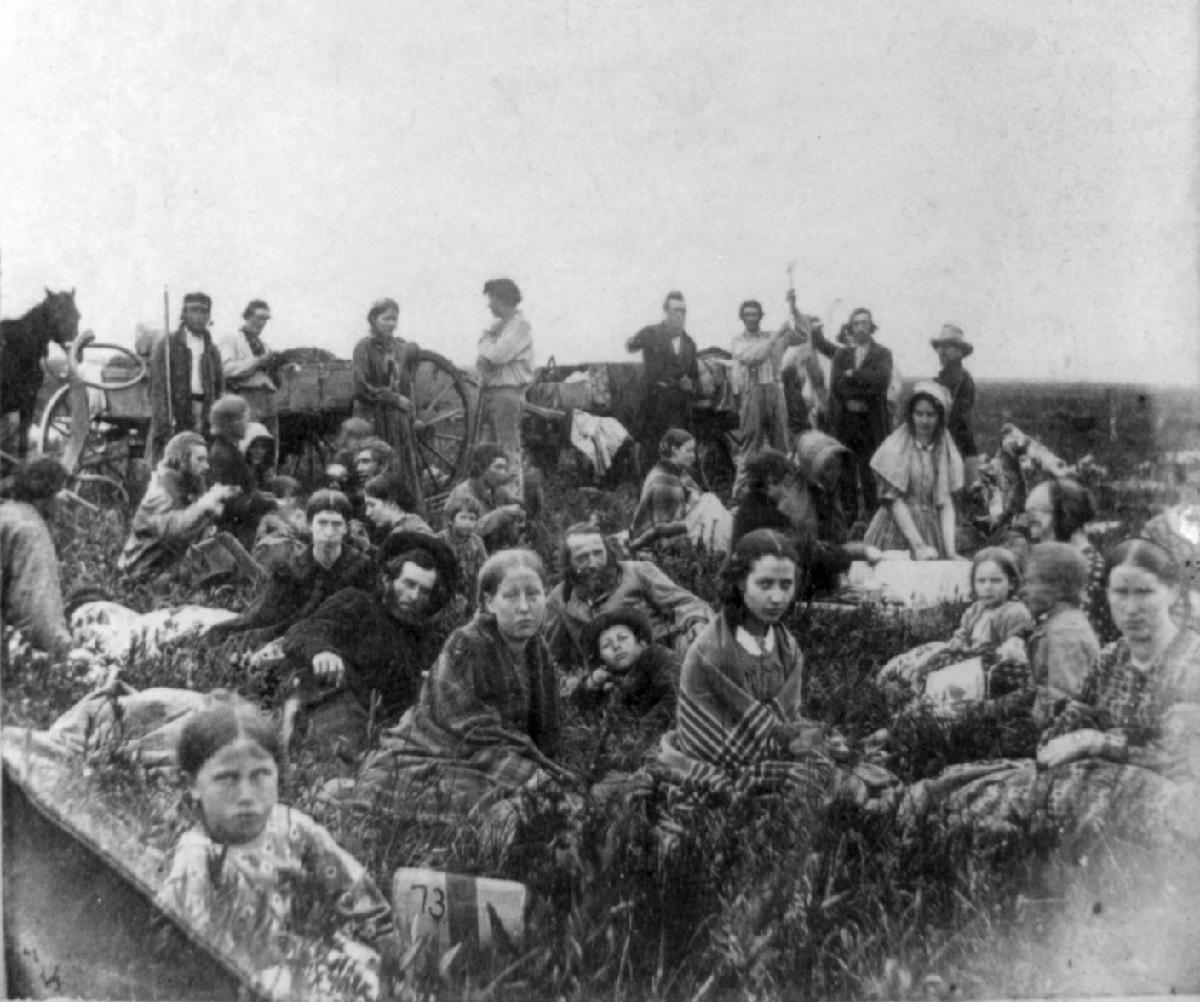
Whites in the Dakota war -1862
Bitterness between Indians and Whites only intensified – leading to an unwarranted attack in late 1864 by Federal troops on a peaceful Cheyenne and Arapaho settlement at Sand Creek (Colorado), with over a hundred Indians killed in the attack.
 In the Southwest there was a huge effort to force Navajo and Apache tribes onto reservations in the bleak Pecos River region – bringing to notice and fame Indian-fighter Kit Carson – who finally broke the will of the Navajo to resist the move. He then in late 1864 turned on the Kiowas and Comanches who had been conducting bloody raids on White settlements in the Texas Panhandle region. At one point he found himself vastly outnumbered by several thousand warriors at the Battle of Adobe Walls (November) and was forced to retreat, but managed to inflict massive casualties on the Indians nonetheless. This battle proved to be a turning point in the Indian wars in the region – greatly undermining the power of the Kiowas and Comanches and ultimately bringing both tribes to sue for peace in 1865.
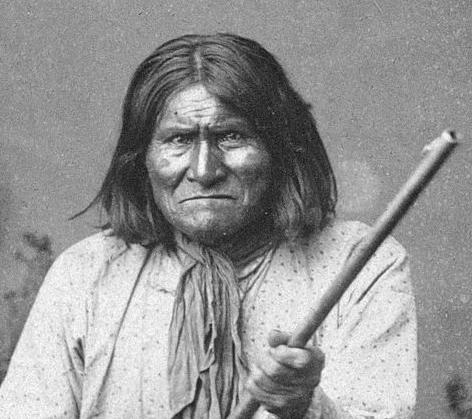 But alongside Kit Carson, the Indians could provide heroics of their own – such as the Apache raider Geronimo, whose small band of warriors seemed to be active everywhere in the West. Although finally forced onto the Apache reservation by the U.S. military, Geronimo broke out several times between 1876 and 1886. Ultimately his name became so well known that he finally was featured in a number of Cowboy-and-Indian shows – even riding horseback in Teddy Roosevelt’s inaugural parade in 1905!
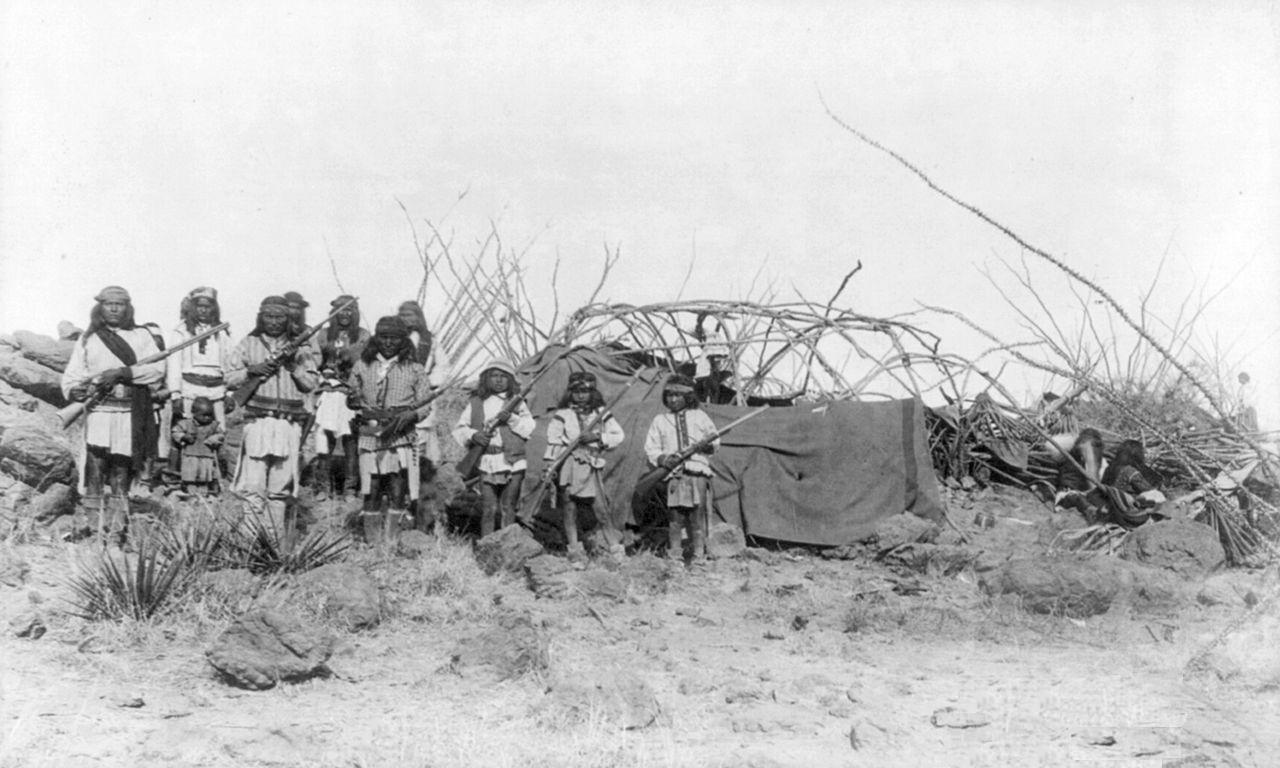
Geronimo’s camp – 1886
Westward Ho! On they came – White men, women and children – by steamer or river barge (as far as the rivers would take them westward), then by wagon train, following trails set out by trail blazing frontiersmen – and then by train as the American railroads pushed West and Southwest deep into Indian lands. They laid claim to railroad land and set up their own farms – and towns to service the fast-growing farming world of the West.
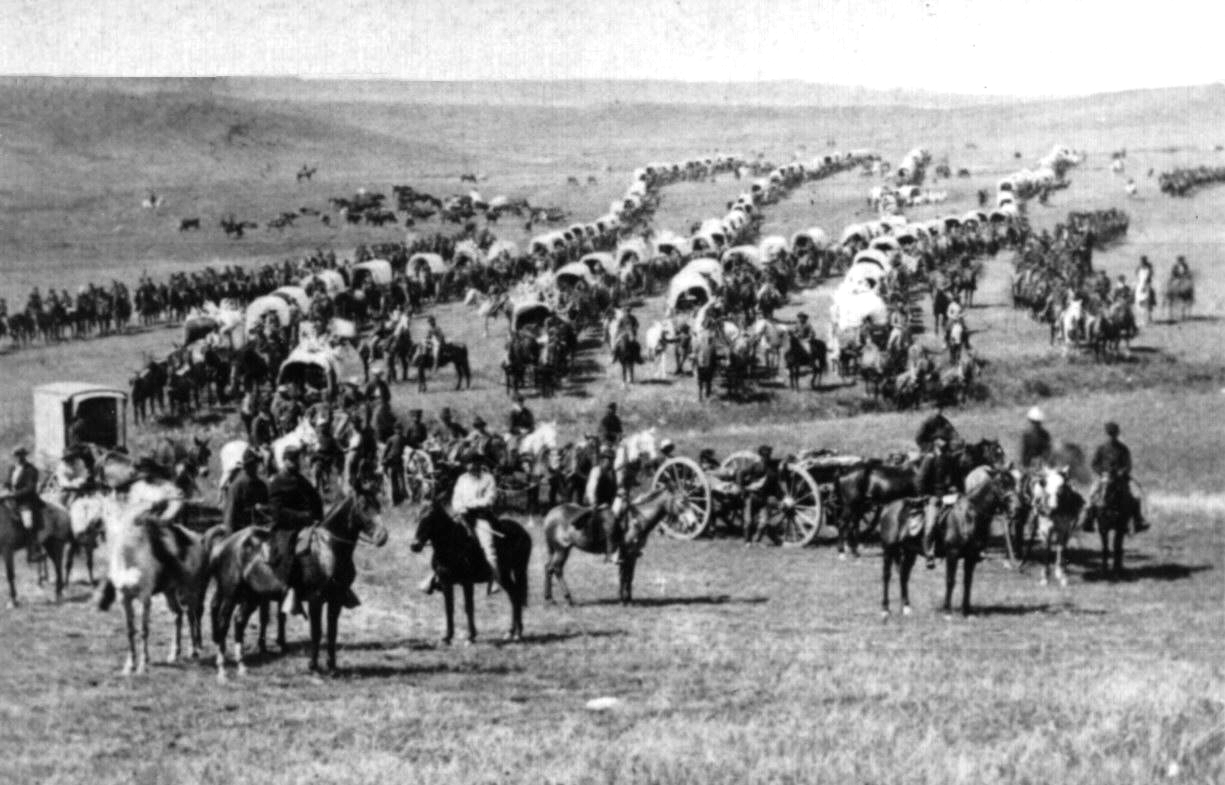
Gen. Custer leading settlers across the Dakotas – 1874
Many came as Mormons, developing communities centered on their City of Zion of Salt Lake City (founded by Young in 1847), but reaching far and wide from Utah into Idaho, Arizona, Nevada, California, Colorado – and even northern Mexico.
The rumors of gold (but also silver and copper) also brought Americans west – though not usually entire families, but instead merely single male fortune hunters. States such as California, Nevada (with its fabulous Comstock Lode), Montana, Idaho and Washington were states particularly sought out by these fortune hunters. Towns would quickly appear wherever mineral sites were discovered, bringing not only the fortune-hunting miners, but also bartenders and prostitutes to keep the miners happy, but also bankers, clergy, and general store operators to bring some degree of American civilization to the towns as well.

Cripple Creek, Colorado, saloon
Then when the mines yielded up all their bounty, everyone moved on to opportunities elsewhere – and another bustling mining town turned into a deserted ghost town.
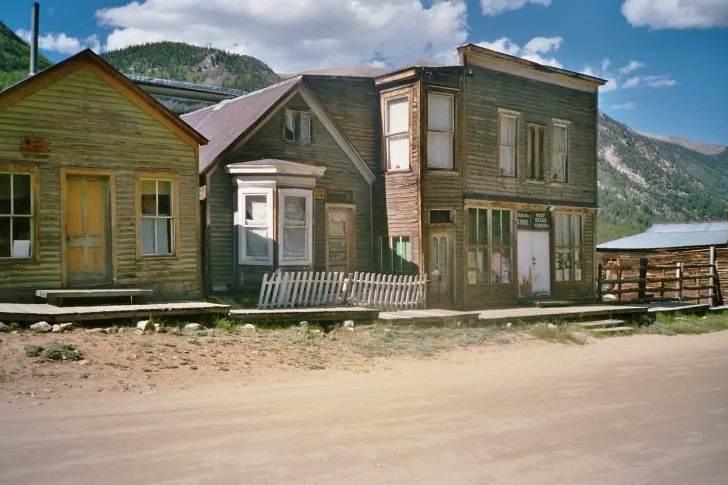
Saint Elmo, Colorado, as a typical ghost town
Cow trails and cattle barons. With the advent of the railroad into the West, new opportunities opened up for the lucrative trade in beef cattle. Thousands of cattle could be herded north out of the grasslands of Texas, through the Indian territory of Oklahoma, to the various railheads of the Kansas Pacific Railroad. For instance in 1867, when the new Chisholm Trail was first laid out, 35,000 head of cattle were brought up from Texas to the railhead at Abilene, Kansas, in that first year alone. The cattle were then herded onto box cars and shipped up to Chicago – or west to Denver for shipment to the Pacific coast. In Chicago the slaughterhouses would be kept busy preparing meat to be shipped up the Great Lakes waterway to the populous Eastern cities.
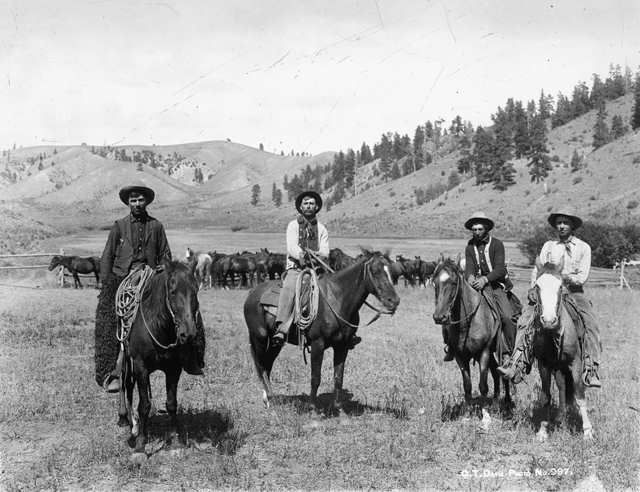

From the end of the Civil War to the mid-1880s the cattle business boomed, making a lot of cattle barons very rich – and creating a fabled American proto type, the American cowboy.
The end of the era of the great Cattle Kingdoms. But three things would bring this era to a close: the steel plow, the barbed wire fence, and the overgrazing of the cow trails. The grassy plains through which the cattle trails led were covered by a thick undergrowth of tough grass with deep roots, which made the land prohibitively difficult to plow – that was until the steel plow began to come under wide usage (sometime in the 1870s and 1880s). With this invention, homesteaders could now begin to settle the plains, with their plowed fields and domestic animals able to support the lives of their families. To protect their investment, they began to secure their landholdings by the relatively cheap means of the new barbed wire fencing (developed in the mid-1870s).

Crude … but home!

A sod house in the tree-less prairies states
Now the cattle herds found their paths along their cow trails blocked here and there by these fenced-in homesteads – and trouble began to brew between these two categories of Westerners, the farmer and the cattleman. For years the cattlemen had been allowed freely to graze their herds on the vast Federal lands of the Great Plains (reaching from Texas to the Dakotas). But now homesteaders were rapidly filling these open lands. Little by little the cattle herding business was pushed further westward, increasing the difficulty and costs of the herding itself. And then a very bad winter hit in 1886-1887, with hundreds of thousands of cattle dying – bringing a number of the former cattle kingdoms to ruin.
The rise of the American farmer. In the meantime, American farming was becoming a very big business – the Western farms fully able to feed the Eastern cities which were also growing rapidly in size. Indeed, America began to see huge industrial farms grow in number during the latter part of the 1800s.
At the same time, towns located along the growing number of rail lines crisscrossing the American Great Plains or Midwest began to develop quickly as economic and social centers for the agricultural industry of entire counties. Thus as the farming business boomed, churches, schools, banks, and general stores began to appear in these towns, bringing American civilization to the American West. In many ways this too, along with the cowboy, was fast becoming a major cultural symbol representing the young and fast-growing America.
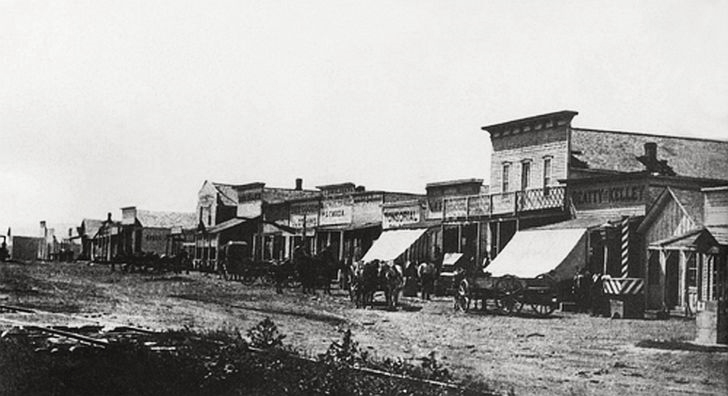
Dodge City, Kansas – 1876
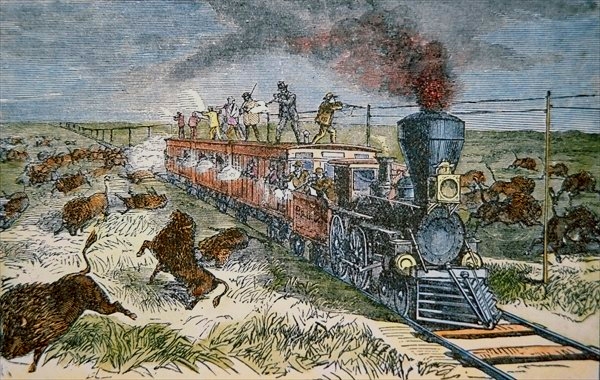
The Indians’ “Last Stand.” Things were growing desperate for the declining Indian tribes of the West. The huge buffalo herds that had sustained the Indians’ hunting economy were dwindling rapidly in size – thanks to both the Indians’ greater killing ability with the new repeating rifles – and the interest of Whites in killing the buffalo simply for sport (sometimes simply from train windows as they passed the buffalo herds).

A mountain of buffalo skulls and horns
Then there was also the interest in Christian missionaries in bringing the Indians to Christian ways – meaning a cultural and economic lifestyle similar to that of the “Christian world.” Reservations were also being chipped away at by land hungry Whites – despite treaties that had guaranteed the land as Indian territory in perpetuity. But events showed quickly that there was no perpetuity when it came to Indian property rights.
Custer’s “Last Stand.” In 1875 Sioux (or Lakota) Chief Sitting Bull and his tactician Crazy Horse decided it was time to leave the Dakota Reservation to take the offensive against settlers invading the Dakota Black Hills – sacred Sioux land. The next year they were joined by Cheyenne and Arapaho warriors – which in turn brought Civil War Cavalry General Sheridan west to force them back onto their reservations. But the Indians proved quite resistant.


Sitting Bull Crazy Horse
 And worse for the American troops, a detachment of several hundred soldiers led by Colonel George Custer got itself surrounded by Crazy Horse’s warriors – and all were either killed or badly wounded at the Battle of the Little Bighorn (1876).
But instead of breaking the will of the White soldiers, the slaughter of Custer and his men became a rallying cry for the White nation to take revenge. At this point Sitting Bull decided simply to return his people to their Dakota reservation.
One last effort of Indians to clear the land of Whites occurred in 1890, when, getting caught up in the Ghost Dance craze, they came to believe that the performance of this ritual would finally clear the land of the White man – even believing that the wearing of special shirts would make the Indians invulnerable to White man’s bullets if it should come to armed conflict. And it soon came to such conflict – in which Sitting Bull was killed along with a dozen of his warriors. Then the 7th cavalry was sent in to impose order, and, at the Wounded Knee Creek, fighting accidentally and tragically broke out – in which possibly 150 to 300 Sioux men, women and children were killed (no one is sure of the count) – along with 25 U.S. soldiers.
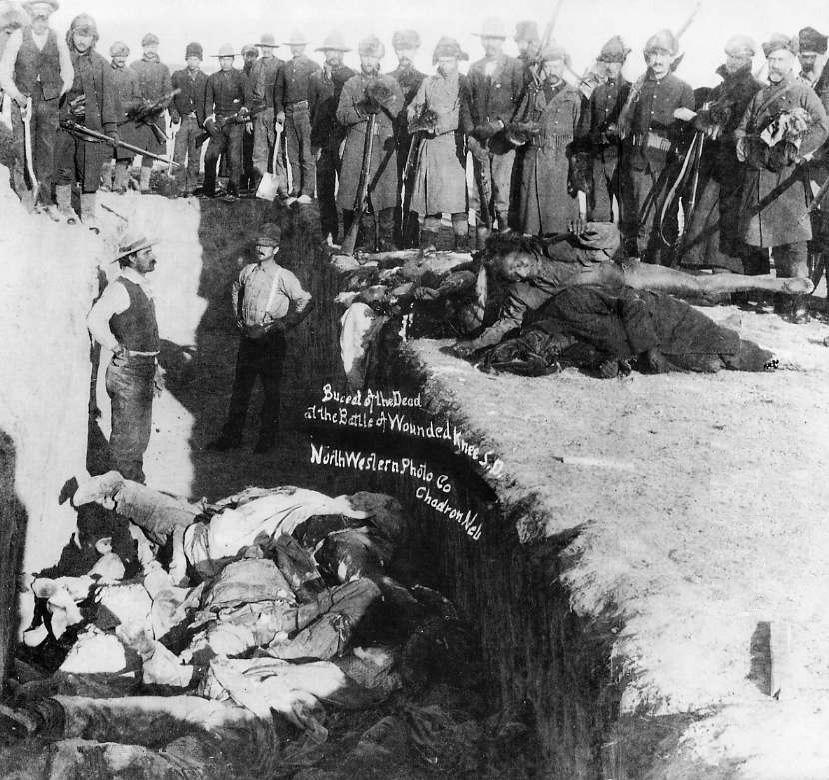
It would be the last sad such episode in the long-standing feud between the American Indian and the American White. Indeed, the “Indian Problem” had now been solved, definitively.