CONTENTS
 American post-war rebound
 However – the Cold War hits home
 Eisenhower’s America
 The Cold War takes on a new quality
 The brief Kennedy Era (1061-1963)
The textual material on this webpage is drawn directly from my work, America’s Story – A Spiritual Journey © 2021, pages 270-302
A swing to the Republican Right after the war. American capitalism had stormed back into existence because of the wartime need for ships, airplanes, tanks, trucks, arms of all sorts, etc. But with the war ending those jobs came to a halt and workers were let go – reviving old anti-capitalist attitudes of the American blue-collar working class – which went on a massive strike (five million workers out) during the 1945-1946 period. Then too the Middle Class or white-collar workforce employed in wartime government offices also faced similar reductions – except that Middle Class America generally expected this to happen – as Middle-Class America in general found bloated government operations distasteful and understood this wartime government work to have been merely temporary.
Indeed, the reaction of the average American voter was not only to expect government cutbacks but also to do something about “unpatriotic” workers’ movement (identified closely with distasteful Socialism). All of this resulted in a massive routing of the Roosevelt New Deal Democrats from public office in the post-war elections and the return of the Republican Party to power, massively so. And one of the first things the Republican Party in Congress did (1947) was to pass the Taft-Hartley Bill which put huge restraints on the American Labor Unions’ ability to force the unionization of the American worker. Truman vetoed the bill – but it was easily overridden by a 2/3 vote in Congress, thus becoming the law of the land.[1]
The G.I. Bill. But one piece of the legacy of the Roosevelt years that the Republicans would not touch was the 1944 G.I. Bill – which promised servicemen that after the war they would receive – not a pension or payment – but financial assistance (very low-cost government loans) in heading off to college, buying a house, or starting up a business. In short, the G.I. Bill worked wonders in helping former soldiers move on – and up – in life after the war, avoiding the typical crisis that occurs when soldiers are returned after war to a sagging economy where jobs are scarce and unemployment rampant.

A young American family at home while the husband studies at the University of Iowa, his bills paid for by the GI Bill of Rights – 1947
The booming American economy. In fact quite the opposite actually happened with the post-war American economy. Virtually no cars had been produced during the war years and consumers were eager to trade up to a shiny new car, helping the automobile manufacturers quickly shift back to massive automobile production from the manufacture of tanks, trucks, and airplanes that they had converted their operations to during the war. Then there was a huge demand for the new and quite affordable small homes that allowed young American families to leave the multi-generational old homes of traditional America – and move out on their own in the widening world of America. Military service had introduced young men to the dreamy world of California, the robust world of Texas, etc. – and after the war young Americans eagerly moved West in huge numbers, into fast-growing suburban neighborhoods – arising, however, around not only the newly expanding cities in the West but also in cities everywhere across the country.

A post-war subdevelopment outside of Los Angeles
Consequently, the construction industry boomed – offering plenty of jobs for young men who had returned home from military service.
The Marshall Plan aiding the European recovery also added immensely to the American economy. Much of Europe’s industrial infrastructure had been destroyed by the war – although America’s factories had been untouched. Consequently, the Marshall Plan funds mostly made their way back to America in the form of orders for American goods: machinery, trucks and tractors, electronics, etc. In fact, by the year 1950 it would be correct to say that America itself provided fully half of all industrial products being produced worldwide.
The “Baby Boomers.” The startup of a family was a matter that young Americans had been forced to put off during the war years. But now, peacetime presented the opportunity for young men and women to make up for that lacking. They rather quickly married in massive numbers – and soon began to produce the next generation. Babies were thus born also in massive numbers in the period of 1946 and after – the beginning of the “Baby Boom.” And those babies, soon children (the 1950s) and eventually young adults (by the mid-1960s) would develop into a very distinct generation of Americans, known appropriately as the “Baby Boomers” – and eventually just “Boomers.” They would come to rock the nation.

A Levittown family with Boomer children – early 1950s
“Entitlement” replaces the sense of service or duty among the Boomers. Tragically, what these young parents seemingly were unaware of was that the enormous dignity they found in their lives as Americans was a huge personal emotional payoff that mysteriously came from the life of service or duty, which they had been forced to take in both the Depression and recent war just to survive. Now with peace in the world and America prospering greatly, they saw the “wonderful” possibilities that their Boomer children would never have to undergo such a social burden.
Sadly this adult or Vet generation failed to understand how important their approach to life – through the taking up of burdensome but necessary service or duty to the surrounding social world – was behind their also deep sense of both personal and corporate success. Thus they would raise and supposedly “bless” their Boomer children – as part of their on-going sense of personal duty – by trying to keep from them the “burden” of such sacrifice, such dutiful service. They would give their children generously and freely all the personal and social payoffs that they themselves in their growing up never had the pleasure to experience.
And in doing so, they believed they were performing a great service to their children. Actually quite the opposite would be the social results.
Consequently, the Boomers would not form this deep sense of personal connection through the path of duty or deep personal service to the surrounding social world. Indeed, they would be amazingly lacking in such social powers. This was because the Boomers would grow up seeing society not as something you are deeply wed to through the personal investment of service or duty. Instead, when they looked out on society it was to see what social entitlements were due them through their social connections, and changing those connections (marriages, jobs, local communities) when they did not see a proper social payoff coming their way. Thus it was that they were largely attached to society only to the extent that society continued to offer a person his or her “entitlements.” In short, socially speaking, they were badly “spoiled.”
Christian America. A notable thing about post-war middle-class culture was that it was personal and highly relational – rather than dreamily rational or utopian – the kind of world that those who like to direct the lives of others from a position of lofty and rather abstract enlightenment typically live by. The war that Middle America had just been through was neither rational nor abstract. It had not been fought on the basis of high and noble ideals – the way Wilson took America into the First World War in the name of “making the world safe for democracy” – but more as a sense of simple defense of the America that had been treacherously attacked by Japan and called to war by Hitler’s own design. There had been much personal sacrifice involved for Americans. Indeed, this war had been from the beginning very personal.
But going at life on a relational rather than rational basis had been given considerable impetus by the Christianity that informed most Americans at this point – the sense that their personal relationship with God was critical in their ability to go the course – all the way to victory. Americans looked to God rather than to human programs to keep them moving forward. True, there was a Washington government to lead the way. But even there, that lead was more personal, prayerful, spiritually-directed than programmatic. Roosevelt had kept in close touch with the hearts of Americans with his fireside chats and personal prayers – ones that related the president, the citizen, and God in a very special way – vitally needed to keep things moving ahead, even in the face of huge uncertainties that always accompany war.
Thus Americans came out of the war highly committed to their Christian faith – especially in the way it defined for them the idea of America itself, what it stood for, how it operated – what was to be expected from American life – and what defined the good and the bad in all of this.
Capitalist America. Right along with Christianity came Capitalism as core to Middle America’s understanding of life. Certainly the huge industrial war machine led by American capitalists had proven itself. And the continuing economic prosperity that followed the war in terms of the building boom in American housing, the booming automobile industry, and the easy availability of a whole number of domestic or personal consumer items brought capitalism back into favor in the American heart. It was also easy to look across to Europe and see that continent’s tendency towards Socialism seemingly serving much less capably than the American capitalist system.
Constitutional America. And America’s governmental system clearly had proven its strengths during and after the war – when Washington’s immense military and bureaucratic system, needed so vitally during the war, was now reduced drastically in order to let America return the focus of its political dynamic back to local American life. Here too, with the process of government carried out essentially as a local responsibility – rather than as some imperial institution located in a distant national capital – there was something very constitutional in all this. Americans were proud of their Constitution, considering it to be the perfect model – even for the world – of excellent government.
Over the next twenty years that followed the end of the war in 1945, Christianity, Capitalism, and Constitutionalism (the Three C’s) would all come together to form something of a grand cultural blend.
Christian revival. It seemed even that America was undergoing another one of its Great Awakenings. Interestingly, one of the groups taking the initiative in this matter were America’s capitalists, now restored to dignity because of the war. They had joined Abraham Vereide even before the war in strongly supporting his prayer-breakfast movement. But now they were joined by Washington senators and congressmen, as a strong sense of Christian responsibility, not just to the country but to the world, called forward an active spirit of American social mission.
 And then along with this, there was the young Christian evangelist, Billy Graham, who seemed to be taking the nation by storm as he packed huge coliseums with vast multitudes attending his various crusades … with his month-long 1952 Washington D.C. crusade drawing as many as half a million participants, many of them also representatives and senators from Congress.
So effective was this crusade (well financed by American business leaders) that it led to the call by President Truman (although he generally tended to prefer to keep the matter of religion personal and private) for an annual National Day of Prayer – the first one, captioned “Freedom Under God,” to be held that year (1952) on the 4th of July.[2]

Even in the rain, Graham could bring out the people – February 1952
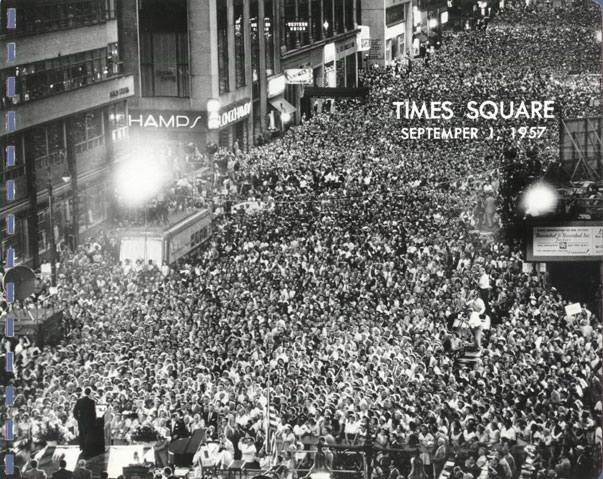
This picture speaks for itself!
The world of television. Then too, just as the radio revolutionized life in the 1920s, the widespread appearance of the new television (TV) would have the same massive impact on American life from the early 1950s onward. The development of the TV certainly also put a huge boost in the American economy, Americans flocking in vast numbers to the stores to buy this new and most wonderful addition to American homelife. It was like having the movie industry brought into your home. In fact, Hollywood was in a bit of a panic fearing that this TV craze would bring down the movie industry (it did not).

But the TV put in front of Americans a clearer picture of a well-modeled world of everything from family life (The Adventures of Ozzie and Harriet),

cowboy heroes (Hopalong Cassidy),
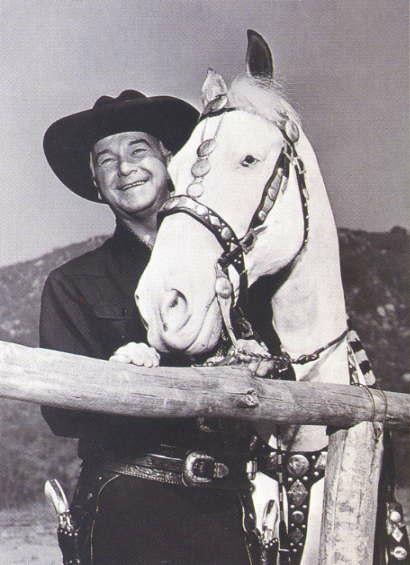
comedy (I Love Lucy),

and classic drama (The Hallmark Hall of Fame). Soon it would move on to major sports events (National Football League games)

The televised NFL championship game – 1958
and the latest dance steps for teens (American Bandstand).

In short it presented a very clear definition of the core ideals of Middle-Class American life, something that Americans felt set them apart from – and way ahead of – the rest of the world in terms of modern development.
[1]But then Truman himself during the remainder of his presidency would use the Taft-Hartley Act twelve times in his own confrontation with American unions.
[2]Actually Truman had several times previously called the nation to prayer … when he found himself facing a number of crises for which he had no easy answers. His unsophisticated but very Biblical and very personal Christian faith drew criticism from more sophisticated and “theologically-informed” voices of the day. But the important fact was that Truman truly looked to God and the Christian world for support in carrying out the responsibilities placed on him by his nation.
HOWEVER – THE COLD WAR HITS HOME
But all was not sunny in Middle America. As the Cold War developed, and Americans watched country after country in East Europe fall under Russian influence – in most cases by political maneuvering within those countries by Soviet-backed local politicians (that fear even extended to France and Italy after huge Communist uprisings in both countries in 1947 were put down only with much effort) – America began to be concerned about the extent and intent of Communism planted in America itself.
Authoritarianism as the new threat. It seemed as if Americans had fought in the recent war to destroy the authoritarian regimes of Germany, Italy and Japan only to have those threats to the peace and prosperity of the larger world replaced by a new authoritarian regime: Stalin’s Soviet Russia. Great concern developed within Middle America that there was some kind of global historical trend that seemed to be pushing civilization in this direction. And that concern increased enormously with the publishing in 1949 of the English author George Orwell’s book, 1984, which portrayed a world in which the very thought process of the world’s people had been taken over – thanks to fast-rising modern technology – by “Big Brother.”

And the cynical attitudes it produced

Panic set in as Americans considered the possibility that this might be happening right there in America, right there under their own eyes, subtly manipulating the thought processes of vulnerable people into authoritarian compliance. That seemed to have been the very pattern of Communism’s spread through East Europe. And it seemed to be part of the ideological fires that burned within Western Europe’s labor movement as well.
Thus this same concern hit America as it considered its own labor movement – conducting (in the early post-war years) labor strikes and strife that looked way too much like those labor maneuverings that had brought Communism to power in Soviet-dominated Eastern Europe.
And also there were the numerous American intellectuals who, during the Great Depression, had loudly identified themselves as strongly anti-Capitalist and pro-Socialist. Where did they stand on such matters today? Where were their loyalties now to be found in this post-war world?
American intellectuals under suspicion. Leading this inquiry into the Communist involvement in America was the House Un-American Activities Committee (HUAC), conducting Congressional investigations not only into the labor movement and the world of socialist intellectuals but also into the movie industry – which had produced a number of films now considered to have strongly Leftist messages. This would come to include even the U.S. government itself, when accusations came out in 1948 that high-level officials in the Roosevelt Administration had been spying for the Soviets.
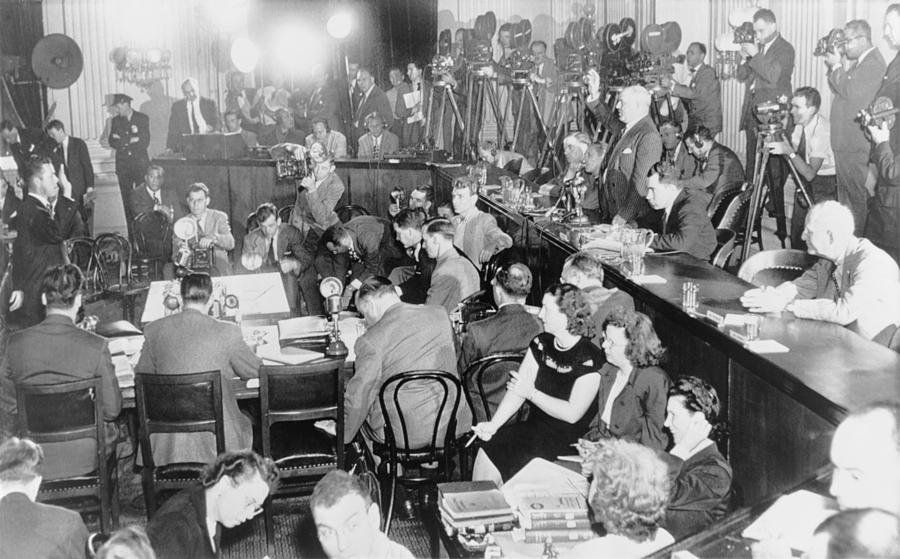
HUAC hearings underway
This matter turned itself into extensive social paranoia on the part of Middle America, met on the other hand by the scorn and disgust against Middle America on the part of Intellectual America. When actors began to be blacklisted and refused roles in Hollywood’s world (ultimately some 300 individuals were blacklisted, including even famous actors), Hollywood protested that this kind of authoritarianism was what America itself was supposed to be combating – not embracing.

Lauren Bacall and Humphrey Bogart leading Hollywood stars to Capitol Hill to protest the HUAC proceedings – 1947
Then when senior U.S. Treasury official Harry Dexter White (who was a key figure at the 1944 Bretton Woods Conference setting up the new United Nations) and Alger Hiss (a top State Department advisor at the Yalta meeting designing the post-war world) were accused of being spies for Soviet Russia, America lined itself up into two opposing camps. Intellectuals were convinced that this was only a form of witch-hunting on the part of unenlightened individuals from the American Middle Class – simply resentful of these individuals because of their highly talented backgrounds (the highly educated White, for instance, was a product of Columbia, Stanford and Harvard University educations – and Hiss was a Johns Hopkins University and Harvard Law School Graduate).
Particular resentment by intellectuals was aimed toward the freshman Congressman and HUAC member Richard Nixon, who refused to relent in his investigation of Hiss… which eventually led to the conviction and imprisonment of this polished diplomat – to the dismay of Hiss’s fellow intellectuals.[3]


Nixon Hiss
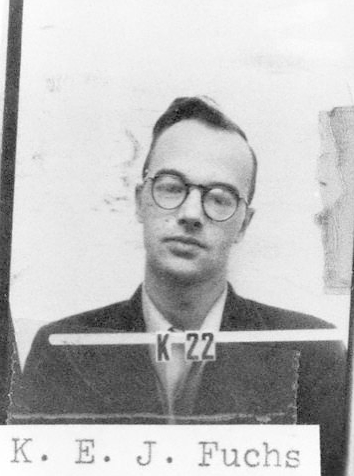
Also, when suspicions turned towards some of America’s scientific community – whom Americans had assumed possessed the highest integrity of all people – the nation was shocked. Intelligence work had cracked the Soviet code and discovered that nuclear scientist Klaus Fuchs was a Soviet spy. He in turn named David Greenglass and Julius and Ethel Rosenberg as spying for the Soviets while helping to develop America’s nuclear weapons.

Julius and Ethel Rosenberg
There were others as well, accused and ultimately convicted of spying in the early 1950s, though only Julius and Ethel Rosenberg were executed – despite the huge international call for clemency (they claimed innocence to the end).[4]
McCarthy cultivates a Red Scare. At this point a loud, accusatory voice in the U.S. Senate became even louder, as Senator Joseph McCarthy in early 1950 began whipping up American fury at this “treachery in high places.” McCarthy accused (without any specific details) the American diplomatic corps broadly, then the American civilian government in general, and then finally, by 1954, even the US military, of being loaded with Communists who were secretly subverting America. With this, the Red Scare was whipped up so as to turn in every direction.

American intellectuals fight back. The Red Scare hit especially hard America’s intellectuals – who were known to have “fancy ideas” about the need for social reform – ideas which seemed overly critical, even unpatriotic, even treasonous, to fiercely patriotic middle-class Vets. The Vets therefore were (with McCarthy’s help) easily led to believe that this class of intellectuals formed a conspiratorial group seeking to overthrow the nation and everything it stood for. Needless to say, the intellectuals did all that they could do to fight back – though it had to be done cautiously, very cautiously.
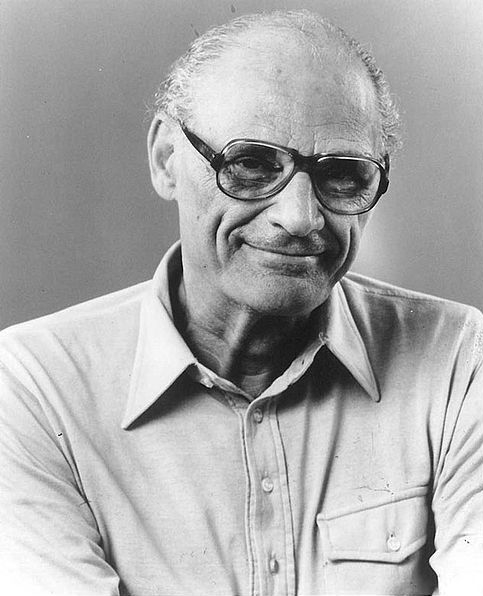 Arthur Miller’s play, The Crucible. An example of this was when in 1952 playwright Arthur Miller’s close friend Elia Kazan, in a hearing before the HUAC, specifically identified eight members of his Group Theater as Communists. Miller was so offended by this betrayal that he responded the next year by writing a play, The Crucible. Miller felt that he dared not answer the Communist witch-hunt going on around him at the time directly (that would have been dangerous), but instead, wrote about a similar betrayal when citizens of Salem, Massachusetts, turned on each other during the infamous witch trials of 1692-1693.
In a not-too-subtle way, this challenged deeply not only the mindset of 1950s Middle America, but also even more deeply the very Puritan-Christian cultural foundations that Miller (and numerous intellectuals) were certain was behind this Middle-American paranoia.
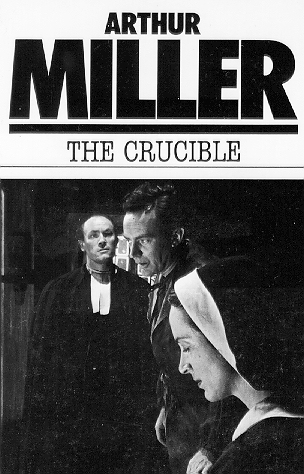
Actually, the play would not do well when it first came out. But in the 1960s, when America found itself moving into a whole new cultural realm, the play would finally find a very enthusiastic audience.[5]
[3]Actually, in the opening of the Russian archives after the collapse of the Soviet Union in the early 1990s, it was confirmed that in fact both White and Hiss had been spying for Stalin.
[4]Again, with the fall of the Soviet Union, it was finally revealed that indeed the Rosenbergs (or at least Julius Rosenberg) too had been spying for the Soviets.
[5]At that point the play became required reading in most high school American literature courses across the country, helping to turn young Americans away from their nation’s cultural roots founded deeply in Puritan Christianity.
EISENHOWER’S AMERICA
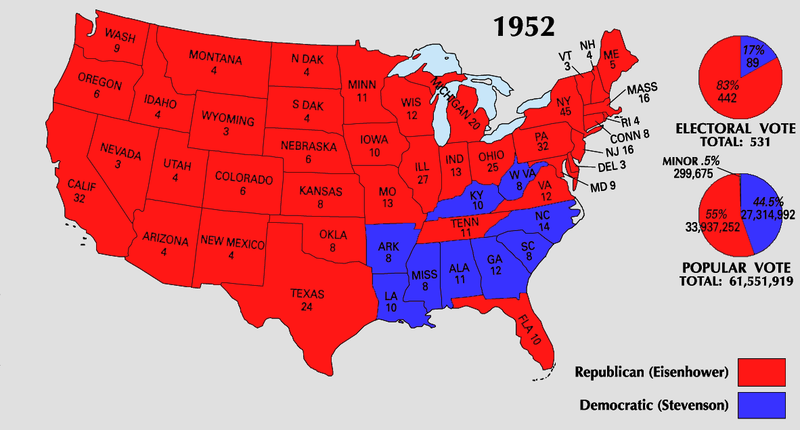
The 1952 election. Despite the new 22nd Amendment to the Constitution limiting a person to only two terms of office as president (in reaction to Roosevelt’s four terms) – it did allow Truman to run for yet one more term. However his decision to take on the Korean challenge had not warmed American hearts, which factored in his not doing well in the early Democratic Party primaries. Anyway, Truman was worn out and ready to retire, so he backed out of the race. In these same primaries Senator Estes Kefauver of Tennessee had done quite well, running on his reputation as an anti-corruption crusader, particularly in fighting the Mafia and also local political corruption. But the Democratic National Convention (DNC) was still represented mostly by local political machines, hostile to Kefauver. Thus the Democrats pressured Illinois Governor Adlai Stevenson to run as their presidential candidate (he would personally have preferred to run for reelection as Illinois governor rather than U.S. president!).
The Republicans bypassed the very conservative Robert Taft (son of former President Taft) to pick the centrist and popular former General Dwight D. Eisenhower (at that point President of Columbia University) – with the HUAC activist Richard Nixon as his running mate … pleasing the Conservative wing of the party.

Basically, American labor, Southern “Dixiecrats,”[6] and American intellectuals backed the rather intellectual Stevenson … who distanced himself from the Truman legacy (not doing well at that point) and focused his campaign on attacking Eisenhower for failing to take a strong stance against McCarthy. But Middle America loved everything the war-hero Eisenhower seemed to stand for, and threw its support to him. Ultimately, the election proved to be a solid win for the Republicans in both the Presidential and House elections – with a Republican-Democrat tie in the Senate. The presidential vote had been 55.2 percent for Eisenhower to only 44.3 percent for Stevenson, and the electoral college was even more skewed in favor of Eisenhower, 442 votes for Eisenhower and 89 votes for Stevenson. Eisenhower had managed to gain the majority even in three of the “Solid South” states!
 Dwight D. Eisenhower. The new president was born third of seven boys in Abilene Kansas, to a rigorously religious family. After graduation from high school he worked two years to help finance a brother’s college education, then – to the disappointment of his quite pacifist mother – was accepted to the West Point Military Academy, which offered a free education. There he was quite involved with sports, and academically graduated at the middle of a class – one that would go on (because of the Great War) to provide the nation a large number of active officers.
Just prior to America’s entry into that war he married (Mamie Doud), and then during the war served at home in various administrative duties (which he became quite good at), becoming deeply frustrated when just as he was finally about to be mobilized for action in France, the Armistice was signed and the fighting in Europe came to a close.

With the long period of peace that followed, he took up both further military study and service as a staff officer in a variety of commands, before being sent to the Philippines in 1935 to serve under General MacArthur, and the following year receive the rank of Lt. Colonel. He returned to the States at the end of 1939 where he again served as a staff officer to various generals, finally attaining the rank of brigadier general in 1941, just prior to America’s involvement in World War Two.
Thus far, however, there was nothing notable about his service that suggested he would one day find himself commanding the most important and final phase of a war in Europe. Yet his administrative work and well-recognized strategic mind impressed General Marshall. And his ability to move things forward in the midst of personality clashes was what had him sent to London to take command of operations there, at the time focused on North Africa, Sicily and then Italy.
But as already noted, it was his selection as commander of the crossing of the English Channel and march across France, Belgium and the Netherlands that secured his place in the history books as a battlefield hero. And after the war, Truman brought him on board as his Army Chief of Staff (Marshall had been sent to China to try to work out some kind of cooperation between Chiang and Mao). And thus as the 1948 elections approached, it was also that both the Republican and Democratic Parties courted him as a possible candidate for the U.S. Presidency, something that Eisenhower refused.
Instead, he accepted the offer to become Columbia University’s president, a strange calling considering the vast difference in mentalities that existed between the scholarly and quite idealistic professors and the quite pragmatic – and deeply religious – Eisenhower. But Eisenhower was much more the scholar – or at least man of well-thought-through ideals – than the country understood about him at the time. He was very active on the prestigious Council on Foreign Relations and a founder of the American Assembly, an organization designed to bring together leaders from all walks of American life to go over a broad range of political, economic and social issues facing the country. Here Eisenhower developed from a starting point of deep knowledge of military strategy and organization to a quite sophisticated understanding of the broader world of business, economics, and social-cultural matters.
Actually, Eisenhower was vastly much brighter than his Columbia University professors – many of whom disliked Eisenhower intensely – portrayed him before the public, and was learning to cultivate excellent working relations with American business leaders – whom liberal professors also tended to distrust.
In 1950 he was appointed Supreme Commander of the North Atlantic Treaty Organization – nonetheless retaining his position at Columbia until sworn in as U.S. president in January of 1953.

Eisenhower, as NATO Supreme Commander, conferring with Truman’s Secretary of State Dean Acheson – 1951
This was an important appointment because Eisenhower could generate stronger support in Congress for this peacetime organization and its operations than could Truman, and at the same time could leverage America’s European allies to make a deeper material commitment (men and money) so as not to make NATO a strictly American operation.
As a Christian, Eisenhower would prove to be one of the most active of all individuals to occupy the White House in support of the Christian faith and its central role in the life of the nation. He did not come to the White House with much of a Christian testimony and was not even baptized until once in office. However, as president he took up regular Sunday attendance at the New York Avenue Presbyterian Church. And also as president, Eisenhower constantly reaffirmed the importance of all Americans taking up their particular Christian responsibilities (including prayer and regular church attendance) as the nation faced social problems at home and political and economic problems abroad. To Eisenhower’s understanding of things, God himself expected no less of America. And Americans seemed glad to take up this very challenge.
Indeed, it would be during his presidency that the words “under God” would be added to the Pledge of Allegiance in 1954, and “In God We Trust” would be confirmed as the nation’s motto in 1956.[7]
Korean Armistice. As already noted, during the 1952 presidential campaign, Eisenhower had distanced himself from the whole McCarthy matter – drawing sharp criticism from Stevenson for Eisenhower’s failing to denounce McCarthy’s witch hunt. Instead, Eisenhower had focused his campaign on doing something to bring the Korean War to some kind of resolution (the fighting itself had actually subsided substantially since mid-1952). And thus now as US President, Eisenhower worked to get the various parties involved to sign an Armistice (actually not a formal end to the war) – recognizing the rather permanent division of Korea north and south not too far from the original 38th parallel. But this seemed to put the Korean crisis now as a thing of the past. Korean tensions would flare from time to time after that – but leave the line itself intact – even down to today.
There were now two Korean societies, increasingly different in character as they went off developmentally in quite different directions, North Korea to become over time even more “Stalinist” in its political makeup, and South Korea to develop strongly along Western (deeply Americanized) political, economic and social lines.
McCarthy finally brought down. Meanwhile, McCarthy’s reckless accusations before his TV audience of “Commies everywhere” had reached into all segments of society – although only on occasion did he actually mention anyone by name. He was on a major fishing expedition to come up with scandal everywhere – in order to keep things focused on him as America’s savior. But in early 1954, radio and TV newsman Edward R. Murrow actually did a series on McCarthyism – the first to openly challenge McCarthy. McCarthy’s response to Murrow’s challenge was not artful – indeed worsening the slowly declining image of the Senator.
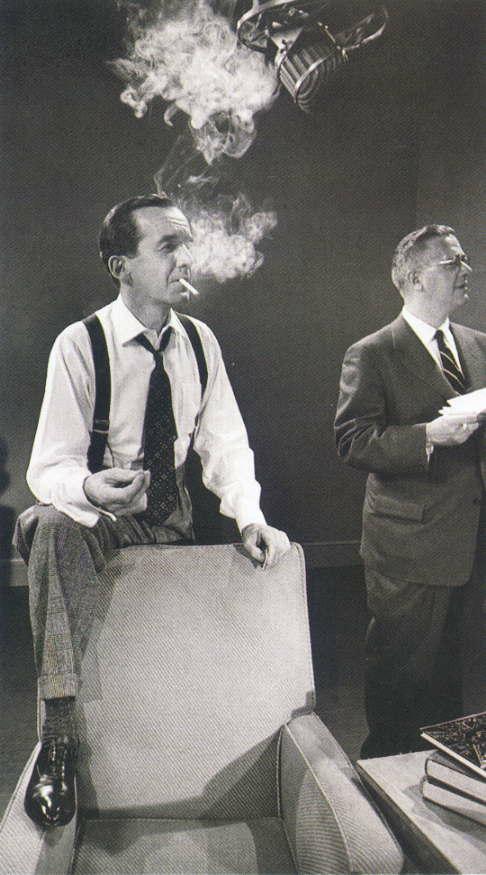
Murrow takes on McCarthy on his “See It Now” show – 1954
But what finally would be McCarthy’s undoing was his taking on the U.S. Army officer corps before his Senate committee – and before his enormous TV audience – for the Army’s harboring of “known Communists.” Finally, the lawyer leading the Army’s defense launched into an attack on McCarthy’s destructive and ill-founded evidence.
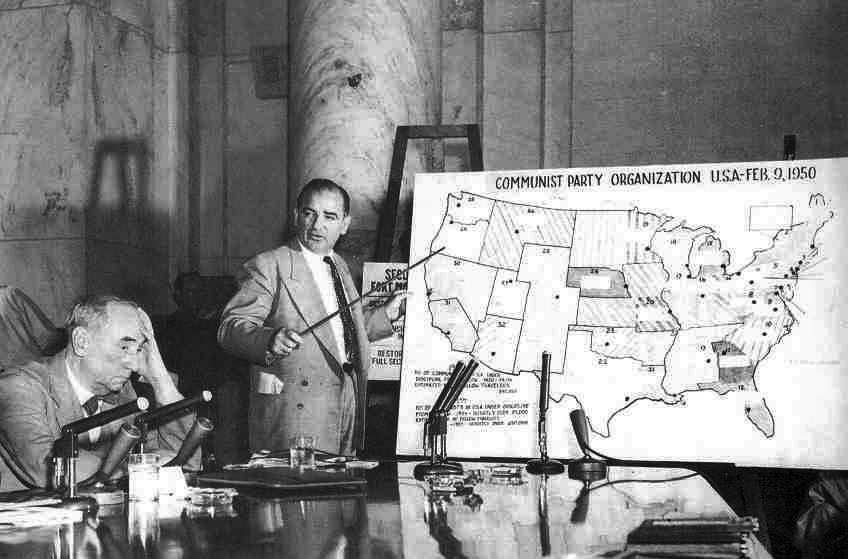
McCarthy haranguing US Army Counsel Joseph Welch for one of Welch’s law partners belonging to the National Lawyers Guild … McCarthy ridiculously accusing the organization of being “the legal bulwark of the Communist Party”
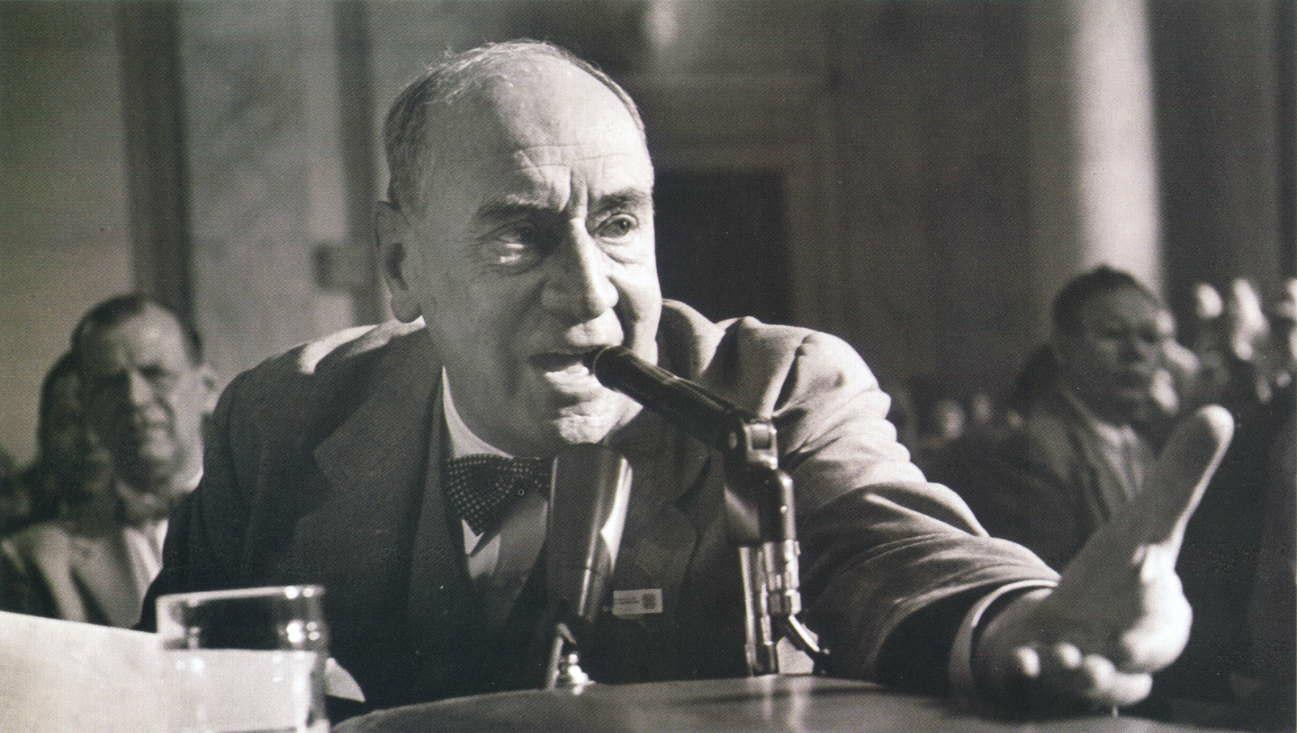
Welch finally explodes: “Have you no sense of decency, sir?”
McCarthy was at a loss for words. His boldness melted away – and what the Americans now saw on TV was a demagogue with no serious political skills, merely a monstrous political gossip with nothing of substance to his agenda. At this point the Senate finally found its courage and voted a motion of censure against McCarthy – almost unprecedented in the history of the U.S. Senate. And although he kept his Senate seat, McCarthy was no longer a person of interest to America. He eventually faded off into alcoholism – and America moved on.
Directives to the Boomer: “Challenge all authority.” America would move on. But it had put in place a set of social-moral foundations that would be lasting: the Boomer mindset. So afraid of the Orwellian Big Brother authoritarianism that walked the earth were the Vets that they made the decision that their children were to be taught in such a way that their Boomer offspring would never become victims of authoritarian thought-control – such as they had witnessed among the Hitler youth, and more recently had heard about taking place in Stalinist Russia – where the youth were so brain-washed by the Communist system that they would even turn their parents over to Soviet authorities if they heard them involved in any “anti-revolutionary” conversation.
So, the Vet parents thought themselves to be very wise in teaching their children to challenge all voices, all efforts of anyone, coming at them as “authority.” They were to do their own thinking, come at rational choices through using their own natural logic.
Tragically, the Vets had fallen into typical Humanist thinking in presuming that their Boomer children – by way of natural human instinct – would come to hold the same social-spiritual values, and go at life in the same way that they, their Vet parents, did. The Boomers would do so because supposedly these values were instinctive to all humankind, values that anyone thinking freely and clearly on such matters would necessarily come to hold.
On two counts, the Vets (as with all Humanists, ancient as well as modern) would be making a huge mistake in their program. First of all, there was nothing “natural” about how they, the Vets, were raised. Very precise circumstances had made them to be the people they were: the hardships of the Great Depression and the massive sacrifices they made during World War Two. As a distinct generation, they were very reflective of this particular development … willing to sacrifice personal interest in order to serve a higher social good. They had been forced into that moral-spiritual position in order to survive. And in doing so, they came to believe religiously that this was just a natural instinct of all decent people.
As for their highly pampered Boomer offspring, this generation had come to understand life and its dynamics through a very different set of circumstances, and would therefore understand life’s “natural” dynamics quite differently – in fact, very differently – than their parents.
And secondly, as Christians, the Vets should have known better than to take up the religious idealism of Secular-Humanism, having been shown repeatedly in long-standing Biblical Scripture – not to mention in the life they had been required to live – that man’s instincts are not naturally always so beautiful, and that human Reason does not always bring things forward nobly, but is often simply the tool by which people justify the worst kinds of behavior. As Christians they should have been acutely aware of the fact that original sin – not original goodness – was what spiritually mature humans always ended up having to deal with constantly, especially when that very sinful instinct came from themselves.
So actually the Vets were themselves “brainwashing” their children, with very interesting but very foolish Humanist Idealism. They were carefully shaping the thought-processes of a rising generation so that when they reached adulthood, they would finally begin to act on this training, training that had taught them to challenge all social authority.
But the only social authority at hand for their Boomer offspring to challenge would be the social authority of the American society and culture that their own parents (and many generations before them) had carefully put in place. By their very training, the Boomers would see themselves called to challenge that authority, especially in the social areas touching close to home: their jobs, their marriages, their social affiliations, their local communities, even their nation. And being a pampered generation, it was easy for these Boomers to find reasons to challenge those social ties, those social responsibilities, when it involved commitment and sacrifice rather than just social payoff.
And in this crusade against their inherited social world, they would also have the mentoring or support of the alienated intellectuals, who themselves felt that they had good cause to oppose, or even overthrow, the social-cultural world of Middle America. Most importantly, those mentors included “Progressive” professors, under whom the Boomers studied in fast-rising numbers, playwrights making plays and movies encouraging new social attitudes (ones highly shocking to the Vet world!), and young journalist crusaders, etc. … that is, any group of people who lived in the world of “progressive” idea-production. They would be quite active in encouraging and ultimately providing moral justification for the new Boomer-think.
Thus things would soon get very strained in America – as Middle America entered the 1960s only to find that everything that it believed in to now be under challenge, deep challenge, by its own offspring!
The Vets’ foreign policy idealism. Sadly, the Vets (as well as the generations of Americans after them) also seemed to go at foreign policy along those same Humanist – rather than Christian Realist – lines.
Certainly the intense strain of going to war against Germany and Japan in World War Two – and then against the North Koreans and their Chinese allies in the Korean War – called for some kind of Idealism to get the Vets through the ugliness of it all. Thus they were not merely involved in killing bad people, the enemy. They were serving the much more noble cause of bringing “democracy” to the world. That grand goal seemed to give their efforts much greater stature, grander purpose.
But huge dangers would accompany this idealizing of American foreign policy. For one thing, democracy is not the natural, inevitable outcome for a people when they have suddenly been freed from what Americans understand as nothing more than dictatorship. They should have learned that lesson from World War One when they sent thousands of American boys off to die in the trenches of Northern France, all for the grand purpose of making the world safe for democracy.
They should have learned that lesson at the end of World War Two when they took such a strong stance opposing their Dutch allies – who were determined to regain their 300-year old colony in Indonesia. Instead, America supported a local independence movement there (and thus the old Wilsonian principle of “the rights of self-determination of peoples everywhere” … one that supposedly, when implemented, leads automatically to democracy) conducted by a regime set up by the Japanese at the time of their surrender to the Americans in August of 1945. But after the Dutch were chased off (or just slaughtered), this led not to Indonesian democracy but rather to the ruthless 22-year dictatorship of Sukarno!
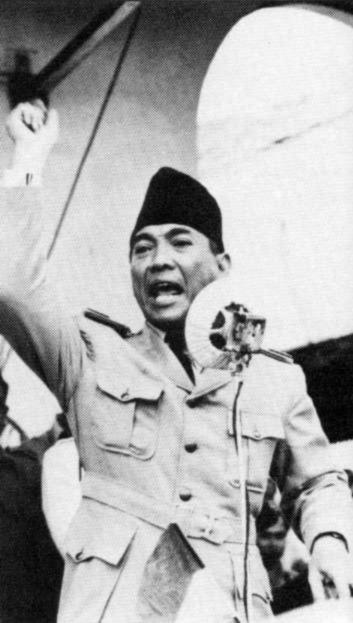
Sukarno, whom the Japanese turned power over to in their retreat from Dutch Indonesia after losing the war … hoping to leave an anti-European legacy there. With the help of the UN (and America!), they succeeded in just that … preventing the Dutch from retaking their colony and in putting Indonesia under a long-lasting dictatorship, not democracy!
Americans have great difficulty understanding the dynamics of power – power which most of the time is subtle, not very glorious in its effect, and always tiresome to maintain. Crusades are much more exciting and seemingly so much more noble. But when back in 1794 Washington marched his army into Western Pennsylvania to put down a whiskey rebellion – doing so only to preserve the little sense of political unity that the new Republic was able to muster – there was nothing very noble about the enterprise. Yet it was quite necessary to make that show of power, or the fragile union holding their new Republic together would have simply dissolved away.
Likewise, there was nothing noble that Lincoln was feeling when he sent Union troops into the rebellious Confederacy in order to force the ongoing unity of the United States. It was simply a job that had to be done. And even in World War Two and Korea the actual task was simply to bring down those whose actions threatened the social world entrusted to the Americans. Nothing about it was very glamorous. But it was all quite necessary.
The same kind of fundamental Realism driving America’s actions abroad however cannot be said to have been present in America’s entry into World War One. Wilsonian Idealism was the sole motive, and it proved disastrous in the end. And tragically many of the “save the world for democracy” crusades that America as the West’s superpower would undertake from the 1960s onward would be just as bad: Cuba, the Congo, Vietnam, Iran, Afghanistan, Iraq, Libya, Syria. Idealistic crusades, though emotionally thrilling (for a little while anyway) are dangerous enterprises, which a great power like America should carefully avoid.
Black and White America. Although about one in ten Americans were classed as Colored (Black) in the 1950s, actually they occupied a rather invisible part of Middle America’s world, living either in Black sections of America’s major cities or else scattered around the South. And that invisibleness gave them very little voice in American society. True, some had distinguished themselves, such as the Tuskegee Airmen who were sought after as excellent fighter pilots protecting American bombers in their run over Italy during World War Two. And there was the excellent baseball player Jackie Robinson, who broke the color bar when he was brought onto the Brooklyn Dodgers. But these were by far the exception.
 But that began to change in the mid-1950s, when an exhausted Black seamstress, Rosa Parks, refused to give up her seat to a White male on a crowded Montgomery (Alabama) bus, and was arrested and fined.
But the Montgomery chapter of the National Association for the Advancement of Colored People (NAACP) decided to fight the case. Parks was secretary of the Montgomery chapter of the NAACP, which included also within its local leadership a young pastor who had recently taken a Montgomery pulpit, the Rev. Dr. Martin Luther King, Jr. – who would come to head up a boycott of the town’s buses.[8]

Not only would they encourage Blacks to avoid the use of the town’s buses, they would fight the $14 fine – as far up the judicial appeals ladder as the case would go – in opposition to the segregation laws designed to keep Blacks in their place.
 The Rev. Dr. Martin Luther King, Jr. King was born in Atlanta, Georgia, in 1929, named “Michael” at the time. His father, also Michael, was the pastor of the Ebenezer Baptist Church in Atlanta and his mother, Alberta, was the daughter of the previous pastor of the same church. While on a trip to Germany in 1934, Michael, Sr. was deeply inspired by Luther’s reforms, and decided to identify himself with Luther’s work by taking Luther’s name, and changing the name of his son Michael, Jr. as well – thus both now becoming Martin Luther King. But the family was not only deeply involved in the Baptist ministry, it was also equally involved in the civil rights movement, with the father head of the NAACP chapter in Atlanta, and a radio broadcaster as well, with a widening influence in the region.
Despite his father’s social influence, King Jr. had to face the discrimination typical of “Coloreds” in his day and time, for instance, having to go to a school for Blacks while his best friend went to a school for Whites – and having the White boy’s parents inform their son that he would have to stop playing with his Colored friend. But King, Sr. taught his son to respond to these hurts not through hate, but through the struggle to love even those who persecuted you, even though they were still to resist strongly the racism behind such cruelty.
Typical of a teenager, King, Jr. distanced himself from his father’s deep faith, no longer able to identify with the emotional spirit so strong in the Black community – and in his father’s church. Instead he devoted himself to scholarly study in history, English and public speaking, and debate – excelling in these areas. At the same time, he still had to face insults from Whites, which infuriated him greatly. Then, even before finishing high school, he went off to attend All-Black Morehouse College[9], where his father and his maternal grandfather before him had attended.
It was during these years that he first traveled outside the South, and was surprised to find that the racial discrimination so strong in the South appeared to be relatively absent in the North. The contrast would help him form a strong idea of what he wanted to see happen in his Atlanta homeland. And it was also in these years, in great part due to his deep admiration for his father – and his equally deep appreciation of the role that the Church played in the lives of those struggling against the pain that the world hurled at them – that King, Jr. decided to prepare for the ministry.
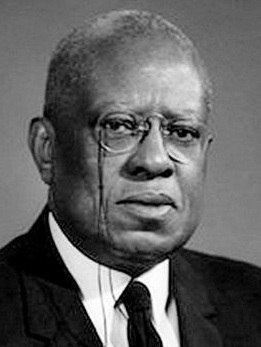 Off to Pennsylvania the 19-year-old King, Jr. went … to study at Crozer Seminary – and to become involved as youth pastor in the Calvary Baptist Church nearby, which a family friend, J. Pius Barbour, pastored. During those years (1948-1951), Barbour would become something like a second father to King, Jr. Also during those years he would fall in love with an immigrant German woman and wanted to marry her, except his friends warned him that this would cause problems in both the Black and the White communities, certainly preventing him from finding a church to lead in the South. So he broke off the relationship, leaving another deep hurt in his life.
After graduation from Crozer, King headed off to Boston University to undertake doctoral studies in systematic theology, serving as assistant pastor in the Twelfth Baptist Church in Boston. It was also during his Boston years that he met Coretta Scott, who was attending the New England Conservatory of Music. They dated for about a year and then in early 1953 announced their intentions to marry, which took place in Alabama that June.
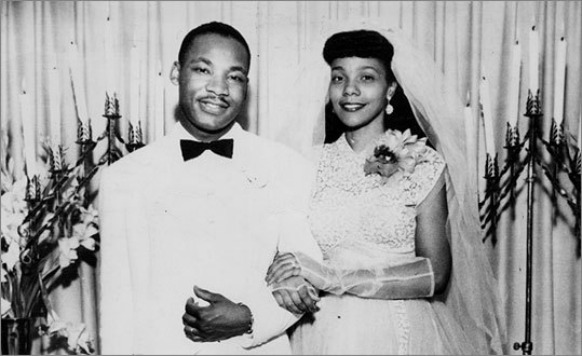
Then in 1954 they moved to Montgomery, Alabama, for King to pastor the Dexter Avenue Baptist Church. And this is what brought King into the Montgomery bus boycott, and his life (similar to his father’s) not merely as a pastor, but as a civil rights activist as well.
A growing call for Black civil rights. The bus boycott dragged on for days, then weeks, then months, gaining national attention in the process. Meanwhile another Montgomery racial segregation case had made its way all the way to the U.S. Supreme Court, which concluded that Montgomery’s laws were in violation of the Fourteenth Amendment.[10] Now the Southern segregation rules had the full attention of Middle America.
Then the following year (1957) focus turned to Arkansas and its Governor Orville Faubus, who decided to court White votes by calling out the Arkansas National Guard to block the entrance into Little Rock’s Central High School of a small number of Blacks (opened to them by the local school board). President Eisenhower then responded by placing Arkansas’s National Guardsmen under his command (plus sending members of the 101st Airborne Division to Little Rock) to open the school.
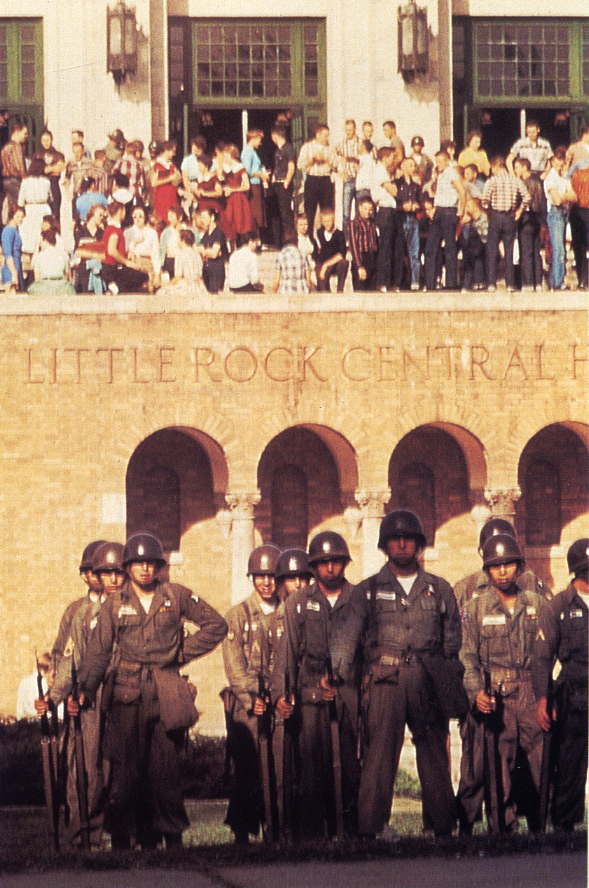
But Faubus fought back, closing all public schools the next year and reopening them as “private” schools, excluding the Blacks of course. But the Federal courts then shut that project down, and Faubus left them closed for the rest of the 1958-1959 school year. But bit by bit, multitudes of Americans were growing very tired of such racist behavior on the part of their public officials.
[6]“Dixiecrat” was a label applied to hard-core Southern Democrats, also known as “yellow dog Democrats”, because they claimed that they would vote for a yellow dog for elective office before they would ever vote for a Republican. The Republican Party was still identified in the mind of Dixiecrat Southerners as the party of the hated Abraham Lincoln! Dixiecrats were reliable Democratic Party voters under all circumstances.
[7]The motto had actually appeared on American coinage since the mid-1800s, although it would not appear on paper money until the 1950s.
[8]The boycott lasted over a year, until the struggling bus company finally put aside the seating restriction.
[9]Many young Blacks had been sent to fight in World War Two and thus the College allowed high school juniors to apply and then enter in what would have been their senior year, in order to maintain a sufficiently large student body.
[10]“No State shall make or enforce any law which shall abridge the privileges or immunities of citizens of the United States; nor shall any State deprive any person of life, liberty, or property, without due process of law; nor deny to any person within its jurisdiction the equal protection of the laws.”
THE COLD WAR TAKES ON A NEW QUALITY
Soviet Russia’s “New Look” under Khrushchev. In 1953 Soviet dictator Stalin suddenly died – apparently just prior to undertaking a new round of Stalinist purges of the Soviet authorities immediately around him. The Soviet Communist Party breathed a sigh of relief and placed a number of more moderate leaders in command of the Soviet Union (and its Empire).
 Eventually (1956) rising to the top was Nikita Khrushchev – who played the career card of a “Thaw” in the icy relations Russia had with the rest of the world. He was trying to give Soviet Russia a kinder New Look – one especially that would be more appealing to the recently emerging “Third World”[11] of Asia, Africa and Latin America.
A major ideological battle thus developed in the effort to win the soul of this rising Third World, comprising these “non-aligned,” recently-independent, countries emerging out from under generations of European imperial domination.
America responds. America was still focused on Eastern Europe – hoping that Khrushchev’s Thaw might mean a standing down of the intense (and expensive) Cold War rivalry that had been going on there since the end of World War Two. Possibly some of the Soviet “satellite” nations might be able to break free from Soviet domination – much as the Third World was breaking free from English, French, Belgian, Portuguese, etc. domination. Thus, America was keeping an eye not only on developments in Eastern Europe but also developments in the rising Third World.
The 1956 Hungarian Crisis. Apparently, university students in Hungary were also hoping that Khrushchev’s New Look indeed meant that Hungary could move out from under Soviet domination, and they began to make demands (street demonstrations) to that effect.
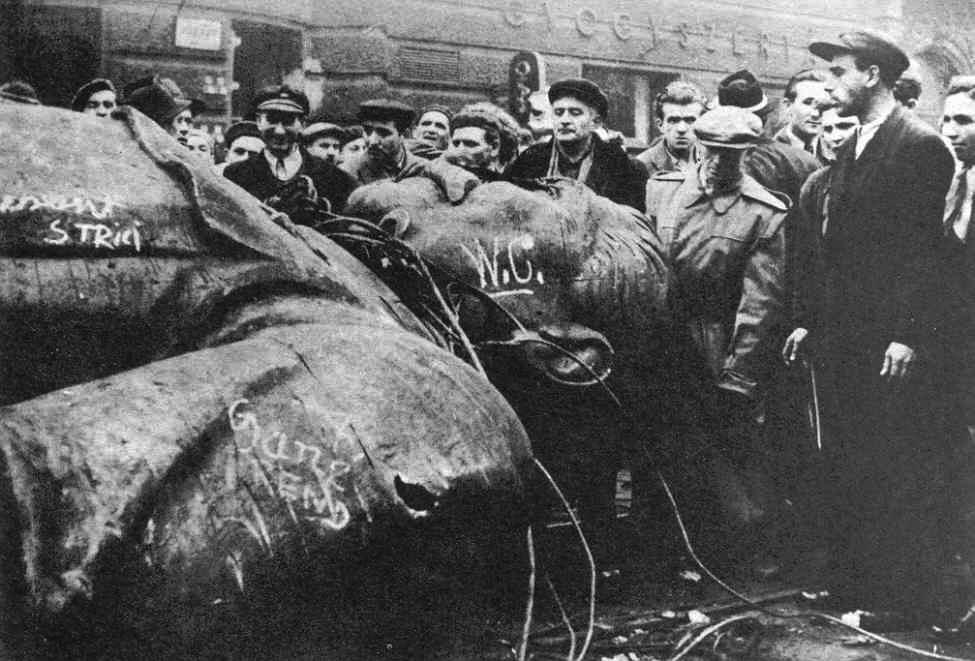
Hungarian students next to a toppled statue of Stalin – November 1956

Hungarian students and dead Hungarian secret police – November 1956
Also U.S. Secretary of State John Foster Dulles had been passing the word via the U.S. government’s propaganda radio station, Radio Free Europe, assuring Eastern Europeans that America stood with them in their quest for national freedom.
Of course that was not at all what Khrushchev had in mind with his New Look. But when things began to quickly get out of hand in the Hungarian capital of Budapest, he hesitated. What should he do? To bully Hungary back into submission would completely undercut his Third World strategy of wooing these “emerging nations” with Communism’s New Look.
Meanwhile China’s rising Communist leader Mao began to taunt Khrushchev about his lack of decisiveness. In part this heckling of his fellow Communist by Mao was because Mao saw those times as very opportune for China – not Russia – to take the lead in directing the Third World towards his own Maoist version of Communism (or “Social Democracy”, as Communism was frequently labeled by the Communists themselves).
The 1956 Suez Crisis. At precisely the same time (October 1956) that the Hungarian crisis was going very badly for Khrushchev, another crisis was brewing over in Egypt. Egyptian President Gamal Abdel Nasser was making himself a candidate for leadership within the rising Third World – or at least within the politically divided Arab world – becoming president not of Egypt but of the “United Arab Republic” (which however included at the time only the union of Egypt and Syria).
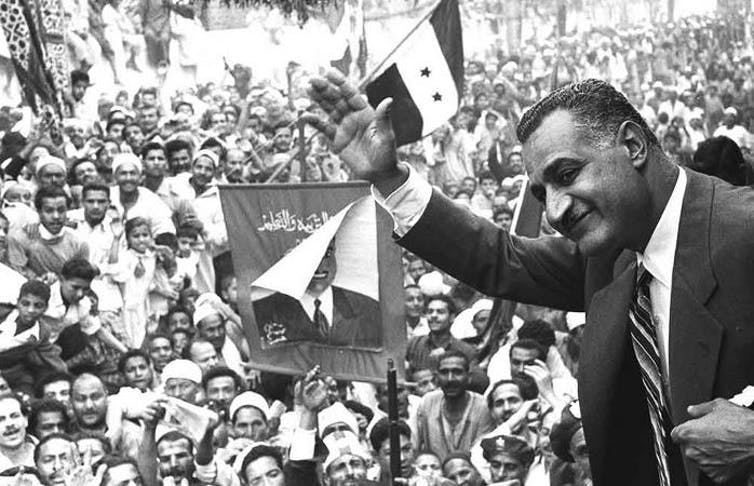
His goal was to make his Arab Republic a rising industrial power (in competition with other rising Arab leaders and their countries), except that the oil-rich region of the Arab world (Iraq, Kuwait, Saudi Arabia) had the monetary resources to do so – resources that Egypt lacked totally. Nasser lamented that Egypt (and Syria) were among the few Arab countries devoid of the valuable asset of oil.
Also once-friendly Egyptian relations with the West were souring – not only with the Middle-East “protectors” Britain and France but also with America. America, trying to stay out of the growing Israeli-Palestinian conflict, had cut off arms sales to all the national players of the Middle East, turning Nasser to Russia in 1955 to buy arms for his growing military force – a major “no-no” to Americans.
Still, America had been willing to finance a major project of Nasser’s – the building of the huge Aswan Dam across the Nile River in order to generate electrical power for an energy-less Egypt. But when in 1956 Nasser recognized Mao’s instead of Chiang’s government as the official Chinese government, Eisenhower was so annoyed that he cut off the funding for the Aswan Dam project. Thus again, Nasser turned to Russia for help (June 1956) – receiving some, but not enough funding to carry out the project in full.
This is what decided Nasser in July to simply grab the English-run Suez Canal as a revenue producer for Egypt. A major international crisis now erupted.
America lines up with the Russians against the English and French. America did what it could to get the British (and French) to come to some kind of deal on the matter (perhaps an international authority governing the canal) – but the effort dragged on for a couple of months with no results. Actually, unknown to Eisenhower, the British and French (and Israelis) were secretly working on plans to simply retake the canal by force – and in late October all three countries invaded Egypt and quickly took the canal.
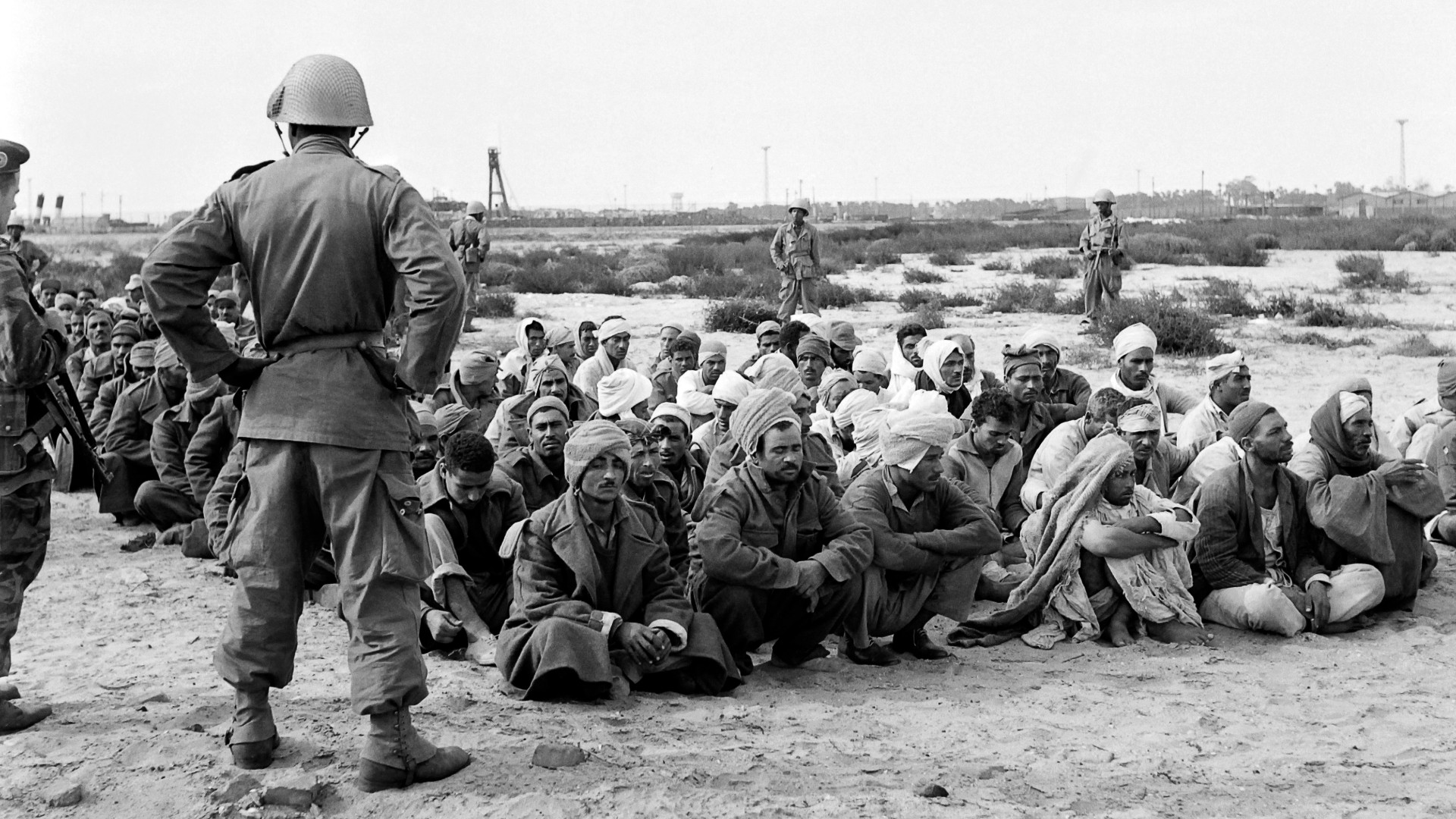
French troops and captured Egyptian soldiers – November 1956

British general Sir Charles Keightley greeting French paratroopers – November 1956
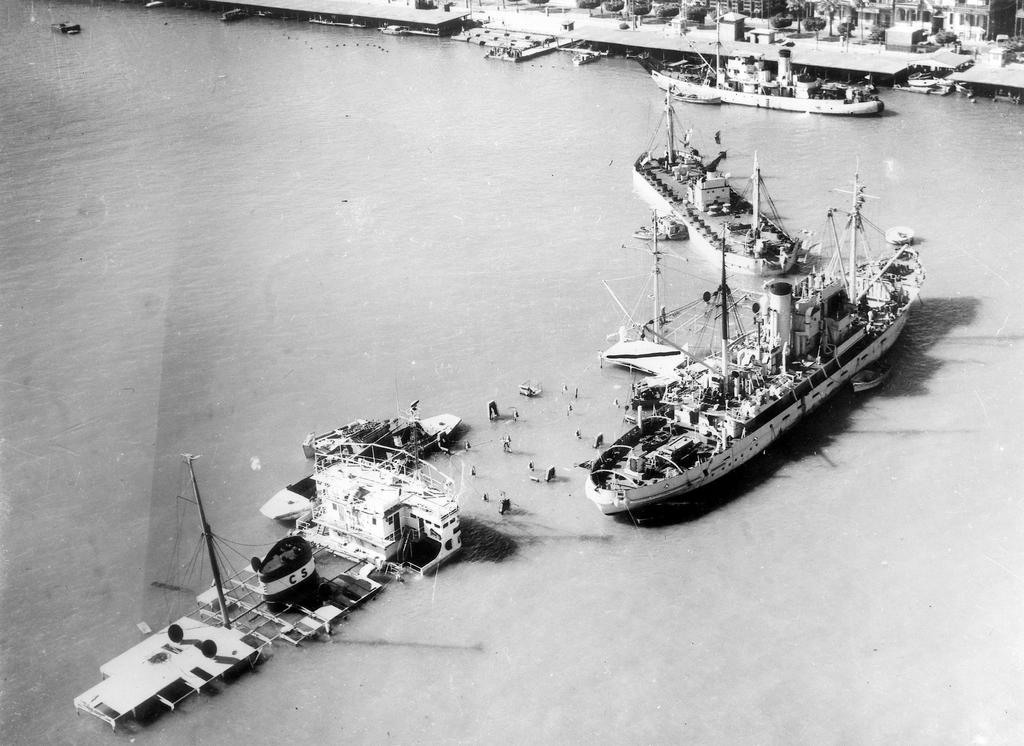
Trying to clear a ship sunk in the Suez Canal during the conflict
But an international outcry resulted over this bullying of Egypt – embarrassing and ultimately angering Eisenhower – who was trying to score propaganda points with the Third World against the Soviets for their bullying behavior with respect to developments in Hungary going on at exactly the same time. America’s allies were behaving no better than the Soviets as far as the Third World – and Eisenhower – were concerned.
Khrushchev crushes the Hungarian Revolt. Worse, because of the political confusion over the Suez Canal grab, Khrushchev finally felt that he had the opportunity to make a bold move to end the Hungarian uprising, in early November sending in 2,500 tanks and 120,000 soldiers to crush the rebellion.

Soviet tanks rolling into Budapest – November 1956
The results for Hungary were disastrous, with the Hungarian Army doing its best to fend off this massive invading force. Around 2,500 Hungarians were killed (700 Soviet troops as well), 22,000 Hungarians imprisoned, 350 executed, and about 200,000 chose to flee the country.
There was nothing America could do to help the Hungarians. But America did help Nasser, coming out strongly against its English and French allies (and Israel) for this act of “imperialism” – actually siding with the Soviets in condemning English and French behavior, and forcing them finally to back out of Egypt and let Nasser keep the Suez Canal.
The political fallout for America (and Europe). Supposedly this was done to put America on the right side of the Third World debate – although time quickly revealed that this position had earned America no political credit from the Third World itself. But it did put America definitely on very shaky ground with its English and French allies – as well as Germany – which began to question publicly the idea of America as a reliable ally, especially as a NATO ally.
America had clearly not come to the aid of its NATO allies, France and Britain, in the defense of vital national interests of theirs. But Americans were unable to understand or even acknowledge the confusion and pain they put the English and French through. The English would basically accept silently their huge loss in national standing. The French, soon under General De Gaulle, would not. In fact De Gaulle would make it a point to work with France’s old enemy, Germany, in an effort to squeeze America out of Europe’s diplomatic affairs. Americans seemed at a loss to understand De Gaulle – whom they grew to dislike intensely.
Sputnik. In October of 1957 the Soviet Russians launched into orbit the first satellite (Sputnik I) – indicating that the Russians possessed the means to deliver virtually unstoppable nuclear weapons – a fact that Americans noted with horror. A month later, the Russians launched into orbit a 7.8-ton Sputnik II – with a dog aboard. This served to intensify the American horror – and shame at having fallen behind in the technological race with the Russians. Finally, at the end of January 1958, America responded with the launching of its own satellite, Explorer I. It helped some to rebuild American confidence – but it certainly did not relieve the fear that with such rocketry available in the Cold War, nuclear war looked more like a possibility than ever.

Models in East Germany of the Sputnik (launched 1957) and the more elaborate Sputnik III (launched 1958)
Rising concern about a post-Imperial Third World. In the latter part of the 1950s, the Cold War contest moved a bit toward the continent of Africa – as the European grip on Europe’s African empires began to weaken – and local leaders began to demand national independence from the various French, British, Portuguese and Belgian colonies.
The Algerian Crisis. This move proved tremendously violent in Algeria – which the French considered not a colony but an integral part of France – so violent in fact that in 1958 it brought to power in France, through basically a military coup against the failing Fourth Republic, former French General De Gaulle. The French were hoping that De Gaulle would bring the Algerian crisis to an end … most of the French expecting him to come down hard on the Algerian rebels.
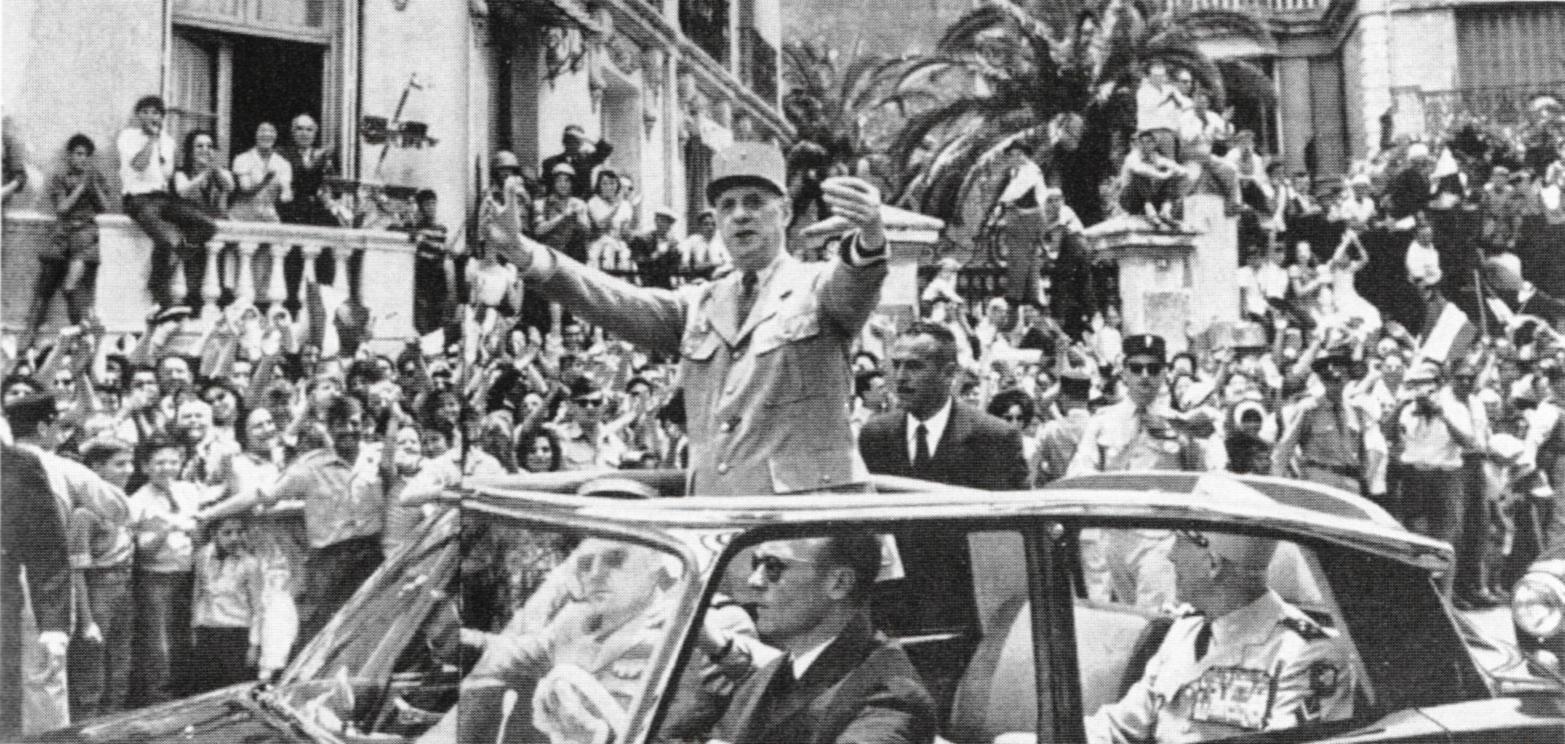
De Gaulle being greeted in Algiers by enthusiastic French Algerians
Much to everyone’s surprise – and to the outrage of three million Frenchmen living in Algeria – he took action in early 1962 by simply agreeing to complete independence for Algeria. To De Gaulle, France had bigger things to do than waste itself on a war with the Arabs of Algeria, a war whose social costs would clearly outweigh greatly any particular social benefits.
Mostly everywhere else in Africa the transition to independence began to occur fairly smoothly as Western-educated African elite began to take the reins of power of their new “nations.”
The Congo Crisis. But the situation in the Belgian Congo did not go so smoothly – as the Belgians had been hesitant to prepare a group of Westernized locals to take over the Congo. Thus the Congo fell into confusion as regions and tribes put forward their own leaders, hoping to either take over the Congo, or break sections from it (such as the mineral-rich Katanga Province) in order to produce their own independent country. Ultimately this stirred both Soviet Russian and American interest in seeing things move in the direction of their own particular choosing. But the chaos made even that fairly impossible.
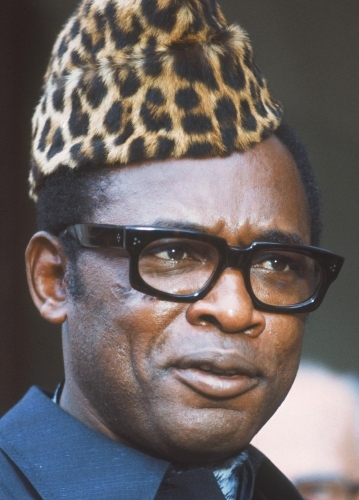 Eventually the Congo, with much help from America, came under the dictatorship of General Mobutu – and things settled down.
This would soon be a pattern repeated in other African countries – as “democracy” failed and dictators came to power to bring these African states under some semblance of unity, ancient tribal hatreds within these new states making the task extremely difficult. In general, America decided that further involvement in Africa was not worth the trouble – and let Africa go its own way (with the exception of South Africa, which continued to interest pro-democracy Americans greatly, in the same way that Dutch Indonesia had once interested them).
Cuba: the problem hits closer to home. Although America never admitted it, America’s relations with its neighbors to the South in Latin America had much the same quality as Europe’s imperial positions in Asia and Africa. America went from a paternalistic instinct to protect its neighbors from the meddling of European powers (the Monroe Doctrine) to a paternalistic interest in seeing its neighbors join America in exemplifying New World Democracy – such as America believed that it itself exemplified.
However such democratic idealism was deeply compromised by the tendency of American businessmen (who generally took the lead in America’s relations with its neighbors to the South) to prefer to work with strongmen (dictators, basically) who offered greater possibilities of social stability and economic protection with respect to America’s extensive industrial and financial investment in their countries. This certainly was the case in Cuba – where America supported the very corrupt Batista dictatorship – but somewhat ambiguously, due to his embarrassing behavior.
Anti-Batista rebellion broke out in the mid-1950s, and Americans (some of them, anyway) took an interest in the colorful rebel lawyer Fidel Castro, who was leading one of the several anti-Batista groups in Cuba. Finally in 1958, the US government placed an arms embargo on Cuba – weakening Batista’s power considerably. Then at the beginning of 1959 Batista fled Cuba – and rebel groups, including Castro’s, took over the country.

Castro addressing the crowd
Castro himself soon took control of Cuba – and proceeded to put into action a huge range of socialist policies, confiscating the lands and businesses of the Cuban wealthy in order to pass these assets on to the poorer classes of Cuba. This in turn caused thousands of middle and upper-middle class Cubans to flee to the mountains – then from Cuba itself, many ending up in Florida.
Then when Eisenhower refused to lift the weapons ban to Cuba, Castro (like Nasser before him) went to the Soviets instead for arms, thus putting Cuba at the center of the Cold War.
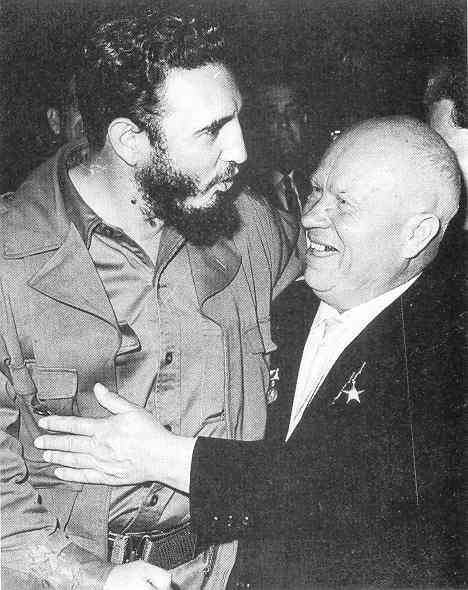
Castro and Khrushchev – 1960
Consequently, Eisenhower ordered an end to the purchase of Cuban sugar and sale of American oil to Cuba. Here too, the Soviets were quite happy to make up the difference – drawing Cuba deeply into the Soviet economic order. Then when American oil refiners in Cuba refused to service Soviet oil, Castro simply grabbed the oil companies – and other key American industries located in Cuba.[12]
At this point Eisenhower authorized the creation of a liberation army made up of anti-Castro Cuban expatriates. And the CIA, at camps in Honduras and Guatemala, began preparing these troops for an invasion of Cuba. But Eisenhower finished his term in office (January 1961) just a few months prior to the proposed launch date of this invasion.
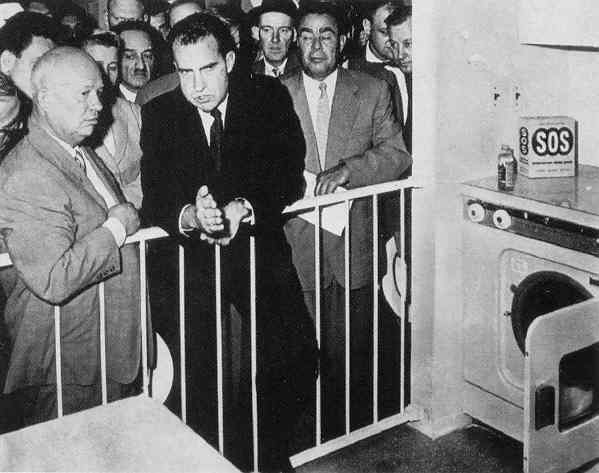
The U-2 incident. Eisenhower was hoping to finish out his presidency with politics in an upbeat mood – with improved Soviet-American relations pointing to a more peaceful future. The Americans had been permitted to put on an American National Exhibition in Moscow in July of 1959 – and Vice President Nixon met Khrushchev there to discuss (the famous Kitchen Debate) the differences between American and Soviet society – all conducted in fair humor.
A couple of months later (September) Khrushchev returned the favor with a two-week visit to the United States – to underline the policy of “peaceful coexistence” that was supposed to mark the new international mood.
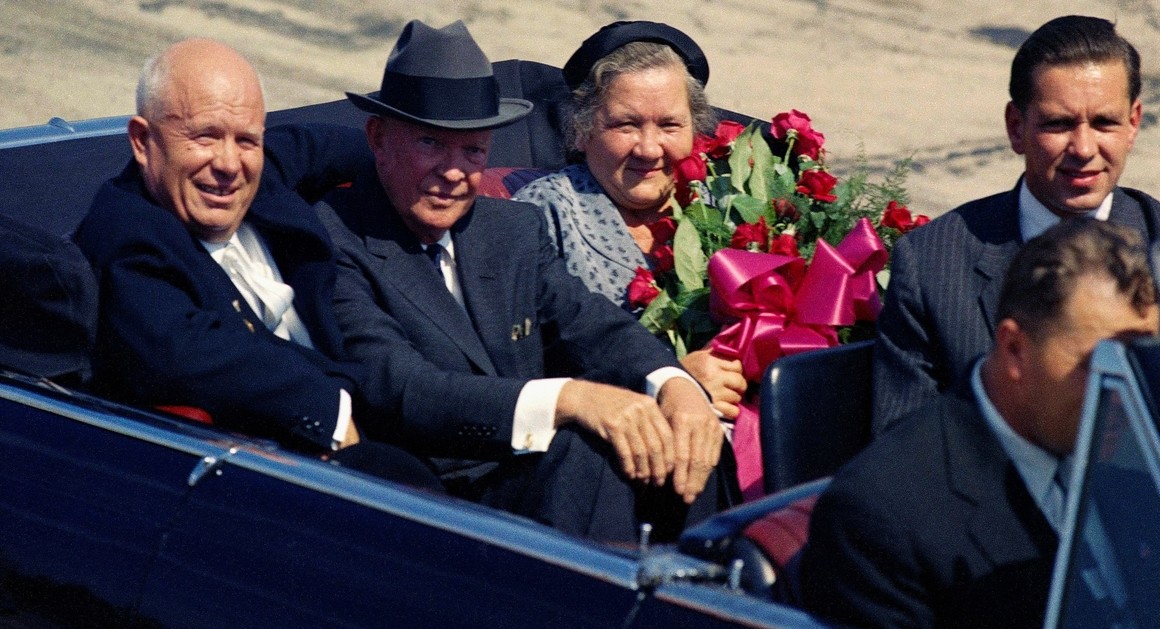

Khrushchev and his wife enjoying their visit with Hollywood star Shirley MacLaine during the filming of Can Can
And a much larger international conference was even scheduled for mid-May in Paris of the next year (1960) to bring America, Russia, England and France together – as a big step in the advancement of world peace.
But two weeks before the event, Khrushchev announced that an American U-2 reconnaissance plane had just been shot down in a flight over the Soviet Union. This very high-level flight was not a new thing, as U-2 spy planes had been regularly overflying the Soviet Union in an attempt to locate and analyze Soviet nuclear siting and development.

Thus why Soviet leader Khrushchev chose to shoot down one of these planes just two weeks prior to the scheduled Paris summit remains a much speculated on mystery. Was Khrushchev feeling himself under too much pressure from Eisenhower to make deep concessions, or from party regulars not to make any concessions in the arms race that the Soviets apparently were winning?
In any case, at the news of the downing, Eisenhower, who understood the damage this would do to his summit hopes – but who also believed that the pilot and his plane shot down at that height would not have survived the attack – claimed that the plane was a weather plane that had inadvertently strayed off course, not a spy plane.
However much to America’s shock, the plane did not disintegrate – and the pilot, who parachuted from the plane, was captured alive, and paraded before the world as an example of American perfidy. Not only did the event provide Khrushchev the opportunity to withdraw from the Paris 4-powers summit meeting with Eisenhower, French President De Gaulle and British Prime Minister Macmillan, but Eisenhower’s attempt at a coverup gave the Soviets the opportunity to strike a huge propaganda blow against the United States – and the “liar” Eisenhower personally.
[11]A “third” part of the world supposedly aligned in the ongoing Cold War with neither the Soviet East nor the American West.
[12]Americans have a very hard time understanding that when we try to shut down a society’s political system by cutting off our relations with that country economically as well as politically, we simply give our enemies an opportunity to rush in there and offer themselves as this country’s new ally. We have done this repeatedly – recently in Syria, Iran and Venezuela – giving the Chinese and Russians (as well as the Iranians themselves) an opportunity to extend their power bases into these same countries.
THE BRIEF KENNEDY ERA (1961-1963)
Kennedy’s New Frontier. The year 1960 produced America’s first televised debate – between Vice President Richard Nixon running as the Republican presidential candidate and John F. Kennedy as the Democratic candidate. At the debate, Nixon looked tired and washed out (he had just come in from a meeting elsewhere and had not taken the time to put on makeup necessary to give a normal appearance in front of the very bright TV lights) – which set him back considerably in popular estimation. The smaller radio audience thought that Nixon had sounded more impressive than Kennedy – indicative of the way physical appearance before the cameras was going to play a much larger role in American politics from this point on. In the end the election was fairly close – and went to Kennedy.

John F. Kennedy. Kennedy was second of nine children born to the very prosperous and politically active Irish-Catholic family of Kennedys of Boston.
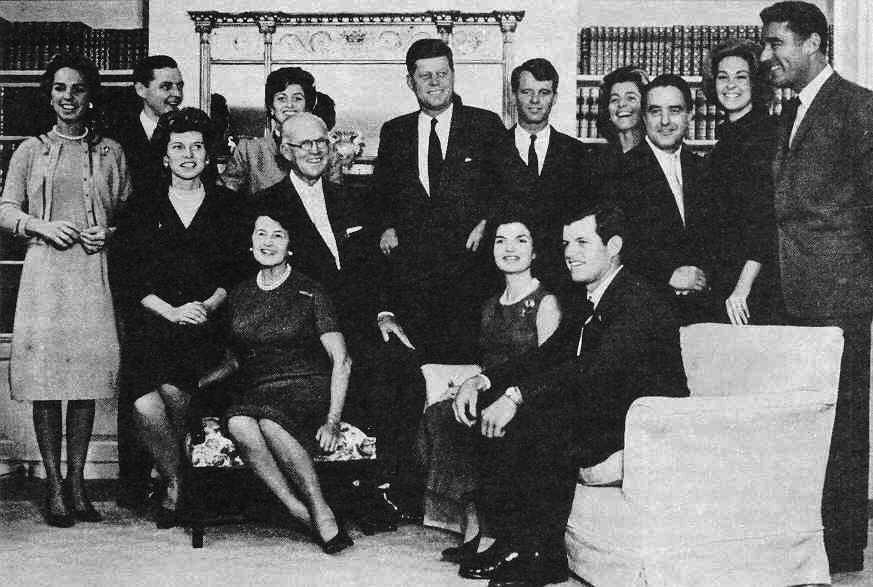
Some of the Kennedy Clan – just after JFK’s election to President – November 1960 (Seated from left: JFK’s parents, Mrs. (Rose) and Mr. Joseph Kennedy; his wife Jacqueline; his brother Edward; standing from left: Mrs. Robert (Ethel) Kennedy; brother-in-law Stephen Smith; Mrs. Smith; JFK; Robert Kennedy; sister Mrs. Peter Lawford; brother-in-law R. Sargent Shriver; Mrs. Edward (Joan) Kennedy; brother-in-law Peter Lawford
His grandfathers on both sides of the family had been very active in Massachusetts politics. And his father, Joseph, Sr. was quite wealthy as a businessman in real estate, the stock market (wisely getting out just before the crash), Hollywood movie production, and – with the end of Prohibition – the whiskey business. But his father was also very active in Roosevelt’s Administration, heading up Roosevelt’s new Security and Exchange Commission and then being sent to London as America’s ambassador to Great Britain.
In addition to the learning acquired in being a member of this dynamic family, Kennedy attended the prestigious Choate boarding school and then headed off to Harvard, traveling widely at the same time (West Europe, Soviet Russia and the Middle East). And in 1940 he proved himself very well in writing (and publishing) his Harvard senior thesis, Why England Slept … full of insight into English diplomacy in dealing (or not) with Hitler.
Unfortunately, he suffered from serious back problems and was able to enter the Naval Reserve only with some intervention by his father, but advanced in the world of naval intelligence in D.C. nonetheless. Then when America finally found itself at war, he entered the action as a patrol torpedo (PT) boat commander. In one particular action, his boat was sunk by a Japanese destroyer, but he was able to swim the three miles to shore – towing a shipmate with him in the process. But this left his back so crippled that after another period of active service he had to have extensive hospital treatment, and ultimately was dismissed from active service. It was also at this time that he learned that his older brother, Joseph, Jr. had been killed in active duty in Europe.
Kennedy’s considerable talent as a political analyst and writer opened the door for him to cover the Potsdam Conference in 1945. But he was also getting enormous pressure from his father to take over the expected role of a Kennedy to go big in the world of national politics. Thus it was, with considerable family support, he was elected to Congress in 1946, to begin that much-expected political career. And by 1952, it was time to take on the challenge of being a U.S. Senator, which he achieved in defeating Massachusetts veteran politician Henry Cabot Lodge, Jr., rather substantially due to the strong support he received from Massachusetts’s large Catholic community.
It was during his Senatorial campaign that he met the very attractive and highly sophisticated Jacqueline Bouvier, who held off his marriage proposal – in order as a journalist to cover Elizabeth’s coronation as British Queen. But they married soon thereafter, a major up-East social event!
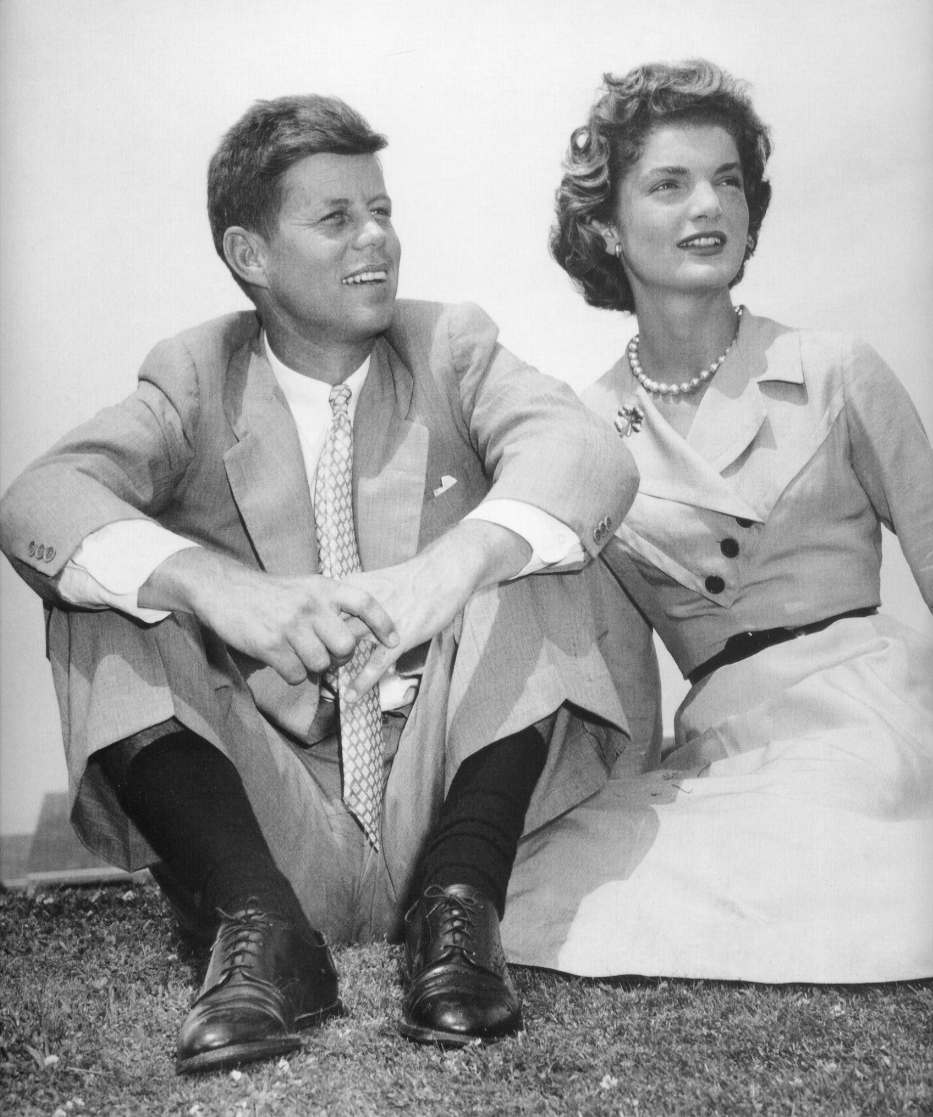
But family troubles almost ended the upward move: back surgery that almost cost Kennedy his life, and a miscarriage (1955) and stillbirth (1956) that Jacqueline suffered, before she was finally able to give birth (1957) to a healthy child, Caroline. But Kennedy was reelected Senator in 1958, taking him closer to the goal of the U.S. presidency.
Finally, in 1960, he was ready to have a go at the presidency. His only serious opponent was the Senate Majority Leader, Lyndon Johnson. Kennedy went into the nominating convention with the largest number of committed delegates, but knew that he would have to win the nomination itself on the first ballot, or Johnson would most likely maneuver the convention over into his own camp. But it turned out that Kennedy did succeed on that first ballot.
Then (to the great irritation of his brother Bobby, John’s campaign manager), Kennedy asked Johnson to become his running mate. It would be a very close race against Republican Vice President Nixon and Kennedy would need the swing vote of the South where Johnson was from, and where Johnson commanded a lot of support. And, in the end, it would become a very fateful decision for the country.
Undoubtedly the biggest issue Kennedy had to face in running against Vice President Nixon was his Catholicism … alarming somewhat quite Protestant America. But he was quick to point out that he was not campaigning on behalf of the Church, and that his Catholicism had not been an issue to anyone back when he served his country in the South Pacific! Actually his religious faith outside of normal Catholic expectations was itself unknown, and would remain unknown. His close associates, including for instance his personal advisor Ted Sorenson, remained unaware of Kennedy’s exact position on such matters as heaven and hell and life after death. Certainly Kennedy lived a life of prayer, personal pain as well as political pain being a big part of his life. But that seemed to have no impact on his extensive womanizing (which at the time was considered by the Washington press and Congressional membership to be nobody’s business other than the president himself).
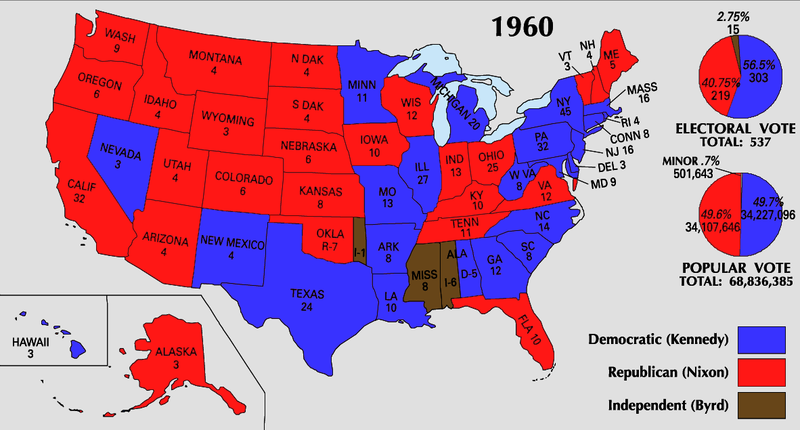
The Kennedy presidential victory. In any case, the November (1960) presidential vote was close[13] – very close indeed, with Kennedy gaining 49.7 percent of the vote and Nixon 49.5 percent. The crucial electoral college majority, however, would register as a bigger difference, with Kennedy’s 303 votes to Nixon’s 219. Kennedy was thus elected as the country’s thirty-fifth president.
In Kennedy’s inaugural address to the nation in January of 1961, he challenged America to step up to the call that had long been on America – to be something of a light to the nations, especially in this Cold War Era. He challenged Americans to “ask not what your country can do for you – ask what you can do for your country.”

In this matter, however, he had something in mind more along the lines of a cultural challenge rather than a military challenge – and one directed toward the Third World of Asia, Africa and Latin America – the region of the world to which the Cold War had shifted its playing field. He wanted to show a loftier approach that America took toward the world, implying the idea that Soviet Russia proceeded only through bullying others into submission.
The Bay of Pigs catastrophe (April 1961). But almost immediately in taking office Kennedy had his loftier approach challenged – from within the American foreign policy establishment itself – in the form of the well-advanced plans to launch the CIA-trained army of Cuban liberationists onto the beaches of Cuba at the Bay of Pigs in order to overthrow the troublesome Castro. Kennedy was now facing a major dilemma. The invasion would succeed only if it received heavy American military support. But such support would make America appear to be the neighborhood bully that Kennedy assured the world America would no longer be.
As a result, Kennedy pulled back considerably the promised military support for the 1400-man Cuban invasion – which ultimately failed – failed miserably.

Some of the captured Cuban “liberationists”
And despite Kennedy’s pull-back, the hand of America was still very clearly evident in this grand catastrophe. And thus the event played beautifully into Soviet Russia’s anti-American propaganda campaign.
Kennedy was highly embarrassed – and America looked as if it were under the leadership of a very weak president. Certainly that is how things looked to Soviet Premier Khrushchev.
The Berlin Wall (August 1961). The NATO-supported Western half of the city of Berlin, located entirely within Soviet-dominated East Germany, was a huge Communist sinkhole into which all sorts of Germans wishing to escape Communist East Germany could make their way to the West simply by reaching West Berlin and flying from there to West Germany. The West Berlin opportunity was draining Communist East Germany of vast portions of its more ambitious and better-educated talent, causing something of a cultural crisis in East Germany. And it was also a huge embarrassment in this Cold War cultural contest to see so many citizens of the Communist World desperate to escape to the West.
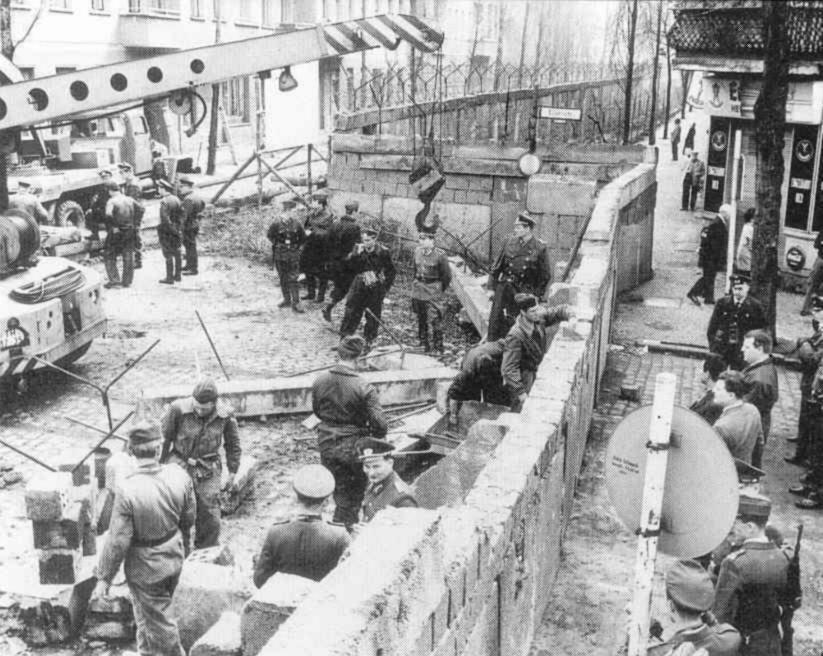
Consequently, in August of 1961, the Communist East German authorities suddenly threw around West Berlin at first a wall of barbed wire, then concrete block, then a perimeter mined with explosives and supervised by machine-guns – shutting down this escape route to the West.
The world watched to see what the leader of the Free World would do in response. Would Kennedy’s American tanks and bulldozers smash down the wall in defiance of this outrage?

In the end Kennedy did nothing – except eventually (June 1963) fly to Berlin and stand in front of the wall to announce to Germany that he was one of them, he was a “Berliner.”[14]
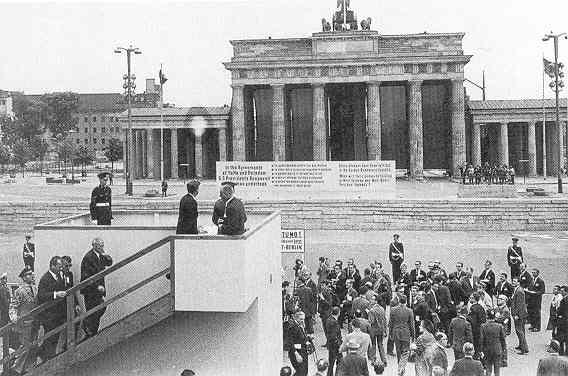

Kennedy: “Ich bin ein Berliner” – June 1963
The Germans were politely appreciative – although their appreciation would have been greater if he had actually made a move to knock the wall down. In any case, East Germany (and for that matter all of Eastern Europe) was now fully imprisoned behind the Soviet Russian Iron Curtain.
The Peace Corps. Not forgetting his promise to advance the American cause in the Cold War through new cultural rather than military means, Kennedy set up a volunteer program that would operate as an alternative to military service widely required of America’s young men – except this program would also include America’s young women as well. These young Americans (drawn from the “Silent Generation” of youth slightly older than the Boomers – culturally closer to the Vets than the Boomers with their strongly patriotic mindset) would sign up as a Peace Corps Volunteer for a two-year term of overseas service in one or another Third World country. They would receive a quick training in the local language and then be sent off to a village to undertake English teaching – or even something as creative as poultry farming (briefly trained in that as well before being sent off!) – to demonstrate the blessings of the American approach to life.[15]
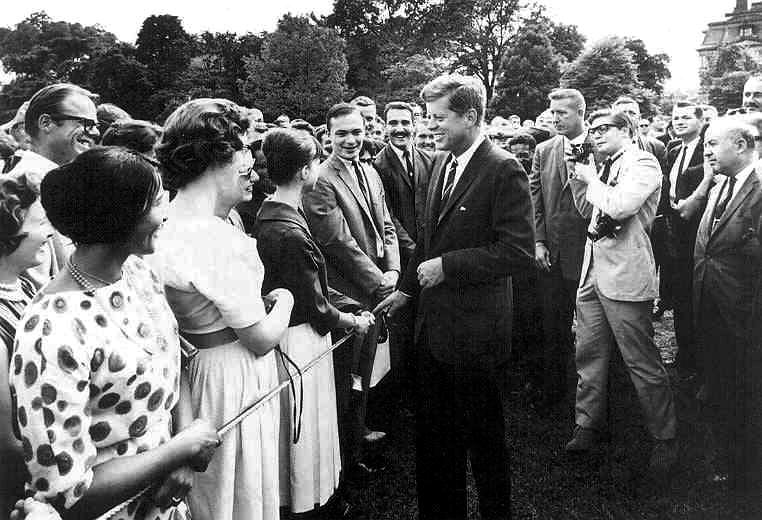
Kennedy greeting Peace Corps volunteers – 1962
Thus hundreds of thousands of young American college graduates signed up for this opportunity to show the world the better “American way.” And indeed, it was obviously a well-received program abroad – although exactly how deeply it pulled the Third World toward the American way was easily questioned. In fact, these idealistic American youth probably learned as much about the blessings of village life of a Third World country as they were able to show the locals the blessings of the American way!
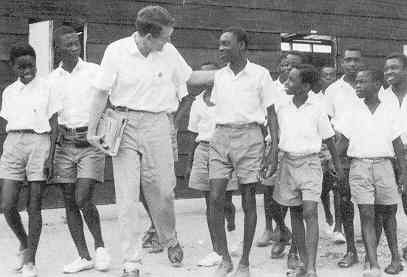
A Peace Corps volunteer in Accra, Ghana, with his students
Ironically, many Peace Corps volunteers returned to America hungry to continue to live the communal way they discovered abroad. And thus a trend toward the founding of hippie communes got underway in America.
The Cuban Missile Crisis (October 1962). Castro continued to believe (correctly) that it remained a goal of America to remove him from power in Cuba – drawing him even closer to Khrushchev as an anti-American ally. Seeing Kennedy back down from a direct confrontation with Russia in the building of the Berlin Wall, Khrushchev came to the conclusion that a much more forward strategy would result in the same lack of strong response from the weak Kennedy. Thus it was that he was so bold as to propose to Castro to base nuclear-tipped missiles in Cuba – easily able to reach any of the American cities of America’s East and Midwest. Siting such first-strike missiles in Cuba would not only protect Cuba – it would slow even further any American responses to further Soviet moves around the globe – as the risk of a nuclear retaliation would cause the Americans to have to back down in such events. Castro agreed to the idea in the mid-summer of 1962, and work on the Cuban missile sites began soon after.
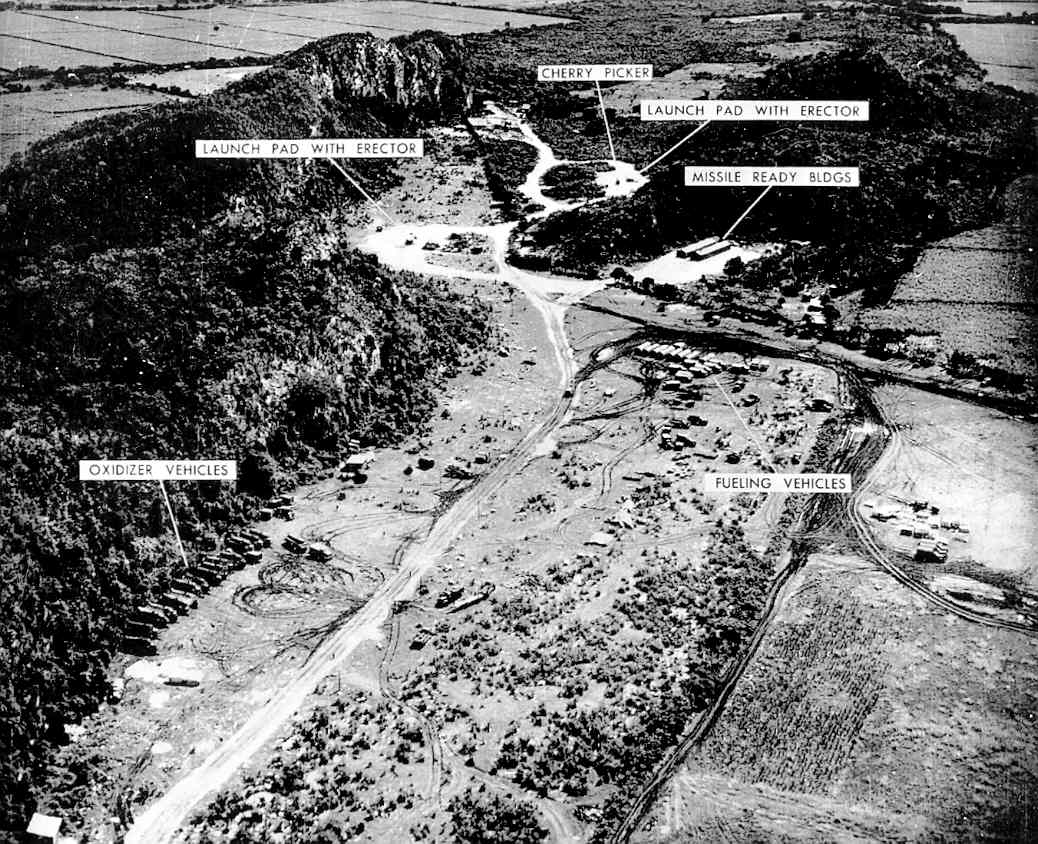
American U-2 spy planes picked up the activity – and when questioned, the Soviets answered that these sites were designed only for local defense. But the character of the nine bases (of the 40-total planned) distinctly had the same structure as the major missile launch sites located within Russia itself – and American concern began to develop. A cloud cover prevented further observation – until mid-October when spy planes detected the delivery to the launch sites of a number of R-12 medium-range missiles – able to carry nuclear warheads 1200 miles into America. They were not yet operational. American action was required immediately.
The White House staff thus gathered to consider a number of strategies to answer this serious threat coming from Russia and Cuba. Finally, after several days of consideration, Kennedy was ready to move. First he got the Latin American members of the Organization of American States to approve a quarantine of Cuba – not only isolating Cuba but also drastically undercutting Khrushchev’s Cold War initiatives in the Western Hemisphere. Then he made a televised announcement as to the nature of the crisis –

and sent his ambassador to the United Nations to show the pictures of the Soviet activity in Cuba – making Russia’s earlier denials of such activity appear to be the huge lie that it indeed was.
But Kennedy gave Khrushchev a way out of the corner he found himself in by offering an exchange: America would remove its missiles in Turkey[16] if Russia would do the same in Cuba. While Kennedy was awaiting Khrushchev’s response, an American naval blockade was placed around Cuba – and the world watched tensely as Russian ships carrying more missiles headed toward that blockade.

An American warship inspecting the cargo of a Soviet ship near Cuba
Finally it was Khrushchev who blinked first and turned his ships around to head them back to Russia. He then accepted Kennedy’s compromise offer of an exchange in missile dismantling – much to Castro’s fury.

An American warship escorting a Soviet tanker carrying missiles out of Cuba
And thus it was that the world breathed again. Had the world just come to the brink of a nuclear disaster? Possibly.[17]
King’s appeal to the conscience of the nation. Considering the fact that America was attempting to put itself forward to a rising Third World of Africa, Asia and Latin America as the social model they should be following as the societies of these regions were one by one coming to independence, America’s well-known problems in the area of race relations did not present a very nice picture to the outside world. Khrushchev knew this – and the Soviet Russian propaganda machine was quick to pick up on every front-page American news report concerning one after another racial incident in America.
As America headed into the 1960s it was clear that Blacks were becoming much more aware of their rights, and demanding that segregation be brought to an end. And American Northerners, Whites as well as Blacks, were joining the chorus demanding an end to this dark mark on America’s national character. Thus sit-ins and protest marches (often joined by Northern Whites) began to break out across the American South.
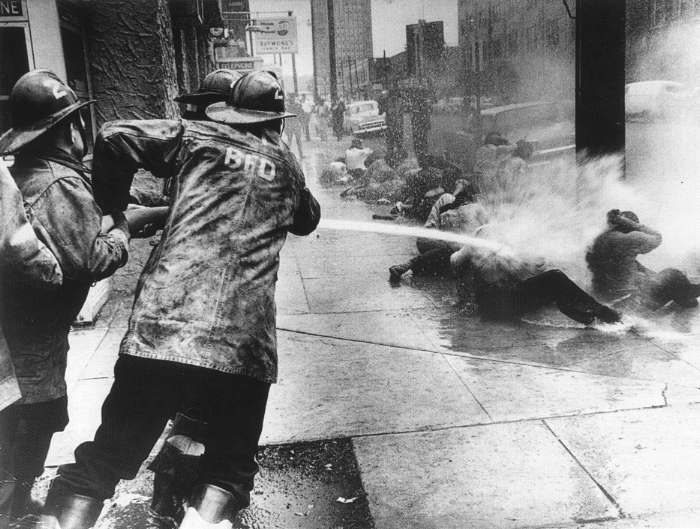
Alabama firemen using hoses to break up a Black sit-in demonstration against politically-enforced racial barriers – 1963
When the ever-active Rev. Dr. King was arrested in Birmingham (Alabama) for conducting a peaceful protest, Northerners were outraged.
Thus King took the issue all the way to the nation’s capital on August 28, 1963, where he stood on the steps of the Lincoln memorial in front of hundreds of thousands who had gathered before him (not to mention the millions watching on TV) to appeal to the Americans’ better instincts. It was time to change things, to bring the country together across racial lines.
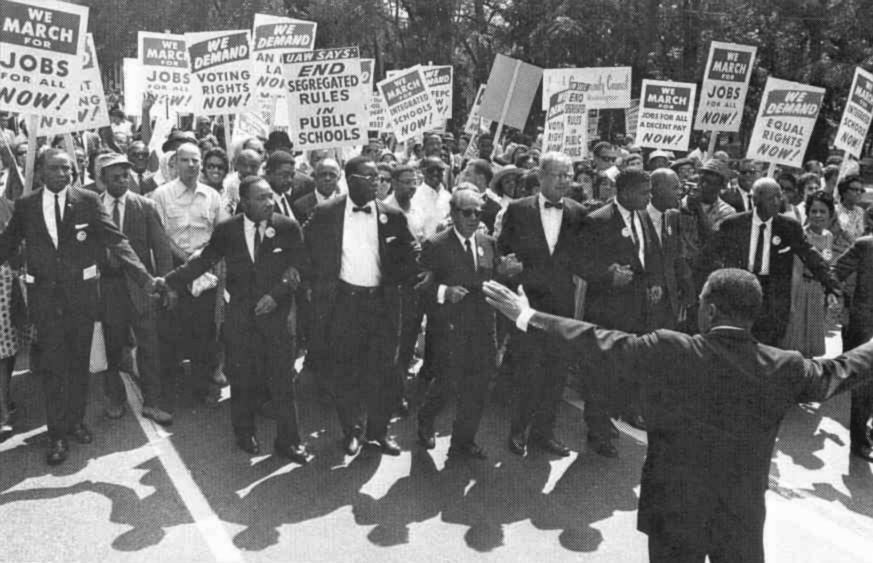
Dr. King leading a “March on Washington” in the quest for jobs and racial freedom – August 1963
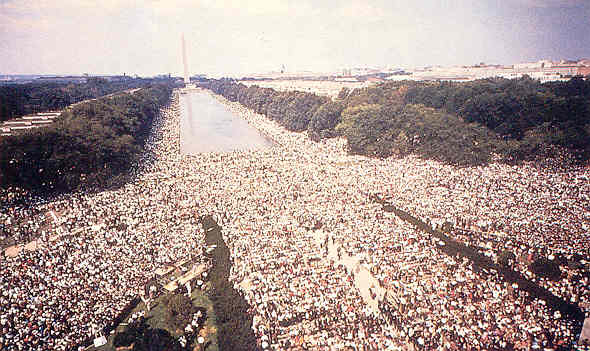
The reception he got in anticipation of his public address
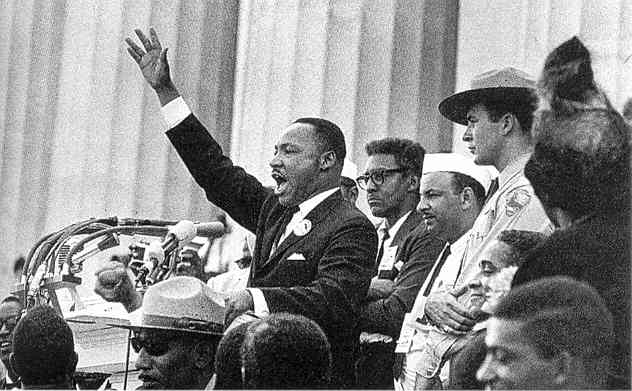
His “I have a Dream” speech outlining his dreams of the day when racism disappeared from America
Like Kennedy, King was not asking for the Washington government to make these changes. He was asking the Americans themselves to do so, after all, this was the American Way. Certainly he wanted developments in the realm of law to occur … particularly those allowing Blacks to enjoy every American’s right to vote. But ultimately, he was looking to shape American social dynamics through a change in American hearts, not through the takeover of those dynamics by masses of government officials.
And indeed, his strong appeal to American consciences had its huge impact, shifting the country, including the South, towards the understanding that it was time to bring Blacks into Middle America as equals.
Mounting problems in Vietnam. From the American point of view, things were not going well in the region of the old French Indo-China (Cambodia, Laos and Vietnam). The French finally had given up their colony by way of an agreement worked out in 1954 at Geneva between major parties (including the Soviets and Chinese as well as the French and British).

But with the French gone the question immediately developed as to how these newly independent countries would rule themselves. Cambodia came to independence under its old monarchy, Laos was taken over by a 3-way coalition of Leftists, Rightist and Centrists – and Vietnam was divided (supposedly temporarily, like Korea) in half, north and south, pending national elections designed to unite the country under a single regime.
But in Vietnam, only the nationalist but also quite Communist leader Ho Chi Minh seemed to have enough of a following to unite the country. But America was in no hurry to see yet another Asian country come under Communist leadership – and so did what it could to stall the scheduled national elections – and instead turned to support the rule (at least in the South) of the pro-Western Ngo Dinh Diem. Soon America began to take the attitude that the division of North and South was a permanent one. So in Vietnam, America was taking up the role that it accused Russia of playing in Korea: blocking national elections destined not to go its way politically!


Ho Chi Minh Ngo Dinh Diem
But Diem’s style was drawing very negative responses from some of the South Vietnamese. Was it because he was so authoritarian in style – or just because he was so pro-Western? Some of the strongest of his opposition was indeed coming from Buddhist monks – who obviously had no interest in promoting Communism – but who were very much opposed to his introduction of Western cultural norms into their formerly Buddhist Vietnam. America and the world, in fact, were shocked when in June of 1963 a Buddhist monk publicly doused himself in gasoline and lit himself on fire in protest against the Diem regime.

This then led to the decision that Diem had to go. A plot developed by the Americans, involving the Vietnamese military’s removal of Diem, took place in early November of that year. But Diem – and his powerful brother – were not merely ousted from power, they were both assassinated.
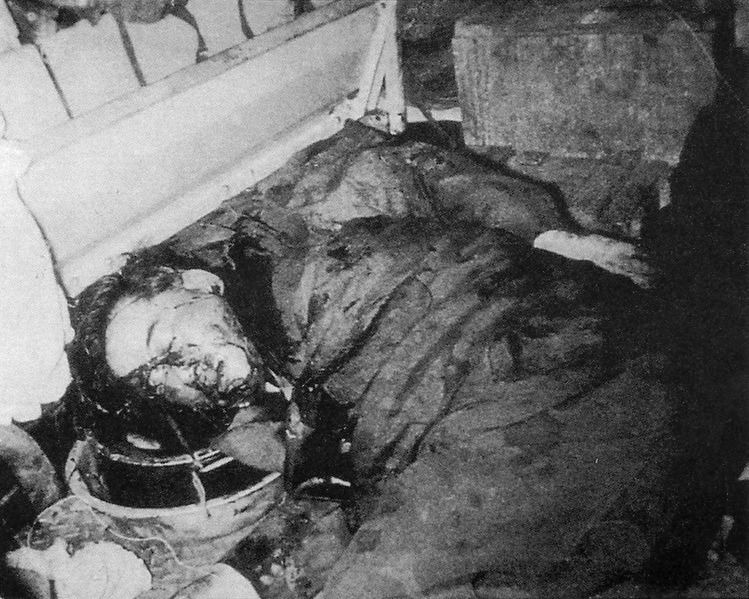
And tragically, no strongly respected national authority was in a position to then step forward and take command of the situation (Americans seemingly unable to understand the problems that inevitably explode when you take down a country’s leader!). At this point Vietnam began its slide into anarchy.
Kennedy is assassinated (November 1963). What Kennedy planned to do at that point about the deteriorating situation in Vietnam will never be known – because three weeks later he too was assassinated.
The assassination occurred in Dallas, Texas, on November 22nd during a visit of Kennedy and his wife with the Texas governor, John Connally – in order to repair strained political relations between the two. Riding in an open convertible, both men were shot, Kennedy fatally.

The trail led immediately to Lee Harvey Oswald who was arrested – and then he too was assassinated by Jack Ruby a few days later when Oswald was being transferred from the Dallas police to the county sheriff.

America was horrified. How had this happened? Was it all just a private act of a deranged Oswald? He had Communist connections. Were they involved? But Ruby had mob connections. Was the mob involved? Was this all just a huge plot? If so, by whom?
In any case, Americans were not used to having their Presidents shot riding innocently through the streets of America. Such innocence would itself be a victim of the assassination. America was about to enter into a whole new world – right there at home in America.
Kennedy’s assassination was the announcement that things were about to change in America – dramatically. And there would be no going back. A certain period or age in America had just come to a close.
[13]There were serious questions about how Chicago Mayor Daley brought in the Illinois vote for Kennedy. But Illinois going to Nixon instead of Kennedy would not have changed the ultimate outcome.
[14]Ich bin ein Berliner – not realizing that his choice of words was such that he was telling the Germans that he was a popular sweet bun (a “Berliner”)! What he meant to say was “Ich bin Berliner.”
[15]For their service they would receive the equivalent of a soldier’s very low military pay, indicative of the fact that Peace Corps service was an act of patriotic duty rather than a professional government job!
[16]Actually, Kennedy had much earlier brought under consideration the removal of those missiles based in Turkey, fearing that they were more a trip-wire to nuclear war than they were an effective deterrent to just such a war.
[17]During the intense days of the crisis, an American ship had dropped depth charges in Cuban waters, nearly taking out a Soviet submarine possessing nuclear missiles of its own, a submarine also possessing orders to use them if attacked, but provided that all three levels of command aboard the submarine agreed. Thankfully one of the three refused to agree to the counter strike, and thus the world was spared the horror of a full nuclear exchange, one that once started might have spun itself into a global nuclear holocaust!