CONTENTS
 Nixon … and Vietnam
 Nixon’s chaotic second presidential term
 The brief Ford presidency (1974-1977)
 The Carter one-term presidency
 The fracturing of America’s traditional social-moral order
The textual material on this webpage is drawn directly from my work, America’s Story – A Spiritual Journey © 2021, pages 337-366
Vietnam. During those first years of Nixon’s first term as president America would find itself heavily focused on one huge political issue: Vietnam. Johnson’s efforts to make Vietnam the showcase of his resolve to block any and all advances by Communism not only had blown up in his face, it had turned the American nation into a deeply divided society – with two American sub-communities feuding bitterly with each other over this issue: the Vets – and their new champion, Nixon – versus their Boomer youth – and the Boomers’ champions, the American intellectuals.
The very idea of Vietnam had become a matter of major political crusade – not that both sides wanted different goals. Both sides wanted America out of Vietnam. But the two sides differed greatly – even violently at times – as to the manner of that departure. Vets were hoping that there would be some way to leave behind in Vietnam some measure of accomplishment achieved by all the blood and social agony America had expended in trying to “do the right thing” in Vietnam. But the Boomers wanted out now, yesterday even, and they did not care how an immediate departure would leave Vietnam itself. They were very angry about having been called to do pointless killing in Vietnam and they could see no reason to stay a day longer there. They wanted out now – and any voices calling for any other approach to the problem they were willing to turn out in huge numbers to protest, shout down, and confront violently if need be.
Being able to pull any kind of success out of the Vietnam misadventure would not be easy. But Nixon – who had promised America to “bring the boys home” – would attempt to effect an American departure – yet at the same time leave behind some kind of pro-American legacy. His goal was to force North Vietnam to back away from its support of the South Vietnamese Viet Cong guerrilla fighters – and get Russia and China to back away from their support of North Vietnam – so as to make it more likely that North Vietnam would have to yield to Nixon’s game plan.
But first he would have to make it clear that although America would be transferring ground operations over to the South Vietnamese military (the “Vietnamization” of the war), he would continue to offer American air cover – a strategy in which America would hold a distinct advantage over its Vietnamese adversaries. The Viet Cong had used non-uniformed guerrilla fighters in opposing clearly-identified American troops to great military advantage. But America had its own realm of distinct military advantage: air power. And, as a political Realist, Nixon intended to go at the Vietnam challenge using fully that distinct advantage. Thus he immediately ordered a new round of B-52 bombing raids in Vietnam – in anticipation of the withdrawal of 60,000 troops scheduled to take place by the end of that first year (1969) – the first round in the withdrawal of the 550,000 American troops stationed in Vietnam. The plan was for a 15-step troop withdrawal, to be completed by the end of 1972.
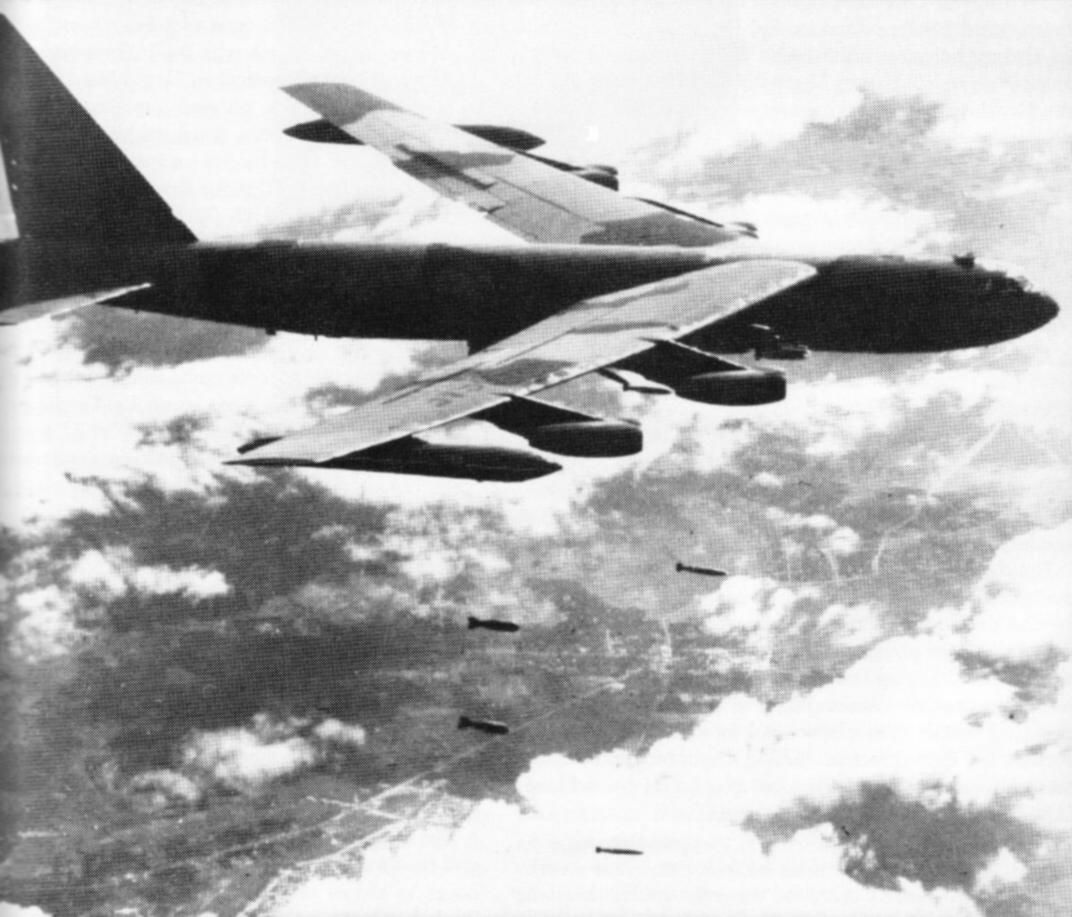
A B-52 Stratofortress on a bomb run over North Vietnam – 1972
But there was still ground-laying to be done in Vietnam at the same time. Peace negotiations between North and South Vietnam had long been dragging on in Paris – a nervous South Vietnam facing a still aggressive North Vietnam. Nixon decided to act – in order to strengthen the position both on the ground and at the peace table by ordering a withering assault (April 1970) on the Ho Chi Minh trail – a military supply route running just inside the Cambodian border next to South Vietnam by which the North brought tons of military supplies south to the Viet Cong. This was something that Johnson had avoided doing, supposedly so as not to drag a neutral Cambodia into the conflict. But Nixon was not slowed up by the fiction of Cambodian neutrality. In any case, the assault was highly successful – and crippled rather severely the Viet Cong effort in the South.
Kent State Massacre (May 1970). Of course to the Boomer crusaders, such strategic matters were of no great interest … or anyway beyond their political comprehension as crusading Idealists. Boomer protests broke out all over the country against Nixon’s “expansion” of the war effort in response to this actually quite carefully limited raid into supposedly neutral Cambodia.
Such “Fascist Imperialism” was exactly the enemy that Students for a Democratic Society (SDS) leaders needed to energize their movement – and focus was turned on the campus of Kent State University, where the SDS organized a huge protest, including the burning to the ground of the Reserve Officers Training Corps (ROTC) building on campus.
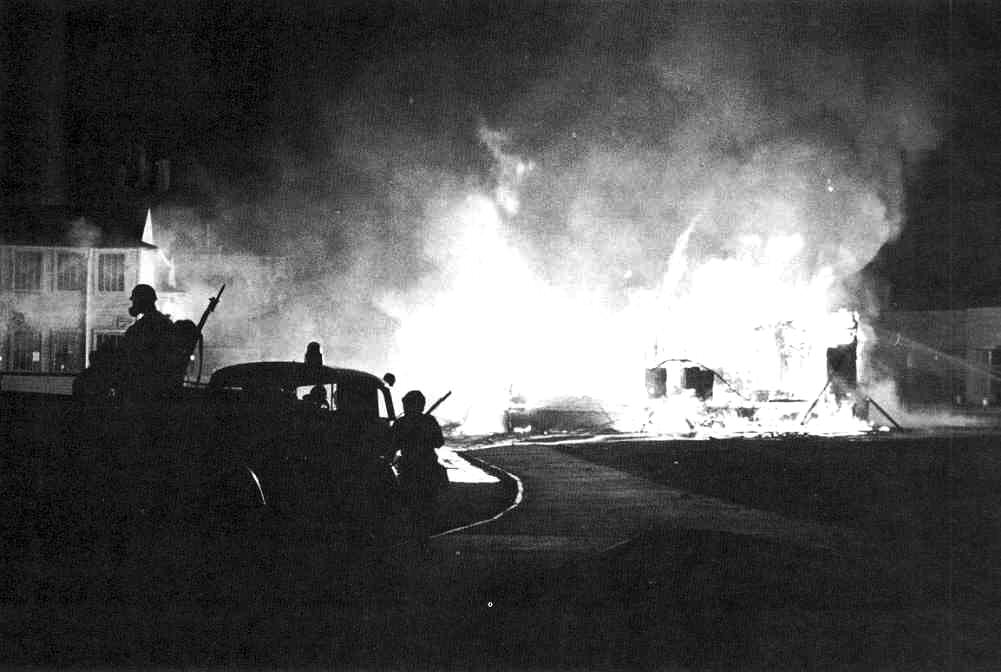
However two days later, when the SDS leaders called for yet a wider protest on the central campus, protesters now found themselves faced by the Ohio National Guard – which had been called out to protect the campus from just such protests.

Shots suddenly rang out, and four students were killed and nine wounded – some protesters, some just observers of the event and some just students crossing campus to get to another class.

Jeffrey Miller, one of four Kent State students killed by nervous National Guardsmen
A major tragedy, one that would shake the nation, had just taken place: the Kent State Massacre.
Vietnam Veterans against the War. Even though the American military draw-down in Vietnam was continuing on schedule, it would never be fast enough for some Americans – and in April of 1971 Vietnam Veterans gathered in Washington to protest the war, some even standing on the U.S. Capitol steps and throwing away their military medals as a sign of their disgust at the continuation of the war.


They also were invited to speak before a Democratic Party controlled Congress about their concerns – most notably a young (27) Lieutenant John Kerry, who was brought in by Senator Kennedy to describe the shocking behavior of fellow soldiers in Vietnam – and the depravity of American officers who covered up – even supported – such behavior:


… not isolated incidents but crimes committed on a day to day basis with the full awareness of officers at all levels of command.
Kerry spared no detail in describing the gruesome behavior – which he personally did not actually witness (he served in Vietnam only four months), which under American law therefore made his testimony mere hearsay:
They told the stories at times they had personally raped, cut off ears, cut off heads, taped wires from portable telephones to human genitals and turned up the power, cut off limbs, blown up bodies, randomly shot at civilians, razed villages in fashion reminiscent of Genghis Khan, shot cattle and dogs for fun, poisoned food stocks, and generally ravaged the countryside of South Vietnam in addition to the normal ravage of war, and the normal and very particular ravaging which is done by the applied bombing power of this country.
This act of “shaming”[1] his fellow soldiers would not only bring considerable public attention to Kerry but open his way eventually to service as Massachusetts Lieutenant Governor (1983-1985), following that as U.S. Senator (representing Massachusetts, alongside Kennedy), and finally even the Democratic Party presidential candidate in 2004. However the last achievement would be undercut greatly when a number of men who had served in Vietnam came out in protest against Kerry’s own service medals, claiming that some were most undeserved – damaging considerably the Kerry campaign. But Kerry would make a grand political comeback when President Obama appointed Kerry as his Secretary of State (during Obama’s second presidential term, 2013 through 2016). Such are the enormous social rewards that come from the simple anti-Fascist act of shaming America.
The Pentagon Papers. Another event that same year (1971) pointed to the passion rather than the logic behind the forces working against the President – even as Nixon continued to follow his program of strategic withdrawal from Vietnam. In June The New York Times published a long series of full-length articles revealing a secret document (which became known as The Pentagon Papers) that had been put together in 1967 at the request of Johnson’s Secretary of Defense Robert McNamara – who simply wanted to know the details of exactly how America fell into the Vietnam crisis in the first place. The published document revealed the deception Johnson had engineered – particularly in his manipulating the Gulf of Tonkin incident in order to march Congress and the American people off to a war in Vietnam that Johnson wanted badly (basically to prove himself to be a stronger foreign policy president than Kennedy had been). It also revealed the hand that President Kennedy had in the assassination of South Vietnamese President Diem in 1963.

Pentagon Papers researcher Daniel Ellsberg following up his story in Congress – July 1971
Encyclopedia Britannica
The nation was shocked – angered actually – by the knowledge that American presidents had played the American people so deceptively – especially Johnson. But oddly enough, the anger – which should have fallen largely on Johnson – was instead cleverly redirected by Nixon’s enemies at Nixon himself, who actually had no part whatsoever in the Vietnam deception. Democrats did not bother to point out that most of this scandal was a result of the (bad) political choices of the two previous Democratic presidents … but instead stressed the point that such behavior was a natural outflow of the office of the presidency itself, an office which had become intoxicated with its political powers. Thus to the Liberals of the Democratic Party – and its followers in the world of media, higher education, and bureaucratic professionalism – The Pentagon Papers clearly underscored the grave dangers to American democracy and American personal liberties posed by the “imperial presidency” – which Nixon clearly exemplified. Certainly therefore, America needed to do something to curb such presidential imperialism – meaning, the ability of Nixon to effectively conduct the office of U.S. presidency. Presidential power needed to be trimmed back – drastically.
Détente – and the full withdrawal of American troops from Vietnam. Meanwhile, Nixon had been delivering on his promise to pull U.S. troops from Vietnam. By the spring of 1972 he had reduced the number of troops there to only 6,000 – most of these now serving simply as advisors to the South Vietnamese army.
But he had also been busy on the larger world stage – working to improve East-West relations – but also with an eye on helping smooth America’s exit from Vietnam. He had sent Kissinger off to China to explore the possibilities of improved Chinese-American relations – a diplomatic initiative helped by the fact that Chairman Mao had been moderated greatly in his political behavior by the grand failure of his Cultural Revolution – allowing the more sensible Chinese Foreign Minister Chou En-lai (Zhou Enlai) to take a stronger hand in shaping Chinese foreign policy.

Henry Kissinger, Zhou Enlai and Mao Zedong in China – July 1971
And having once been the militant anti-Communist congressman (in the late 1940s) no one could fault Nixon as being soft on Communism. And thus it was that in February of 1972 Nixon himself flew to China to follow up on the program of improving relations with China. The 25-year American boycott of mainland China had come to an end.

Nixon and Mao in China – February 1972
But at the same time Nixon took the same diplomatic line toward Soviet Russia – just three months later (May 1972) flying to Moscow to open talks with Soviet Premier Brezhnev about the possibility of working together to bring the arms race under some kind of control. The reception in Moscow was highly positive.
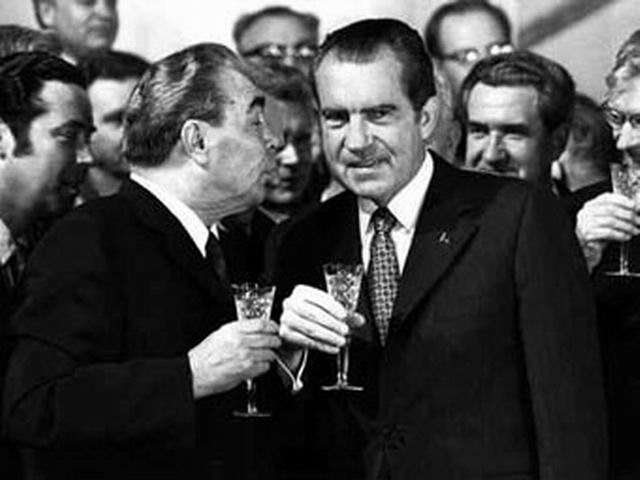
Actually, Nixon and Kissinger were playing the Realpolitik game – playing to the weaknesses of their Cold War adversaries – knowing full well that China and Russia, though both being Communist nations, were bitter rivals on the stage of world diplomacy. Cutting back on the tensions (popularly termed a détente[2]) between America and these two nations would strengthen both Russia’s and China’s hand in their mutual rivalry. But this assistance from America would come at a cost: Nixon intended to link (the policy of “linkage”) these improved East-West relations with some kind of understanding that America now expected both countries to back away from their support of Nixon’s adversaries in North Vietnam.
Nixon’s re-election (November 1972). For the upcoming national elections, the Democratic Party had nominated the professorial senator from North Dakota, George McGovern – loved passionately by the Boomer youth who saw him as crusading hero against the vile Vietnam policy of Richard Nixon (McGovern had in 1970 and 1971 sponsored congressional legislation calling for an immediate termination of all American involvement in Vietnam). However by 1972 the American voters – still largely drawn from the Vet Middle Class – saw Nixon, not McGovern as the true American hero, and in the November election returned Nixon to the White House with the fourth largest majority of all presidential elections.[3] The Boomers (and their intellectual mentors) were humiliated. Middle America (termed by Nixon as the “Silent Majority”) was jubilant.
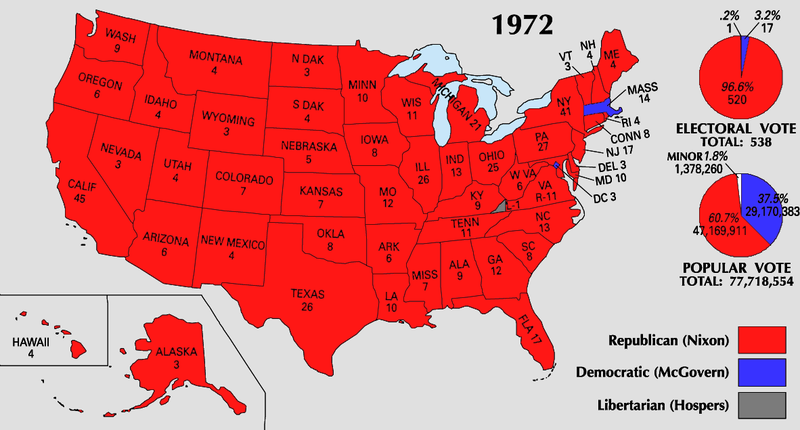
But all that pro-Nixon enthusiasm did not however alter the makeup of Congress itself – with both the House and Senate remaining under a Democratic Party majority and thus control. Consequently, the battle lines between the Republican White House and the Democratic Congress would merely harden because of the 1972 national elections.
The 1973 Paris Peace Accords. With support for his presidency thus confirmed by the November elections – and some kind of understanding worked out with the Russians and Chinese – Nixon now moved more boldly to bring some kind of acceptable conclusion to the long and painful Vietnam episode. The peace discussions between the North and South Vietnamese representatives meeting in Paris had dragged on long enough – with neither side willing to move to an agreement. Nixon decided it was time to break the stalemate – and proceeded to show a doubting South Vietnam and a sneering North Vietnam that he was serious when he had stated that although American military presence on the ground was coming to a close, America’s interest in protecting South Vietnam’s integrity through the use of American air power was not. During the next month after the elections, Nixon directed a massive air assault on Vietnam’s capital at Hanoi and its major port city of Haiphong. This time the Vietnamese got the message – and in January (1973) both sides came to an agreement about the sovereign rights of each other’s government – under the understanding that America intended fully to enforce the agreement with its own air power if that sovereignty were violated.

While Nixon’s enforced peace in Vietnam made great sense in terms of international Realpolitik, it was a policy greatly weakened by one key fact: the Democrats in Congress were in no mood to support Nixon’s success in any field of endeavor – and would do everything in their power to embarrass and handicap Nixon’s ability to conduct “imperialistic” American foreign policy. This would soon become quite apparent.
[1]The “shaming” of America became for the Boomers (and their offspring) a kind of ideological vaccination supposedly protecting them from falling victim to the Fascist disease of patriotism – a disease supposedly rampant among their Vet parents. Being visibly anti-patriotic or as Boomers termed the matter, anti-Fascist – for patriotism and Fascism were the same thing in the Boomer lexicon – Boomers participated eagerly in protest marches, the burning of flags, even the burning down of ROTC buildings, for instance. To them, participation in such group action was a popular way of evidencing just such immunity to “blind patriotism” – of manifesting a high degree of personal nobility. Thus Kerry’s shaming of his fellow soldiers before Congress stood him out as a person of enormous integrity and nobility. That’s how things worked in those days (and generally since then): to be able to shame America in some form or fashion automatically elevated a person to political sainthood.
[2]The French word détente, means a relaxing or backing down.
[3]Nixon received 60.7% and McGovern 37.5% of the popular vote; the electoral college vote went 520 votes for Nixon against a mere 17 votes (14 from the very Liberal Massachusetts and 3 from equally Liberal Washington, D.C.) for McGovern.
NIXON’S CHAOTIC SECOND PRESIDENTIAL TERM
Watergate: “Dirty tricks.” An event that occurred during the summer’s presidential election campaign would provide exactly the opportunity to undo the results of the election that had just delivered the humiliating defeat to the Democratic Party in its attempts to capture the presidency. Fairly high-level staff members of Nixon’s re-election committee decided it would be a cool [yet quite unnecessary][4] trick to raid the Democratic Party offices in the Watergate apartment complex in order to plant listening devices – sadly rather typical of the “dirty tricks” that go on with political campaigns. Except that their prank got detected by Watergate security police – and a number of these pranksters were caught and arrested.
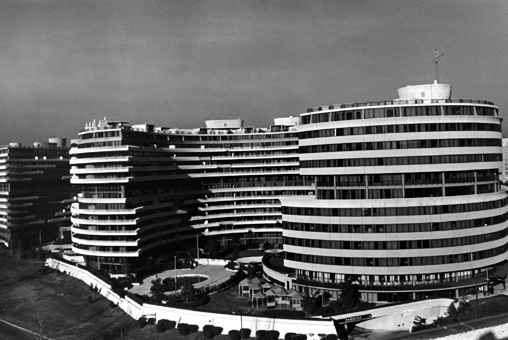
Woodward and Bernstein. This event would likely have gone largely unnoticed, except that two young crusading journalists of The Washington Post, Bob Woodward and Carl Bernstein, saw a headliner story in this event, one that might reach all the way up to the president himself. And with some inside help from an FBI informant, they began to develop the story into a full-blown presidential scandal.

Washington Post reporters Carl Bernstein (left) and Bob Woodward (right)
Congress goes to war. With the beginning of the trials of the culprits in January of 1973, the call went out for a complete Congressional investigation into the affair. Kennedy sponsored a resolution calling for the creation of a select committee of four Democrats and three Republicans to undertake a full investigation of Nixon’s re-election committee. Senator Sam Erwin, rather than Kennedy, would however head up this committee – as Kennedy’s moral credentials were not themselves all that great – and he had ambitions to run for the 1976 presidential race and did not want the committee to look like it was part of his personal electoral strategy.

Republican Senator Howard Baker and Democratic Senator and Committee Chairman Sam Ervin directing the Senate Watergate Hearings
Actually, of course, as with everything that goes on in Washington, this was all indeed pure politics. Although Nixon was likely not part of the Watergate prank, the committee was hunting for something, anything, that would lead directly to a Nixon involvement that they could then bring him down with.
Nixon paranoia. Nixon did not help his own case – paranoia in dealing with the Democratic Congress and an equally hostile and aggressive press having completely overtaken Nixon at this point. At first Nixon tried to head off the investigation – the very thing that the Democrats would be looking for in their efforts to find impeachable “high crimes and misdemeanors” on the part of the president. Then (April 1973) he fired a number of his staff – merely further conveying the image to the press of Nixon conducting a cover-up.
John Dean. At the same time, Nixon’s young Legal Counsel, John Dean, decided at this point that it was wise to switch sides in this political contest and offer himself as a witness before Congress (June 1973) to Nixon’s attempted cover-up of the criminal investigation. Dean did not have any actual evidence to offer, other than the assurance that Nixon certainly knew about the Watergate coverup and also tried himself to keep things hidden away. And he suspected that there was taped evidence that would corroborate his story.

Dean was describing a series of taped recordings that Nixon had been making over the years of White House operations – with the intent of eventually using those tapes to help him write and publish his memoirs. Congress wanted to get their hands on those tapes – in order to find actual evidence of an attempted coverup of the investigation. A battle over the tapes ensued.
The “Saturday Night Massacre.” Attorney General Elliot Richardson had earlier, in May – in agreement with the House Judiciary Committee – appointed Archibald Cox to look into the Watergate affair. Understandably tensions in the White House grew over Cox’s wide-ranging investigation, when it became apparent that Cox was clearly also looking for broader instances of corruption in Nixon’s Administration (even the president himself), and was particularly interested in getting his hands on Nixon’s tapes. When Cox finally insisted that Nixon had to turn over taped copies of his White House conversations, Nixon refused, offering instead to turn them over to Senator John Stennis to review and summarize. But Cox refused the “compromise.” Thus on the night of October 19th, Nixon at that point demanded that Richardson fire Cox. But Richardson refused, and instead resigned. The same would also hold true that same night with Deputy Attorney General William Ruckelshaus – who also resigned rather than carry out the Nixon request. Finally the matter fell to Solicitor General Robert Bork, who complied with the order, firing Cox, though Bork would fairly quickly appoint Leon Jaworski to fill Cox’s position.
This event finally began to swing American public opinion in favor of impeaching the president.[5] But even more importantly, it finally gave the House of Representatives justification for undertaking the process of impeachment when Nixon refused to comply with a congressional subpoena to turn over those tapes.
Vice President Agnew. Then as things seemed to Nixon that they could not possibly grow worse, the Department of Justice came out with an announcement that it was investigating Vice President Agnew for having taken large bribes for government contracts.
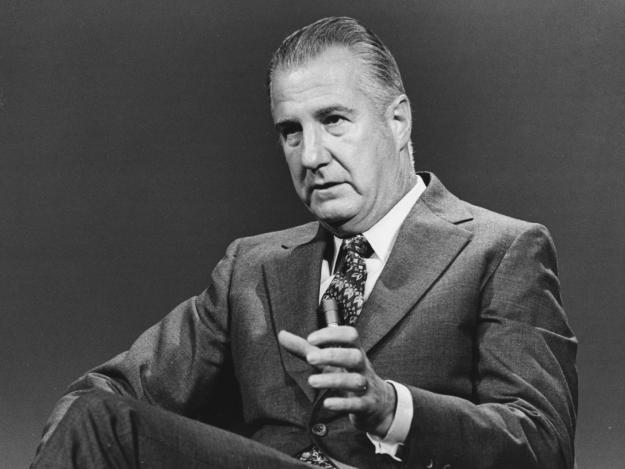
In October Agnew resigned – and Nixon appointed the popular Michigan Congressman Gerald Ford to replace him. The next month Congress gave a strong vote of confirmation to the widely-admired Ford.
The Arab-Israeli Yom Kippur or October War of 1973. In the midst of all of this turmoil, the world was shocked to hear that on October 6th, the Egyptian Army crossed the Suez Canal to attack Israeli forces holding the East bank of the Canal. Another Arab-Israeli war was underway.
 Egyptian President Anwar as-Sadat was hoping to draw the larger world into the Egyptian standoff with the Israelis – because despite the United Nations Resolution 242 calling for Israel to return to its 1967 boundaries, the Israelis had refused to move from their position at the Canal – or for that matter their control of Syria’s Golan Heights or the Palestinian West Bank region. The Israeli explanation was that they would not move until the other part of the Resolution – Arab recognition of Israel’s right to exist within certain defined borders – had taken place. No such recognition had been forthcoming from the Arabs. So Israel was not moving.
In the years since the 1967 war, Egyptian President Nasser had died (1970), Sadat had taken the presidency and – with considerable Soviet help – had upgraded the Egyptian military defenses (air and ground) quite considerably. But Sadat’s loyalty to the Soviets was rather limited. And he was willing to play a round or two of the Realpolitik game himself – forcing some 20,000 Soviet advisors out of Egypt in July of 1972 in order to keep a free hand in his own doings. He then undertook the holding of huge military exercises – which put the Israelis on edge wondering if Sadat was about to start something. Apparently he was not, and everyone backed down.
But this time, October 6th, he was not just conducting an exercise. It was an actual attack – and timed for the Jewish celebration of Yom Kippur – when the Jews would be more focused on religious celebrations than war (but oddly enough it was also the beginning of Ramadan, the Muslims’ month of fasting). At first the Egyptians made huge advances against the Israelis. But the war was costly to both sides. Both sides were losing jet planes, tanks, trucks and soldiers rapidly – and began to look to their military suppliers for help: Israel to America and Egypt to Soviet Russia.
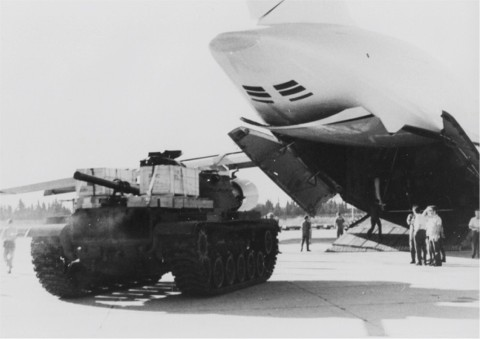
A C-5 Galaxy unloads an M-60 Patton tank at Ben Gurion International Airport in Israel
Syria and Jordan joined the conflict, and Israel turned its attention to these less prepared foes – humiliating both countries with swift Israeli counteraction. Then the Israelis began a strong counteroffensive against the Egyptians.
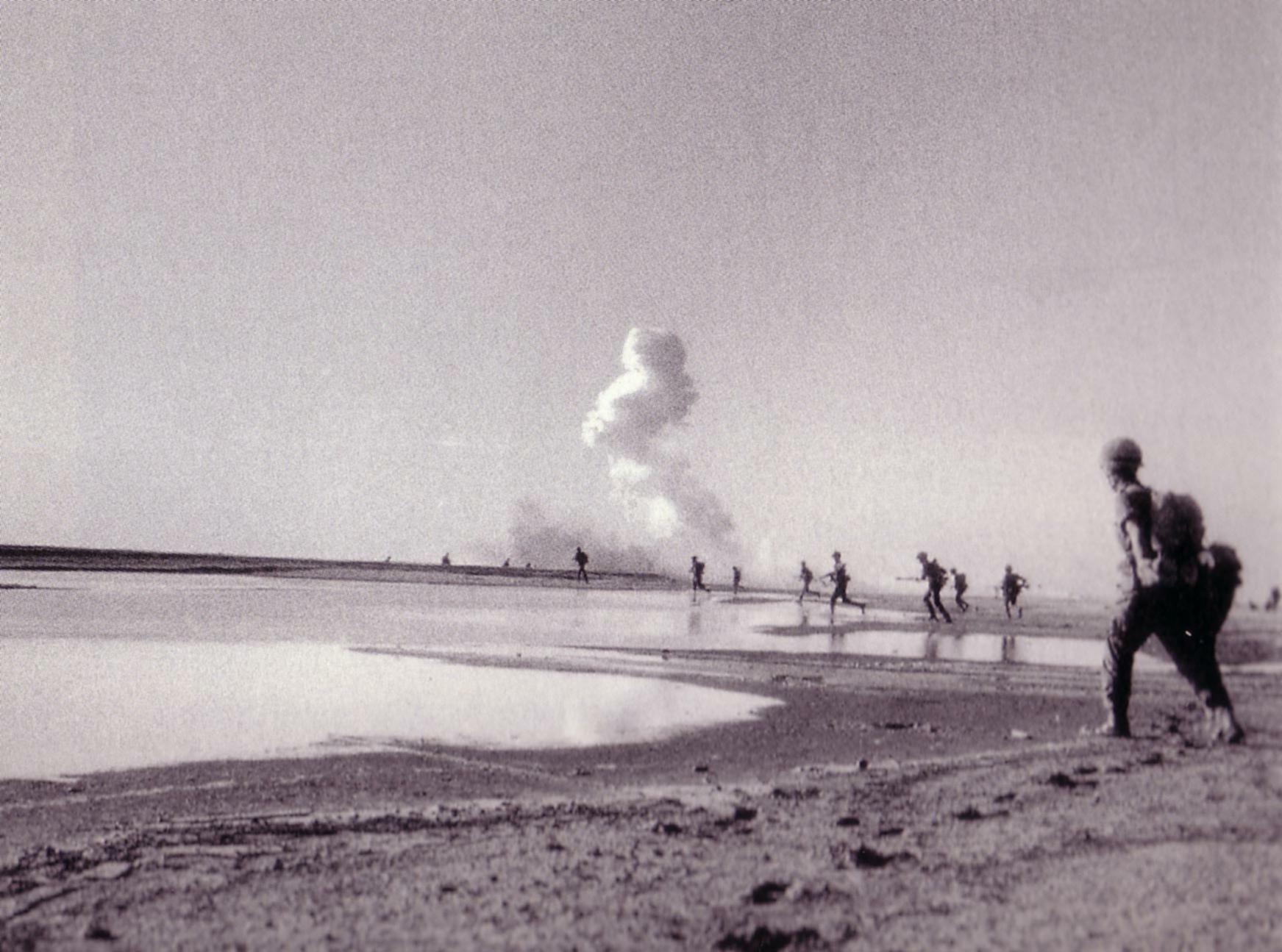
Israeli paratroopers breaking through Egyptian lines – October 1973
At this point the Arab oil-exporting countries jumped into action – especially when Nixon went to Congress with a request for $2.2 billion in aid to Israel. The Arabs now moved to impose an immediate slowdown in oil sales – putting America’s allies in Europe in a very tight spot – but also putting the squeeze on America’s energy supplies as well. Very quickly the price of gasoline at the pump went up and up (fourfold), when it was even available.
This in turn brought the United Nations into action, with both America and Russia agreeing to terms for a cease fire – which Israel ignored in its effort to surround and crush the Egyptian Third Army. At this point the Russians threatened to intervene directly if the Israelis did not back down. Thus something of a cease fire came into effect. The war was (more or less) over.
In the end, the real benefactors of this event were the Arab oil exporters – who now found their small populations among the richest in the world.
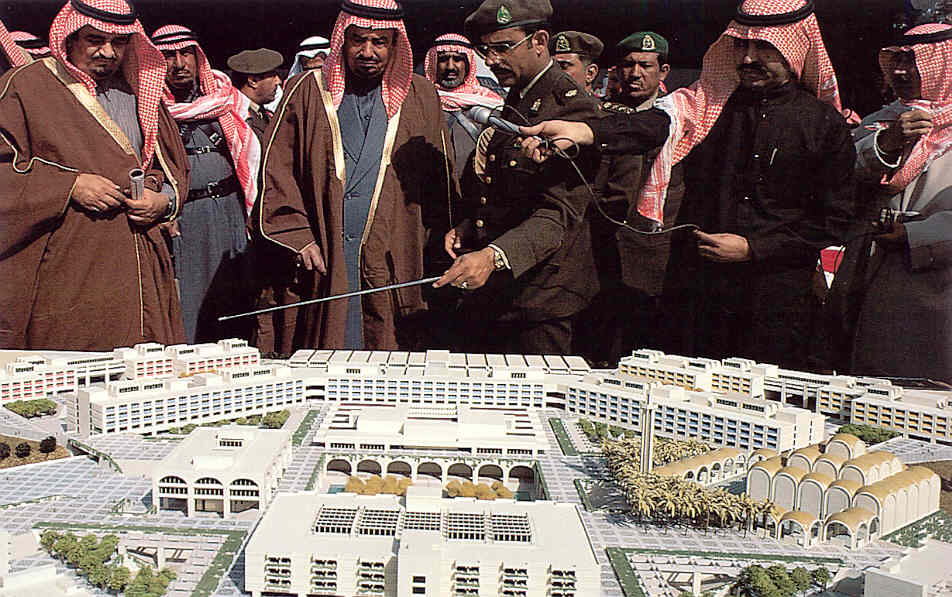
Saudi King Khalid overlooking a model of a $8.5 billion military city, to be paid for with increased oil revenues
This would work to the great benefit of the regimes governing these societies – mostly. But one country that would actually find itself in trouble because of this sudden wealth was Iran. Eventually this would be a key factor bringing down America’s most important ally in the Muslim East, the Shah of Iran.
Congress takes over American foreign policy. Meanwhile, Congress was busy attempting to undo the Nixon legacy in American foreign policy – by curtailing the “imperialistic” powers of the American presidency – and restoring American “democracy” by placing foreign policy activity fully in the hands of the Democratic-Party-controlled Congress. In June of 1973 Congress passed the Case-Church Amendment to the government budget bill, preventing the president from providing any kind of direct military aid to Vietnam – aimed particularly at Nixon’s use of the threat of air attack to make the North Vietnamese respect the Paris Peace Accords protecting the sovereignty of the South Vietnamese society and government.
Then just to make matters even worse for America’s friends in South Vietnam, the following May (1974) Congress turned down a Nixon request for a small amount of additional funding for South Vietnam – to carry that country until June when a new round of funding (supposedly) would be forthcoming. With the huge price hike in energy costs, the South Vietnamese government had run out of money to buy fuel for its military. But Congress gave Nixon (and Vietnam) a flat “no” as its answer to this request. And worse, it announced that as of 1976, South Vietnam would receive no further financial support from America!
What was Congress’s thinking on this matter? It already had Nixon pinned against the wall. Russia was still giving serious financial and military backing to North Vietnam. Why would Congress desert America’s allies in South Vietnam? What was to be gained by this “anti-imperialist” move?
Obviously Nixon, not the Vietnamese themselves, was the target of this move by Congress. But it would be the Vietnamese who would ultimately pay for this piece of incredibly poor and politically-blinded policy, pay dearly.

Nixon, “the imperial president,” must be brought down in order to “save democracy”
Stripping the president of his discretionary spending powers. Much to the annoyance of Congress, Nixon had pledged to cut back on government spending – and was simply refusing to release funding for various programs and projects approved by Congress (to the tune of some $12 billion). But many of these programs were pet programs of Congressional legislators, ones that they liked to remind folks at home about at election time, jobs for the many and favors for the special few that were considered absolutely necessary in order for these Congressmen to remain in office in Washington. Nixon’s crippling of this game infuriated them, of course.
Thus in July Congress put into effect the 1974 Congressional Budget and Impoundment Control Act – which required Congress to approve any desire of the president to hold off spending for any part of the national budget. In this they stripped presidential powers that reached all the way back to 1801 during Jefferson’s presidency – this too done in the name of promoting democracy.
In addition, Congress set up the Congressional Budget Office (CBO) specifically to see that the president was actually spending the money as Congress directed. But what they inadvertently had done was to set up a budgetary enforcing agency that would end up being just as interested in the curious ways the Congressmen themselves might be using their fiscal powers. Thus Congress’s favorite system of political rewards – the “pork barrel” system – found itself as well under detailed scrutiny! Ooops!
Watergate finally brings Nixon to resign (August 1974). During all this time, the Watergate battle continued to focus on Nixon’s White House tapes. But the nation was also following closely the trials of the “Watergate burglars” presided over by Washington, D.C. District Court Judge John Sirica … who used his own legal authority to subpoena those tapes. Thus some of the tapes were turned over. It was at this point (November) that it was discovered that some 18 minutes on one of the tapes was missing, blanked out by some unknown source. That in itself fueled even more speculative fire.
Meanwhile Congress (and the press) pushed ahead with its own investigation, in April (1974) subpoenaing those tapes, all of them. Nixon ultimately offered Congress 1200 pages of edited transcripts of those tapes. But this hardly satisfied his accusers. When Nixon again refused to turn the tapes over, Jaworski turned to the Supreme Court, which finally on July 24th (1974) in an 8-0 decision ruled against Nixon’s claim that he had executive privilege allowing him to keep those tapes personal and private.
Thus the full array of tapes were finally released on August 5th. And yes, one tape in particular pointed to a discussion that Nixon had with his Chief of Staff H.R. Haldeman soon after the Watergate event – concerning what it was that they needed to do to make a potential scandal go away. With that disclosure Nixon lost all ability to defend himself.
Republicans in Congress were now panicking. Watergate – and just the general political tenor in Washington – had destroyed not only Nixon, but was also undermining the Republican Party’s chance of any kind of good results in the Congressional elections coming up that November (indeed, the Republicans would take a big hit that fall). It was quite obvious that Nixon was not going to be able to avoid impeachment by the House. And enough Republicans were considering switching sides so that it appeared most likely that the Senate would find the 2/3rds vote needed to convict. Thus Republican advisors pleaded with Nixon simply to step down.
This he did in going before TV cameras on August 8th.

[4]The polls made it quite clear that Nixon was running well ahead of McGovern in the race for the presidency. However, the break-in was perhaps motivated by the hope of finding precise information about Democratic National Chairman Larry O’Brien’s connections (if there actually were any) with the incredibly wealthy but highly secretive Howard Hughes. It seems that the Democrats had been feeding information to Nixon through his rather improvident brother Donald that Nixon was going to lose the 1972 campaign because O’Brien had damaging information about Nixon given him by Hughes – including evidence that the gift of $205,000 from Hughes back in 1957 to rescue Donald’s failing restaurant business was actually given as a political favor for then Vice President Nixon. Such information – true or not true – would have damaged the 1972 Nixon campaign tremendously. However, the whole thing was likely a hoax. But this was the kind of misinformation that the Democrats were possibly hoping would put Nixon in a self-destructive frenzy. Unfortunately, it was not untypical of the kind of antics that go on in races for political office. But in any case, it did succeed after all (quite ironically) if this is what got the Nixon team to attempt the disastrous Watergate stunt.
[5]However, only slightly at the time, with now 44% in favor of impeachment versus 43% opposed, and 13% still undecided.
THE BRIEF FORD PRESIDENCY (1974-1977)
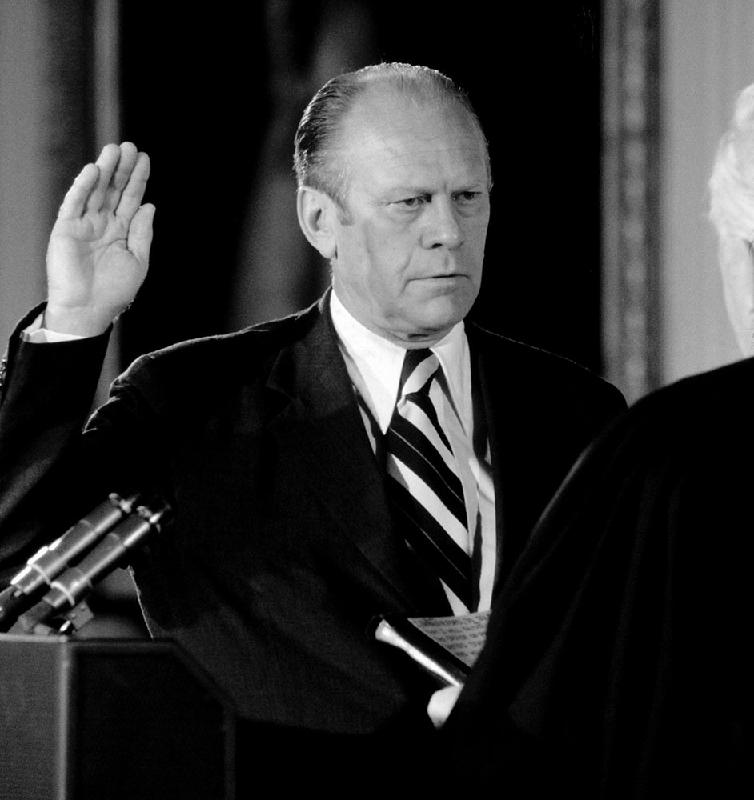
Thus as Nixon bade farewell, Vice President Gerald Ford took over the U.S. presidency.

Ford would be greatly handicapped as president (which was just fine with Congress) – never actually having gone before the American voter to achieve his presidential position. However, it would turn out to be a huge blessing to America that the individual left with the responsibility of getting America past this huge mess was an all-around “good guy,” able to pull off one of the greatest feats in American political history, which is to get both his Democrat and Republican colleagues in Congress to like and respect him deeply, at least up to this point.
Ford issues a presidential pardon for Nixon. Certainly the most important task facing Ford as he took office was bringing America past this one issue that had the country so divided that politically speaking it could do nothing to help the nation itself or the surrounding world. Thus after a month of pondering the matter, and then a Sunday morning of worship – and of much prayer on the matter – Ford announced to the press that he was extending a presidential pardon to Nixon. This would exempt Nixon from all charges, all efforts of those eager to continue their crusade to destroy the imperial president, the evil Richard Nixon.

The Democrats (and some Republicans) were furious. They wanted “social justice” (revenge), not pardon. But there was little they could do at that point. Ford had just taken out of their hands a key political weapon – an extensively dragged-out show trial – that they were counting on to destroy not only Nixon (they wanted him behind bars), but the Republican Party in general, in anticipation of the coming November 1974 elections.
But for the well-being of the country, this was absolutely the right decision. And Ford was able to take this stand because he was a Christian, answering to God first and foremost, and not America’s “peace and social justice” warriors. It would cost Ford dearly, to save America from itself. But he did, and America moved forward, amazingly quickly afterwards.[6]
Moral recovery. It had to have inspired Graham and others who had put so much trust in Nixon, and felt so deeply betrayed by Watergate. But ultimately Graham and some others moved on, even rebuilt a relationship with the disgraced former president, and Nixon himself moved on, actually to serve as wise counsel to future presidents and political officials. The social justice warriors, of course, never forgave Nixon, and were able to write that unforgiveness into their history books, even elementary and high school textbooks, ones that would remember Nixon only as that evil president.
But didn’t the social justice warriors forgive Ted Kennedy for Chappaquiddick? No, not really. They just simply put it out of their minds and thus avoided having to pay some kind of personal price in the matter. It was simply as if the event never actually happened. That’s not forgiveness. That’s politics.
Horrifying collapse in Southeast Asia. In the meantime, the situation in South Vietnam was worsening drastically. In early 1975 panic set in among the South Vietnamese soldiers who now saw their cause as lost without further American aid. And at the end of April the world was treated to the spectacle of the last of the American diplomatic mission beating a cowardly retreat from Saigon – with loyal Vietnamese civilians hanging on to the American helicopters in an effort to get out of the country with them.
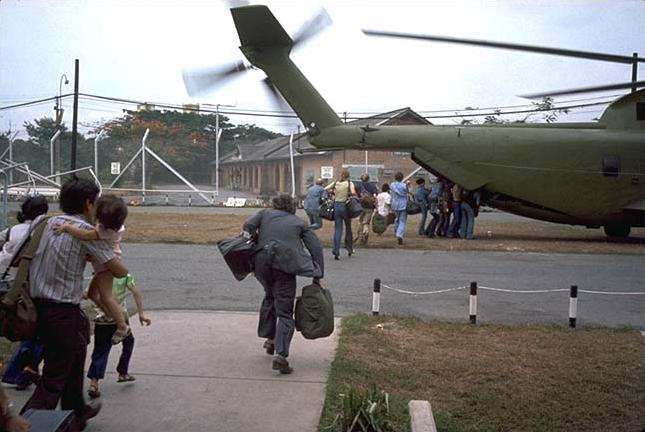

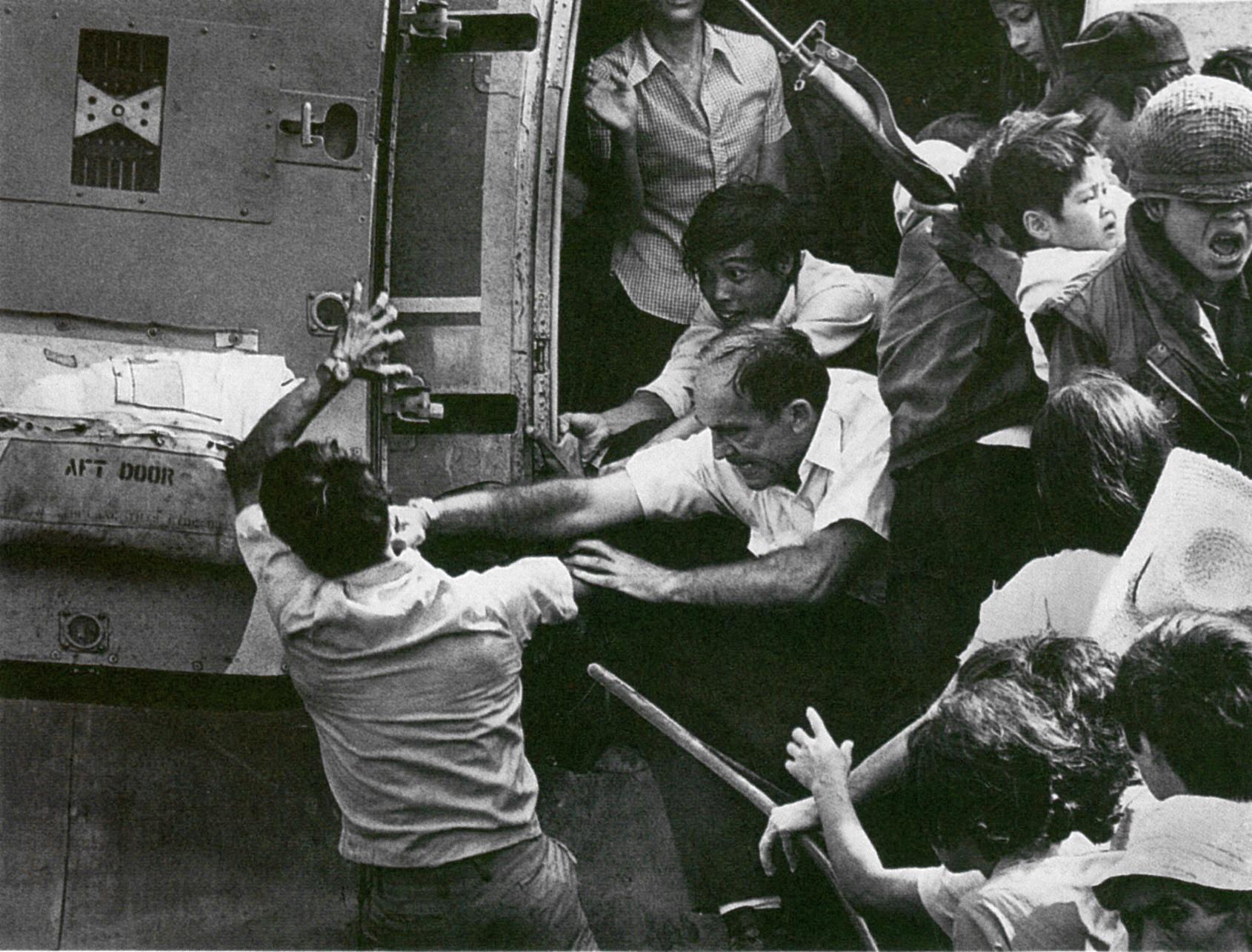
The Communists had completely routed the mighty America in Vietnam. But this also meant that the political status quo in the entire region of Southeast Asia was going to suffer a huge shift.
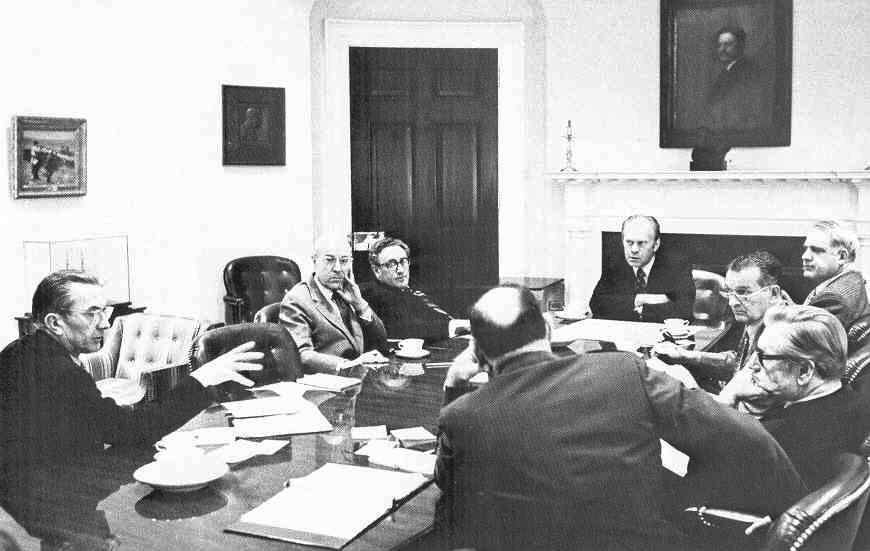
President Ford deliberates with his National Security Council concerning the fall of Saigon in 1975 … realizing at that point that there was little that could be done to reverse the horrible situation that the American departure (thanks to Congress) had brought on the Vietnamese
The Communist “re-education” camps. Now the Communist victors in the South began to march multitudes (possibly as many as a million) of Vietnamese off to “re-education” camps – to cleanse them of the “capitalist” ways they might have picked up in those years working with the Americans. Conditions in these camps were so terrible that huge numbers of them died.
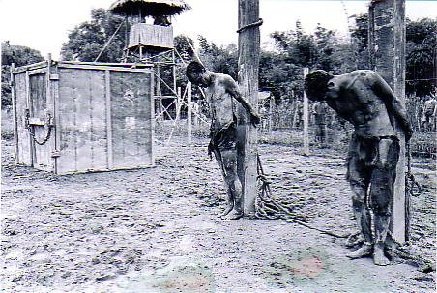

And then to make the situation even worse, the new regime seized the small independent farms and local businesses in order to collectivize or bring them under full governmental control – thus crippling further the economy – to the point of human disaster.
The Vietnamese “boat people.” Consequently, millions of Vietnamese attempted to flee the country – by any means possible. Some fled across the countryside in an attempt to reach Thailand or Malaysia. Others took to boats – or anything that would float – in the hopes of being picked up by passing Western commercial freighters and thus brought to freedom in the West. Multitudes simply drowned. Many were picked up by pirates and raped and killed or sold into slavery.
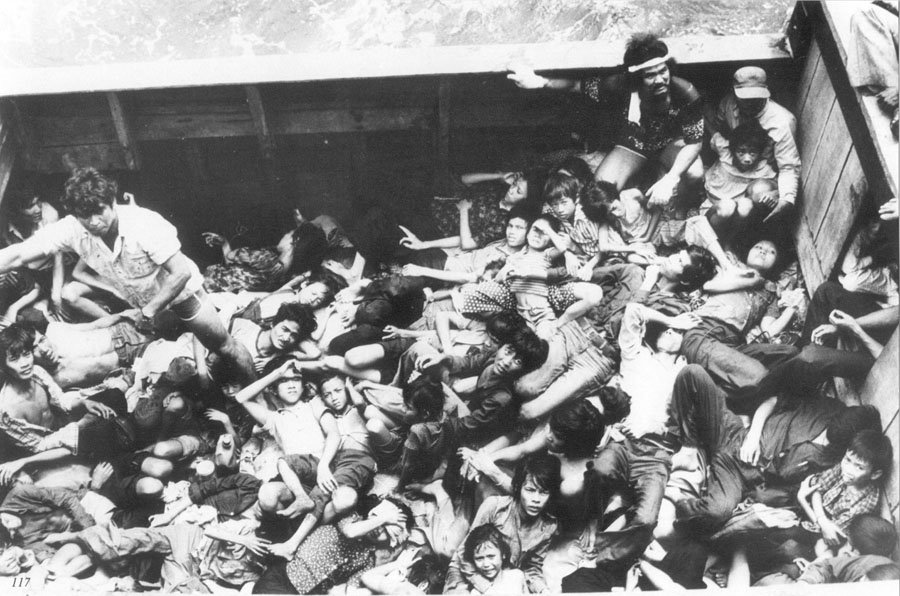
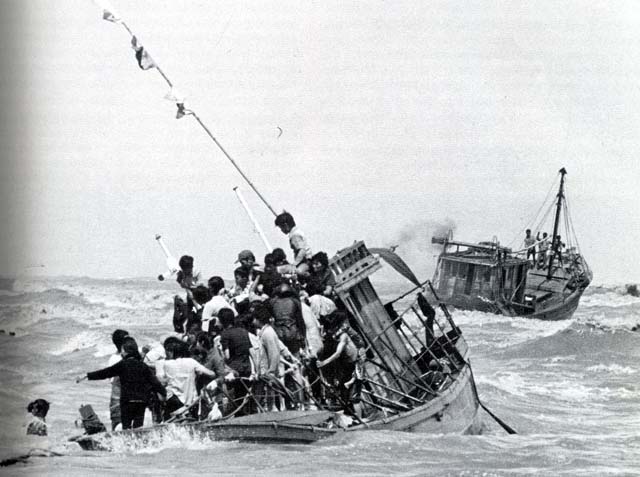
Tragically, so many of them will die at sea

Some, however, will be fortunate enough to be picked up by friendly ships
Even then, if they were somehow able to reach foreign lands in the area (the Philippines, Malaysia, Thailand) they would spend months, even years, waiting to receive refugee status in the West.

The Pulau Bidong Island Camp in Malaysia where some 36,000 were located as of this 1979 photo
But ultimately, America took in 800,000 of these refugees – and another 250,000 were settled in Europe or England’s Commonwealth countries.
The “Killing Fields” of Cambodia. One place the Vietnamese were not headed for in their escape from Vietnam was next door in Cambodia – for there the situation turned even uglier than was even the case for poor Vietnam. With the withdrawal of the American presence in Vietnam, Communists were also emboldened to end the fiction of Cambodian neutrality and simply take over the country. But this was a different group of Communists – not of the North Vietnamese type – who mostly took their ideological cues from Russia. These were Maoists, termed the “Khmer Rouge”[7] under their leader Pol Pot, taking their cues from the zany Mao Zedong – who, like him, held some kind of romantic view about the purity of rural life in contrast to the corruptions of urban life (supposedly too Western or capitalist in style). Urban Cambodia thus had to be purged of this evil – with those who had come under its influence either marched off to re-education camps of the Maoist variety – or simply executed on the spot. No one was keeping population statistics at the time – but the best estimates run in the range of 1.5 to 2 million Cambodians died from either execution or exhaustion/starvation – this holocaust discovered when multitudes of “killing fields” of thousands of skeletal remains were later uncovered – discovered when the Vietnamese Communists next door finally sent troops into Communist Cambodia to end the slaughter.[8]


Victims of the Khmer Rouge security police, some of the million Cambodians slaughtered by Pol Pot’s Communist regime – 1975

Skeletons of Cambodian victims of the Khmer Rouge, discovered when the Communist Vietnamese invaded Cambodia and discovered what their fellow Communists had done – December 1978
The American Bi-Centennial (1976). The year 1976 was supposed to be a year of celebration – for it marked the 200th anniversary of the signing of the Declaration of Independence – considered by most Americans as the birth date of the American nation. But there was very little to cheer about. Officially, America put on a happy face. But the spirit behind that face was lacking. Fireworks and grand ceremonies attempted to mark the importance of the occasion. But actually, America was feeling low – very low.

[6]Forgiveness always comes at a huge price, one that human pride finds very difficult to muster. The human ego instinctively prefers revenge – and has well-developed means by which to rationalize or justify that burning desire. That’s why we hire lawyers: to achieve “justice.” But forgiveness is the most important of all Christian virtues, powerful in the way it restores broken life, which “justice” seldom achieves. For instance, it was Truman’s willingness to quickly forgive America’s former enemies Japan and Germany that allowed America to bring true peace to a European continent (at least the Western portion) that had known only bitter nationalist rivalry since the beginning of the 20th century … and also Truman’s willingness to work with former adversary, Yugoslavian Communist President Tito, that enabled Europe also to keep the Mediterranean realm from being dragged into Stalin’s Empire. Forgiveness is a powerful social as well as personal instrument.
[7]The French name of the group comes from the fact that a number of the leaders of the Khmer Rouge were Paris-educated intellectuals of the worst kind with their pure and unyielding idealism, idealism that turned them into moral monsters.
[8]Although both Vietnam and Cambodia were officially Communist as of 1975, the two countries practiced very different forms of “Communism” (actually just ethnic nationalism) and found themselves in conflict along their mutual borders from 1975 onward – with the Cambodian Khmer Rouge actually undertaking several direct attacks on Vietnamese territory. Finally in late December 1978, the Communist Vietnamese invaded Communist Cambodia and overthrew the Khmer Rouge government, placing in power a pro-Vietnamese government in the Cambodian capital, Phnom Penh. This finally brought the massacre of the Cambodian population to an end.
THE CARTER ONE-TERM PRESIDENCY
The national elections of 1976. The gravely wounded Republican Party decided to stay with Ford as its candidate – despite a strong run at the candidacy by California actor and former governor (1967-1975) Ronald Reagan. The Democrats, however, had no strong front-runner. Kennedy would have been the most logical choice, given the power that the Kennedy name seemed to have among the Democrats. But Chappaquiddick was still too fresh a memory – and would certainly have been brought up as a campaign issue by the Republicans.[9]
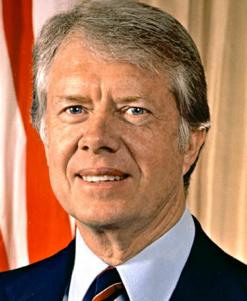 Carter proposes a foreign policy of “morality.” The Democratic Party finally nominated as its presidential candidate the one-term former Governor of Georgia (but also the Campaign Chairman of the Democratic National Committee), Jimmy Carter. Outside the inner circle of the Democratic National Committee, he was largely unknown – thus having the appeal of not being a Washington insider – a blessing in the eyes of many Americans. Also, it was hard to fault his record – as he had none foreign policy-wise and very little domestically.
In his public presentations and in the presidential debates with Ford, Carter stressed how it was time for America to find its way back to serving a more moral purpose in the world of domestic and foreign policy.
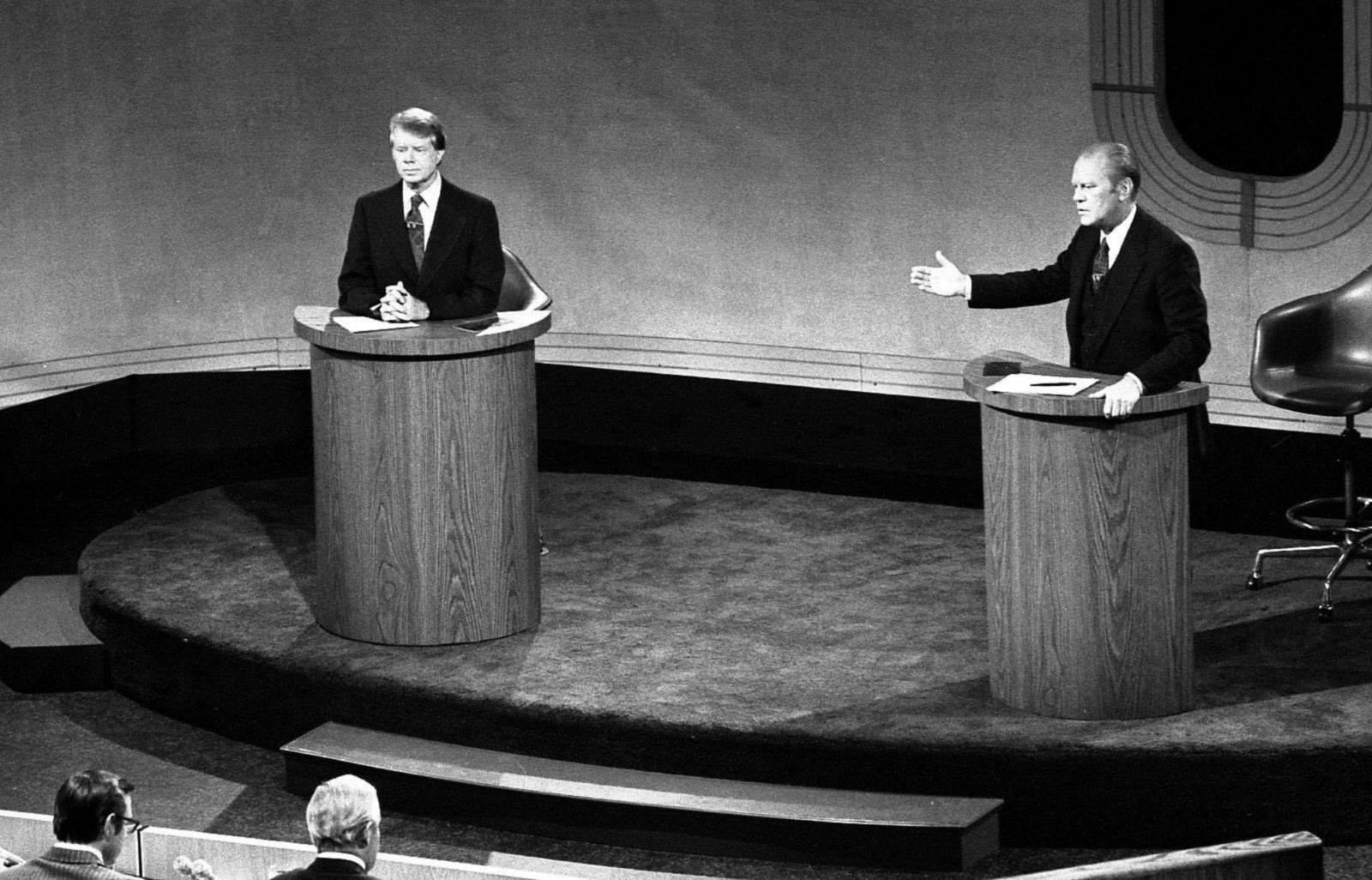
America had too long supported dictators, had conducted foreign policy away from the view of the American people, and was way too reactive in the field of foreign affairs – causing America a huge loss of global respect generally – and in the United Nations in particular. America would do much better presenting a more moral, a more democratic face to the world than had been all too much the case recently. Carter pointed specifically to the Park Chung-hee dictatorship in South Korea – and indicated that he would pull American troops out of Korea if South Korea were not redirected to a more democratic political profile. He mentioned other dictators as well that America had been wrongly supporting (specifically Latin American) – leaving Americans wondering what he would do about all the dictators of the Muslim Middle East – for the region knew no other form of government. Would America also be pulling its support away, for instance, from the Shah of Iran – famous for imprisoning political opponents?
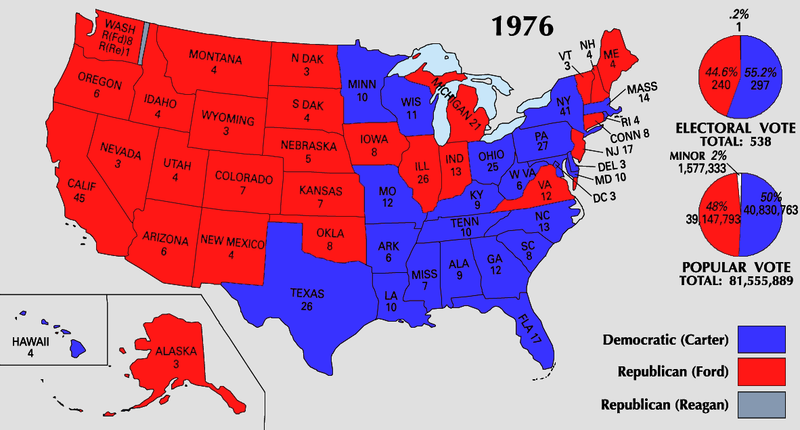
The November election was a very close one, with Ford coming from way behind at the beginning of the contest but moving up quickly on Carter as the election approached. But in the end Carter won with 50.1% of the popular vote to Ford’s 48.0% and 297 electoral votes to Ford’s 240 electoral votes (the solid support of the American South was a big factor in Carter’s win).
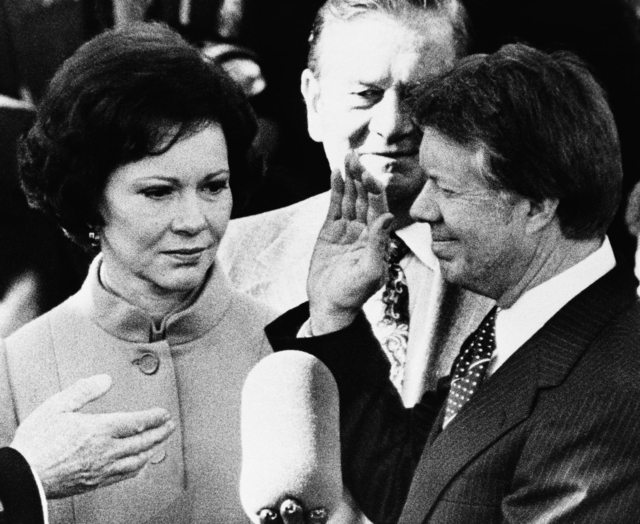
Carter, with his wife Rosalynn looking on, taking the oath of office
James (“Jimmy”) Earl Carter. Carter was born in 1924 to a very non-conformist Plains, Georgia, family, especially with his mother as a very independent-minded political Liberal. From an early age, Carter dreamed of gaining entrance into the U.S. Naval Academy, but had to start his college career in local community colleges, at least for a couple of years before finally being admitted to the Academy. He performed well, and became a nuclear engineer serving in the navy’s submarines in the immediate post-World-War-Two era. But in 1953 he would leave the service to return to Plains to take over the family farm when his father died.
But national military service had stirred his interest in political service, and in 1962 he was finally able to run and win a seat in the Georgia State Senate. Then four years later he took on the race for the Georgia governorship, losing out to the arch-segregationist Lester Maddox in the Democratic Party primaries.
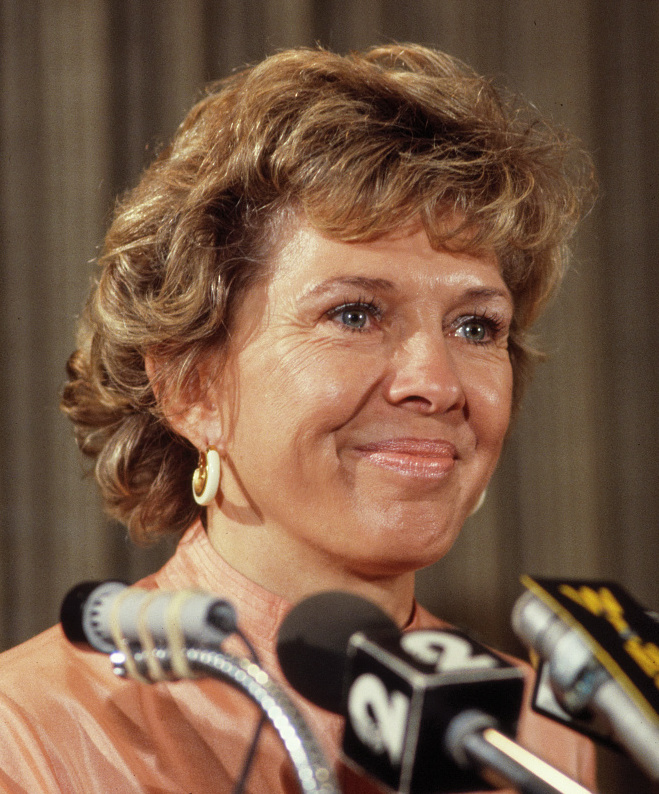 This threw his political ambitions into confusion, but at the same time stirred a very strong interest in going deeper in his Christian faith and calling. With the help of his evangelist sister, Ruth Carter Stapleton, he went through another “born again” experience, and then headed North (Pennsylvania and Massachusetts) to do some door-to-door evangelistic work himself, particularly among some poorer Hispanic communities there.
But he eventually returned to Georgia, to take on another run at the governorship (1970). This time he hid his Liberal orientation and let the press speculate on the matter, saying nothing when even the Atlanta media accused him of being a segregationist – when he refused to announce his stand on the race issue. This tactic worked, and in November he was elected governor of the state of Georgia.
And weren’t the Georgians surprised when it turned out that he was not at all the segregationist they believed him to be. In fact he was quite the opposite! But he also pushed other political items strongly besides racial equality and aid to the poor: educational reform, governmental restructuring and environmental protection, reflections of his own tendency as an engineer to want to see a high degree of order brought to the state’s social activities.
But as his term as governor was limited by Georgia law to a single term, he soon began to look to larger political fields to cultivate. He made no particular impression at the 1972 Democratic Party National Convention. But the next year he did succeed in getting himself appointed to Rockefeller’s newly created (and quite prestigious) Trilateral Commission, designed to bring Japan, Western Europe and North America into closer cooperation on a number of fronts. This brought him the notice that he needed to move forward with his plans and dreams. Thus the year after that (1974), he was asked by Democratic Party national chairman Robert Strauss to head up the party’s campaign committee, monitoring the 1974 midterm elections. This of course made him a very familiar figure to a large number of party members. And then when in 1976 he took an early lead in both the New Hampshire and Iowa caucuses, he became quite the political topic. Who was this rising figure from Georgia? There seemed to be almost something magical about his strong political rise.
There was, however, also some concern about his “born again” Christian character, like Kennedy’s Catholicism, something that made others (such as the very secular press) rather nervous. But like Kennedy, Carter made it clear that his strong personal faith had nothing to do with the way he intended to approach the very technical issues of environment, health care, education, foreign policy, etc. Those were matters of state, not religion.
Anyway, he gained the party’s presidential nomination, and then went on to defeat Ford in that close election.
As president, he stayed away from the topic of religion, although he had made his understanding of the moral principles he intended to follow as president quite clear, basing these however on the peace and social justice norms familiar to the Secular world. He also tried to run a tight ship in terms of administrative discipline, actually a bit too involved directly in administrative details that should have been assigned to staff. But that was the perfectionist engineer in him showing itself.
Nonetheless, despite his promise to keep religion out of his presidential responsibilities (even Billy Graham was rarely seen at the White House), Bible study and Christian spiritual reflection would be a strong part of the Carter presidency, all the way to the end of his four-year presidency. And if nothing else, this certainly helped introduce the nation to the idea of the more evangelical, born-again side of the Christian faith (which was also being pushed forward by the growing charismatic movement of the 1970s and after).
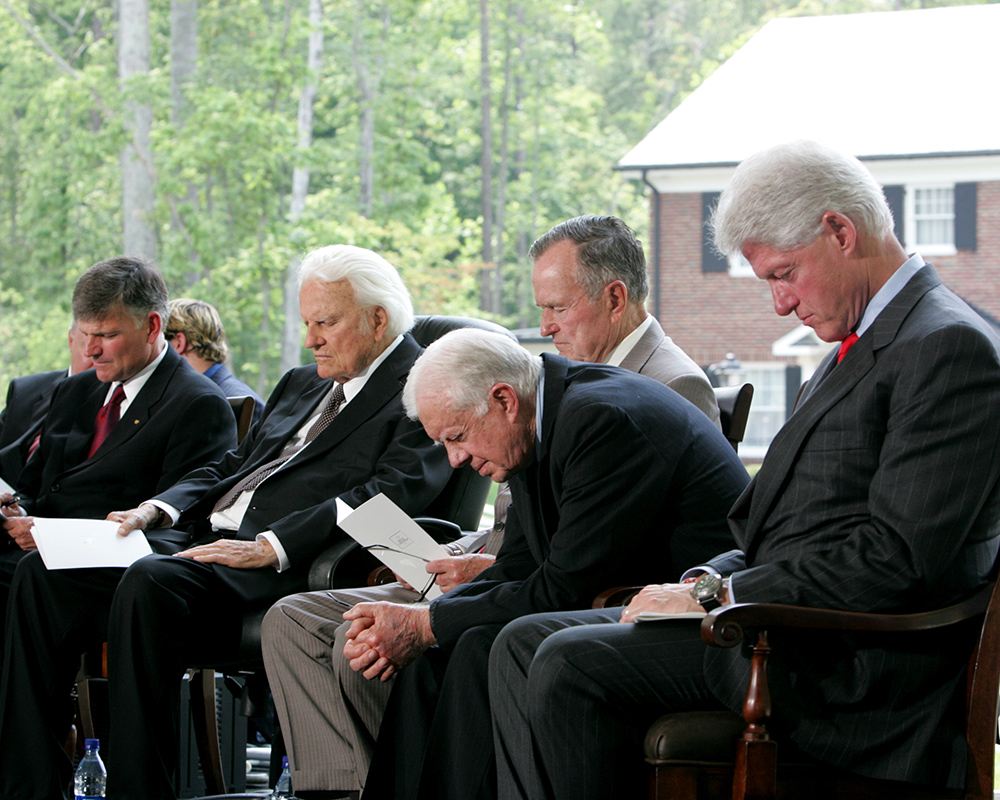
Christian presidents at prayer (Carter, Clinton, Bush Sr.) with Billy Graham and his son Franklin – 2007
The Panama Canal. Early on as president, a decision of Carter’s to offer the Panamanians full possession of the Panama Canal brought bewilderment to Americans – as Carter met with Panamanian military dictator, General Omar Torrijos, to consummate the deal.

Where did Carter’s scruples about not working with dictators go? And why was Carter giving up such a valuable American asset? Panama as a nation was originally a fiction of American creation, America had paid dearly in dollars and human effort (and loss) in building that canal, and the canal was a strategic necessity in the way it linked America’s two sea coasts – and vital to the American navy in its call to protect those coasts.
Supposedly this was done to encourage good-will between America and Latin America. But it merely ended up making America look weak – and in no ways improved the respect or love that the Latin neighbors had for America.
South Korea. Carter also announced a pending withdrawal of the American military from South Korea – as he had promised during the campaign. But thankfully some of his own foreign policy team convinced him that this would simply invite another North Korean invasion – and war – similar to what happened in the early 1950s, when America pulled its troops out of South Korea. So Carter backed down on this matter.
Iran. With respect to Shah Mohammed Reza Pahlavi’s Iran, here too, Carter’s moral-initiative threw confusion into the works. He threatened the Shah with a withdrawal of American support (sale of military items) if the Shah did not undertake a more democratic hand in the governing of Iran. Specifically, he wanted an end to the imprisonment of Iranians (presumably some 3,000 individuals) simply because of their opposition to the Shah’s rule. Under such a serious threat, the Shah complied – and released most of these political adversaries.
But again, wise counsel got to Carter – who was reminded about what had been going on in neighboring Afghanistan, when the Shah of Afghanistan was overthrown and a Republic – headed by the Afghan Shah’s cousin, Daoud – was declared. The Communists had taken advantage of the chaos – and were a rising threat to the Daoud regime – which put the Soviets in the position to make some very serious trouble in this quite vital part of the world (very close to the Indian Ocean and the path of the West’s oil from the oil-rich Persian Gulf region). Iran found itself in a similar situation located where it was (right next to Afghanistan). Carter needed to tread lightly in his “straightening up” of the Shah.
So at the end of 1977, Carter flew off to Europe and India. But that trip included Iran (celebrating New Year’s Eve in Tehran) as a demonstration of America’s ongoing support of Iran – Carter even publicly praising the Shah’s Iran as “an island of stability in one of the more troubled areas of the world.”

Carter arrives in Tehran in time to celebrate New Year’s Eve with the Shah (December 31, 1977)
Understanding that he now had full American support, the Shah moved to arrest again opponents of his regime. But he now found himself facing a new resolve from these opponents – who were able to mobilize street protesters in support of their anti-Shah crusade.
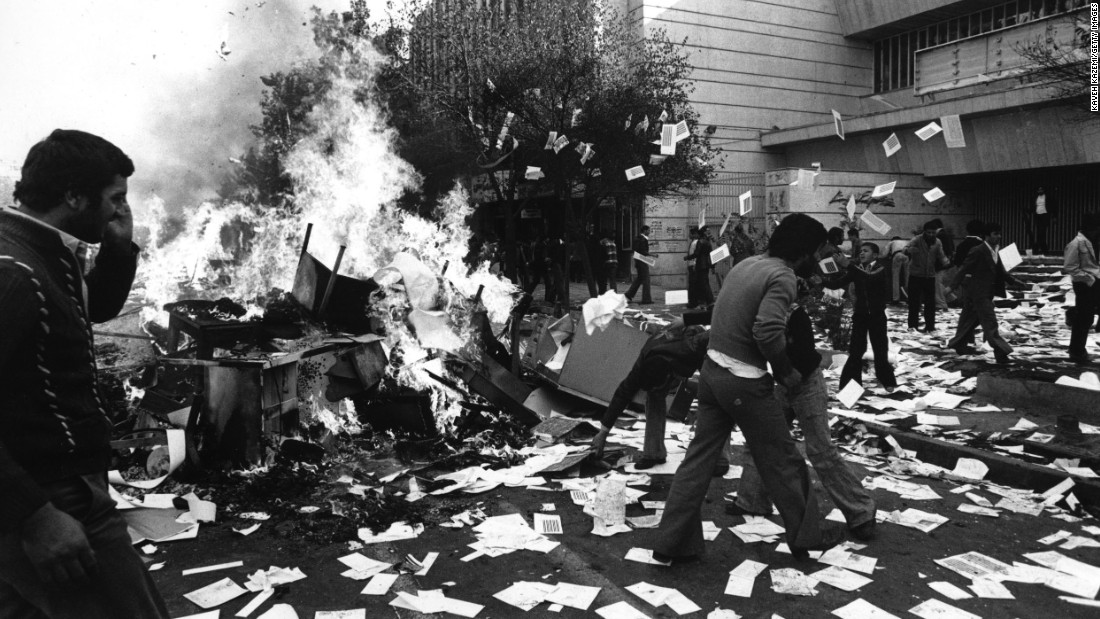
1978 – Iranian students protesting the Shah’s government
Mostly the opponents were young Secularists – indeed looking for an Iranian Republic, and the economic and political advantages they saw in such a republic. But this protest movement also allowed very traditionalist Muslims and their religious leaders to also get into the act – to oppose the Shah’s very secular culture itself (proto-Western and pro-American) as the embodiment of pure evil.
Inflation and unemployment. Two major economic factors drove the anger of the protesters. The sudden wealth that had come to Iran as a result of the four-fold increase in oil revenues had the effect of driving the price of available goods also to new heights. But Iranian salaries did not keep up with this increase in consumer prices – angering multitudes of Iranians. For the Iranian farmer, the situation was even worse because the earnings from their harvests were pegged to the price of agricultural products globally (including American agricultural exports) – meaning, they went up barely at all – at the same time that the cost of fuel for their machinery and the cost of their fertilizers rose sharply. In short, the oil bonanza had actually made the Iranian farmer poorer – much poorer.
And there was the problem of the multitudes of young Iranians whose families were able to send them off to study engineering at various universities in the West – thousands of educated young men who subsequently were to discover that Iran’s basic oil-driven economy did not need multitudes of engineers. There were no jobs for them as engineers back in Iran.
Mounting protests. Thus it was that the Shah found himself facing mounting bitterness and anger – over matters that he himself had little ability to alter or improve.
 And prompted by a rising Muslim voice – in particular through the cassettes of sermons sent back from Paris to Iran by the top Muslim cleric, the Ayatollah Ruhollah Khomeini – it seemed clearer and clearer to many Iranians that the Shah had allowed some great evil to come in among the Iranians. And if the Shah was powerless before such evil, then he needed to go.
The Shah flees Iran. As the year 1978 developed, so did the street protests – which by the end of the summer had virtually paralyzed the country – yet somehow grew even worse as the rest of the year unfolded.
Finally, the Shah simply fled the country early the next year (mid-January 1979). The streets were immediately filled with cheering crowds at the news of the Shah’s departure – for Iran could now move to the status of being a Republic.[10]
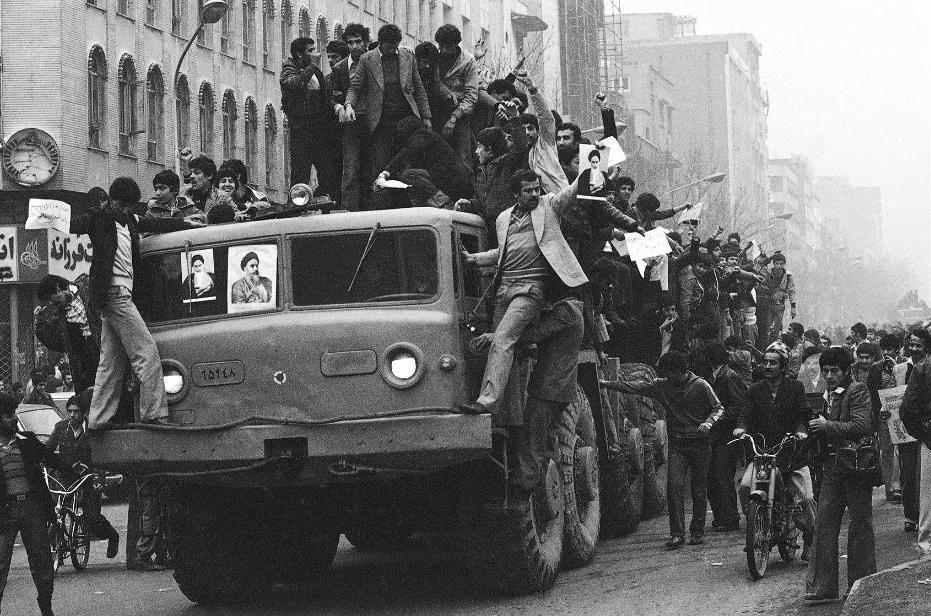
The Islamic Republic. But almost immediately a split began to develop in the anti-Shah ranks – between the modernizing Secularists (Westernized youth) and the arch-traditionalist Muslims, headed up by the Ayatollah Khomeini, who arrived from Paris at the beginning of February – just as the last pro-Shah forces were being crushed.
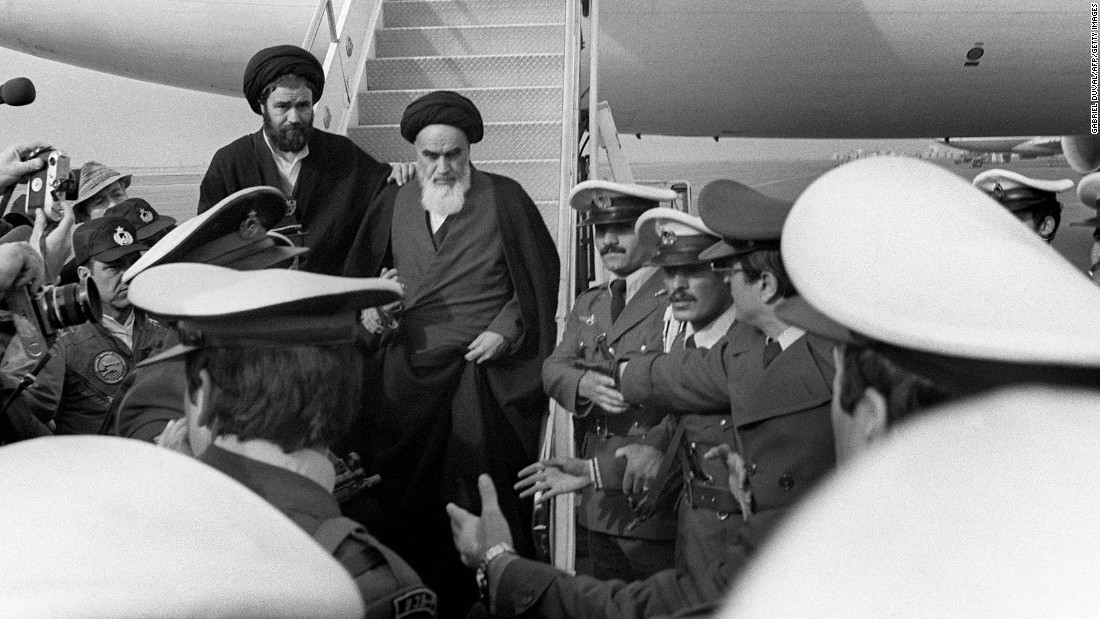
Employing young Muslim zealots (the Revolutionary Guard), the Muslim faction slowly drove the Secular Iranians from power – then suppressed all voices of dissent.
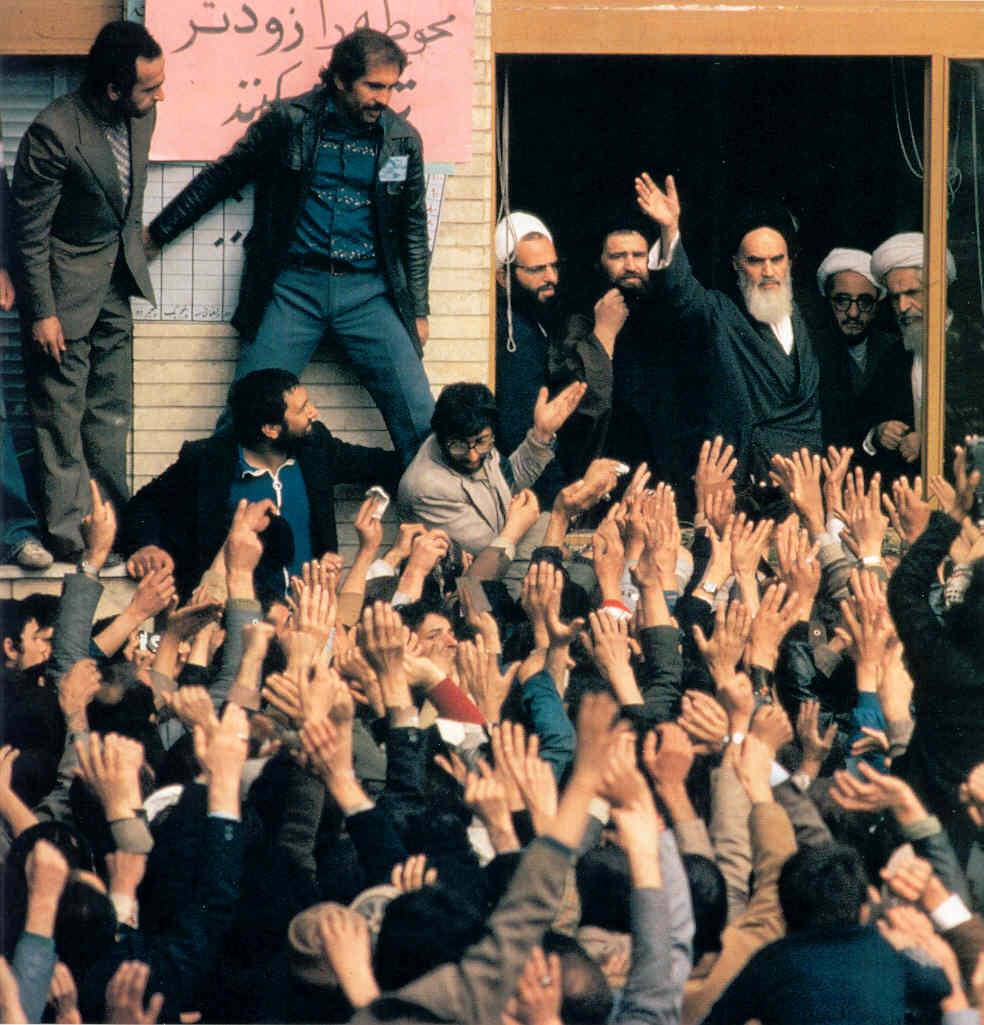
Iran was indeed going to be a Republic – but an Islamic Republic … complete with an elected national Assembly – but presided over ultimately by the Supreme Ruler, the Ayatollah Khomeini.
The Camp David Accords between Egypt and Israel (1978). In November 1977 Egyptian President Sadat surprised the world (including Carter) by flying off to Jerusalem to address the Israeli Knesset about the possibilities of an Egyptian-Israeli peace. Sadat of course had secretly worked out a deal with Israeli Prime Minister Menachem Begin – who was eager to see a split in the Arab ranks (this action would certainly alienate Sadat from the rest of the Arab front) and was willing to negotiate some kind of a deal over Egypt’s Sinai Peninsula (still under Israeli occupation) in order to achieve such a political breakthrough.
This move in turn put pressure on Carter to do something to help Sadat bring some kind of fruit from this venture – for all this also put Sadat in trouble with his own people. Thus Carter finally invited both Sadat and Begin to come to the presidential retreat at Camp David (September 1978) – to see what could be worked out.

But now Carter put a larger set of interests into the discussions – demanding that the status of the Palestinian lands of the West Bank and the Gaza Strip be included in the deal. Sadat was not all that interested in going beyond retrieving his Sinai territory. But Carter put the pressure on both Sadat and Begin – demanding some kind of reward for the Palestinians as well in the deal. Finally, not wishing to come away empty-handed from the nearly two-weeks-long talks, Begin yielded and agreed on a withdrawal not only from the Sinai but also the Palestinian lands still occupied by the Israelis (Syria’s Golan Heights however were left out of the deal).

Even though this finally brought progress in the stalled Israeli-Arab standoff, it would not benefit Sadat very much politically. In fact it would have the opposite result. Egypt was immediately kicked out of the Arab League – and the United Nations announced its deep opposition to the deal – because negotiations had not included the leaders of all the Arab states involved (although such larger involvement would have resulted in a continuing deadlock – in other words, no deal at all). But the Norwegian Nobel Committee was not bothered by this widespread negative reaction – and awarded both Sadat and Begin the 1978 Nobel Peace Prize.[11]
China. At the same time, China was undergoing deep changes since Mao’s death in September of 1976. His domineering wife and three colleagues (the Gang of Four) were arrested, and Deng Xiaoping moved up to take control of China (although Hua Guofeng would serve as the presidential face of China up until 1981). Deng had a very different plan for China than Mao’s zany (and lethal) socialism: he wanted to open China up to foreign investment – and full involvement of China in the international marketplace – in order to get China’s economy finally up and moving.
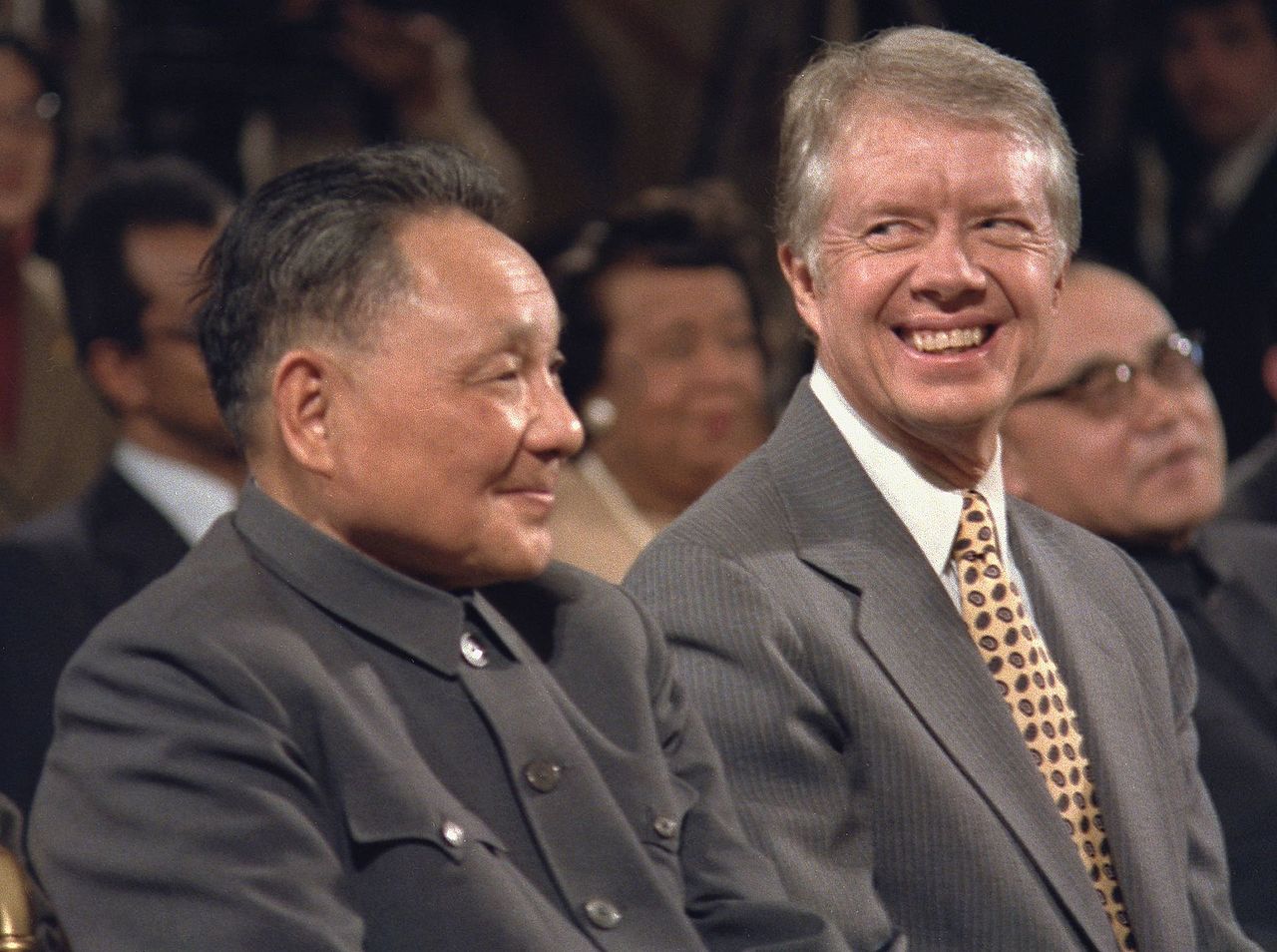
Carter certainly wanted to support this new phase and in 1977 sent his National Security Advisor Zbigniew Brzezinski to China to explore the possibilities of upgrading America’s Liaison Office (established during Nixon’s presidency) to full diplomatic recognition – and exchange of ambassadors. This meant having to agree on the status of Taiwan. Carter subsequently agreed to withdraw all diplomatic recognition (and naval protection) from Taiwan in acknowledging the island’s status as merely a part of China. But he did so under the agreement with China that America could continue to trade freely with Taiwan. Thus in January of 1979 Deng flew to Washington to meet with Carter and sign the new diplomatic accords – followed that summer with full diplomatic recognition of Deng’s Chinese regime.

Carter and Soviet Premier Brezhnev’s SALT II Treaty (1979). At the same time Carter decided to balance his eastward diplomatic offensive by bringing the Soviets into a new arrangement concerning arms limitations. There was growing concern that the SALT (Strategic Arms Limitation Treaty) negotiated in 1972 was not keeping up with the advances in military technology, especially the development of MIRVs – missiles with multiple nuclear warheads – and thus SALT I needed to be upgraded with a SALT II. On the Russians’ part, they were also interested in such an agreement, growing nervous about America’s new fondness for the Chinese – Russia’s major competitor, even opponent. Thus in June of 1979, Carter and Soviet Premier Leonid Brezhnev met in Vienna to sign the new SALT II document.


But Congress balked at the vagueness of the provisions, concerned that the only serious limitations that would come from the treaty would be on the American side. In any case, when then in December the Soviets invaded Afghanistan – even Carter was willing to back away from the agreement. Thus it was never ratified by Congress – although it did remain as something of a diplomatic understanding in continuing Soviet-American talks over the coming years.
Afghanistan. As already mentioned, the Afghan King Zahir Shah had been overthrown in 1973 by his cousin Mohammed Daoud Khan – who attempted to construct something of a modern republic in Afghanistan. At the same time Daoud had attempted to follow a neutral foreign policy in the Cold War – which irritated the Soviets, who considered that part of central Asia standing between themselves and the Indian Ocean as entirely within their sphere of influence (potentially including also Pakistan’s largely uninhabited Baluchistan desert along the Indian Ocean just to the south of Afghanistan). Finally, in April of 1978, Communists (under Soviet direction) made their move against Daoud, had him assassinated, and took control of Afghanistan under their leader Nur Mohammad Taraki. Taraki then began to take out anti-Communist (or just Westernized) political opponents, with possibly as many as 27,000 executed over the next year and a half.
But this merely stirred opposition all the more – and a massive rebellion broke out later that same year – involving not only conservative Muslims but also members even of the Afghan army.
Now both the Soviets and the Americans got involved – with Carter sending secret aid to the rebels (not exactly the open diplomacy he promised America!)

– and the Soviets having Taraki assassinated (October 1979) and replaced by Hafizullah Amin. But Amin was not servicing Soviet interests adequately either, and the Soviets then had Amin assassinated (December) and replaced by Babrak Karmal – who immediately invited the Soviets to send troops to restore order.
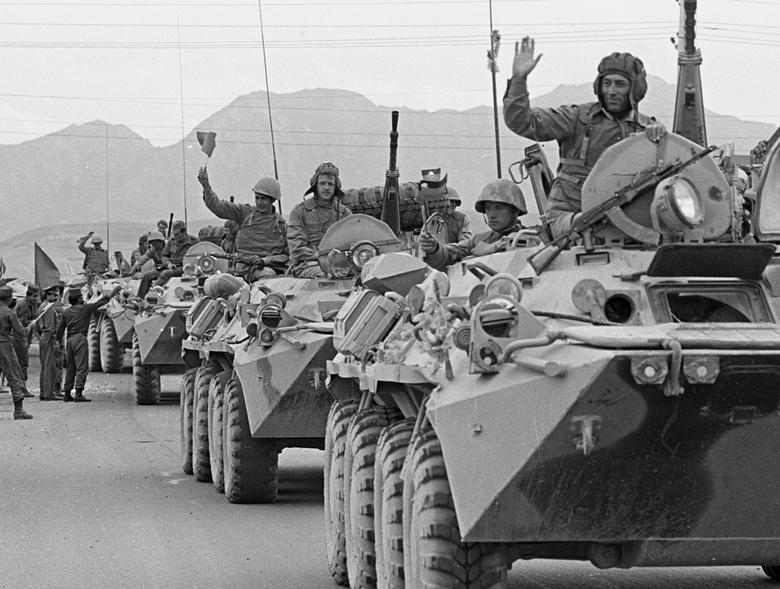
At this point the Soviets were about to discover what Vietnam felt like to the Americans.[12]
America’s further humiliation delivered by Iran. In October of 1979 a very sick Shah of Iran was being considered by Carter for medical treatment in America. When the Iranians got wind of the news, they exploded in anger (or was it just clever manipulation?) and invaded the grounds of the American embassy, seized, bound and blindfolded the staff working there – and paraded them in front of the world’s camera – proud to be able to demonstrate such contempt for the American diplomatic staff. And there was no way they were going to release them (except for the Black employees, who were released and sent home).
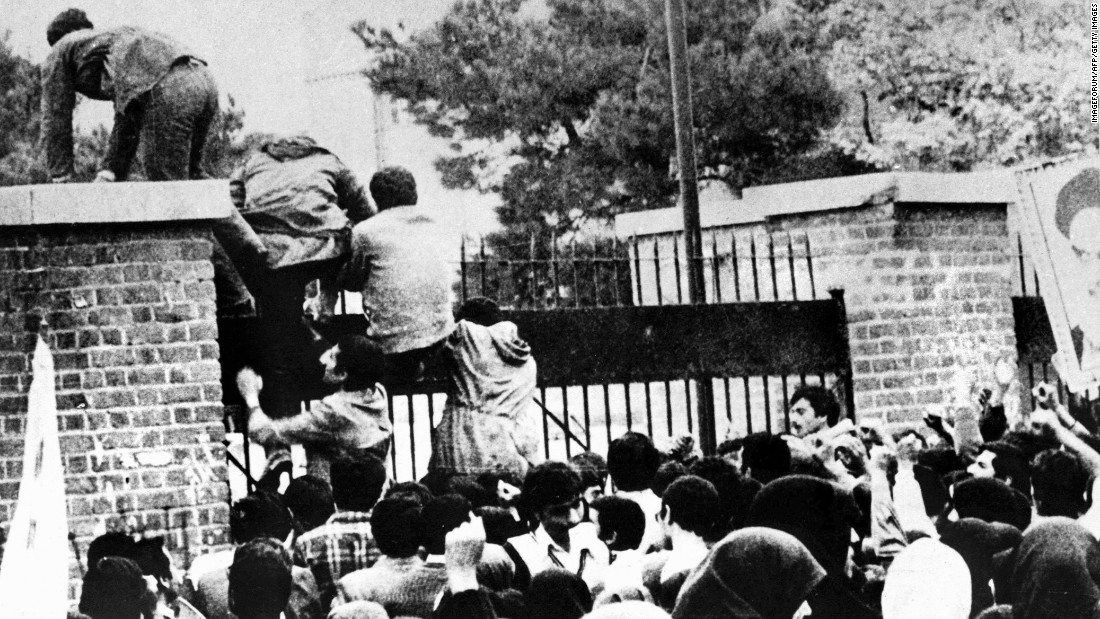
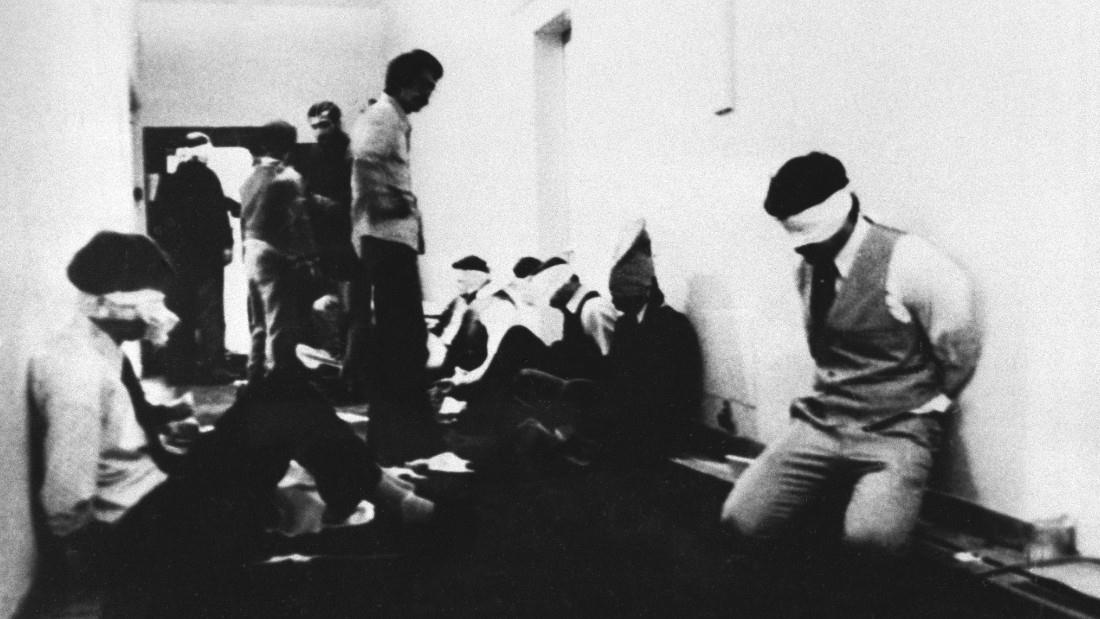

Finally Carter decided to do something bold – or just desperate – to secure the release of the American captives, when in April of the next year (1980) he sent Special Forces for a surprise raid by night on Tehran to retrieve the 52 Americans being held at the Embassy. But an early landing just inside Iran in preparation for the final assault turned into a disaster when a sandstorm and mechanical failure disabled three helicopters – forcing a cancellation of the operation – but not before another helicopter collided with a C-130 transport plane (killing 8 American troops).

Consequently, a very humiliated Carter had to go before the American press to explain the failure of Operation Eagle Claw.

Volcker makes an economic crisis go from bad to terrible. Once again, the world by 1979 was hit with another major energy shortage – and consequent massive rise in energy prices – due to the political chaos in Iran which took Iranian oil out of the global market. Long lines at the gas pumps and inflation everywhere once again afflicted the energy-hungry West – America no less.

Then to make matters worse, the Federal Reserve chief Paul Volcker got the brainy idea of fighting inflation by driving up the Federal discount rate to 20% – forcing banks, which depended on dollar reserve backing by the Fed, to raise their prime rates offered to their very best industrial/commercial customers at the unheard-of rate of 21.5%.
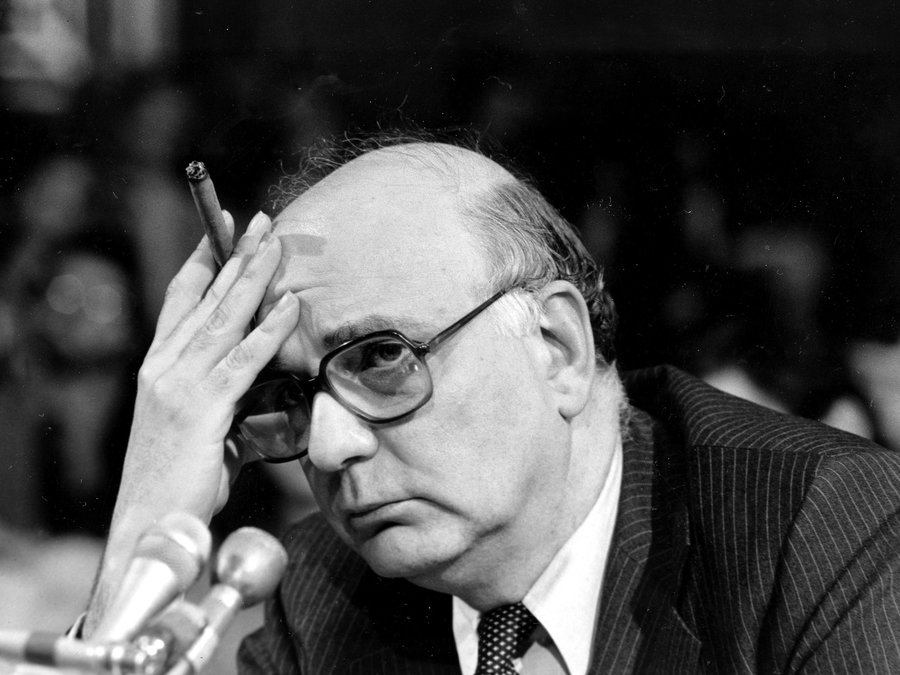
How Volcker figured this would combat inflation was a mystery – because in order to stay in business, companies now not only had to raise prices to cover their new energy costs – they would have to raise them even more to cover the cost of borrowed capital running at these outrageous interest levels. Thus the only way that Volcker’s monetarist policy could have brought down inflation would have been to throw the whole economy into a deep depression – which is exactly what happened. Not only did businesses begin to shut down, but banks financing those businesses soon followed when their customers went bankrupt.
Carter takes the hit. Carter was naturally the target of a very grumpy America – so much so that even “Chappaquiddick Ted” Kennedy decided he had a chance at the Democratic Party nomination – and boldly challenged Carter as an incompetent president. But Volcker intervened and lowered the Fed’s discount rate back down again – in time to get the economy back up and moving that summer (1980) – and Carter re-nominated as the Democratic Party presidential candidate. But then Volcker raised the rates back up again (even higher this time) – and threw the economy back into another decline. At that point Carter had virtually no chance of winning the November election.
[9]Chappaquiddick somehow never seemed to bother the good people of Massachusetts, who were perhaps a more “forgiving”(or “forgetting”) people, especially when it came to the doings of the Kennedys.
[10]Soon after this, I had an Iranian student who had just taken my politics of the Middle East course come to me, all excited about developments in his home country. I didn’t want to dampen his enthusiasm. But I did ask him if he was also aware that Muslim traditionalists were just as anxious to gain control over events as were the young Westernized Secularists like himself back in Iran. He hadn’t thought of that. A year later he came to me and told me that his parents had written to him, and told him to make no plans to return to Iran. Developments back home had turned in a direction under the control of the Muslim hardliners that had made life very dangerous for the Westernized Iranians like themselves. Truly sad.
[11]Unfortunately, this deal would ultimately cost Sadat his life, when bitter Egyptians assassinated him in 1981 during a military review he was attending.
[12]Carter ordered the boycott of the Olympic Games held in Moscow in July of 1980 as punishment for the Soviet invasion of Afghanistan. In the end the only ones punished by this decision were the U.S. athletes who had trained for this grand event, but who would now not be participating in the games. Furthermore, when the Olympic Games were held four years later in Los Angeles, the Russians returned the favor by not participating.
THE FRACTURING OF AMERICA’S TRADITIONAL SOCIAL-MORAL ORDER
The assault on the American family. Since the days of the Puritans, the political foundations of American politics had always been the family – an enormously strong social institution able to carry the heavy responsibilities of truly democratic governance – meaning exactly, governance by the people themselves. The family was represented in the voting for local community officers, from city hall to the school board. The family controlled the nation’s economy through the simple device of local demand for goods and the willingness to use family wealth to purchase these goods. It even controlled its religion through the ability to call, by way of a congregation’s vote, their own pastors to their pulpits.
Men worked hard in fields, factories and mines to put food on the table. Women represented the family in the larger social context (church work, library work, sewing circles, etc.). And children were raised at an early age to prepare to take up just those same roles.
But now, centuries later, things were changing – dramatically. The call to family duty was being replaced by the call to personal professionalism. Getting married and having a family was put off so as not to interfere with the task of achieving and developing a person’s professional status – women as well as men now. Indeed, marriages were no longer life-time commitments – but instead divorce was becoming rampant (as many as 50% of Boomer marriages were ending in divorce) – thanks in part to the no-fault divorce and the prenuptial agreements where divorce was understood to be a huge possibility even as a man and a woman entered marriage.
Sex was now viewed widely as a matter of recreation – not family responsibility. Consequently, abortions exploded in number as unwanted pregnancies multiplied dramatically in the new age of “free sex.”
Also the role of the male became confused – as men were told to back down and let the women advance in the professional world outside the family. Indeed, feminism even took on a distinct anti-male quality – as men were accused of being “male chauvinist pigs” in not letting women advance to full equality with them in the workplace.
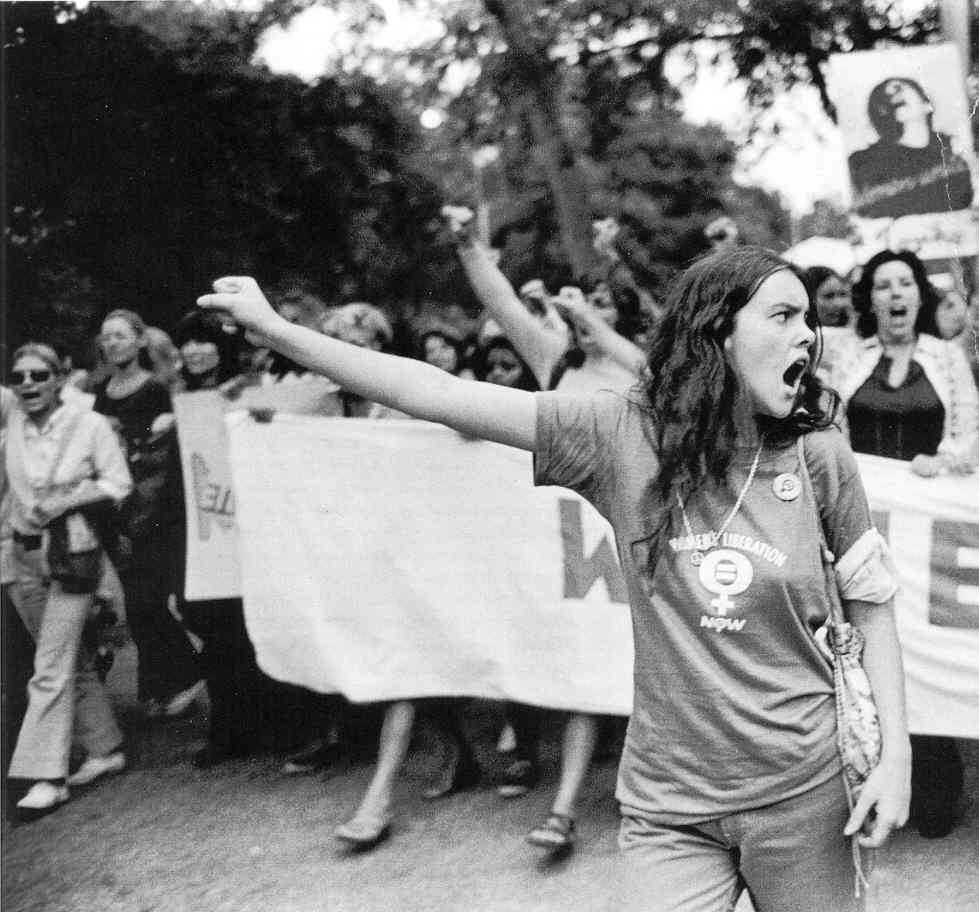
Members of the National Organization of Women (NOW) protesting in New York City
Lesbianism (what woman would come to have any affection at all for a male chauvinist pig?) developed as women fell into each other’s arms – and male homosexuality now “came out” in huge public displays as men simply found mutual attraction in each other’s company (expressed in a typical male fashion, to be sure).

A gay rights demonstration at the Democratic National Convention, New York City – July 1976
A classic example of how far America had moved from its 1950s idealization of the American family is summed up in the top-rated TV series All in the Family (which ran through the entire 1970s) in which Archie Bunker, the father, is portrayed as the quite ignorant male chauvinist, his wife Edith as the male-dominated (but subtly the one with something of real social sensibility) wife, and two Boomer college-age kids – who pretty much played out the classic Boomer roles. America did not realize that it was laughing at the very institution that had long carried America through hard times as well as good times. The family now seemed overstated, ridiculous at times, and generally an almost pointless accident as a social institution.

But certainly countering the Middle-America bashing of All in the Family was an alternate TV program, Happy Days … an equally popular program (running 1974-1984) which romanticized the glory of Middle America’s 1950s and early 1960s era
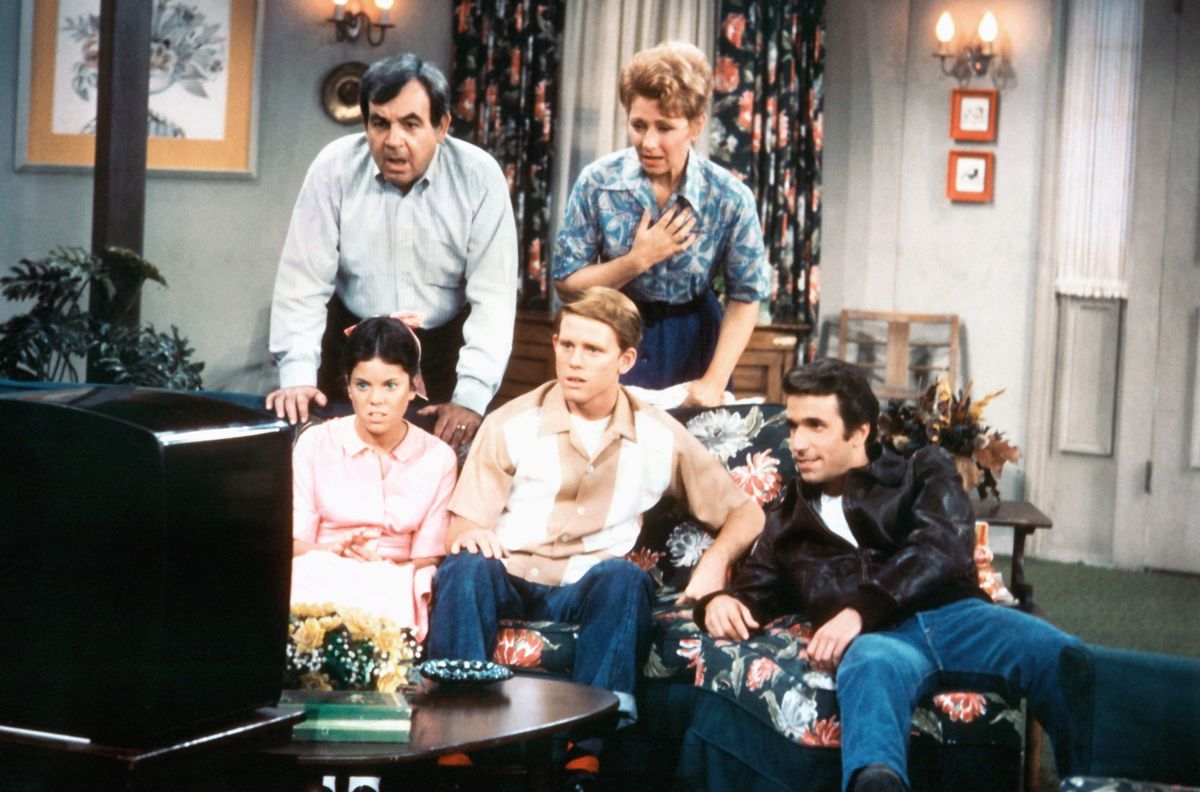
So … which of the two got it right … as far as American opinion went? Time would tell.
The rise of Federal Judicial legislation. Since the early 1960s, “Progressive” organizations such as the American Civil Liberties Union (ACLU) had demonstrated that the Federal Judiciary – rather than Congress – was the place to go to get their programs put in place as national law. A favorable decision required only five individuals of the nine Supreme Court judges in order to get the kinds of laws that the ACLU wanted to see direct the country. That certainly was easier than going through the complicated task of getting multitudes of Congressmen and Senators (ever sensitive to the views and feelings of the American voter) – plus a willing president – to put those laws into full effect.
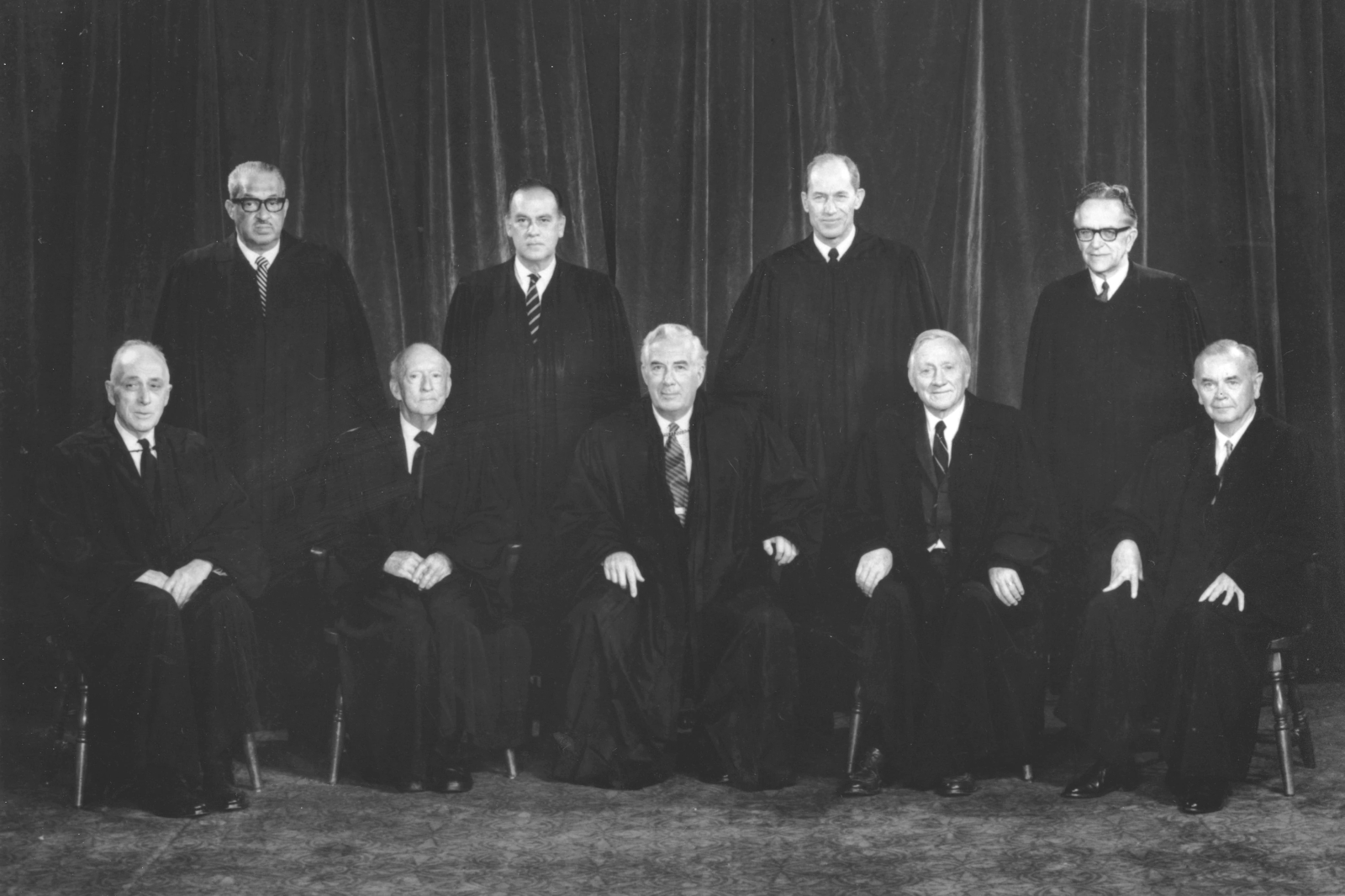
The Burger Supreme Court – 1971
Desegregation. Thus it was that federal judges – even at the regional level of the federal circuit courts – got into the legislation business. For instance, federal judges took it upon themselves in a number of court cases to design exactly the specific ways that the country was to undertake racial integration (as in the 1969 U.S. v. Montgomery County Board of Education decision) – establishing specific racial hiring goals and various bussing programs sending specific numbers of school children to this or that local school district – regardless of the views of the local citizens, even when Black parents showed an interest in sending their children to schools of their own racial character (as in the 1968 Green v. County School Board) – all of this supported all the way up to the Supreme Court (the 1971 Swann v. Charlotte Mecklenburg Board of Education case). This judicially-decreed program coming from the Supreme Court would naturally survive all political challenges over the next thirty years.[13]
Abortion. Then there was the matter of abortions – outlawed in the majority of American states. A Texas law prohibiting abortion made its way up to the Supreme Court in 1973 (with others much like it pending) in the case of Roe v. Wade. In a 7-2 decision, the Texas law was overthrown, because it (according to the 14th Amendment) deprived a woman of her right to due process. Realizing the highly controversial nature of this ruling, the Supreme Court then set out specific terms by 3-month periods as to when an abortion could occur, with increasingly restrictive standards as the fetus developed into a full child. That was simply legislation!
In any case, feminists were overjoyed – and Christians deeply outraged, for Christianity had always considered life from the moment of inception as belonging to God – neither man nor woman. To them Roe v. Wade simply amounted to court-approved murder. But there was little that the Christian world could do. The Supreme Court had made it quite clear on which side of the moral issue it stood (at least the majority of its members, anyway). And there was no known appeal that Americans could make to block a Supreme-Court-created law.
Christianity in trouble. Right along with the middle-class family, Christianity was finding itself losing status at the heart of American culture – for the two were closely connected. And behind this was again, the Supreme Court and the legal crusaders of the American Left – who wanted to see Christianity gone from all public life. Citing the First Amendment as calling for the separation of church and state, in case after case the Supreme Court had since the early 1960s been invoking the “non-establishment clause” of the Amendment as actually calling for the legal disestablishment of Christianity whenever and wherever it should come into the ever widening realm of the state – meaning, virtually all public life now. Even locally, the state (local schools, town halls, public parks) could not involve itself with the Christian religion in any way – for to do so would be to “establish” it. The fact that this had long been a key part of local life was no longer sufficient reason to allow this to continue. And all of this was done in violation of the protections of religion outlined in the First Amendment which stated clearly that Congress (meaning the part of the Federal system that made its laws, not anticipating that the Supreme Court would take over supreme responsibility in that area) was to “make no law respecting an establishment of religion, or prohibiting the free exercise thereof.” But prohibiting the free exercise was exactly what the Supreme Court was doing. How was it that the Supreme Court could not find itself able to defend the very clear wording of the Constitution?
Lemon v. Kurtzman (1971). Worse, the Supreme Court even got into the business of the “establishment of religion” in its 1971 decision in the Lemon v. Kurtzman case. Its decision stated that only secular (or basically non-Christian) programming could be part of the local school program. Also, the only material that could be brought into the classroom had to clearly serve a purely secular purpose.
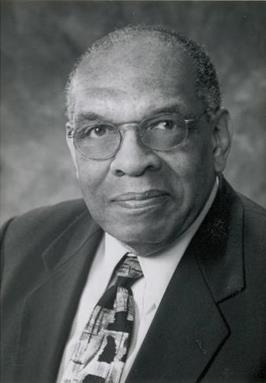

Alton Lemon David Kurtzman
Supposedly secularism was not a religious matter, and therefore the Supreme Court felt it fully within its power to prescribe the Secular worldview as the only worldview to be presented and worked from in developing the thinking and understanding of America’s rising generations.
What this small group of “enlightened” lawyers was doing was actually deciding for the rest of the country the quite religious question as to the dynamic source of life. They had made for the country the decision that life was to be understood as being by nature purely secular, that is, mechanical, operating only from a set of natural laws that scientists (social and physical) have discovered – or will soon discover anyway – which direct all existence.
And that sense of life being purely mechanical extended also to all social as well as material dynamics (the Humanist part of Secularism). According to Secular-Humanists, society too operates strictly according to a set of mechanical or “natural” social laws, which “social scientists” are working hard to discover.
And in any case, being purely “mechanical” in view of life and its dynamics, Secularism cannot be considered to be “religious”, because religion is only about supernatural or “non-mechanical” causes. Or so the Secularists argued.
Therefore, anything to do with advancing a Christian worldview, being obviously religious in nature, was supposedly forbidden by the Constitution (which part were they actually referring to?). Only Secularism had the right to be established (by the Court itself) as America’s fundamental worldview (in other words, religion), the only one to be allowed legal support in America’s public life.
Wow! With that Supreme Court decision, the people’s right to determine those religious matters themselves, one of their key freedoms – the first one to be mentioned, in fact, in the First Amendment – just got thrown out. Religious orthodoxy was now completely in the hands of the federal judges, the new high priests of Secularism.
The Humanists respond. Of course the American Humanist Association[14] recognized its opportunity in the Kurtzman ruling – but also the dangers. If the original Humanist Manifesto (1933) had been brought into the Kurtzman hearings, it would have been very clear that what the Supreme Court was supporting was indeed a religion, not merely some neutral Truth – because the Manifesto itself clearly confessed this to be the case in its repeated use of the term “Religious Humanism.” Consequently, the organization came out in 1973 with the Humanist Manifesto II – in which all the language about Humanism as being a new, more progressive religion was dropped. Humanism was simply pure science, nothing more.
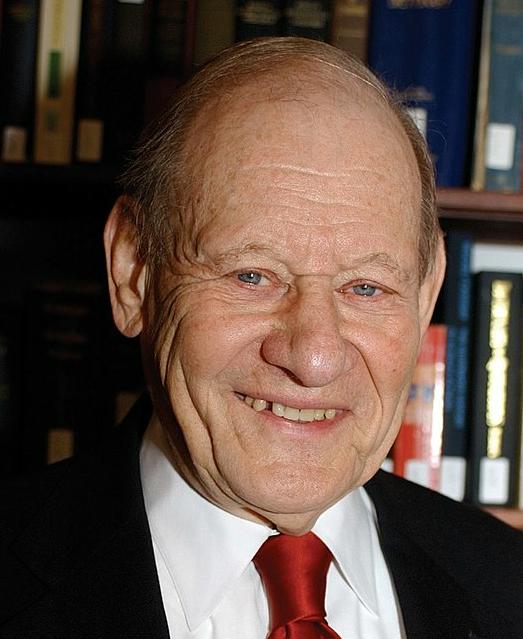

Paul Kurz Edwin H. Wilson
Behind this 1973 revision of the Manifesto were Kurz (a philosophy professor at SUNY-Buffalo) and Wilson (a Unitarian minister who first helped publicize the 1933 version of the Manifesto) … both editors at one time or another of the Humanist magazine.
Mainline Christianity in crisis. As the 1970s rolled along it became increasingly apparent that the traditional denominations (Baptist, Methodist, Presbyterian, Lutheran, Episcopal, etc.) were being sustained largely by an ageing Vet generation. Boomers showed little interest in participating in, much less committing themselves to, congregational life.
To try to reverse a persistent decline in numbers, church officials at the national level attempted to design programs that would adjust their denomination’s agendas in a way to make them more relevant to the changing culture around them. They proudly took up the causes of “peace and social justice,” authorizing special seminars on the subjects – and just in general going on public record in favor of this or that stand (mostly Leftist) similar to the progressivist world around them. “Old-time religion” (personal salvation and gospel missionary work among the unchurched at home and abroad) dropped from the agenda.
But sadly, all this did was make their churches so much like that larger, secular culture that there was very little reason to come into church from that culture – when culture and church offered mostly the same programs. Thus the persistent decline in Mainline Christianity continued.
Sadly, the denominational leaders never caught on to what was actually happening, or were so deeply committed to their religious “Liberalism” that they refused to change course.
The Evangelical – even Charismatic – movement. Yet there seemed to be something of a small “Awakening” among a breed of independent, mostly Pentecostal, churches – that directed Christianity down that “old-time-religion” road. Not only did they bring the message of repentance and God’s offering of personal salvation back into focus – but as Pentecostals they engaged in prayerful healings, prophesy and other works of the Spirit (that scared mainline Christians terribly). And pianos, guitars and drums replaced the church organ – and the music became more contemporary in style – helping to bring in even some of the Boomers and their children.
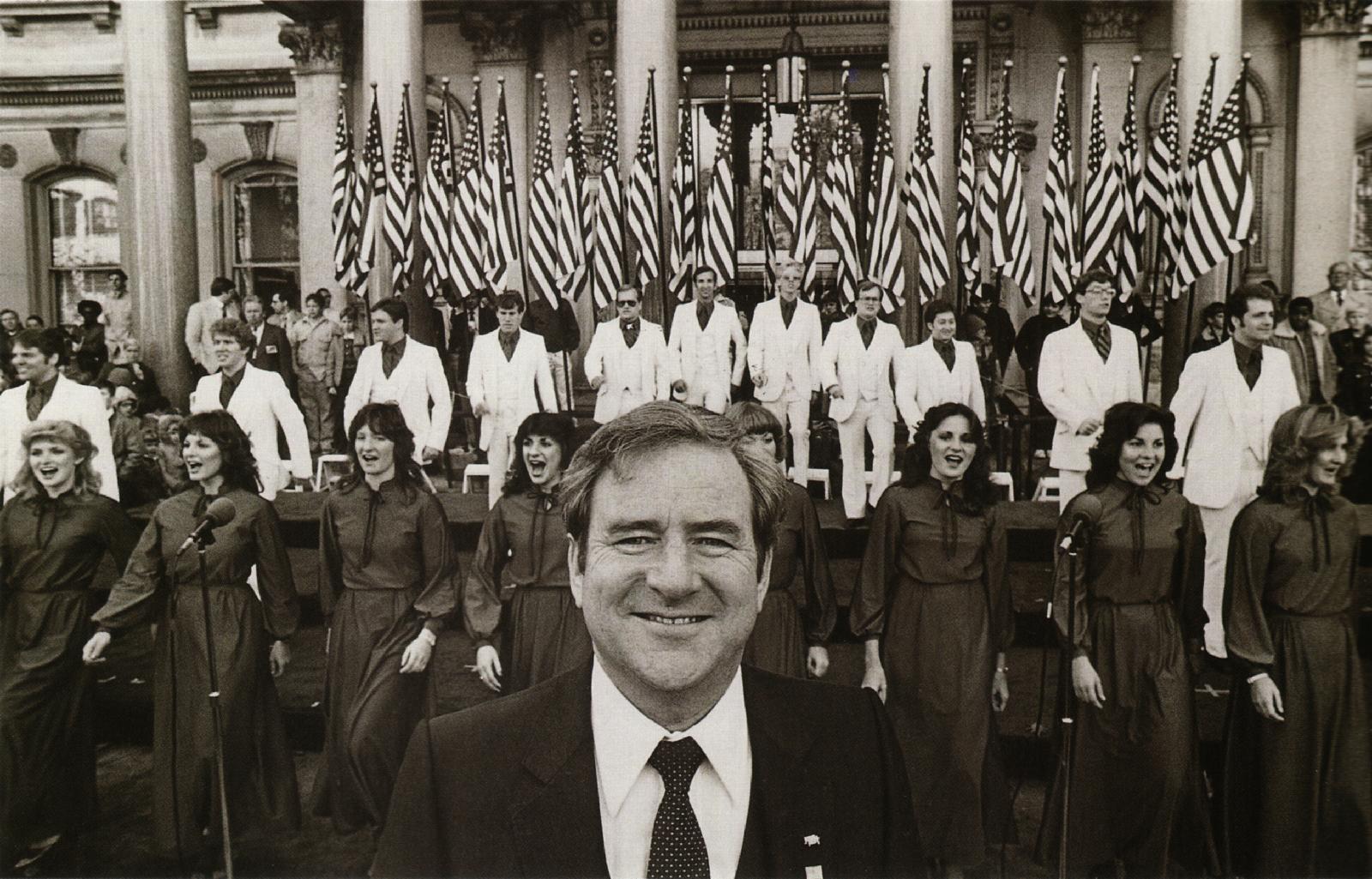
Pastor Jerry Fallwell certainly understood how to conduct televised Christian worship – 1980
New kinds of leaders – with popular TV ministries – began to come into view – and speakers at renewal events began to take up the preaching circuit. Missionary work became emphasized – supported by real tithing (and not just tipping the offering plate) which now became the norm. And personal testimonies of the work that God had accomplished through this or that individual – sometimes just ordinary members of these churches – filled their time together. Bible studies and family seminars became common.
Did all this start up a new grand revival in America? Was America entering yet another Great Awakening? Not apparently. But the Evangelical agenda certainly slowed down the overall decline of Christianity in America.
But there still remained a lot of work to be done to get America back on its original Christian foundations. America was up against a culture which was swinging rapidly to the Secular, Humanist, not to mention hedonist/narcissist Left.
[13]Did desegregation equal integration? Not exactly, as the bitter anti-White attitudes of the Black Panthers demonstrated, even as White America was moving strongly to desegregate the country. Desegregation could be done under government authority, no matter what the public feelings were on the matter. But integration requires a change in the human heart, not something that laws can themselves generate. That takes inspiring leadership to develop the necessary changes in human hearts.
[14]The Humanist Association states in its letterhead: “Good without a God: Advocating progressive values and equality for humanists, atheists, and freethinkers.”