CONTENTS
 Reagan enters the White House
 Reagan gets tough
 The American economy struggles forward
 The Major developments in foreign policy
 The Iran-Contra Affair
 The one-term presidency of George H.W. Bush
 Foreign affairs during the Bush, Sr., presidency
 The Boomer Bill Clinton takes the White House
 Domestic politics during the Clinton years
 Clinton and the world
Particular events shake the country deeply in the 90s
Social developments during the Reagan-Bush-Clinton years
The textual material on this webpage is drawn directly from my work, America’s Story – A Spiritual Journey © 2021, pages 367-408
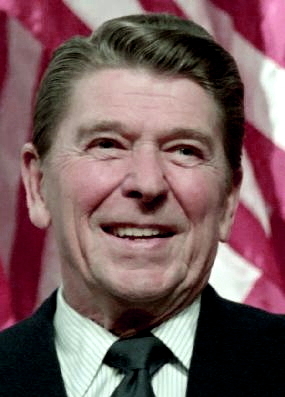 The 1980 presidential election. In the upcoming 1980 national elections, the Republicans nominated as the party’s presidential candidate the former actor Ronald Reagan – who however also had a long political career – as once head of the actors’ guild and then two terms as governor of California (1967-1975). He had run for the Republican nomination in 1976, taking a tough stance on the Cold War (he was not greatly fond of détente) – but in the end lost out to Ford. In the 1980 convention he competed against and ultimately defeated veteran Washington insider George Bush for the presidential nomination – but ended up asking him to join him on the Republican ticket as vice president. He campaigned on the same tough stance – depicting Carter as just another nice guy.
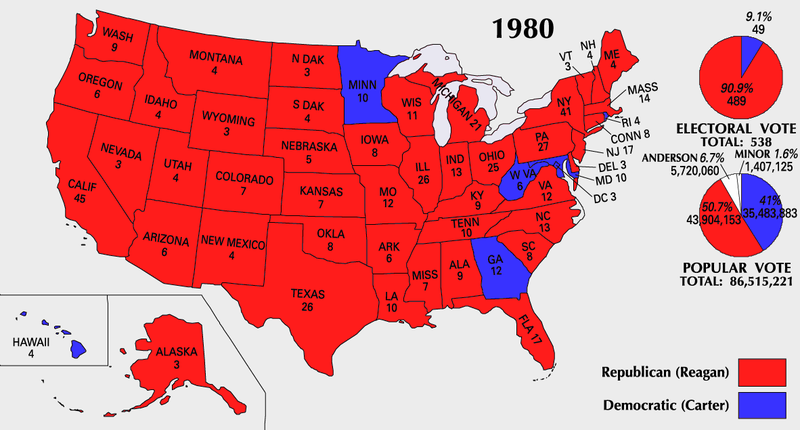
But the sad state of the economy would ultimately be the cause of a sweeping Reagan victory in the November 1980 elections. Reagan received 50.7% of the popular vote and 489 electoral college votes to Carter’s 41% of the popular vote and only 49 electoral college votes, the balance of the popular vote going to third-party candidate John Anderson with 6.7% of the popular vote (but no electoral college votes).
The 1980 presidential election. In the upcoming 1980 national elections, the Republicans nominated as the party’s presidential candidate the former actor Ronald Reagan – who however also had a long political career – as once head of the actors’ guild and then two terms as governor of California (1967-1975). He had run for the Republican nomination in 1976, taking a tough stance on the Cold War (he was not greatly fond of détente) – but in the end lost out to Ford. In the 1980 convention he competed against and ultimately defeated veteran Washington insider George Bush for the presidential nomination – but ended up asking him to join him on the Republican ticket as vice president. He campaigned on the same tough stance – depicting Carter as just another nice guy.
But the sad state of the economy would ultimately be the cause of a sweeping Reagan victory in the November 1980 elections. Reagan received 50.7% of the popular vote and 489 electoral college votes to Carter’s 41% of the popular vote and only 49 electoral college votes, the balance of the popular vote going to third-party candidate John Anderson with 6.7% of the popular vote (but no electoral college votes).
 As the last humiliation to Carter, on exactly the day Reagan was being sworn in as the new U.S. president, Iran released the American hostages – and they were on their way home. True, Carter had worked hard for that release. But the fact that it came when it did made it appear that it was done possibly out of fear of the new tough president – at least that is how a lot of Americans read the event.
 Reagan – the man, and the Christian. Reagan was born in Illinois in 1911, and raised in several Illinois towns, to an Irish Roman Catholic father, who was a salesman, and a Protestant mother, whose deep religious convictions would have a very strong influence in the way Reagan grew up, and the way he looked at life. In Dixon, where the Reagans finally settled in, Reagan became strongly influenced by his pastor, Ben Hill Cleaver – who would become like a second father to Reagan – and ultimately also Cleaver’s daughter, with whom Reagan became engaged, until she moved to Europe and broke the engagement. Although this hurt did not undercut his Christian faith, which remained strongly private, it did end his church attendance, for a very long time.
His youth seemed unexceptional, even at Eureka College where he was merely a “C” student. But his service as a lifeguard (saving numerous lives), swim team captain, and student body president gave indication that he did not intend to stay “average.” And he got that chance to step out in life as a radio sports announcer. And then, on a trip to California covering a game there, he took and passed a screen test – which then opened the door for him to become a bit-player in numerous B-grade Hollywood movies. But he moved up in importance, until his role as the lead actor in the Knute Rockne movie (1940) brought him to stardom.
Reagan – the man, and the Christian. Reagan was born in Illinois in 1911, and raised in several Illinois towns, to an Irish Roman Catholic father, who was a salesman, and a Protestant mother, whose deep religious convictions would have a very strong influence in the way Reagan grew up, and the way he looked at life. In Dixon, where the Reagans finally settled in, Reagan became strongly influenced by his pastor, Ben Hill Cleaver – who would become like a second father to Reagan – and ultimately also Cleaver’s daughter, with whom Reagan became engaged, until she moved to Europe and broke the engagement. Although this hurt did not undercut his Christian faith, which remained strongly private, it did end his church attendance, for a very long time.
His youth seemed unexceptional, even at Eureka College where he was merely a “C” student. But his service as a lifeguard (saving numerous lives), swim team captain, and student body president gave indication that he did not intend to stay “average.” And he got that chance to step out in life as a radio sports announcer. And then, on a trip to California covering a game there, he took and passed a screen test – which then opened the door for him to become a bit-player in numerous B-grade Hollywood movies. But he moved up in importance, until his role as the lead actor in the Knute Rockne movie (1940) brought him to stardom.
 In the meantime, he had entered the Army Reserves (1937) as a second lieutenant, and in early 1942 was activated fully, in the military’s Public Relations division, producing everything from military training to war-bond campaign films. And like so many, his military service introduced him to the world of political affairs. Thus in 1947 he ran and was elected as the president of the Screen-Actors Guild.

Reagan appearing before the House Un-American Activities Committee – 1947
But it was a very troubled time for the movie industry, due to the political controversies aroused by the postwar Red Scare, and Reagan had to tread lightly, although he himself was strongly anti-Communist in his own political standing. Yet here is where his strong Christian background – and his mother’s influence – played a key part in his efforts to bring reconciliation rather than condemnation to all this political dynamic. Unfortunately, such reconciliation did not work with his wife, actress Jane Wyman, and their 9-year marriage ended in 1949 when she divorced him because of all the political dynamics their lives were caught up in. But he would remarry three years later another actress, Nancy, whom he came to the aid of when she was confused with an actress of the same name, who was identified as a Communist. And though she would never become quite the Christian that he was, they worked closely together in a very harmonious marriage, one that would be a big support to Reagan as he moved forward in life, increasingly of a conservative political nature. His known conservatism – and national popularity because of his long hosting of the popular TV show, The General Electric Theater – led him to be a keynote speaker at the 1964 Republican National Convention and Barry Goldwater supporter. This in turn caused the California Republican committee to ask Reagan to run against Democratic Party Governor Pat Brown in the 1966 gubernatorial election, which Reagan won!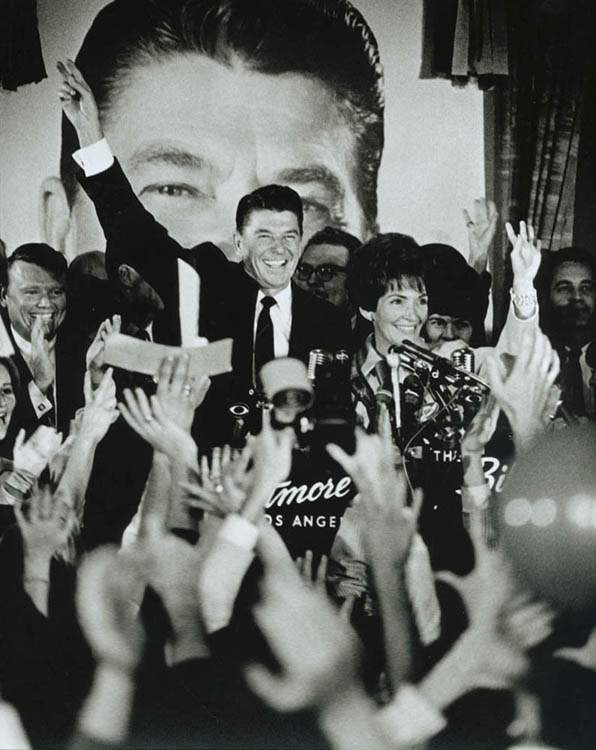
Reagan and his wife Nancy at his win of the California governor’s race – November 1966
Here his conservatism demonstrated itself in the way he went at the state’s finances, and his stand against all the student protests that had rocked the state. This proved to be exactly how the California majority (at that time, anyway) wanted things. And he was reelected governor in 1970. As he approached the end of his second term as governor, he began to look at the idea of running as the Republican candidate for the U.S. presidency itself. And indeed, in the 1976 race, he became the leading contender against Ford, the latter who however ultimately got the Republican nomination (but lost the presidential race itself to Carter). That did not seem to slow Reagan up much, and four years later he made another run at this goal, was indeed nominated as presidential candidate by the Republican Party, and ultimately brought to the White House by the American voting public.
 As a strongly self-acknowledged Christian (as Carter had also been) Reagan certainly led the nation to wonder where his Christian faith would touch on his political leadership. He had not been a church-going individual, and seldom spoke of his personal faith. But he (much like Eisenhower and Nixon before him) spoke very often about the American nation itself and the vital relationship it had long had with God – and the way that this relationship was so important to the nation’s development. And indeed, it would be this sense of America’s ties with God that would register itself deeply during his presidency, in numerous ways.
The importance of the Christian religion would even become an important part of his discussions with Gorbachev, in Reagan’s efforts to bring Russia out of its Communist camp and into a much freer world – one of peace rather than contention.
As a strongly self-acknowledged Christian (as Carter had also been) Reagan certainly led the nation to wonder where his Christian faith would touch on his political leadership. He had not been a church-going individual, and seldom spoke of his personal faith. But he (much like Eisenhower and Nixon before him) spoke very often about the American nation itself and the vital relationship it had long had with God – and the way that this relationship was so important to the nation’s development. And indeed, it would be this sense of America’s ties with God that would register itself deeply during his presidency, in numerous ways.
The importance of the Christian religion would even become an important part of his discussions with Gorbachev, in Reagan’s efforts to bring Russia out of its Communist camp and into a much freer world – one of peace rather than contention. The air traffic controllers strike. The American economy remained in horrible shape, thanks to persistent inflation, ruinously high interest rates, and high national unemployment. Consequently, America’s labor groups were in a very restless mood. But when the members of the Professional Air Traffic Controllers Organization (PATCO) went on strike in August of 1981, Reagan moved strongly against them, claiming that they had no right to shut down America’s airports – merely worsening the national economy all the more. He fired some 11,300 strikers, cut back scheduled flights to about 50 percent of the normal rate, and brought in replacements (including military air traffic controllers) to take over those flights.

America was not used to seeing such presidential power – but greatly approved his actions. Ultimately this shattered PATCO – and sent a warning to other unions not to mess with the nation’s economy. They didn’t!
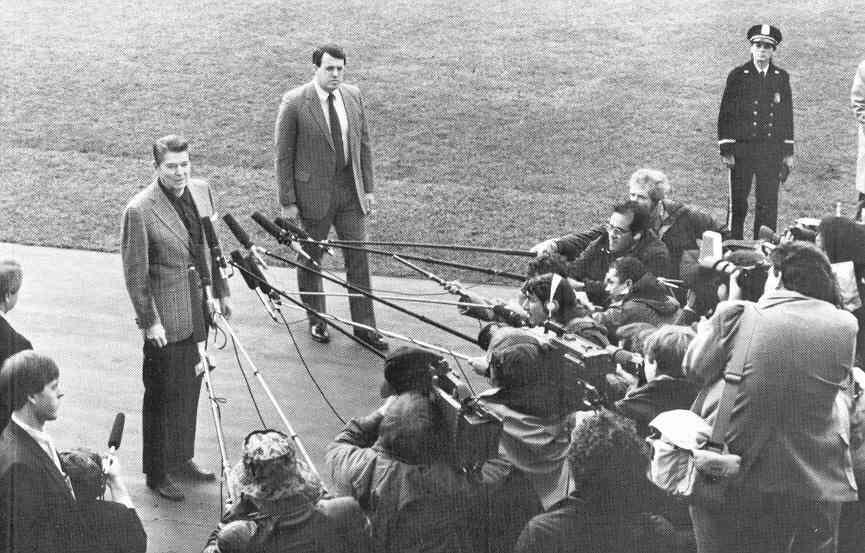
The Lebanon crisis (1982-1984). In 1982 Reagan decided to answer an appeal for help by the United Nations in pacifying warring groups – stirred to wrath by Israel’s attack on Palestinian refugee camps in Lebanon that June. Lebanon was tearing itself apart. Consequently, Reagan sent 800 American troops in August to try to separate the warring parties. But the fighting only grew worse, especially when Christian Lebanese fighters, allied with Israel, surrounded and then slaughtered men, women and children in those same refugee camps – causing America, France and Italy (the bulk of the UN peacekeeping force) to increase their number of soldiers. For a while it looked as if the situation was improving.
But the next year the situation had deteriorated again, especially after Syria decided to intervene in the civil strife in Lebanon and invaded the country – merely increasing the level of chaos there. Then that October a truck-bomb attack on the UN barracks killed 241 American and 58 French soldiers.

Now Reagan had a decision to make – pull out – or dig in even more deeply. Ultimately he decided to pull out in early 1984.
Actually, Americans were rather impressed by the ability of the president to admit defeat and go home – rather than what was often the case (such as Vietnam) when leaders would only get themselves and the country caught more deeply in a mess – because they could not admit to a mistake. Americans in fact felt comforted by the knowledge that they had a president of unusual political wisdom operating from the White House.
The U.S. military intervention in Grenada (October 1983). Partly the decision about Lebanon was shaped by events taking place in the Caribbean – when Marxist revolutionaries overthrew the government of the tiny island Republic of Grenada. From Reagan’s point of view, this was a totally unacceptable development, especially as Grenada was located on the path leading to the entrance of the Panama Canal. America did not need another opportunity for the Soviets to gain yet another strategic position in the Western hemisphere. Encouraged by other Caribbean governments – which felt themselves vulnerable to the same kind of action – Reagan sent American troops to Grenada – sparking the angry outcries of the “anti-imperialist” wing of American politics (and the world).
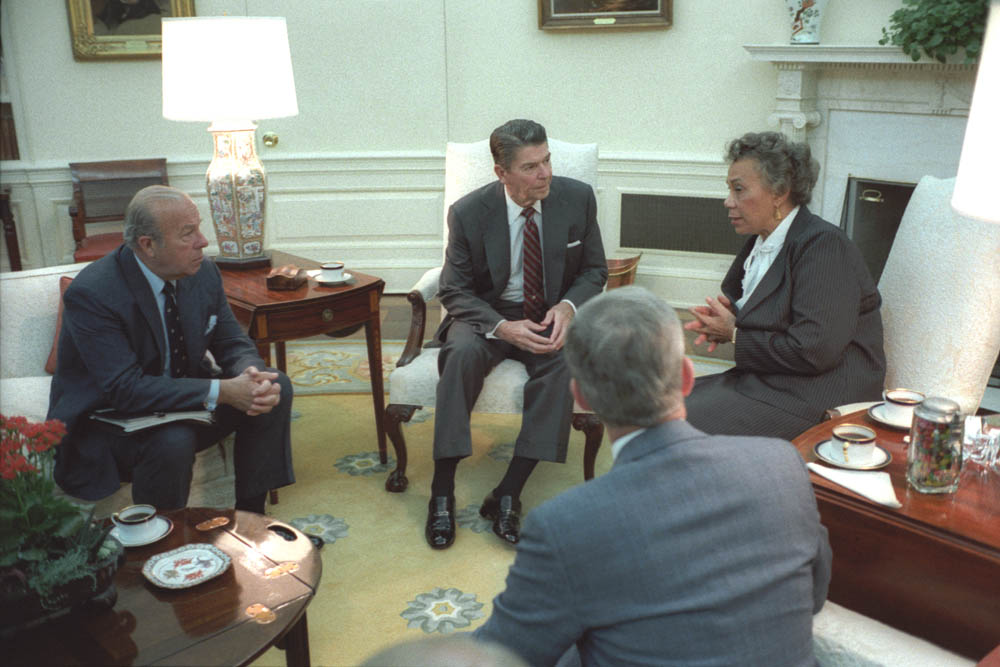
Reagan and Dominica Prime Minister Eugenia Charles discussing the situation in Grenada – 1983
Even the United Nations was quick to protest the American action. But the American troops moved so quickly (just a few days) to restore the Republic’s constitutional government back to power that the American voices of opposition died away quickly. As for the United Nations, Reagan was tiring of its whining – and simply disregarded it – much to the delight of the majority of Americans. Clearly Reagan was not one to be pushed around by world public opinion. Everyone – including the Soviets – took notice.
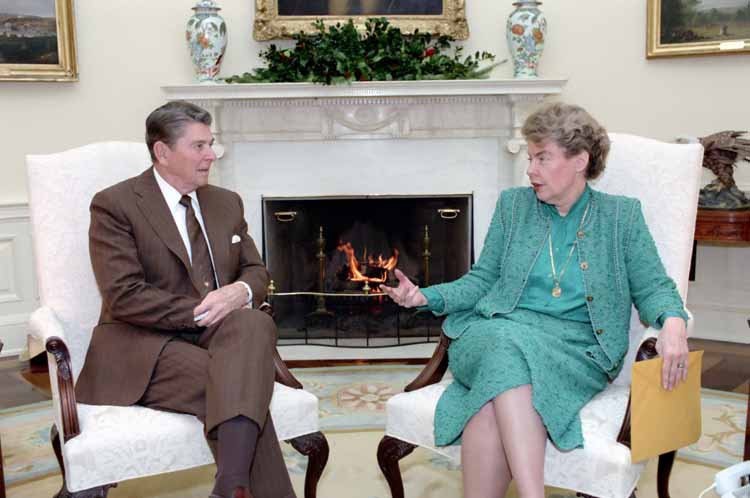
That same toughness extends to the US presence at the UN where America is represented by the no-nonsense US Ambassador Jeane Kirkpatrick … here discussing matters with Reagan – December 1984. A dozen year earlier, she was one of my professors and then ultimately one of my three doctoral dissertation mentors at Georgetown University … very, very supportive of my work on the politics of multiculturalism in Belgium.
THE AMERICAN ECONOMY STRUGGLES FORWARD
Supply-side economics. Reagan had made a big deal of how he intended to fight the stagflation (economic stagnation and accompanying inflation) with his own approach to the economic crisis (popularly termed “Reaganomics”). He was going to pursue the doctrine of supply-side economics – in short, get industry back up and running so that a more abundant supply of goods would begin to bring prices back to normal.
But how he planned to do that with Volcker’s interest rates running so high was a huge mystery. With car loans and mortgages running at such high interest rates, few Americans were willing to purchase either cars or houses. Likewise, businesses could not contemplate their expansion when interest rates demanded by the financial world remained prohibitive. How exactly then was Reagan going to get production or “supply” back up and running again?

Reagan gives a televised address from the Oval Office, outlining his plan for Tax Reduction Legislation – to help get the American economy back up and running again – July 1981
Actually, two things would have to happen first. The price of energy would have to come back down to an affordable level. And so would interest rates. But those were matters with two very different causes: Arab-dominated OPEC – and America’s “economic czar” Federal Reserve chief Paul Volcker – neither of which seemed to be in a very cooperative mood.
Energy prices. But something was stirring in the energy world. And it was coming from Russia. The Soviet economy was slowing down. Socialism had not brought “workers’ paradise” to Russia – and Russian workers were losing interest in the well-being of their economy, with workers’ absenteeism rampant at the workplace – as well as alcoholism when they did show up. Years of focusing the Russian economy on the military had left the country with little to offer its workers. Russia had no plans to cut back on its military – but needed something extra to provide funding in order to develop something of a private or personal economy. But the only such asset Russia possessed – one that had serious value on the world market – was oil and gas – which Russia was enormously abundant in.
Russia was not a member of OPEC, but followed OPEC pricing closely. But now Russia was going to have to break from that group and drop prices for its petroleum products in order to get them to a hungry market ahead of OPEC. So in 1981 the Soviets lowered their prices. This now put OPEC members in a bind because they would have to do so also – in order not to have all their customers head off to Russia for their oil purchases. But then OPEC’s lowering of its prices forced Russia to have to do another round of price reductions – forcing OPEC to do the same thing. Now a price war began to bring energy prices down – dramatically so. Thus the politically designed energy shortage, the primary cause of the global inflation, eventually came to an end – and inflation with it.
Dealing with Volcker. Now Volcker no longer had the excuse of fighting inflation with his monetarist or tight-money strategy. Volcker, as the American economy’s supposed savior, did not let up gladly – until Congress threatened to reduce the powers of the Federal Reserve if he did not do so. Thus interest rates finally came down – and the economy finally got up and moving again.
Social Security. One of the issues that had troubled the 1970s and was needing a solution heading into the 1980s was the matter of Americans’ Social Security funding. Due to the immense energy-driven inflation that hit during the 1970s, the Cost of Living Allowance (COLA) had to be adjusted to the point that it nearly emptied out the assets of the Social Security Trust Fund. Thus Social Security taxing was increased from 2% to 6.15% of a worker’s earning, helping somewhat. Also the rate of increase of the COLA was slowed up.
Then in 1983 it was decided to separate the Social Security Fund from the federal government’s general revenue, giving it its own dynamic to be worked with (at this point combining its account with the federal general budget account was actually considered a detriment – not a boost – to the federal budget picture!).
But, provision was made to use now-independent Social Security Funds to “help” the federal government by purchasing the federal government debt – which is supported through the sale of bonds or IOUs to a funding source. And why not the Social Security Trust Fund? That money just sits there. Why not “invest” that money in government bonds? But critics pointed out that should some serious problem arise with the government debt, the people’s Trust Fund could be found to be holding only worthless government IOUs. Defenders said that this was highly unlikely (conveniently forgetting the numerous times in the past that the federal government came close to financial failure). Supporters of the deal ultimately won the argument, and thus this indeed became the character of the Trust Fund: a major creditor to the federal government, holding a massive amount of federal government IOUs, at times fully one-half of the huge federal debt.
Reagan’s reelection in 1984. The Democrats would certainly understand that they were going to have a hard time running against the very popular Reagan – who was due to run for reelection in 1984. Democrats nominated the former U.S. senator from Minnesota and vice president under Carter, Walter Mondale, as their presidential candidate.

In the end, Reagan scored a huge 58.8% of the popular vote and 525 electoral college votes to Mondale’s 40.6%, and only 13 electoral college votes: the ever-Democratic-Party supporting three votes of Washington D.C.[1] – and those of Mondale’s home state of Minnesota. The outcome was never in doubt.
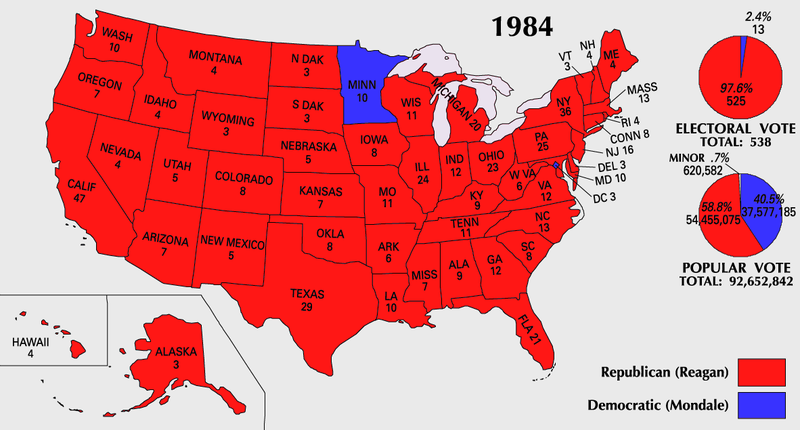
[1]Ever since Washington, D.C. was given the right to choose its own presidential electors in 1961 (the 23rd Amendment), D.C. has been the strongest Democratic Party supporting constituency in the nation. This is hardly surprising, as the Democratic Party represents perfectly the idea that the Washington bureaucracy should be running the country. In fact it is surprising that there are any Republicans at all in this district! Thus in the most recent national elections, the Democrat Biden received 92.15% of D.C.’s vote, compared to the Republican Trump’s 5.4%, a D.C. voting spread identical to that of the 2016 race between Hillary Clinton and Trump.
MAJOR DEVELOPMENTS IN FOREIGN POLICY
 Muammar Gaddafi. With the exception of Egypt – now under Mubarak but continuing to follow Sadat’s same pro-West, even pro-American, foreign policy – the Arab world was as eager as ever to develop Arab nationalism. Israel provided the ever-ready cause behind restless Arab nationalism – with various Arab modernizers such as Muammar Gaddafi of Libya trying to present themselves as the Arab world’s best champion. The flamboyant Gaddafi attempted all sorts of programs (his little Green Book of Gaddafi quotations – similar to Mao’s little Red Book), from Arab Socialism and then back to Arab Capitalism (Libya was very wealthy in terms of oil reserves) – sometimes quite Secular, sometimes orthodoxly Muslim (in Gaddafi’s own unique way). When the Arab world turned out not to be terribly responsive to his attempts at Arab leadership, he then became very “African” – attempting to make himself the leading voice in African affairs taking place to the south of Libya.
But he pushed things too far with Reagan when it was discovered that he was connected to the 1986 Berlin bombing of a discotheque in which a number of American soldiers were killed
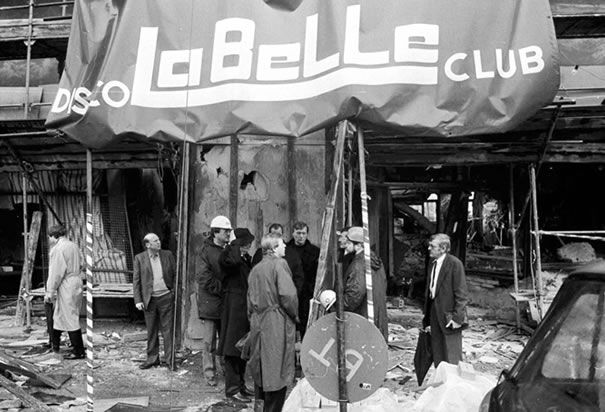
– and Reagan retaliated by sending patrol boats into waters claimed by Libya (considered by the West as high seas and thus nobody’s territory) – which naturally were fired on by Libya – and which Reagan answered by attacking Gaddafi’s Presidential Palace. When the United Nations condemned the attacks, Reagan simply ignored the organization – as did a number of other countries which too were tired of Gaddafi’s ventures (principally supporting various terrorist organizations such as the Irish Republican Army and various Moro or Islamic jihadist groups operating in the Philippines). Even the Soviets found themselves backing away from Gaddafi, not wanted to get dragged into an unwanted event.
Anyway, for a while, Gaddafi would be forced to behave – for fear of Reagan’s reprisals.
Other militant organizations. But huge problems in the Middle East were coming from a number of other sources, principally the PLO or its subgroup Fatah, plus Hezbollah and Hamas – primarily dedicated to the crippling or even destruction of Israel. But each represented a very different part of the world of Islam. The Palestinian Liberation Organization (PLO) or Fatah had long been the voice of the Palestinians chased out of their homelands by the Jewish migration into Palestine – and was the organization officially sponsored by the Arab League. Defending both Christian and Muslim Arab interests in Palestine, it tended to be mostly Secular in its promotion of Palestinian rights. Hezbollah however was a strongly Muslim voice of the Shi’ites – founded and supported by Iran and numerous Shi’ites among the Lebanese and Syrians – which found itself constantly in competition with the Arab Sunnis. Then Hamas came into being in the later 1980s – upset that the PLO/Fatah was beginning to show a willingness to negotiate a compromise of some kind with the Israelis. Hamas was also more militantly Muslim (Sunni) – rather than merely Secular in character.
The Rapid Decline of the Soviet Empire: Afghanistan. Meanwhile, the Soviets found themselves caught in a quagmire of rising Afghan Muslim and tribal hostility – aroused by the Russian attempt to impose a Communist puppet government in the Afghan capital city, Kabul. Afghan rebels (mujahedin) even looked to the Reagan government for help in ousting the Russian troops occupying their country – finding Reagan very eager to help out.
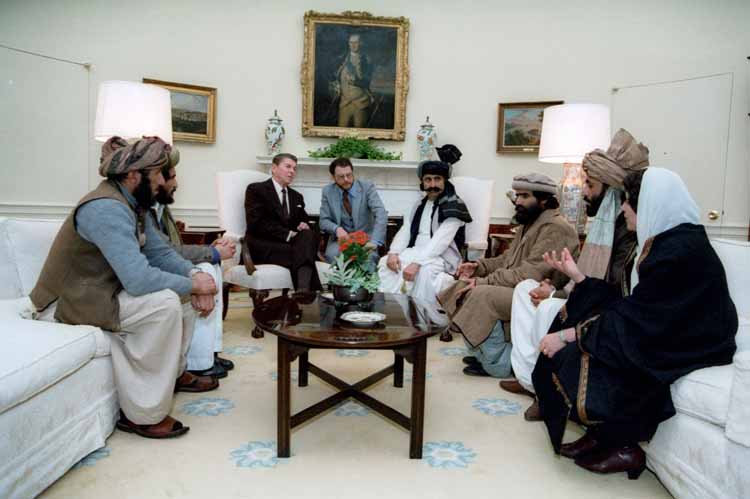
Americans sent the mujahedin all varieties of weapons, including missiles that could easily take out Russian tanks and jets. Consequently, the Soviets found themselves struggling to hang on to any kind of defensive position in the country. Soon anti-war sentiments began to grow among the Russians – including even members of the Russian military.
The rapid turnover in Soviet leadership (1982-1985). This all was taking place at a time when the Russians were having a very hard time getting leadership in place – ever since Brezhnev’s death in late 1982. At first a Communist hardliner (supposedly a good match to the equally hardline Reagan) was put in place at the head of the Party in Moscow. But he died only a year later. He in turn was replaced by another individual – who was in no better health – and who also died only a year after that.
Pressure from Reagan. Meanwhile Reagan was pushing and pressuring the Soviets in every way possible. He sensed the Soviet decline and intended to exploit it. He threw down the challenge to Russia in a speech before the British Parliament in 1982 when he called the Soviet Union an “Evil Empire” and predicted its collapse in the near future.

Soon thereafter Reagan restored the B1-bomber program that Carter had canceled and armed NATO with Pershing II missiles. In 1983 he announced plans (the Strategic Defense Initiative or SDI) to develop and deploy missiles capable of defending America from a missile attack from any enemy – which Kennedy termed as “reckless Star Wars schemes.”

It was an expensive program – but one which the Soviets – whose economy was stumbling – would be unable to match. Ultimately, the American people seemed to approve of Reagan’s “Star Wars schemes.” Once again, Reagan’s toughness drew the approval of the majority of Americans.
But in the end, the program would not be needed. The Soviet Empire would soon collapse.
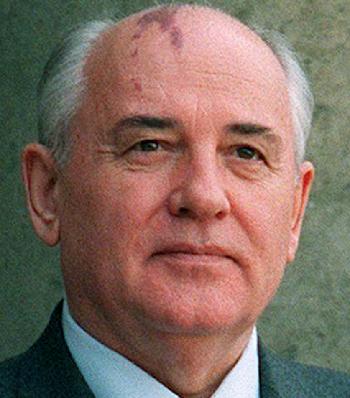 Mikhail Gorbachev. In 1985 the Russians brought to power a younger, more visionary Mikhail Gorbachev – who was looking forward to enacting a number of reforms to liberalize the government and Russian society. He was also hoping to improve relations with America.
Gorbachev introduced a number of liberalizing reforms – known as glasnost (more personal freedom for the people), perestroika (liberalizing the economic system), and demokratizatsiya (a democratizing of the political system).
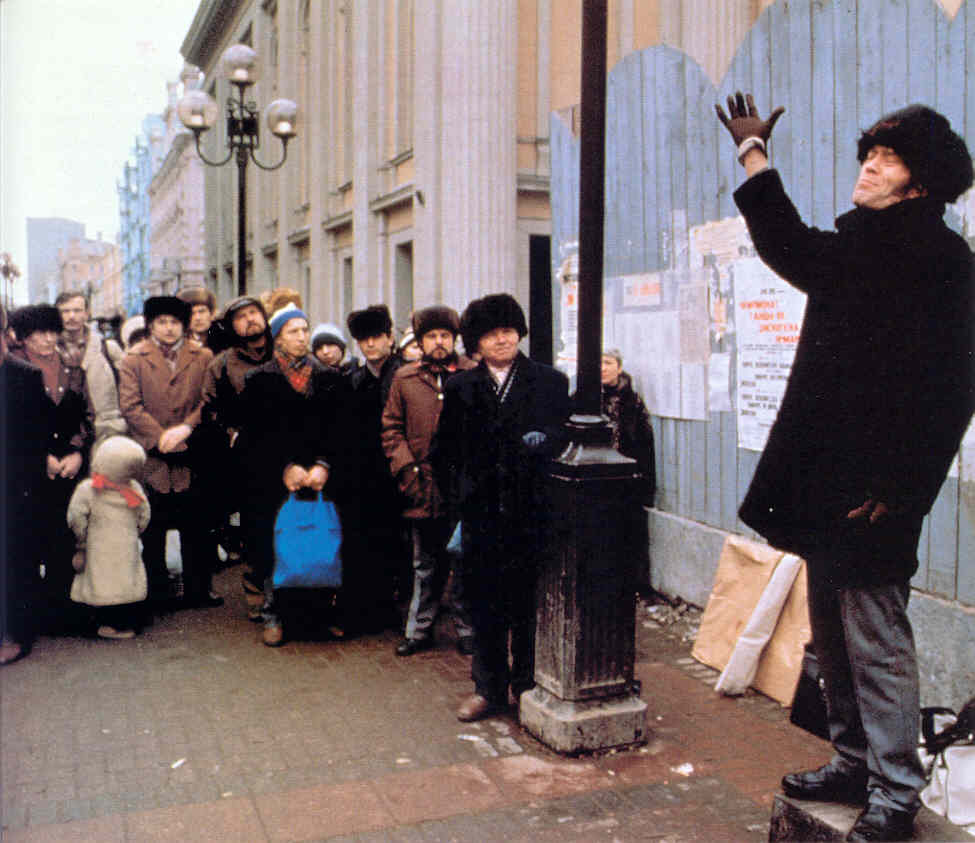
A Russian practicing glasnost on a Russian street
These reforms were well received both at home and abroad – and led to a number of very friendly meetings between Reagan and Gorbachev – to see how they could finally end the Cold War.

Reagan and Gorbachev at the first Summit in Geneva, Switzerland – November 1985
Reagan’s challenge. At one point, in June of 1987, when Reagan was visiting Berlin, he issued this challenge as he was speaking at the Brandenburg Gate:
… if you truly want peace and liberalization – Mr. Gorbachev, open this gate! Mr. Gorbachev, tear down this wall!

This did not happen right away – but something like it was underway. And Reagan knew so – although he would be one year out of office when this challenge finally was answered with the coming down of the Iron Curtain separating East and West Europe.
China continues self-reform under Deng Xiaoping. While the Soviets were undertaking deep reforms to get their economy up and moving, the Chinese Communists were doing the same thing, except with very different results. At the same time that the reforms crumbled the Soviet social-economic-political order, in China similar reforms were clearly working to strengthen Chinese society – politically in a moderate fashion and economically in a massive fashion.

A huge billboard in Shenzhen celebrating Deng’s economic reforms
Part of this was due to the Chinese entrepreneurial instinct being still alive and well in China – especially along its major Eastern cities such as Shanghai, which earlier in the century had been a hub of Chinese industry. But part of it was also due to the very favorable trade protection deals with the West that Deng had secured from the Westerners, the latter anxious to see China move closer to their world of capitalism.
Deng also kept important restraints on the dynamic in order to keep it from getting out of control (as things had developed in Russia), largely through the heavy government subsidizing of this new “independent” industrial dynamic. This heavy government support not only gave huge trading advantages to the Chinese industrialists, it kept them in a very cooperative relationship with the Deng government. Thus the Chinese economy began to boom, annual growth rates averaging 8-10% during most of the 1980s and 1990s.

In the meantime a major problem for Reagan exploded at home when in November of 1986 a Lebanese newspaper reported a story about a secret deal to get Iran to intervene to release kidnapped Americans held in the Middle East by Hezbollah – through the sale of various US weapons (via Israel as intermediary) to Iran. At about the same time (October), a CIA plane was shot down by the Nicaraguan Sandinista (strongly Leftist) government, a plane carrying weapons to anti-government troops known as the Contras. One American, Eugene Hasenfus, survived the downing, was arrested by the Nicaraguans and immediately tried – at which point he confessed to the secret shipment of arms to the Contras. Both actions were in violation of very specific legislation (the Bolen Amendment to the Pentagon budget forbidding further help to the Contras) plus the long-standing taboo of paying off kidnappers (even if only indirectly, by way of Iran’s intervention), because it merely encouraged more kidnapping.
The two events occurred at around the time of the 1986 Congressional elections in which the Democrats increased their majority in the House and now took control of the Senate as well – with large majorities in both houses (House: 258 to 177 and Senate 55 to 45).
But even before the new Congress could take its seat, the Iran-Contra Affair (as it came to be known) exploded as a major news item – forcing Reagan in mid-November to go before national television to explain his side of the affair. Two weeks later U.S. Attorney General Edwin Meese admitted that the money from Iran was used to finance the Contra shipments. On that same day Reagan fired Marine Lt. Col. Oliver North – who confessed to being in charge of the whole matter. And on that same day Reagan set up a three-man Presidential Commission, headed up by former Texas Senator John Tower, to look into the matter. In late February of the following year (1987) the Tower Commission delivered its report, outlining the actions of various participants in the whole affair – although it largely excused Reagan as not having much knowledge of the operation.

President Reagan received the Tower Commission Report in the Cabinet Room with Senators John Tower (l.) and Edmund Muskie (r.) attending – February 1987
In March Reagan again went before TV audiences – to apologize for his mishandling of the whole affair – explaining that he was in part trying to help get the release of hostages and in part working with Iranian moderates in trying to improve Iranian-American relations.
But in the meantime (January), the new Democratic Congress set up its own investigative committees – dismissing the Tower Report – obviously looking for more material to bring against the Reagan “imperial presidency.” It was Watergate all over again. The hearings ran from early May to early August – again watched closely on TV by the Americans – especially when Lt. Col. North was interviewed.

Finally a Joint Committee Report was published in November – with Republican members of the Committee issuing a dissenting Minority Report. Basically Reagan was criticized for not doing his job in staying on top of such matters. However, the Report came up with nothing specific that Congress could charge Reagan with. But even then, that would not be the end of the matter – as further investigations were conducted by a Democrat-controlled Congress all the way into 1991.
At the time, Reagan’s popularity dropped dramatically from a two-thirds approval rating to less than half. Yet his approval ratings would soon climb again to pre-Iran-Contra levels as he finished out his presidential term – due to his obvious success with Gorbachev in lowering the tensions of the Cold War.
THE ONE-TERM PRESIDENCY OF GEORGE H. W. BUSH
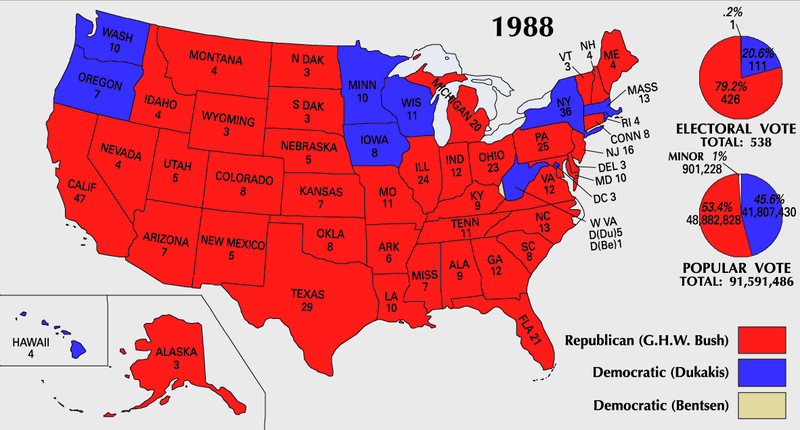
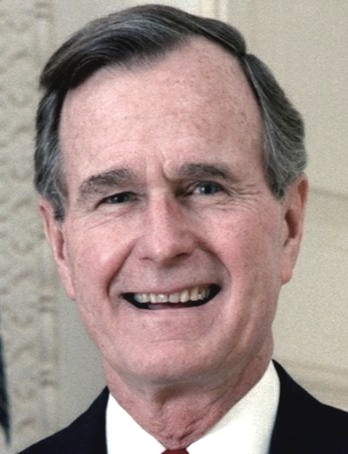 The 1988 presidential election pitted Regan’s vice president George Bush against the Democratic Party nominee, Massachusetts governor Michael Dukakis. At first Dukakis led in the polls – then Bush began to pull ahead as the elections approached – finally finishing with a large Bush victory, 53.4% of the popular vote to Dukakis’s 45.6% – and the Electoral College vote 426 to 111 (the latter, however, did not include Massachusetts!).

George Bush sworn in as the 41st president of the United States
George H. W. Bush – the making of the man. Bush was born in 1924 to a very prestigious Connecticut family, his father, Prescott, being a Yale graduate, a World War One artillery officer, a very successful Wall Street investment banker, and then (1952-1963) U.S. Senator representing Connecticut. The son, George, attended the elite Phillips Academy (1937-1942), but upon graduation joined the navy rather than head on to college. After all, at this point America was deeply involved in World War Two.
As a navy pilot, his combat experience included being shot down in the Pacific, but being picked up by a navy ship, one of the lucky survivors of the battle. He soon learned that other downed Americans were captured and executed, even having parts of their bodies eaten by their Japanese captors. This would have a profound spiritual impact on Bush, causing him to wonder why God had spared him.
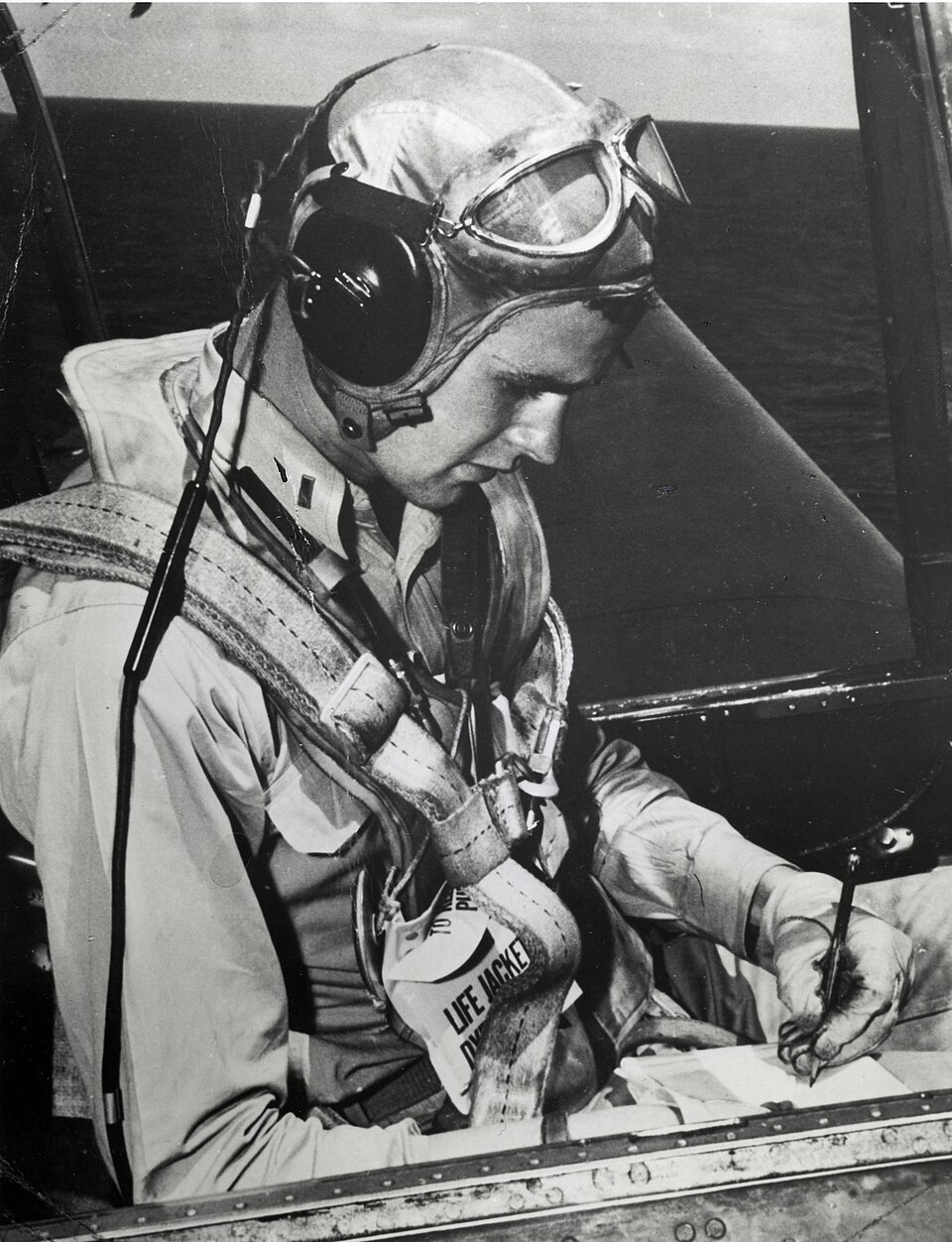
Just prior to the war’s end he married a sweetheart, Barbara Pierce, from his Phillips Academy days, and they would go on to have six children, including George W (or just “W”) and Jeb, who would go on to develop their own careers as political notables (Jeb as Florida governor and the younger George as Texas governor and U.S. president).

The Bush family – mid-1960s
After his release from service, Bush would head to Yale, graduating in 1948 with distinction, having served as captain of the baseball team, as Phi Beta Kappa, and member of the secret and very prestigious Skull and Bones society. Bush then headed into the business world, notably that of the Texas oil industry rather than the Connecticut financial world he had been born into. He wanted to be “his own man.” He quickly rose from oil equipment salesman to owner of his own oil exploration company.
But his father’s 1952 run for the senate seat, and his involvement in Eisenhower’s presidential campaign brought a strong political line to his work, though he would stay in the oil business into the early 1960s. But he could not avoid attracting the attention of the Texas political parties and he was courted, first by the Democrats and then the Republicans (the latter fitting better his conservative political instincts), and in 1966, he was able to gain a seat in the U.S. House of Representatives, one of the few Republicans to come out of the traditionally “Dixiecrat” South.
Two years later (1968) he came close to being named as Nixon’s running mate, though Maryland governor Agnew was chosen because of his strong stand against the Black riots that had shaken the country (Maryland had thus been spared the destruction experienced elsewhere). But Nixon nonetheless appreciated Bush’s political potential, and appointed him as the American ambassador to the United Nations – beginning Bush’s serious international experience.
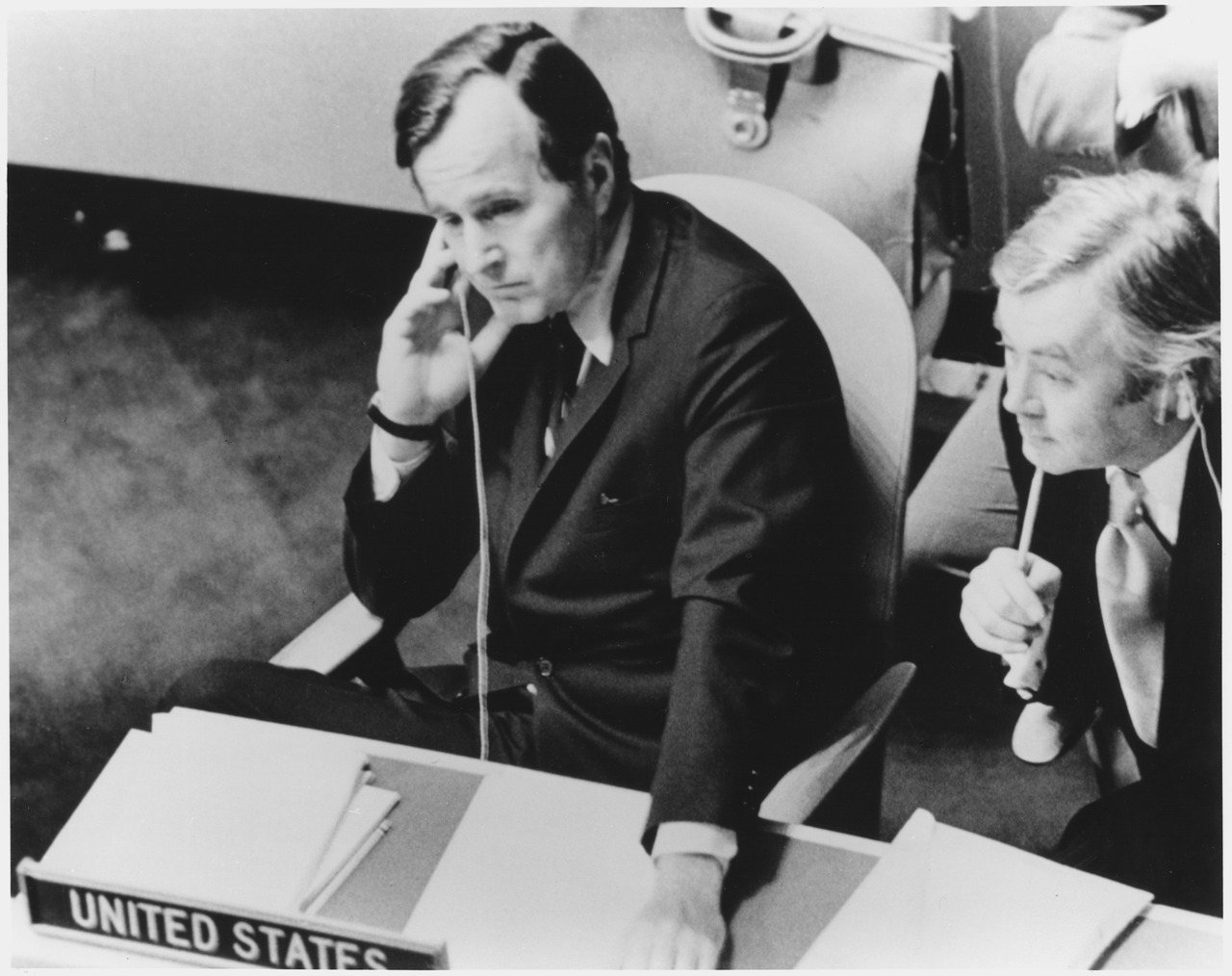
Then as Watergate was embroiling American politics at home, Nixon convinced Bush to chair the Republican National Committee, now moving Bush front and center in the party’s national political dynamics. Then with Nixon’s resignation and Ford taking the presidency, Ford asked Bush to head up the U.S. Liaison Office in China, making him something like the American ambassador to China (1974-1975).
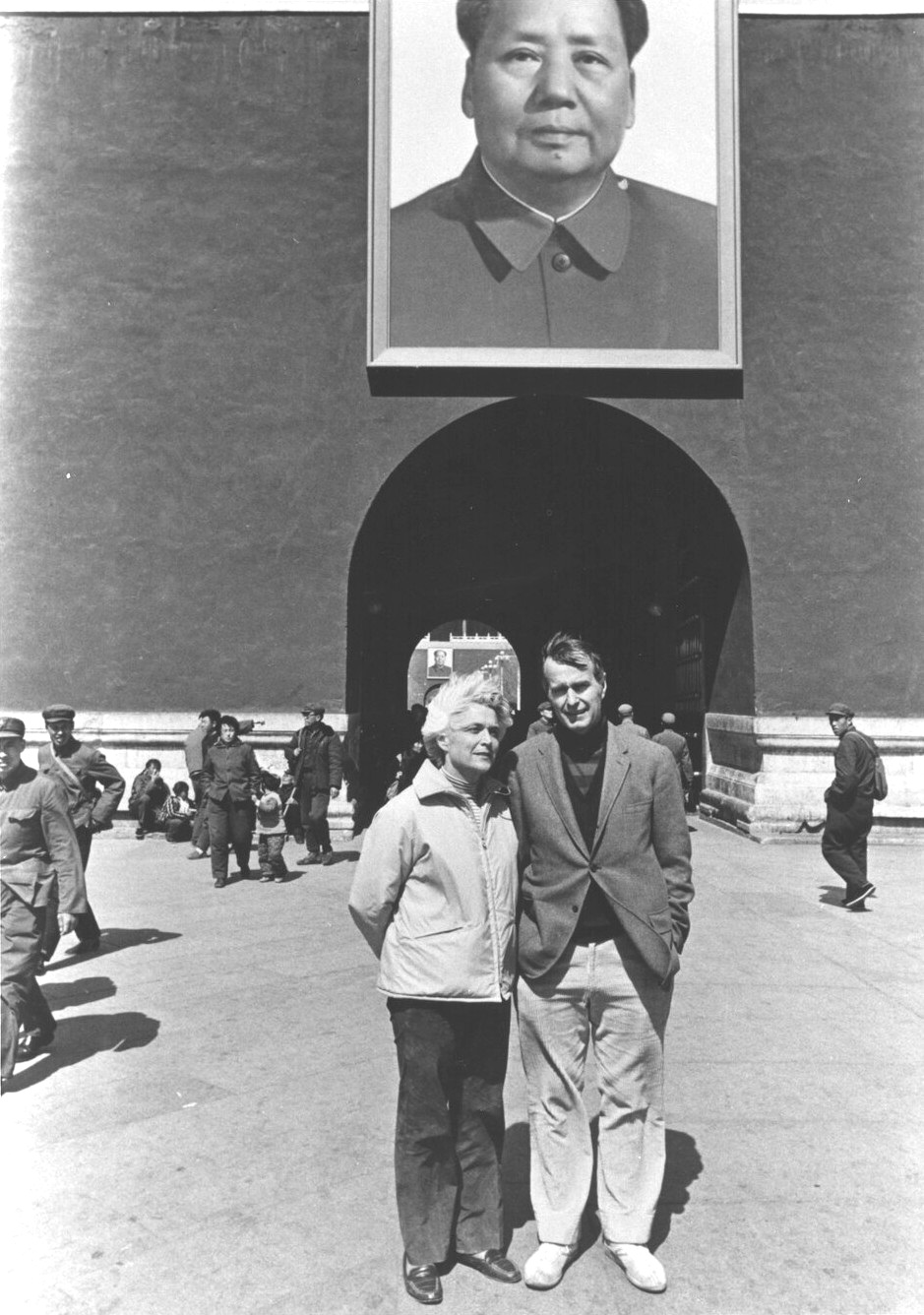
The Bushes in China – 1974-1975
Then Ford brought Bush back to D.C. to take charge of the C.I.A., which was suffering from serious image-decline due to the strongly Leftist atmosphere blanketing the nation’s capital. But he would hold that position only a year, when Carter’s election put Bush out of a job. He thus returned to his Texas business world as a Houston banker, and began thinking about a run for the U.S. presidency in the upcoming 1980 race.
And so he undertook to build his support going into the 1980 electoral campaign, but found himself up against the even stronger support running in Reagan’s favor. So he backed out of the race, only to have Reagan ask if he would be willing to serve as his running mate. He agreed, worked hard in support of Reagan, and then for the next eight years found himself serving strongly, but quietly, Reagan’s presidency. And thus it was an easy thing for the Republicans to ask Bush in 1988 to take over the Reagan legacy as the Republican Party candidate as Reagan approached the end of his second term of office.
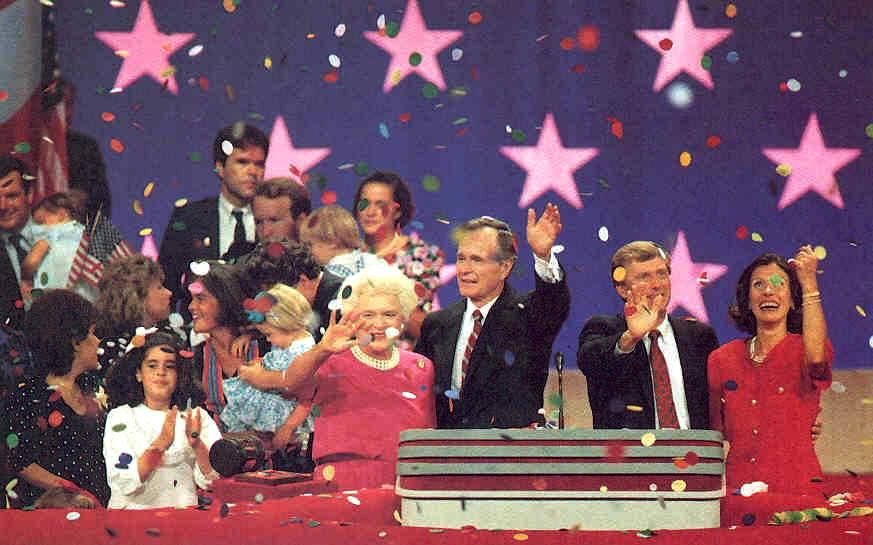
George Bush and Dan Quayle nominated by the Republican Party Convention – 1988
Bush as a Christian president. In taking office in January of 1989, Bush (and America in general) found the Christian world rather deeply divided between a rising Evangelical Christianity and a declining Mainline Christianity, the division itself hurting the Christian legacy in America. Bush himself was a member of the very Mainline Episcopal Church, but himself of somewhat an Evangelical nature. Thus the Christian world looked to him to take up the Reagan legacy, and give the nation some spiritual guidance greatly needed by all.
At first he seemed simply to affirm merely the Evangelical side of things, in his public speeches often (in more than 200 speeches) calling on the nation to go to prayer over this or that matter. And like Reagan, Biblical verses and language found their way often into Bush’s speeches.
But because of Bush’s strong support of the 1992 legislation making it a “hate crime” when behavior was directed against the rights of minorities, notably homosexual rights, Evangelicals (who believe that the straying from divinely ordained sexual norms to be wrong in every way) saw this as a Bush move over to Mainline Christianity’s “peace and social justice” agenda – considered by Evangelicals to be no different than the social-political position of the “Liberal” or Secular world.
Thus Bush’s effort to appear more “inclusive” in spirit succeeded only in weakening the vital support of Evangelicals in the 1992 elections. Nor did it improve his standing at all with the very sensitive “minorities,” which were finding a louder voice in American politics.
FOREIGN AFFAIRS DURING THE BUSH, Sr. PRESIDENCY
The Lockerbie bombing (December 1988). Perhaps as the result of an effort by Libyan dictator Gaddafi to see what the newly elected American President was made of (would he be tough like Reagan?) … at the end of 1988 a Pan Am passenger jet (Flight 103) exploded in the sky over Lockerbie, Scotland – with everyone on board and 11 people on the ground killed. Under the subsequent investigation of the explosion, the trail led back to Libya. But nothing was done immediately to punish Gaddafi.

However long-standing (and already struggling because of earlier security concerns) Pan Am was sued for failing to take security precautions (but Pan Am reminded its opponents that it received hundreds of notices daily about security concerns and had no way to check out each and every one of them), bringing one of America’s oldest and largest global airline companies to bankruptcy and extinction.
The breakup of the Soviet Empire in East Europe (1989). Although President Bush had little to do with what was about to break out in the Soviet Empire, events there would form a huge part of America’s political focus during the Bush years (January 1989 to January 1993).
Gorbachev’s reforms – not surprisingly to those who understand these things – set off another “revolution of rising expectations,” which once underway would get way out of Gorbachev’s ability to control. The well-announced new freedoms of glasnost and perestroika were also received in the European satellite countries as some kind of permission to move to the same freedoms in their own countries – first in Poland, then East Germany and Czechoslovakia, etc. – and finally the very repressive Romania. 1989 would be the banner year for this event. Poland had actually been heading down this road since 1980 under what started out as a labor organization: Solidarność (Solidarity). It had been suppressed by the Polish military (fearful that it would invite another Soviet invasion) but had survived nonetheless. And now in the new Gorbachev era, it was an active participant in Poland’s 1989 summer elections – in which Solidarity trounced the Polish Communist Party. Gorbachev made no move to dismiss the election results.

Polish Round Table Talks took place in Warsaw, Poland, from February 7 to April 4, 1989, beginning the challenge of the East European “Soviet satellite” countries to Communist domination
Now began a mad dash of other East European countries to attempt the same kind of national elections – with virtually the same results: the Communists were swept from power and replaced by new national parties. The most dramatic was the event taking place in East Germany – when East Germans began to flood into newly free Czechoslovakia and Hungary …embarrassing the East German Communist leader Honecker sufficiently so that he stepped down from power. At this point, the East German government simply disintegrated. In November East Germans found themselves free to leave the country – and by Christmas German youths had taken to smashing down (or trying anyway, because it was quite sturdy!) the Berlin Wall.

Only in Romania was the new order met by violence, when Romanian dictator Ceausescu had his troops attack protesters – until the soldiers actually joined the protesters. In late December he and his wife were arrested and rather immediately executed by a firing squad.

The last of the Soviet satellite nations had made their escape from the Soviet Empire.
The Disintegration of the Soviet Union itself (1989-1991). But the momentum did not stop with East Europe. At the same time, minority Soviet Republics (from Estonia, Latvia, etc., on the Baltic Sea, South to Moldova and Ukraine, and East across Asia to the Turkish “stans” of Kazakhstan, Uzbekistan, etc.) were demanding independence from the Soviet Union itself. Even the Russian Federation (headed up by the Moscow Mayor Boris Yeltsin) was calling for independence from the Soviet Union. Gorbachev was quickly losing control of political events over the country that he theoretically still presided over.
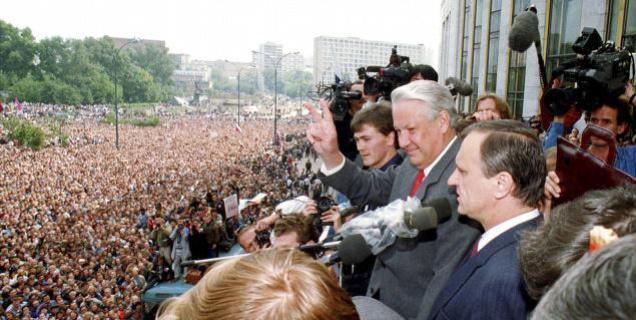
Boris Yeltsin addresses the Moscow crowd
So angry were the old Communist hardliners in Gorbachev’s own cabinet over his reforms that in August of 1991 they attempted a coup against Gorbachev, which did not go very well – when Yeltsin led angry Russian protesters to virtually imprison the plotters inside the Parliament Building. Thus the coup failed. But in the end, it also undercut Gorbachev’s authority so badly that Russia’s political leadership seemed simply to have passed on to Yeltsin. And by the end of 1991, the Soviet Union was no more when all of the former Soviet Republics (including even Russia) had declared their national independence.
Tragedy at Tiananmen Square. Chinese youth were watching closely developments in the Soviet Union … and decided that they wanted to go down the same road to full political freedom. In April of 1989 thousands, then tens of thousands, of youth gathered in Beijing’s Tiananmen Square to demonstrate support for full release from the Chinese government’s political restraints on Chinese society.

At first the Chinese government did nothing, while a bitter debate developed between the hardliners and the appeasers. Finally Deng, seeing social disintegration as the possible result of appeasement, moved toward the side of the hardliners, and the decision was made at the beginning of June to forcibly clear the square of its (possibly a million by this time) youth gathered there.
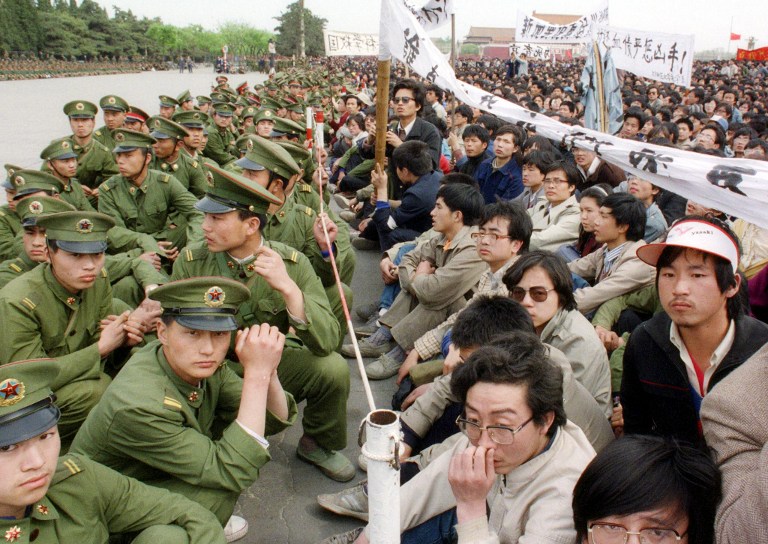
Police and protesters meet at a line drawn up in front of the Great Hall of the People
Thus on the night of June 3-4 the Chinese military was ordered to clear the square, by whatever means necessary. Guns and even tanks were brought into use, resulting in the clearing of the square – but also the death of countless youth in the process. And thus the political movement such as it was (not always clear what exactly it hoped to achieve) came to an end in China.

Bush, in company with the rest of Western leaders, was outraged at the Chinese government’s actions. But Bush soon backed off, trying to keep a positive attitude toward Deng’s China and its efforts to Westernize, without disintegrating socially like Russia in the process.
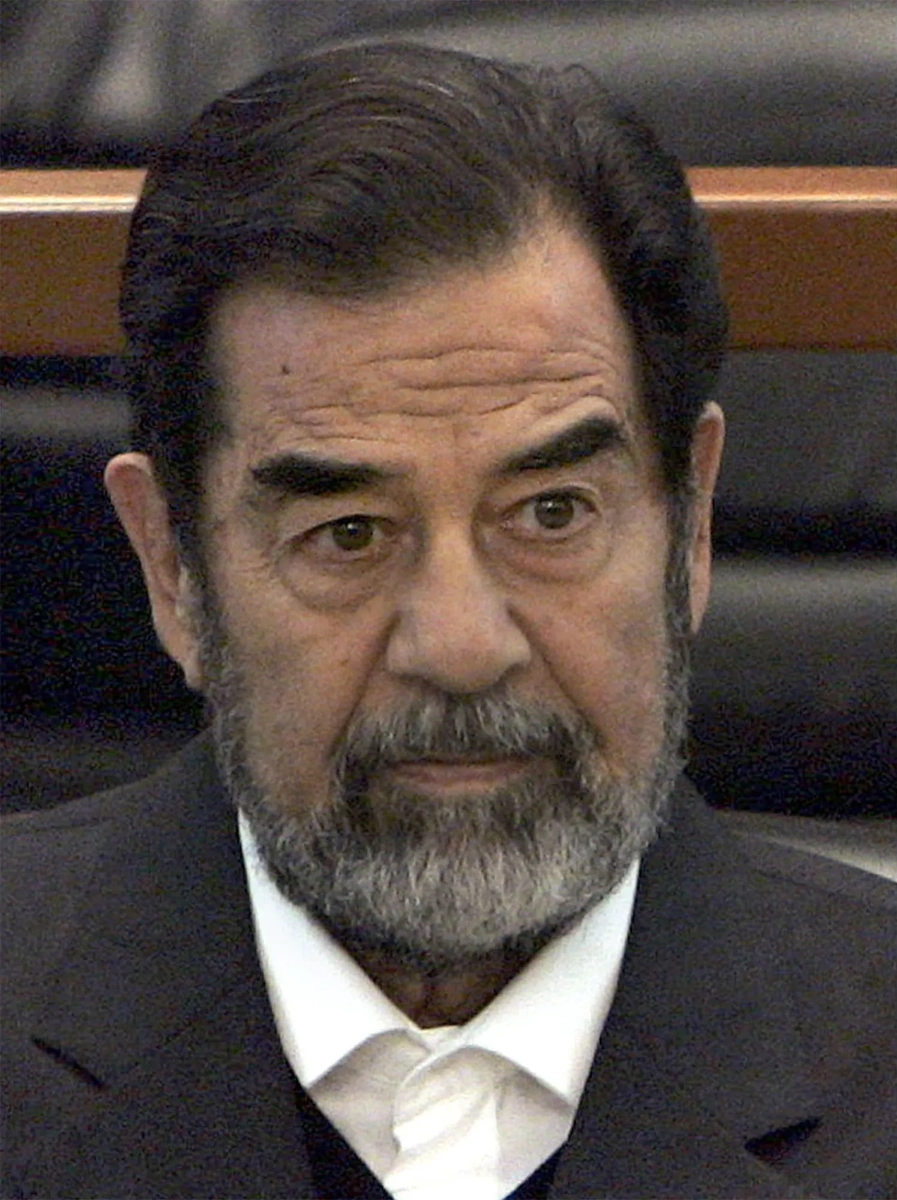 The Gulf War or “Desert Storm” (1990-1991). In the meantime, a very big problem had developed in the Middle East when Iraqi dictator Saddam Hussein had his Iraqi army invade and occupy the tiny (but oil rich) neighbor, Kuwait. The whole thing ended up as a huge political miscalculation by Saddam – one that threatened to start up another Arab oil crisis. But Bush was determined to prevent that from happening.
Saddam had been long involved in an Iran-Iraq War (1980-1988) which started up when Saddam attempted to grab ethnically Arab lands located just across the Iraqi border in ethnically Persian Iran (Persian Iran is not Arab in language or culture – though certainly Muslim, although of the dissenting Shi’ite variety, as are most of the Arabs in that part of the Muslim world). But this merely bogged the two countries down in a campaign of vast mutual destruction …until in 1988 when the United Nations was able to work out a truce between the two countries. At the end of this war Iraq found itself hugely in debt due to the fact that its oil industry had been mostly shut down during that long war.
Then tensions had grown between Iraq and Kuwait, when Iraq accused Kuwait of not only overproducing oil sales (thus keeping prices very low) but also slant-drilling below ground – right into Iraqi oil fields near their border. There was also Iraqi resentment over the very existence of Kuwait in the first place – carved out of former Mesopotamia (Iraq) after World War One – simply to give the British oil company, British Petroleum, an oil source it could continue to control. Also Saddam had the usual Arab desire to play the part of grand leader of the larger Arab world.
On top of this, Saddam thought he had the go-ahead from America via the American Ambassador who seemed to offer only an indifferent response when Saddam told her of his plans to grab Kuwait. Besides, Iraq was something of an American ally – being the third-largest recipient of American foreign aid (especially during the Iran-Iraq War).
Thus when Saddam invaded Kuwait in August of 1990, he was stunned to find himself in trouble with Bush, who demanded that he get his troops out of Kuwait. But at that point Saddam felt he could not do that – for such a retreat would deeply undermine his ever-shaky position as Iraqi dictator.
This was importantly due to the fact that he was a Sunni Arab, supported by the smaller Sunni Arab portion of the Iraqi population, holding tight control over the majority Shi’ite Arab portion of the population, the latter group resenting deeply Saddam and his Sunni Ba’athist Party’s dominance in Iraqi political affairs. Thus it was that his position in Iraq was very fragile.
Negotiations between Saddam and Bush dragged on … going nowhere in the process. But in the meantime, Bush was putting together a grand coalition of European and Arab countries (other Arab countries were also afraid of Saddam’s ambitions), including Saudi Arabia, which let America use its land as a base to build up a large coalition force there. By mid-January the coalition army was ready to move.
The Iraqi Army and Air Force proved to be no match to the coalition forces which quickly downed and blasted everything Saddam could muster. In the matter of simply a few days, the Iraqi Army was chased from Kuwait.
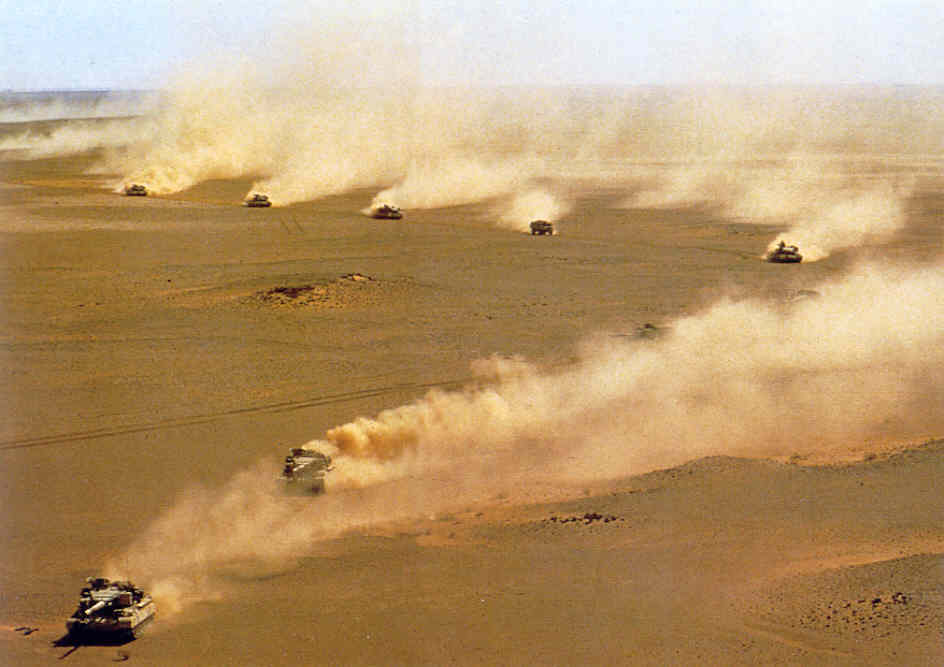
US tank assault on Iraqi lines – February 1991

Iraqi troops surrendering
Of course at the first gun shots, the “anti-imperialist” voices of the American Left waxed indignant – but soon were silenced by the stunning success of Bush and his coalition forces.
Then Bush halted his attack on the retreating Iraqis. He had no interest in going any further after Saddam. He had kicked him out of Kuwait. That was as far as he was going to go.
Furthermore, he had no desire whatsoever to find himself having to take responsibility for a shattered country of conflicting ethnic groups (60% Shi’ite Arabs, 20% Sunni Arabs, and 20% Sunni Kurds) groups that hated each other and were held together as a society only by the tight grip of the Ba’athist organization that Saddam headed up in Baghdad. No, America was not going to get itself caught up in nation-building. Vietnam had taught President Bush the dangers of such arrogance. America would not be fixing Iraq.
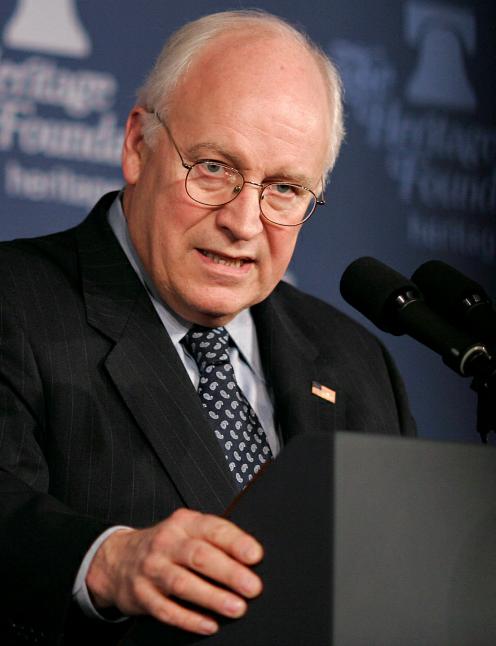
To try to do so would be for America to fall into a “quagmire,” as Bush’s Secretary of Defense Dick Cheney would later (1994) explain the decision.
Troubles in the American economy. In his early years in office, during the horrible economic recession he stepped into, Reagan had lowered taxes in an effort to put money in people’s pockets so as to help get the economy back up and moving again. This of course cut Federal tax revenues at a time when Reagan was also trying to rebuild American military strength. Then when the economy began to move, Regan could have – should have – moved toward a balanced budget of government expenditures being matched by government tax receipts – by raising taxes or cutting back on government programming, or both. But Reagan did neither. And as a consequence, the Federal debt grew monumentally, more than tripling over Reagan’s eight years in office.
But Bush, in his 1988 presidential campaign – at a time when America was again experiencing a small recession – promised American voters that during his presidency there would be no new taxes: “read my lips – no new taxes.” But unemployment brought on by the recession meant that the government was going to be spending more money for federal unemployment benefits – at a time that tax revenues would also be down even further. Thus the deficit continued to climb.
Finally in 1992 – in cooperation with the Democratic Party controlled Congress – a range of tax increases were put in place to slow up the growth in the deficit. But it was a presidential election year – and those increases (plus his promise of “no new taxes”) would be played against him by his political opponents (two actually) in the presidential race that year.
Ross Perot. Indeed, the failure of Bush to bring the growing federal deficit under control gave billionaire businessman, Ross Perot, just the right cause he needed to put himself in the running for President as an independent, third-party candidate. He voiced concerns Americans had about this matter or that – sometimes taking a Democrat position, sometimes a Republican position. His rankings in the polls also rose and fell – causing Perot at one point to back out of the race – then reenter again. He even flew off to Vietnam to demonstrate his ability to conduct a new style of diplomacy – only to have the Vietnamese refuse him entry into their country. And – his unusual campaign was heavily financed by his own immense personal fortune.
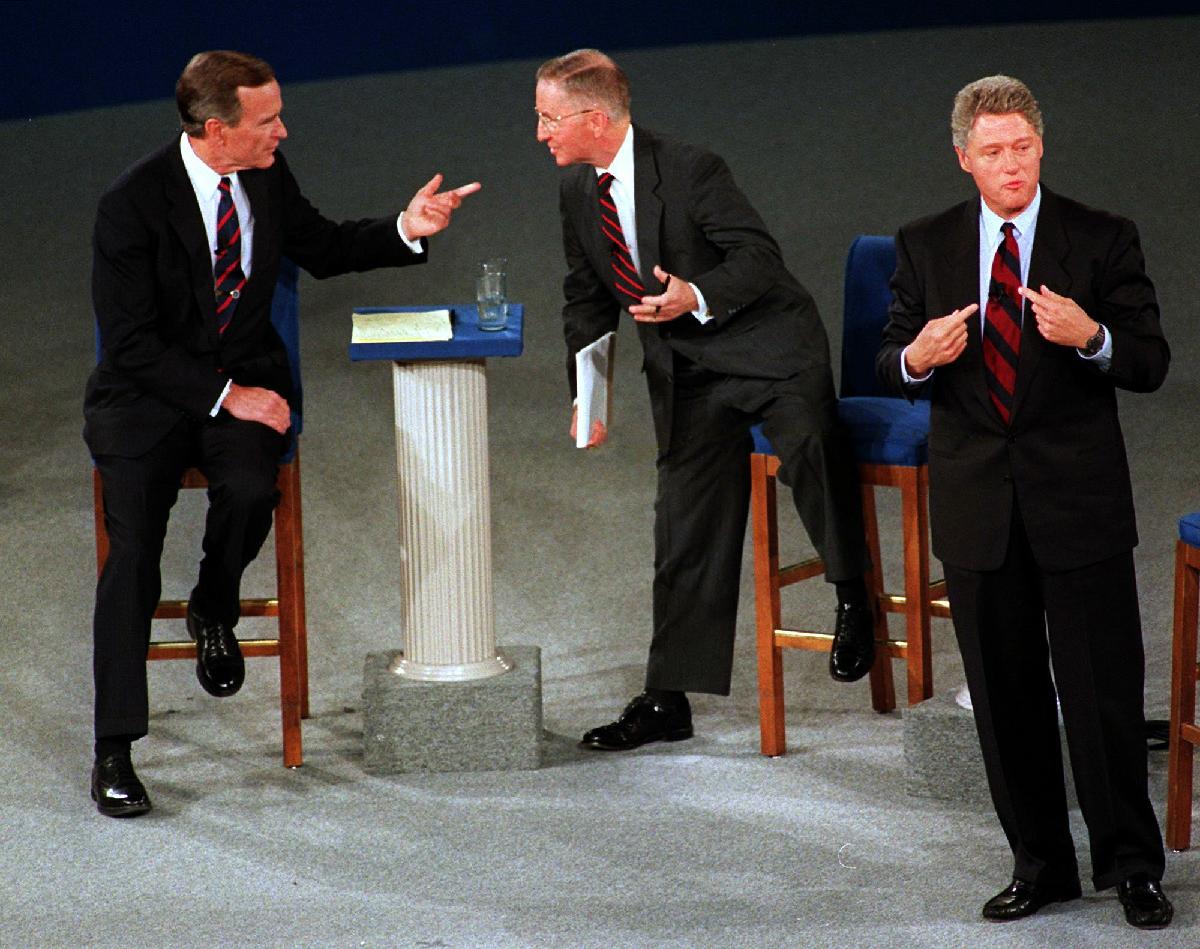
Bush, Perot and Clinton debating – 1992
The 1992 campaign and election. The presidential campaign of 1992 was an amazing balance of all three candidates. In June, polls put Perot at 39% approval, Bush 31% and Clinton (not yet officially the Democratic Party candidate) at 25%. The debates helped Clinton move ahead, the sense of economic slump undercut Bush, and Perot – despite his zaniness – was able to hang on to a respectable size of support.
What was sad for Bush was that the economy was actually picking up again – in fact would go on to be the largest and longest growth period in American history. But this was not yet perceived by the American voters. Thus when elections were finally held in November, Clinton came in with 43% of the popular vote, Bush 37.4% and Perot nearly 19%. It is easy to wonder what the results would have been if Perot had not been in the race – hacking away at the Washington Establishment (Bush and company) for its poor economic performance.
But in any case, the electoral college gave Clinton a full majority win with 370 votes to Bush’s 168 votes (and Perot, nothing). Clinton would thus be entering the White House the following January (1993).

THE BOOMER BILL CLINTON TAKES THE WHITE HOUSE
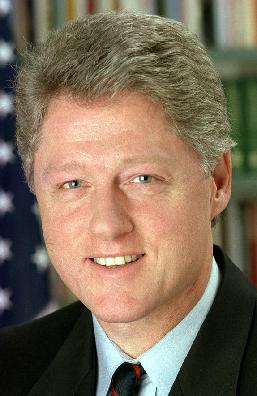 William (Bill) Jefferson Clinton. Clinton was born in Hope Arkansas in 1946, just after the end of World War Two, thus qualifying (even exemplifying) himself as a Boomer. But unlike most Boomers, Clinton’s life as a child and youth was anything but normal for the times. His actual father had died just before his birth, and his mother, a rather dramatic individual, remarried four years later to a quiet, not terribly successful, alcoholic – who proved to be abusive of her.
In his family’s move (when he was just six) to the most unusual Southern city of Hot Springs, Arkansas, Clinton found himself in the midst of a multi-ethnic (and corrupt: gambling, Mafia, etc.) environment. And with both his parents working, he found himself alone at home much of the time, or on his own exploring the larger world around him. Actually the family housekeeper offered the nurture that his parents did not, and would become a strong influence in his own Christian development.
He even walked by himself regularly to the huge Park Place Baptist Church and became very active in Sunday School there. The contrast between the violence of his step-father (the Clinton surname came from his step-father, not his biological father) and the Christian counsel he found both at church and from the housekeeper – who advised him “live and let live, for God will ultimately take care of all matters” – turned the young Clinton even more closely to God. At age nine he confessed Jesus as Lord of his life and was baptized, an event he claimed was a major part of his personal development. Also the fact that Billy Graham refused to segregate a crusade he once held in his town touched Clinton’s heart deeply.
Clinton’s need to grow his world himself led him to push himself educationally, take up music (saxophone), and become active in every social circle possible, winning awards and finding himself taking up leadership positions widely. In this he saw himself called by God to make a big difference in the world.
His high academic performance opened his way in 1964 to Georgetown University’s School of Foreign Service in Washington, D.C., quickly even there finding leadership, as president of both his freshman and sophomore classes.

But he did not follow the 1960s trends, and failed to win that position his senior year (1967-1968), as he was now viewed as too much a part of the “Establishment” that Boomers by this time were in the streets protesting against everywhere – and especially in D.C.
He continued his schooling, the next year (1968-1969) at Oxford University in England as a Rhodes Scholar, and then after that Yale Law School. Here he met the equally scholarly and ambitious Wellesley graduate, Hillary Rodham.
The two of them would eventually move to Clinton’s home state of Arkansas to practice law, and both become Law School faculty at the University of Arkansas. And in 1975 Hillary would set aside her hesitations and marry Bill Clinton.

His ambition now turned in the direction of public office, and in 1974 he ran for the position as the Democratic candidate for the U.S. House of Representatives, though he proved not to be successful in the venture. But two years later he ran (unopposed) for the position of Arkansas Attorney General, a key stepping stone on his way to the Arkansas governorship. And this he won in 1978, making him the youngest governor in the country.

The “Boy Governor” Bill Clinton and President Jimmy Carter – 1978
Not surprisingly, he was a very active “reformer” as governor, taking on tax reform strongly, which upset voters sufficiently for him not to be reelected two years later. But he was the “Comeback Kid”, and two years after his defeat, he was reelected on the basis of a more “moderate” platform, having learned how to read the public’s interest a bit better. And from that point on, he would be reelected continually, until his run for and election to the U.S. Presidency ten years later. Meanwhile Hillary worked hard on building the couple’s family fortunes.[2]
As governor, Clinton proved to be still a reformer at heart, and poured his efforts into educational reform, his reform programming taking the state from the country’s lowest ranking on the testing scale to the most greatly improved in all the nation, drawing him much attention from the nation in the process. This brought him the invitation to offer an opening-night address at the Democratic Party national convention in 1988, now making him indeed a national political figure. At this point, the U.S. presidency itself interested Clinton as a new personal political goal.
He used his talents learned from his rise in Arkansas politics to very carefully pick up support here and there for his candidacy. And in the process, he was able to arrive at the 1992 Democratic National Convention with the key states of Florida, Texas, New York and California committed to his nomination. Thus he easily secured the presidential nomination at the convention itself.
As for his Christian life, not untypical of a self-advancing youth, he had let his churchgoing fall to the wayside during his college years, and in fact would not resume active church attendance until 1980, when he was reelected as Arkansas governor after his first reelection defeat to an active churchgoer. So it certainly helped his political image to now be a churchgoer in his second attempt at reelection. But part of the change was undoubtedly authentic, as he sought God’s support in the road that still lay ahead. Indeed, he would draw very close to his Immanuel Baptist Church pastor, W.O. Vaught, all the way up to Vaught’s death in 1989.[3]
[2]One of the Clintons’ financial ventures, the Whitewater Development Corporation – a vacation properties investment venture undertaken with Jim and Susan McDougal in 1978 – failed badly a few years later. Then in 1992 McDougal’s Madison Guarantee Savings and Loan Association was accused by the New York Times of illegally granting money from the financially shaky (and ultimately insolvent) Madison Guarantee to the Clinton campaign organization. This raised other questions, such as the possible involvement of McDougal’s bank in funding the Whitewater venture as well. Soon accusations about various questionable financial transactions (and Hillary’s and her Rose Law Firm’s involvement as legal counsel to the McDougals) were raising the matter to the level of major political scandal. And in 1995 – with Clinton in the White House as U.S. president – the U.S. Senate finally set up the Whitewater Committee to look into the matter. Ultimately in 1998 (as the public’s attention was turning to the Lewinsky-Clinton sex scandal) the Whitewater Special Prosecutor Ken Starr (who was also now investigating the Lewinsky scandal) concluded that there was insufficient evidence in the Whitewater affair to indict the Clintons of any criminal act (although fifteen other people were convicted of various crimes in this matter – including Jim Guy Tucker, Governor of Arkansas) – and the investigation was thus dropped.
[3]Hillary however would remain true to her Methodist upbringing, attending the also Liberal First United Methodist Church in Little Rock, even teaching Sunday School there.
DOMESTIC POLITICS DURING THE CLINTON YEARS
“Two presidents for the price of one.” Actually America had elected a husband-wife team of Bill and Hillary – proudly declared by Clinton himself when he uttered the famous phrase that a vote for him would amount to “two presidents for the price of one.” He fully intended to put Hillary to work at the very top of his Administration.
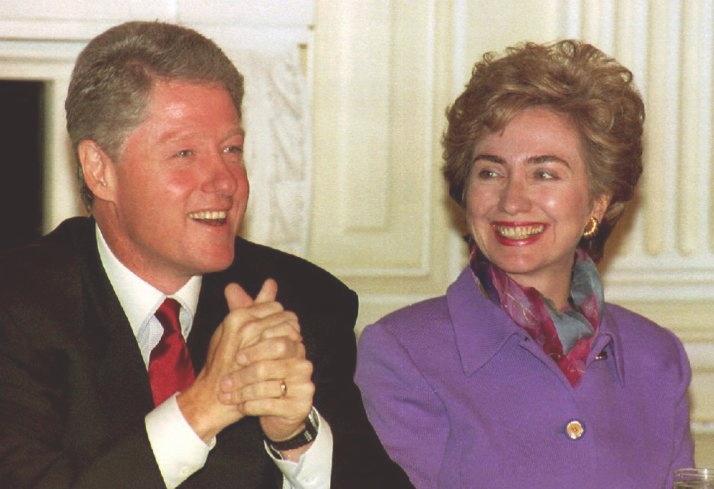
Hillary was born a year after Bill (1947) in a Chicago suburb to a strongly Methodist family, with a father as founder and director of a small textile company and a typical at-home mom. Hillary too proved to be academically talented as well as an active leader in high school. And she, like her family, started out as a political conservative, but was professionally quite ambitious – and very irritated at the roadblocks females experienced on such a road. She went on to all-girls Wellesley College, majoring in political science, and saw her political loyalties shift to the Democratic Party – feeling that the Republicans were not strong enough on their civil rights stands. And then at her graduation, she was called on to address her fellow graduates (Massachusetts Senator Edward Brooke was actually the commencement speaker), receiving a seven-minute standing ovation from fellow graduates for her speech – and bringing her national recognition in the process.

1969 – Hillary delivering her Wellesley commencement address
She then went on the Yale Law School, where found herself focused on child care, poverty, and migrant labor issues. And she soon met Bill and the two moved in together in New Haven. She then finally made the decision (after many requests) to follow him to Arkansas to begin his – and her – professional careers, as faculty at the University of Arkansas Law School. And in 1975 they finally married.
But she nonetheless worked hard at keeping their professional lives quite independent of each other, as she took on her own assignments, such as moving to Indianapolis in 1976 to help the Carter presidential campaign. But finally she settled down (somewhat) in joining the Rose Law Firm, a leading Arkansas group … working now more in the business realm, but still active in children’s issues as pro bono supplementary work.
National health care reform. Now as president, Bill immediately assigned Hillary the task of putting together a new national health program – similar to the ones in Europe – considered highly Socialist in typical American thinking.

Hillary announcing her ideas for a national health insurance program
Almost immediately things did not go well with this effort. The doctors’ national organization, the AMA (American Medical Association), was highly opposed – as was the private insurance industry. Too many people (including lawyers) were getting very rich from the way the health industry worked in America – and were in no mood to see things changed. Thus the idea soon got dropped by Clinton – both Clintons.
Homosexuals in the military. Then Clinton attempted to move down the Boomer path that not only saw nothing amiss about homosexuality but indeed viewed bitterly the lack of sympathy of most of American society to the plight of the homosexual – especially since so many of them had begun to suffer agonizing deaths from the AIDS virus that broke out within their circles in the 1980s. As usual, the U.S. military’s chain of command reaching all the way to the White House seemed to be the perfect laboratory to conduct the moral reform of America with respect to its traditionally very negative reaction to homosexuality.
But here too Clinton’s effort did not take him very far – when it became clear that American society was not yet ready to undergo such reform. He finally agreed to settle on the principle of “don’t ask, don’t tell” – actually not a new principle at all. Something like thus understanding had pretty much been policy all along. Homosexuality in the military existed – and was tolerated – as long as it remained “in the closet.”

Announcing his “don’t ask, don’t tell” decision on homosexuals serving in the military
The homosexual community (and its Boomer supporters) would thus have to wait – until yet another generation came along – the Gen-Xers and their President Barack Obama – to finally “change”[4] the official American position on the practice of homosexuality in the military – and in American society in general.
Deficit reduction through the raising of taxes. One area that Clinton did indeed find success was in attacking the problem of the growing federal deficit. In sponsoring the Deficit Reduction Act of 1993, he was able to raise taxes on a wide variety of incomes – which naturally met resistance from those whose taxes would increase. But nonetheless, the bill passed, though only by the slimmest of margins (the Republicans strongly opposed … as well as numerous Democrats). Nonetheless it would have a dramatic impact in bringing the federal budget into balance – even reducing the deficit somewhat.
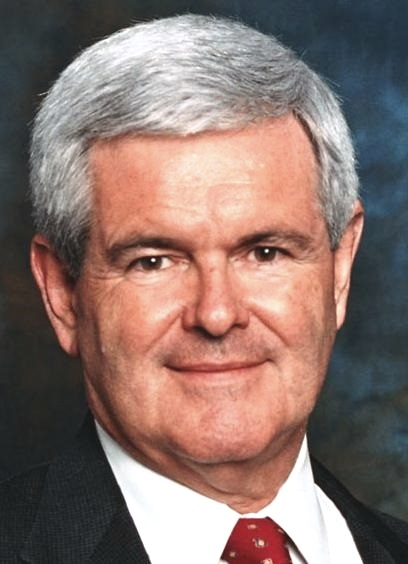 The Gingrich challenge moves Clinton to the political center (1994). In the House of Representatives, the Congressman (and former university professor) from Georgia, Newt Gingrich, had taken the lead of his party as Minority Whip, and had begun to rebuild the party around a program which he clearly outlined in his publication, Contract with America. It called for the classic Republican doctrines of balancing the budget – not by raising taxes but instead by reducing the immense size and cost of the Washington bureaucracy. It also called for the reforming of the welfare programs that had many Americans living off the dole rather than from their earnings from jobs. And it called for a transformation of Congress itself through the infusion of new blood.

And indeed, in the 1994 elections the Republicans came in control of both Houses of Congress – ending the 40-year reign of the Democratic Party in the House of Representatives – which then would also elevate Gingrich to the powerful position as Speaker of the House.
But this would then lead to a political standoff between the Republican Congress and the Democratic White House – a reversal of the previous political profile of Washington politics. At the heart of this standoff was a federal budget approved by Congress – which followed Gingrich’s lines quite closely – and which got vetoed by Clinton (as was the case also with much of the Republican Party’s other bills). Finally, a shutdown of the Federal bureaucracy occurred in mid-November (1995) when neither the White House nor Congress would back down with their opposing positions on the budget bill.
But of course, this was portrayed by the press as a result entirely of Gingrich’s intransigence – such hardness of heart that Americans were having to go without various governmental services. Clinton’s vetoes were not mentioned. The American press – now almost entirely on the Leftist side of the political spectrum – hated Gingrich, depicting him in the worst possible light.

But at this point Clinton was already beginning his move to the political center, sensing the opportunity there to undercut Gingrich – even by taking on some of Gingrich’s programs. For instance, after twice vetoing Republican bills calling for reform of the welfare system – offering job training instead of outright monetary grants to individuals – Clinton finally signed on with the program (the Personal Responsibility and Work Opportunity Act of 1996 … also known as the Temporary Assistance for Needy Families Act, or TANF) – actually making it appear as if this new approach to unemployment and poverty was his idea! Initially the Democratic Party was very unhappy at this Clinton betrayal. But it certainly was greeted with strong approval by the Americans themselves – and Clinton’s move to the center finally was accepted by his party.[5]
Then there was the matter of a North American Free Trade Agreement (NAFTA) with Canada and Mexico – opening the economic borders with America’s neighbors to the north and south. Actually the Agreement had been put together in the last days of the Bush presidency. But it was Clinton who came up against the American labor unions and their Democratic Party voices in Congress when he pushed for Congress’s ratification of the NAFTA treaty. But its passage by the Republican Congress actually soon demonstrated that this helped boost the American economy greatly – even for labor union workers!
Clinton also took up the task of deregulating the banking industry (pleasing the Republicans) at the same time supporting the expansion of low income mortgages through Fannie Mae (FNMA or Federal National Mortgage Association) and Freddie Mac (FHLMC or Federal Home Loan Mortgage Corporation) – government-subsidized lending (pleasing the Democrats) … however leaving both lending organizations vulnerable to financial mishap (which would indeed take place disastrously a dozen years into the future).
Consequently, the American economy entered into a long period of growth – some seeing Clinton as the force behind this development, some seeing Gingrich as its author. Actually, it was a bit of both.
Clinton as a Christian president. When in 1993 the Clinton’s came to reside in the White House, the two eventually attended together quite regularly the Foundry United Methodist Church located nearby. And Clinton’s relationship with Graham deepened, Graham being called on to deliver the benediction at Clinton’s inauguration ceremony and the two meeting often for prayer and consultation thereafter.
[4]Actually, reverse the position, now making any visible opposition to homosexuality the new social crime highly punishable under the law.
[5]After at first supporting the concept as an Illinois state senator, Obama, as president, would work to reduce the work requirements of the TANF welfare program.
In the field of foreign affairs Clinton was to demonstrate an instinct for Realpolitik – perhaps picked up from his university days at Georgetown, perhaps by learning from the examples set before him by both Reagan and Bush … and certainly learned from his own experience as Arkansas governor when he had to change course in order to make a political comeback after having lost an election to a more populist opponent.
His moves abroad were carefully calculated on the basis of cost versus reward in promoting the American national interest (the central thesis of Political Realism), but also the global interest – thanks to America now being the world’s sole superpower.
“Black Hawk down” in Somalia (1993). Somalia would be an early test case. The United Nations looked to America for help in its efforts to get food aid to thousands of civilian victims of a civil war going on in Somalia among various tribal and gang groups, a war that was tearing that country apart. In October of 1993 Clinton ordered an air assault on the group holding the Somali capital of Mogadishu
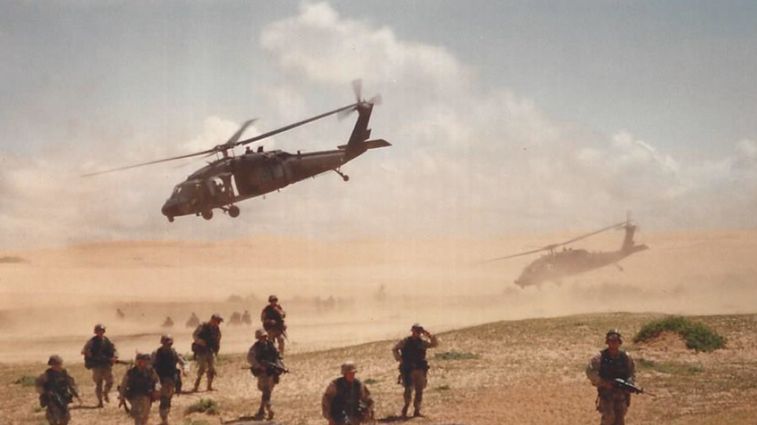
– which did not turn out well when the local citizens shot back – and two Black Hawk helicopters were downed. Clearly such American intervention had little local support from the Somalis (probably too afraid to come up against the gangs).
At this point Clinton’s goal became one of simply extracting American troops from Somalia. There would be no further effort to straighten out Somalia. Actually – as with Reagan’s failure in Lebanon in his early years as President – Clinton’s pullout from Somalia was greeted with respect on the part of those watching the drama unfold there. Clinton had done the right thing – in not letting his ego get the better of him – and admitting failure in the effort. As a Realist he had simply cut costs and moved on.
Haiti intervention (1994). In Haiti, Clinton was faced with another rapidly deteriorating situation as a result of the overthrow by a military junta in 1991 of the elected government of Jean Bertrand Aristide. Deteriorating conditions in that country had set Haitians in huge numbers (tens of thousands) fleeing the country, heading for America by sea – but with many of the overloaded and unseaworthy boats sinking along the way.

In this matter, Clinton was more circumspect because of the Mogadishu mess. In 1994, with full backing from the United Nations – even as he began military preparations for intervention in Haiti – he sent representatives (former President Carter, General Colin Powell of Iraq War fame and Senator Nunn) to Haiti to let the military junta know that the US was getting ready to send troops to their country, and that they had better restore the civilian government of Aristide before these troops landed.
The Haitian military officers ultimately backed down just as some 20,000 troops (mostly the American 82nd Airborne, but including some from other nations) were about to land in Haiti (September 19, 1994)

– and in October Aristide returned to power in Haiti – under the protection of US troops sent to Haiti to oversee the transfer of power.
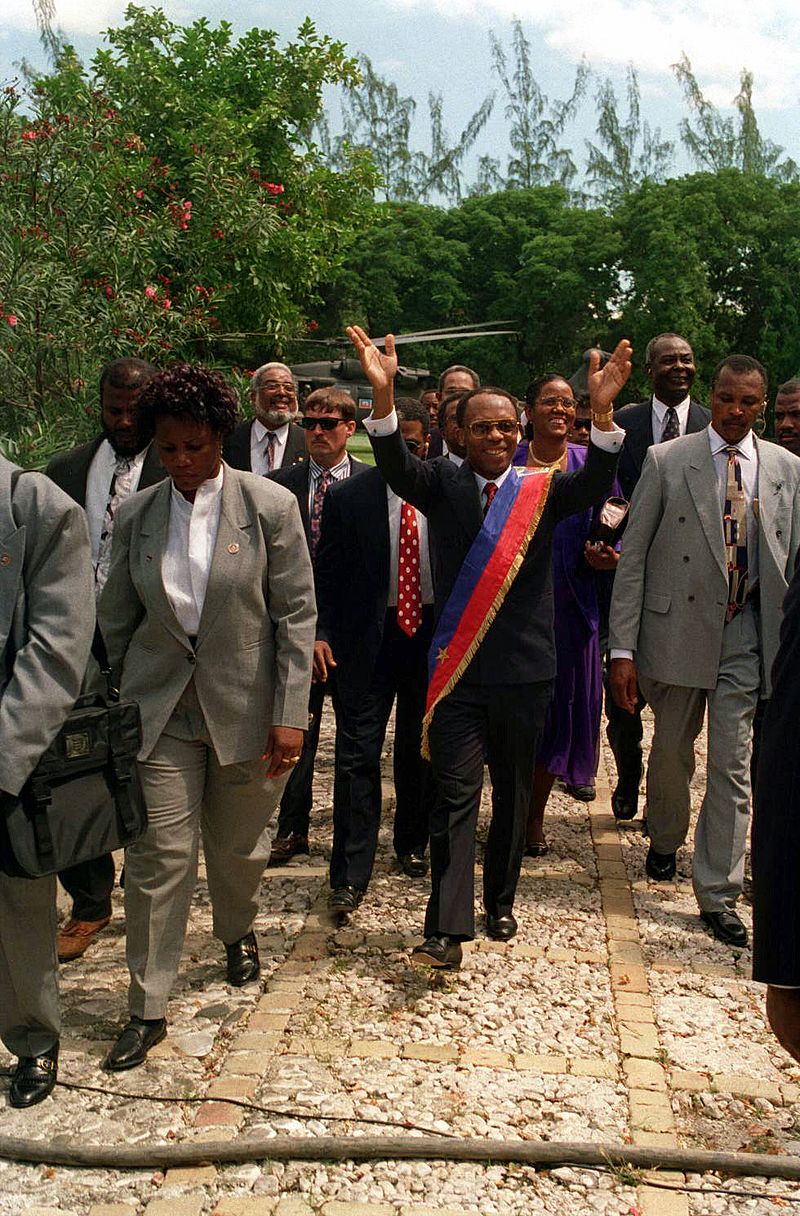
The American troops were then soon pulled out.
Clinton came away from this venture looking very presidential.
“No” – to Rwanda (1994). On the other hand, Clinton had to say “no” to a request from the UN to intervene in the slaughter taking place in Rwanda, as Hutu tribesmen and Tutsi tribesmen fell into mutual slaughter – causing virtual genocide – when possibly as many as a million Rwandans (no one knows for sure the actual count) were butchered in the fighting.

This was way too big for America to take on. Clinton’s “no” was greeted with scorn by fellow Liberals. But Clinton was very wise not to drag America into something that would only tragically drain a huge amount of American blood with little likelihood that it would make much difference in how things worked out among the Hutus and Tutsis.
But “yes” to Bosnia (1995). Ever since Tito died in 1980, it had been a struggle to keep the various ethnic groups making up Yugoslavia together. Basically, divisions were getting deeper – and increasingly hostile. Then with the example set in the departure of the East European countries from the Soviet Empire, the various national groupings in Yugoslavia began to declare independence, starting in early 1990 with Croats and Slovenians (basically Roman Catholic rather than Eastern Orthodox like the dominant Serbs). Then Bosnia-Herzegovina declared independence in 1991 – except independence would carry away a huge section of the Serbian population (about a third of the population in Bosnia). At this, the Serbs invaded Bosnia (also about 44% Muslim – with another 17% Croatian), and ethnic and religious tensions exploded.
Civil war soon became mere genocide – as, for instance, in the town of Srebrenica when in 1995 some 8,000 Muslim men and boys were executed by Serbs. And the beautiful city of Sarajevo (the site of the Winter Olympic Games of 1984) became a no-man’s land and a physical disaster.
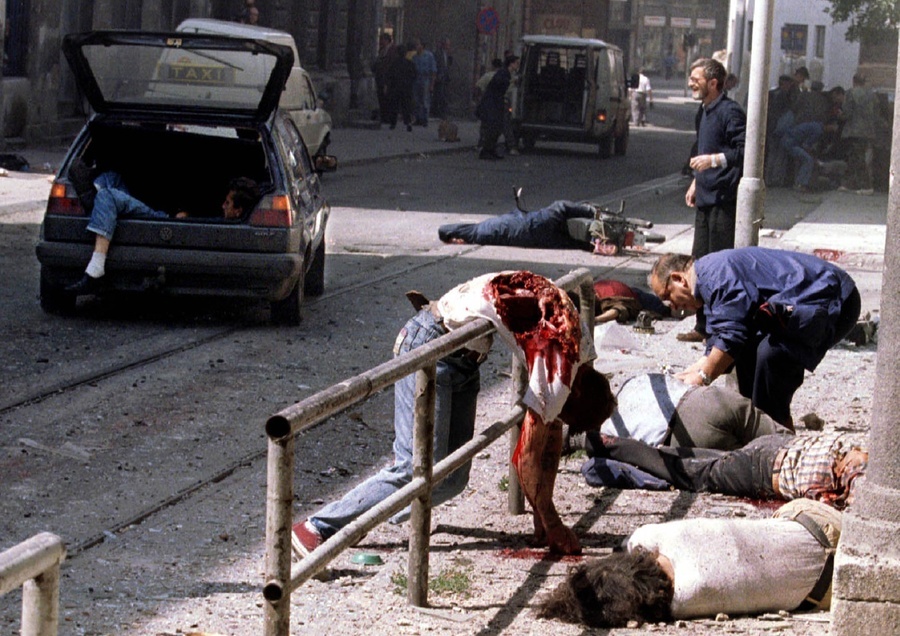
Sarajevo became a slaughterhouse as hostile forces fired across streets, catching civilians in the cross-fire.
Europeans looked on in horror, and began to discuss the possibility of NATO intervening to stop the genocide. At first, Clinton’s reaction was shaped by his experience in Somalia. But the situation grew so grim that he agreed to lead NATO airstrikes against Serb positions – at the same time that Croatian and other Muslim nationals engaged ground troops against the Serbs.

A US F14 tomcat fighter takes off on a patrol over Bosnia from the aircraft carrier USS Theodore Roosevelt

August 1995 – NATO airstrike of a Serbian ammunition depot in Bosnia
Finally, toward the end of 1995, an armistice – followed by peace negotiations at Dayton, Ohio, plus an agreed-on stationing of 60,000 international troops (20,000 of which were American) – brought the region to a nervous peace.

The signing of the Dayton Accords by the presidents of Bosnia, Croatia and Serbia in Ohio – November 21, 1995

The final peace agreement is signed in Paris December 14, 1995. Seated are Slobodan Milošević (Serbia), Franjo Tudjman (Croatia), and Alija Issetbegovic (Bosnia Herzegovina). Standing behind them are Felipe Gonzalez (Spanish Prime Minister), Bill Clinton, Jacques Chirac (French President), Helmut Kohl (German Chancellor), John Major (British Prime Minister) and Viktor Chernomyrdin. (Russian Prime Minister)
At this point a quarter of a million people had been killed and over a million had been made homeless and living in refugee camps. Getting the states of former Yugoslavia back into some kind of order could now begin – although it was not going to happen quickly – and would require the continuation of the stationing of international troops in the region – on a reduced basis, but there in any case as a warning not to start things up again.
In the end this measured response worked the best way possible. There would be no victory parades and no heroic talk. But the job had been done – and again, Clinton looked very presidential!
The Kosovo Crisis (1999). Then ethnic tensions flared up again in the former Yugoslavia – this time in the southern region of Kosovo – pitting a Serbian minority (but backed by Serbian power to the north) against the Albanian-speaking and largely Muslim Kosovar majority.

Genocide again became the rule of the day – with a million Kosovars forced to flee their homes or be slaughtered by the invading Serbs (but small Serbian communities here and there suffered as well from groups of Kosovar militia).

Genocide in Kosovo – Albanian dead (1999)

Kosovar refugees fleeing the war zone

Some of the (800 thousand to 1 million?) Kosovar refugees
… including my now son-in-law (and pastor) Rimi, who was a teenager at the time
Having so recently experienced the Bosnian crisis, NATO was quick to respond this time – with Americans once again involved in heavy air attacks on Serbian positions – including even the Serbian capital at Belgrade.

Rather quickly Serbian President Milosevich was forced to yield – and accept another peacekeeping force of 50,000 troops (7,000 of them American).
Milosevich was subsequently arrested and brought before the International Court of Justice at The Hague for war crimes – but died in a Dutch prison during his long trial. And the Kosovars erected a large statue of Clinton in their capital of Priština – certainly the hero to many in Kosovo!

The new friendship with the Russians. The Russians, now under Boris Yeltsin, were experiencing something that roughly qualified as democracy – and enjoyed watching the developing friendship between Clinton and Yeltsin.

Clinton plays the saxophone presented to him by Russian President Boris Yeltsin at a dinner hosted by President Yeltsin – January 1994
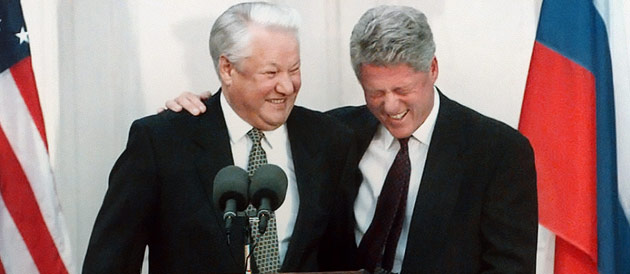
Yeltsin and Clinton having a good laugh together during Yeltstin’s visit to the US in 1995
But underneath it all was a Russia that was having a very hard time coping with a world in which the Russians themselves – and not just their government – found themselves responsible for the social rewards that came their way. A few of them (mostly younger) grew quite rich – some through what would qualify in the West as purely criminal behavior.

Others just could not figure out how this democracy thing was supposed to work – and found their lives gradually growing poorer and poorer. Life expectancy dropped by a full ten years – and Russia began to look and act like a Third World country. Increasingly, disenchantment with “Russian democracy” mounted in Russia.
The development of the European Union and NATO. For the West, these were very good times. European nations were coming closer together through the European Union – and the new Maastricht Treaty (1992) which pointed to a full unity of European states – through Europe’s single currency, the Euro, and through the free movement of workers and industrial products from country to country within the Union (with Britain still a bit standoffish in keeping their Pound rather than the Euro as their currency).

The Signing of the Maastrict Treaty – February 1992
In addition, the military side of this unity, NATO, was looking very good after action in old Yugoslavia – and was also taking on new members from the former Soviet bloc (to the annoyance of Russian hardliners): the new Czech Republic, Hungary and Poland – bringing the total membership in NATO to 19 countries.
 Saddam Hussein’s Iraq. Ever since the ouster of Saddam from Kuwait, America had kept a close watch on the Iraqi dictator’s doings. He had been forced to accept U.N. terms allowing inspectors into his country to confirm that he was keeping his side of the agreement to suspend chemical, biological and nuclear weapons development (“weapons of mass destruction” or WMDs). But Clinton was not convinced that the inspections were digging deeply enough. Thus in October of 1988 he signed the Iraq Liberation Act, financing Iraqi opposition to the Saddam regime. Then in December of that year he forced the inspectors out of Iraq in order to conduct four days of missile attacks on Iraq – although they appeared designed more to undercut the Iraqi government than simply take out questionable weapons production sites (mostly military installations and their personnel were targeted).
There was considerable international opposition to Clinton’s program this time, not only from outraged Arabs but also from Russia, China and even France – which reacted with a call to end the oil embargo aimed at Iraqi exports. Others loudly accused Clinton of undertaking in this attack merely a diversion away from the spotlight aimed at him because of the scandal of his having sex with a White House intern. But it certainly was also part of Clinton’s tough response to the bombing of the American Embassies in East Africa just a few months earlier. He was getting very tired of dealing with rising Arab Islamic radicalism – from any source, whatever that might be.
Dealing with Islamic Jihad. This matter arose from a growing problem brewing in the Middle East – one that did not necessarily take conventional national lines and thus fairly expected behavior. Muslim fanatics, young and extremely dedicated in their hatred of things Western, were growing in number – in various ways that had little to do with nations or even countries and their governments. These fanatics, mujahideen or jihadists – both words formed from the Arabic jihad, meaning “struggle” (against evil) – could be found widely around the Middle East (even as far away as the Philippines) – forming here, moving there, so that it was all that Western intelligence agencies (such as the America’s CIA, Britain’s MI6 or MI5, or Israel’s Mossad, etc.) could do to keep up with their activities.
The Taliban. One such group was the Taliban (from talib, Arabic for “student”) – that had formed originally at various conservative Muslim schools – most notably the one in Pakistan headed by the mullah Omar. They were found strongly positioned among the Pashtun tribesmen of Northern Pakistan and Southern Afghanistan. This was the group actually helped by America in their effort to oust the Russian Soviet troops from Afghanistan in the 1980s. But now (1994) from a political base in the southern Afghan (Pashtun) city of Kandahar, the Taliban were focused on overthrowing a tribal coalition governing in Kabul – one which the Americans were trying to work with. In 1996 the Taliban advanced on Kabul and drove the coalition from the capital city – the coalition retreating to the north of the country to become the Northern Alliance under the leadership of the Tajik, Ahmed Shah Massoud.


Mullah Mohammed Omar Ahmed Shah Massoud

The Taliban after the takeover of Kabul – 1996
But the regime of the Taliban was so oppressive (they executed thousands of civilian Shi’ites and minority Hazaris – and drove thousands more to the north of the country as refugees) that Americans felt compelled to support Massoud and the Northern Alliance. This in turn brought friction between America on the one hand and its old allies Pakistan and Saudi Arabia on the other – Sunni Muslim states actively supporting the Taliban. Clinton thus had to move cautiously concerning the mounting crisis in Afghanistan.
 Al-Qaeda (or more properly al-Qa’ida). Even more ominously for America, another group of Muslim jihadists – al-Qaeda – was being organized by a Saudi Arab, Osama Bin Laden. His anger at the Saudi Royal family for allowing the stationing of kaffir (infidel or unbelieving) American troops on holy Arabian soil (Saudi Arabia itself) during the Gulf War of 1991-1992 had led to his expulsion and flight to the Sudan. In the Sudan, his family name (he was the son of a very wealthy Saudi businessman) convinced the Sudanese government to give him permission to set up a training camp there to prepare young Muslims for jihad – until his organization started conducting attacks on Sudan’s neighbors – and he was again expelled. This time he moved to Pashtun lands (both in Afghanistan and Pakistan) where his radicalism was well received. From this position, Bin Laden began to organize cells of operatives instructed in the art of suicide bombing against various kaffir targets – all done to the glory of Allah. At the same time, al-Qaeda missionaries were sent around the world to various mosques to bring them to al-Qaeda’s jihadist vision.
Part of this was also done in competition with Shi’ite Iran – to promote a Sunni lead in the destruction of infidel Western culture – in Europe, in Asia (principally the Philippines), in Africa, and in America.
The 1993 New York World Trade Center bombing. In late February of 1993 a van parked in the garage of the New York Trade Center exploded – with the purpose of collapsing the North Tower against the South Tower and killing the tens of thousands of people working at these immense towers. Instead, it merely destroyed six stories of the building – although it did kill six people and wound thousands of others. Had the van been parked closer to one of the main supports of the North Tower, the bomb might well have succeeded in its evil design.
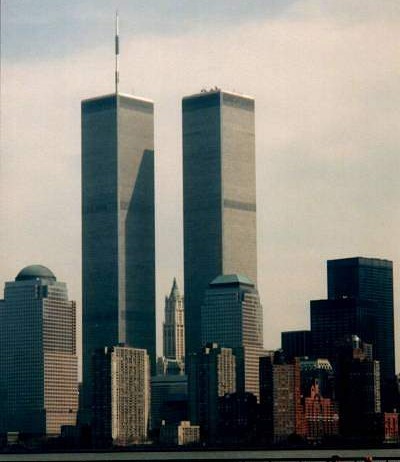

The attack was supported financially by a Pakistani al-Qaeda member, Khalid Sheikh Mohammed, uncle of the actual organizer of the event, Ramzi Yousef – who would also be the mastermind of the second (and successful) attack on the World Trade Center in September of 2001 (9/11).


Khalid Sheikh Mohammed Ramzi Yousef
The 1993 operation involved a number of mosques in the New York metropolitan area, and the arrest of a number of the conspirators gradually followed. From the outset, American investigators were strongly suspicious of the al-Qaeda organization as the source of the enterprise – though no precise connection was established in the investigation. But at this point, al-Qaeda was put at the top of America’s list of terrorist organizations.
The attack on American embassies in Tanzania and Kenya (1998). In August of 1998 two American embassies in East Africa were bombed, with hundreds of people killed.

The American embassy in Dar es Salaam, Tanzania

The American embassy in Nairobi, Kenya
This time al-Qaeda’s connection (through its Egyptian affiliate, Egyptian Islamic Jihad) was clearly identified as responsible for the bombings. Clinton struck back immediately, with missile strikes on Afghan and Sudanese targets (although the Sudanese site may have been unconnected to the event). Many Arabs cheered the al-Qaeda attack on the embassies – and took to the streets in protest against the American retaliation.
America’s relations with significant parts of the Arab Islamic world were clearly reaching a very low point.
PARTICULAR EVENTS SHAKE THE COUNTRY DEEPLY IN THE 90s
Although the country had settled down greatly since the tumultuous 1960s and 1970s, there were a number of incidents (besides the Twin Towers bombing of 1993) that shook the country, incidents that stood out not because they represented the sweep of new political impulses, but incidents that for unique reasons of their own shattered the American image of prevailing peace and social justice.
The Rodney King incident (1991-1992). A major tragedy hit the nation in 1992 when a court decision in Los Angeles did not go the way Blacks felt that it should, and for the next six days they rioted, plundered and torched the world around them, causing over $1 billion in property damage to some 1,600 businesses (some 40% of them owned by local Korean shopkeepers), a social catastrophe that injured 2,000 and killed 63 people as well.
The incident occurred over the arrest of Rodney King the previous year, whose takedown by police was videoed by someone drawn to the commotion by police sirens and helicopters.

The video was submitted to a scandal-hungry press, which repeatedly showed only the last moments when King was beaten to the ground, failing to mention in their report the long chase of his (and two companions) car through the city’s streets and failing to show (in the same video) King’s repeated efforts to break from the police when finally caught. But the jury that tried the case did have all the contextual information, and acquitted the police.
That was not a decision that the Blacks wanted. So they rioted … urged on by LA Mayor Tom Bradley, expressing his own anger at the jury decision (understandable on the part of a Black mayor, but one disastrous for LA in the way it encouraged the wrong kind of behavior, not to mention disastrous for Bradley’s own political career).

Ironically, King eventually sued the city of Los Angeles, and was awarded $3.8 million in compensation (plus $1.7 million for his lawyers). Thus supposedly American justice was served. King would continue to drink and take drugs, was arrested eleven more times, and finally drowned in his own swimming pool years later.
The Ruby Ridge incident (August 1992). A local feud among neighbors in Idaho turned into a major Alcohol, Tobacco and Firearms (ATF) disaster when an angry neighbor – who lost a property claim in court – took revenge on the Weaver family by reporting them to the FBI and Secret Service as having made threats on the life of the President, the Pope and the Idaho governor (pure fabrication by the neighbor), and eager government officials took the bait. The matter was put in the hands of the ATF and they set a trap to bring Randy Weaver into custody, and the event went wrong. Their warrant, deviously place in his hands when Randy Weaver attempted to help ATF agents pretending to be stranded motorists, listed the wrong date for the court appearance. And when he did not show up, ATF agents were sent to arrest him, resulting in months of a standoff when Weaver refused to give himself up. Then when a TV cameraman filming from a helicopter the action accused (quite falsely) the Weavers of having fired on his helicopter, the Feds felt that they finally had the just cause to act directly against Weaver. Thus six Federal Marshals were sent to raid his home. When Harris, a family friend, and the Weaver’s 14-year-old son went out to investigate the family dog’s barking, shooting broke out between Harris and the Federal agents and the son was killed – as well as a US Marshall. Then a sniper killed the wife when she went to the door to let Harris back into the house, and for the next twelve days a standoff occurred at the site as agents negotiated Weaver’s surrender.
Ultimately the ATF had no case to stand on other than Weaver not originally showing up at court on schedule. Harris was found not guilty of all charges on the basis that he had simply responded to being fired on by an agent who had failed to identify himself before firing. In fact it became clear that the Federal agents had disregarded the Rule of Engagement (ROE) completely.
Ultimately the “Ruby Ridge” episode became famous as a case of government misconduct – books, songs, and even a CBS miniseries was published over the tragedy, and a lawsuit (quite light in terms of the horrible damage to the Weaver family) was brought successfully against the government.
The Waco Siege (February-April 1993). A similar incident of government malfeasance occurred the following year in Waco, Texas, when locals reported to local officials all kinds of misconduct going on at a very secretive commune of Branch Davidians (a break-away millennialist group from the Seventh-Day Adventists). The locals had no evidence of any of the “facts” they were reporting – only rumors which grew more graphic with the retelling. Thus it was that the ATF was once again brought into a local drama in order to bring “justice” to the matter.
Here too a standoff occurred, which the ATF tried to resolve by simply invading the compound, only for a firefight to break out between the two groups.

Four federal officers and five Davidians died and more than 20 other federal officials were wounded in the action. Now the matter became truly a war. Water was cut off to the compound and over 900 officers assembled to begin a full-scale attack (including armored tanks), which on April 19th finally took place. In the melee, the compound burst into flames, 76 Davidians (including numerous women and 25 children) died in the blazing inferno (only nine Davidians came out alive from the event).
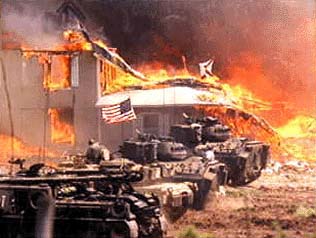

The trial of the survivors dragged on for years, even reached the Supreme Court, which finally reduced greatly the sentences imposed on the survivors, and the ATF again came away looking very bad as the facts of the whole incident became ever clearer.
The Oklahoma City bombing (April 19, 1995). Two years later on exactly the same date as the Waco disaster, a huge explosion took out the front portion of a federal building in Oklahoma City, killing 168 people (19 of them children at a day-care center located in the building) and injuring some 680 others, and causing property damage reaching blocks away.

Timothy McVeigh and his accomplice Terry Nichols were stopped for a license plate violation, which in the process revealed to police a record of weapons possession – which in turn led the police to realize that these two were the ones who had carried out the explosion.
McVeigh explained his action as revenge for both the Ruby Ridge and Waco disasters caused by federal authorities (the latter determining the date for McVeigh’s action). But McVeigh’s vigilante act gave him no just cause in the eyes of the jury and he was found guilty (1997) and executed (2001), with Nichols receiving life imprisonment. This in turn prompted Congress to pass the Antiterrorism and Effective Death Penalty Act of 1996, providing for stronger protection at federal facilities.
The O.J. Simpson murder case (1994-1995). Another event which had the potential to shake the country to the core was the trial of O.J. Simpson, accused by Los Angeles authorities of having killed his ex-wife, Nicole and her boyfriend Ron Goldman on the night of June 12, 1994. Evidence, (a bloody glove found at the scene of the crime in front of Nicole’s home and a matching bloody glove found at the home of Simpson) immediately pointed to this famous football (and media) celebrity. Thus when the news hit the media, a huge national drama unfolded. At first it looked as if Simpson might take his own life rather than surrender himself. But ultimately, he gave himself up, and the country prepared for a major courtroom media event.
To make the case as “fair” as possible, a predominantly Black jury was chosen, and the defense thus was able to employ the “bad police” defense (the prosecuting attorney was a “genocidal racist”; racist police could have planted the second glove at Simpson’s home to make him look guilty).

But the racist argument was countered by pointing to the fact that police had been called to the Simpson’s home eight times by battered wife Nicole and only the last time was Simpson actually arrested. However the October 3rd (1995) verdict was foreordained. There was no way that a predominantly Black jury was going to find Simpson guilty of the murders.[6] Thus the hundreds of police (remembering the Rodney King situation), who were ready to deal with a situation that was expected to follow if he were found guilty, were able to stand down.
The Million-Man March (1995). Just two weeks after the Simpson verdict a huge “Million-Man March” on Washington, D.C., was assembled by Black Muslim leader Louis Farrakhan. But it was designed to encourage a very different sense of honor among Black males than simply “burn, baby burn.” Behind this event was deep concern that it was Black women who were left with the responsibility of holding the Black family together – in the face of widespread male no-show at the family scene. The March was a call to men to repent of the way they related to the women of their community, to put themselves before God, and take up the family and social responsibilities that should be theirs as men.
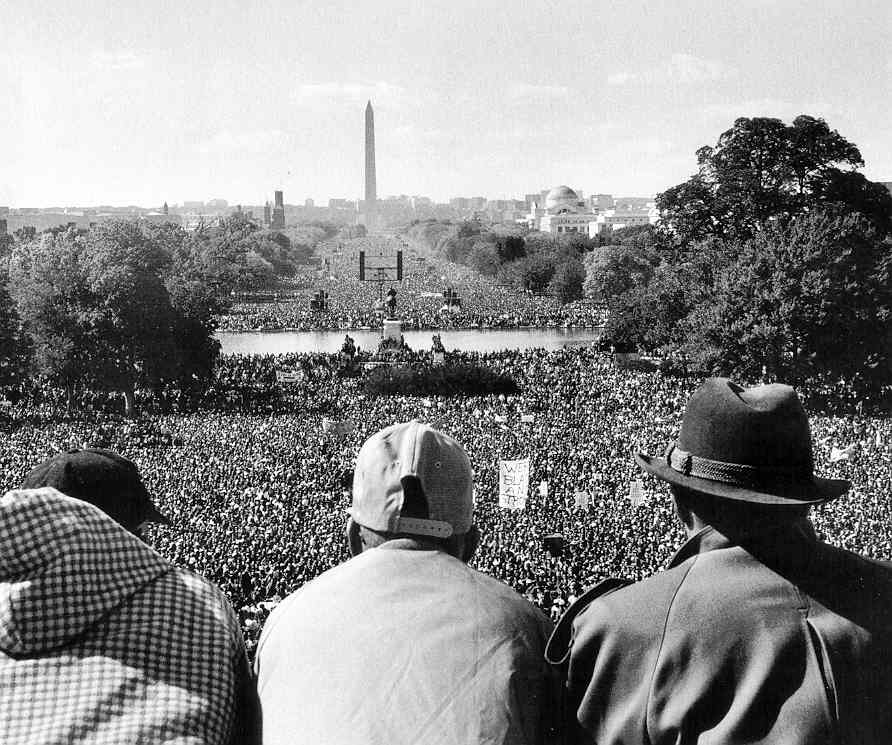
The gathering was peaceful and dignified throughout, seemed to please the White world (which actually commented very little about the event), but did draw some complaints from Black feminists – who did not find anything redemptive about any event that was focused just on men and them alone.
In any case, would this appeal work? Would it restore the Black family (over 70% of Black children lived in homes with only the mother present) – once the bulwark of Black strength through some very terrible times in American history. But to address that issue, America would also have to address the welfare system that rewarded Black families only when an employable male was not present. This was a major financial disincentive facing the Black family. Thus ironically, the effort of the welfare system to help the Black community had only seemed to make things worse.
The “workfare” policy of Gingrich/Clinton was designed to address this situation, but seemed only to give Black women greater talent as members of the workforce (a good thing) without addressing the matter of the missing male (a bad thing). In the meantime, young Black males were still being left to enter manhood without any guidance from a loving father at hand to help them make that entry. Gang membership was too often providing such instruction to rising Black males. But that was hardly a good thing.
What could be done to correct this matter? No one seemed to have any good answers. The Million Man March was an excellent step forward – but ultimately seemed to have changed very little over the longer run.
Impeach, impeach, impeach. Clinton’s last two years in office were darkened by revelations of an affair he had been having with a young White House intern, Monica Lewinsky. Sex or money in exchange for status and power has not been a particularly new thing in Washington, or for that matter in the world or across the centuries. This does not make it right. There are rules against it. But being powerful tends to cause people to think themselves exempt from such rules. You are just not supposed to get caught.[7]
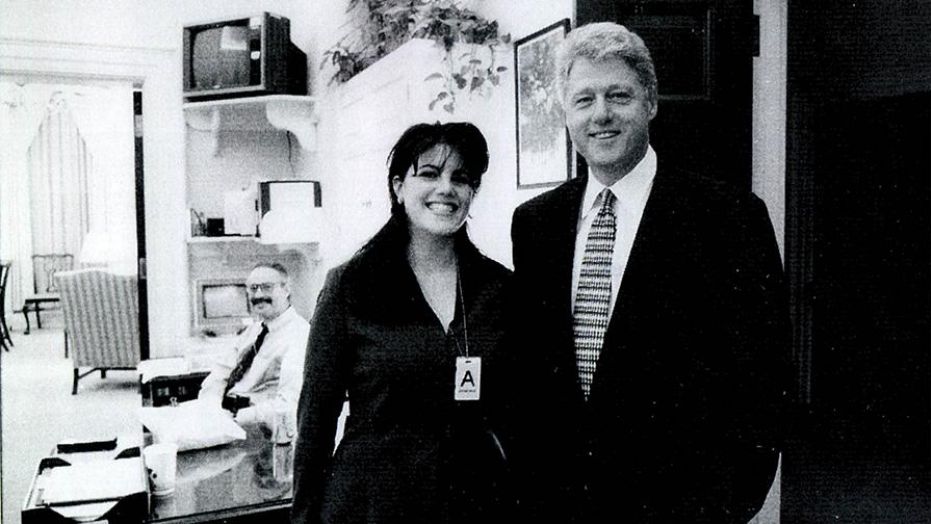
Naturally, Clinton denied having the affair. Then the truth of this affair came out, along with a number of other women who testified that they themselves had had the same experience with Clinton along his way to power. Ah-hah!, so he lied about the affair! Certainly lying to Congress about this affair constituted supposedly one of those “high crimes and misdemeanors” that then allowed the Republicans to begin impeachment hearings against the president.
But the American public was in no mood for such a move against the president, and the November 1998 elections cut back the Republican majority in the House from 21 seats to 12 seats. This in turn caused a Republican revolt against House Speaker Gingrich, who then announced his resignation as Speaker.[8]

Nonetheless, the impeachment hearings continued forward and on December 19th the vote went against Clinton on two counts and in his favor on two other counts (most of the voting along party lines).
Thus the Republicans joined the Democrats in confirming the new political practice of impeaching the President when any opportunity to do so would present itself, a horrible political activity to mix into the “normal” process of Washington politics.
But when the case went to trial in the Senate, the best the Republicans could do was a 50-50 vote on one count and an even worse 45-55 vote on the other, neither coming close to the 2/3s vote needed to convict.
There were some interesting outfalls from all this. First of all, a new email campaign which called itself “moveon.com” mobilized the young “wired” generation during the 1998 electoral campaign to “move on” past this meaningless scandal, the organization then itself “moving on” to become a major Democratic Party campaign support group in future elections.
And most bizarre of all, Clinton ended his last months in office (prior to the end of his term in January of 2001) with one of the highest approval ratings of a president at the end of his term! Indeed, the nation had “moved on.”
The Columbine High School Massacre (April 1999). A tragic event became part of the closing of the 20th century when two high school students undertook a long-planned massacre of fellow students at their Columbine High School in Littleton, Colorado. A bomb by which they had planned to blow up the school failed to detonate.

But they were fully armed and succeeded in killing twelve students and a teacher, before they turned the guns on themselves and ended their lives when the police arrived on the scene. Ultimately, there was no reason given as to their actions, other than the desire to commit a grander murder than had been the case in the Oklahoma City bombing.
This raised the question, would there be more copycat killings (as this one seemed to be), by people who simply wanted to be significant, to be noticed? People do the most horrible things for the worst reasons imaginable, especially when it becomes a trend (like mass rioting, pillaging and ultimately killing). Would America see more of this kind of behavior in the future?
[6]Black jury members included even a former member of the Black Panthers – who in the announcement of the verdict, raised the Black Power fist salute to Simpson!
[7]A classic example was King David of ancient Israel, who had sex with a man’s wife while the husband was off fighting wars for the King. And bitterly ironic, Gingrich, who was leading the impeachment effort against Clinton, was having his own affair with a woman not his wife (but soon to become his third wife) while Clinton was being tried for his sexual “high crimes and misdemeanors”!
[8]Gingrich, despite being returned to his House seat by a huge majority in the November 1998 elections, in January of 1999 – when new terms were due to start – announced that he was stepping down from even his position as simply a House member. Actually, this seems to have been the startup of a spiritual journey for Gingrich, from a Secular Realist (we were both of that same moral-spiritual order back when we were friends, both doing our doctoral research in Brussels in the late 1960s) finally developing into to the strong Catholic Christian he is today.
SOCIAL DEVELOPMENTS DURING THE REAGAN-BUSH-CLINTON YEARS
Overall, America had certainly settled down a lot since the tumultuous days of the 1960s and 1970s. America enjoyed strong, stable, and quite wise presidential leadership during the 1980s and 1990s. But this did not mean that America was a completely harmonious society. Indeed, a number of fundamental social (even spiritual) problems continued to tear at American society – especially as the world of the Vets gradually found itself giving way to the rising world of the Boomers – with a very different set of political expectations accompanying this major cultural shift.
The continuing advance of professionalism. The American family took a huge hit – as personal professionalism as the supreme goal in life replaced the goal of a family and comfortable place in society, characteristic of the way the Vets went at life. The workplace, not the home, was becoming the staging ground for life’s most important endeavors.
Increasingly militant feminism. And there – at the workplace – was the biggest of all problems – for feminists anyway because the workplace had long been dominated by men – and women were demanding equal opportunities to rise professionally, much like the men. And when the system seemed not to move fast enough to accommodate these rising expectations – for instance women claiming to have hit a “glass ceiling” – when they seemed unable to rise to the top in their climb professionally – feminism turned increasingly militant. Men were viewed not as partners in life but as the problem … at times even the enemy.
“Progressives” picked up on the challenge and began to call for an end to the subtle ways men were given priority status in American culture. “Inclusive language” was to be employed in all walks of life. One could no longer talk about “man” as the representative of all humanity (such as in “paleolithic man”). Instead of mailman, the term mail-carrier was to be employed. Congressmen became congressional representatives. “Our men” at war were now “our men and women” at war. Gender studies – or more directly, women’s studies – were added as major fields of study at numerous colleges and universities across America (no men’s studies however). And virtually all men’s colleges were forced to go co-ed (men and women students) – though numerous women’s colleges chose to remain in that single-sex category.
In the Christian world the change was just as apparent. Women were not only entering the Christian ministry in large numbers but even finally being appointed as Methodist (1980) and Episcopal (1989) bishops. And, following the trend of the culture, the use of “inclusive language” even in Scripture reading, much less sermons and theological studies, became mandatory in many of the mainline denominations.
One of the more radical of developments along the feminist line was the November 1993 Re-Imagining Conference in which over 2000 women – mostly from the traditional mainline denominations – (plus some 80 men) assembled in Minneapolis to consider ways to rid Christianity of male-centered language which supposedly oppresses women – not to mention to end centuries of patriarchy which crushed the souls of women.

To strip God of masculine traits such as “our heavenly Father,” the conference continuously referred to God as “Sophia,” understood as the life-giving female God of Wisdom. And a communion service was held in which milk was substituted for wine as the new sacramental element. Lesbianism was honored (standing ovation) as the successful release from the oppressive male-dominated family system.
Ultimately the conference sparked enormous outrage of such mainline denominations as the Presbyterians and Methodists, whose national officers had originally contributed funding and planning for the conference, so that the movement backed down … somewhat (continuing conferences, but smaller attendance over the next decade).
The Feminist/Liberal attempt to block the Supreme Court nomination of a conservative Black, Clarence Thomas (1991). Things got explosive when in 1991 Bush had the audacity to nominate as a Supreme Court Justice a Black conservative, Clarence Thomas.

The large Democratic Party majority was not in the mood to see political conservatism grow within the Black world and tried to shoot down the nomination, the same way they had four years earlier when they threw full opposition to the appointment of another conservative (but White), Robert Bork.
And just the previous year another Supreme Court appointment by Bush, that of David Souter, barely got past the full-force opposition of the National Organization of Women, the NAACP and Senators Kennedy and Kerry, because Souter was a known “conservative,” and such ideological bias had no place on the Supreme Court (meaning by someone who did not have the Democratic Party’s ideological bias!).
Now the Democrats fully intended to block another conservative Supreme Court appointment by “Borking” Thomas (as the resistance action was coming to be termed). Their effort to destroy the character of Thomas was built on the testimony of a Black female, Anita Hill, brought forward to testify about “inappropriate” behavior of Thomas towards Hill when she worked for him as a staff member.
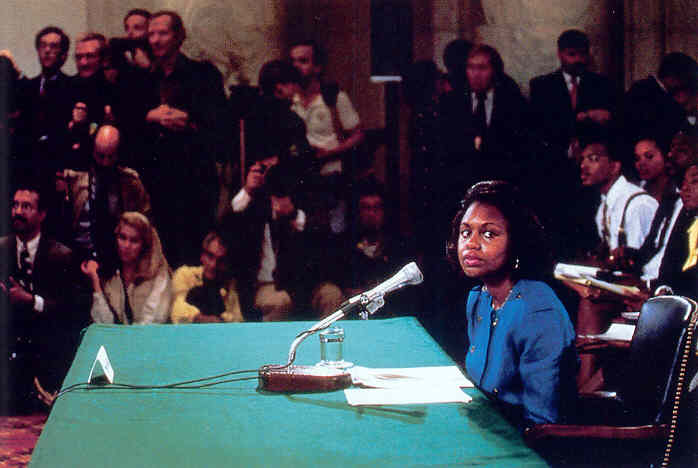
But the effort was muddied greatly by the number of women staffers who came forward to testify strongly in favor of Thomas’s excellent behavior as their boss, and the fact that Hill had followed Thomas from job to job, and that it was she who seemed to be initiating whatever relationship (which turned out to be not much) that actually existed between the two of them. Thus the effort to “chauvinize” Thomas fell somewhat flat, and eleven Democrats found the way to vote in favor of his appointment, which passed 52 in favor and 48 against (again, with those 11 exceptions and 2 Republicans who opposed Thomas, the vote being along party lines).
Supreme Court appointments were now big political business, since the Court had taken up the responsibility of being the country’s chief legislative branch of the federal government.
The “coming out” of gays and lesbians. Feminists were not the only ones attacking the traditional role of the male in American society. The Boomers’ social justice instincts turned to a new victim group – the homosexuals or gays who were being hit hard with the deadly plague of the AIDS virus.

The source of the problem was clear enough – as was its most obvious solution. But abstinence even in the face of this deadly disease was not going to happen, and now Boomer Liberals or Progressives began to demand that medical research be diverted from traditional pursuits (cancer, for instance) and focus on finding a cure for AIDS, no matter what the cost.

Anyone who differed with this sense of urgency received the immediate label as “homophobe” (hating homosexuals) – so discussion or debate was placed out of reach. For that matter all research into the causes of homosexuality was now declared off limits – because it was decided by the social justice crusaders that homosexuals had no more choice about their status than did Blacks – or even women, for that matter. A person was simply born that way. End of discussion.
Indeed, those who came out of the closet to confess their homosexuality were celebrated as the real heroes of the day. Any who did not feel like celebrating this development with them were portrayed in the most negative of ways.
Traditional Christianity of course considered homosexuality to be no less a sin than prostitution, alcohol, drug and gambling addictions, tendencies to physical violence, etc. – human problems that needed addressing – and deliverance from.[9] But homosexuality was by the 1980s being taken off the list of such sins … even by some Christians.
Soon therapy was being insisted on not on the part of homosexuals seeking to emerge from that status (actually such therapy was now even outlawed in some parts of the country) but instead, on the part of those not ready to accept it as proper behavior. Pro-homosexual “sensitivity sessions” were being required by corporations of their officers, or employees in the field of government and education, and ultimately even of pastors and lay leaders in some Christian denominations.
This gave recognition to the fact that people’s attitudes, beliefs and deepest tastes and preferences can be reformulated through careful re-education (“brainwashing” some would call it, as has so often taken place in dictatorial countries) – and that not only was such action allowed in America, it was even required – as long as it went in the “right direction” – that is, in the direction of “political correctness,” as some would term the newly enforced cultural dynamic.
The continuing decline of America’s traditional Christian denominations. Christianity was losing its membership rapidly during the 1980s and 1990s. For a variety of reasons, Boomers were not interested in church life, either for themselves or in the raising of their children. Morality was viewed as a matter of simple human logic (just as the Vets had unfortunately supposed to be the case with their Boomer children) – which required no special modeling or discipline. Anyway, the public schools could tend to that matter – because that was simply part of what public education was supposedly all about.
Also this issue of homosexuality tore deeply into the unity of the various Protestant denominations, the ones that once had been the foundation of American culture and society. Fierce battles were fought at national conferences on the issue of the ordination of homosexuals, starting with the need at first to affirm that no such thing was going to be allowed – only to have that position challenged at each new national gathering – with the pro-homosexual group making slow progress against the traditionalists (older Vets disappearing in numbers with age). Ultimately the decision would go fully in the LGBT direction – splitting the denominations – and causing bitter battles over church properties of those congregations that pulled out of the old denominations because of this issue. Certainly the loss of unity contributed greatly to the increasing emptiness of the old American churches.
Reagan’s prayer amendment. And then there was the failed effort of Reagan in 1984 to get Congress to try once again to put into effect a constitutional amendment protecting the right of prayer in the public schools or any other public institution. Reagan cited the Constitutional Framers’ own pro-Christian views on the matter. But it was all to no avail. Reagan could not get the necessary two-thirds vote (only 56 in favor with 44 votes opposed, largely along predictable party lines) needed to authorize a referendum on a constitutional amendment proposal. Reagan would try again the next year, but again with no success.
Edwards v. Aguillard (1987). Just to add to the sense of decline of the Christian covenant that had so long carried the country, the Federal Judiciary got into the act again by way of a case that made its way to the Supreme Court. This blow to the Christian faith came in 1987 in the Court’s decision in favor of plaintiffs who argued that the teaching of creationism (the universe being created by God) alongside Darwinism (creation as a self-engineered mechanical process moving forward through time on the basis of its own momentum) was disallowed by the 1973 Lemon Test, which stated clearly that only things that served a purely secular purpose – namely the Darwinist worldview – could be taught in the public schools.

1987 – the Rehnquist court
Only Justice Scalia (back right) and Chief Justice Rehnquist (center)
dissented from the Edwards v. Aguillard decision
During the court hearings, the only scientists that were allowed to testify were ones that affirmed that creationism was not a co-equal science with the secular world view, “science” now meaning only things that operate mechanically, and thus predictably – and consequently subject to full human control, socially as well as materially. Other opinions were not allowed – as this would merely move things down the forbidden religious path.
Thus with this decision, American children could no longer be taught in the public schools that there was intelligent design in the creation of the universe – only a mysterious self-generated creation. Scientists who would have pointed out that statistically the secular viewpoint made no sense at all were not allowed to make their case – not in 1973, not in 1987 – nor repeatedly after that. To the Federal Courts – God did not exist in any meaningful way. Once again, the First Amendment was interpreted to mean not the freedom of religion, but instead the freedom from religion!
Evangelical or charismatic Christianity continues forward. Only in the area of Evangelical Christianity was real growth still being registered – again, not at the same rate as the decline of the traditional mainline churches, but certainly at a rate strong enough to keep Christian America from sliding into the status of the largely defunct European Church. Many of these churches were part of the breakaway groups that formed new denominations. But most were simply independent churches formed up out of no particular denominational family – or were part of church growth movements that developed so strongly that satellite churches were started up by the mother churches – even in other parts of the country.
Liberals termed these churches as Fundamentalist. But they really were not part of that group at all – any more than they were a part of mainline Christianity. Evangelicals considered both fundamentalist churches and mainline churches as heavily into “works righteousness.” They saw fundamentalists as religious legalists – possessing something of the same legalistic spirit as the ancient Pharisees – the very ones who had Jesus put to death because he was not keeping the Jewish Law the way that the Pharisees read the Law. Likewise they saw the focus of the mainline churches on peace and social justice as just more Liberal abstract idealizing of a perfect world, one that would never come to pass through Christian Progressivists’ carefully-designed social programs.
Evangelicals continued to focus on sinners (to the Evangelical, that was all of us) and the need for repentance, the acceptance of forgiveness by God through nothing more than faith in God’s sacrificial gift of Christ’s cross (such faith if even only the size of a mustard seed!), and the acceptance of help by the Holy Spirit to live the new life in Christ in power – power to push back the ever-pressing forces of evil.
Evangelical Christianity was/is personal – very personal – personally relational rather than rationally programmatic. It did not happen by taking the right position with respect to the fundamentalists’ laws of the Church – nor the Liberals’ programs of peace and social justice. It came through getting involved, personally, in a very confused and needy world, needy of personal companionship and a mutual sharing of life’s journey. As some would put it, Evangelical Christianity was like one street bum showing another street bum where they could together get some food.
And certainly the world would not soon run out of the need for that kind of Christianity!
[9]The first-century Christian leader, Paul, in his Letter to the Romans (chapter one, verses 20-32) goes into lengthy discussion about how such male and female sexual perversity is a result of men and women abandoning their knowledge of God … with the tragic result that God then simply allows them to fall victim to their own very self-destructive sexual lusts. Not surprisingly, therefore, many Christians believed that AIDS was simply the fruit of just such a horrible sexual dynamic.